Of Light and Air: Winslow Homer in Watercolor
Reviewed by Gretchen SinnettGretchen Sinnett
Salem State University
Email the author: gsinnett[at]salemstate.edu
Citation: Gretchen Sinnett, exhibition review of Of Light and Air: Winslow Homer in Watercolor, Nineteenth-Century Art Worldwide 25, no. 1 (Spring 2026), https://doi.org/10.29411/ncaw.2026.25.1.23.
This work is licensed under a Creative Commons Attribution-NonCommercial 4.0 International License  unless otherwise noted.
Your browser will either open the file, download it to a folder, or display a dialog with options.
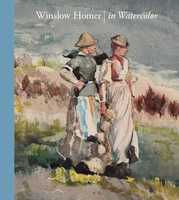
Of Light and Air: Winslow Homer in Watercolor
Museum of Fine Arts, Boston
November 2, 2025–January 19, 2026
Catalogue:
Christina Michelon, with Annette Manick,
Winslow Homer in Watercolor.
MFA Publications, 2025.
160 pp.; 70 color illus.; notes; list of illustrations.
$35.00 (hardcover)
ISBN: 9780878469062
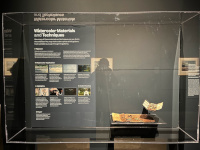
Winslow Homer’s watercolor box and brushes gleamed like relics in the Museum of Fine Arts, Boston’s Of Light and Air: Winslow Homer in Watercolor exhibition (fig. 1). The marvel in this case being the artist’s almost miraculous ability to conjure the materiality and ephemerality of the world around him with such simple tools. Curated by Christina Michelon and Ethan Lasser, the exhibition showcased the MFA’s collection of over fifty Homer watercolors and drawings. The museum holds the largest collection of the artist’s watercolors, allowing an overview of Homer’s career supported by their oil paintings, prints, and select loans. The curators addressed several ongoing strands in Homer research, including the artist’s engagement with the art market, the ambiguities of his representations of Black subjects, and the environmental resonance of his work, while primarily inviting the visitor to look closely and engage with the artist’s process over time. As Michelon notes in an online video introducing the exhibition, “Homer’s watercolors invite a kind of slow looking that is increasingly unfamiliar to us in our twenty-first-century digital world,”[1] and the exhibition rewarded visitors who gave Homer’s works the kind of attention he lavished on the people and places around him when he drew out his watercolor box and brushes.
Exhibition
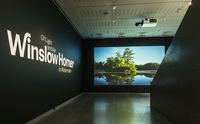
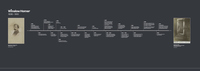
A wall-sized video of crashing waves and sheltered inlets, evocative of the seascapes for which Homer is best known, greeted visitors as they approached the exhibition (fig. 2). Further on, a timeline highlighted significant dates in the artist’s childhood and early career in greater Boston, his visits to the key locales that fueled his watercolor practice, and the museum’s acquisition of his paintings during Homer’s lifetime (fig. 3).
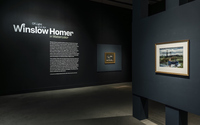
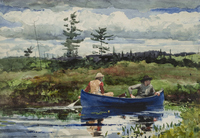
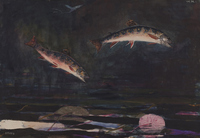
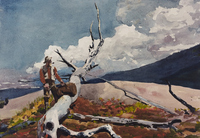
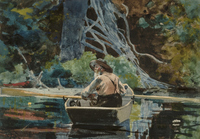
The exhibition opened with a showstopper, The Blue Boat, which hung opposite the entrance to the first gallery, immediately introducing viewers to the artist at the height of his technical abilities (fig. 4). Delicate washes in a wide range of greens evoke the diversity of plants along the shore, while reserved areas of paper suggest the reflection of clouds on the still surface of the water (fig. 5). The rich cobalt blue tones of the canoe, water, and sky as well as the bright red pigment on the paddler’s shoulders suggest the painting had limited light exposure before joining the MFA’s collection. This first gallery “introduce[d] the range of watercolor techniques and approaches the artist developed over the course of nearly forty years,” with an emphasis on his Adirondack scenes. Four other watercolors from the 1880s and 1890s—including Leaping Trout, the first the museum purchased—were mounted on blue-gray panels against the room’s dark gray walls (figs. 4, 6–9). This amplified the paintings, encouraging visitors to pay close attention to each one. Wall text explained some of the techniques Homer mastered to create a dazzling range of light and atmospheric effects, including blotting, scraping, and reserve.
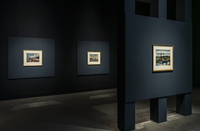
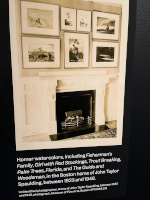
The artist’s watercolor box and brushes were displayed with a guide to key materials and techniques, which visitors were encouraged to photograph so they could seek out examples as they moved through the exhibition (see fig. 1). This gallery also called attention to the collectors, including women, who donated many of the museum’s works, and credit lines throughout the exhibition revealed just how important this patronage was for building the collection. A reproduction of a photograph of Homer paintings in collector John Taylor Spaulding’s Boston home was a reminder that many of the artist’s watercolors first hung in domestic environments, the works’ scale and price appealing to a wider range of collectors than his oil paintings, part of his lifelong effort to create new markets for his work (fig. 10). A notation on the label for The Blue Boat that “the artist expressed his pride in this work with a pencil inscription hidden by the frame: ‘This will do the business,’” was the first of several instances in which the curators provided glimpses beyond the margins of the artist’s watercolors and referenced Homer’s “knowing the market.”
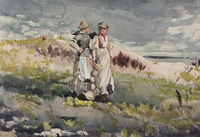
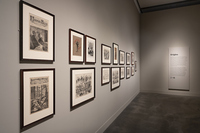
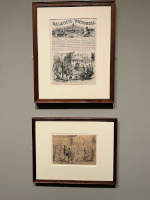
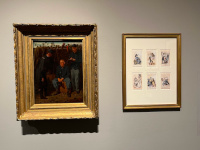
The rest of the exhibition traced Homer’s path to these deceptively simple evocations of light and air. The second gallery, “Origins,” was designed to show how “Homer’s upbringing, early illustration work, and wartime experiences shaped his art and perspective . . . and introduced him to the possibilities of watercolor.” A collection of illustrations, spanning almost twenty years, including Boston street scenes for Ballou’s Pictorial and Civil War images for Harper’s Weekly, stretched along one wall (figs. 11, 12). The Civil War images included some of the artist’s early depictions of African Americans. Preliminary sketches with areas of wash demonstrated how his commercial work laid some of the groundwork for his later watercolor practice (fig. 13). This gallery also visualized the early connection between Homer’s commercial work and first oil paintings, with “Surgeon’s Call” from Life in Camp, a series of pocket-sized color lithographs on which Homer collaborated with Boston publisher Louis Prang, displayed next to Playing Old Soldier, the oil painting that inspired it (fig. 14). A comparison of Homer’s In the North Woods (Playing Him), created thirty years later, and Prang’s chromolithograph after it, Fly Fishing from a Canoe, North Woods, highlighted Homer’s continued efforts to expand the market for his work (fig. 15).
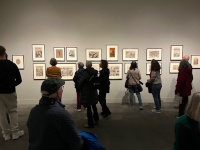
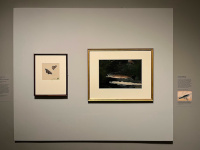
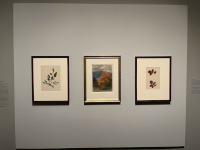
The curators also emphasized an influential force closer to home, the artist’s mother, Henrietta Benson Homer, “an accomplished watercolorist [who] introduced her son to the medium.” Homer’s childhood efforts were represented by Farm Scene (1847; Bowdoin College Museum of Art, Brunswick), likely “a copy of one of his mother’s paintings.” The fact that Homer displayed her work in the house and studio he later designed in Prouts Neck, Maine, suggest its ongoing importance to him, and the gallery included several comparisons of mother’s and son’s work. Hanging the paintings to be compared, including Henrietta’s Untitled (Study of Two Butterflies) and Winslow’s Trout Breaking, on light gray panels against the medium gray walls again cued close observation (figs. 16, 17). While the shared “directness and honesty” of their approach to the natural world was clear, more striking perhaps was the divergence. As the curators noted in the first gallery, Homer “created immersive scenes that not only depict the natural world but also invite us to inhabit it.” The mother’s plants and butterflies have the feel of botanical illustrations while her son, to quote Helen Cooper, “painted not so much the thing but the effect it produced,”[2] influenced in part by the interest in Japanese and Chinese art that he shared with other artists and collectors.
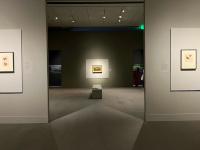
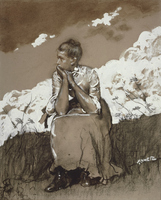
Homer’s sunny oil painting Boys in a Pasture, visible through the doorway, drew visitors into the third gallery, “Transitions,” which primarily included paintings from the 1870s when Homer focused on bucolic scenes of rural childhood and pensive young women, and began to paint the coastal scenes “for which he would become best known” (figs. 18, 19). Three of the four walls featured oil paintings, suggesting an artist still not fully committed to watercolor. The watercolors on the fourth wall, however, showed Homer beginning to experiment with the medium. While he treated watercolor like oil paint in “Bo-Peep” (Girl with Shepherd’s Crook Seated by a Tree) (1878; Museum of Fine Arts, Boston), he quickly began to embrace the medium’s inherent qualities through washes, reserving, and scraping in Boy and Girl on a Hillside (1878; Museum of Fine Arts, Boston) and Driving Cows to Pasture (figs. 20, 21). The small oil sketch of The Dinner Horn (fig. 22) hung beside Homer’s illustration for the June 11, 1870, issue of Harper’s Weekly, again highlighting his exploration of similar themes across media (fig. 23). The star of this wall to my eye, though, was Girl Seated (fig. 24) with its vigorous charcoal lines and gouache strokes. Centered on the wall and amplified by its dark frame and slightly larger sheet, the drawing demonstrated the artist’s increasing adeptness at economically capturing pose and facial expression, as well as the tight control he exercised over his compositions.
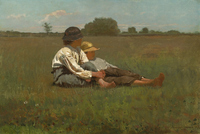
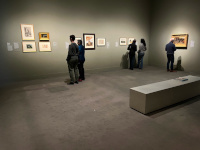
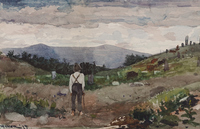
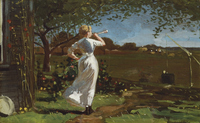
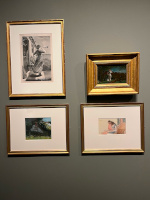
In addition, the gallery included The Dove Cote (formerly Uncle Ned at Home), one of Homer’s meditations on the experiences of Black Americans during Reconstruction (fig. 25). The carefree white youths in Boys in a Pasture, which hung on the opposite wall, contrasted with the Black man and boy laboring before the dove cote. As Peter H. Wood and Karen C. C. Dalton have noted, “the entire picture revolves around the axis of the old [B]lack man,”[3] and Homer depicts the African American figures with sympathy, but the painting’s message is ambiguous. The curators explain that responses have varied over time, highlighting Gwendolyn DuBois Shaw’s recent interpretation of the painting as “an image of free Black masculinity that did not stir the anxiety of white audiences.”[4]

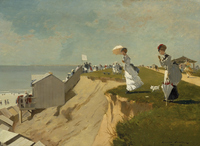
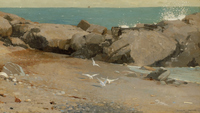
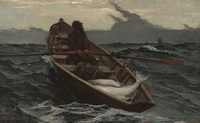
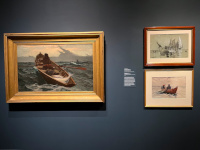
Long Branch, New Jersey and Rocky Coast and Gulls, identified as “one of Homer’s earliest seascapes,” framed the doorway to the next gallery, entitled “Atlantic Shores” (figs. 26, 27). If the sandy color of the “Transitions” gallery walls and the light-infused beaches of these early coastal oil paintings evoked the pleasures of sunshine and salt air, the sightline into “Atlantic Shores,” where The Fog Warning hung ominously against deep blue walls, signaled a return to weightier subjects and the artist’s increasingly serious engagement with the medium (figs. 28, 29). The Adirondack Guide (fig. 30), painted the following decade, glowed further in the distance, nicely showcasing Homer’s evolution as an artist. The figures in these paintings, which were all featured in the audio guide, advanced in age, along with the artist, calling to my mind Elizabeth Johns’s psycho-biographical study of the artist.[5]

In “Winslow Homer: A Legacy in Watercolor,” a short video playing adjacent to the gallery, conservator Judith Walsh provided a peek into the museum’s study room and introduced Homer’s Prouts Neck studio and house. Artist James Prosek demonstrated some of the techniques that he, like Homer, uses to capture the dazzling coloration of brook trout, which was especially helpful for those of us who aren’t painters.
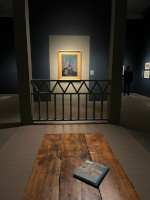
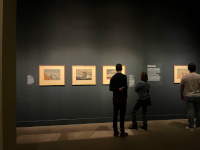
“Atlantic Shores” was the largest gallery in the exhibition and showcased the artist’s coastal scenes through which “he increasingly differentiated his oils from his watercolors” and found “his voice in the medium.” The paintings were largely grouped by location with maps showing the Atlantic communities in which the artist worked over several decades—Gloucester, Massachusetts; Cullercoats, England; Prouts Neck; and Florida and the Caribbean. The cool blue walls of this gallery evoked the cold waters of the North Atlantic while setting off the light-suffused Caribbean and Florida paintings. In the center of the long, rectangular gallery a wooden plank floor bounded by airy railings evoked the porch of Homer’s Prout’s Neck house-studio, recognizable to visitors from the earlier video (fig. 31). The exhibition was very crowded on my initial visit, and wide plank benches in this section provided a respite from the weave-and-dodge required to look closely at the watercolors.
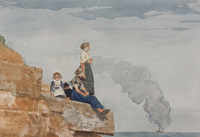
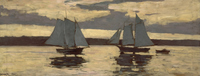
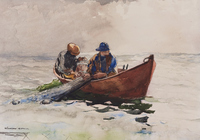
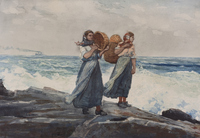
Moving from the 1873 Gloucester watercolors to ones created during his 1880 return visit, the visitor could follow Homer’s increasing ambition in his technical experimentation as well as the size of his sheets (fig. 32). The Cullercoats watercolors showed Homer further pushing the medium as the clouds and reflections on the water in An Afterglow, and the billowing smoke and cliff face in Fisherman’s Family (The Lookout) veered into abstraction (figs. 33, 34). There were several particularly effective contrasts in this gallery. Children idling in dories in Gloucester and the serene dawn and dusk oil paintings of schooners the artist created “to decorate the cabin paneling of his brother’s sailboat” contrasted with more solemn scenes of Prouts Neck fishermen at work and Cullercoats families along the shore that hung across the gallery (figs. 34–42). The Lookout—“All’s Well” and The Sponge Diver faced off at either end of the “porch”: oil vs. watercolor, cool nocturne vs. tropical sun, choppy seas vs. lapping waves, front vs. back, foul weather gear vs. glistening skin (figs. 31, 43, 44). As the curators noted, Homer’s Caribbean and Florida watercolors “portrayed a world entirely different from the gray Atlantic coast displayed elsewhere in [the] gallery,” and his access to that world depended on colonial privilege; “white tourists were allowed to visit Black areas, but Black residents were restricted from visiting white neighborhoods on the islands.” In The Sponge Diver, the evocation of the man’s body beneath the transparent water and the wavering reflections on the boat’s stern showed the painter’s mastery of his medium, but the depiction again feels ambiguous, at once objectifying the figure and enabling him to partially resist the viewer’s gaze. Fox Hill, Bahamas, hanging nearby, provided another example of the artist’s seemingly effortless ability to capture his models’ postures and expressions with a stunning efficiency and bodily empathy, regardless of their identity (fig. 44). In the audio guide, Darcy-Tell Morales, the museum’s Chief of Learning and Community Engagement, offered a perspective on the Caribbean works from “someone who has lived experience” of the region.
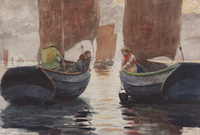
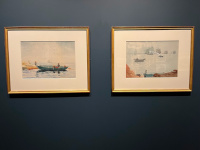

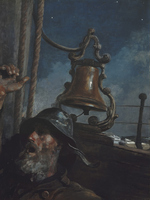
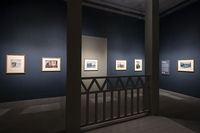
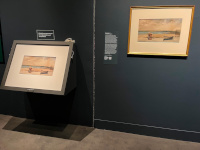
In addition, “Atlantic Shores” offered another opportunity to look beyond the margins. Clamming was displayed next to a facsimile in a hinged frame that allowed viewers to peek behind the mat and see how Homer’s evocation of dawn or twilight has dissipated due to faded purple and red pigments, demonstrating the fragility that limits museums’ displays of their watercolors (fig. 45). In addition, a series of Xs along the bottom revealed the artist’s decision to crop the scene’s foreground with the mat, bringing the viewer closer to the clammer, rather than excising the bottom as in the nearby Trout Fishing, Lake St. John, Quebec (1895; Museum of Fine Arts, Boston), which offered a preview of the next gallery, “The North Woods.”
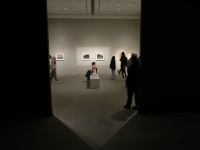
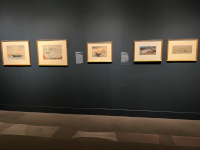
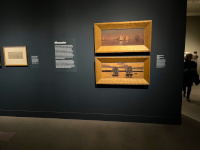
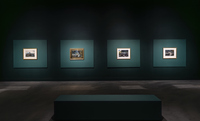
“The North Woods,” which focused on the artist’s Adirondack and Canadian subjects, brought the exhibition full circle. The reduced lighting and dramatic spotlights in this gallery and in “Atlantic Shores” created a jewel-box effect, reinforcing the rarity of seeing most of the museum’s Homer watercolors at one time (fig. 46). The fact that several works were framed to mimic the gold mats that the artist favored, believing “they elevated the pictures and enhanced their luminosity,” reinforced the effect (fig. 47). The curators noted that “Homer knew the art market well, and his idyllic scenes of the wilderness . . . were some of his most popular and saleable works.” While Homer frequently focused on the fishermen he hoped to lure into a purchase, Montagnais Indians, Pointe Bleue, Quebec (1895; Museum of Fine Arts, Boston) depicted First Nations Ilnu people building canoes. Audio guide commentary by Professor Caroline Nepton Hotte, a member of the Ilnu community of Mashteuiatsh (formerly known as Pointe Bleue) provided context for the scene that Homer depicted, as in his Caribbean works, from a tourist’s perspective, albeit one perhaps off the beaten path.
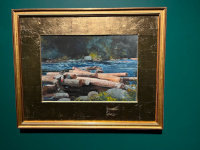
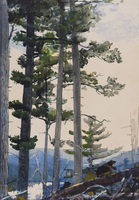
“The North Woods” showed Homer experimenting with a darker palette and his increasing willingness, as in his coastal Maine paintings, to forgo human subjects, including in Old Settlers (fig. 48). This gallery, which included The Fallen Deer, on the back of which Homer scribbled, “just shot” and “a miserable pot hunter,” also revealed the artist’s environmental awareness and called into question Nikolai Cikovsky Jr.’s assertion that Homer’s watercolors, compared to his oils, lacked “any claim or pretension to ‘higher’ deliberated meanings” (fig. 49).[6] The painting reads as a meditation on life and death and beauty as well as a commentary on hunting practices in a region under development. Hudson River, with its woodsman and pile of logs in the foreground and darting deer in the background, raises the question of whether the artist was arguing that nature and commerce could be balanced or indicting forces that would eventually drive the denizens of the forest away (see fig. 47). Homer was notoriously prickly about attempts to pin down the meanings of his paintings, but he did seem to be deliberating in many of the watercolors on view in “The North Woods.”
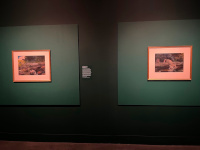
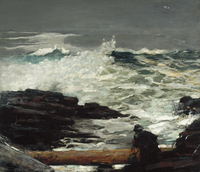
The final gallery, “Turn, Turn, Tumble”—words Homer inscribed on the wall of his Prouts Neck studio—included just two paintings, the watercolor Breaking Wave (Prout’s Neck) (1887; Museum of Fine Arts, Boston) and the artist’s last completed oil painting, Driftwood (fig. 50). Hung side by side, they provided a final opportunity to compare the artist’s efforts in oil and watercolor and to marvel at his ability to capture the particularities of light and air in the scenes he painted (fig. 51).

Catalogue
The exhibition was accompanied by a catalogue with illustrations of the museum’s full collection of Homer watercolors, including those not included in the galleries. The book begins with a concise biographical essay, “Of Light and Air: Winslow Homer in Watercolor,” by Michelon. She opens by addressing the possible symbolism of Homer’s watercolors, noting that the mayflies, real or artificial, after which the fish jump in Leaping Trout “have been deployed as a metaphor for ephemerality by artists for centuries,” and arguing that the “watercolor also evinces Homer’s fascination with life and death” (11). Michelon discusses Homer’s foray into etching, which wasn’t addressed in the exhibition, and includes a fuller discussion of his illustration work and his tendency to address subjects across media than was feasible in the galleries. She ends by arguing that during this era of climate change, “Homer’s watercolors take on a new resonance, underscoring the fleetingness and vulnerability of the natural world and the medium of watercolor, then and now” (33). The rest of the catalogue is divided by location: Gloucester, Massachusetts; Central Massachusetts and Upstate New York; Cullercoats, England; Florida and the Caribbean; The North Woods; and Prouts Neck, Maine. Each section begins with a one- or two-page introduction that addresses some of the particularities of the artist’s time and work in the location, developments in his watercolor technique, and contemporary critics’ and more recent scholars’ responses.
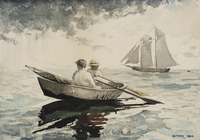
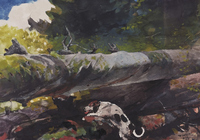
Full-page illustrations of the watercolors follow the introductions. Entries on selected paintings by conservator Annette Manick explore Homer’s materials and techniques in greater detail than practical in the galleries. For example, she elucidates the range of techniques the artist combined to create the illusion of billowing smoke in Fisherman’s Family (The Lookout) and the varied applications of pigment he used to economically create “three different qualities of light” in a “single masterful stroke” in The Blue Boat (see figs. 5, 34) (102). Details, in some cases full page, allow the reader, or perhaps more accurately in this part of the catalogue, the observer, to home in on the artist’s varied techniques, including the scraped, roughened paper that mimics the dog’s fur in Hunting Dog among Dead Trees, the blue carbon tracing outlines in Two Boys Rowing, and the granulation in Ouananiche Fishing, Lake St. John, Province of Quebec (1897; Museum of Fine Arts, Boston; figs. 52, 53). The beautifully illustrated catalogue provides an engaging introduction to Homer’s career and watercolor practice.[7]
Notes
[1] Christina Michelon, “Homer’s Immersive, Ephemeral Watercolors,” Museum of Fine Arts, Boston, 1:05, accessed December 20, 2025, https://www.mfa.org/.
[2] Helen A. Cooper, Winslow Homer Watercolors, exh. cat. (Yale University Press, 1986), 168.
[3] Peter H. Wood and Karen C. C. Dalton, Winslow Homer’s Images of Blacks: The Civil War and Reconstruction Years (University of Texas Press, 1988), 77.
[4] Gwendolyn DuBois Shaw, “‘The Various Colors and Types of Negroes’: Winslow Homer Learns to Paint Race,” in Winslow Homer: Crosscurrents, exh. cat., eds. Stephanie L. Herdrich and Sylvia Yount (Yale University Press, 2022), 50. For a discussion of the painting’s ambiguity, particularly compared with some of Homer’s other Reconstruction scenes, see Diana Greenwold and Dana Byrd, “A Vexing Image: Winslow Homer’s ‘Uncle Ned at Home,’” Portland Museum of Art, 11:43, accessed December 20, 2025, https://www.portlandmuseum.org/.
[5] Elizabeth Johns, Winslow Homer: The Nature of Observation (University of California Press, 2002). The decision to limit the number of works discussed in the audio guide seemed wise given the popularity, and thus crowdedness, of the exhibition at certain times.
[6] Nicolai Cikovsky Jr., “Something More than Meets the Eye,” in Winslow Homer, exh. cat., eds. Nicolai Cikovsky Jr. and Franklin Kelly (Yale University Press, 1995), 247.
[7] Those looking for longer expositions on Homer’s life, work, and the watercolor movement in the United States of which he was a part, can delve into rich scholarship on the subject, including Maggie Cao, “Perils on the Caribbean Sea,” in Painting US Empire: Nineteenth-Century Art and Its Legacies (The University of Chicago Press, 2025), 197–228; William R. Cross, Winslow Homer: American Passage (Farrar, Straus and Giroux, 2022); Kathleen A. Foster, American Watercolor in the Age of Homer and Sargent, exh. cat. (Yale University Press, 2017); Martha Tedeschi, ed., Watercolors by Winslow Homer: The Color of Light, exh. cat. (Yale University Press, 2008); Linda S. Ferber and Barbara Dayer Gallati, Masters of Color and Light: Homer, Sargent, and the American Watercolor Movement, exh. cat. (Smithsonian Institution Press, 1998); Judith Walsh, “Innovation in Homer’s Late Watercolors,” in Cikovsky and Kelly, Winslow Homer, 283–99; Sue Welsh Reed and Carol Troyen, eds., Awash in Color: Homer, Sargent, and the Great American Watercolor, exh. cat. (Bulfinch Press, Little, Brown and Company, 1993); and Cooper, Winslow Homer Watercolors.