Cézanne’s Shadows: Poussin, Chardin, Rubens by Nancy Locke
Reviewed by Nina Athanassoglou-KallmyerNina Athanassoglou-Kallmyer
University of Delaware
Email the author: nina[at]udel.edu
Citation: Nina Athanassoglou-Kallmyer, book review of Cézanne’s Shadows: Poussin, Chardin, Rubens by Nancy Locke, Nineteenth-Century Art Worldwide 25, no. 1 (Spring 2026), https://doi.org/10.29411/ncaw.2026.25.1.10.
This work is licensed under a Creative Commons Attribution-NonCommercial 4.0 International License  unless otherwise noted.
Your browser will either open the file, download it to a folder, or display a dialog with options.
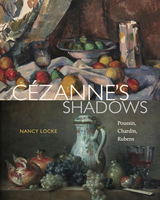
Nancy Locke,
Cézanne’s Shadows: Poussin, Chardin, Rubens.
Penn State University Press, 2025.
176 pp.; 23 color and 52 b&w illus.; notes; bibliography; index.
$84.95 (hardcover)
ISBN: 9780271098791
In her recent book, Cézanne’s Shadows: Poussin, Chardin, Rubens, Nancy Locke addresses an original and important topic. It concerns Paul Cézanne and his engagement with the Old Masters and their artworks, some of which he studied and sketched during his visits at the Louvre Museum. The author focuses on Cézanne’s fascination with three painters in particular, Nicolas Poussin, Jean Siméon Chardin, and Peter Paul Rubens. She argues that Cézanne’s engagement with past art and its remote creators, while serving as an undertow to modernism, was also a live force in its own right that led current artists to a better “modernist understanding.” Indeed for Cézanne, the study of the Old Masters represented a perennial source of inspiration, a resilient and competitive challenge that fed his constant self-assessment and self-doubt, even to the degree of aspiring to rival the biblical prophet Moses.[1] “To look at Cézanne’s interest in the art of the past [Locke writes] is, finally, to look at how he painted what he did in the fullest possible sense” (4).
The book accordingly consists of three chapters, each dedicated to one of Cézanne’s selected forbears—Poussin, Chardin, and Rubens—and his “painterly meditations” about their art. To build her argument, the author employs two methods: first, a formalist analysis of the paintings Cézanne chose as his models, enacted by way of selective visual comparisons with his own; and second, a collection of opinions gathered from a vast array of art historians and art critics ranging from Cézanne’s contemporaries to modern scholars—from Baudelaire and Clement Greenberg, the vicomte de Toulongeon and Michael Fried, Mallarmé and Tim Clark, Charles Blanc and Roger Fry, and innumerable others.
Analogies and similarities between Poussin’s works and Cézanne’s own paintings serve as a way to locate stylistic and thematic common ground. According to the author, several of Cézanne’s paintings emulate Poussin’s model rooted in the seventeenth-century thinker René Descartes’s mathematical and geometrical spirit and his famous motto, Cogito ergo sum. Rationalism and severe classicism underpin conceptual and visual form; order and logic rule.
The author detects analogies between Poussin’s and Cézanne’s landscapes in, for instance, the triangular compositional underpinning of Poussin’s scenes and motifs that is allegedly echoed in Cézanne’s works. Thus, Cézanne’s Fisherman with α Line (1868–70; currently unlocated) with its ribald embracing couple in the center, seemingly calls forth “affinities” with Poussin’s sensitively emotive classical theme of Poussin’s Orpheus and Euridice (ca. 1648; Musée du Louvre, Paris). A minuscule motif of a fisherman nearby serves as a typical staffage. Poussin’s Landscape with the Ashes of Phocion (1648; Walker Art Gallery, Liverpool), a scene unraveling in the foreground of a hill mounted with pyramidal-like piled up temples, altars, and a castle, is said to have inspired Cézanne’s Montagne Sainte-Victoire with a Large Pine (1887; Courtauld Institute of Art, London). Likewise, Cézanne’s Temptation of Saint Anthony (1870; Emil Bührle Collection, Zûrich) presumably recalls Poussin’s Plague of Ashdod (1630–31; Musée du Louvre, Paris) as both pictures seem to share the flesh tones and the voluptuous fleshy bodies of naked figures placed against a gloomy background that goes “beyond the biblical account of the men of the city, stricken in their private parts.” The dead mother in the foreground with the “convexity” of her “gravity defying breasts” is allegedly reminiscent of the “buttocks of the seated mother and the rolls of flesh” in the standing woman in Cézanne’s The Temptation of Saint Anthony (29–31). More plausible affinities between Poussin’s historicized landscapes and Cézanne’s naturalistic imaginary culminate in the Large Bathers (1900–06; Philadelphia Museum of Art, Philadelphia). Interlocking triangles account for a symmetrical, balanced composition, an apt and lucid arrangement worthy of Poussin’s complex historical conceptions.
As opposed to Poussin’s historized narratives, Cézanne’s paintings inspired by Chardin’s themes of everyday life are concerned with the “here and now” of common folk, reflected in the materiality of plain interiors and simple still-lifes that exude a sense of earthy humanity, humility, and modesty. Cézanne fell under the influence of Chardin in the 1870s, well after his acquaintance with Gustave Courbet and Camille Pissarro. From Chardin Cézanne learned to simplify his imagery as well as his style, which was often deliberately unfinished and invested with the awkwardness of “an artisanal labor.” In fact, that last feature was embraced by more than one of his contemporaries. As Vincent van Gogh wrote in a letter to his brother Theo in 1885, “I am more and more convinced that the real painters do not finish their canvasses, in the sense that one has often given ‘finish’—that is to say pushed far enough that you could bury your nose in it” (qtd. 67–68).
Chardin’s genre scenes focused on subjects evoking a middle-class bourgeoisie bathed in an atmosphere of humane and honest propriety (62). As a result, his approach to painting was viewed as “frank” and “sincere,” two attributes, along with “simplicity,” that would also characterize Cézanne. As his biographer Joachim Gasquet relates: “[Cézanne] painted everything . . . ‘Isn’t it a bunch of carrots, he cried out,’ yes, a bunch of carrots observed directly, painted simply in the personal way one sees it, worth more than the Ecole’s everlasting slices of buttered bread, that tobacco-juice painting, slavishly done by the book? The day is coming when a single original carrot will give birth to a revolution.”[2]
Simplicity was paired with strict earnestness in Chardin. His deep passion for a realistic “representation of visual experience” took on nearly metaphysical accents in Cézanne’s eyes. As Gasquet recalled, Cézanne declared that “Chardin was the first to have glimpsed . . . and rendered the atmosphere of objects.”[3] Going even deeper, Cézanne claimed that Chardin invested his lifeless objects with a soul. For Chardin, in Cézanne’s view, a sugar bowl on the shelf had a face, a soul, and would never stop living.[4] And elsewhere, Cézanne mentioned plain objects as his mentors: “A sugar bowl teaches us as much about ourselves and our art as a Chardin or a Monticelli.”[5] Still, there were significant differences between the two. For whereas Chardin struggled to imitate nature and its objects to quasi photographic perfection, Cézanne allowed his approach—though originating in that of Chardin—the liberty to challenge visual accuracy and to reject convention, rules, and formalities.
As opposed to Cézanne’s two previous models, his use of Rubens is labeled “paradoxical” by the author. Likewise, the impressions uttered by nineteenth-century art critics conflict and mutually cancel one another, wavering between positive and negative comments—between praise and vulgarity. Rubens’s bold color and the animation of his flesh tones became nothing more than a continuous struggle for Cézanne as well. On the one hand, and despite his academic training, Rubens embraced the “unfinish” and did so successfully. And on the other hand, he forsook the symmetry and order of Poussin’s landscapes in favor of the mobility and the vitality of human flesh. To this can be added his “paradoxical” imagery: his tendency to represent allegorical, mythic, and dreamlike implausible scenes as if they were present, unfolding in front of one’s eyes. “Rubens paints angels not only as if he had seen them but as if there were no need to reconcile the physical, outward looking aspect of the senses of sight and touch with the interior or metaphysical realm of belief in angels (101).” It follows that given the vitality and variety of his imagery and technique, Rubens never faced doubt. Cézanne was fully aware of that when he placed Rubens along with his favorites, Veronese, Velasquez, and Tintoretto, whose vitality of touch and color he viewed as a sign of life “that . . . made the sap flow again through all those dead tree-trunks . . . their own sap, that prodigious life force of theirs . . . The flesh they paint is warm-blooded: you feel as if you could stroke it.”[6] Indeed, Rubens’s art represents a perfect test for nineteenth-century concerns with live materiality. Thus, whereas Rubens painted female portraits that resonate with a sensual impulse, Cézanne “painted his wife with about the same engagement and vitality that he bestowed upon the apples of his still life” (103).
Ultimately, what Cézanne learned from Rubens was how to add to his creativity the space of the fictive and the fantastic. One proof was his late scene of Bathers at the Pont des Trois Sautets (1906; Private collection), a sketch of the bridge over the Arc River near Aix with ghostly bathers’ bodies interlocked and pulsating in the foreground. Cézanne did not use live models for them; he just used his imagination.
Notes
[1] In a letter to his art dealer, Cézanne wrote: “I work tenaciously, I glimpse the Promised Land. Will I be like the great leader of the Hebrews [Moses], or will I be able to enter?” Cézanne to Ambroise Vollard, Aix, January 9, 1903, in The Letters of Paul Cézanne, ed. and trans. Alex Danchev (The Paul Getty Museum, 2013), 325.
[2] Joachim Gasquet’s Cézanne. A Memoir with Conversations, trans. Christopher Pemberton (Thames and Hudson, 1991), 68.
[3] Gasquet’s Cézanne, 220.
[4] See Joachim Gasquet, Cézanne (Éditions Bernheim-jeune, 1926), 202–03.
[5] Gasquet’s Cézanne, 223.
[6] Gasquet’s Cézanne, 156.