Manet & Morisot
Reviewed by Lynne D. AmbrosiniLynne D. Ambrosini
Independent Scholar
Email the author: orbma12[at]gmail.com
Citation: Lynne D. Ambrosini, exhibition review of Manet & Morisot, Nineteenth-Century Art Worldwide 25, no. 1 (Spring 2026), https://doi.org/10.29411/ncaw.2026.25.1.17.
This work is licensed under a Creative Commons Attribution-NonCommercial 4.0 International License  unless otherwise noted.
Your browser will either open the file, download it to a folder, or display a dialog with options.
Manet & Morisot
Legion of Honor, San Francisco
October 11, 2025–March 1, 2026
Cleveland Museum of Art, Cleveland
March 29–July 5, 2026
Catalogue:
Emily A. Beeny, ed.,
Manet & Morisot.
Yale University Press, 2025.
352 pp.; 208 color illus.; endnotes; timeline; appendices; bibliography; index.
$75.00 (hardcover)
ISBN: 9780300280982
Visitors to the exhibition that opened October 11, 2025, in San Francisco may wonder why this topic has never previously occasioned a museum show. Here were two Impressionist painters, both now renowned and admired, one having modeled for the other for a sequence of portraits, and the two even linked by family ties. However, the differences between their art—coupled with cultural blinders—long kept us from thinking of them in the same frame.
In his early and mid-career work, Edouard Manet issued grand-scale realist salvos against academic precedent, marshaling incisively outlined figures, dramatic color contrasts, and powerful black accents; this style dominated our thinking about him. Berthe Morisot, on the other hand, began as a landscapist, modeling her small canvases on the plein-air methods of Jean-Baptiste-Camille Corot and Charles François Daubigny; she was still emulating the latter’s habit of painting from a boat in 1875.[1] Morisot was most remembered for modestly scaled images of women and domestic life, rendered with delicate overlapping brushstrokes in clear vivid colors, evincing an independently conceived Impressionist style.
Subsequent generations hailed Manet as a major artist—a groundbreaking instigator—and Morisot as minor, a follower; weren’t all brilliant innovations made by male artists? Manet’s belated conversion to Impressionism was naturally attributed to the influence of Claude Monet and other men in his cohort. Cracks in the seemingly solid edifice of this account began to open, however, in the mid-twentieth century. Rigorous scholarship on Morisot commenced with the publication of her family’s correspondence (1950) and the first modern catalogue raisonné (1961) of her work, much of which had been held in private collections.[2] In the 1970s and 1980s, feminist historians set about probing the careers of effaced women artists, while others questioned the perspectives of the masculinist canon.[3] At last it seemed relevant to ask: if Morisot autonomously conceived a unique Impressionist idiom before Manet—by 1869, in fact—could the great male artist whose pictures sometimes had a family resemblance to hers just possibly have learned something from a woman?
Decades of research on Morisot have since ensued.[4] After the 1993 donation of twenty-five of Morisot’s oil paintings from her family to the Musée Marmottan Monet, moreover, exhibitions of her work have proliferated, making clear at last her originality. Meanwhile, distinguished scholars of Manet’s work have provided further insights into his accomplishments.[5] What has been missing, until now, though, has been the integration of the new understanding of Morisot’s work with the latest scholarship on Manet’s brand of Impressionism. Manet & Morisot, a distinct accomplishment, creates this new gender-neutral synthesis.
The Exhibition

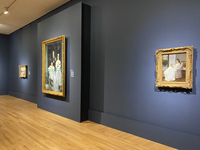
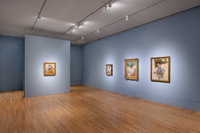
Upon entering the galleries, visitors encountered a seating area, two grand-scale photo enlargements, an introductory wall text, and a simplified timeline (fig. 1). The exhibition proper consisted of four large galleries containing five sections, organized chronologically, with key pairings or clusters of related works grouped within that framework.
“A Friendship Begins,” which traced the meeting of Manet and Morisot in the mid-1860s, comprised ten artworks created between 1868 and the early 1870s (fig. 2). The most striking here, and effectively centered in viewers’ first line of vision, was Manet’s riveting grand-scale The Balcony (1868–69; Musée d’Orsay, Paris). It features an image of Morisot, gazing intensely outward as if glimpsed by a passing flaneur. Equally mesmerizing is Manet’s Berthe Morisot with a Bouquet of Violets (see fig. 12), which captures a momentary, candid expression with breathtaking mastery. Morisot’s Young Woman at Her Window (fig. 2), offered a counter-image to Manet’s Balcony: here again was a young woman before a window, but Morisot’s model sits indoors and turns her attention inward; Morisot evocatively expresses female interiority. Also exhibited here was another early painting by Morisot, three more of the twelve oil portraits Manet painted of her, and three of his graphic images of her. His evident fascination with his model and her facility at assuming different guises bespoke a collaborative venture.
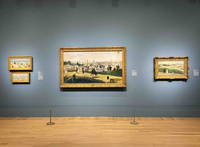
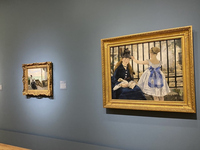
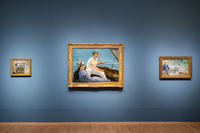
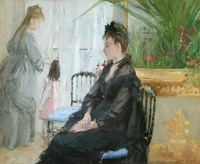
The second gallery, “Impressionism and Independence,” focused on the years 1873 to 1875, when Morisot came to artistic maturity and Manet began his flirtation with Impressionism. Some thirteen canvases (nine by Morisot, four by Manet) revealed shared interests, such as panoramic views of central Paris from its western edge (fig. 3). Similarly, the two took turns rendering a woman-and-child pair before a railing (fig. 4). Morisot began the volley with her Woman and Child on a Balcony (ca. 1871; Artizon Museum, Tokyo). (Not figuring in the exhibition, the picture is reproduced on a wall label.) Manet then picked up the motif in The Railway (1872–73; National Gallery of Art, Washington). The following year, Morisot offered another interpretation of it in Villa by the Sea (1874; Norton Simon Art Foundation, Pasadena). A further felicitous juxtaposition in this gallery consisted of boating pictures by each (fig. 5). Scrutiny of all these images made clear that, far from being a “student” of Manet, Morisot was steadily pursuing her own quite distinct vision, and one that keenly interested Manet. Aspiring to render figures outdoors under daylight from at least 1869, she formed them of swift dabs of paint—well before he did.[6] As can be seen in one of her most powerful early works, Intérieur (fig. 6), her technique was more spontaneous, luminous, and airy than Manet’s. The contrast in style makes their points of convergence all the more notable.
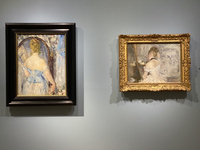
A third gallery contained two sections. “New Directions,” the first, showcased nine pictures dating from the late 1870s through the death of Manet in 1883. Here, Manet’s assimilation of Impressionism was on display, allowing viewers to understand, through judiciously selected loans, just how formative Morisot’s influence was in this regard. The prime pairing of his Before the Mirror with her Woman at Her Toilette says it all (fig. 7). The whirlwind of brushstrokes that animates Manet’s figure was inconceivable without Morisot’s example. It is now clear that his embrace of plein-air painting and new, looser brushwork owes much to his (recorded) admiration for the work of his sister-in-law, Morisot.
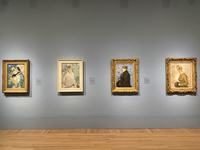
In the same gallery, another section displayed “The Four Seasons,” a pair of pictures each by Manet and Morisot (fig. 8). Although their precise relationship is undocumented, the exhibition makes the case that they are related. Morisot began the dialogue with her allegorical half-size figures of Summer (ca. 1878–80; Musée Fabre, Montpellier) and Winter (ca. 1879–80; Dallas Museum of Art, Dallas). After seeing these pendants at the fifth Impressionist exhibition in April 1880, Manet began his similarly formatted and conceived Jeanne (Spring) (1881; J. Paul Getty Museum, Los Angeles) and Méry (Autumn) (1881 or 1882; Musée des Beaux-Arts, Nancy). Seeing the four together supported the curatorial argument that Manet was consciously completing the series, a tempting, if unprovable, conjecture.[7] The exhibition catalogue likewise presented the four paintings, in a gatefold, as a unified quartet.
A fifth and final section, “Morisot After Manet,” comprised of seven canvases, primarily treated Morisot’s work during the period 1883 to 1895, the year of her death (fig. 9). Featured were pictures that refer to Manet paintings that she owned or to gifts from Manet, such as her Before the Mirror (1890; Fondation Pierre Gianadda, Martigny), which responds to a Manet canvas. The highlight of the group was Morisot’s Self-Portrait (1885; Musée Marmottan Monet, Paris) with its colored reflections in the artist’s gray hair: her assured interweaving of touches of pink, blue, and violet rivals comparable passages in Pierre Auguste Renoir’s portraits of the same decade.
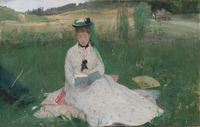
Some desirable loans are missing, such as that key work in the early relationship between the two painters, Morisot’s The Mother and Sister of the Artist (see fig. 13), which is legally prohibited from traveling. Manet’s Bouquet of Violets, a delightful small still-life of a folded fan, bunch of violets, and a scribbled note to Morisot (ca. 1872, private collection) would ideally have hung alongside the related Berthe Morisot with a Bouquet of Violets. Likewise, Manet’s Repose, (ca. 1870; Rhode Island School of Design Museum, Providence), another potent portrait of Morisot, would preferably have joined them. Similarly, in the gallery that houses Morisot’s Reading (fig. 10) and Lilacs at Maurecourt (1874; private collection), two scenes of bourgeois family groups relaxing in gardens, one wanted to see Manet’s similar subject, The Monet Family in Their Garden at Argenteuil (1874; The Metropolitan Museum of Art, New York), which was likely influenced by Morisot; it was represented here by a small reproduction on a wall label. Missing, too, was Morisot’s daring image of a woman reclining, Portrait of Madame Hubbard (1874; Ordupgaard Museum, Copenhagen), her answer to a Manet painting she owned, his Lady with Fans (1873; Musée d’Orsay, Paris). Finally, Manet’s magisterial Nude Woman Arranging Her Hair (ca. 1878–79; private collection), a painting with which Morisot lived, should have figured in the last gallery, next to her own interpretation of the theme—but apparently its owner, Jeff Koons, proved resistant to the organizers’ appeal. This writer is no stranger to the practical difficulties involved in securing loans—especially loans of Impressionist paintings—so it is likely that the curators made heroic but doomed efforts to secure some of these pictures.
The design of the exhibition is simple and straightforward. The four galleries received paint in four successively lighter shades of blue, with the first, a dark slate blue, serving as an attractive foil for its realist works. The exhibition graphics read easily in a clean, uncomplicated typeface. White text was the right choice for the two darker galleries, allowing for maximum legibility, and then the text color was correctly adjusted to black for the two lighter galleries, ensuring ease of reading. The font of the large text panels was appropriately sized, allowing multiple readers at eight or nine feet, whereas the text size on the individual object wall labels was quite small and only legible for one or two people standing right in front of them at a time. Given the crowds that attend any Impressionist exhibition, the accessibility of these latter texts would have benefited from being scaled up slightly.
As to content, however, the didactic materials were impeccable and doubtless added a great deal to visitors’ experience. Wall panels for the various sections synthesized the complexities of the two painters’ artistic relationship intelligently, balancing the need for biographical information against commentary on their styles and innovations. The individual object labels were ample, eloquent, and jargon-free (or largely so: Does the public know the word odalisque?). These aids answer the most pressing questions of visitors—always the goal—while often underlining the exhibition’s themes. Supplementary educational materials included exhibition catalogues, available in the introductory area; an audio tour; large-print wall-text books; and a good twelve-minute film, “More Than a Muse,” playing, thankfully, in an adjacent room where its narrated soundtrack did not disturb those looking at the art.
The Catalogue
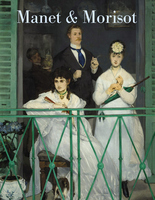
The catalogue’s attractive cover reproduces a detail of Manet’s The Balcony (1868–69; Musée d’Orsay, Paris). A hardbound volume of 352 pages, this ambitious book exhaustively investigates the two painters’ artistic relationship. Measuring 8 7/8 × 12 1/8 inches, and a full inch-and-a-half high, it can easily pass as a coffee-table tome. The fine color plates evince careful work on the part of museum and editorial staff to maintain accurate hues.
Like the exhibition, the book design offers the virtues of simplicity and clarity: there is no effort to tart up the design with flourishes or fancy graphics. The highly legible, classicizing typeface—Bodoni, sporting serifs—sets a dignified tone. While the text is printed in black ink, the titles of essays appear in dark blue, a contrast that provides the only striking element of the book design. The strategic use of blue font continues in the appendices, where it contributes to functionality and saliency. Scholars will be grateful, too, for the ample index.
A few quibbles: those who read endnotes may wish in vain that they were not two or three hundred pages removed from their texts; sadly, it’s the trend of our publishing times to bury these in the back matter. This is a minor flaw. One editorial choice is more vexing: a large section of color plates, following the first, longest essay, features not only the fifty-seven works that were exhibited in San Francisco or in Cleveland but also some twenty-six paintings that were not included. This distinction is not indicated in the captions, so the reader assumes that all the works illustrated with large plates figure in the exhibition, as would accord with common conventions of catalogue design. Only in the list of plates in the back matter are the two categories of images distinguished, by means of small asterisks. More typically, works not included in the show would be reproduced at smaller scale as textual illustrations, not intermingled with the loans. As this book presents some eight essays, there would have been ample opportunity to follow this route. Granted, some of the asterisked works may have been aspirational loans that were not in fact achieved before the book went to press. Then too, wanting the catalogue to stand as enduring documentation, the organizers sought to illustrate all the major works that demonstrate mutual influence. However, the resulting format is slightly misleading.
The catalogue content impresses as both substantive and cogent. The genesis of the exhibition lay in the 2019–20 exhibition of Manet’s late work, Manet and Modern Beauty, as it is Manet’s later style that reveals his debt to Morisot. While working on that project, Emily Beeny (chief curator, Fine Arts Museums of San Francisco), realized that the Manet-Morisot comparison deserved its own inquiry. The instigator of this resulting exhibition, Beeny has written by far the longest essay for its catalogue (sixty-one pages).
Entitled eponymously, “Manet & Morisot,” Beeny’s essay is the first text to focus exclusively and comprehensively on Manet and Morisot’s artistic dialogue. She attends most closely to the years between their meeting in 1865 or 1868—original sources vary—to the death of Manet in 1883. Fellow artists, friends, mutual supporters and collectors, and then—after Morisot’s 1874 marriage to Manet’s younger brother Eugène—family, the two were, as Beeny justifiably claims, the two closest artists among the Impressionists. She begins by summarizing obvious contrasts: Morisot treats the world of haute-bourgeoise women and their domestic lives in the Parisian suburb of Passy, while Manet presents the public life—enjoyed by men—of Parisian boulevards, cafés, courtesans’ salons, and concert halls. Nonetheless, the two painters both rendered balcony images, bourgeois interiors, seascapes, portraits, family groups, boating scenes, and female toilettes. Proceeding chronologically, Beeny reassesses the zones of relationship between the two painters’ subjects and styles, exploring the artistic conversation that extended over a fifteen-year period, 1868–83. (Move over, Picasso and Braque!)
Beeny demonstrates that, if Manet, the older and more established artist, at first took the lead, the balance shifted decisively around 1879–80, when Morisot more often initiated. Specifically, Manet borrowed some of her figural motifs, essayed his own versions of her vibrantly colored plein-airisme, and finally adopted Morisot-like flurried brushwork, a method of handling that was more evocative of immediate perceptual experience in the open air, which he must finally have recognized as being more compatible with his long-held goal of capturing modernity in art. While critics disparaged her talent as feminine and therefore a mere matter of instinct,[8] Manet took her innovations very seriously indeed. In essence, Beeny’s essay unfolds as a fully documented and richly illustrated counterpart to the recent, largely theoretical text by the philosopher Fabienne Brugère, who argues for a coauthored art called “Marisot,” a joint Impressionist undertaking by Manet and Morisot.[9]
Seven shorter essays follow Beeny’s. Isolde Pludermacher’s “An Enigma in Painting: Manet’s Portraits of Morisot” treats the dozen paintings that Manet made of a woman who was variously described as inscrutable, alluring, and forbiddingly reserved. The series has received substantial previous attention, much of which overemphasizes biography, allowing the possibilities of flirtatious sittings and hidden passions to hijack sober historical scrutiny. Pludermacher aims—and succeeds—in looking at the works afresh.
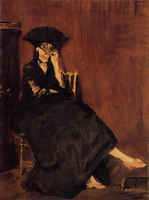
Addressing the traditional dating of the series to 1868–74, Pludermacher proposes some corrections. Recognizing in Berthe Morisot with a Fan (fig. 11) the presence of a heating vent found in a studio that Manet moved into in July 1872, she securely dates the painting to that year. By analogy of attire, she suggests the same date for Berthe Morisot with a Pink Slipper (ca. 1872; Hiroshima Museum of Art, Hiroshima). Third, she offers a persuasive dating revision for Berthe Morisot with a Muff (ca. 1869–73; Cleveland Museum of Art, Cleveland) to 1875–76, thus discounting the conventional idea that Manet stopped painting Morisot upon her marriage. Earlier scholars were swayed, she plausibly submits, by a sentimental desire to read the series of pictures as a progressive tale of growing intimacy cut short by Morisot’s wedding bells.
Pludermacher then examines the two portraits of Morisot that Manet exhibited at the Salons. She sees in Morisot’s 1868 agreement to pose for The Balcony (1868–69; Musée d’Orsay, Paris), a large-scale Salon canvas by a highly controversial artist, a decidedly daring offer of public support. However bon-bourgeois this particular balcony appears, the topos of woman on balcony was associated with prostitution. Similarly, when Morisot modeled for Repose (ca. 1870, Rhode Island School of Design Museum, Providence), her half-reclining posture recalled the lounging images of cocottes (mistresses) seen in contemporary prints, as Beatrice Farwell first demonstrated.[10] Morisot may not have known this, but Manet did, which probably explains why he cut down the canvas, preserving only the bust portrait of a young woman to whose family his own was growing close.
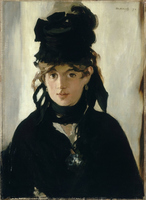
Turning to the remaining, unexhibited portraits, Pludermacher emphasizes Morisot’s agency as cocreator, which has been occluded previously by the unconscious assumptions of male writers. In Berthe Morisot with a Fan, for instance, the calmly self-possessed model regards the painter through her fan, deliberately flirtatious, fully aware of the fan’s symbolism (see fig. 11); after all, she had just returned from the land where “señoritas” expressed an entire language of seduction with fans. Pludermacher notes the bared ankle in the same portrait, an outright impropriety that was indubitably instigated by the model. Moreover, Pludermacher manages to make some new discoveries. In Berthe Morisot with a Bouquet of Violets (fig. 12), she uncovers (in a period florist’s book) a reference to a type of corsage—the bouquet de berthe—denoting a cluster of violets used in place of a ribboned bow at the closure of a berthe (a collar or capelet worn over a dress). She convinces this reader, at least, that the witty Manet was punning on Berthe’s name. Her essay should henceforward become required reading on Manet’s series.
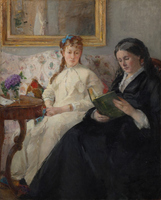
The essay by Kimberly A. Jones, “‘The Prettiest Caricature That Was Ever Seen’: Morisot, Manet, and The Mother and Sister of the Artist,” explores the notorious episode in which Manet, unbidden, took up a brush to spontaneously retouch portions of Morisot’s double portrait (fig. 13). Morisot had invited Manet only to advise her on her Salon submissions, so his presumptuous outright repainting of this canvas—on the very day in March 1870 when her works had to be transported to the Salon—horrified her. Letters from Morisot and her mother detailing the event have long been in the public record. New here, however, are conservators’ findings from the National Gallery of Art’s laboratory: X-radiography and infrared reflectography reveal that Manet’s most likely alterations were to the face and hands of Madame Morisot, where he seems to have added bold red accents and areas of impasto. Although well-meaning, Manet’s “proprietary effort”[11] made manifest the condescending power with which Morisot and other female painters had to contend in an art world that was long the sole province of men.
Sylvie Patry takes on the topic of a single year in “‘Marisot’ in 1874,” a title that signals acceptance of Brugère’s paradigm. In 1874, she claims, the two artists’ mutual influence became visible via transformations in three realms: private (or biographical), strategic (or commercial), and artistic. Biographically, 1874 brought the death of Morisot’s father and her marriage to Eugène Manet. Artistically, her sittings for Manet largely ended. Commercially, in that year, the two artists formally chose different paths: Morisot made the momentous decision to show her work in the new independent exhibitions while Manet chose to stay with the Salons. Though refusing to exhibit with the new group, he supported Morisot’s venture by lending her important plein-air painting, Hide-and-Seek (1873; private collection), to the first show.
Patry reminds us that 1874 also pried Manet out of his studio. Under the twin influence of Morisot and his experience painting outdoors with Monet and Renoir that summer at Argenteuil, Manet embraced plein-air painting, to which Morisot had been committed for at least five years. Like Beeny, Patry thus sees Morisot—not Monet or Renoir—as the prime stimulus behind Manet’s stylistic transformation. As the rare scholars who had earlier considered the question of Manet-Morisot reciprocity generally focused on the period from 1868 into the early 1870s, Patry’s analysis fills a significant gap.
Only one writer before Samuel Rodary had previously focused a lens on Eugène Manet.[12] In “‘An Honest and Excellent Man’: Eugène Manet,” Rodary traces the biography of the second-born Manet son. Eugène occasionally modeled for both his brother and his wife but, more importantly, supplied support and practical aid to the two artist-relatives who needed him. Rodary relies on the Morisot family letters, newer literature on Manet, and his own recent findings.[13] He uncovers some new facts: that Eugène Manet worked for some years as a journalist and that he held a job at the Ministry of the Interior, where Eugène’s brother Gustave Manet also worked. Eugène Manet’s income, combined with the couple’s inheritances, sufficed to let Morisot paint as she wished without being obligated to sell her canvases.
In “Manet and Morisot: Pastels,” Heather Lemonedes Brown focuses on a pair of works held by the Cleveland Museum of Art that embody Manet-Morisot commonalities. (Neither could safely travel to be shown in San Francisco.) Working in pastel by at least 1864, Morisot made a name for herself in that medium first. Manet evidently admired her work, for he recommended her as a pastel portraitist to a potential patron in the early 1870s.
Manet’s own earliest known work in pastel dates from about 1873; he employed it increasingly after 1875, as pastels were easier for the ailing artist to manipulate than oil paints. Between 1880 and 1883, he created some forty-five bust-format pastel portraits of women (212). Well suited to Manet’s interest in depicting contemporary feminine elegance, pastel also seemed the ideal form for his April 1880 exhibition at the gallery of La vie moderne, since this magazine’s subject was fashionable Paris. Besides ten oil paintings, he showed fifteen pastels there. About the portrait of Claire Campbell (1876; Cleveland Museum of Art, Cleveland), Lemonedes Brown casts doubt on Adolphe Tabarant’s assertion that Manet created it quickly. Its technique, which alternated wet (brushed) pastels with dry (drawn) pastels, argues against this idea.
Of the two artists, Morisot was the more prolific pastelist, exhibiting such works at six Impressionist exhibitions and creating some two hundred of them in total. About her sheet in Cleveland, Lemonedes Brown emphasizes Morisot’s exploitation of pastel to describe a variety of textures. She notes how fitting it was that Louise Riesener, a friend of the artist, sat for a pastel, since her father, Léon Riesener, was himself a noted pastelist and may indeed have influenced Morisot’s adoption of the medium early on.
In their use of tinted papers and coloristic richness, both Manet and Morisot nodded to the medium’s associations with the Rococo. Yet both also insisted on the modernity of their own expression: Morisot’s pastels continue the whirling mark-making that characterizes her oil painting, blurring figures with their environments, while Manet played up the bold flourishes of his strokes. Mutual admiration reigned.
Nicole R. Myers’s essay, “A Woman for All Seasons: Morisot and Manet in Dialogue,” addresses the four seasonal allegories of 1878–82 in depth. Looking first to Morisot’s sources, Myers points to the fashionable women Belgian artist Alfred Stevens painted as seasonal allegories in 1869; Stevens was a friend of both Morisot and Manet. She plausibly suggests also James Tissot’s female personifications of the seasons, for Morisot visited Tissot in London in 1875, before these works were published as engravings. Morisot also looked closely at Rococo precedents. That the noted connoisseur of eighteenth-century art Charles Ephrussi purchased her Winter in 1880 underscores this point. As Myers herself has elsewhere pointed out, it seemed entirely appropriate to the art public then that a female artist would treat such subjects, since the Rococo style had long been associated with “feminine” grace.[14] No surprise, then, that critics greeted Morisot’s revival with comparisons to Jean-Honoré Fragonard.
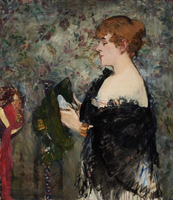
Myers makes a strong case for Manet’s seasonal allegories being inspired by Morisot’s (see fig. 8). Moreover, taking a cue from Léon Leenhoff’s posthumous register of Manet’s pictures, Myers convincingly identifies another painting, the unfinished canvas known as At the Milliner’s (fig. 14), as the work that Manet originally envisioned as a pendant for Jeanne (Spring). It represents, she argues, not a millinery shop but a woman dressing. The work does indeed have a similar profile format, an autumnal palette, and the same model as Méry (Autumn). According to this theory, Manet encountered difficulties with the painting—a not-infrequent occurrence for him—and left it unfinished while carrying over some of its conception as a starting point for Méry (Automne) (see fig. 8).
Myers’s essay concludes with a valuable discussion of the differences between Manet’s pair of paintings and Morisot’s. Most importantly, the costumes and cosmetics he selected for his two figures identify them as actresses or courtesans, whereas Morisot’s figures, dressed in modest attire, seem to belong to her own elegant, upper-bourgeois circle. The two pairs of paintings are thus complementary not only in terms of the annual calendar but in their two-part menu of oppositional choices offered to French women: one could be mistress or wife, compromised or above reproach. In this way, the four paintings encapsulate Manet and Morisot’s ongoing artistic dialogue on the topic of contemporary womanhood.
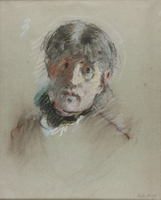
Anne Higonnet’s “Morisot After Manet” examines Morisot’s three self-portraits of about 1885, noting that it was likely impossible for her to render her own face without thinking of Manet. A pastel self-portrait not included in the exhibition (fig. 15) shows Morisot confronting her aging face in a mirror, recording under-eye pouches and graying hair with undaunted candor. Higonnet’s interpretation of the pastel seems too literal, however:
Only extreme existential self-doubt could explain the pastel self-portrait in which Morisot seems to be more in the process of being erased than appearing. She has no body, and her eyes are reduced to black holes. Morisot’s choice of fragile pastels for this portrait exacerbates its tenuous representation of presence. (242)
Are all radically simplified images to be read as psychologically self-effacing? Rather, I see here artistic daring and self-searching. Higonnet is right, though, that this frank pastel contrasts with Manet’s admiring approach to the same subject.
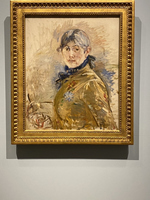
Of the two remaining self-portraits, both in oil, one represents the artist at work, holding a palette and brush (fig. 16), while the other presents her with her daughter, Julie. It is as if Morisot had to make two pictures to adequately sum up her divergent roles. Higonnet interprets these as confident self-images, opposing them to the pastel, and though I can’t endorse the psychological opposition, she is certainly on target in suggesting that Morisot was representing “someone who switched back and forth between being an artist and being a mother” (242). Higonnet asserts that Morisot did not exhibit these three works due to “doubts about the validity of this self-portrait trio” (243). I would attribute it rather to Morisot’s habitual discretion; her extreme reserve was noted by all acquaintances. As Higonnet notes, these were Morisot’s “replie[s], or retort[s]” to Manet’s portraits of her (243). A private conversation was not for display.
Higonnet also discusses images Morisot painted, such as Julie with Her Violin (1893; private collection) that incorporate portraits by Manet that hung in the family home. Undoubtedly, this was an indirect mode of engaging with his art. His works, like certain gifts from him that resurfaced in her paintings, served her as memorial touchstones.
A few useful appendices round out the volume. A thirteen-page timeline by Beeny interweaves the biographies of the two artists with artistic and political events and is illustrated by photographs, portraits, and documents pertaining to Morisot and Manet. Readers unfamiliar with the story of Manet and Morisot’s contacts will find the next appendix—a heftier one at twenty-two pages—thoroughly gripping: it is a selective compilation of contemporary correspondence concerning the two artists’ relationship. Ably assembled, edited, and annotated by Samuel Rodary, an experienced hand with period documents, the letters are translated by Beeny. Even knowledgeable readers will find new tidbits of interest, for Rodary has extended the 1950 publication of the correspondence by including snippets of text that Denis Rouart, Morisot’s grandson, had excised and by adding new letters from the state archives of Fribourg; the Musée Marmottan Monet, Paris; the Bibliothèque de l’Institut national d’histoire de l’art, Paris; the Bibliothèque Nationale de France, Paris; and assorted recent auctions.
Chronologically arranged, the letters essentially present episodes, given subtitles such as “Morisot Models for Manet” or “The War.” A very few later letters are helpfully printed out of sequence where their inclusion serves to close off a narrative. Letters appear in both English and French, aligned in two columns for easy comparison of the languages. Rodary’s commentary and notes add significant value, while Beeny’s translations render the original French more accurately and pleasingly than those of Betty Hubbard (1957). Readers gain a strong sense of Manet’s and Morisot’s mutual attention and respect.
As the final appendix, Beeny offers a handy visual compendium of the twenty-six works by Manet that Morisot and her husband owned at one time or another, published here in the form of another gatefold. (Conveniently for posterity, Morisot made a descriptive list in a notebook in 1885–86.[15]) The accompanying provenances make clear Morisot’s continuing efforts not only as a collector of her brother-in-law’s paintings but also, poignantly, as a staunch campaigner in support of his posthumous reputation.
Overall, the catalogue marshals all possible evidence to bear on the question of Manet-and-Morisot, now assembled in one convenient place. The quality of the essays is high. On one topic, the overblown romantic hype from popular sources about Morisot and Manet as star-crossed lovers, the catalogue authors’ restraint is welcome and praiseworthy. (The artists were demonstrably sensitive to each other’s charms, but there is no factual support for any infidelity. Moreover, the penalties for Morisot for any lapse—the risk of losing her reputation and becoming a social pariah—were sufficiently extreme, we can assume, to kill even the germ of temptation.)
Beeny and the other catalogue contributors have at last set the record straight: Manet and Morisot mattered to each other because they understood each other’s artistic language and saw, perhaps better than anyone else then alive, what the other was trying to achieve and how. Their compelling communication took place in their art, allowing us, the happy audience, to eavesdrop on the duet they left behind.
Notes
[1] “On a boat,” she lamented to her sister in 1875, “everything sways.” Berthe Morisot to Edma Pontillon, summer 1875, Cowes, Isle of Wight, in Denis Rouart, ed. Berthe Morisot; The Correspondence, trans. Betty W. Hubbard (1957; repr., Moyer Bell Limited, 1987), 104.
[2] See Denis Rouart, ed., Correspondance de Berthe Morisot avec sa famille et ses amis Manet, Puvis de Chavannes, Degas, Monet, Renoir, et Mallarmé (Quatre Chemins-Editart, 1950); Marie-Louise Bataille and Georges Wildenstein, Berthe Morisot: Catalogue des peintures, pastels, et aquarelles (Beaux-Arts Editions d’Etudes et des Documents, 1961); and Alain Clairet, Delphine Montalant, and Yves Rouart, Berthe Morisot, 1841–1895: Catalogue raisonné de l’oeuvre peint (CERA-nrs, 1997).
[3] Griselda Pollock, Vision and Difference: Femininity, Feminism, and the Histories of Art (Routledge, 1988); Linda Nochlin, “Why Have There Been No Great Women Artists,” in Women, Art and Power and Other Essays (1971; Harper & Row, 1988); and Kathleen Adler and Tamar Garb, Berthe Morisot (Phaidon, 1987).
[4] The pioneering works were: Berthe Morisot, Impressionist, ed. Charles Stuckey, exh. cat. (National Gallery of Art, 1987); Anne Higonnet, Berthe Morisot (Harper & Row, 1990); and Anne Higonnet, Berthe Morisot’s Images of Women (Harvard University Press, 1992).
[5] Monographic exhibitions on Morisot include: Sylvie Patry, ed., Berthe Morisot, 1841–1895, exh. cat. (Palais des Beaux-Arts, 2002); Marianne Mathieu, ed., Berthe Morisot, 1841–1895, exh. cat. (Musée Marmottan Monet, 2012); Nicole Myers and Sylvie Patry, eds., Berthe Morisot, Woman Impressionist, exh. cat. (Rizzoli Electa, 2018); Sylvie Patry, ed., Berthe Morisot (1841–1895), exh. cat. (Flammarion, 2019); Marianne Mathieu, ed., Berthe Morisot, Shaping Impressionism, exh. cat. (Dulwich Picture Gallery, 2023); Marianne Mathieu, ed., Berthe Morisot et l’art du XVIIIE siècle, exh. cat. (Musée Marmottan Monet, 2023); and Johanne Lindskog and Marianne Mathieu, eds., Berthe Morisot à Nice: Escales impressionists, exh. cat. (Musée des Beaux-Arts Jules Chéret, 2024). Other important studies have come from T. J. Edelstein, Wilhelm Hugues, and Claire Moran. On Manet, the most incisive writers are Carol Armstrong, Françoise Cachin, T. J. Clark, Diana Greenwald, Anne Coffin Hansen, Nancy Locke, and Juliet Wilson-Bareau.
[6] In 1869, she commented that Bazille had done “what we’ve so often attempted—a figure in the outdoor light.” Rouart, Berthe Morisot, 37.
[7] Although one nineteenth-century writer, Edmond Bazire, asserted in 1884 that Manet intended a set of four seasons, there is no other evidence of this, and he only created two. Did he in fact mean to supply the two remaining seasons left undone by Morisot or to create two more himself? See Scott Allan’s catalogue entry on the painting Jeanne (Spring), in Scott Allen, Emily Beeny, and Gloria Grooms, eds., Manet and Modern Beauty: The Artist’s Last Years, exh. cat. (J. Paul Getty Museum, 2019), 311.
[8] On the gendering of Impressionism and diminishment of Morisot’s work, see Tamar Garb, “Berthe Morisot and the Feminizing of Impressionism,” in Perspectives on Morisot, ed. T. J. Edelstein (Hudson Hills Press, 1990), 57–66.
[9] This slender book by a writer uninterested in marshalling art historical evidence hits the nail on the head in its assertions of a joint project. It preceded the exhibition: Fabienne Brugère, La vraie histoire de l’impressionisme: Manet, Morisot, et les autres (Vrin, 2024).
[10] Beatrice Farwell, “Manet, Morisot, and Propriety,” in Edelstein, Perspectives on Morisot, 45–56.
[11] Marni R. Kessler, “Unmasking Manet’s Morisot,” Art Bulletin 81, no. 3 (September 1999): 477.
[12] William Scott, “Eugène Manet,” in Manet: A Model Family, exh. cat., ed. Diana Seave Greenwald (Princeton University Press, 2024), 107–8.
[13] Samuel Rodary, ed., Edouard Manet: Correspondance du siege de Paris et de la Commune, 1870–71 (L’Echoppe, 2014).
[14] “‘Extreme Novelty or Things of the Past’: Morisot and the Modern Woman,” in Patry, Berthe Morisot: Woman Impressionist, 101–2.
[15] Samuel Rodary, “Carnets de Berthe Morisot,” in Patry Berthe Morisot (2019), 254–80. The list appears in the Carnet vert A: Samuel Rodary, ed. Berthe Morisot: Carnets (L’Echoppe, 2023).