Beyond Vanity: The History and Power of Hairdressing by Elizabeth L. Block
Reviewed by Susan HinerSusan Hiner
Vassar College
Email the author: suhiner[at]vassar.edu
Citation: Susan Hiner, book review of Beyond Vanity: The History and Power of Hairdressing by Elizabeth L. Block, Nineteenth-Century Art Worldwide 25, no. 1 (Spring 2026), https://doi.org/10.29411/ncaw.2026.25.1.9.
This work is licensed under a Creative Commons Attribution-NonCommercial 4.0 International License  unless otherwise noted.
Your browser will either open the file, download it to a folder, or display a dialog with options.
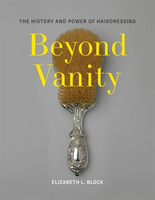
Elizabeth L. Block,
Beyond Vanity: The History and Power of Hairdressing.
The MIT Press, 2024.
236 pp.; 70 color illus., 19 b&w illus.; notes; bibliography; index.
$39.95 (hardcover)
ISBN: 9780262049054
If vanity is a sin, then Beyond Vanity is a redemption story of the most visible feature of women’s vanity: their hair. Elizabeth Block’s new cultural history reframes hairdressing as a vital practice of embodied art that demands critical engagement and offers new, relatively unexplored pathways to understanding craft practices, self-presentation, and the visual and material culture of hair and its significant social impact. Block’s study brings rigorous archival inquiry to hairstyling, long overlooked as fashion’s poor cousin, spotlighting it as a vector through which to analyze the intersections of culture, history, gender, and race in the late nineteenth-century US context. Beautifully and generously illustrated, the book is both comprehensive and inclusive in its exploration of a wide range of untapped archives, from private journals, photographs, and letters—including previously unexamined photographs and documents of Black Americans—to advertising posters, equipment catalogues, fashion illustrations and columns, and much more. Beyond Vanity places these materials into conversation, not to establish equivalency among them, but to highlight the multiple and often unexpected ways in which hair and hair care were styled by and reflected a rapidly shifting culture, revealing the importance of this ubiquitous human feature (hair) and its associated representational practice (hairstyling) within personal, social, and professional realms. Through her archival work, Block models potential future scholarship on a domain of beauty culture that has long been deemed too frivolous for legitimate consideration, suggesting fresh areas of inquiry in the burgeoning field of critical hair studies. Balancing scholarship with popular interest and written in a crisp, engaging voice that recounts diverse stories about women’s lived experiences, Beyond Vanity invites readers to join Block as she documents and interprets this form of embodied art as a critical social history of nineteenth-century US culture.
Block opens her book with an introduction that establishes its principal concerns, stakes, and geographical and temporal parameters. Although focusing her study on women’s experience in the period roughly from the end of the Civil War until the turn of the twentieth century, Block offers the backstory of US hairstyling in order to contextualize her topic within a longer history. Specifically, she dates the negative association of hairstyling with frivolity to the French Revolution and the cultural response in the American colonies to aristocratic extravagance, embodied in Marie-Antoinette’s famous poufs, a subject that has been fruitfully analyzed by Carol Rifelj and Caroline Weber, among others.[1] Methodologically, the book places itself, through brief considerations, within the critical frameworks of cultural geography and mobility studies, which allow Block to assert the importance of hair “spaces” in these fields and the potential social movement haircare could enable. But Block’s primary methodology is more clearly grounded in visual and material culture studies, as she brings her skills as an art historian to bear in equal measure on her analysis of photographs of interiors and building exteriors, trade cards, documentation of the international hair trade, and more traditional materials like paintings and prints. Notably, she evokes Saidiya Hartman’s concept of “critical fabulation” in her sensitive approach to incomplete or unreliable archives, teasing out meanings that are not explicitly offered; this proves a particularly useful lens through which to examine photographs lacking contextual information.[2] Block is keen to explore a diverse range of women—from Gilded Age debutantes to working- and middle-class women, both white and Black—those who enjoyed the varied services offered in “hair rooms” and those who labored in homes and salons and who innovated in the creation of specialty products, styling, and marketing.
The book is organized around a series of different spaces where hair is featured, worked upon, worn, or procured and addresses a rich array of archival materials reflective of each space. These spaces include those for preparation, for display, for work, for play, and for exchange. Following the Introduction, which doubles as the book’s first chapter, chapter 2, “Bedrooms, Barbershops, and Parlors,” considers settings—whether intimate, public, or semipublic—where hair care regularly occurred across the United States and argues that hair care is largely a social activity. Block’s discussion of the intimate space of the bedroom relies on photographs, chromolithographic trade cards, and paintings to illustrate scenes typical of hairdressing in the home centering white women of the middle or upper classes with long, silken hair, consolidating through repetition the prevailing beauty standard of white womanhood. Fear of hair loss emerges as a prominent concern when examining materials such as “Seven Sutherland Sisters Hair Grower” solution and trade cards illustrating the positive benefits of various potions on the market. By linking trade card compositions featuring Black or white working-class servants brushing their mistresses’ hair to art historical traditions such as those of seventeenth-century Dutch genre paintings, Block untangles the class- and race-based hierarchies of the nineteenth-century United States while also demonstrating that such domestic scenes, however seemingly unrelated, were imitative of European models of respectability. Her discussion of hairdressing parlors—the precursor to the modern hair salon—brings with it a fascinating foray into unusual archival materials such as equipment catalogues and architectural photographs and floor plans. The solidity and luxury of sinks, chairs, and mirrors and the vastness of these spaces, often situated within hotels, photographed both from the interior and exterior, attest to the importance of these spaces within communities and offer a counterpoint to hair’s “ephemerality.” Block explores the spaces and practices around hair preparation and styling by deducing historical data from the archives of everyday life, noting, for example, the proximity of parlors and photography studios, suggesting the temporal proximity of hair styling to the capture of self-presentation in a posed studio photograph. While today we might post selfies on a “good hair day,” in the late nineteenth century, the photography studio, located near the hair salon, was poised to profit from the hairdresser’s art; it seems to have been a mutually beneficial arrangement.
Chapter 3, “Parties, Stages, and Studios,” moves to those places where hair would have been on display and, building on Yi-Fu Tuan’s space theory, focuses on the emotional current underpinning performative self-presentation in public spaces. Here Block offers case studies of different types of women, across class and race, emphasizing that hair care and self-presentation were key features of identity for all women. In this chapter, Block explores the notion of respectability, essential to proper womanhood in nineteenth-century, US society, which required that hair be worn up and close to the head; “undone hair” typically signified loose morals, and women’s styling choices depended on their position and role in society. Actresses, for example, had more leeway with their self-presentation, and Block’s discussion of celebrity actresses, such as Sarah Bernhardt, who toured the United States, nuances the question of hair symbolism and illustrates the power of celebrity to shift styles. In this chapter, we meet Sissiretta Jones, a popular Black soprano performer of the 1890s, who refused to wear a wig and proudly displayed her natural hair. Block elaborates on her elegant self-assurance in the stage photograph she analyzes, noting that Sissiretta’s choice was a visual celebration of her Black identity, a remarkable gesture in an era of deep and open racism. The chapter explores other hair trends that did not conform to white women’s beauty standards, such as hair coloring, associated with actresses and women of questionable reputation. Block’s discussion of hair dying relies on manufacturing manuals and broaches the potentially dangerous effects of chemical products alongside questions of stigma attached to artificially colored hair. This intervention calls to mind the work of Alison Matthews David, who has explored the health implications of dyes for nineteenth-century clothing workers; Block’s observations imply that further study of the medical and scientific impacts of hair care would potentially yield rich analyses.[3] Finally Block includes here an exploration of the portrait studio—considering works by John Singer Sargent alongside the more affordable portrait option of the photography studio, once again demonstrating the broad social range of her study’s subjects.
The workspaces Block examines in chapter 4, “Workplace and Marketplace,” are further broken down into the categories of home, field, store, office, and road, with careful attention to the balance between construing these places as defined by both labor and social experience. In this chapter, race takes a central role as Block analyzes how racism permeates the vocabulary of hair used in documents ranging from “missing persons ads to novels, memoirs and diaries of white people” (96). She traces the history of derogatory terminologies used to link people of African descent with “livestock,” explaining the hegemony of white women’s beauty standards. Following fashion historian Jonathan Square’s work on Black women’s headgear and its appropriations by white women as fashionable accessories—as in the case of madras scarves—Block mines archives that document exchange across cultural traditions.[4] Importantly, she devotes time to the Black press, amplifying those whose voices may not have been officially archived and showcasing how Black people dressed and talked about their own hair. She discovers a wide array of descriptive terms that reflect the diversity of merchandise that Black women entrepreneurs created and marketed in the late nineteenth century as they developed products for hair straightening, softening, and growth; opened factories to make these products; and established beauty schools and houses to train hairdressers and offer services to an expanding population of Black women consumers. Block also documents the robust counter discourse to the adherence to the white female beauty standard implied by some of these products in the Black press, such as straighteners and softeners. She locates dissenting voices that promoted pride in natural Black beauty, and she is careful to identify and question archival sources created by enslavers. Hair care offered pathways for the expansion of Black women’s entrepreneurship and consumerism, even as it sometimes reproduced beauty standards that reflected and magnified power structures. Block’s study of hair thus opens here onto an exploration of women’s professionalization in the late nineteenth century alongside a critical analysis of evolving beauty practices for a diverse female population.
Chapter 5, “In Motion and Outdoors,” takes us into the domains of travel, transit, and sport. Again, Block frames the chapter with an evocation of cultural geographer Yi-Fu Tuan’s inquiry into “how a place acquires meaning” (109) and introduces mobilities theory to explore more widely the changing environments and practices available to women of the period. This chapter traces the shift in feminine hair trends as women started to move into spaces and engage in activities previously associated only with men. As they began traveling and participating more frequently in outdoor sporting activities, such as cycling, women developed hairstyles—and clothing—with fewer restrictions that permitted greater mobility, and, consequently, signaled greater freedom. Block refers specifically to looser, more relaxed New Woman hairstyles in this context and analyzes the cultural work that hair was doing to index women’s emerging, if limited, emancipation from more traditional roles. She also tells the “hair stories” of civil rights activist Ida B. Wells and actress Minnie Maddern Fiske to illustrate how each woman deployed the popular hairstyle strategically to assert her identity and challenge existing power structures.
Block takes up the global plane of the international hair market, arguing that it exposes “systems of patriarchal imperialism,” in chapter 6, “The International Marketplace” (145). Here, she aims to “expose and destabilize the unreliable archive” by restoring women’s stories and reconstructing emotional dimensions to this transnational network (172). She accomplishes this by analyzing catalogue entries from the World’s Columbian Exposition of 1893 in Chicago and documentary photographs of women participating in the trade through a critical and humanizing lens, effectively exposing the unreliability of the archive. Deliberately omitting the captions for photographs of Breton girls at the annual “human hair harvest” to avoid revictimizing the girls pictured, Block instead studies their faces and engages in what she calls “creative imagining,” evoking Hartman’s methodology. In this chapter Block also broaches the question of the provenance of some traded hair, documented through attention to business correspondence and other records of the prejudices and disdain reserved for hair from certain populations. Chinese hair, sometimes procured from male prisoners, was considered potentially diseased or overly coarse, but would be processed and treated through techniques of rolling, boiling, and dying to produce a product with greater market value. Many surprising details emerge from Block’s research, such as the high premium placed on silver hair at this time, attributed to the need of older women for wigs or hairpieces and the intense labor required to separate silver hairs from darker strands. While such observations may seem incidental, they ultimately reveal the increasing value placed on women’s labor at a moment of rapidly expanding professionalization, shifting beauty standards, and the visibility of women from all age groups and classes with respect to hair.
Block concludes her book with a brief discussion of the theme of “Grounding the Ephemeral,” a continuous strand throughout her study. If hair styles are so ephemeral that they can be swept away by an instant’s breeze, then the archival work that Block has done pins it up into “sites of critical meaning in society” (173). Although the occasional references to cultural geography and mobilities theory that punctuate the book are not out of place in a work structured around space, Block does not develop these critical frameworks extensively. Although some readers might appreciate a more sustained analysis of them and their application to hair studies, the positive result of Block’s light touch is that—while the book’s argument is supported by intersecting critical discourses—it is not overburdened by lengthy theoretical interventions or jargon that would have interfered with its refreshing and readable style. Beyond Vanity’s greatest strength is its surprising and expansive exploration of many rich and undiscovered archival sources; in this regard, Block’s accomplishment is significant. With this book, Block makes a major contribution to the growing field of critical hair studies and opens pathways for further exploration as this innovative area of scholarly inquiry continues to expand. Perhaps most importantly, Beyond Vanity models rigorous archival work with often recalcitrant, incomplete, or unreliable archives and offers both a humanizing view and sensitive evaluation of the many unsung heroines of hair and haircare, celebrating the vital role of this embodied art in shaping the everyday lives of late nineteenth-century American women.
Notes
[1] See Carol Rifelj, Coiffures: Hair in Nineteenth-Century French Literature and Culture (University of Delaware Press, 2010); and Caroline Weber, Queen of Fashion: What Marie-Antoinette Wore to the Revolution (Picador, 2007).
[2] Saidiya Hartman, “Venus in Two Acts,” Small Axe 26 (June 2008): 1–14.
[3] See Alison Matthews David, “Dangerous Dyes: A Pretty, Deadly Rainbow,” in Fashion Victims: The Dangers of Dress Past and Present (Bloomsbury Visual Arts, 2015).
[4] Jonathan Square, “Slavery’s Warp, Freedom’s Weft: A Look at the work of Eighteenth- and Nineteenth-Century Enslaved Fashion Makers and Their Legacies,” in Black Designers in American Fashion, ed. Elizabeth Way (Bloomsbury Visual Arts, 2021).