Berthe Morisot à Nice. Escales impressionnistes (Berthe Morisot in Nice. Impressionist Stages) / Impression, Morisot
Discover Degas & Miss La La
Paris 1874. Inventer l’impressionnisme (Paris 1874: The Impressionist Moment)
Women Impressionists / Impressionismen og dens oversete kvinder
Reviewed by Allison Deutsch
Allison Deutsch
The University of Oxford, Lifelong Learning
Email the author: allison.deutsch[at]conted.ox.ac.uk
Citation: Allison Deutsch, exhibition review of Berthe Morisot à Nice. Escales impressionnistes (Berthe Morisot in Nice. Impressionist Stages) / Impression, Morisot; Discover Degas & Miss La La; Paris 1874. Inventer l’impressionnisme (Paris 1874: The Impressionist Moment); Women Impressionists / Impressionismen og dens oversete kvinder, Nineteenth-Century Art Worldwide 25, no. 1 (Spring 2026), https://doi.org/10.29411/ncaw.2026.25.1.15.
This work is licensed under a Creative Commons Attribution-NonCommercial 4.0 International License  unless otherwise noted.
Your browser will either open the file, download it to a folder, or display a dialog with options.
Berthe Morisot à Nice. Escales impressionists
Musée des Beaux-Arts Jules Chéret, Nice
June 7–September 29, 2024
Impression, Morisot
Palazzo Ducale, Genoa
October 12, 2024—February 23, 2025
Catalogue:
Johanne Lindskog and Marianne Mathieu, eds.,
Berthe Morisot à Nice. Escales impressionnistes.
Electa, 2024.
240 pp.; color illus.
€39.00 (hardcover)
ISBN: 9788892826038
Discover Degas & Miss La La
National Gallery, London
June 6–September 1, 2024
Catalogue:
Anne Robbins and Chiara Di Stefano, eds.,
Discover Degas & Miss La La.
National Gallery Global, 2024.
136 pp.; 71 color illus.
£16.99 (softcover)
ISBN: 9781857097146
Paris 1874. Inventer l’impressionnisme
Musée d’Orsay, Paris
March 26–July 14, 2024
National Gallery of Art, Washington
September 8, 2024–January 19, 2025
Catalogue:
Stéphane Guégan, Sylvie Patry and Anne Robbins, eds.,
Paris 1874. Inventer l’impressionnisme.
RMN–Grand Palais/Musée d’Orsay, 2024.
288 pp.; 250 illus.
€45.00 (hardcover)
ISBN: 9782711880164
Women Impressionists
National Gallery of Ireland, Dublin
June 27–October 6, 2024
Impressionismen og dens oversete kvinder
Ordrupgaard, Denmark
February 9–May 20, 2024
Catalogue:
Dorthe Vangsgaard Nielsen, ed.,
Impressionism and its Overlooked Women.
Charlottenlund, 2024.
288 pp.; numerous color illus.
249.00 DKK (hardcover)
ISBN: 9788794211239
“Women Impressionists” like Berthe Morisot, whose work is the focus of or figures prominently within the exhibitions considered here, have entered the mainstream. Since 2018, two major monographic Morisot exhibitions have toured four countries: Berthe Morisot: Woman Impressionist (Quebec, Philadelphia, Dallas, and Paris, 2018–19) and Berthe Morisot: Shaping Impressionism (London, 2023). In 2024, celebrations of Impressionism included the following reviewed exhibitions: Berthe Morisot à Nice. Escales impressionnistes, Women Impressionists, and Paris 1874. Inventer l’impressionnisme, which featured five of Morisot’s works. Slated for 2025–26, are Impression, Morisot (Palazzo Ducale, Genoa, October 12, 2024–February 23, 2025), Morisot/Pétrovitch (Musée Marmottan Monet, Paris, April 9–September 15, 2025), and Manet and Morisot (Legion of Honor Museum, San Francisco, October 11, 2025–March 1, 2026).
The scale and frequency of these exhibitions affirm Morisot’s consolidated position within the canon of French Impressionism, made possible by the feminist scholars who have focused their attention on her since the 1970s. While regarded in her own era as the quintessential Impressionist and praised for embodying the movement’s most appealing qualities, Morisot’s reputation waned after her death. Rozsika Parker and Griselda Pollock have demonstrated how early twentieth-century art history largely erased women’s contributions to art, including Morisot’s.[1] The retrospective Berthe Morisot: Impressionist (Mount Holyoke College Art Museum; National Gallery of Art, Washington; Kimbell Museum of Art, Fort Worth, 1987) helped restore Morisot’s public profile in the United States, both reflecting and stimulating scholarly interest.[2] Four additional retrospectives followed between 1997 and 2012 in the United States and Europe.[3]
Morisot was not the only woman Impressionist that feminist art history recovered. One of the defining features of exhibitions commemorating the 150th anniversary of the 1874 exhibition of the Société Anonyme (see Paris 1874, also reviewed in Alexis Clark’s contribution to this issue) is that the work of Mary Cassatt and, to a lesser extent, Eva Gonzalès and Marie Bracquemond is no longer sidelined or necessarily understood in different terms than the art of men.[4] Acknowledging women’s participation in both vanguard exhibitions and the Salons, Paris 1874 included paintings by all four.[5]
This review reflects on recent modes of framing women Impressionists and the gendered labor their work displays and depicts. I consider how these exhibitions manifest the legacies of the feminist art histories that made them possible and what they reveal about how to build on them, while attending to the different conditions under which we now write. The first half of what follows addresses Women Impressionists, raising questions about the politics of women-only exhibitions, conflicts around canonicity, and tensions in the definition and delimitation of French Impressionism. The second half focuses on Berthe Morisot à Nice: Escales impressionnistes, which deals very differently with gender and marginalization.
Impressionismen og dens oversete kvinder (Impressionism and Its Overlooked Women) opened at the Ordrupgaard Museum in Copenhagen before traveling to the National Gallery of Ireland in Dublin, where it was retitled Women Impressionists. In Dublin, where I saw it, it included some sixty combined works by Morisot, Cassatt, Gonzalès, and Bracquemond.
“Women Impressionists” has been a recurring exhibition theme since the 1990s. Prominent examples are Les femmes impressionnistes: Mary Cassatt, Eva Gonzalès, Berthe Morisot (Musée Marmottan Monet, Paris; Isetan Art Museum, Tokyo; Hiroshima Museum of Art; Takashimaya Ground Hall, Osaka; Hakodake Museum of Art, Hokkaidō, 1993–95), Mujeres Impresionistas: La otra mirada (Women Impressionists: Another Look; Museo de Bellas Artes de Bilbao, 2001–02), and Women Impressionists (Schirn Kunsthalle Frankfurt; Fine Arts Museums of San Francisco, 2008), the last of which displayed 150 works by these four artists. These shows owe much to Tamar Garb’s 1986 study of the same name as well as to Garb and Kathleen Adler’s monograph, Berthe Morisot, which was published the following year.[6] Focusing on Morisot, Cassatt, Gonzalès, and Bracquemond, Garb observed that “few people will have heard of the women Impressionists.”[7] At the time, Morisot’s most recent retrospective had taken place at the Galerie Bernheim-Jeune in Paris in 1941, while Cassatt’s retrospective exhibition of 1970 (National Gallery of Art, Washington; the Whitney Museum of American Art, New York; the Art Institute of Chicago) never traveled beyond the United States.
Yet Garb was cautious about the implications of her grouping:
It is misleading to create, in retrospect, a common identity for four very different artists that is based on the fact of their sex. Each of the women Impressionists related in her own specific way to the artistic and political debates of her time. . . They can no more be identified as a group simply by their femininity than can the male Impressionists be exclusively explained by the constraints of their masculinity.[8]
Such a framework risked suggesting a shared aesthetic position attributable to biology when, in fact, the artists’ styles, social positions, and career trajectories differed significantly.[9] Garb justified the grouping because the structural asymmetries that shaped women’s artistic lives compared to their male peers were then poorly understood. The longer-term aspiration was that once histories of women artists were recovered and contextualized—and the patriarchal structures of the nineteenth-century art world revealed—the need for branding based on gender would diminish. As Ann Sutherland Harris and Linda Nochlin earlier wrote in the catalogue for their landmark 1976 exhibition Women Artists: 1550–1950:
Slowly these artists must be integrated into their art historical context. For too long they have either been omitted altogether, or isolated, as even in this exhibition, and discussed only as women artists, and not simply as artists, as if in some strange way they were not a part of their culture at all. This exhibition will be a success if it helps to remove once and for all the justification for any future exhibitions with this theme.[10]
Others, including Carol Duncan and Pollock, critiqued these terms, arguing that “integration” was insufficient. The canon required dismantling to expose its sexist (and Eurocentric[11]) mechanisms of exclusion. Without such interrogation, intact underlying structures would regenerate selective histories.[12] Garb and Adler themselves feared that in recovering a French Impressionist, art history would simply absorb her into its prevailing narrative that privileged Impressionism, rather than using Morisot’s twentieth-century marginalization to interrogate the assembly of canons and great artists.[13] If their scholarship could be easily accommodated within established frameworks, it would also be stripped of its critical edge and radical potential. One imagines the authors might have felt their concern warranted had they had access to the marketing materials for Morisot’s 2018 retrospective, Berthe Morisot: Woman Impressionist, more than thirty years later:
[The exhibition seeks] the reestablishment of the recognition that Morisot enjoyed in her lifetime; that of a groundbreaking, innovative artist who, against all odds, shaped the trajectory of modern art in France. By shining a spotlight on her artistic achievements, specifically within the realm of painting modern life, we hope to affirm Morisot’s rightful place within the canon of great French artists and assure her legacy for generations to come.[14]
The point is that for more than fifty years, art historians with an explicitly feminist methodology have been studying the art of “women Impressionists,” asking questions about their exclusion from the canon, and debating the relative value of reinstating them within an expanded canon (either of or including women) or dismantling it. For more than thirty years, exhibitions devoted to women Impressionists have disseminated information about nineteenth-century French gender norms and the ways that women were written out of art history.
For these reasons, it is puzzling, in 2024, to visit an exhibition that began its run as Impressionism and Its Overlooked Women (also the title of its difficult-to-access exhibition catalogue); the title frames neglect as its organizing principle. Even if the title changed when the exhibition traveled to Dublin, the show continued to make a similar claim to the one Garb articulated and to implicitly echo her rationale: that audiences are unfamiliar with these artists. “Which audiences?” is a reasonable question. Major exhibitions of this kind often require advance booking and thus primarily reach informed audiences already interested in art generally and Impressionism in particular. In its press release, the Ordrupgaard explains that an exhibition of these artists together is “a first of its kind in Scandinavia” but also “a natural extension of Ordrupgaard’s earlier solo presentations of Morisot in 2012 and Cassatt in 2013.”[15] The conflicted nature of its claims to novelty are evident when clearly, the museum has already done important work to familiarize audiences with the most famous of the group.
Women Impressionists covers a rather wide chronological sweep, from 1870 to 1910, with relatively small numbers of works by its artists—a room and a half at most for Morisot and a handful of paintings by Gonzalès and Bracquemond. Curators Janet McLean and Dorthe Vangsgaard Nielsen have succeeded admirably in locating and borrowing works by these latter two, for relatively few paintings by them are known and even fewer are held in major public collections. Because of the scale and scope of the show, which displays range within each artist’s oeuvre as well as across the four painters, its strength is not actually in tying them to Impressionism, the meaning of which is difficult to pin down. Whether Impressionism is a style, a group, or a commitment to modern subjects, to plein air painting, to exhibiting independently—the curators do not provide a clear or singular definition other than as painting the directly observed world in an informal style. But each artist is presented in a dedicated section (and likewise, the catalogue includes a chapter on each artist, including Marie Baskirtseff (Mariya Bashkirtseva), who featured in the Ordrupgaard version), so their sex unifies them more than shared themes, techniques, or styles.
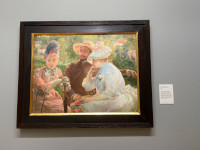
What the exhibition does very well is showcase a diversity of female expertise in a variety of forms, giving the lie to notions of a “feminine” way of seeing or painting. Such constructions were dominant when these artists worked and have not entirely lost their currency.[16] Cassatt is introduced through The Bath (fig. 1), a large, late painting of statuesque women and poised children that is surprisingly traditional. Gonzalès’s section follows but shifts back four decades with The Bugler (1869–70, Musée de Gajac, Villeneuve-sur-Lot), accepted to the Salon of 1870 and purchased by the state shortly thereafter. This depiction of a boy soldier—with its controlled brushwork, somber tonality, and formal staging—is a testament to Gonzalès’s relationship with Manet, who had painted a similar subject in the previous decade, and not to the other women, although the catalogue essay overstates the matter when it argues that “Eva drew sustenance from the works of the master [Manet], yielding to his every instruction, rectification, and example” (54). Bracquemond’s On the Terrace at Sèvres (fig. 2) has a surface densely woven like a tapestry and would best speak to a Camille Pissarro from the same period. The bold use of white paint applied in slashing strokes to dissolve the surface of Morisot’s The Child with the Doll (also, Cottage Interior, 1886; Musée d’Ixelles, Brussels) appears even more radical next to the more resolved work of these other figure painters.
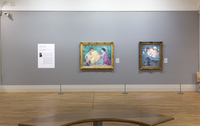
The selection of paintings assembled therefore bears an uneasy relationship to the defining visual language of Impressionism, which manifests inconsistently across their individual oeuvres and over the course of their careers, some of which were long and others tragically brief. Gonzalès died at 34, shortly after childbirth—surely the starkest reminder of the disadvantage of being female in the nineteenth century, though rivaled by Bracquemond’s final thirty years of isolation at the behest of her artist-husband who preferred she commit herself to psychiatric care rather than to art.[17] Morisot, Cassatt, and Bracquemond participated in Impressionist exhibitions; seven, four, and three times, respectively. Gonzalès never did.
The difficulty of fitting these artists into a neat definition of Impressionism might have been presented as a productive tension, building on a feminist prerogative to attend to what resists or disrupts established categories. The assembled works could encourage visitors to test the boundaries of the term, aligning nicely with one ambition of the grandest anniversary exhibition: Paris 1874. That show queried what Impressionism signified in its formative years and presented overlap between camps usually positioned as distinct: rebellious modern-life painters exhibiting independently and conventional academics devoted to the state-sponsored Salon. Showcasing the variety of works presented at the inaugural exhibition of the Société Anonyme, Paris 1874 challenged any sense of a singular Impressionist project or a clearcut separation from mainstream practices.
Framing Women Impressionists solely within Impressionism limits our appreciation of the range of their work, their backgrounds, and their training, among other things. Anchoring their reputations to a movement that, the exhibition insists, is primarily associated with its major male, French figures carries a tone of pleading, a need to guarantee that these women were truly recognized and accepted as equals within that company. Leaving the shadow of that company might illuminate new networks and relationships of impact and influence, and it raises different questions. If, for example, Impressionism were not so dominant a field of study, might someone like Gonzalès have come to prominence sooner? Or Bashkirtseff, who featured in the Copenhagen version of the show, not to mention numerous wide-ranging salonnières, some of whom were included in Paris 1874 and have been comparatively neglected by art histories that focus on the avant-garde?[18] And if not, might we justifiably question whether Gonzalès’s relationship to Manet is the reason she is now considered noteworthy? If so, how does this trouble the narrative the exhibition supports: that attention to male artists keeps women out of the spotlight?
I raise these questions to emphasize the possibilities Women Impressionists offers to complicate categories and initiate new lines of inquiry—and not just in relation to gender. In her critique of canonicity, Pollock argues that art history has sidelined not just half the population but most of the world. For her, a feminist methodology must interrogate difference in all its forms, including hierarchies of class, race, and nation.[19] For all its interest in debunking myths around early modernism, Paris 1874 fully embraces the city of its title. Its scope does not extend to examining how national frameworks have shaped art’s histories. Writing in 1987, Thalia Gouma-Peterson and Patricia Mathews already cautioned that “since many of the same women artists have been repeatedly discussed, feminist art history has come dangerously close to creating its own canon of white female artists (primarily painters), a canon that is almost as restrictive and exclusionary as its male counterpart.”[20] One of the most exciting directions in Impressionist studies today follows the transnational circuits through which paintings, people, and ideas circulated.[21] Cassatt herself, the Philadelphian in Paris who facilitated transatlantic collecting and understanding, exemplifies how confining narratives of Impressionism to France can distort interpretation. Exhibitions that group artists on the basis of a shared identity—in this case, sex—are well poised to interrogate the politics of such groupings, and to question the selective histories they sustain. As Katy Deepwell puts it:
If the premise of an exhibition is to produce a separate history of women artists as a corrective to a nation’s art history and to make visible again work which was erased from a particular historical account, isn’t a critique of the model of nationalism and national schools now also fundamental for art history and museum practice?[22]
Obviously, exhibitions must have parameters. But audiences may appreciate the opportunity to grasp something of the politics of how an exhibition’s protagonists are selected. A level of transparency about the stakes would invite visitors into curatorial narratives and put pressure on the claims to neutrality they often sustain.
Major exhibitions negotiate audience expectations, a marketing department’s preferences, and a financial bottom line. So, while Paris 1874 revises the story of the first Impressionist exhibition as a breakthrough, breakaway moment for a small, cohesive group, it is also a celebration of that group, most clearly communicated by a final section that jumps ahead to the 1877 exhibition. This room offered a more familiar vision of Impressionism as visitors were bid au revoir by Pierre Auguste Renoir’s Bal au Moulin de la Galette (1876; Musée d’Orsay, Paris), a painting entirely in line with public understanding of Impressionism. Women Impressionists makes its own compromises. It promises to explore the margins, alternative perspectives and suppressed stories, but does so within established bounds.
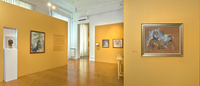
Berthe Morisot à Nice: Escales impressionnistes at the Musée des Beaux-Arts Jules Chéret de Nice took a different approach. Until its final two galleries, it was primarily a monographic exhibition of some sixty works that Morisot produced during two extended winter stays in Nice in 1881–82 and 1888–89. It opens with Self-Portrait (1885; Musée Marmottan Monet, Paris), displayed near Self-Portrait with Julie (fig. 3), positioning Morisot as a serious, self-defining artist. In general, and especially in the catalogue’s “Avant-propos” by curators Johanne Lindskog and Marianne Mathieu, the exhibition emphasizes Morisot’s popularity with the public today over a narrative of invisibility. It moves loosely chronologically and lingers primarily around 1888–89, a rich period when the artist focused on a variety of subjects—garden settings and her daughter are the favored themes presented—in a range of media. In the final section on Morisot, the curators propose that a series of prints and drawings for prints were intended not just for Stéphane Mallarmé’s Le Tiroir de Laque, but for an album of her own titled Carnival (1888–89), thus emphasizing a little-known side of the artist as a printmaker. The penultimate room frames paintings by Julie Manet and Renoir as carrying forward Morisot’s legacy and her passion for the region, while the large concluding section displays works by fourteen other women who practiced in the South of France between 1870 and 1914.
The title, Escales impressionnistes, translatable as Impressionist Ports of Call or Impressionist Journeys, emphasizes Morisot’s connection to place and to the circle of family and friends who shared her time there. The inclusion of “Impressionist” functions largely as a draw for the public, as the exhibition was not concerned with defining Impressionism or Morisot’s relationship to it. It was refreshing to move beyond Paris and instructive to see these works where they were made. Considerable research was done to reconstruct Morisot’s itineraries and details of the homes and hotels where she stayed, the local festivals she depicted, and, in a striking installation, how the architecture of a local church, Le Gesù, inspired the design of a shared wall separating her bedroom from the salon/studio in the Paris house that Morisot and her husband were then having built in Paris. A reconstruction of that wall vividly evoked the “spaces of femininity” of Pollock’s influential essay on gendered space.[23] It demonstrated how actively Morisot shaped her living and working environments and also pointed to her considerable wealth.
Gender was not a central interpretive lens, nor were narratives of erasure, until the final gallery. After a midsize exhibition with a tightly focused chronology, Berthe Morisot à Nice shifted dramatically. The visitor emerged from small, colorful rooms to a long, white gallery entitled “Création féminine sur la Riviera à la Belle Époque” (“Female Creativity on the Riviera in the Belle Époque”). Alongside Cassatt and Gonzalès, this section featured Bashkirtseff, Amélie Beaury-Saurel, Emma Biscarra, Mathilde de la Blanchetée, Louise Breslau, Blanche-Augustine Camus, Therese-Marthe-Francoise Cotard-Dupré, Marie Dubois, Louise-Émilie Leleux-Giraud, Anna Nordgren, Jeanne Rosenberg, and Alice Vasselon.
It was a fascinating and disorienting coda in which these women at first seemed to be portrayed as continuing Morisot’s artistic lineage. But the dates do not support such an arc, and the diversity that quickly became obvious on the walls lacked clear connection to Morisot’s work. Cotard-Dupré’s monumental In the Farmyard (fig. 4) and its flock of chickens inherits the tradition of Rosa Bonheur. Breslau relishes the light through a window as it hits the contour of a young woman at the piano in a somber drawing room (The Children’s Song; fig. 5). The couple in rapt attention in Beaury-Saurel’s pastel Memories of Bullfights (fig. 6) is depicted with impeccable realism even as the rest of the canvas is unfinished. Nevertheless, it bears a prominent signature, suggesting Beaury-Saurel was pleased with the result. While also a portrait on a largely blank canvas, Cassatt’s Girl in a Blue Hat (no date, fig. 6) uses patches of color to provide a far less detailed, but more dynamic, image of childhood. Bashkirtseff’s Portrait of a Lady in a Pink Hat (between 1877 and 1884, fig. 6) also appears unfinished but shares none of the fluidity of Cassatt’s rendering nor the apparent ease of Memories of Bullfights.
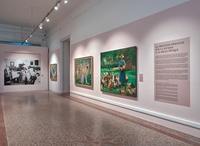
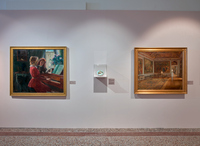
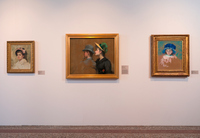
More emphatically than Women Impressionists, this section challenged any notion of a singular, “feminine” aesthetic or shared sensibility. It introduced viewers to artists who remain genuinely underrecognized, many of whom are represented in the museum’s permanent collection.[24] A catalogue essay by Louise Guillot, Lindskog, and Jeanne Pillon provides valuable archival information about women who worked for periods in the region and displayed work at the Nice Salons, and it should become a reference for scholars.
This section of the exhibition was not constrained by any stylistic category like Impressionism or coaxed into a framework other than that of “female creativity,” but it is difficult not to be irritated by that category because it suggests that women’s creativity somehow must still be affirmed and advertised. A monographic exhibition of a male artist would not conclude with a gallery of male contemporaries grouped by sex and by having painted in a popular tourist region at some point in a half century. The question is whether, in the name of exposure, it is worth the risks of separating women artists from their wider circles, uniting them in loosely assembled showcases, and burdening the diversity of their practices with the category of one overarching “difference.”[25] These elide the networks in which these women were respected participants, unless they suggest that meaningful exchange occurs only between women. Comparative analysis that might reframe how we view the male artists of their time is not encouraged. Guillot, Lindskog, and Pillon know this and end their catalogue essay in promising that: “the museum is now committed to highlighting these women creators through exhibitions that do not isolate them, but instead restore the reality of the mixed nature of the art worlds of the Riviera in the nineteenth century” (173). And what a pleasure those exhibitions will be.
In addition to increasing public awareness of these artists, the conclusion also successfully communicated that Morisot was not the only woman producing significant work in the South of France in the late nineteenth century. The exhibition therefore resisted elevating its titular artist to the status of an isolated icon of greatness or newly minted representative of one authoritative style. Situating her among women artists in the Riviera prompts comparisons that move us in different directions than those that have arisen when she has been fixed in the context of Impressionism.
My discussion of the Morisot exhibit will be limited to two themes that have long interested feminists: the home as a site of both responsibility and creativity and whose labor counts as such. Early in the show, paintings by young Julie, and one by Morisot’s husband Eugène Manet, are presented together. In them, the three family members painted the same motif, likely side by side. Three depictions of the port of Nice by Morisot, Julie, and Eugène (fig. 7) demonstrated this dynamic. Morisot’s pastel The Carnival at Nice (1889; Musée Marmottan Monet, Paris) accompanied Julie’s watercolor of the same view (The Carnival at Nice, 1889; Musée des Beaux-Arts Jules Chéret, Nice). The Illuminated Boat (1889; private collection) appeared alongside Morisot’s workup of the motif in her sketchbook and two of Julie’s watercolors of the boat (The Illuminated Boat, 1889; Musée des Beaux-Arts Jules Chéret, Nice) (fig. 8).
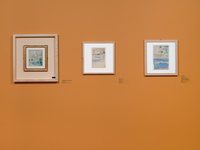
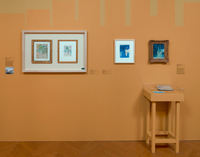
These juxtapositions revealed the coexistence of different forms of labor, where mother instructs daughter (and likely husband) as well as produces art for sale. These glimpses into Morisot’s working life encouraged a nuanced view of familial structures and complicated accounts that would treat gender and domesticity solely in terms of constraint.[26] Here, the painter’s domestic obligations appeared not as obstacles to creativity, but as sites of it. Numerous paintings of Julie by her mother, alongside Alphonse Legros’s unremarkable Portrait of Eugène Manet (1862; private collection), attested not just to family bonds but to a mutually sustaining arrangement. Scholarship is now elucidating Eugène Manet’s role as enthusiast, partner, and de facto agent for his wife, and this could be fruitfully brought to bear in future exhibitions, especially when they include images of Manet with Julie, as the Genoa version will do and as Women Impressionists does.[27]
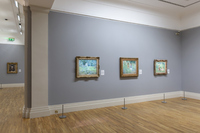
Future inquiry might also extend to figures traditionally excluded from accounts of creativity. Julie’s nanny, known only as Pasie (sometimes spelled as Paisie),[28] traveled with the family to Nice in 1881–82. She appears in three variations of The Beach at Nice (1882) and in The Story (1883; private collection). Women Impressionists also included two paintings of this trusted servant: The Artist’s Daughter, Julie, with her Nanny (ca. 1884; Minneapolis Institute of Art, Minneapolis), and Woman and Child in a Garden at Bougival (fig. 9), in which the fashionable attire makes the woman’s relationship to the child, whether paid caregiver or unpaid relative, ambiguous, foregrounding the combination of roles that women played.
Despite her repeated appearance in Morisot’s work and her evidently key role within the household, Pasie remains essentially unknown. Accompanying labels to the paintings that include her focus on Morisot’s formal innovation, her labor. Of course, art exhibitions centralize art, not childcare, and foregrounding the work of artistic production is especially important in discussions of, and exhibitions devoted to, women artists. In the nineteenth century, bourgeois women were encouraged to treat painting as a genteel pastime, making it difficult for their professional aspirations to be respected. Morisot’s critics often downplayed effort and intentionality, characterizing her style as instinctive, haphazard, and lightweight—a natural extension of feminine sensibility.[29] This rhetoric persists and, as in the later nineteenth century, is typically intended as a form of praise.
Nevertheless, centralizing an artist’s work need not come at the expense of treating seriously the labor shown within paintings, which feminists have long advocated. That it still matters can be illustrated with an extraordinary claim from the wall text in Paris 1874, which asserts that at the 1874 exhibition of the Société Anonyme, Edgar Degas’s The Laundress (1869; Musée d’Orsay, Paris) “was the only one to represent the world of labor.”[30] In a 1988 article, Nochlin critiqued this tendency to associate Impressionism with depictions of bourgeois leisure while ignoring the gendered labor also included that made that leisure possible, from entertainment and bartending to sex work. By making this claim about Degas’s laundress, Paris 1874 overlooked other activities represented in the reassembled works, including wet-nursing (Degas’s At the Races in the Countryside, ca. 1869; Museum of Fine Arts, Boston), ballet dancing (Degas’s The Ballet Rehearsal, 1874; Musée d’Orsay, Paris), and sex work (Paul Cézanne’s A Modern Olympia, 1873–74; Musée d’Orsay, Paris).
Since Nochlin’s intervention, many forms of paid female labor in Impressionist painting have been studied. The National Gallery’s concurrent Discover Degas & Miss La La is an excellent example of how new research continues to shed light on the working lives of women. This targeted exhibition introduced the public to the acrobat Anna Albertine Olga Brown, including in unpublished family photographs taken as personal mementos, alongside many of the publicity posters advertising her acts. The exhibition situated her life and career within wider conversations about gender, race, class, travel, and performance. In the end, it made Degas’s Miss La La at the Cirque Fernando (1879; The National Gallery, London) more interesting, but without turning Degas into the protagonist or positioning Brown’s life and profession as secondary to his.
Compared to so much fastidious investigation of women’s work in the nineteenth-century entertainment industry, discussions of paid and unpaid childcare are lacking. Morisot’s women with children are overwhelmingly framed as enjoying moments of leisure, pleasure, or play, even when signs of boredom, unease, or fatigue are legible in expressions and gestures. The Cradle (1872, Musée d’Orsay, Paris), displayed in 1874 and in Paris 1874, acknowledges in the woman’s expression the exhausted vigilance that even the most dedicated caretaker or infatuated parent experiences. The seated figure’s formfitting, high-necked silk dress and black choker contrast with the infant’s soft, pale cocoon. Her tightly pulled-back hair tugs at the skin near the eyebrows, broken strands escaping the coiffure from repeated brushing, twisting, and tying. The fact that one critic dismissed this figure as “rather badly dressed” in an otherwise effusive review about the painting’s charm shows how easily male critics overlooked the physical and emotional toll of care and the burden of meeting social expectations.[31] It took a psychiatrist in 1995 to read The Cradle as absolutely ambivalent about the pleasures and pains of newborn care, much to the displeasure of one art historian who, defending the interpretation of the painting as a “maternal idyll,” wrote confidently that “this is not at all what Berthe Morisot intended to express.”[32] Nevertheless, scholars are increasingly turning to the embodied discipline required to sustain both caregiving and composure in the painting, even if this has yet to significantly shape the presentation of Morisot’s paintings of women with children in the exhibitions discussed here.[33]
Perhaps, in seeking to emphasize women’s artistic contributions to culture, the domestic labor so often shown in their paintings is unconsciously downplayed. Yet valuing the full range of paid and unpaid work and the relationships of care and dependence that underpinned professional achievements (as well as more amateur pursuits, the study of which need not detract from understanding of the professional women’s context) does not diminish an artist’s seriousness. Painters need not be cast as isolated heroes of their own narratives, and we should be candid about the wealth many of them enjoyed—which likewise need not compromise their accomplishments. Complex social structures enabled and sustained their practices, and homes were workplaces for large numbers of people who enjoyed neither privacy nor autonomy in them, accentuated by their visible presence in many paintings.
The fact that we now see a range of approaches to the production and legacies of women artists underscores a critical point, even if exhibitions sometimes minimize it: the contributions many women made to modern art in late nineteenth-century France are now firmly established in major exhibitions of Impressionism. This recognition is not always reflected in the permanent collections of major museums, many of which continue to hold few works by the artists discussed here.[34] Nonetheless, it is curious that a standard way of asserting a woman artist’s significance is to ignore the extent to which that artist is now, in fact, widely recognized.[35] One problem with continually framing women as victims of patriarchal culture and historical neglect—when figures such as Morisot and Cassatt have, by any objective metric (frequency of exhibition, market value, scholarly attention), achieved lasting recognition—is the implication that without this narrative our interest might not be sustained. If their painting must always be revived, reclaimed, or rescued from the brink of oblivion, how important can it truly be?
The same principle holds for the work of feminist art history that enabled exhibitions dedicated to women and altered the discourse around modern art, and feminist activism, which transformed the institutional landscape in the countries where these exhibitions are staged. Rehearsing marginalization as a theme may aim to honor that foundational scholarship by ensuring it is not forgotten, but in so doing it also obscures the extent of its success. We might better develop modes of inquiry that do not rely on rediscovery as a default stance. Today, feminist art history is a generative, contested, and institutionally embedded method with its own histories and its own gaps. The challenge is to sustain its critical power—to ask questions about who is excluded and what structures are being reproduced now. The answers and methods will be contentious, but this complexity is a mark of feminist art history’s achievements.
The category of “women artists” has been crucial for exposing structural exclusions, but today it requires scrutiny. Since Women Artists, in which Nochlin and Harris hoped to “remove once and for all the justification for any future exhibitions with this theme,”[36] the pitfalls of making gender a show’s organizing principle have been debated while museums continue to stage them. Insisting that an artist is also a woman is no longer a radical act.[37] There is even greater urgency today to rethink the category “woman artist” as intersectional, trans, queer, and decolonial critiques interrogate normative ideas of gender, embodiment, and identity. “Woman” seems to promise specificity but remains on the one hand an impossibly huge, unwieldy term and, on the other, confers value only to a very select group of practitioners who tend to be white, wealthy, and Euro-American. Narratives that frame their lives, careers, and legacies primarily in terms of struggle sit uneasily alongside this fact, as well as alongside the reality curators so often emphasize: that these artists were accepted by colleagues and critics within the avant-garde of their time. These stories of struggle ring increasingly hollow the more they are repeated and the more audiences for art expand.
Feminists have long been attuned to how powerful and circumscribed Impressionism can be as a category. Following their lead, we should approach Impressionism with a degree of openness about what its study and exhibition might continue to obscure. The prominence of Monet and his compatriots has often come at the expense of others, notably those who aimed for success by the rigorous standards of academicians and sought recognition in French Salons as well as artists at times far from France who also engaged with Impressionism. Paris 1874 and the concluding section of Berthe Morisot à Nice usefully present several artists of the former group, reminding us that women Impressionists comprised a minuscule proportion of women artists of the period, though the number of their works included as compared to Impressionism in both shows does not attempt to put it on equal footing. More exhibitions of art bought by the state would, for example, offer audiences a truer picture of what nineteenth-century French art enthusiasts saw and discussed, and make clear how selective the blockbuster exhibition has tended to be.
Just as not all exhibitions of women artists are feminist, if the directions suggested here do not make women artists the primary conceptual node, they can still carry forward feminist prerogatives. We should be clear about this, because underscoring the many ways that early feminist critique forced a reckoning with power, absence, hierarchy, and privilege—and how the strategies it developed for understanding and resisting them can be used for a great many purposes—will convince younger audiences that feminism is relevant to their lives. Perhaps this would be the best way to honor the foundational scholarship that has made it impossible to organize a capacious exhibition of Impressionism without women.
Notes
[1] Rozsika Parker and Griselda Pollock, Old Mistresses: Women, Art and Ideology (Pantheon Books, 1981).
[2] The catalogue is Charles F. Stuckey and William P. Scott, Berthe Morisot: Impressionist, exh. cat. (National Gallery of Art; Hudson Hills Press, 1987). Key publications from around this time include Teri J. Edelstein, ed., Perspectives on Morisot (Hudson Hills Press, 1990); Tamar Garb, Women Impressionists (Phaidon, 1986); Tamar Garb and Kathleen Adler, Berthe Morisot (Phaidon, 1987); Anne Higonnet, Berthe Morisot’s Images of Women (Harvard University Press, 1992); Griselda Pollock, Vision and Difference: Femininity, Feminism and the Histories of Art (Routledge, 1988; repr., Routledge Classics, 2003); Linda Nochlin, Women, Art, and Power and Other Essays (Harper & Row, 1988).
[3] Dominique d’Arnoult and Sylvie Patry, eds., Berthe Morisot ou l’audace raisonnée, exh. cat. (Fondation Denis et Anne Rouart; Musée Marmottan Monet, 1997); Dominique Bona, Françoise Cachin, Geneviève Lacambre, and Sylvie Patry, eds., Berthe Morisot, 1841–1895, exh. cat. (Palais des Beaux-Arts de Lille; Fondation Pierre Gianadda, 2002–03); Pilar Bádenas de la Peña, Sylvie Patry, and Guillermo Solana, eds., Berthe Morisot: La pintora impressionista, exh. cat. (Museo Thyssen-Bornemisza, 2011); adapted as Berthe Morisot (1841–1895), exh. cat. (Musée Marmottan Monet, 2012).
[4] Bracquemond and Gonzalès have recently appeared in group exhibitions focused on artists who were women. An exception is Caroline Corbeau-Parsons, ed., Discover Manet & Eva Gonzalès, exh. cat. (National Gallery, London, 2022–23). A monographic exhibition of Gonzalès is currently being prepared between the Van Gogh Museum, Amsterdam, and the Petit Palais, Paris. Cassatt has been the subject of multiple major monographic shows in the United States and Paris, even if significant chronological gaps characterize the early history, and her work continues to feature prominently in solo and group exhibitions. Major examples are: Mary Cassatt: A Retrospective Exhibition (National Gallery of Art, Washington; Whitney Museum of American Art, New York; Art Institute of Chicago, 1970); Mary Cassatt: Modern Woman (Art Institute of Chicago; Museum of Fine Arts, Boston; National Gallery of Art, Washington, 1998–99); Mary Cassatt Retrospective (Yokohama Museum of Art; National Museum of Modern Art, Kyoto, 2016); Mary Cassatt: An American Impressionist in Paris (Musée Jacquemart-André, Paris, 2018); Mary Cassatt at Work (Fine Arts Museums of San Francisco; Philadelphia Museum of Art, 2024).
[5] The exhibition also includes Salon-exhibited work by Hélène Bertaux, Henriette Brown, and Adélaïde Salles-Wagner.
[6] Garb and Adler, Berthe Morisot.
[7] Garb, Women Impressionists, 5.
[8] Garb, Women Impressionists, 5.
[9] Warnings of a similar nature are expressed in Ann Sutherland Harris and Linda Nochlin, Women Artists: 1550–1950 (Los Angeles County Museum of Art; Alfred A. Knopf, 1976), 40–41; Parker and Pollock, Old Mistresses, 41; and Mary D. Garrard, “Feminism: Has It Changed Art History?,” Heresies: A Feminist Publication on Art and Politics 4, no. 1 (1981): 28–33.
[10] Harris and Nochlin, Women Artists, 44. This follows discussion of which women artists can justifiably be included in undergraduate survey courses on Western art.
[11] See, for example, the exhibition Global Feminisms (Brooklyn Museum, 2007), organized by Nochlin, with Maura Reilly, in order to expand the geographical scope of Harris’s and Nochlin’s frame.
[12] Carol Duncan, “When Greatness Is a Box of Wheaties,” Art in America 68, no. 5 (1980): 124–31; Pollock defends this position in several publications, including Griselda Pollock, “Women, Art and Ideology: Questions for Feminist Art Historians,” Block 6 (1982): 4–21; Pollock, Vision and Difference, 13–47 [ebook pagination]; and Griselda Pollock, “A History of Absence Belatedly Addressed: Impressionism with and without Mary Cassatt,” in The Two Art Histories: The Museum and the University, ed. Charles W. Haxthausen (Cambridge University Press, 2002), 45–68.
[13] Kathleen Adler and Tamar Garb, “Introduction,” in The Correspondence of Berthe Morisot with Her Family and Friends, ed. Denis Rouart, trans. Betty W. Hubbard, with introduction and notes by Kathleen Adler and Tamar Garb (Camden Press, 1986), 3.
[14] Cindy Kang, Marianne Mathieu, Nicole R. Myers, Sylvie Patry, and Bill Scott, eds., Berthe Morisot: Woman Impressionist, exh. cat. (Rizzoli Electa; Barnes Foundation; Dallas Museum of Art; Musée national des beaux-arts du Québec; Musée d’Orsay, 2018), 8, cited in Alecia S. Whitmore, “Review of Berthe Morisot: Woman Impressionist,” Nineteenth-Century Art Worldwide 18, no. 1 (Spring 2019): 189–92, https://www.19thc-artworldwide.org/.
[15] Mary Cassatt: Fransk-Amerikansk impressionist på papir (Ordrupgaard, February 8–August 25, 2013); Berthe Morisot: Den kvindelige impressionist (Ordrupgaard, September 21, 2012–January 27, 2013).
[16] With respect to nineteenth-century criticism, this tendency is explored in Tamar Garb, “Berthe Morisot and the Feminizing of Impressionism,” in Edelstein, Perspectives on Morisot, 57–66; and Norma Broude, Impressionism: A Feminist Reading—The Gendering of Art, Science, and Nature in the Nineteenth Century (Rizzoli, 1991). For an example of writing which relies on notions of distinctly feminine painting, see Jean-Dominique Rey, Berthe Morisot (Rizzoli Electa; Flammarion, 2018).
[17] See Laurent Manoeuvre, “Marie Bracquemond: An Independent Artist,” in Impressionism and its Overlooked Women, 72.
[18] In her catalogue essay “Marie Bashkirtseff’s Sincere Art: Fighting Against Matter and Death,” in Impressionism and its Overlooked Women, Jeanne Pillon suggests that art-historical focus on Impressionism is to blame for Bashkirtseff’s neglect (78).
[19] See, for example, Pollock, Vision and Difference, 45. Also discussed in Katy Deepwell, “Feminist Curatorial Strategies and Practices Since the 1970s,” in An Introduction to New Museum Theory and Practice, ed. Janet Marstine (Wiley-Blackwell, 2006), 73. On how feminist agendas have privileged white Euro-Americans, see, for example, F. H. W. Tesfagiorgis, “In Search of a Discourse and Critique/s That Center the Art of Black Women Artists,” in Theorizing Black Feminisms: The Visionary Pragmatism of Black Women, eds. A. P. A. Busia, J. Cole, and S. M. James (Routledge, 1993), 228–66.
[20] Thalia Gouma-Peterson and Patricia Mathews, “The Feminist Critique of Art History,” The Art Bulletin 69, no. 3 (1987): 327.
[21] See Alexis Clark and Frances Fowle, eds., Globalizing Impressionism: Reception, Translation, and Transnationalism (Yale University Press, 2020); and Emily C. Burns and Alice M. Rudy Price, eds., Mapping Impressionist Painting in Transnational Contexts (Routledge, 2022).
[22] Deepwell, “Feminist Curatorial Strategies,” 75.
[23] Pollock, Vision and Difference, 81–109 [ebook pagination].
[24] Several of these artists, and the strategies they developed to show and sell their work, are discussed in Tamar Garb, Sisters of the Brush: Women’s Artistic Culture in Late Nineteenth-Century Paris (Yale University Press, 1994). See also Gabriel P. Weisberg and Jane R. Becker, eds., Overcoming All Obstacles: The Women of the Académie Julian (Rutgers University Press for the Dahesh Museum of Art, 1999); and Laurence Madeline, ed., Women Artists in Paris, 1850–1900 (American Federation of Arts in association with Yale University Press, 2017).
[25] My use of this term owes much to Pollock’s scholarship, as indicated in Pollock, Vision and Difference and Griselda Pollock, Differencing the Canon: Feminism, Desire and the Writing of Art’s Histories (Routledge, 1999).
[26] This is not to argue that they could not be, to which the case of Marie Bracquemond so clearly testifies.
[27] Claire Moran, “E. Manet,” paper presented at Workshopping Future Directions in Impressionism, University College London, September 5, 2024.
[28] As, for example, in the exhibition catalogue Impressionism and its Overlooked Women.
[29] See in particular Garb, “Berthe Morisot.”
[30] I have also made this point in Allison Deutsch, review of Paris 1874: Inventing Impressionism, exh. cat. (Musée d’Orsay, 2024), The Burlington Magazine 166, no. 1456 (July 2024): 735–38.
[31] Jean Prouvaire, “L’Exposition du boulevard des Capucines,” Le Rappel, April 20, 1874, 3: “rien n’est plus vrai ni plus tendre à la fois que la jeune mère—assez mal fagotée, il est vrai—qui se penche vers un berceau où s’endort un enfant rose.”
[32] Hughes Wilhelm, “The Cradle, or the Intimate World of the Impressionists,” in Women in Impressionism: From Mythical Feminine to Modern Woman, ed. Sidsel Maria Sondergaard (Skira 2006), 275–305, quote at 291. The “maternal Idyll” quote is from Paul Jamot, “Musée du Louvre: La Dame aux éventails de Manet, et le Berceau de Berthe Morisot,” Bulletin des Musées de France 8 (August 1930): 159.
[33] Elinor Kapp, “The Cradle, Berthe Morisot,” Psychiatric Bulletin 19, no. 6 (1995): 358–59. Gal Ventura situates The Cradle within a context of mounting pressure on nineteenth-century mothers to regulate their children’s sleep, amid anxieties that a child’s wellbeing depended on unbroken adult vigilance. See Gal Ventura, “The Cradle: Berthe Morisot and the Medicalization of Babies’ Sleep,” Art History 45, no. 3 (2022): 550–73. See also Catherine Furlong-Clancy, The Depiction and Description of the Female Body in Nineteenth-Century French Art and Literature (Brepols, 2017), 156.
[34] This is well known. See, for example, Emma Crichton-Miller, “New Impressions,” Apollo (June 2024): 101–02.
[35] On this trend in general, see Gabriella Nugent, “Celebrating Women Artists and Forgetting Feminist Art Histories,” Burlington Contemporary, March 23, 2023. Nugent relates this persistent “forgetting” to market forces: “Neoliberal feminism and its celebration of women artists is similarly premised on that which is allegedly novel, and, in order to make these claims of novelty or its pretence, the work of other women must be erased, thus creating its own ‘virgin islands’” that can be monetized (Nugent, “Celebrating Women Artists,” 12).
[36] Harris and Nochlin, Women Artists, 44.
[37] For instance, the curators of Berthe Morisot: Woman Impressionist (2018) argued that Morisot remained unfamiliar to many visitors and so justified their use of the “woman” modifier, but they also expressed hope that such qualifiers would no longer be necessary in future exhibitions. See Therese Dolan, review of Berthe Morisot, ed. Jean-Dominique Rey; and Berthe Morisot: Woman Impressionist, ed. Sylvie Patry, with essays by Cindy Kang et al., Woman’s Art Journal 40, no. 2 (Fall–Winter 2019): 45. Their decision was contested by feminists at the time, who argued that the term “serves only to weaken her place in the history of Impressionism.” Quote is Kathleen Adler, “Berthe Morisot,” The Burlington Magazine 161, no. 1395 (June 2019): 513.