Impressionnisme: La modernité en mouvements (Impressionism: Pathways to Modernity)
Post-impressionnisme: Au-delà des apparences (Postimpressionism: Beyond Appearances)
Reviewed by Dalila Meenen
Dalila Meenen
Sorbonne Université
Email the author: dalilamee[at]gmail.com
Citation: Dalila Meenen, exhibition review of Impressionnisme: La modernité en mouvements (Impressionism: Pathways to Modernity); Post-impressionnisme: Au-delà des apparences (Postimpressionism: Beyond Appearances), Nineteenth-Century Art Worldwide 25, no. 1 (Spring 2026), https://doi.org/10.29411/ncaw.2026.25.1.16.
This work is licensed under a Creative Commons Attribution-NonCommercial 4.0 International License  unless otherwise noted.
Your browser will either open the file, download it to a folder, or display a dialog with options.
Impressionnisme: La modernité en mouvements (Impressionism: Pathways to Modernity)
Louvre Abu Dhabi, Abu Dhabi
October 12, 2022–February 5, 2023
Catalogue:
Sylvie Patry and Stéphane Guégan, eds.,
Impressionnisme: La modernité en mouvements (Impressionism: Pathways to Modernity).
France Museums, 2022.
273 pp.; 173 color illus.; appendix; biographical notes; bibliography; list of exhibited works.
€45.00 (hardcover)
ISBN: 9789461618207
Post-impressionnisme: Au-delà des apparences (Postimpressionism: Beyond Appearances)
Louvre Abu Dhabi, Abu Dhabi
October 16, 2024–February 9, 2025
Catalogue:
Jean-Rémi Touzet and Jérôme Farigoule, eds.,
Post-impressionnisme: Au-delà des apparences (Postimpressionism: Beyond Appearances).
France Museums, 2022.
240 pp.; 149 color illus.; appendix; bibliography; list of exhibited works.
€45.00 (hardcover)
ISBN: 9792370732551
The Louvre Abu Dhabi recently staged two landmark exhibitions that trace the trajectory of modern art: Impressionism: Pathways to Modernity (October 12, 2022–February 5, 2023) and Postimpressionism: Beyond Appearances (October 16, 2024–February 9, 2025). Both were organized in collaboration with the Musée d’Orsay and France Museums, and together they mark a significant moment in the global circulation of French modernism.[1] As the first comprehensive presentations of Impressionist and Postimpressionist art in the Gulf region, these exhibitions not only brought masterpieces by iconic artists like Edouard Manet, Claude Monet, Vincent van Gogh, and Paul Gauguin to new audiences but also opened a rare window into the intersections between Western modernism and the cultural landscape of a rapidly modernizing Gulf. The two exhibitions brought over 250 works to the United Arab Emirates, many on loan from prestigious French institutions. This unprecedented effort gave visitors the chance to encounter canonical works of modern art in a new geographic and cultural setting—an experience that invited both admiration and critical reflection.
While the exhibitions adhered to familiar curatorial approaches—particularly in their exploration of the aesthetic and historical development of Impressionism and Postimpressionism—they also raised compelling questions about the nature of global modernism and the power of art to bridge cultural divides. This review examines the curatorial strategies employed in both shows, with attention to thematic structure, spatial design, and the ways in which the exhibitions sought to resonate with both local and global narratives of modernity. By analyzing how French art was positioned within the broader context of Abu Dhabi’s cultural ambitions, I argue that these exhibitions effectively positioned Impressionism and Postimpressionism not only as historically significant movements but also as transcultural points of contact—art movements that continue to speak to contemporary issues of identity, change, and the complex dynamics of global exchange.
Although Impressionism: Pathways to Modernity and Postimpressionism: Beyond Appearances remain rooted in the scholarly and museological traditions of France, they also raise intriguing questions and reflect the Louvre Abu Dhabi’s broader curatorial aim: to foster inclusive dialogue across cultural boundaries.[2] My analysis will therefore assess how successfully these exhibitions navigated this delicate balance, exploring both their adherence to European art historical paradigms and their efforts to engage with the unique cultural context of the Gulf region.
I. Impressionism: Modernity in a Global Context
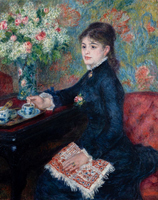
The exhibition Impressionism: Pathways to Modernity marked a significant cultural milestone as the first comprehensive presentation of Impressionist art in the Gulf region. Curated by Sylvie Patry and Stéphane Guégan, the exhibition featured over 150 Impressionist masterpieces, most of which were on loan from the Musée d’Orsay’s esteemed collection. Important contributions were also made by the Musée des Arts Décoratifs, allowing the curators to include some splendid period costumes and illustrate the close dialogue that Impressionist painters entertained with Parisian high-society fashion. The Louvre Abu Dhabi was able to exhibit in a new context some of its own masterpieces—including its recent acquisition, Pierre-Auguste Renoir’s La Tasse de chocolat (fig. 1)—while the Bibliothèque Nationale de France contributed some engravings and photographs.
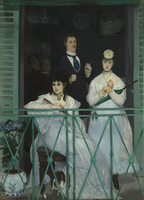
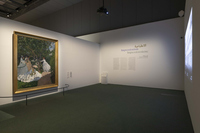
The curatorial approach adopted for this exhibition was both chronological and thematic, structured into fifteen sections that traced the evolution of Impressionism from its precursors to its legacy. This structure allowed for a nuanced exploration of the movement’s development in response to the profound social, political, and cultural upheavals of the nineteenth century. The exhibition opened with a striking display of two largescale masterpieces: Edouard Manet’s Le Balcon (fig. 2) and Claude Monet’s Femmes au jardin (fig. 3). By starting with these masterpieces, the exhibition underscored the innovative approaches of Manet and Monet, whose works challenged traditional artistic conventions and paved the way for the impressionist revolution in 1874.
The narrative progressed through key themes such as the representation of modern life, the effects of light and color, and the rejection of academic standards, culminating in the legacy of Impressionism and its influence on subsequent art movements. Catering to an audience that was assumed to be relatively less informed in European art history, the exhibition chose a generalist approach, establishing a detailed and well-informed chronology of Impressionist art in its political, social, and aesthetical context.
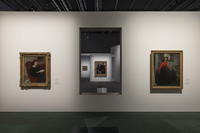
Most significantly, rather than isolating the Impressionist group from the Parisian art scene, the curators embedded it in a larger art world. Instead of drawing an image of a unified group of revolutionary artists, the exhibition stressed the continuous efforts of some of its members to exhibit in the official Salon and thus to position themselves not so much as young rebels, but as artists trying to paint according to their personal aesthetic preoccupations while creating images that would speak to their desired, bourgeois clientele. Following this idea, the exhibition juxtaposed works by canonical Impressionists with those by Salon artists with whom they are seldom exhibited, thus stressing their shared ambition to paint the modernity of the new social elites. Thus, the exhibition included contemporaries such as Eugène Boudin, James Tissot, and Carolus-Duran, who frequently and with great success exhibited at the official Salon. Boudin, generally revered as the father of Impressionism for his paintings of “the impermanence of modern life” (Patry and Guégan, 37), exhibited his beach scenes at the official Salon in the 1860s. His paintings often depicted the subdued bustle of leisure activities in seaside towns—Trouville in particular—against a scarcely present sea. The same paintings would later reappear at the first Impressionist exhibition of 1874, showing clearly that the border between Salon painting and independent exhibitions wasn’t as strict as it is sometimes imagined to be. Boudin’s primary concern was to render, with a light and delicate brushstroke, the elegance of fashionable attire and the refined pleasures of leisurely idleness. The painter’s clientele expected from him a meticulous attention to their sartorial display, an expectation that the painter was happy to oblige in intimate works such as La Plage de Trouville (1864; Musée d’Orsay, Paris) or in another version of the same subject painted a year later. James Tissot, though a close friend of Manet and Degas, would never enter the Impressionist exhibitions; therefore, his art cannot be properly described as impressionist in style or matter. Nevertheless, as the exhibition so clearly shows, his paintings contributed considerably to impressionist aesthetics and to the vocabulary of contemporary subject matter, especially through his attention to the fashion accessories of the Parisienne. The curators reunited two paintings that Tissot chose to send to the Salon of 1864, his Les Deux Soeurs (1863; Musée d’Orsay, Paris) and the Portrait de Mademoiselle L. L. (fig. 4) both of which put the delicate fabrics of the dresses and fashionable accessories of the ladies at the center of the composition. Similarly, Carolus-Duran’s acclaimed Salon painting of 1869, La Dame au gant, places the elegant garments of the Parisienne—and notably the white glove she has seductively thrown to be picked up by a suitor—at the center of the viewer’s attention.
Impressionism and Fashion: Recycling a Narrative
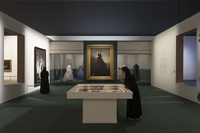
A notable feature of the exhibition was the inclusion of five period costumes (fig. 5). These garments provided a tangible connection between the fashion of the era and the subjects depicted in the artworks, highlighting the interplay between art and fashion during a period of rapid change. The inclusion of period costumes echoed an earlier curatorial strategy employed by the teams of the Musée d’Orsay in the acclaimed 2012 Paris exhibition Impressionism, Fashion, and Modernity.[3] Co-organized with the Metropolitan Museum of Art and the Art Institute of Chicago, that exhibition had already explored the intricate relationships among fashion, modernity, and the visual language of the Impressionists, placing garments from the period in direct dialogue with paintings by Manet, Monet, Edgar Degas and others and contextualizing their interest in modern life through the material culture of the time.[4] Paintings by Manet, Monet, Degas, and Berthe Morisot were exhibited alongside period garments, fashion plates, and accessories, offering a vivid portrayal of nineteenth-century bourgeois style and its codified visual language.[5] By incorporating garments from the Musée des Arts Décoratifs in its own layout, the Louvre Abu Dhabi reinforced a similar curatorial narrative: the Impressionists were not simply painters of light and leisure, but acute observers of shifting identities, social mobility, and aesthetic modernity as expressed through clothing. This material convergence highlighted a shared institutional methodology that bridges Western and Middle Eastern exhibition practice.[6] Its use in Abu Dhabi, while no longer very original, affirmed the global portability of Impressionism’s themes—modernity, transformation, and the visual politics of the everyday.
The curatorial team aimed to present Impressionism as more than an artistic style. They sought to contextualize it within the profound social, political, and cultural upheavals of the nineteenth century. The exhibition emphasized how Impressionist artists embraced new ways of seeing, making art, and living, celebrating a thrilling new reality and representing truthful observations of nature and modern life.
In staging this exhibition in the Emirates, the curators drew parallels between the transformative periods in nineteenth century France and the UAE today. Sylvie Patry noted that the Impressionists’ responses to the rapid urbanization and societal changes in nineteenth-century France mirror recent transformations in the UAE and broader Gulf region, thereby facilitating “cross-cultural dialogue and reflection on universal artistic innovation.”[7] Furthermore, the exhibition exemplified the potential of cultural partnerships to bridge geographical and cultural divides, fostering a global appreciation of art.[8] This decision to link the aesthetic innovations of Impressionism with the sociopolitical transformations in the UAE was striking and opened a conversation about modernity’s global dimensions. However, while this thematic framing was thought-provoking, the curators may have missed an opportunity to explore more critically the role of colonialism and empire in shaping art. The juxtaposition of period costumes and paintings was effective in showing the intersection between fashion and art, but a more nuanced discussion of the role these images played in reinforcing social hierarchies would have added depth to the exhibition’s curatorial narrative.
II. Constellations of Modernity: Reframing Postimpressionism
Postimpressionism: Beyond Appearances offered a profound exploration of the Postimpressionist movement, emphasizing the interconnectedness and individualism of its key figures. Curated by Jean-Rémi Touzet of the Musée d’Orsay and Jérôme Farigoule of the Louvre Abu Dhabi, the exhibition presented a nonlinear narrative that highlighted the diverse trajectories of artists such as Paul Cézanne, Vincent van Gogh, Paul Gauguin, Georges Seurat, Henri-Edmond Cross, the Nabis group, Henri de Toulouse-Lautrec, and others. This approach underscored the movement’s multifaceted nature and its global influence. Bringing together over a hundred artworks, among which were seventy-four masterpieces from the collections of the Musée d’Orsay in Paris, the narrative focuses on the last two decades of the nineteenth century.
Conceived as a continuation of the Louvre Abu Dhabi’s Impressionist exhibition of 2022–23, Postimpressionism: Beyond Appearances focused on a generation of artists, active between 1880 and 1910, who proposed new approaches to art, sometimes in direct opposition with the previous generation of Impressionists. In contrast to Impressionism, Postimpressionism does not appear as a structured movement, but rather as a constellation of disparate artists—this astronomical term serving as inspiration for the spatial organization of the exhibition rooms. While some of those artists stand alone in the singularity and autonomy of their art—Cézanne, Van Gogh, Gauguin, Toulouse-Lautrec—others shared their vision by founding more or less organized groups, as was the case with the Pointillists, the Symbolists, and the Nabis. As the homogeneity of the Impressionist group began to disintegrate during the 1880s, Postimpressionists set a challenge and searched to represent a new kind of truth. This search for a dimension of existence inaccessible to the simple eye, the surpassing of Impressionist spontaneity, and an opposition to photorealist precision as championed by Salon painters, received the name “Postimpressionism” posthumously in 1910, when the art critic Roger Fry invented it on the occasion of the exhibition he organized at the Grafton Galleries in London under the title “Manet and the Postimpressionists.”[9] Fry himself admitted the insufficiency of the term for capturing the diverse aims of the twenty or so artists featured in his show.[10] As he argued, “Postimpressionism” should not be understood as an heir to the Impressionist movement, but rather as a protesting after—the vision of a new generation that has rejected the “passivity” of impression and replaced it with the expression of the artist and his capacity to see beyond the appearances “that emotional significance which lies into things.”[11] As Jean-Rémi Touzet states in his introductory essay to the exhibition catalogue, the coherence of Postimpressionism is thus to be understood through the complexity of its relationship to the present and the artists’ search for a synthesis and a state of harmony that goes beyond a prosaic reality (Touzet and Farigoule, 24).
Departing from traditional linear or stylistic categorizations, the exhibition emphasized individual contributions and dynamic interactions among artists. This framework allowed for a nuanced understanding of how these artists, while pursuing distinct paths, were interconnected through shared themes such as color theory, emotional expression, and the quest for new modes of representation at a time when the Impressionist movement seemed to have reached its stylistic limits. The exhibition’s design facilitated this conceptualization, guiding visitors through a spatial arrangement that mirrored the artists’ interrelations.
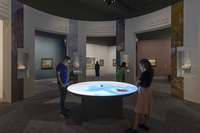
Similarly, the exhibition’s layout was intentionally designed to reflect the diversity and interconnectedness of the Postimpressionist movement. At the center of the gallery stood a rotunda-like space, housing masterpieces that encapsulated the movement’s core themes. From this central space, eight radiating sections extended outward, each dedicated to a specific artist or group (fig. 6). This radial structure, reminiscent in form and palette of a color wheel, symbolized the spectrum of styles and ideas within the movement as well as the more or less scientific approach of some artists of the theory of colors; this allowed visitors to navigate the exhibition in a manner that mirrored the artists’ explorations of color and form.
The Paths Through Modernity
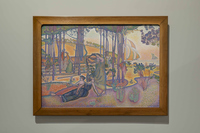
Thematic sections visualized eight paths through modernity. Although no specific order was imposed upon the visitors and the layout encouraged them to find their own way through the exhibition and, metaphorically speaking, through the Postimpressionist movement, the first section started off in an explosion of color. It focused on Neoimpressionism and artists such as Cross, whose work L’air du soir (fig. 7) exemplified the pointillist technique. The painting’s depiction of women resting and walking by the sea highlighted the movement’s emphasis on scientific approaches to color and light, reflecting the artist’s deep engagement with contemporary theories of optics and perception.
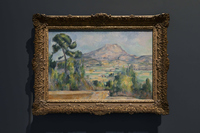
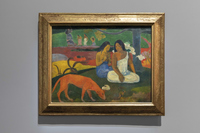
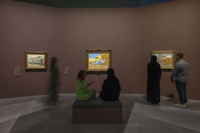
The neighboring three sections were each dedicated to a single artist whose impact in the last decade of the nineteenth century was particularly remarkable and the approach strikingly personal. The section devoted to Cézanne showcased a variant from his series of paintings of Montagne Sainte-Victoire from around 1890 (fig. 8), illustrating his evolving approach to form and perspective. Over time, as Cézanne returned over eighty times to his beloved motif, he abstracted the landscape, focusing on geometric structures and the interplay of color, which laid the groundwork for the development of later avant-garde movements such as Cubism. Gauguin appeared in the exhibition as one of the most influential figures of the Postimpressionist era, evolving from his Pont-Aven period during which he collaborated closely with Émile Bernard, to his personal aesthetic principles synthetized in his Polynesian subjects, such as his Arearea (fig. 9). Gauguin’s section explored his turn away from realism toward symbolic narrative, expressive color, and non-Western influences. His work seeded a generation of artists, such as Van Gogh and the Nabis, who took up his challenge to move beyond material reality. A centerpiece of the exhibition, Van Gogh’s gallery explored the artist’s vivid palette, emotional intensity, and raw materiality (fig. 10). Alongside The Bedroom in Arles (1889; Musée d’Orsay, Paris), works like La Méridienne (1889–90; Musée d’Orsay Paris) offered a moment of quietude within the visual chaos. The inclusion of his actual palette in the exhibition, encrusted with thick layers of pigment, allowed visitors to confront the physicality of his process.
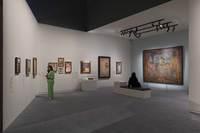
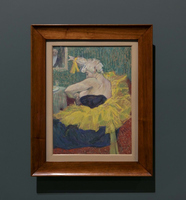
The section dedicated to the Nabis included Paul Sérusier’s Talisman, Paysage au Bois d’Amour (fig. 11), which served as a foundational icon for the group. Influenced by Gauguin and Japanese prints, the Nabis embraced flattened forms and spiritual abstraction. The gallery also included ceramics, furniture, and other objects that emphasized the synthesis of art and life in their vision and the decorative aesthetic of their art (fig. 12). Toulouse-Lautrec’s section highlighted his depictions of Parisian nightlife, including scenes from cabarets and circuses such as his Clowness Cha-U-Kao (fig. 13). His innovative use of lithography and poster design bridged the gap between fine art and commercial illustration, reflecting the era’s blurring of artistic boundaries. The last single artist section was dedicated to Odilon Redon and delved into his exploration of the subconscious of the mystical, featuring his Symbolist prints and drawings. His work, influenced by various religious and philosophical traditions, invited viewers into a dreamlike realm of imagination and introspection.

The final galleries traced the forward momentum of Postimpressionism into the early twentieth century. Artists such as Henri Matisse, Maurice de Vlaminck, and Raoul Dufy embodied the exuberance of Fauvism and the structural rigor of Cubism. The exhibition demonstrated how key Postimpressionist ideas—bold color, symbolic abstraction, structural simplification—seeded multiple avant-garde movements. The experimental approach to color and the structural perception of objects typical for Postimpressionism opened the path for the deconstruction of form used by Cubist artists as well as for the bold use of color applied by the Fauves. Inspired by the use of pure colors and the palettes of Van Gogh, Seurat, and Gauguin, Matisse revolutionized his approach and laid the fundament for Fauvism with his Femme au chapeau (1905; San Francisco Museum of Modern Art, San Francisco), evidenced also in his Portrait de Fatmah (1912; Musée de Grenoble, Grenoble). Around the same time, Dufy pushed further Cézanne’s explorations of space and perspective as well as his geometric simplification of forms in works such as Arbres à l’Estaque (1908; Centre Pompidou, Paris).
At the exhibition’s conclusion stood a particularly striking and inclusive gesture by the curators: an entire wall dedicated to Georges Sabbagh, an Egyptian artist trained in Paris by Postimpressionist mentors, including Sérusier, Félix Vallotton, and Maurice Denis. His paintings, executed in France but depicting intimate moments from his Egyptian family life, underscored the global reverberations of Postimpressionist ideas. Sabbagh’s presence in the exhibition was a conscious effort to expand the Western canon and affirm the shared, overlapping roots of global modernism. Despite his evident artistic merit, Sabbagh remains one of the lesser-known figures in the Abu Dhabi exhibition—likely reflecting the complex cultural positioning he occupied as an outsider even during his lifetime. Seen as neither fully Egyptian nor French, he was labeled in his homeland al-ra’ed al’mughtarib (“the expatriate pioneer”)[12] and “the glory of Egypt.”[13] The uncertain position between the Western and the Middle Eastern worlds of this “son of Egypt who became the adopted child of France,”[14] is evidenced in the fact that he was regularly invited by Egyptian officials as a guest to promote French art in Egypt, while the French government crowned his career with success by acquiring his paintings for public institutions. Sabbagh created some of his most significant paintings between 1917 and 1923, two of which were included in the Louvre Abu Dhabi exhibition: La famille: les Sabbagh à la Clarté (1920; Musée National d’Art Moderne, Paris) and La famille: les Sabbagh à Paris (fig. 14). Both works portray the painter’s family, his favorite subject in these formative years. His wife Agnès, their two sons Jean and Pierre, and the painter himself appear in monumental, well-balanced compositions that verge on the sculptural. Bold brushstrokes and a richly expressive palette imbue these scenes of everyday domesticity with an emotional density. The portrayal of the closeknit family unit—an enduring tradition in Arab culture—translates the painter’s nostalgia and cultural inheritance, offering him a symbolic refuge amid the social dislocation and uncertainty of post–World War I France. Although often defined as an heir of the Nabis, Sabbagh himself asserted his transnational identity and his cosmopolitan roots: “I am neither of Brittany, Paris, Nabi, nor Cubist. I am a painter of the Orient and the West; a man from Africa, the Levant and Europe; a Mediterranean in love with light and life.”[15] The Abu Dhabi exhibition thus ends on this resonant note of artistic hybridity, foregrounding the global dialogues between the Middle East and the West that shaped modernism in the early twentieth century.

A Global Narrative of Transcultural Modernity?
This exhibition was more than a survey of modern European painting. It was a powerful act of cultural translation, revealing how the ideas and aesthetics of Postimpressionism resonate within a Middle Eastern context. The museum’s commitment to presenting global narratives—and to foregrounding transcultural exchanges rather than isolated histories—was fully realized in this layout. In staging a constellation of modernity rather than a linear chronology, the exhibition offered a generous and inclusive framework through which to understand not only the diversity of Postimpressionism but its deep entanglement with broader questions of identity, spirituality, and cross-cultural influence—themes that continue to shape artistic discourse in the region today.
It is important to note, however, that the curators of Postimpressionism: Beyond Appearances elected to frame the movement almost exclusively within the boundaries of the French art scene. Even the inclusion of Egyptian-born artist Sabbagh—an ostensibly transnational gesture—ultimately reinforced a Francocentric narrative, as his artistic training, influences, and career were firmly rooted in Paris and shaped by French mentors.[16] While it is historically accurate that Paris functioned as the global center of artistic innovation at the close of the nineteenth century, especially for avant-garde circles, the curatorial approach notably sidesteps the broader international dimensions of Postimpressionism. This omission is particularly striking in light of Roger Fry’s second landmark Postimpressionist exhibition, organized in London in 1912, which explicitly expanded the scope of the term postimpressionism beyond the French context to include artists from the British and Russian avant-gardes.[17] In contrast, the Louvre Abu Dhabi’s presentation—despite its ambitious scale and global setting—largely reaffirmed a national art historical narrative, leaving unexplored the transnational dialogues that were already recognized in early twentieth-century interpretations of the movement.
III. Between Diplomacy and Display: The French Imprint and Regional Resonances in Louvre Abu Dhabi’s Exhibitions
Both exhibitions at the Louvre Abu Dhabi presented sweeping art historical narratives but also implicitly reflected the complex cultural and geopolitical ties between France and the UAE. As one of the most prominent outcomes of the intergovernmental agreement between France and the UAE, the Louvre Abu Dhabi has often drawn heavily on French expertise and collections, notably those of the Musée d’Orsay. This French “cultural monopoly,” while strategically framed as a bridge between East and West, is increasingly being questioned in light of the imminent openings of major Emirati-led or other international institutions, such as the Zayed National Museum and the Guggenheim Abu Dhabi.[18] These future institutions may offer a counterbalance to the current dependence on French museological frameworks and allow for a greater diversity of narratives shaped by regional voices.
I have mentioned continuities between the 2022–23 exhibition and the Musée d’Orsay’s treatment of Impressionism, yet the context and timing of the 2024 exhibition reveal important departures from the Musée d’Orsay’s program. While the French museum celebrated the 150th anniversary of the first Impressionist exhibition with the outstanding exhibition Paris 1874. Inventing Impressionism in the spring of 2024,[19] its curators in Abu Dhabi took a different tack in the fall of the same year: rather than focusing on the group’s formation, Postimpressionism: Beyond Appearances emphasized the fragmentation of the Impressionist movement and the development of successive avant-garde tendencies. This divergence in emphasis is telling; it not only reflects the different institutional missions of the Musée d’Orsay and the Louvre Abu Dhabi, but also gestures toward a global, more didactic narrative suited to a diverse and potentially less specialized audience.
Indeed, the Louvre Abu Dhabi’s broader museological mission hinges on accessibility and cross-cultural exchange. While some critics question the extent to which the museum is independent of French intellectual authority, it has strategically embraced a universalist model that seeks to engage local Emirati visitors as well as the museum’s international demographic.[20] This inclusive vision is especially apparent in the curatorial rhetoric surrounding Pathways to Modernity, which emphasized transcultural influences, exchanges, and global modernity—a concept that resonates deeply with the UAE’s own self-image as a rapidly modernizing, cosmopolitan nation. The Postimpressionist exhibition’s subtitle, Beyond Appearances, further underscored this aim: it invited viewers to move past the decorative or picturesque qualities often associated with Impressionism and Postimpressionism to instead consider the artists’ radical engagement with modern life, technology, and visual perception.
The resonance of such themes within the Gulf context is amplified by a concurrent regional investment in reexamining Arab modernism, which developed during the twentieth century, following in the steps of the European avant-gardes. Institutions like the Barjeel Art Foundation in Sharjah have played a significant role in shaping the discourse around local artistic modernities. The long-term exhibition A Century in Flux (2018–19) at the Sharjah Art Museum, for example, surveyed the development of modern and contemporary art in the Arab world, with key works by artists such as Saloua Raouda Choucair, Ibrahim El-Salahi, and Kadhim Hayder.[21] While these exhibitions operate within a different cultural frame, they share with Louvre Abu Dhabi’s projects a commitment to situating modern art in its broader historical and geopolitical dimensions. In this way, Impressionism: Pathways to Modernity and Postimpressionism: Beyond Appearances participate in a larger regional conversation about the meanings and manifestations of modernity, both imported and indigenous. The Louvre Abu Dhabi’s handling of these exhibitions highlights the potential for museums in the Gulf region to engage with global artistic narratives in ways that resonate locally. While both exhibitions succeeded in creating a bridge between Western and local modernities, they also prompted the visitor to consider how global narratives in art history must continually adapt to contemporary contexts and evolving audience needs.
Notes
[1] Post-impressionism: Beyond Appearances, exhibition press release, Louvre Abu Dhabi, 2024.
[2] Manuel Rabaté, “Louvre Abu Dhabi and the Global Museum,” in Louvre Abu Dhabi: Birth of a Museum, ed. Laurence des Cars (Flammarion, 2013), 25–34.
[3] Gloria Groom, ed., Impressionism, Fashion, and Modernity, exh. cat. (Art Institute of Chicago, 2012).
[4] Guy Cogeval, ed., Impressionnisme et la mode, exh. cat. (Hazan, 2012), 15–17.
[5] Susan Hiner, “Class, Gender, and the Spectacle of Fashion in Impressionist Painting,” in Groom, Impressionism, Fashion, and Modernity, 55–69.
[6] Sylvie Patry and Stéphane Guégan, curators’ statement, quoted in Louvre Abu Dhabi Presents: Impressionism: Pathways to Modernity, Abu Dhabi Department of Culture and Tourism press release, October 2022.
[7] Sylvie Patry, in press interview with Louvre Abu Dhabi, December 2022.
[8] See France Museums, Strategic Planning in International Collaboration, accessed June 2, 2025, https://francemuseums.com/.
[9] Roger Fry, Manet and the Post-impressionists, exh. cat. (Ballantyne & Company LTD, 1910).
[10] Fry, Manet and the Post-impressionists, 7.
[11] Fry, Manet and the Post-impressionists, 7–9.
[12] Mokhtar al-Attar, Ruwwad al-Fann wa-Tali’at al-Tanwir fi Misr wa-I-Alam al Arabi (al-Hay’a al-Misriyya al-‘Amma li-I-Kitab, 1996), 205.
[13] “Une gloire de l’Égypte: G. H. Sabbagh,” Images 217, November 11, 1933, 8.
[14] Robert Blum, “En causant avec le peintre G. H. Sabbagh,” Images, January 28, 1933, 4–5.
[15] Georges Sabbagh, “Georges Sabbagh vu par lui-même,” Confidences du peintre G. H. Sabbagh sur sa peinture et sur la peinture, Premier Cahier (1920–1925) (Association pour la fidélité à l’œuvre du peintre Georges Sabbagh, 1991), 6.
[16] See Marina Ferretti Bocquillon, Georges Sabbagh, un Égyptien à Paris: Un peintre de la modernité méditerrannéenne (Somogy, 2009).
[17] Roger Fry, “Second Post-Impressionist Exhibition. British, French and Russian Artists,” London, Grafton Galleries, 1912; for contextual analysis of Fry’s international curatorial choices, see also Charles Harrison, English Art and Modernism, 1900–1939 (Yale University Press, 1994), 49–59.
[18] Sultan Sooud Al Qassemi, “The Louvre Abu Dhabi and the Future of Museums in the Gulf,” ArtReview, November 2022.
[19] Sylvie Patry and Annie Robbins, Paris 1874. Inventing Impressionism, exh. cat. (Musée d’Orsay, 2024).
[20] Sabrina Wakefield, “Cultural Politics and the Louvre Abu Dhabi: Between Universalism and National Identity,” International Journal of Cultural Policy 26, no. 5 (2020): 678–92.
[21] Barjeel Art Foundation, A Century in Flux: Highlights from the Barjeel Art Foundation, Sharjah Art Museum, Sharjah, May 12, 2018—October 22, 2019.