Hidden in Plain Sight: Concealing Enslavement in American Visual Culture by Rachel Stephens
Reviewed by Jenny CarsonJenny Carson
Maryland Institute College of Art
Email the author: jcarson[at]mica.edu
Citation: Jenny Carson, book review of Hidden in Plain Sight: Concealing Enslavement in American Visual Culture by Rachel Stephens, Nineteenth-Century Art Worldwide 25, no. 1 (Spring 2026), https://doi.org/10.29411/ncaw.2026.25.1.7.
This work is licensed under a Creative Commons Attribution-NonCommercial 4.0 International License  unless otherwise noted.
Your browser will either open the file, download it to a folder, or display a dialog with options.
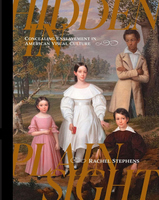
Rachel Stephens,
Hidden in Plain Sight: Concealing Enslavement in American Visual Culture.
The University of Arkansas Press, 2023.
340 pp.; 164 color illus.; bibliography; notes.
$60.00 (hardcover)
ISBN: 9781682262337
Hidden in Plain Sight: Concealing Enslavement in American Visual Culture is an important contribution to the study of US art history and cultural studies. It is part of a growing body of interdisciplinary scholarship that seeks to better understand the evolving and symbiotic relationships between racism and visual culture in the nineteenth-century United States. As the Civil War loomed, both sides of the slavery issue used visual means to support their cause; while abolitionists sought to reveal the horrors of chattel human bondage by visualizing the lived experiences of hard labor, torture, capture, and forced family separations, proslavery advocates responded with imagery that sought to conceal these realities. Rachel Stephens argues that by studying these works—many of which were produced in the South, a region of the country whose art has not yet been fully studied—we develop a fuller understanding of the history of US art. One aspect of this comprehensive study that makes it so valuable is the wide range of media that it covers, including illustrated political pamphlets, popular prints, photographs, paintings, sculpture, and printed ephemera such as Union envelope covers and Confederate currency. The sheer variety of images and objects analyzed demonstrates the ways in which the themes of slavery and white supremacy saturated virtually all visual media.
A project this ambitious in scope is in danger of being a mile wide and an inch deep, but Stephens avoids that trap by organizing the book’s six chapters thematically; the first two chapters provide overviews of the ways in which idealized imagery and rhetoric were used to defend slavery, including visual evidence of the violence directed toward abolitionists and their causes. The following three chapters explore specific themes: the various ways in which secrecy and concealment were used by enslavers in response to antislavery imagery, which was often infused with sarcasm; efforts made by enslavers to promote the romanticized concept of “the family white and black” through commissioned photographs of Black caretakers with their young charges; and an analysis of the proslavery prints produced by Baltimore artist Adalbert John Volck. The final chapter examines the ways in which the works of several Virginian artists effectively propagated the idealization of slavery and romanticized antebellum Southern culture into the postwar years and beyond.
As the book’s title suggests, its overarching theme is concealment. Stephens reminds us that, in addition to the work slavery’s defenders did to hide its atrocities, even within their own private correspondence, these efforts at secrecy and subterfuge have helped to ensure that history is left with an incomplete record of the institution. Thus, a stated goal of this book is to not “probe the atrocities of slavery as such” but to “locate and acknowledge the absences in visual culture” (15). And while Stephens acknowledges that this study does not purport to fully uncover a clear history of slavery, it aids in our ability to gain a fuller picture of those who sought to defend it. Because much of this history has been covered up, often with the complicity of governmental, cultural, and educational institutions, raising the individual voices and identities of African Americans who suffered from bondage and white supremacy in the antebellum and postwar years, where possible, is another important aim of this study.
The book begins by examining some of the ways in which slavery was idealized in visual culture, either by “omitting enslaved people or representing false benign scenes” (29). Stephens outlines several of the justifications for bondage proslavery advocates used, including the message that slavery was “familial, healthy, and preferable to freedom,” an argument that was often drawn from perverse readings of the Bible as well as perceived racial hierarchies (29). These ideas were conveyed visually in various ways and became widely popular across the South as a means of countering the antislavery materials produced by abolitionists, who emphasized slavery’s cruelty. Southern responses to this powerful imagery included a variety of forms, including prints that sought to demonstrate the innate potential for violence within individuals of African descent; paintings featuring contented enslaved individuals living and working alongside their white enslavers; and portraits of plantation estates in which the presence of the enslaved workforce was completely—or almost completely—erased.
Several examples of romanticized estate portraits are included, ranging in date from 1800 to 1861, indicating that this practice of concealment was deeply embedded. For example, in Charles Fraser’s watercolor of the Joseph Winthrop estate in Goose Creek South Carolina—The Seat of Jos. Winthrop, Esq., Goose Creek (ca. 1800; Gibbes Museum of Art/Carolina Art Association, Charleston)—the only people featured are its well-dressed owners fishing on the bank of a gently flowing river in the foreground, while the house and its grounds, which include tidy outbuildings that frame the estate, are eerily devoid of human presence. And despite the fact that one-twelfth of the nation’s enslaved population lived in Louisiana, many toiling on sugar plantations, in Marie Adrien Persac’s idealized and geometrically-ordered view of the Bois de Flèche Plantation in St. Martin Parish (Bois de Flèche Plantation, 1861; Louisiana State Museum, New Orleans), very few enslaved individuals inhabit the scene, and those who do are relegated to the discrete spaces “given over to sites of enslavement” (59). These are compelling examples, but looking at earlier estate portraits in which enslaved labor is more overtly visualized might further contextualize and bolster Stephens’s argument of concealment, white supremacy, and social hierarchy. For example, Charles Willson Peale’s portrait The Gittings Family (1791; Maryland Center for History and Culture, Baltimore) features patriarch Gittings, his wife, and granddaughter in an interior that looks out over a landscape filled with several enslaved individuals working the fields. These laborers, along with the land on which they work, the family home, and Gittings’s wife and granddaughter, are clear signifiers of his property, as well as his perceived role as benevolent provider and caretaker of those possessions.
In one of the strengths of this book, Stephens adeptly draws a visual and conceptual connection between the idealized labor depicted in plantation portraits and similar images that appeared on everyday mass-produced media like Confederate currency. For example, several well-dressed Black laborers are prominently featured in a picturesque vignette on a one-hundred-dollar note from Richmond. Stephens convincingly argues that such imagery normalizes slavery as beneficial to Southern life while, ironically, underscoring the ways in which planters and the Southern economy were entirely dependent upon such labor. Following the war, images of agricultural labor ceased to serve as propaganda in support of slavery; no longer needing to justify the institution, many of these images, such as William Aiken Walker’s chromolithograph, A Cotton Plantation on the Mississippi (1884; Amon Carter Museum, Fort Worth), published by Currier & Ives, depict African Americans toiling in the fields under the watchful eye of white overseers, thus reaffirming the social hierarchies based on race that held sway on plantations during the postwar years.
While the romanticized prewar portraits of plantations project a false picture of the realities of agricultural labor, photography was used beginning in the 1840s for the same purpose, albeit focused on domestic labor. Most of these photographs, commissioned by enslavers and featuring Black nannies seated alongside or holding the white children that they cared for, attempt to present the nannies not as property, but as valued members of the family. Stephens offers several ways of looking at these photographs that are worth considering. She argues that when juxtaposing the photographs of nannies with those of the plantations’ white matriarchs, it becomes clear that these depictions of women, both white and Black, are a “tangible documentation of hard labor” (148).
The Black women are carefully posed in tidy housework attire, while their white counterparts, often appearing without their biological children in separate photographs, are dressed in elegant leisure gowns that belie the labor that they are necessarily engaged in to maintain the running of the household, a task that had become even more arduous during the Civil War. Although such imagery was meant to convey white supremacy, it may have subverted it for several reasons. Black nannies were entrusted to care for the white children, tacitly conveying that they were intellectually and emotionally capable of such an important role. And while we don’t know the identities of many of these women, their photographs document the valuable positions that they held within the household. Further, Stephens argues that their facial expressions and demeanor often project a sense of defiance, indicating that they were able to exert a degree of agency, even as they were forced to take care of their white charges at the expense of caring for their own children, who could, at any time, be sold and separated from them. Because images of Black nannies with their white charges don’t appear in paintings of the period, their widespread appearance in photographs is significant and raises the question of what the specific function of these small, one-of-a-kind likenesses was—an avenue that might be further explored.
Stephens’s cultural and iconographic reading of several prints produced on both sides of the slavery issue is another strength of this book. She spends some time on prints showing the destruction of Abolitionist Hall in Philadelphia in 1838, a dramatic event that underscores the very real dangers faced by abolitionists and reporters who attempted to document the realities of slavery. That this violence took place in Philadelphia serves as a reminder that proslavery sentiment was not confined to the South. The story of Abolitionist Hall and its almost immediate destruction as told by popular prints reveals a broader and deeper history of antebellum racial tensions. While John Sartain’s small mezzotint, Destruction of the Hall (1838), offers a dramatic view of the building engulfed in flames, some anti-abolitionist printmakers responded by invoking the perceived dangers of race mixing to “stir up white anxiety” (88). In one such image, Abolition Hall (1838), signed Zip Coon, Abolitionist Hall is conceived as an “interracial brothel,” entertaining groups of white and Black individuals cavorting with each other in front of the building (89). All of these prints were widely disseminated.
By contrast, Volck’s anti-Union prints had a limited audience, as they were necessarily created in secrecy and behind enemy lines in Baltimore. Stephens argues that because these works were created independently, we find in them a “pure example of un-remediated pro-Confederate, anti-union sentiment. . . rarely expressed so directly in art” (182). Publishing under the pseudonym V. Blada, Volck’s satirical prints, which Stephens views as a response to Thomas Nast’s pro-Union works that regularly appeared in Harper’s Weekly, lampooned the Union and its leaders, abolitionists, and free Black people while presenting a positive view of the South, its leaders, and slavery. Stephens carefully analyzes iconographic elements in several of Volck’s prints, noting that they often quote notable works, such as Alexander Gardner’s well-known photograph, Abraham Lincoln Seated Next to a Small Table (1861; Library of Congress, Washington) and Emanuel Leutze’s famous canvas, Washington Crossing the Delaware (1861; The Metropolitan Museum of Art, New York). The inclusion of Volk’s racist output is important in a study such as this because while it was relatively small and sold by limited subscription to northern consumers, after the war, it reached a wide audience, from the Jim Crow era well into the twentieth century.
Building on this theme of the legacy of white supremacy and slavery, the book’s final chapter focuses on the works of several Virginian artists—including William D. Washington, William Ludwell Sheppard, and Edward Valentine—who continued to promote pro-Confederacy ideology, especially the myth of the “loyal slave.” While her focus is on Virginia, Stephens demonstrates how the work of these prominent figures enjoyed a national audience and thus played a pivotal role in promoting and sustaining white supremacy and Lost Cause mythology. She further argues that these artists, the enslavers who commissioned their works, and the state and federal institutions that uncritically patronized and celebrated them has led to a troubling “cover-up of the history and humanity of enslaved people” (214). Thus, Stephens’s analysis of these images seeks to look beyond the surface to discover the meaning the images conveyed and how they functioned for their contemporary audience.
Stephens spends some time with Washington’s painting, The Burial of Latané (1864; The Johnson Collection, Spartanburg). Unlike many other southern works produced during the Civil War, this painting is well-documented, providing us with, as Drew Gilpin Faust argues, “a promising object for scholarly attention” (246). The painting illustrates the burial of Confederate captain William Latané, the only soldier killed during the 1862 Peninsula Campaign in Richmond. The work, which features his internment surrounded by women, children, and several enslaved individuals, became an immediate icon of the Confederate cause, in particular the myth of the loyal slave and the biblical justification for slavery. Stephens makes the convincing assertion that Washington produced this proslavery painting as a Southern response to Eastman Johnson’s abolitionist work, Negro Life at the South (1859; The New York Historical, New York), arguably one of the most well-known paintings of the period and certainly Johnson’s masterpiece. Although I’m not sure that Negro Life at the South was viewed as unambiguously antislavery as Stephens suggests, her argument that the two works may be regarded as counterpoints is compelling. The Burial of Latané, along with the poems and prints that it inspired, provides an excellent example of how racist imagery promoted the Lost Cause myth. Portraits of Confederate leaders like Robert E. Lee and Thomas “Stonewall” Jackson, widely circulated as prints, took on religious significance after the war. Stephens’s discussion of how these images circulated and functioned in mourning rites, often enacted by Confederate women, is one of the strongest points of the book, reminding us of how ubiquitous and dangerous much of this problematic imagery was.
An important contribution of Stephens’s richly illustrated book is its inclusion of representative images pertaining to enslavement and white supremacy. Although much of the printed materials included were widely circulated during the antebellum period, many of these works—including political prints and pamphlets, currency, and envelope covers—may be unfamiliar today. One-of-a-kind images that served a more private function, like small watercolors of a Southern estate or the many daguerreotypes that feature Black nannies, may also not be widely known. One of the most intriguing objects Stephens reproduces and analyzes is the reverse side of a bust-length portrait of an unknown white man, Portrait of a Man/Virginian Luxuries (ca. 1825; Colonial Williamsburg Foundation, Williamsburg). Painted at the same time the portrait was created, the reverse of the canvas features two pairs of figures: on the left side of the composition, a well-dressed white man embraces a young Black woman; to their right, a white man dressed as an overseer, raises a whip over a shirtless Black man. The words “VIRGINIAN LUXURIES” are inscribed at the bottom. With little known about this painting’s commission and provenance, the function of its reverse side, concealed from view when hanging on a wall, remains elusive, raising the question as to how this and other personal images functioned in propagating political messaging. This book—and the histories and images analyzed within its covers—is highly relevant today. As Stephens argues, “this art intended to cause damage,” and it mustn’t be taken at face value (275). This study provides new insights into the ways in which visual culture propped up and perpetuated racism and the Lost Cause myth that are felt even today through the “racial imbalances still present in American culture” (139). Hidden in Plain Sight: Concealing Enslavement in American Visual Culture reminds us that we must commit to recovering the truth that white supremacists have worked so hard to conceal.