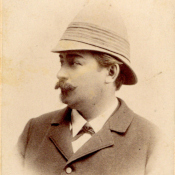
This article examines the African exhibitions organized by the Czech traveler, physician, and collector Emil Holub between 1874 and 1892, focusing on their scenographic design and ideological implications and on Holub’s exhibition strategies. It analyzes Holub’s curatorial practices in displaying natural-history and ethnographic objects gathered during his travels in southern Africa, particularly the use of taxidermy, dioramas, mannequins, and life-size models, which drew on contemporary exhibition practices to enhance visual impact, visitor engagement, and economic viability. The article situates Holub’s exhibitions within the broader context of nineteenth-century scientific colonialism and explores their role in shaping colonial imaginaries in Central Europe. It also argues that they functioned as instruments of Czech national emancipation within the Austro-Hungarian monarchy, presenting the Czechs as culturally and scientifically advanced participants in a global colonial order.
DOI