José María Velasco: A View of Mexico
Reviewed by Emmanuel OrtegaEmmanuel Ortega
University of Illinois at Chicago
Email the author: eortega[at]uic.edu
Citation: Emmanuel Ortega, exhibition review of José María Velasco: A View of Mexico, Nineteenth-Century Art Worldwide 25, no. 1 (Spring 2026), https://doi.org/10.29411/ncaw.2026.25.1.22.
This work is licensed under a Creative Commons Attribution-NonCommercial 4.0 International License  unless otherwise noted.
Your browser will either open the file, download it to a folder, or display a dialog with options.
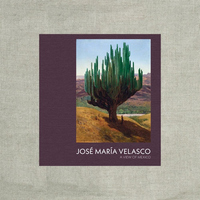
José María Velasco: A View of Mexico
The National Gallery, London
March 29–August 17, 2025
The Minneapolis Institute of Art, Minneapolis
September 27, 2025–January 4, 2026
Catalogue:
Dexter Dalwood and Daniel Sobrino Ralston, eds.,
José María Velasco: A View of Mexico.
The National Gallery Global, 2025.
144 pp.; 120 color illus.; catalogue; notes; bibliography.
$30.00 (hardcover)
ISBN: 9781857097252
In a review of Jose Maria Velasco: A View of Mexico, then on view at The National Gallery in London, Jonathan Jones averred: Velasco “is boring, though. The devil has all the best tunes and Mexico’s visual history is replete with them. . . . Velasco’s work is different from such art simply because his eye is more European, academic and rationalist. This is a Mexico tamed.”[1]
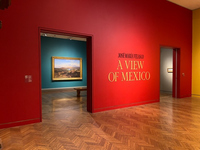
Evincing five hundred years of fantasies of place, Jones makes the case for a more engaging view of the artist at the expense of a reductive understanding of Mexico. This exhibition marks the first major solo show in London of José María Velasco, a towering figure in Mexican art history and a canonized landscape painter both during and after his lifetime. It is also, notably, “the first-ever exhibition that the National Gallery has dedicated to a historical Latin American artist.”[2] As one of the tour guides from the Minneapolis Institute of Art—where the exhibition was presented in its only iteration outside of the National Gallery—noted, the exhibition also celebrates the two hundredth anniversary of diplomatic relationships between Mexico and the UK (fig. 1). This is an important detail when considering the catalogue’s presentation of Velasco as a truly international artist.
“So what?” Jones asks. After all, “from its chunky Mesoamerican monsters to its modern surrealisms, [Mexican art] doesn’t lack attention.”[3] Despite such attitudes, the catalogue for this exhibition—edited by art historian Daniel Sobrino Ralston and artist Dexter Dalwood, with contributions by Dawn Ades, María Elena Altamirano Piolle, Pablo Arredondo Vera, Omar Olivares Sandoval, and Valéria Piccoli—offers a comprehensive glimpse into Velasco’s complex nineteenth-century world. Tracing his development from his early days at the Academia de San Carlos (Academy of San Carlos, the first art academy in the Americas) to his pivotal involvement in the Sociedad Mexicana de Historia Natural (Mexican Society of Natural History), the catalogue continues the celebratory, traditional reading of Velasco’s work—now reframed for an international audience, many of whom may be encountering the artist for the first time (even as it wrestles with the orientalist fantasies underlying The Guardian’s review). Together with the exhibition, it seeks to undo such retrograde understandings of Mexico, albeit with mixed results. Three major themes emerge. First, the exhibition labors to present a Mexican painter who belongs in a transnational artistic canon by demonstrating his close relationship to multiple traditions of landscape. Second, gesturing toward a changing discipline, the contributing art historians develop a romanticized yet fresh account of the artist’s environmentalism. Third, the formal analysis of the works, continuing a long-standing way of understanding Velasco, privilege the intersection of landscape conventions with his scientific observations. However, the human figures depicted and the oppressive sociopolitical context that frames them are overlooked. Taken together, these themes offer a strong introduction for European audiences and Midwesterners who may have only recently seen the artist’s works on display at the National Museum of Mexican Art as part of the 2024 exhibition From the World’s Fair to the Present Day. Given the resources supporting this intercontinental exhibition, the catalogue represents a missed opportunity to move beyond conventional readings. While it may be difficult to reinterpret a national icon whose portrait belongs on currency, he deserves more critical scrutiny, as would any artist of his stature.
International Velasco
Both the “Directors’ Foreword,” written by the National Gallery Director Sir Gabriele Finaldi and Minneapolis Institute of Art Director Katherine Crawford Luber, and the “Preface,” written by art historian Dawn Ades, note Velasco’s relative obscurity outside Mexico (9–11). Ades highlights her own efforts to rectify this via her 1989 exhibition, Art in Latin America: The Modern Era, 1820–1980.[4] In “Velasco Beyond Mexico,” Ralston argues that Velasco’s aversion to travel confined his art and discussions of it to a national context; however, Mexico’s participation during the great era of International Expositions helped place him on a larger global stage (23–37). Ralston also helpfully places Velasco in his historical context, stressing how his early struggles ran parallel to the nation’s own search for self-definition during and following the War of Independence from Spain, the Mexican–American War (better known in Mexico as the US Invasion), and the French Intervention. Further, Ralston establishes little-explored connections between picturesque landscape traditions of the seventeenth century and the work of Velasco’s Italian teacher in the Academy of San Carlos, Eugenio Landesio. The extension of these influences is noted by way of Landesio’s own teacher, Károly Markó the Elder, who exhibited several compositions in Mexico.
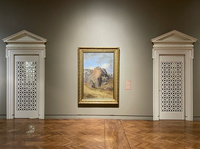
While the catalogue does an excellent job in contextualizing Velasco as a true international artist, it does not emphasize his contributions to these global networks. One example is Piccoli’s discussion of the painting titled Rocks (1894; Museo Nacional de Arte, Mexico City), alternatively titled Porphyries of Tepeyac (23). This impressive canvas depicts an outcropping of “purplish igneous rock” (96) from Tepeyac, the legendary site where the Virgen de Guadalupe appeared to Juan Diego in 1531. More than any other work in the exhibition, this image places Velasco within the European Romantic tradition because it depicts a natural formation with imposing, human-like personality; it is a pathetic fallacy of sorts filtered by new scientific and nationalist preoccupations. As the English polymath John Ruskin explained in his seminal Modern Painters (1843–60), the pathetic fallacy imbues inanimate objects with human qualities and emotions.[5] In fact, this nearly door-sized work—prominently displayed on its own in the stunning Minneapolis iteration of the exhibition—successfully communicates the scientific, nationalist, and Romantic aims of its creator (fig. 2). The wall label reiterates how historians often characterize these types of studies as “portraits of inanimate things.” This magnificent work is one of only a few in the exhibition accompanied by text, a fact that initially took me aback. However, after spending time with the paintings, I came to realize that they effectively present central Mexican natural vistas with such dignity and technical mastery that wall text might have been superfluous.
The conflation of poetic and philosophical ideas with Christian ideologies was characteristic of many European painters of the era, as, for example, in the work of German artist Caspar David Friedrich, whose famous landscapes, painted a little over half a century before Velasco’s works often included rocks, cliffs, mountains, trees, and other natural motifs that underscored the power of God in shaping the world. The catalogue explores Velasco’s fascination with this Tepeyac rock, noting that one surviving version of the composition features a cross atop it. And yet, it stops short of recognizing that the religious symbolism, combined with a meticulous depiction of nature, posited a new kind of sublime that wed an appreciation of the immensity of God’s creation to a scientific curiosity that invited viewers to admire the geological time represented by these rocks and the valley that housed them. Perhaps this might even be discussed as a specifically Mexican variation on the sublime.
Environmentalist Velasco
One of the most illuminating essays in the catalogue is by Mexican art historian Omar Olivares Sandoval, titled “At the Intersection of Art and Science” (39–49). Particularly compelling is Olivares’s exploration of Velasco’s relationship with the broader scientific community of the late nineteenth century and the dialogical exchanges that emerged from Velasco’s meticulous scientific eye. These observations are crucial in demonstrating that scientific communities in Latin America were shaped as much by local engagement as by foreign influence.
Mexico’s position within nineteenth-century global cultural and scientific discourse provides a framework for many of the essays in the catalogue. Such an approach often concentrates on the nation’s marginal position rather than interrogating the perspectives or structures that marked Mexico as peripheral. This pertains especially to Alexander von Humboldt’s so-called second discovery of the Americas, which often incorporates a savior narrative. That view tends to obscure the diverse scientific epistemologies Humboldt drew upon—from Native knowledge systems to the research of local criollo (white Spaniards born in the Americas).
Olivares’s essay offers a refreshing take, not only on Velasco’s contributions, but also on the more complex and often overlooked history of Latin American science and art in a global context. This discussion is enriched by his intersectional analysis of paintings, which unites aesthetic concerns with detailed examinations of the natural world. A single rock, as Velasco likely intended, invites viewers to consider his landscapes beyond their visual appeal—encouraging them to consider the geological complexity and botanical richness of the environment. Yet, what does it mean to juxtapose these ecological insights with Velasco’s celebration of Mexico’s technological progress, such as the railroad developments discussed in the essays by Piolle and Ralston? These seemingly conflicting interpretations of Velasco’s relationship to the environment call for a more critical and nuanced examination.
What Piccoli identifies as “the dichotomy between change and permanence” is a theoretical approach that needs to be nuanced (68). For instance, in “Landscape as the Site of Change,” Dalwood focuses on “the relationship between humanity and the environment, and between the generations of peoples who have shared Mexico City’s sprawling valley over the centuries” (52). While compelling, this expansive reading risks casting Velasco as a proto-environmentalist, thereby retroactively imposing contemporary ecological concerns onto his work. Such historical relativism risks distorting the significance of his paintings by attributing to them a modern environmental consciousness that may not align with the artist’s motivations or historical context.
In the opening paragraph of the catalogue, Ralston notes how Velasco “juxtaposes the rhythms of the natural world with the steady advance of industrialization in the Valley of Mexico” (64). Yet, as art historian Michael Baxandall reminds us, “description is the mediating object of explanation.”[6] This framing of his work collapses multiple aspects of Velasco’s identity—as a painter of the nation under Porfirio Díaz’s dictatorship (r. 1884–1911), as a keen observer of nature, and as a scientific enthusiast—into a simplified narrative. A more productive approach to Velasco’s “painting of change” (as Dalwood describes it) would be to shift the focus from interpreting his intentions to examining the significance of his observations. Was Velasco documenting localized environmental transformations in the Valley of Mexico, or was he engaging with broader questions about Mexico’s place in increasingly global industrialization (one that would lead to the Anthropocene)?
Another example of conflicting interpretations can be found in the contrast between Dawn Ades’s analysis of The Curved Bridge of the Mexican Railway Over the Metlac Ravine (1881; private collection) and the catalogue’s discussion of The Goatherd of San Ángel (1861–63; Museo Nacional de Arte, Mexico City). Ades views The Curved Bridge as enhancing rather than “spoiling the majesty of the land” (10), while the catalogue’s interpretation of The Goatherd and similar compositions frames painting as a tool for documenting environmental change—once again casting Velasco as a painter preoccupied with ecological concerns and simultaneously as a proponent of massive industrialization (10). Ades also notes the formal and thematic affinities between The Curved Bridge and Joseph Mallord William Turner’s Rain, Steam, and Speed–The Great Western Railway (1844; private collection). However, meaningfully assessing the differences between the two artists calls for a much deeper conversation—one that the catalogue gestures toward but does not offer. As art historian Sarah Gould notes in relation to Turner’s use of atmospheric contamination, “one could wonder how to tackle the question of atmospheres without univocally essentializing Turner’s experimentations with the medium.”[7] Similarly, in Velasco’s case, attributing environmental meaning without acknowledging the aesthetic and political complexities risks flattening the interpretation of his work and encouraging journalists like Jones to miss the significance of Velasco’s oeuvre.
A similar approach is evident in the catalogue’s discussion of Mafaffa Leaves (ca. 1880; Museo Kaluz, Mexico City), which highlights “Velasco’s ongoing interest in Mexico’s rich and diverse flora as well as his systematic approach to developing larger landscape compositions” (76). The study exemplifies this dual concern: the left half of the composition remains unfinished, while the right half features Velasco’s signature botanical detail rendered in expressive strokes of oil paint. It is precisely in this unresolved quality that a more nuanced approach to Velasco should begin.
Artists like Velasco—who was clearly aligned with power and became a canonical figure in the development of his medium—deserve to be examined with the same analytical rigor he applied to rocks and plants. His artistic achievements must be celebrated, but they must also be understood in relation to the sociopolitical conditions that enabled his work to be collected and legitimized by hegemonic elites. Doing so avoids doing (as art historian Kirsten Pai Buick calls it) “the work of the object”—that is to say, it fails to address the many complex histories informing the picture, which are erased by murky, post hoc environmental readings.[8]
Picturesque Velasco
One of the factors that has kept Mexico on the margins of global art conversations is its historical status as a colony and, in the nineteenth century, as a product of international exploitation. Post-contact, the region’s history has been viewed politically as, first, an extension of the Spanish Crown and, later, a nation whose borders and economy were shaped by neocolonial and foreign interventions. Whatever its limitations, this framework has allowed art historians to situate artistic development in relation to broader sociopolitical forces. My own work has identified a specifically Mexican picturesque and related this mode to Mexico’s status as a newly independent nation after its 1821 separation from Spain. As such, the Mexican picturesque is, “a product of European imperialism—one that aesthetically and ideologically situates Native Americans in the middle ground, at a distant point between explorer and the landscape explored, and at the necessary intersections that allow the national gaze to sustain neocolonial fantasies.”[9] This visual convention thrived at the Academia de San Carlos, where marginalized peoples in Mexico—particularly Indigenized groups—were consistently rendered as extensions of the flora and fauna that Velasco ever so carefully depicted in his compositions. These figures served to anchor entire segments of the population to a romanticized past, creating a dichotomy between them and a technological or economic future symbolized by the railways and factories that appear throughout his paintings. This tension becomes especially salient when considering the catalogue’s emphasis on Velasco’s role in classifying plants as scientific specimens—a practice that, during this period, was similarly applied to the study of Native peoples. Yet, this parallel is often brushed aside under the conventional umbrella of “the picturesque” or “Romanticism” and rationalized through the lens of ethnography.
In his seminal book Race and Manifest Destiny, historian Reginald Horseman asserts that the rise of Romanticism in the US “parallels in time the growth and acceptance of the new scientific racialism,” because it was “less interested in the features uniting mankind and nations than in the features separating them.”[10] In Mexico, a similar racially driven attachment to Romanticism occurred toward the end of the nineteenth century—actively opposing the neoclassical conventions previously used to articulate a cohesive image of the nation. This seemingly belated approach originated in a period where the superiority of a mestizo race (the mixture of Indigenous and European peoples) contested directly the “Indian predicament” (the highlighting of a glorious Meso-American past while reckoning with the downtrodden condition of Native communities).[11] As such, Velasco’s scientific objectivity, which anchored national history painting to Romantic landscape, also appealed sentimentally to the emotions of a learned local audience attuned to these two seemingly opposing cultural tendencies. The Mexican Romanticism of Velasco shows us how European artistic traditions were deployed as internal rhetorical tools of oppression and do not stand as testaments to the supposed backwardness of Mexican society alluded to by the fantasies of Jones’s review.
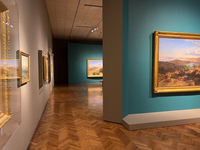
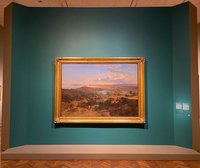
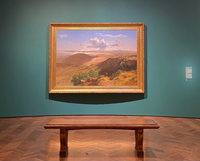
In the catalogue, indigeneity is mentioned only to illustrate two compositional decisions. It is used first in a discussion of the artist’s relationship to Tepeyac and second in the description of Velasco’s most notable work, The Valley of Mexico from the Hill of Santa Isabel (1875; Museo Nacional de Arte, Mexico City): “The episode in the foreground, with a woman carrying a basket of nopal pads and two young children, bridges past and present by evoking the indigenous communities that, though central to the nation’s history, had suffered persistent marginalization since the arrival of the Spanish” (86). This line of thinking extends to acknowledging the ongoing minoritization of Mexico’s sixty-eight officially recognized Pueblos Originarios (Native Peoples). However, their presence—both in Velasco’s images and in the catalogue—is neutralized: acknowledged, yet rendered passive or peripheral. This was also evident in the curatorial approach to the exhibition, which anchored the entire show around two large-scale paintings, created two years apart, depicting views of the Valley of Mexico from Santa Isabel Hill (figs. 3, 4, 5). While the more celebrated vista perfectly captures the othering logic of the Mexican Picturesque, the latter omits all human presence in favor of local fauna. This choice not only foregrounds regional biodiversity but also commemorates the Aztec origin myth in which the Mexica, guided by their war god Huitzilopochtli, were instructed to establish the center of their empire after witnessing an eagle devouring a serpent atop a cactus. These two vistas and their prominent placement in the exhibit successfully unite the central concerns of the political climate in which they were produced: namely, the promotion of the nation’s natural resources and the deep history at the cost of Indigenous erasure. However, in doing so, Velasco’s rhetoric is augmented through the exhibition’s central placement of both paintings, creating a narrative that privileges the flora and fauna’s historical symbolism over the lived presence of the Indigenized communities who had stewarded the land for centuries prior to European intervention. If the exhibition seeks to emphasize the global dimensions of Velasco’s circulation—grounded in his innovative translation of local allure through European pictorial conventions—then the fossilization and erasure of Native epistemologies emerge as a critical oversight, particularly for a project invested in tracing networks of scientific knowledge production.
As many formal analyses of Velasco’s work suggest, this framing reduces them to mere compositional devices or visual markers of scale, freezing their existence in an idealized past. It effectively erases their contemporaneous agency and their pivotal role in shaping the nation’s future cultural and identification politics. Most importantly, this aesthetic neutralization contributes to the broader sanitization of social difference actively promoted during Díaz’s dictatorship. Such efforts included state-backed programs of ethnic cleansing and racial mixing under the guise of mejorar la raza (“improving the race”). These policies were legitimized by Díaz’s inner circle, known as Los Científicos—an elite, Enlightenment-influenced oligarchy grounded in positivist thought, yet deeply invested in racist Indigenist ideologies. Within this context, Velasco’s work can be seen as an extension of these ideologies, whether consciously or not.
The core of these essentializing philosophies continues to have dire consequences for the very populations depicted, who require a magnifying glass to find their legacy quietly embellishing the magnificence of the Mexican landscape in Velasco’s paintings. In the spirit of resisting doing “the work of the object,” we must assess Velasco’s contributions to the global picturesque not through the lens of his presumed intentions—however benevolent or aligned with power as they may have been—but by situating his broader impact.
Conclusion
Overall, this catalogue represents a modest step toward a more critical conversation surrounding the work of a towering figure of Mexican art. Velasco’s induction into transnational and European art history expands the framework through which his legacy can be contextualized and affirms his rightful place within the tumultuous genealogy of global landscape painting.
The catalogue’s essays are well-researched and contribute biographical insights—such as the location of Velasco’s home near La Villita (Tepeyac Hill), the scientific applications of his geological studies, his participation in archaeological expeditions, his wide-ranging scientific interests, and the governmental acquisition of his works. They also highlight how Velasco is normally studied only in relation to Mexican cultural figures. With the possible exception of the engraver José Guadalupe Posada, no Mexican artist of the nineteenth century has received such sustained scholarly attention.
The catalogue also succeeds in presenting a well-rounded portrait of Velasco that supports his inclusion in the global canon of art history and renders him a worthy figure to help commemorate the diplomatic ties between both Mexico and the UK. However, it ultimately stops short of taking the bold leap that an international exhibition of this magnitude demands. While its discussions of Velasco’s international outlook, environmental sensibilities, and contributions to global formulations of picturesque and Romantic landscape conventions are compelling, the catalogue does little to interrogate critically his formal and iconographic choices beyond contemporary political and environmentalist concerns. Nonetheless, the exhibition represents a stunning offering that brings together an oeuvre seldom seen in the same room. It is also a very rare opportunity for audiences to engage with Mexican cultural production beyond Frida Kahlo and the usual modernist suspects.
This review does not argue for the revocation of Velasco’s legacy in the same way one might with Paul Gauguin (for his exploitation of colonial prerogatives) or Edgar Degas (for his racism and antisemitism). Rather, it should be read as a call to action: when marginalized artistic traditions are granted a global platform, that opportunity should not be limited to celebration alone. It should also serve as a mirror reflecting the forces that historically marginalized their production and as a tool for scrutinizing the complicity of the institutions and agents now responsible for their display. José María Velasco: A View of Mexico was neither a boring affair nor un-Mexican, as Jones suggests. It simply lacks the criticality that countering trite fantasies of a violent and exotic Mexico warrants.
Notes
[1] Jonathan Jones, “José María Velasco Review—Proudly Dull Mexican Was Wasted in Wonderland,” The Guardian, March 26, 2025, https://www.theguardian.com/.
[2] National Gallery, “José María Velasco: A View of Mexico,” press release, March 26, 2025, https://www.nationalgallery.org.uk/.
[3] Jones, “José María Velasco.”
[4] Art in Latin America was on view at the Hayward Gallery in the UK.
[5] See John Ruskin, The Complete Works of John Ruskin. Modern Painters 3, eds. Edward T. Cook and Alexander Wedderburn, vol. 5 (Allen, 1904).
[6] Michael Baxandall, Patterns of Intention (Yale University Press, 1987), 3.
[7] Sarah Gould, “The Polluted Textures of J. M. W. Turner’s Late Works,” Victorian Network 10 (2021): 82, https://doi.org/10.5283/vn.117.
[8] See Kirsten Pai Buick, “‘Race’ as Object Lesson: Objects of Rebellion,” in Object Lessons in American Art, ed. Karl Kusserow (Princeton University Press, 2023), 31–60.
[9] Emmanuel Ortega, “The Mexican Picturesque and the Sentimental Nation: A Study in Nineteenth-Century Landscape,” The Art Bulletin 103, no. 2 (2021): 131, https://doi.org/10.1080/00043079.2021.1847587.
[10] Reginald Horseman, Race and Manifest Destiny: The Origins of American Racial Anglo-Saxonism (Harvard University Press, 1981), 159.
[11] Stacie G. Widdifield, The Embodiment of the National in Late Nineteenth-Century Mexican Painting (University of Arizona Press, 1996), 92–93.