L’Empire du sommeil (The Empire of Sleep)
Reviewed by Gal VenturaGal Ventura
The Hebrew University of Jerusalem
Email the author: gal.ventura[at]mail.huji.ac.il
Citation: Gal Ventura, exhibition review of L’Empire du sommeil (The Empire of Sleep), Nineteenth-Century Art Worldwide 25, no. 3 (Autumn 2026), https://doi.org/10.29411/ncaw.2026.25.3.25.
This work is licensed under a Creative Commons Attribution-NonCommercial 4.0 International License  unless otherwise noted.
Your browser will either open the file, download it to a folder, or display a dialog with options.
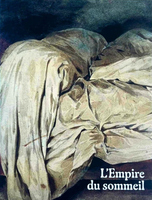
L’Empire du sommeil (The Empire of Sleep)
Musée Marmottan Monet, Paris
October 9, 2025–March 1, 2026
Catalogue:
Laura Bossi, ed.,
L’Empire du sommeil.
Musée Marmottan Monet, 2025.
248 pp.; 40 color illus.; essays; catalogue; chronological anthology; list of exhibited works; selected bibliography; index.
€39.00 (hardcover)
ISBN: 9782382032374
We all love life, and we all wish to live as long as possible; yet the third part of our lives, and sometimes even half, we give up to sleep.
—Marie de Manacéïne, 1897
This striking observation, formulated at the end of the nineteenth century, captures a paradox that continues to shape our understanding of sleep. Despite occupying a substantial portion of human life, sleep has long been treated as a natural and self-evident condition, one that seems to require neither explanation nor historical inquiry. As Marie de Manacéïne, a pioneer in the field of somnology—the scientific study of sleep—insisted: “What, then, is sleep? In what respect does a sleeping man differ from a waking man? . . . If we pay no more attention to sleep,” she concluded, “we thereby admit that a third part of our lives is unworthy of investigation.”[1]
Despite the force of her insight, the study of sleep remained, for much of the twentieth century, confined primarily to its physiological and psychological dimensions, largely excluded from the purview of the humanities and social sciences. In recent decades, however, scholars have argued that sleep cannot be understood in isolation from its social, cultural, and historical contexts. Rather than a purely biological state, it emerges as a complex, socially embedded practice shaped by norms, rituals, and structures of power.[2]
While this shift has significantly reshaped scholarly approaches to sleep, it has only belatedly begun to register within the exhibition context, where it has seldom surfaced as a sustained curatorial theme—most notably in the exhibition Le Sommeil ou quand la raison s’absente (Sleep, or When Reason Withdraws) in 1999[3]—and has rarely been the subject of large-scale curatorial attention. This absence is all the more striking given the ubiquity of sleeping figures in visual culture. Across media, collections, and historical periods, sleeping bodies appear with remarkable frequency, so much so that they risk passing unnoticed. It is precisely this tension—between visual abundance and curatorial neglect—that L’Empire du sommeil (The Empire of Sleep) takes up, approaching sleep not only as an iconographic motif but as a broader field of inquiry at the intersection of visual culture and science.
Held at the Musée Marmottan Monet in Paris, the exhibition presented a wide-ranging selection of over 130 works—paintings, sculptures, drawings, photographs, caricatures, illuminated manuscripts, and bas-reliefs—devoted to the theme of sleep. While the catalogue frames the exhibition within the “long nineteenth century”—an extended period roughly from the late eighteenth century to the early twentieth—the actual selection extends well beyond these limits. Works ranging from the late Middle Ages to the twenty-first century were also integrated into this rich display, creating a strikingly broad temporal spectrum.
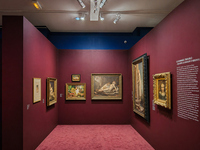
Curated by Laura Bossi, a neurologist and historian of science, and Sylvie Carlier, director of collections at the Musée Marmottan Monet, the exhibition explored the symbolic and allegorical dimensions of sleep; its role within both sacred and profane iconographies; and the influence of scientific, philosophical, and psychoanalytic approaches on its representation. It was structured thematically rather than chronologically, moving across a series of states and meanings: sleep as repose and intimacy; sleeping figures drawn from biblical traditions; mythological configurations linking sleep and death; sleep in relation to love and desire; the imaginative space of dreams; disturbed and pathological sleep; and forms of artificial or induced sleep, culminating in the intimate space of the bed.
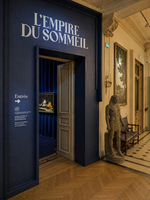
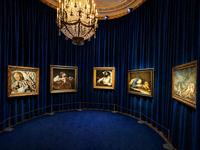
This conceptual framework was translated into spatial terms. The exhibition opened with a highly deliberate, almost theatrical gesture that shaped the viewer’s experience even before sleep appeared as an artistic subject. From the museum’s brightly lit, nineteenth-century bourgeois interior, with its pale walls and ornate ceilings, visitors entered a narrow, darkened passage that opened onto a dim, blue-draped space, evoking a bedroom and narrowing the field of vision (fig. 1). Here, sleep became legible not as an object but as a liminal state, suspended between consciousness and unconsciousness, activity and passivity, the biological and the social. These tensions took visual form in the five paintings set into the drapery, which emerged as luminous presences in the dimness (fig. 2). At first glance, they appeared strikingly similar: sleeping figures withdrawn into themselves. Yet this apparent uniformity soon gave way to difference, as each work articulated a distinct mode of sleep.
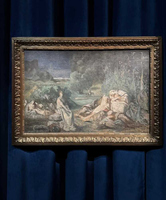
At the far right, Pierre Henri Puvis de Chavanne’s Sleep presented sleep as a collective, mythic condition: figures stretched out in nature merge into a muted, atemporal landscape (fig. 3). At the center, however, one figure remains awake, quietly unsettling the scene’s apparent harmony. Beside it, Giuseppe Antonio Petrini’s Saint Peter sleeping over his book, his fallen head interrupting reading and devotion, thus frames sleep as bodily weakness (fig. 4). Carolus-Duran secularizes the motif in a modern interior, where a man has also fallen asleep while reading (fig. 5). His slumped body suggests fatigue or convalescence rather than repose, linking sleep to healing and mortality. The early seventeenth-century girl on the left introduces a more intimate ambiguity: dozing mid-activity, she hovers between distraction and reverie (fig. 6). Here, sleep is not withdrawal but a fleeting lapse of attention. At the far left, in the room’s final painting, Claude Monet depicts his son asleep on a pillow, his body turned gently to the side, his flushed cheeks and half-open hand suggesting complete release (fig. 7). At first glance, the image seemed to belong with the others: another figure at rest, withdrawn from the world. Yet whereas the other figures fall asleep where they are—in nature, over a book, on a chair, or at a table—Jean Monet alone sleeps in a bed. His sleep is therefore not merely bodily but environmental, shaped by emerging norms, medical discourse, and practices of care, suggesting a modern, regulated understanding of sleep that the exhibition only partially explored.
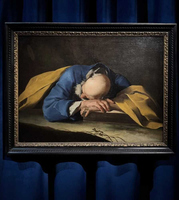
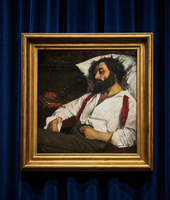
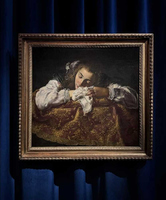
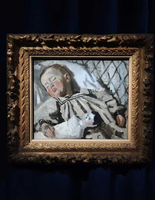
In his well-known essay on bodily techniques, Marcel Mauss argues that the ways in which bodies are used are not natural but learned, shaped by sociocultural practices. Sleep, no less than other gestures, varies across time and place: some bodies rest collectively or incidentally, while others depend on forms of “instrumental assistance,” including beds, pillows, and arranged environments.[4] From the early modern period onward, these differences became increasingly structured as sleep shifted from a shared, often public activity to a private, regulated practice within the domestic sphere.[5] As sociologist Simon Williams has shown, this transformation operates at several levels: as embodied experience, as social practice shaped by cultural meanings, gender roles, and life stages, and as an institutional phenomenon governed by schedules, surveillance, and medical discourse. Sleep, then, is not simply something the body does, but a practice organized by daily rhythms, spatial arrangements, and expectations about when, where, and how bodies may rest.[6] This became especially pronounced in the nineteenth century, when medicalization and modernization brought sleep (and sleeplessness) under new scrutiny through emerging norms of “sleep hygiene”: fixed hours, controlled environments, and attention to air, light, and spatial arrangement.[7]
This transformation was especially pronounced in relation to children. Infants’ sleep, once regarded as natural and largely self-regulating, became an object of sustained medical attention. Physicians, hygienists, and childcare manuals increasingly defined its proper conditions: where the child should sleep, in what position, for how long, under what sensory conditions, and according to which daily rhythms. Rather than following the “laws of nature” or the child’s needs, sleep was expected to obey the “laws of habit”: to be trained, structured, and regulated.[8] The sleeping child thus became a site of care, observation, and discipline, while the bed itself was reconceived as an instrument of hygiene, safety, and supervision. Within this framework, infant sleep was no longer regarded simply as a biological state but rather as a managed practice shaped by new forms of knowledge and by the growing authority of medicine within the domestic sphere.[9]
Monet’s image aligns closely with these developments. As in Berthe Morisot’s The Cradle (1872; Musée d’Orsay, Paris), where Blanche Pontillon lies in a crib,[10] Jean is shown in a modern metal bed: elevated, immobile, and consistent with emerging hygienic concerns. He wears a nightgown rather than swaddling; his head is uncovered and rests on a pillow, his body arranged in a posture that echoes contemporary medical prescriptions. Most strikingly, he holds a doll that functions as a transitional object, soothing him and structuring his passage into sleep, while recalling Charles Baudelaire’s reflections on toys as objects animated by the child’s inner life and imagination.[11]
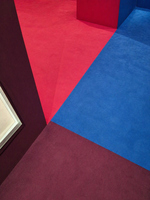
If Monet’s image crystallizes a distinctly modern, regulated form of sleep, the exhibition as a whole turned elsewhere. Rather than isolating this development, it approached sleep through mythic, religious, erotic, dreamlike, and pathological registers, relocating it from the ordered space of modern life to more unstable and ambiguous states. From this point on, the display unfolded as a sequence of color-coded rooms, each devoted to a different mode of sleep (fig. 8). This chromatic structure did more than guide the visitor’s movement; it organized sleep as a shifting network of states, from idyllic repose to disturbance, from metaphysical passage to artificial induction, rather than as a linear narrative.
The first thematic room, “Doux sommeil, bonheur pur” (“Sweet Sleep, Pure Happiness”), presented sleep as a state of harmony: the body appears soft, intact, and protected. Images of infants, children, women, and domestic animals showed figures asleep across a range of settings, from beds and interiors to gardens, park benches, and church interiors (figs. 9–11). Their recurrence subtly suggests an uneven distribution of vulnerability, associating certain bodies more readily with passivity, care, and exposure. As in the entrance space, sleep entails surrender: the body relinquishes control and depends on implicit forms of care. The idyll thus rests on an invisible structure of protection, sustained by underlying frameworks of attention and supervision.
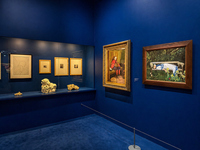
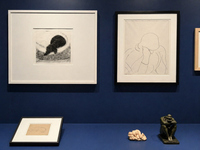
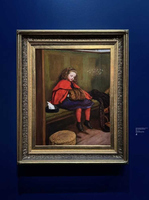
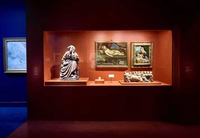
The next room, “Figures du sommeil dans la Bible” (“Figures of Sleep in the Bible”), shifted from the domestic to the sacred. Bringing together works from the Renaissance to the nineteenth century, it juxtaposed canonical images with lesser-known paintings, inviting both recognition and discovery (figs. 12, 13). Devoted to biblical and New Testament figures, this section presented sleep as a series of charged narrative moments: Eve created from Adam’s sleeping body, Noah overcome by drunken slumber, the sleeping Christ Child as a prefiguration of death, the apostles asleep at moments of spiritual trial, and the Dormition of the Virgin. Across these scenes, sleep appeared as a sensory suspension, a moral lapse, a threshold of resurrection, and, repeatedly, a state approaching death.
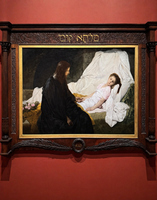
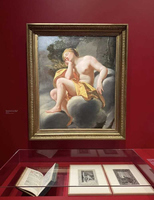
The proximity between sleep and death became explicit in the following section, “Hypnos et Thanatos” (“Hypnos and Thanatos”), where sleeping and lifeless bodies converged, at times becoming indistinguishable. The mythological brothers Hypnos and Thanatos, children of Nyx, embody this affinity: suspended in a dim, nocturnal space, their intertwined bodies and muted tones blur animation and stillness (fig. 14). The theme extended beyond allegory to literary figures such as Ophelia and to intimate deathbed portraits (fig. 15). Here the body is stripped of agency, poised where control and awareness recede, while sleep softens death into a visible, almost bearable form, leaving the viewer uncertain whether this is rest or its end.
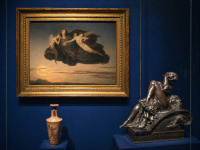
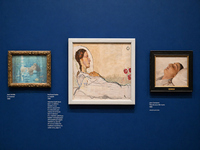
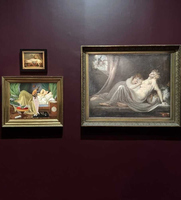
In the next section, “Le Sommeil et l’amour” (“Sleep and Love”), sleep became a condition of erotic encounters, staged through images of the sleeping Venus and mythological scenes involving Endymion, Psyche, and Antiope, in which sleep renders the body vulnerable to another’s gaze or desire (figs. 16, 17). Here, sleep does not protect the body but makes it available—to contemplation, approach, or intrusion—marking it as both vulnerable and idealized. Frequently feminized or otherwise rendered passive, the sleeping body becomes the object of a gaze that depends on its unawareness, reinforcing the unequal agency between observer and observed.
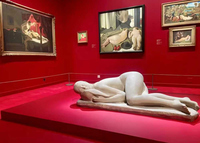
In the exhibition’s final sections, devoted to altered states of consciousness, from dreams, nightmares, and somnambulism to chemical or hypnotic induction, sleep emerged as psychologically unstable, entangled with hallucination, disturbance, and loss of control. No longer a withdrawal from consciousness, it becomes a liminal state in which waking and dreaming, past and present, subject and object begin to blur (figs. 18, 19). Like the opening pages of In Search of Lost Time,[12] these works evoked an experience akin to Henri Bergson’s durée, in which time unfolds as a continuous flow and perception loses its stable coordinates.[13] Dreams appear as both generative and elusive, producing images and narratives that never fully cohere. This instability is also epistemological: throughout the nineteenth century, dreams became objects of systematic inquiry—observed, recorded, and analyzed—yet continued to elude explanation. The exhibition thus staged a tension between inner experience and the effort to make it intelligible, revealing sleep as a precarious state between vision and disorientation, insight and danger.
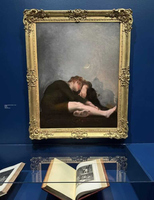
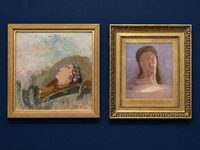
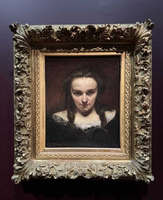
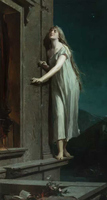
In “Le Sommeil troublé” (“Disturbed Sleep”), this precariousness became explicitly threatening. Sleep loses any residual sense of repose and becomes a site of intrusion, anxiety, and exposure (fig. 20). In some images, disturbance appears as an external force that weighs upon or invades the body, collapsing the boundary between dream and reality (fig. 21). Elsewhere, the threat turns inward: the sleeper hovers between sleep and waking, caught in inner dissociation, or is set into motion, exposed to risk and suspended between control and collapse (figs. 22, 23). Across these works, sleep exposes the subject to psychic, corporeal, and imaginary forces it can neither anticipate nor master.
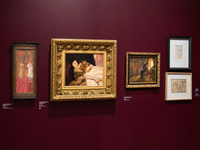
In the penultimate section, “Sommeils artificiels” (“Artificial Sleep”), sleep was deliberately produced through intoxication, narcotics, or hypnotic techniques (fig. 24). Rather than restoring equilibrium, these states sever the subject from the external world and intensify interiority, as suggested by contemporary discourses from neurological studies to Baudelaire’s Les Paradis artificiels (Artificial Paradises). The self appears at once anesthetized and hyper-receptive, as sensations and hallucinations blur dream, waking, and chemical experience. Sleep thus emerges as a constructed, experimental state that exposes the fragility of consciousness and the limits of subjective agency.
In the final section, “Au lit!” (“To Bed!”), the bed emerged as an intimate threshold where presence and absence, body and trace, interiority and exposure converge (figs. 25, 26). Images of unmade or empty beds foregrounded a paradoxical presence-in-absence: the body had vanished, yet its imprint persists in folded fabric and disordered sheets, registering the trace of a body just gone (fig. 27). Spanning early nineteenth-century paintings to contemporary works, these images render the bed as a space of transition between night and day, self-immersion and reentry into the world. Unlike Monet’s regulated site of care and protection, it becomes a surface of absence and memory. Like the disoriented awakenings described by Proust, it reveals the everyday as unstable: a space where sleeping, waking, and inhabiting one’s own body remain uncertain, fragile, and deeply subjective.
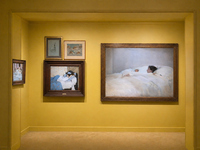
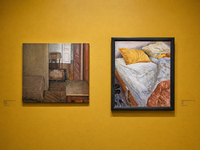
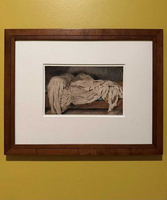
The exhibition’s richness was matched by its generously illustrated and conceptually ambitious catalogue, which approaches sleep through the lenses of art history, medicine, psychology, music, and cinema, spanning a broad historical range. Laura Bossi frames sleep as a persistent motif in Western culture; Jacqueline Carroy traces the transformation of dreams into objects of scientific inquiry; Isabelle Arnulf and Jean-Baptiste Maranci situate sleep disorders between artistic representation and medical classification; Ivan Alexandre follows the lullaby from embodied practice to abstract musical form; and Dominique Païni considers sleep in cinema as a limit case that disrupts narrative and reconfigures spectatorship. Seen alongside the exhibition, these essays sharpen the project’s broader intellectual stakes, presenting sleep not as a stable or purely physiological condition, but as a shifting cultural construct: refuge and abandonment, repose and anxiety, bodily necessity and imaginative excess. The exhibition gave this multiplicity spatial form, bringing together works from different periods and media, canonical and lesser-known images, and creating an experience that moved between recognition and discovery.
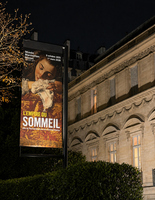
Yet this very openness also produced a certain indeterminacy: the boundaries between sections were porous, and individual works could have plausibly belonged to more than one category. Broader distinctions of period, gender, class, and age remained largely undifferentiated, so that sleep sometimes appeared as a general, even universal condition rather than a historically specific practice shaped by modern regimes of discipline and domestic life. This was not merely a curatorial limitation, however, but also a reflection of the subject itself, which resists stable classification and unsettles conceptual boundaries across images, periods, and contexts. Despite and partly because of this indeterminacy, the exhibition succeeded in making visible the extent to which sleep has shaped Western visual culture. Thoughtful, visually compelling, and conceptually open, it invited visitors to reconsider sleep not as a neutral or passive state, but as a charged and multifaceted condition. I emerged from the exhibition late at night (fig. 28), sharply awake—an apt reminder that, once turned into an object of thought, sleep becomes anything but restful.
AI Disclosure Statement
AI-assisted image editing tools were used on original photographs taken by the author to remove background visitors from crowded exhibition spaces. No AI-generated visual content was introduced. AI tools were not used to research, inform, or draft any portion of the written text.
Notes
[1] Marie de Manacéïne, Sleep: Its Physiology, Pathology, Hygiene, and Psychology (Walter Scott, 1897), 1–4.
[2] See, for example, Brian Taylor, “Unconsciousness and Society: The Sociology of Sleep,” International Journal of Politics, Culture, and Society 6, no. 3 (1993): 463–71, https://doi.org/10.1007/BF01415970; Simon J. Williams, Sleep and Society: Sociological Ventures into the (Un)known (Routledge, 2005); Roger A. Ekirch, At Day’s Close: Night in Times Past (W. W. Norton, 2005); Gal Ventura, Hush Little Baby: The Invention of Infant Sleep in Modern France (McGill-Queen’s University Press, 2023).
[3] Le Sommeil ou quand la raison s’absente (Sleep, or When Reason Withdraws), Musée Cantonal des Beaux-Arts, Lausanne, 1999. Exhibition curated by Jörg Zutter, Catherine Lepdor, and Caroline Nicod; accompanied by a catalogue of the same title (Musée Cantonal des Beaux-Arts, 1999).
[4] Marcel Mauss, “Techniques of the Body,” in Sociology and Psychology: Essays, ed. Ben Brewster (Routledge & Kegan Paul, 1979), 95–123.
[5] Norbert Elias, The Civilizing Process, trans. Edmund Jephcott (Blackwell, 1994), esp. 3–41, 136–39, 245–59; Roger A. Ekirch, “The Modernization of Western Sleep: Or, Does Insomnia Have a History?,” Past & Present 226, no. 1 (2015): 149–92, https://doi.org/10.1093/pastj/gtu040; Wolfgang Schivelbusch, Disenchanted Night: The Industrialization of Light in the Nineteenth Century (University of California Press, 1988), esp. 179–89; Alain Corbin, ed., Les douze heures du jour et de la nuit: Histoire des rythmes et des activités (Flammarion, 1991), esp. 187–90; Ventura, Hush Little Baby, esp. introduction and chap. 1.
[6] Simon J. Williams, “Dormant Issues: Towards a Sociology of Sleep,” in Exploring the Body, eds. Sara Cunningham-Burley and Kathryn Backett Milburn (Macmillan, 2001), 137–60.
[7] See, for example, Jean-François Dancel, Hygiène: nouveaux préceptes pour diminuer l’embonpoint sans altérer la santé (Adrien Delahaye, 1867), 18, 40.
[8] On “laws of nature,” see Jean-Charles Desessartz, Traité de l’éducation corporelle des enfants en bas âge (Croullebois, 1799), 135. On “laws of habit,” see Louis Girault, Conseils aux jeunes mères, aux nourrices et aux sages-femmes, pour éviter la mortalité fréquente chez les enfants en bas âge (Adrien Delahaye et E. Lecrosnier, 1882), 38.
[9] Ventura, Hush Little Baby, 27–45, 59–68.
[10] For a fuller discussion of Morisot’s The Cradle and the medicalization of infant sleep, see Gal Ventura, “The Cradle: Berthe Morisot and the Medicalization of Babies’ Sleep,” The Art Bulletin 104, no. 2 (2022): 89–117, https://doi.org/10.1080/00043079.2022.2000270.
[11] Gal Ventura, “Jean Monet Sleeping: Medicalisation, Dreams, and Transitional Objects,” Social History of Medicine 36, no. 1 (2023): 80–109, https://doi.org/10.1093/shm/hkac059; Charles Baudelaire, “Morale du joujou,” in Œuvres complètes, vol. 2, ed. Claude Pichois (Gallimard, 1976), 581–86.
[12] Marcel Proust, Du côté de chez Swann (Grasset, 1913), 3–5.
[13] Henri Bergson, Essai sur les données immédiates de la conscience (Félix Alcan, 1889), 74–78.