Transgressive Masculinity: Virility, Violence, and Eroticism in William Bouguereau’s Dante and Virgil in Hell
by Viktoriia BazykViktoriia Bazyk is a PhD candidate at the University of Vienna and a faculty member in the university’s Department of Art History. Her dissertation, “Constructing Hypermasculine Masculinities: The Envois de Rome and the Academic Male Nude in Mid-Nineteenth-Century France,” explores the ambivalent status of the male nude in nineteenth-century French painting, its role in constructing ideals of masculinity amid the sociopolitical instability of the mid-nineteenth century, and the impact of state educational institutions on these processes of construction. Her research is supported by the Vienna Doctoral School of Historical and Cultural Studies and the Austrian Academy of Sciences. In 2024, she was awarded the Sir-Ernst-Gombrich-Nachwuchspreis for her master’s thesis on transgressive masculinity in William Bouguereau’s Dante and Virgil in Hell.
Email the author: viktoriia.bazyk[at]univie.ac.at
Citation: Viktoriia Bazyk, “Transgressive Masculinity: Virility, Violence, and Eroticism in William Bouguereau’s Dante and Virgil in Hell,” Nineteenth-Century Art Worldwide 25, no. 3 (Autumn 2026), https://doi.org/10.29411/ncaw.2026.25.3.3.
This work is licensed under a Creative Commons Attribution-NonCommercial 4.0 International License  unless otherwise noted.
Your browser will either open the file, download it to a folder, or display a dialog with options.
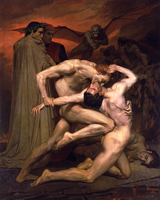
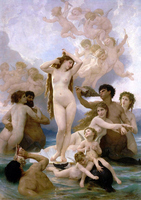
In 1850 William-Adolphe Bouguereau (1825–1905), a twenty-five-year-old exemplary student at the École des Beaux-Arts (School of Fine Arts), shocked both his teachers and Paris Salon goers by exhibiting a large-scale painting inspired by Dante Alighieri’s (1265–1321) epic poem Inferno (1314), prominently foregrounding two excessively muscular, damned men, engaged in ferocious single combat. Both in terms of its spectacular portrayal of powerful and dangerous masculinity and its unorthodox subject matter, associated with the Romantic movement, Dante and Virgil in Hell (fig. 1) remained unique in the oeuvre of the artist, who later became known for images of mythological female nudes and sentimental depictions of women and children (fig. 2).[1] While ensuring his financial prosperity, these paintings at the same time brought Bouguereau a certain notoriety as an artiste pompier (a derogatory term in the nineteenth century for a history painter), leading to his erasure from the art historical discourse of most of the twentieth century. Alongside his fellow Salon stars, the artist was rediscovered many decades after his death, in a series of exhibitions in Paris, Montreal, and Hartford, Connecticut, in 1984–85, marking the first comprehensive show of his oeuvre, of which Dante and Virgil was also part.[2] This early work went on to play a key role in reacquainting modern viewers with Bouguereau, by appearing in a number of exhibitions in France, Japan, Spain, Germany, the United States, and Italy, dedicated to topics ranging from nineteenth-century Salon painting to so-called Dark Romanticism to religious art.[3]
Though Dante and Virgil in Hell gradually became one of Bouguereau’s more recognizable paintings, the published research on it long remained limited to short catalogue entries and paragraphs in books and articles, mostly expounding on the work’s style and iconography as well as Bouguereau’s influences and Salon strategy.[4] In the late 2010s, however, the discussion around the painting shifted in a new direction: Writing for the catalogue of the Munich exhibition of 2017, Gut Wahr Schön (Good True Beautiful), Nerina Santorius examined some of the physical aspects of the painting’s protagonists, focusing in particular on the depiction of their mouths and their connections to oral aggression, monstrosity, and guilt.[5] In the same catalogue, Melanie Ulz considered Dante and Virgil against the backdrop of changing ideals of nineteenth-century masculinity and interpreted the exaggerated musculature and poses of the damned as Bouguereau’s attempt to reinvigorate the academic male nude by detaching it from the classical ideal.[6] Briefly mentioning the work in Looking at Men (2018), Anthea Callen described it as follows: “In this extraordinarily powerful composition, characteristic of his rapidly abandoned early virile style, Bouguereau achieves in his fighting figures both a violently erotic confrontation and a brilliant tour de force of anatomical painting.”[7]
This turn to discussions of body and gender reflects the ever-increasing interest in the male nude as a form of artistic construction of masculinity, beginning in the 1980s. While Margaret Walters and Abigail Solomon-Godeau’s pioneering works on the subject framed the early 1800s as the age of the gradual decline of depictions of the male nude, more recent contributions, such as Callen’s publications and the interdisciplinary conference “Hard Bodies” (2025), demonstrated the continued relevance of the male nude throughout the long nineteenth century and beyond.[8] Concentrating primarily on the beginning and the end of that period, this research largely omitted mid-century academic nude painting, produced in great quantities by the students and graduates of the École des Beaux-Arts and displayed at the Salons of the Second Republic and the Second Empire. Bouguereau’s Dante and Virgil is a perfect case study to fill this gap in regard to the hypermasculine male nude, enthusiastically embraced and abruptly abandoned by many young artists of this period.[9]
This article examines Bouguereau’s painting through the lens of masculinity studies, reading it as a destabilizing commentary on accepted standards of nineteenth-century masculinity. I argue that in his fighting group Bouguereau constructed a highly physical, violent, and sexually charged vision of manhood that was aesthetically subversive, in that it ran counter to contemporary academic ideals for the representation of the male nude, and socially subversive in its representation of male interaction as a ferocious, bestial struggle with homoerotic overtones. The painting’s dangerous masculinity is narratively framed as sinful, transgressive, and worthy of condemnation. Visually however, the protagonists of the narrative are valorized through purely artistic means such as lighting, color, and technical virtuosity in rendering the nude, and staged as figures of identification for the viewers. This contradiction dilutes the moral message about proper and improper masculinity that, I argue, was intended by the artist, resulting in an ambivalent image that attracts the viewers’ admiring gaze to the spectacular male bodies on display even as it tries to caution them against the dangers of such ambiguous attractions.
Bouguereau’s Inferno: Schicchi and Capocchio Between Dante’s Poem and the Paris Salon
Originally listed in the livret (catalogue) as L’enfer du Dante (chant XXXe) (Dante’s Inferno [Canto 30]), Bouguereau’s second Salon submission was ambitious in both scale and content.[10] The nearly three-meter-tall oil painting shows a little-known scene from canto 30 of Dante’s Inferno: While traveling through the underworld, Dante and Virgil witness a savage attack of the impostor Gianni Schicchi on the fraudulent alchemist Capocchio, both men condemned to eternal suffering in hell for their sins.
But no Theban crazed with rage –
or Trojan – did ever seem as cruel
in rending beasts, much less human parts,
as did two pallid, naked shades I saw,
snapping their jaws as they rushed up
like swine charging from an opened sty.
The one came at Capocchio, set its tusks
into his neck, then dragged him
so his belly scraped the rock-hard ground.
And the Aretine, who stood there, trembling,
said to me: “That demon’s Gianni Schicchi,
and in his rabid rage he mauls the others.”[11]
While Dante’s description of the incident has a comedic edge, Bouguereau opts for sensual pathos. He depicts Schicchi and Capocchio as nude musclemen embroiled in a brutal combat in the foreground of a crowded pictorial space. The redheaded aggressor attacks the other sinner from behind, forcefully pressing his knee into his victim’s back, digging his claw-like fingers into his side, and sinking his teeth into his throat. Forced to his knees, Capocchio tries to free himself from the choke hold by pulling at Schicchi’s hair, to no avail. Although the faces of the damned are full of intense emotion, their bodies communicate the drama of the scene much more eloquently: As their herculean torsos turn in a powerful circular motion, their veins bulge and their muscles strain, and the prominent anatomical distortions—long limbs, massive upper bodies, and especially Schicchi’s extended, dragon-like neck—are emphasized by the momentum of the combat. The precise drawing and sophisticated modeling highlight every indentation and protrusion on the bodies, while the nuanced coloring of the flesh gives the nude skin an untarnished, idealized appearance that belies the gritty nature of the struggle. As if lit by a spotlight, the seemingly supernatural figures stand out against the dim palette of the painting, their contrasting hair colors evoking hellfire, soot, and ash. Although Bouguereau’s brushwork remains decidedly academic, which is to say, polished away to near invisibility, the combination of ostentatious anatomy, sculptural plasticity, and expressive lighting and coloring turns the clash of the nude bodies into a veritable spectacle.
Dante and Virgil, positioned on the left directly behind the fighting damned, observe the struggle with horror: the latter covers his mouth and turns away in dismay while the former continues to stare in morbid fascination. The two groups of men are both visually and thematically opposed: The damned shamelessly show off their nude bodies in vigorous movement, whereas the stiff and motionless poets are covered from head to toe, their voluminous but orderly garments increasing the statuesque effect of the figures and hiding any sign of the bodies beneath. In terms of composition, Dante and Virgil adhere to a strict vertical line, in sharp contrast to the amalgamation of diagonals and curves underlying the group of fighters. Finally, while the damned embody animosity and bloodlust, Dante embraces Virgil with care and friendship. Mind and body, order and disorder, love and hatred are thus visually articulated via this opposition.
Bouguereau chooses a tight frame which he fills completely, obfuscating the spatial relationships of the infernal scenery. On the right, there is another man writhing in agony on the ground behind the fighting group. This figure, likely representing Griffolino d’Arezzo—“the Aretine,” who introduces Schicchi to Dante and Virgil—appears to counterbalance the protagonists: While they are shown parallel to the picture plane, he is located perpendicular to it and foreshortened. His face distorted in pain and his sallow skin tone resembling the earthy grey color of the ground, the sinner is positioned at the bottom of a falling diagonal line that begins with Dante and Virgil and cuts through Schicchi and Capocchio. Remarkably, in contrast to the other figures’ unobtrusive hairstyles, he is wearing sideburns, which first became broadly fashionable in Western Europe in the first half of the nineteenth century.[12]
In the shadowy background on the right, a swarm of the damned floating over the fiery pits of hell can be glimpsed. In this group of approximately nine artfully interconnected nude figures Bouguereau once again demonstrates his virtuosity in the depiction of human anatomy. Veiling the painful reality of hellish torment, more convincingly visualized in the suffering fallen sinner, their somewhat theatrical poses are seemingly designed to show bodies in all possible aspects, positions, and variations. Unlike the main characters, however, the idealized background nudes, most of which also appear to be male, do not impress by their muscularity, thus serving as a visual foil to Schicchi and Capocchio in terms of masculine-body ideals.
The final touch—and the only element reminiscent of Dante’s grotesque humor—is the winged flying demon supervising the events from the glowing red sky. His impish grin forms a stark contrast to the high drama of the rest of the painting. The artist signed his work in the bottom right corner, creating the illusion of the signature inscribed inside a crack of the rocky ground of hell, its fiery orange easily mistaken for one of the smaller flames.
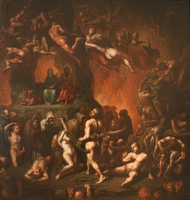
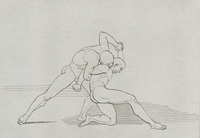
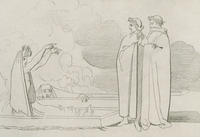
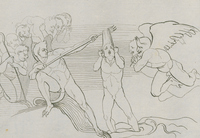
Bouguereau drew inspiration from a number of other artists, both his contemporaries and the old masters, belonging to different artistic schools. The general idea for the painting may have been inspired by Dante’s Inferno by Paul-Marc-Joseph Chenavard (1807–95) (fig. 3), which was exhibited at the Salon at the time of Bouguereau’s arrival in Paris in 1846: The older artist, whose work featured a similarly extravagant corporeality and earthy color palette, had included an episode with one sinner biting another on the nape of the neck in the bottom right corner, albeit with a much less dramatic staging involving no combat.[13] The combat itself, the Dante and Virgil group, and the demonic guard appear to have been influenced by John Flaxman’s (1755–1826) prints illustrating the Inferno (figs. 4, 5, 6). While Bouguereau’s profile views of the wrestling figures, the gymnastic nature of the wrestling, and the exaggerated muscularity of the wrestlers are similar to Flaxman’s figures, Bouguereau took a step away from Flaxman’s imagery by moving the bite from the nape of Capocchio’s neck in Flaxman’s Imposters (see fig. 4) to his throat, which made for a much more intimate confrontation. Bouguereau’s Dante and Virgil, on the other hand, look like reversed versions of the poets as depicted in Flaxman’s Fiery Sepulchres (see fig. 5).
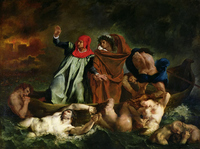
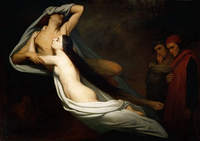
It is not surprising to also find in Bouguereau’s painting subtle references to Eugène Delacroix’s The Barque of Dante (fig. 7), exhibited at the Salon of 1822 and acquired by the state for the Musée du Luxembourg. Rather than emulating the painting’s bright colors and dynamic brushstrokes, Bouguereau instead joined Delacroix in his appreciation of Michelangelo Buonarroti (1475–1564), adopting the old master’s opulent physicality and citing a number of his works in the supporting figures: The swarm of lost souls in Bouguereau’s background, for example, seems to reference Michelangelo’s Last Judgment (1536–41; Sistine Chapel, Vatican City), while some of the latter’s sculptures clearly served as templates for Bouguereau’s individual figures. Most notably, the sinner turning away from the viewer on the right side of Dante and Virgil closely resembles Michelangelo’s The Rebellious Slave (1513) in the Musée du Louvre, whose counterpart, The Dying Slave (1513–16), is echoed in the pose of the brightly lit sinner on the left in Delacroix’s The Barque of Dante. Next to the latter, another damned man is forcefully biting into the wood of the boat, his teeth visible and his face distorted into a grotesque grimace by his effort. By comparison, the bite in Bouguereau’s painting—central to the composition and the narrative yet at the same time hidden behind Capocchio’s chin—comes across as rather subdued. Finally, the couple at the top of the swarm of the damned in Dante and Virgil is reminiscent of Ary Scheffer’s (1795–1858) Paolo and Francesca (fig. 8), with which Bouguereau’s painting also shares the general arrangement of foregrounding the pair of sinners and moving Dante and Virgil to the margins to serve as commentators.[14]
This brief outline of the artistic influences on Dante and Virgil attests to their eclecticism. While one might expect references to Flaxman, Chenavard, and Scheffer in a work by a young academic artist such as Bouguereau, his aiming to imitate Delacroix and Michelangelo might at first seem surprising.[15] Hélène Jagot explained Bouguereau’s uncharacteristic flirtation with a dark and eye-catching Romantic aesthetic as an attempt to aggressively draw attention to himself at the Salon.[16] One year earlier his classicizing and more restrained Salon debut had been ignored by the press; he may have wanted to make sure that his second entry would be noticed among the thousands of other artworks, and perhaps even cause a small scandal. Without completely ignoring his academic training, the artist turned for inspiration to less conventional artistic and literary sources. He intended to demonstrate his proficiency as a history painter by displaying the breadth of his art historical knowledge as well as his stylistic flexibility. On the one hand, the resulting odd collage of art historical citations and influences made the painting more sophisticated, while on the other, such an opportunistic condensation of visual references unintentionally revealed the artificiality of the artwork and the inexperience of its creator, capable of alienating a discerning audience as much as attracting it.[17] The audacious painting, which seems to break with the established rules of the artist’s academic milieu, is thus exposed as a carefully designed product made in accordance with the increasingly commercialized and sensationalized nature of the Salon.
Exhibited at the same Salon as the famously controversial Burial at Ornans by Gustave Courbet (1819–77) (1849–50; Musée d’Orsay, Paris), Bouguereau’s Dante and Virgil likely arrived several decades too late to cause a real scandal. But it did cause conflicting reactions. The only critic to express unreserved admiration was Théophile Gautier (1811–72):
M. Bouguereau’s Gianni Schicci [sic] is a fierce strapping fellow, if the painting and poem are to be believed. . . . Gianni Schicci [sic] throws himself at Capocchio, his rival, with a strange fury, and between the two combatants, a battle of muscles, nerves, and tendons ensues, from which M. Bouguereau emerges with honor. There is in this canvas a rawness and strength—strength, a rare quality![18]
A reviewer writing for La gazette de France was similarly impressed by the depiction of the combat: “There is a verve, an astonishing energy in the pantomime of these furious phantoms biting, tearing at each other, and seemingly intent on annihilating one another.”[19] Edmond Thierry, however, dismissed the painting as merely “a bold and vigorous study,” noting that Schicchi’s anatomy seemed bewilderingly distorted.[20] Augustin-Joseph Du Pays and Claude Vignon complained about the prevalence of shocking and violent imagery at the Salon, citing Bouguereau’s work as one of the biggest culprits.[21] According to Du Pays, such Dantesque visions of hell were unsuitable for fine art, and he felt the artist should have looked “elsewhere for pretexts for an anatomical painting that was less devilish.”[22]
Bouguereau took the negative criticism to heart and subsequently avoided both such drastic subject matter and such unorthodox male nudes. In 1891 he commented on his decision in an interview:
Ah! Here is my Angel of Death. Opposite, you will find my second painting, Dante’s Inferno. As you can see, it differs from my works today. It is a bold and violent academic study. . . . If I had continued to create similar paintings, it is likely that, like this one, they all would have remained with me. What can you do? One must align with the tastes of the public, and the public only buys paintings which it finds pleasing. That is why, over time, I changed my manner of working.[23]
After this failed experiment Bouguereau increasingly focused on sentimental genre paintings and easily comprehensible mythological pastorals that sold well but did not shield him from the disdain of many critics.[24] Mostly seen as a youthful blunder by Bouguereau’s admirers, Dante and Virgil was never sold during his lifetime and remained in the private collection of his heirs until its donation to the Musée d’Orsay in 2010.[25]
Interestingly, none of Bouguereau’s reviewers mentioned his extensive artistic influences in either a positive or negative way: Most of the praise and disapproval was concentrated on the ugliness and savagery embodied by the distorted, battling damned, the rest of the figures receiving nary a mention. Regardless of the critics’ personal opinions about the main group, none of them failed to describe the fighting men in elaborate detail, unwittingly proving the efficacy of Bouguereau’s macabre spectacle that manages to capture viewers’ interest to this day. While Dante and Virgil might have failed to stand the test of time by virtue of its formal artistic merits or art historical allusions alone, I would like to argue that its real strength lies in its compelling visual exploration of proper and improper masculinities. As the truly creative elements of the painting, Schicchi and Capocchio appear to be the bearers of its central idea: They embody a hypervirile, violent, and erotically charged masculinity that transgressed contemporary models of manhood defined by the rule of mind over body. In particular, the fighting group violated the refined aesthetic ideal of the male nude, which was propagated by the Académie des Beaux-Arts (Academy of Fine Arts) for the better part of the nineteenth century.
Departing from the Academic Ideal: The Michelangelesque Nude as a Representational Mode of Transgressive Virility
Since mastery of the male nude was essential to history painting, its study was a core exercise at the Académie Royale de Peinture et de Sculpture (Royal Academy of Painting and Sculpture) from its founding in 1648. Great emphasis was placed on the drawing classes, in which students were required to make studies from a live model (so-called académies). The École des Beaux-Arts, restructured in 1817 following the creation of the Académie des Beaux-Arts, inherited this tradition, and its importance grew dramatically with the introduction of a series of competitions focused on the nude figure as the foundation of the new curriculum: From the admission exam up to the competition for the Grand Prix de Rome, the evaluation of academic success involved demonstrating a proficient knowledge of male anatomy and competence in its depiction.[26] As Susan Waller has demonstrated, this educational system based on contests and awards, including monetary prizes, incentivized students to devote more time to studying the nude model, leading to a marked increase in both the frequency and the duration of life‑drawing sessions at the École as well as in the private ateliers in the first half of the nineteenth century.[27]
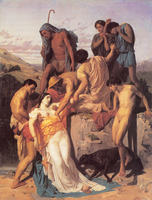
It is therefore no surprise that both Dante and Virgil and Shepherds Find Zenobia on the Banks of the Araxes (fig. 9)—Bouguereau’s two major works from 1850, his fourth year as a student at the École des Beaux-Arts—rely on the male nude for their impact. However, each utilizes it to construct distinctly different aesthetic ideals of masculinity. Although Shepherds Find Zenobia—Bouguereau’s third and ultimately successful submission to the competition for the Grand Prix de Rome—skillfully depicts men of different ages, body types, skin tones, and postures, the sinuous nude youth on the right, easing himself down from the rock, is the one who rivals the female protagonist for attention. Lauded in the press reviews as the painting’s finest feature,[28] this graceful, androgynous ephebe embodies a neoclassical ideal of masculine beauty, which came to prominence in French elite visual culture in the 1790s–1810s and persisted in the academic discourse and education system well into the second half of the nineteenth century, despite gradually going out of fashion in the broader art world.[29] The aesthetic principle underpinning this image of masculinity was the so-called beau idéal—a generalized, purified form that suppressed individual minutiae and ostentatious anatomical detail and was articulated through a particular canon of the human figure modeled on the art of classical antiquity. Shaped by Johann Joachim Winckelmann’s (1717–68) writings on ancient Greek sculpture, which had been translated into French in the 1760s, and further elaborated in the treatises of Victor Cousin (1792–1867), Théodore Jouffroy (1796–1842), and Antoine Chrysostôme Quatremère de Quincy (1755–1849) in the first half of the nineteenth century, this concept proved to be profoundly influential for the development of the academic doctrine in France.[30] Within this paradigm, the body was regarded chiefly as a vessel for the spirit; accordingly, features that emphasized excessive corporeality, such as veins, tendons, and muscles, were frowned upon.[31] The balanced athletic physique of the Apollo Belvedere, whose muscles, in the words of Winckelmann, “manifest themselves more to the feeling than to the sight,” was celebrated as the canonical embodiment of the beau idéal.[32] Conversely, herculean bodies with exaggerated musculature were often judged by these scholars to be turgid, unhealthy, or lacking in “moral” and “intellectual” beauty.[33]
Since Shepherds Find Zenobia was intended to impress an academic jury first and foremost, Bouguereau gave his version of the ideal ephebic nude pride of place in the painting. By contrast, in Dante and Virgil, created for the Salon, he resolved to transgress the mid-nineteenth-century boundaries of academic aesthetics and body ideals: Here, the “battle of muscles, nerves, and tendons” is prominently staged in the foreground and emphasized by lighting and color, whereas more lithe sinners can barely be glimpsed in the background. The one seen from behind, striking an elegant pose that resembles that of a model posing for an académie and thus undermining the impression of hellish torment, is another quintessential example of the nineteenth-century academic beau idéal—and yet he is quite literally dwarfed and overshadowed by the main figures. The ideal nude, which has served as the foundation of the most esteemed art in France for more than half a century, is now pushed to the margins of the composition.
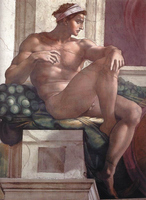
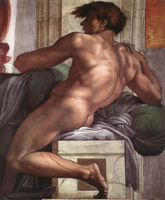
Instead, Bouguereau seems to elevate the grandiose nudes in the style of Michelangelo, whose “extravagant ideas and bizarre tastes,” in the opinion of Étienne-Jean Delécluze, were firmly associated with antiacademic Romanticism.[34] The artist endows Schicchi and Capocchio with impressively sculpted physiques, not shying away from occasional anatomic distortions and exaggerations that are emphasized by their artfully intertwined poses. The two giants are wedged together like two infernal ignudi (seated male nudes on the Sistine Chapel ceiling) (figs. 10, 11), their heads caught in something of a yin-and-yang configuration. The terrifying struggle aims to evoke the concept of terribilità (terribleness)—the sublime intensity and greatness of style that renders the viewer awestruck, but in this case is equally to be understood in a more literal manner as the terrible violence of hell. At the same time, while the painting clearly signals its sources, it presents a version of the Michelangelesque nude as envisioned by a student of the École des Beaux-Arts, whose training was strongly shaped by academic aesthetics. The relatively strict arrangement of the group in profile views goes against Michelangelo’s preference for inventive viewpoints, sophisticated rotations, and radical foreshortenings. His poetic idealization of the human body is replaced in Dante and Virgil by a fidelity to nature that anticipates the hypernaturalism of Bouguereau’s mature and late work. In the end, compared to Michelangelo’s figures that appear to be demigods hailing from the realm of imagination, Schicchi and Capocchio look like real men, cast by the artist to play the roles of the damned in his staging of the Inferno.
Nevertheless, the specific word choices in the reviews of Dante and Virgil indicate that the critics associated the painting with Michelangelo’s style: It was described as “terrible,” “vigorous,” “bold,” and “furiously staged,” full of “power,” “roughness,” and “verve”—epithets that had been attributed to Michelangelo in writing about art ever since Giorgio Vasari (1511–74) and whose gendered connotations had traditionally served to construct a mythos of pronounced, virile masculinity around the artist’s manner.[35]
As an artistic quality, virility was ascribed to Michelangelo more than to any other artist: from the muscularity of his figures, to the precision of his drawing, to the terrible power of his style—everything Michelangelo created in painting, sculpture, and architecture appeared to be masculine-coded to the highest degree. He was therefore regarded as an icon of virile creativity, and the art discourse around the benefits and disadvantages of emulating him abounded with explicit and implicit commentary on masculinity and male sexuality. For example, the classicists declared him “the most obscene of the great modern artists,” “too fervent for tender emotions,” lacking any “grace in all its virginity,” and “perverting” artistic schools.[36] Quatremère de Quincy, the Academy’s perpetual secretary from 1816 to 1839, criticized Michelangelo for his excessive use of “muscular science,” which, according to him, foregrounded a too-material—indeed “animal”—view of the human body and made the artist and his viewers lose sight of “the moral man.”[37]
Such commentary was, in contrast, derided by the likes of Delacroix:
It is hardly surprising that mediocre artists despise this savage genius. They cannot help hating this terrible style, which subjugates them in spite of themselves; they lash out at him out of a deep sense of their own impotence, and then denounce the inaccuracies and oddities, the fruits of his caprice.[38]
Writers like Stendhal (1783–1842) and Gautier expressed admiration for the primitive energy and unrestrained freedom of Michelangelo’s masterpieces, perceiving a feeling of something pagan in how his art seemingly allowed the body to triumph over the soul.[39] Thus, while the academic classicists advocated moderation and temperance in all aspects of art and advised against imitating Michelangelo, the Romantic proto-avant-gardists embraced the subversively virile qualities attached to the artist in order to create around themselves an aura of energetic manliness and (hetero-)sexual potency and distance themselves from academic art, which was perceived as weak, mediocre, and impotent in the broadest sense.[40]
It is hardly a coincidence that these two opposing views on ideal masculinity correspond to the two male couples depicted by Bouguereau in Dante and Virgil: The stoic poets, modeled after Flaxman’s austere drawing (see fig. 5), seem to stand for the classical Academy, casting a condemning glance at a rather accurate figuration of the “terrible style, which subjugates,” embodied in the Michelangelesque main group. In addition to juxtaposing competing aesthetic ideals of the male nude, the painting thus appears to incorporate the agents who produce them and to visualize the modalities of their production. Which side, then, does the artist ultimately align with? What model of masculinity does the painting advance?
In light of Bouguereau’s dialogue with Michelangelo’s oeuvre and the compositional prominence of hypermuscular male figures in Dante and Virgil, some scholars view the young artist as a romantically inclined admirer of the old master, rebelling against the academic norm and trying to revitalize the antiquated subgenre of the academic nude.[41] This maverick image, however, clashes with contemporary accounts of the artist as a pious, disciplined, and diligent student who, lacking paternal support, applied himself at the École des Beaux-Arts to prove the respectability of his vocation.[42] Bouguereau’s consistent training under academic classicists aligned him far more with Raphael’s (1483–1520) style, whose grace and charm would become the trademark feature of his mature works.[43] By contrast, apart from Dante and Virgil, he produced no other work inspired by Michelangelo.
Furthermore, Bouguereau’s interest in nonclassical and hypermasculine constructions of virility would not linger beyond his student years. Later in his career, he would concentrate his nude studies on the female body, with rare depictions of nude men representing youthful gods, idyllic shepherds, or suffering biblical figures. Strong and muscular men, on the other hand, would appear in his paintings only in the guise of satyrs, centaurs, and other mythological creatures, usually shown in the company of one or more idealized female nudes (see fig. 2). Commenting on this phenomenon, Richard Leppert wrote: “Real men in essence have evolved, . . . women have remained ever the same. Men are not satyrs, so Bouguereau informs us, solely driven by their goat-like sexual urges.”[44] One can observe a clear development away from the muscular nude in Bouguereau’s oeuvre, with this type of male body acquiring a very specific, not necessarily positive, connotation.
Therefore, I would like to suggest that Bouguereau, who was most probably on the side of the puritanical classicists in the debates regarding the art of Michelangelo, deliberately utilized a macabre version of the Michelangelesque nude as a visual attribute of sinfulness in the depiction of Schicchi and Capocchio. Their dangerous virility, derived from the body rather than the mind, and their monstrous muscularity, shared only by the winged demon, are to be condemned, as the censoring gazes of Dante and Virgil make clear. The stoic and virtuous poets, depicted in a reserved classicist mode, represent the disciplined, civilized, and respectable way to be a man. By contrast, far from possessing any grace and virginal innocence and driven only by their physical urges, the damned run amok and wreak havoc. According to the artist, true subversive freedom from the laws of art and polite society, true terribilità, can ultimately be found only in hell.
The Hellish Combat and Its Layers of Meaning in the Contemporary Sociopolitical Context
Although single combat has been one of the essential artistic motifs since classical antiquity, its striking brutality in Dante and Virgil, entirely uncustomary for academic art, invites one to consider that Bouguereau found inspiration outside of the art historical canon. Seen against the backdrop of contemporary sociopolitical events, the savage struggle of the damned can be understood as a dramatization of street battles Bouguereau experienced firsthand in 1848 and as a commentary on the problematic figure of the modern combatant.
Having enlisted in the National Guard during the revolution of 1848, the twenty-two-year-old artist participated in the brutal suppression of the workers’ uprising, which left behind a deep and traumatic impression. In his journal Bouguereau lamented the tragic civil war as follows:
Death—a terrible word that echoes around me. . . . Against whom, then, did these iron barrels roar with their formidable voices? For whom were these bullets intended? For brothers, for Frenchmen—desolation! Desolation! May this not merely be an omen, but may these bloody fights where brothers slit each other’s throats end here—if I could only have faith. . . . Is there a brake to hold back these masses? Alas! No, faith does not exist, honor is rare, and strength is faltering—what, then, can we rely on? Oh! How dark the horizon is: Paris, France, have you not been through enough! I am afraid—corruption is widespread—the philosophers, the socialists distort the minds of the masses, decadence is imminent, and these signs have always been the precursors to the fall of empires.[45]
Clear parallels emerge between Bouguereau’s memories of the horrors of war and the hellish scenery in Dante and Virgil. The painting appears to allegorize the disastrous and senseless class struggle, with Schicchi’s attack and bite on Capocchio’s throat evoking the “luttes sanglantes où des frères s’entr’égorgent” (the bloody fights where brothers slit each other’s throats). The French word égorger is etymologically related to the word gorge (throat) but connotes no specific tool of violence, making the confrontation as it appears in the painting a particularly apt, if somewhat sensationalized, visual reference.[46]
While the displacement of the violent action onto an imaginary Dantesque setting might make this interpretation less than obvious, there is no doubt that Bouguereau’s contemporaries viewed this artwork in the context of the revolution of 1848: According to Du Pays, at the Salon it was shown next to the depictions of martyrs, corpses, and starving families—the familiar imagery of postrevolutionary suffering—and the critic definitely recognized the common theme when he complained that the social order and its destruction were not appropriate subjects for painting.[47] The metaphor of the horrors of revolution as hell on earth becomes even clearer in Vignon’s appeal in 1851 to put an end to showing art with such subjects at the Salon: “We firmly demand, for next year’s Salon, the elimination of the horrible. Under this generic term we include representations of the devil, hell, the guillotine, the executioner, etc., etc.”[48]
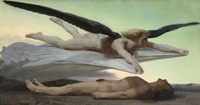
Furthermore, Bouguereau’s debut at the Salon of 1849, Equality Before Death (fig. 12), is commonly interpreted as a direct response to the bloody events of 1848 and as an expression of his reactionary social stance.[49] The title seems to be a play on the revolutionary slogans “Liberty, Equality, Fraternity” and “Liberty or Death,” the latter most memorably visualized in Jean-Baptiste Regnault’s (1754–1829) painting of the same name (1795; Kunsthalle, Hamburg). In contrast to Regnault—and later Delacroix—who had depicted the choice to fight for freedom and equality as worth the mortal peril, Bouguereau’s image of the angel of death spreading his shroud over a lifeless body presented a much more somber and pessimistic view of the revolutionary struggle and its results. Skeptical that true equality could be achieved this side of the grave, the artist used the Salon livret to invite viewers to reflect instead on whether they had done enough good in life.[50] If we regard this memento mori image and the combat motif in Dante and Virgil as companion pieces commenting on the revolution of 1848, they appear to frame the rebellion of the oppressed social classes as unnecessarily violent and pointless.
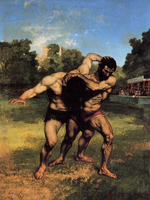
In addition to military combatants, the fighting damned can be understood as wrestlers. Their comparison with Courbet’s rendition of the same motif (fig. 13), suggested by Callen, invites one to consider the painting in a contemporaneous socioeconomic context.[51] While the second half of the nineteenth century saw the muscular ideal gradually become the universal standard of manhood, desirable for all men regardless of social standing, around 1850 it was still associated with the working class more so than with the bourgeoisie.[52] Self-discipline being regarded as no less virile a quality than bodily strength, the cultivation of one’s musculature was to be kept within limits, as sheer physical bulk risked tipping over into crudeness. After a number of workers’ uprisings, the sight of excessively muscular manliness could therefore trigger anxiety among the more refined Salon goers, as evidenced by the public outcry caused by Courbet’s work: Even Gautier, who profusely praised Bouguereau’s “battle of muscles, nerves, and tendons,” called Courbet’s Wrestlers “frankly detestable.”[53]
By monumentalizing in high art the sort of masculinity that middle- and upper-class commentators would have preferred to see safely sequestered within the confines of a wrestling match, Courbet compelled these viewers to confront their proletarian Other. On the contrary, Bouguereau, who would likely have counted Courbet among the “socialists [who] distort the minds of the masses,” made the tragic result of civil unrest, rather than its root causes, the subject of his clash of the damned, which lent to the painting a tone of admonition. The artist, who justified the suppression of the June uprising of 1848 as a defense of civilization, drew a parallel between the frenzied lost souls of the inferno and the insurgents, in turn described in his journal as “these new Cains,” against whom the spilt blood demands vengeance from the bosom of the earth.[54] The violent combat is understood in Dante and Virgil as a state of existence of certain corrupt individuals, and destructive cruelty is seen as an attribute of a specific, reprehensible type of masculinity. The contrast of the combat to the civilized behavior of the poets, whose bodies are invisible under their robes, links the unfathomable violence of the damned to their emphasized physicality and frames their aggressiveness as the result of the subjugation of the mind by the body. At the same time, these problematic bodies of the working-class models who posed for the painting disappear under the layers of academic finish, as they are figuratively banished to hell. As a result, bourgeois critics like Gautier were merely amused by the now harmless, “fierce strapping fellow” Schicchi, instead of finding him detestable.
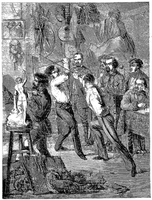
Apart from war and sport, young nineteenth-century artists could witness scenes of disturbing violence directly in the all-male, homosocial environment of the École des Beaux-Arts, described by some professors as “a sort of gymnasium,” where young talents could test their strength against one another.[55] This partly sociable, partly antagonistic atmosphere is documented in many depictions of artists’ studios, where wrestling and fencing were often used as a means of conflict resolution and as rituals for proving one’s manhood (fig. 14).[56] At the same time, the rites of passage in the studios included more brutal power plays: The so-called charges d’atelier (hazing of the atelier), which awaited all newcomers, involved teasing, harassment, bullying, rough treatment, and other forms of abuse. New students were forced to undress and perform various acts for the entertainment of the old, such as singing obscene songs, engaging in wrestling matches, or staging mock duels with paintbrushes instead of swords.[57] This mentally taxing routine was described by Jean-François Raffaëlli (1850–1924) as follows:
I am still ashamed! The wretched young men, most of them coarse and vulgar, indulged in disgusting jokes. Stupid obscenities were sung. Shameful masquerades were invented, which quickly tainted the heart. . . . And the torrent of horrors continued around me. Yet more new students were stripped naked, smeared with filth, and, in that colorless room, orgies took place. . . . And that was what they called studying art! And never, never, in that gathering of men destined to become artists, was there a discussion about art, never a generous word. Never an elevated idea. Always and always that vile and stupid mockery, always filth.[58]
In Henry Monnier’s fictionalized account of a new student’s arrival at an atelier of the July Monarchy, the student was greeted with shouts of “Kill him!” “Roast him!” “Eat him!” and “No room!,” which might be dismissed as fun and games but for the documented fatal outcomes of the charges.[59] According to Waller, the studios of the École des Beaux-Arts thus functioned as a place for the reproduction and internalization of unsettling behavioral patterns, which significantly shaped the social skills and gender perceptions of the young men involved.[60]
Albert Boime saw the degrading initiation rites as a vent for the hostilities triggered by the stressful environment of art education, organized around high-stakes competitions that served as the sole measure of academic success and, occasionally, as a source of funding.[61] The students’ professional future after graduation was not particularly promising either: The nineteenth-century art world on the whole was governed by a constant competition for state commissions, appointments, honors, and public recognition. Under these circumstances, both official and unofficial contests staged in the atelier hardened the character of aspiring artists for this male-dominated professional world, where open expression of emotions was not permitted. The exemplary bourgeois man was expected to hide his sentiments and passions behind a mask of respectability: Politeness and restraint were valued, while public displays of anger, frustration, and sorrow were condemned.[62] This mindset resonates in Bouguereau’s journal when he expresses a desire to create works “worthy of a man” while simultaneously forbidding himself to experience emotions.[63] In addition to the control over the body, the control over affects therefore drew another boundary around proper masculinity, while the suppressed frustrations and fears of the young men were alleviated within the homosocial structure of normalized physical and psychological violence through the enactment of cruel fantasies, periodic vulgar outbursts, and power games that sometimes went too far.
Bouguereau, who at that point had already been studying at the École for several years, was under substantial pressure to succeed. Burdened by financial concerns, he described his mental state at the time as “indecisive, anxious, painfully nervous.”[64] In the absence of his family’s support, the artist could apply for public funding only by demonstrating academic success, which had eluded him for quite some time. The year 1849, in particular, marked a low point with his second failed attempt to win the Grand Prix de Rome and the lack of press reactions to his Salon debut. It was during this period that the artist must have begun his work on Dante and Virgil. Given this context, the combat of the damned can further be interpreted as both a depiction and a processing of the conflicts inherent in the lives of young artists. Described by a fellow student René Ménard as disdainful of “the diversions sought by his peers . . . and devoid of the sarcastic humor so commonly employed by the young,”[65] Bouguereau seems to condemn the brothers who slit each other’s throats in a metaphorical sense as well. Albeit indirectly, the artist grapples with the underlying brutality of the art world—the violence, rivalries, and transgressions that shaped the artistic and gender identity of himself and his peers. At the same time, the heightened cruelty of the fictional struggle sublimates the latent frustrations and destructive impulses of the obscene and aggressive masculinity of a classroom bully, as it is revealed to be the flipside of the rational and creative masculinity of a cultured artist. The decline of the enlightened man reveals the beast inside.
The Eroticism of Violence and the Violence of Eroticism
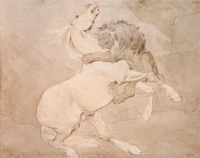
The notion that humans are nothing more than animals whose base instincts are suppressed but not eradicated by civilization found widespread expression in the art and literature of the so-called Dark Romanticism, whose macabre visual language may have inspired Bouguereau’s Dante and Virgil.[66] In particular, Schicchi’s voracious bite on Capocchio’s throat that figuratively transforms the aggressor into a wild and dangerous animal is reminiscent of George Stubbs’s (1724–1806) and Théodore Géricault’s (1791–1824) depictions of a lion attacking a horse (fig. 15).[67] Both artists freeze the violent action in the climactic moment of the final assault. Capocchio lets out a painful scream, like the horse caught off guard by the carnivore, while Schicchi’s determined, malevolent gaze mirrors that of the lion staring ahead. With his mane of red hair, the sinner looms over his victim like a predator over his prey. Géricault anthropomorphizes the animals by giving them human facial expressions, while Bouguereau animalizes the men by placing them in a bestial fight. This echoes the parallel between tortured beasts and human bodies drawn by Dante, which was particularly pronounced in the French translation of the verses that accompanied the painting in the Salon livret.[68]
Yet in addition to constructing this feral hypermasculinity, Bouguereau’s combat motif conveys a sense of violent yet thrilling sensuality. The two men seem to be entangled in an act of savage passion. In his hell-induced frenzy, Schicchi seizes hold of Capocchio and thrusts his knee into his body from behind, bending it into a receptive curve—a vivid phallic metaphor that evokes penetration during anal intercourse. Mirroring Schicchi’s oscillation between bloodlust and desire, Capocchio seems to writhe in agony and ecstasy alike, before surrendering to the brutal embrace of his tormentor. The rapacious bite, too, brings to mind all-consuming passion and can be understood as another symbolic act of copulation, whose transgressive appeal is sharpened by the violation of as cardinal a taboo as cannibalism. Like Schicchi’s red hair, conventionally associated with dangerous lustfulness, this kiss of death is part of Gothic imagery, populated by succubi and vampires that prey on people while at the same time fulfilling their repressed sexual desires. The sensual nature of the fight is further emphasized by the carefully modeled, yielding materiality of the glistening bodies, which lessens their sculptural rigidity and enhances their tactile appeal. The resulting ambiguous tension between combat and sex, rage and lust, domination and submission is accentuated by the eerie mood of the painting, the orgiastic scene in the background, and Dante and Virgil’s shocked reaction.
In his book Erotism: Death and Sensuality, Georges Bataille defines eroticism as a transgressive movement that dissolves the boundaries of the isolated self, entwining desire with violence, suffering, and death.[69] For Bataille, erotic union constitutes “a violation of the very being of its practitioners, a violation bordering on death, bordering on murder.”[70] Today, the Bataillean eroticism of Bouguereau’s Dante and Virgil is readily perceived and has been commented on by both art scholars and nonprofessional viewers. While Callen described the combat as “violently erotic,” Ulz contextualized Schicchi’s vampiric bite as a homoerotic motif, contrasting it with the friendly gesture between Dante and Virgil that marks the limits of homosocial intimacy between men.[71] The sensual undercurrents of the bite were once again foregrounded in the exhibition Vampires (2019) at the Cinémathèque Française, where Bouguereau’s painting was shown in the section Vampires érotiques (Erotic Vampires), with the chief curator Matthieu Orléan explicitly addressing the painting’s homoeroticism in the promotional materials.[72] The public clearly agreed with this assessment: From professional artists like Sara Shakeel, who in 2020 presented a camp reworking of the painting as a crystal collage on her Instagram, to porn actors who use the combat motif as a template for gay erotic photography, to pop culture fans creatively engaging with the work’s sexual subtext online, twenty-first-century viewers seem to share the opinion that there is something inherently queer about Schicchi and Capocchio’s intense encounter.[73]
Considering the frequent veiled references to male sexuality in the nineteenth-century debate around Michelangelo’s style, which are discussed above, it stands to reason that Bouguereau’s contemporaries perceived the erotic undertones of the combat motif as well. For example, when Gautier characterized Schicchi as “un farouche gaillard” (a fierce strapping fellow), he implicitly acknowledged the sexual dimension of his virility.[74] The word gaillard suggests a man of strong physical constitution, who is full of vigor and energy and who “overindulges in life’s pleasures, especially in the sexual realm.”[75] Bouguereau, too, arguably associated such physically embodied hypervirility with sexual promiscuity, given his later exclusive treatment of muscular bodies as an attribute of libidinous mythological creatures.
Despite being taboo, same-sex relations and desire were part of life in nineteenth-century France. Anne-Marie Sohn’s works on the subject show that homosexual encounters were widespread in homosocial male environments, such as lycées, prisons, and the military, and that engaging in them was not necessarily perceived as contradictory to performing virile masculinity.[76] Given the psychosexual turn that some of the charges d’atelier took, one should imagine that same-sex liaisons occurred in the all-male studios of the École des Beaux-Arts as well. As of 1791, homosexual acts as such were not penalized under French law,[77] and thereafter societal attitudes toward gender and sexuality expressions that deviated from the norm shifted from decade to decade: According to Victoria Thompson, the July Monarchy was characterized by relative tolerance and even a noticeable literary interest in unconventional and fluid models of gender and sexuality. In contrast, the June uprising of 1848 triggered reactionary attitudes toward any kind of social change, and the return to the traditional Catholic values under Napoleon III led to the consolidation of the heteronormative binary gender order.[78] At the same time, a series of sensational murder cases involving men who engaged in same-sex relations in the 1830s and 1840s reinforced the association of homosexuality with criminality and increased the interest of medical practitioners in the psychology of these perpetrators.[79] While the medical discourse of the second half of the century pathologized homosexuality primarily as an intrinsic physiological condition connected to effeminacy, before the establishment of such theories homosexual activity was generally viewed as just another example of sexual anomalies and excesses, not related to reproduction, stemming from an overexcited imagination, and therefore dangerous for one’s physical and mental health.[80] For instance, officials of the police des moeurs (morality police) explained homosexual acts as “a sort of erotic madness,” “a passion which could destroy all noble feelings, love of country, love of family.”[81]
Given this historical background, it is not unthinkable that the deeply pious Bouguereau, either consciously or subconsciously, instrumentalized the notion of the criminal and homosexual erotomaniac, who threatens the bourgeois social order, in order to construct the sinful masculinity of his fighting damned. The suggestive arrangement of their satyr-like bodies conceals their genitals in accordance with the requirements of artistic decorum, yet the bodies themselves are phallicized by assuming the characteristics of aroused sexual organs, such as inflated volume and accentuated tense muscle, protruding veins and shining sleekness, and the absence of body hair.[82] If the couple at the top of the background group can indeed be regarded as a reference to the legendary lovers Paolo and Francesca (see fig. 8), then Schicchi and Capocchio appear to be flanked by a paragon of male friendship on the one side, and by a heterosexual pair on the other, thus delineating the boundaries of permissible relationships and desires for male viewers. Above the damned, who transgress these boundaries in their passionate entanglement, hovers the demonic visage of evil. Homoeroticism and homosexual acts are thus, quite literally, condemned through the composition of the painting. The disgusted expressions of Dante and Virgil convey an example of an appropriate reaction. At first seduced by the sensual meeting of lavish male bodies, one quickly discovers the infernal scenery, the devil, and the censoring gazes of the esteemed poets, which warn against any indecent thoughts.
At the same time, the gaze directed at the nude men both within the painting and in front of it is inherently ambiguous. Philippe Saunier’s suggestion that the subject of Bouguereau’s later works depicting female nudes with captivated male observers is the voyeuristic gaze itself (see fig. 2) seems to apply, to a certain extent, to the morbid pleasure of looking at Schicchi and Capocchio, facilitated by the complex interplay of the gazes around them.[83] In both cases, the gaze of the supporting cast at the main figures purports to have a higher function, such as an expression of reverence or horror, yet what it achieves, in the end, is directing, mirroring, and enhancing the viewer’s gaze at the resplendent naked bodies. While such a gaze can be understood as either desirous or merely appreciative in a broader sense, it is often difficult to disentangle the two, especially when it comes to men looking at active muscular men. As in Bouguereau’s Dante and Virgil, the subject and object positions in paintings such as Jean Alexandre Joseph Falguière’s (1831–1900) Wrestlers (1875; Musée d’Orsay, Paris) and François Sallé’s (1839–1930) Anatomy Class (1888; Art Gallery of New South Wales, Sydney), discussed by Callen within her framework of the “classed homosocial gaze,” appear to be strictly regulated: The respectable bourgeois is allowed to look, while the muscular sportsman must earn his daily bread by being looked at.[84] Real viewers, too, are positioned as clothed middle-class voyeurs, sitting in the auditorium in Anatomy Class or around the wrestling ring in Wrestlers, their right to observe scantily clad men legitimized by the special event in the latter work and by the conventions of art in the former. While the social reality that gives the observers political and economic power over the observed creates solid barriers between them, one must assume a certain fascination of the onlookers with the objects of their gaze and a narcissistic identification with their strong and virile masculinity. But even identifying with someone and desiring to embody their gender expression can contain an erotic dimension. By examining homosocial bonds between men in literature, Eve Kosofsky Sedgwick concluded that the lines between identification and desire are blurry at best.[85]
The transgressive connection between violence and eroticism and the ambiguous distinction between identification and desire are united in Steve Neale’s understanding of masculinity as a spectacle. Responding to Laura Mulvey’s reflections on the male gaze in narrative cinema, he wrote:
In a heterosexual and patriarchal society, the male body cannot be marked explicitly as the erotic object of another male look: that look must be motivated in some other way, its erotic component repressed. The mutilation and sadism . . . are marks both of the repression involved and of a means by which the male body may be disqualified, so to speak, as an object of erotic contemplation and desire.[86]
According to Neale, combat, being strongly associated with manliness, is best suited for this purpose. Duels, gunfights, scenes of mutilation, contest, and combat, when “male struggle becomes pure spectacle,” displace explicitly erotic acts, yet they serve a similar voyeuristic purpose.[87] The action, characterized by aggression, violence, and pain, becomes the main text of the spectacle and legitimizes looking, while repressed homoerotic desire becomes the unspoken subtext. In this way, within the visual exchange where both the observer and the object of the gaze are men, the erotic spectacle is often obscured by the masochistic spectacle.
Dante presents the savage fight of the damned as a form of hellish torment which they must endure for their sins. Schicchi, the duplicitous Florentine knight, who earned his living through deceit and fraud, is punished in the afterlife with eternal rage and madness.[88] In Bouguereau’s rendition, the idealized depiction of his muscular body still alludes to chivalric virtue, but this noble appearance mutates and disintegrates under the influence of rabid fury, as the false hero transforms into a dragon-necked, ravenous monster in front of our very eyes. In contrast, Capocchio suffers from the loss of agency. His body is portrayed as passive matter, reshaped under the influence of external power. Men as masters of their fate succumb to the furor of madness and the tragedy of powerlessness, and one must torture the other in a never-ending cycle of violence.
The fascination with the violent imagery of the scene resonates in contemporary accounts: Du Pays describes two nude, fighting men, one of them “tearing the other apart with his teeth.”[89] According to Thierry, Schicchi throws himself at Capocchio, “twists his back and devours his face.”[90] The “battle of muscles, nerves, and tendons,” in the words of Gautier,[91] and the “pantomime of furious phantoms biting, tearing at each other, and seemingly intent on annihilating one another,” in the words of Thénot,[92] evidently fascinated the critics much more than the artistic achievements of the painting. In their descriptions, the ambiguously seductive bodies of the damned, which they must have studied in great detail, appear fragmented into separate body parts that either exert or endure violence: Backs, faces, necks and their napes, muscles, nerves, tendons, throats, and teeth stand metonymically for entire bodies. In contrast, the more sensual limbs such as arms, hands, and legs, as well as torsos and hair, which are just as actively involved in the action, are omitted. Unlike the bite, which is the most brutal element of the confrontation, the other points of contact between the men are not described individually: Capocchio’s hand in Schicchi’s hair, Schicchi’s knee against Capocchio’s back and his hand around Capocchio’s wrist, his fingers digging deep into the other’s skin, as well as the suggestive arrangement of the two men’s poses, are all subsumed under the general references to the fall, the fight, and the “strange fury.”[93] The emphasized physicality of the damned is only implicitly addressed through adjectives such as “strong,” “powerful,” “vigorous,” and so on. As a consequence, the opulent male bodies depicted by Bouguereau are transformed into seemingly de-eroticized machines of aggression. Their potential as objects of a desiring gaze is concealed by their role as actors in a violent action.
Condemning and Coveting Transgressive Masculinity
The group of male figures in the foreground of Bouguereau’s Dante and Virgil forms a pyramid with the poets at the top, the struggle of Schicchi and Capocchio in the middle, and the sinner writhing on the ground at the bottom. Weakened by the torments of hell, the frail physique and flaccid penis of this sinner are reduced from fantastically exaggerated symbols of masculinity to a mere body of a man, further temporalized as a nineteenth-century individual by his moustache and sideburns. This pitiful, powerless figure can be understood as the sad result of the vita activa (the active life), filled with physical pleasures and indulgences: A man like Schicchi, who is initially strong and full of vigor, can soon be overwhelmed, like Capocchio, until finally he falls to the ground, weak and helpless. This ruination is the prophesied end of rebellious proletarians, vulgar art students, provocative musclemen, and sexually deviant lunatics, allegorized by Bouguereau as “Dark Romantic” antiheroes, whose bestial nature turns them into monsters. Hierarchically positioned above such base concerns and yet only a step away from the instinct-driven and violent state of total irrationality, the serene representatives of the vita contemplativa (the contemplative life) observe the allegory of transience unfolding before them with great concern and warn the viewer not to fall victim to male vanity.
Since the eternal combat of the damned, with its accompanying pain and strain, is supposed to represent the punishment for sins committed during one’s lifetime, the painting can be interpreted as a warning against masculine transgression, of whatever kind. However, any such moralizing statement is visually undermined by the spatial arrangement of the figures, the virtuosity of the nude studies, the lighting direction, and the color scheme. In contrast to Delacroix’s composition (see fig. 7), which has Dante and Virgil tower over the infernal swarm, in Bouguereau’s case the flesh seems to triumph over the mind, as the poets are cast into the shadowy background and the damned are staged as protagonists, functioning both as figures of narcissistic identification and as objects of an ambiguous gaze. Although the narrative framing precludes any positive connotation of the savage fight, the perfectly modeled, fetishized nude bodies seem to aggrandize the violence, constructing an ambivalent sort of masculinity that evokes a mixture of fascination and discomfort. Even though the observers within the painting appear horrified and disgusted, real spectators outside are invited to gawk at the brutal confrontation and admire both the virile physicality of the fighting damned and the artist’s skill in rendering their spectacular, hypermasculine bodies. Through the dim color of his robe, Virgil is more closely associated with the inhabitants of hell than with his companion, who, in turn, seems to be consumed by the shadows. The red in Dante’s garments is desaturated, while the orange in the hellfire and Schicchi’s hair stands out with particular intensity. Even the artist, who signs the painting in this tone, seems to ally himself with the darker side of humanity.
Despite its excessive brutality, the combat motif is hardly successful at repressing the luxuriant carnality of the muscular bodies, frozen in time so that the viewers can look to their satisfaction, while the Dantesque framing with all its didacticism comes across as rather halfhearted. The appeal for condemnation of violence and same-sex desire is largely invalidated by the extravagant display of the scene, as Bouguereau enables and encourages the voyeuristic gaze at what he simultaneously purports to criticize. Here, both sides of masculinity as spectacle discussed by Neale are present simultaneously—the fight evoking a violent sex act, the roughness alluding to dangerous foreplay, and the cannibalistic assault appearing intimate even in its perversity. Thus, through the lens of Bataille’s dialectics of violence and eroticism, one can argue that, rather than simply disguising the homoeroticism of the scene, Bouguereau’s striking symplegma blurs the boundaries between horror and sensuality, pain and pleasure, love and hatred, life and death. Instead of precluding any potential erotic investment, the horror and violence end up inciting the unsettling moment of transgression that makes the scene erotic in the first place.[94]
Therefore, the true message of the painting about masculinity, violence, and sexuality remains ambiguous. Viewers might potentially identify with both the virtuous thinkers and the hypermasculine fighters, thus allowing for both the fantasies of intellectual and moral superiority and the fantasies of physical power, virility, and aggression. The sophisticated male Salon visitor was invited to join in the disapproval and condemnation of these brawling brutes. At the same time, however, he was offered the opportunity to enjoy the spectacle of crude, physical manliness while still feeling superior in his own refined and rational masculinity. Although Bouguereau’s Schicchi and Capocchio embody everything a nineteenth-century man must not be, no element conceals them from the admiring and empathetic gaze of the viewer, who was socially conditioned to suppress his anger and sorrow. Immersed in the hellish pictorial reality, which lies beyond the norms and taboos of human society, he could now vicariously experience a primal, physical, aggressive masculinity and sublimate his fantasies of power—or of surrendering control—through the act of viewing art. By identifying with the damned rather than the poets, he mentally participated in this transgressive and exciting performance of manhood, thereby compensating for the high demands on the nineteenth-century gentleman to always act rationally and decorously.[95]
Conclusion
Bouguereau’s Dante and Virgil in Hell makes the clashing ideals of nineteenth-century masculinity its subject. Its combat motif lays bare violent corporeal fantasies, forbidden desires, and dark impulses that lurked on the reverse side of classical ideals and bourgeois virtues. In the painting the conviction of the triumph of spirit over matter, civilization over base instinct, and self-discipline over reckless abandon is destabilized by the focus on the beauty and physical power of the clashing male bodies. The passionately carnal self, which had been separated from and repressed by the disembodied rational-moral self, returns in full force and gains the upper hand. The illicit fantasy of the strong, violent, and virile manliness overshadows the highbrow ideal of the stoic, intellectual hero. Positioned above everyone on the pictorial surface, the flying demon appears to mock the audience, which might be shocked by what it sees yet cannot look away from the spectacle, gawking at the pandemonium of sensual male bodies with morbid fascination or perhaps even erotic enjoyment. Viewers are caught in the act of watching with interest, their hypocritical outrage ridiculed. In this regard, the self-aware grin of the demon can perhaps be interpreted as an ironic metacommentary on the exaggerated, socially conforming reaction of haughty and prudish spectators, both within the canvas and in front of it, to the vigorous and untamed masculinity, which they might secretly long to partake in.
Acknowledgments
I would like to express my gratitude to Marianne Koos for commenting on this material at each stage of its development.
Notes
This article is based on my unpublished master’s thesis, “Transgressive Männlichkeit: Virilität, Gewalt und Erotik in William Bouguereaus Dante und Vergil in der Hölle” (University of Vienna, 2023). Translations of quotes from French and of some of the text passages from German were generated by u:ai (the artificial intelligence platform of the University of Vienna) and edited by me. All other translations are my own.
[1] For an overview of Bouguereau’s oeuvre, see Damien Bartoli and Frederic C. Ross, William Bouguereau, vol. 2, Catalogue Raisonné of His Painted Work (Antique Collectors’ Club, 2010). While many different art movements in nineteenth-century France showed interest in Dante and his works, the Inferno was favored by Romantic artists in particular. See Aida Audeh, “Dante in the Nineteenth Century: Visual Arts and National Identity,” in “Dante in France,” ed. Russell Goulbourne, Claire Honess, and Matthew Treherne, special issue, La parola del testo 17, no. 1–2 (2013): 85–100.
[2] Louise d’Argencourt, ed., William Bouguereau: 1825–1905, exh. cat. (Musée du Petit Palais; Musée des Beaux-Arts de Montréal; Wadsworth Atheneum, 1984).
[3] The up-to-date list of exhibitions featuring the painting can be found at the Musée d’Orsay’s website: “Dante et Virgile,” Musée d’Orsay – Collections, last modified June 16, 2026, https://www.musee-orsay.fr/.
[4] See D’Argencourt, William Bouguereau, 145–46; Hélène Jagot, “La malédiction du Prix de Rome: Les lauréats face aux critiques et à l’Académie des Beaux-Arts,” in Devenir peintre au XIXe siècle: Baudry, Bouguereau, Lenepveu, ed. Alain Bonnet, exh. cat. (Éditions Fage, 2007), 91–92; Philippe Saunier, “L’éthos protestant de Bouguereau,” 48/14: La revue du Musée d’Orsay 30 (2010): 75–77; and Côme Fabre, “William Bouguereau: L’assaut, Dante et Virgile, Égalité devant la mort,” in Sept ans de réflexion: Dernières acquisitions du Musée d’Orsay, 2008–2014, ed. Guy Cogeval and Yves Badetz, exh. cat. (Musée d’Orsay; Skira Paris, 2014), 210–11.
[5] Nerina Santorius, “William Bouguereau: Dante und Vergil, 1850,” in Gut Wahr Schön: Meisterwerke des Pariser Salons aus dem Musée d’Orsay, ed. Roger Diederen and Laurence des Cars, exh. cat. (Hirmer Verlag, 2017), 96–97.
[6] Melanie Ulz, “Zwischen Mythos und Boudoir: Der weibliche Akt in der französischen Salonmalerei des 19. Jahrhunderts,” in Diederen and Des Cars, Gut Wahr Schön, 92.
[7] Anthea Callen, Looking at Men: Anatomy, Masculinity, and the Modern Male Body (Yale University Press, 2018), 93.
[8] Margaret Walters, “The Disappearing Male,” chap. 8 in The Nude Male: A New Perspective (Paddington, 1978), 228–55; Abigail Solomon-Godeau, Male Trouble: A Crisis in Representation (Thames and Hudson, 1997); Callen, Looking at Men; and “Hard Bodies: Aesthetic, Materiality, and Mediality of Masculinity in American and European Art and Visual Culture, ca. 1900–Today,” Goethe University, Frankfurt, Germany, January 9–11, 2025 (reviewed in Viktoriia Bazyk, “A Fresh Look at Muscular Masculinities,” Kunstchronik: Monatsschrift für Kunstwissenschaft 78, no. 4 [2025]: 184–91). The series of exhibitions dedicated to the male nude that took place in Vienna, Paris, and Mexico City in 2012–14 also contributed significantly to the revival of interest in this topic. See, for example, Guy Cogeval, ed., Masculin – masculin: L’homme nu dans l’art de 1800 à nos jours, exh. cat. (Flammarion, 2013).
[9] Examples of other artists who represented the hypermasculine male nude include Alexandre Cabanel, Paul Baudry, and Joseph Blanc, who created paintings featuring similarly muscular and active (anti-)heroes during their student years in Rome but, like Bouguereau, later shifted their focus to (and consequently are remembered for) works foregrounding the voluptuous female nude.
[10] “L’enfer du Dante (chant XXXe),” in Explication des ouvrages de peinture, sculpture, architecture, gravure et lithographie des artistes vivants exposés au palais national le 30 décembre 1850 (Paris, 1850), no. 337, Musée d’Orsay – Base Salons, accessed February 25, 2026, https://salons.musee-orsay.fr/.
[11] “Ma né di Tebe furie né troiane / si vider mäi in alcun tanto crude, / non punger bestie, nonché membra umane, // quant’ io vidi in due ombre smorte e nude, / che mordendo correvan di quel modo / che ’l porco quando del porcil si schiude. // L’una giunse a Capocchio, e in sul nodo / del collo l’assannò, sì che, tirando, / grattar li fece il ventre al fondo sodo. // E l’Aretin che rimase, tremando / mi disse: ‘Quel folletto è Gianni Schicchi, / e va rabbioso altrui così conciando.’” Dante Alighieri, Inferno, canto 30, verses 22–33, trans. Robert and Jean Hollander, in Dante’s The Divine Comedy, ed. Robert Hollander (Anchor Books, 2012), 307–8 (English translation), 544–45 (original Italian), https://archive.org/.
[12] See Christopher Oldstone-Moore, Of Beards and Men: The Revealing History of Facial Hair (University of Chicago Press, 2016), 156–60.
[13] This group has been alternatively identified as Schicchi biting Capocchio or Ugolino biting his son. See “Dossier d’oeuvre: Chenavard, L’enfer de Dante,” Musée Fabre, accessed August 7, 2025, https://flora-api.montpellier3m.fr/; and Paul Chenavard, Ugolin et l’un de ses fils, Musée du Louvre, Département des arts graphiques, last updated September 6, 2021, https://collections.louvre.fr/.
[14] Apart from Chenavard, these and other influences were suggested in D’Argencourt, William Bouguereau, 145–46; Saunier, “L’éthos protestant de Bouguereau,” 75–77; and Fabre, “William Bouguereau,” 210–11. I would like to express my gratitude to Ulrike Kastler for pointing out some other influences as well as to Petra Chu for drawing my attention to the biting figure in Delacroix’s painting.
[15] It has to be pointed out, however, that the divisions between artists associated with the classical and the anticlassical traditions were often not as clear-cut as art history later made them out to be. For example, Flaxman himself was partly inspired by Michelangelo when working on his Dante illustrations. See Francesca Salvadori, ed., John Flaxman: The Illustrations for Dante’s Divine Comedy (Royal Academy of Arts, 2005), 24–25, 45n34.
[16] Jagot, “La malédiction du Prix de Rome,” 91–92. For a discussion of connections between Dante’s Inferno and the Romantic movement in France, see Audeh, “Dante in the Nineteenth Century.” Michelangelo’s association with Romanticism is discussed further here in this article.
[17] Saunier explains this effect in Bouguereau’s early works through the lens of William Labov’s concept of hypercorrection. Saunier, “L’éthos protestant de Bouguereau,” 75–76.
[18] “C’est un farouche gaillard que le Gianni Schicci, de M. Bouguereau, à en croire le tableau et le poème. . . . Le Gianni Schicci se jette sur le Capocchio, son rival, avec une furie étrange, et il s’établit entre les deux combattants une lutte de muscles, de nerfs, de tendons, de dentelés dont M. Bouguereau est sorti à son honneur. Il y a dans cette toile de l’âpreté et de la force—la force, qualité rare!” Quoted in Charles Vendryes, ed., Catalogue illustré des oeuvres de W. Bouguereau (Paris, 1885), 5–6.
[19] “Il y a un entrain, une verve étonnante dans la pantomime de ces fantômes furieux qui se mordent, qui se déchirent, qui semblent vouloir s’anéantir.” [Jean-Pierre] Thénot, “Salon de 1851,” La gazette de France, April 14, 1851, 4.
[20] “Ce n’est pas de la manière, ce n’est peut-être pas non plus un tableau, c’est une étude, une hardie et vigoureuse étude.” Edmond Thierry, “Exposition de 1851,” Journal de l’Assemblée nationale, March 31, 1851, 2.
[21] Augustin-Joseph Du Pays, “Salon de 1850 (4e article): Le salon carré,” L’Illustration, February 8, 1851, 88; and Claude Vignon, Salon de 1850–51 (Paris, 1851), 95–97.
[22] “Et cette réserve est louable. Il aurait dû, selon nous, la pousser plus loin encore, en allant chercher ailleurs des prétextes de peinture anatomique moins endiablée.” Du Pays, “Salon de 1850,” 88.
[23] “Ah! voici mon Ange de la Mort. En face, se trouve mon second tableau, L’Enfer du Dante. Comme vous pouvez le voir, il diffère de mes tableaux d’aujourd’hui. C’est une étude d’académie hardie et violente. . . . Si j’avais continué à faire des tableaux semblables il est probable que, comme celui-ci, ils me seraient tous restés. Que voulez-vous, il faut marcher avec les goûts du public et le public n’achète que les tableaux qui lui plaisent. C’est pourquoi j’ai changé, avec le temps, ma manière de faire.” “Nos peintres: M. Bouguereau chez lui,” L’éclair, May 9, 1891.
[24] See Paul Perrin, “‘Spott gegenüber stellte er sich einfach taub’: William Bouguereau und seine Kritiker,” in Diederen and Des Cars, Gut Wahr Schön, 19–27.
[25] See Léon Plée, “Études et croquis: William Bouguereau,” Les annales politiques et littéraires, August 27, 1905, 131–32; and Philippe Saunier, “Autour d’une exceptionnelle dation d’œuvres de William Bouguereau,” La revue du Louvre et des musées de France 60, no. 4 (2010): 25–27.
[26] See Alain Bonnet, “Le cursus studiorum académique: La formation à l’École des Beaux-Arts,” in Devenir peintre au XIXe siècle: Baudry, Bouguereau, Lenepveu, ed. Alain Bonnet, exh. cat. (Éditions Fage, 2007), 39–55.
[27] Susan Waller, “Professional Poseurs,” chap. 1 in The Invention of the Model: Artists and Models in Paris, 1830–1870 (Ashgate, 2006), 6–7.
[28] See the reviews of Étienne-Jean Delécluze and Henry Trianon quoted in Philippe Grunchec, Le grand prix de peinture: Les concours des Prix de Rome de 1797 à 1863 (École Nationale Supérieure des Beaux-Arts, 1983), 426.
[29] For the analysis of the ephebic ideal in French art on the cusp of the eighteenth and nineteenth centuries see Abigail Solomon-Godeau, “Ephebic Masculinity: The Difference Within,” chap. 3 in Male Trouble, 99–175; Mechthild Fend, “Der Jüngling und die Trauer um die Antike in der Zeit des Empire und der Restauration,” chap. 5 in Grenzen der Männlichkeit: Der Androgyn in der französischen Kunst und Kunsttheorie, 1750–1830 (Reimer Verlag, 2003), 85–111; and Satish Padiyar, Chains: David, Canova, and the Fall of the Public Hero in Postrevolutionary France (Pennsylvania State University Press, 2007), 51–117.
[30] See Régis Michel, “Winckelmann: Le beau ideal,” in Le beau idéal ou l’art du concept, exh. cat. (Editions de la Réunion des Musées Nationaux, 1989), 43–62; and Alex Potts, Flesh and the Ideal: Winckelmann and the Origins of Art History (Yale University Press, 1994), 113–81.
[31] Johann Joachim Winckelmann, Geschichte der Kunst des Altertums, ed. Reinhard Barth (Edition Deutsche Bibliothek, 1987), 377; and Antoine Chrysostôme Quatremère de Quincy, Essai sur l’idéal dans ses applications pratiques aux œuvres de l’imitation propre des arts du dessin (Paris, 1837), 60–89, 102–3.
[32] “Im Apollo, dem Bilde der schönsten Gottheit, sind diese Muskeln gelinde und wie ein geschmolzen Glas in kaum sichtbare Wellen geblasen und werden mehr dem Gefühle als dem Gesichte offenbar.” (In the Apollo, the image of the most beautiful of the gods, these muscles are smooth and, like molten glass, blown into scarcely visible waves, and manifest themselves more to the feeling than to the sight.) Winckelmann, Geschichte der Kunst des Altertums, 172. This sentiment is echoed by Quatremère de Quincy: “Dès lors le mot idéal joint au mot beau, doit exprimer même en vertu de son acception grammaticalement reçue jadis, cette sorte de beauté que l’art, forcé d’employer la matière, ne peut pas ne point rendre visible à l’organe physique, mais qui ne fait qu’y passer, si l’on peut dire, pour s’adresser plus particulièrement encore à l’entendement, à l’âme, au sentiment, c’est-à-dire aux yeux de l’esprit, plutôt qu’à ceux du corps.” (From then on, the word “ideal” joined to the word “beautiful” must, even by virtue of its formerly accepted grammatical sense, express that kind of beauty which art, being forced to employ matter, cannot help but render visible to the physical organ, but which, so to speak, only passes through it in order to address itself more particularly to the understanding, to the soul, to the feeling—that is, to the eyes of the mind rather than to those of the body.) Quatremère de Quincy, Essai sur l’idéal, 30–31. Victor Cousin and Théodore Jouffroy, too, follow Winckelmann in citing the Apollo Belvedere as the paragon of ideal beauty, even as they develop theories of other types of beauty. See Victor Cousin, Du vrai, du beau et du bien, 2nd ed. (Paris, 1854), 162–69; and Théodore Jouffroy, Cours d’esthétique (Paris, 1843), 181–84, 319–22.
[33] Winckelmann wrote: “Man könnte hier den Farnesischen Herkules anführen, an welchem alle Muskeln schwülstiger sind, als es die gesunde Zeichnung lehrt.” (One could cite the Farnese Hercules, in which all the muscles are more turgid than what healthy draftsmanship teaches.) Winckelmann, Geschichte der Kunst des Altertums, 235. See also the words of Jouffroy: “l’Hercule ne possède que le beau physique simplement, sans beau moral, sans beau intellectuel, sans beau sensible.” (Hercules possesses nothing but mere physical beauty, without moral beauty, without intellectual beauty, without beauty of feeling.) Jouffroy, Cours d’esthétique, 183.
[34] “Quel que soit le goût qui fasse préférer Léonard de Vinci, Raphaël d’Urbin ou Michel-Ange, tout le monde conviendra que de ces trois hommes, chacun en son genre également grands par le génie, les deux premiers ont été des artistes pleins de raison et de délicatesse, tandis que le troisième était extravagant dans ses idées et bizarre dans ses goûts.” (Whatever the taste that leads one to prefer Leonardo da Vinci, Raphael of Urbino, or Michelangelo, everyone will agree that of these three men—each, in his way, equally great in genius—the first two were artists full of reason and refinement, whereas the third was extravagant in his ideas and bizarre in his tastes.) Étienne-Jean Delécluze, Léonard de Vinci, 1452–1519 (Paris, 1841), 52. For the reception of Michelangelo’s works in France in the first half of the nineteenth century and his influence on French Romanticism, see Marie-Pierre Chabanne, “Michel-Ange romantique: Naissance de l’artiste moderne, de Winckelmann à Delacroix” (PhD diss., Saint-Denis, Université Paris VIII, 2000); Allan Doyle, “A Rule Without Measure: Michelangelo Buonarroti’s Afterlife in French Painting, 1814–1837” (PhD diss., Princeton University, 2016); and Edith Heindl, Michelangelo in der Malerei der französischen Romantik: Sublime & terrible (Michael Imhof Verlag, 2023). The attitudes toward Michelangelo at the Académie des Beaux-Arts in the nineteenth century are summarized in Alain Bonnet, “Michel-Ange et l’Académie des Beaux-Arts,” in Michel-Ange au siècle de Carpeaux, ed. Mehdi Korchane, exh. cat. (Musée des Beaux-Arts de Valenciennes; Silvana Editoriale, 2012), 19–37; and Sara Vitacca, “Les copies d’après Michel-Ange: Une fascination tardive,” in Formations artistiques et académies: Les envois de Rome en question (1804–1914), ed. Olivier Bonfait, France Lechleiter, and Pierre Sérié (Publications de l’Institut National d’Histoire de l’Art, 2025), 74–88. While the involvement of the state in the Academy’s affairs in the 1830s–40s led to the creation of the so-called Chapelle Michel-Ange, which housed copies after Michelangelo’s works and was meant to encourage students of the École des Beaux-Arts to draw inspiration from them, Bonnet’s and Vitacca’s analysis of the institutional structures and attitudes at the Academy demonstrates both the teachers’ continued prejudice against the old master and the students’ consequent reluctance to engage with his work, both of which persisted well into the second half of the century.
[35] “mâle et vigoureuse,” “âpreté,” “force” (Gautier, quoted in Vendryes, Catalogue illustré, 6); “hardie et vigoureuse,” “terrible,” “puissance” (Thierry, “Exposition de 1851,” 2); “furieusement mis en scène” (Du Pays, “Salon de 1850,” 88); and “verve,” “entrain” (Thénot, “Salon de 1851,” 4). These descriptions from the reviews cited above align with the contemporary language of art criticism used to discuss Michelangelo. See, for example, Delacroix’s words describing Michelangelo’s The Last Judgment: “l’impression du grand et du terrible” (the impression of the grand and the terrible); “cette sauvage vigueur des gestes et ces contorsions puissantes” (this savage vigor of gestures and these powerful contortions); and “cet ouvrage si plein de hardiesse dans la conception et d’une exécution si virile” (this work so full of daring in conception and of so virile an execution). Eugène Delacroix, “Sur Le jugement dernier,” Revue des deux mondes 11, no. 3 (1837): 339, 340, 342. For a discussion of Michelangelesque vocabulary and its gendered connotations, see Philip Sohm, “Gendered Style in Italian Art Criticism from Michelangelo to Malvasia,” Renaissance Quarterly 48, no. 4 (1995): 759–808; and Andreas Plackinger, Violenza: Gewalt als Denkfigur im michelangelesken Kunstdiskurs (De Gruyter, 2016), 50–85.
[36] “C’est un homme à part, chrétien quand il pense, païen dès qu’il manie le crayon ou le ciseau, rigoureusement chaste dans ses mœurs et dans ses vers, et le plus obscène des grands peintres modernes.” (He is a singular man, a Christian when he thinks, a pagan as soon as he handles the pencil or the chisel, rigorously chaste in his morals and in his verses, and the most obscene of the great modern artists.) Delécluze, Léonard de Vinci, 53. “Sein hoher Verstand und seine große Wissenschaft wollte sich in Nachahmung der Alten nicht allein einschränken, und seine Einbildung war zu feurig zu zärtlichen Empfindungen und zur lieblichen Grazie.” (His lofty intellect and great learning would not confine themselves solely to the imitation of the Ancients, and his imagination was too fervent for tender emotions and for charming grace.) Johann Joachim Winckelmann, “Von der Grazie in Werken der Kunst,” in J. J. Winckelmanns kleine Schriften und Briefe, vol. 1, Kleine Schriften zur Geschichte der Kunst des Altertums, ed. Hermann Uhde-Bernays (Insel-Verlag, 1925), 162. “Pauvre Michel-Ange! tu ne te relèveras plus de cette souillure de la personnalité, ta grande âme te fera produire des merveilles, mais tu as failli, tu t’es laissé choir, tu n’auras plus la grâce dans toute sa virginité.” (Poor Michelangelo! You will never recover from this taint of personality, your great soul will make you produce marvels, but you have transgressed, you have let yourself fall, you will no longer have grace in all its virginity.) Thomas Couture, Méthode et entretiens d’atelier (Paris, 1867), 354. Jacques-Nicolas Paillot de Montabert was reported to have accused Michelangelo “d’avoir donné à l’art moderne la manière outrée et à prétention, les contorsions prétendues magnifiques, les contrastes fougueux et sans convenance, et enfin tout ce fatras de fausse science qui a perverti et qui pervertira encore les écoles à venir si l’on oublie, si l’on dédaigne les anciens.” (of having given to modern art the exaggerated and pretentious manner, the contortions falsely hailed as magnificent, the fiery and inappropriate contrasts, and, finally, all that farrago of false learning which has perverted and will yet pervert the schools to come if one forgets, if one disdains the Ancients.) Quoted in “Des envois de l’École de Rome et du Moïse de Michel-Ange,” Journal des artistes, October 12, 1834, 232.
[37] “Accoutumé, en effet, à ne considérer l’homme que dans cette sorte de construction mécanique d’os, de muscles et de tendons, qui en constituent la structure; habitué ainsi par trop, à ne voir et à n’étudier que le mécanisme corporel, il devra facilement perdre de vue ce qu’il faut appeler, même dans les traits de sa forme extérieure, l’homme moral, qui s’y réfléchit aussi avec plus ou moins d’évidence. . . . Les images peintes du corps humain dans les figures où domine par trop le savoir anatomique, en révélant trop clairement à l’homme les secrets de sa structure, lui en découvrent aussi par trop, ce qu’on pourrait appeler le point de vue matériel, ou, si l’on veut, animal. L’emploi excessif de la science musculaire, et son application trop généralisée, ont nécessairement encore l’inconvénient d’exclure ce sentiment délicat de la Grace.” (Accustomed, in fact, to consider the man only as a kind of mechanical construction of bones, muscles, and tendons that constitute his framework, thus too habituated to see and study nothing but the bodily mechanism, he will easily come to lose sight of what must be called, even in the features of his outward form, the moral man, which is reflected there as well with greater or lesser clarity. . . . Painted images of the human body in figures where anatomical knowledge predominates all too much, by revealing to man the secrets of his structure too clearly, also disclose to him only too much what one might call the material—or, if you will, animal—point of view. The excessive use of muscular science and its overly generalized application necessarily also has the drawback of excluding that delicate feeling of Grace.) Antoine Chrysostôme Quatremère de Quincy, Histoire de la vie et des ouvrages de Michel-Ange Bonarotti (Paris, 1835), 246–48 (emphases in original).
[38] “Il ne faut pas être étonné du mépris des artistes médiocres pour ce sauvage génie. Ils ne peuvent s’empêcher de haïr ce style terrible qui les subjugue malgré eux; ils s’en prennent à lui du sentiment profond de leur impuissance et se rejettent alors sur les incorrections et les bizarreries, fruits de son caprice.” Eugène Delacroix, “Michel-Ange,” Revue de Paris 15 (1830): 53 (emphases added).
[39] See Stendhal [Marie-Henri Beyle], Histoire de la peinture en Italie (Paris, 1854), 405; and Théophile Gautier, Fusains et eaux-fortes (Paris, 1880), 124.
[40] The connections between Michelangelo and the machoistic rhetoric of the French Romantics is discussed in Elisabeth A. Fraser, Delacroix, Art, and Patrimony in Post-Revolutionary France (Cambridge University Press, 2004), 28–36.
[41] Fabre, “William Bouguereau,” 210; Sebastian Schütze, “Zwei Meister des ‘visibile parlare’: Dante und Blake,” in William Blake: Die Zeichnungen zu Dantes Göttlicher Komödie, ed. Sebastian Schütze and Maria Antonietta Terzoli (Taschen Verlag, 2014), 34; and Ulz, “Zwischen Mythos und Boudoir,” 92.
[42] See Marius Vachon, W. Bouguereau (A. Lahure, 1900), 13–22. Vachon’s is the first biography of the artist, which includes excerpts from his journals and the accounts of his contemporaries. For a similar analysis of Bouguereau’s personal motivations, see Jagot, “La malédiction du Prix de Rome,” 91–92. See also Solomon-Godeau’s analysis: “Bouguereau, however, was anything but an artistic rebel. A pious Catholic, husband and father, dutiful son, temperamentally as well as politically conservative, he made up in diligence and hard work for any artistic gifts he may have lacked.” Abigail Solomon-Godeau, “William-Adolphe Bouguereau: A Problem for Art History,” in Bouguereau & America, ed. Tanya Paul and Stanton Thomas, exh. cat. (Yale University Press, 2019), 63.
[43] His first teacher in Bordeaux was a student of Jean Auguste Dominique Ingres. See Vachon, W. Bouguereau, 7. Apart from his mentor François-Édouard Picot, in Paris he was taught by Ingres, Michel-Martin Drölling, Louis Hersent, François-Joseph Heim, and Merry Joseph Blondel, who in their own time had studied under Jacques-Louis David, François André Vincent, and Jean-Baptiste Regnault. See Damien Bartoli and Frederic C. Ross, William Bouguereau, vol. 1, His Life and Works (Antique Collectors’ Club, 2010), 68.
[44] Richard Leppert, The Nude: The Cultural Rhetoric of the Body in the Art of Western Modernity (Westview, 2007), 126.
[45] “La mort—mot terrible qui retentit autour de moi. . . . Contre qui grondaient donc ces tubes d’airain à la voix formidable? À qui ces balles étaient-elles destinées? À des frères, à des Français—désolation! désolation! Que ce ne soit pas là seulement un présage, mais qu’ici finissent ces luttes sanglantes où des frères s’entr’égorgent, puis-je le croire. . . y a-t-il un frein pour retenir ces masses? hélas! non, la foi n’existe pas, l’honneur est rare—et la force chancelante—sur quoi donc compter? Oh! que l’horizon est sombre: Paris, France, auriez-vous assez vécu! J’ai peur—la corruption est générale—les philosophes, les socialistes faussent l’esprit des masses, la décadence approche, ces signes furent toujours précurseurs de la chute des empires.” Bouguereau’s Paris journal, July 2, 1848, quoted in D’Argencourt, William Bouguereau, 43 (ellipses in original).
[46] See Trésor de la langue française: Dictionnaire de la langue du XIXe et du XXe siècle, 1789–1960, vol. 7, Désobstruer–Épicurisme (Centre National de la Recherche Scientifique, 1979), 791. In a more general sense, the French word égorger means to slaughter an animal by slitting its throat or murdering a person in an especially cruel, bloody manner. While “slaughtering each other” might be a more literary translation of s’entr’égorger, in this case, I opted for translating it as “slitting each other’s throats” to preserve the etymological relation to the word gorge (throat), which is necessary for my interpretation.
[47] Du Pays, “Salon de 1850,” 88.
[48] “Nous demandons décidément, pour le salon de l’année prochaine, la suppression de l’horrible. Nous comprenons dans ce terme générique les représentations du diable, de l’enfer, de la guillotine, du bourreau, etc., etc.” Vignon, Salon de 1850–51, 97.
[49] See Fabre, “William Bouguereau,” 210; and Saunier, “L’éthos protestant de Bouguereau,” 75.
[50] “Lorsque l’Ange de la Mort étendra sur vous son linceul, à quoi vous aura servi la vie si vous n’avez fait le bien sur la terre?” (When the Angel of Death spreads his shroud over you, what will have been the use of your life if you have not done good on earth?) Quoted in Vendryes, Catalogue illustré, 5.
[51] Callen, Looking at Men, 92.
[52] This idea is vividly illustrated in Nicolas-Toussaint Charlet’s lithograph Middle Class, Strong Class (1840; Bibliothèque Nationale de France, Paris). For a discussion of class-related connotations of the muscular male body in nineteenth-century French visual culture, see Callen, Looking at Men, 121–39; and Tony Halliday, “The Trouble with Tatius,” Oxford Art Journal 29, no. 2 (2006): 199–211. According to George L. Mosse, the widespread interest in athleticism in France and Italy developed much more slowly than in northern Europe. For instance, the vast majority of French treatises on the importance of physical education for boys were published in the 1870s, no doubt spurred on by the nation’s defeat in the Franco-Prussian War. The mid-century middle-class Frenchman instead derived his sense of virility from being a successful businessman, husband, and father, rather than from having a strong, well-trained body. George L. Mosse, The Image of Man: The Creation of Modern Masculinity (Oxford University Press, 1996), 45. See also André Rauch, “Le modèle bourgeois,” chap. 3 in Le premier sexe: Mutations et crise de l’identité masculine (Éditions Fayard, 2012), 85–120; and Ivan Jablonka, “L’enfance ou le ‘voyage vers la virilité’,” chap. 2.1 in Histoire de la virilité, vol. 2, Le triomphe de la virilité: Le XIXe siècle, ed. Alain Corbin, Jean-Jacques Courtine, and Georges Vigarello (Éditions du Seuil, 2011), 33–61.
[53] “Quant aux lutteurs, ils sont franchement détestables.” Théophile Gautier, “Salon de 1853,” La presse, July 21, 1853, 2.
[54] “Que de misère! Grand Dieu! le coeur le plus dur en serait contristé. Des gens infâmes, dont la bouche prononce des paroles de bonté, d’amitié, ne pensent qu’à leur intérêt personnel; et pour arriver séduisent les masses et les excitent jusqu’à répandre du sang . . . du sang qui du sein de la terre crie vengeance contre ces nouveaux Caїns.” (What misery! Good God! The hardest heart would be saddened by it. Vile people, whose mouths utter words of kindness and friendship, think only of their own self-interest; and to achieve their ends they seduce the masses and stir them up to the point of shedding blood . . . blood which, from the bosom of the earth, cries out for vengeance against these new Cains.) Bouguereau’s Paris journal, July 5, 1848, quoted in D’Argencourt, William Bouguereau, 43 (ellipsis in original). This excerpt rephrases the Bible verse in which God discovers Cain’s murder of his brother (Gen. 4:10). Bouguereau described the reasons for the participation of his friend and colleague Isidore Pils in the suppression of the June uprising as follows: “Il avait compris que l’art ne peut fleurir au milieu des tempêtes et s’était levé parmi les premiers pour défendre sa cause, qui est celle de la civilisation elle-même.” (He had understood that art cannot flourish amid storms and was among the first to stand up to defend its cause, which is that of civilization itself.) Quoted in D’Argencourt, William Bouguereau, 43. It stands to reason that this justification for Pils’s participation would have applied to Bouguereau’s own motivations as well.
[55] According to Henri Delaborde, before the reform of 1863, the École des Beaux-Arts was nothing but “un terrain neutre où les talents en formation, de quelque ordre ou de quelque provenance qu’ils fussent, s’essayaient librement à la lutte; une sorte de gymnase où de jeunes artistes, préparés par les leçons qu’ils avaient reçues au dehors, apportaient un commencement d’expérience et des forces déjà exercées.” (a neutral ground where talents in the making, of whatever order or origin they might be, freely put themselves to the test in the struggle; a kind of gymnasium where young artists, prepared by the lessons they had received outside, brought the beginnings of experience and powers already trained.) Henri Delaborde, L’Académie des Beaux-Arts depuis la fondation de l’Institut de France (Paris, 1891), 197. See also Anthea Callen, “La Lutte: Masculinity, Muscularity, and the Martial Arts of Anatomy,” chap. 2 in Looking at Men, 64–109.
[56] The role of dueling in the construction of bourgeois manhood is discussed in Robert A. Nye, “Bourgeois Sociability and the Point d’Honneur: 1800–1860,” chap. 7 in Masculinity and Male Codes of Honor in Modern France (Oxford University Press, 1993), 127–47.
[57] See Susan Waller, “Académie and Fraternité: Constructing Masculinities in the Education of French Artists,” in Artistic Brotherhoods in the Nineteenth Century, ed. Laura Morowitz and William Vaughan (Ashgate, 2000), 138–40.
[58] “J’en suis encore honteux! Les malheureux jeunes gens, pour le plus grand nombre grossiers et vulgaires, s’y livraient à des plaisanteries écœurantes. On y chantait des obscénités stupides. On y inventait des mascarades honteuses, auxquelles le cœur se salit vite. . . . Et les bordées d’horreurs continuaient autour de moi. Et on mettait de nouveaux élèves tout nus, on les salissait d’ordures et, dans cette salle aux murs sans couleur, des orgies se déroulaient . . . Et c’était là ce qu’on appelait étudier l’art! Et jamais, jamais, dans cette réunion d’hommes appelés à être des artistes, une discussion d’art, jamais un mot généreux. Jamais une idée élevée. Toujours et toujours cette blague immonde et stupide, toujours l’ordure.” Quoted in Arsène Alexandre, Jean-François Raffaëlli: Peintre, graveur et sculpteur (H. Floury, 1909), 31–32 (second ellipsis in original).
[59] Monnier is quoted in Albert Boime, The Academy and French Painting in the Nineteenth Century (Phaidon, 1971), 196n10. In regard to the fatal outcomes of the charges d’atelier, see Waller, “Académie and Fraternité,” 144, 152n30.
[60] Waller, “Académie and Fraternité,” 138.
[61] Boime, The Academy and French Painting, 49–50.
[62] See Rauch, “Le modèle bourgeois,” 113.
[63] “Quand viendra donc le jour où je pourrai faire quelque chose de digne d’un homme; malheureusement, que de choses à acquérir avant d’y arriver! . . . J’ai cependant bien le désir de produire. Mon Dieu, dirigez mes pas, car plus j’avance, plus je vois la petitesse de l’homme, et mon âme est indécise. Je désire les émotions, et cependant il est préférable qu’il n’en soit pas ainsi, les études demandent le calme et la réflexion; et je suis encore écolier: j’ai cependant vingt-deux ans!” (When, then, will the day come when I shall be able to do something worthy of a man? Alas, how many things there are to attain before getting there! . . . Yet I truly have the desire to produce. My God, guide my steps, for the farther I go, the more I see the smallness of man, and my soul is undecided. I long for emotions, and yet it is preferable that it not be so; studies demand calm and reflection; and I am still a student—yet I am twenty-two!) Bouguereau’s Paris journal, May 13, 1848, quoted in Vachon, W. Bouguereau, 21–22.
[64] “Mais, pendant assez longtemps, je ne savais pas exactement où j’allais; j’en étais indécis, inquiet, douloureusement nerveux, et je me tuais à dessiner.” (But for quite a long time I did not know exactly where I was going; I was indecisive, anxious, painfully nervous, and I was working myself to death drawing.) Quoted in Vachon, W. Bouguereau, 20.
[65] “Il était très travailleur, ne perdant jamais un moment, et affectant un parfait mépris pour les distractions recherchées par ses camarades. Pas très causant et dénué de l’humour sarcastique si communément employé par les jeunes gens, il avait des idées très arrêtées sur la ligne qu’il souhaitait suivre; et au milieu des tendances conflictuelles de l’époque, il n’éprouva jamais l’ombre d’une hésitation.” (He was very hardworking, never wasting a moment, and affecting a perfect contempt for the diversions sought by his peers. Not very talkative and devoid of the sarcastic humor so commonly employed by the young, he had very firm ideas about the path he wished to follow; and amid the conflicting currents of the time, he never felt the slightest hesitation.) Quoted in D’Argencourt, William Bouguereau, 255n18.
[66] The term “Dark Romanticism” was coined in literary studies to denote literary currents that explore the irrational side of the human psyche, including themes such as madness, eroticism, and violence. However, the cultural phenomenon it refers to was not confined to literature alone: Even Mario Praz, who is often credited with theorizing the concept, viewed the romanzo nero (literally “black novel,” referring, in literary terminology, to the gothic novel) as closely linked to the visual arts, citing the works of such artists as Delacroix and Gustave Moreau as examples. Mario Praz, La carne, la morte e il diavolo nella letteratura romantica (Sansoni Editore, 1992), 135–38, 254–57. The term was further contextualized within art history and visual studies by the exhibitions at the Städel Museum in Frankfurt and the Musée d’Orsay in Paris in 2012–13, with Bouguereau’s Dante and Virgil being featured in the latter. See Felix Krämer and Roland Borgards, eds., Schwarze Romantik: Von Goya bis Max Ernst, exh. cat. (Hatje Cantz, 2012), 14–28; and Côme Fabre and Felix Krämer, eds., L’ange du bizarre: Le romantisme noir de Goya à Max Ernst, exh. cat. (Musée d’Orsay; Hatje Cantz, 2013), 106. While both exhibitions focused on the long nineteenth century, the curators noted that the phenomenon of “Dark Romanticism” cannot be reduced to a single time period. It is not to be regarded solely as a subgenre of Romanticism, even while it intersects with the Romantic movement in French art in the 1820s–30s. See, for example, David Blayney Brown, “Altered States: The Romantic Exploration of the Psyche,” chap. 6 in Romanticism (Phaidon, 2001), 307–60; Michael Marrinan, “The Thrill of Violence,” chap. 5.2 in Romantic Paris: Histories of a Cultural Landscape, 1800–1850 (Stanford University Press, 2009), 173–90; and Albert Boime, “Restoration Horror: Part I,” chap. 3 in Art in an Age of Counterrevolution, 1815–1848 (University of Chicago Press, 2004), 91–149.
[67] Saunier was the first to see the resemblance between Bouguereau’s group of fighters and the lion and horse motif in the work of George Stubbs. Saunier, “L’éthos protestant de Bouguereau,” 77. However, it seems likelier that Bouguereau might have seen the motif in the work of Géricault, who was inspired by Stubbs during his visit to England.
[68] “Mais ni les Thébains, ni les Troyens furieux, ne montrèrent autant de cruauté à torturer des animaux ou des corps humains, que ne m’en firent voir deux ombres blafardes et nues, qui couraient en mordant comme un porc lorsqu’il s’échappe de son étable. L’une d’elle courut sur Capocchio, lui asséna un coup sur la nuque, et, l’entrainant, lui fait gratter avec le ventre le rude terrain. L’Arétin en demeura tremblant, et me dit: ‘Ce furieux est Gianni Schicci, et sa rage va maltraitant ainsi les autres.’” (But neither the Thebans nor the furious Trojans showed as much cruelty in torturing animals or human bodies as two pallid, naked shades made me witness, running and biting like a pig when it breaks out of its sty. One of them ran at Capocchio, dealt him a blow on the nape of the neck, and, dragging him along, made him scrape the rough ground with his belly. The Aretine stood there trembling and said to me: “That madman is Gianni Schicchi, and his rage goes on mistreating others in this way.”) “L’enfer du Dante (chant XXXe),” no. 337, Musée d’Orsay – Base Salons, accessed February 25, 2026, https://salons.musee-orsay.fr/. Interestingly, this translation turns the bite to the nape of the neck into a blow—a detail that accords less with Bouguereau’s depiction than with Gustave Doré’s later illustration of the scene, which replaces the bite with strangulation. See Dante Alighieri, L’Enfer, trans. Pier-Angelo Fiorentino (Paris, 1868), fig. 62. It invites the question of how the acts’ perceived violence and sensuality influenced the alterations.
[69] Georges Bataille, Erotism: Death and Sensuality, trans. Mary Dalwood (City Lights Books, 1986), 17–21.
[70] Bataille, Erotism, 17.
[71] Callen, Looking at Men, 93; and Ulz, “Zwischen Mythos und Boudoir,” 92.
[72] Matthieu Orléan, ed., Vampires: Cinéma, littérature, beaux-arts, séries, histoire, politique, érotisme, pop, exh. cat. (Cinémathèque Française, 2019), 165; and Matthieu Orléan, “Exposition Vampires, de Dracula à Buffy,” Cinémathèque Française, 2019, https://www.cinematheque.fr/.
[73] See Viktoriia Bazyk, “Reclaiming Hell: Bouguereaus kämpfende Verdammte im Spiegel der queeren Online-Fandoms,” in “Adapted to Fit: Aktualisierungen von Artefakten im sozialen Gebrauch,” ed. Christian Berger and Kirsten Lee Bierbaum, special issue, Zeitschrift für Kunstgeschichte (forthcoming).
[74] For the full quotation containing Gautier’s words, see note 18.
[75] “Homme qui profite à l’excès des plaisirs de la vie, en particulier dans le domaine sexuel.” This is the second nineteenth-century definition of the word gaillard in Trésor de la langue française: Dictionnaire de la langue du XIXe et du XXe siècle, 1789–1960, vol. 9, G–Incarner (Gallimard, 1982), 22. The first definition of the word, found on the same page in Trésor, is: “Personne de solide constitution physique qui est pleine de vigueur et d’allant.” (A person of strong physical constitution who is full of vigor and drive.).
[76] See Anne-Marie Sohn, “Sois un homme!” La construction de la masculinité au XIXe siècle (Éditions du Seuil, 2009), 152–68; and Régis Revenin, “Homosexualité et virilité,” chap. 6.2 in Histoire de la virilité, vol. 2, 400–407.
[77] People who engaged in homosexual encounters were, however, prosecuted for other offenses, such as “public offense against decency.” See article 330 of the Code pénal de l’empire français (Paris, 1810), 50.
[78] Victoria Thompson, “Creating Boundaries: Homosexuality and the Changing Social Order in France, 1830–1870,” in Homosexuality in Modern France, ed. Jeffrey Merrick and Bryant T. Ragan Jr. (Oxford University Press, 1996), 102–9.
[79] See Antony Copley, Sexual Moralities in France, 1780–1980: New Ideas on the Family, Divorce, and Homosexuality; An Essay on Moral Change (Routledge, 1989), 101–4; and Revenin, “Homosexualité et virilité,” 384.
[80] According to Revenin, nineteenth-century theories of homosexuality framed it either as an innate bodily disposition or an acquired psychological condition, the latter approach related to eighteenth-century writings on the dangers of masturbation, most notably L’onanisme (1760) by Samuel Tissot, who theorized that sexual overindulgence could lead to madness and painful death. See Revenin, “Homosexualité et virilité,” 384–86. While the former approach became dominant in the second half of the century due to an influx of new medical treatises on homosexuality in the wake of Ambroise Tardieu’s Étude médico-légale sur les attentats aux moeurs (1857), around 1850 it was not as established and therefore cannot, in my opinion, be of use in this discussion. Interestingly, Delécluze, who labeled Michelangelo “the most obscene of the great modern artists” (see note 36), also advised young artists against masturbation because, according to a commonly held belief, it could deplete their creative energy. See Callen, Looking at Men, 79.
[81] Quoted in Copley, Sexual Moralities in France, 104.
[82] See Norman Bryson, “Géricault and ‘Masculinity,’” in Visual Culture: Images and Interpretations, ed. Norman Bryson, Michael Ann Holly, and Keith Moxey (Wesleyan University Press, 1994), 235–36.
[83] Saunier, “L’éthos protestant de Bouguereau,” 80.
[84] Callen, Looking at Men, 101–2 and 121–39.
[85] See Eve Kosofsky Sedgwick, Between Men: English Literature and Male Homosocial Desire (Columbia University Press, 1985), 1–5.
[86] Steve Neale, “Masculinity as Spectacle: Reflections on Men and Mainstream Cinema,” Screen 24, no. 6 (1983): 8. For Mulvey’s discussion of the male gaze, see Laura Mulvey, “Visual Pleasure and Narrative Cinema,” in The Feminism and Visual Culture Reader, ed. Amelia Jones (Routledge, 2003), 44–53.
[87] Steve Neale, “Masculinity as Spectacle,” 12.
[88] See Robert Hollander’s commentary to canto 30, verses 28–33 in the notes of Alighieri, Inferno, 804–5.
[89] “enfin une scène plus affreuse peut-être encore, où deux hommes nus luttent ensemble, et où l’un des deux mord l’autre à la gorge. . . . Celui qui déchire l’autre avec ses dents était de son vivant un certain Gianni Sghicci.” (finally, a perhaps even more horrendous scene, where two naked men wrestle together, and one of them bites the other in the throat. . . . The one who is tearing the other apart with his teeth was, in his lifetime, a certain Gianni Sghicci.) Du Pays, “Salon de 1850,” 88.
[90] “Gianni Sacchi, un des furieux du Dante, se jette sur Capocchio, lui tord les reins et lui dévore le visage.” (Gianni Sacchi, one of Dante’s madmen, leaps upon Capocchio, twists his back and devours his face.) Thierry, “Exposition de 1851,” 2.
[91] See note 18 for the original French.
[92] See note 19 for the original French.
[93] The quoted words are Gautier’s. See note 18 for the original French.
[94] Bataille, Erotism, 63–80.
[95] Likewise, according to Fend, the idea of letting go of reason and control was part of the appeal of the imagery featuring fragile and passive ephebes around 1800. See Fend, Grenzen der Männlichkeit, 174. While this construct of masculinity is the polar opposite of that of Bouguereau’s fighting damned, in this regard, both appear to have similar functions.