De werelden van Jan Toorop (The Worlds of Jan Toorop)
Reviewed by Helena BurdzińskaHelena Burdzińska
University of Amsterdam
Email the author: helena.burdzinska[at]gmail.com
Citation: Helena Burdzińska, exhibition review of De werelden van Jan Toorop (The Worlds of Jan Toorop), Nineteenth-Century Art Worldwide 25, no. 3 (Autumn 2026), https://doi.org/10.29411/ncaw.2026.25.3.19.
This work is licensed under a Creative Commons Attribution-NonCommercial 4.0 International License  unless otherwise noted.
Your browser will either open the file, download it to a folder, or display a dialog with options.
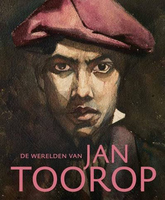
De Werelden van Jan Toorop (The Worlds of Jan Toorop)
Museum Singer Laren, Laren
January 21–May 10, 2026
Catalogue:
Jan Rudolph de Lorm, Suzanne Veldink, Laura Prins, Petra Timmer, eds.,
De Werelden van Jan Toorop (The Worlds of Jan Toorop).
WBOOKS, 2026.
171 pp.; 124 color and 43 b&w illus.; biographies of figures mentioned in the exhibition; bibliography; notes; colophon.
€32.50 (hardcover)
ISBN: 9789462587434
Between January 21 and May 10, 2026, Museum Singer Laren hosted an exhibition about one of the most prominent nineteenth-century Dutch artists, focusing on a crucial aspect of his life and oeuvre that has been neglected until now. The artist in question is Jan Toorop, and the exhibition, The Worlds of Jan Toorop, was marketed as the first to focus on the artist’s Javanese heritage. By the museum’s own description, it was the first time Toorop’s work was analyzed as “showing consistent and clear references to his Javanese and Chinese heritage throughout his entire career.”[1] Presenting over eighty works, including paintings, works on paper, sculptures, and letters, the exhibition also strove to position him in the context of contemporaries such as James McNeill Whistler and Floris Hendrik Verster. The show was also accompanied by a catalogue, available only in Dutch (De Werelden van Jan Toorop).
Museum Singer Laren’s retrospective is far from the first about Toorop in the Netherlands, but from the beginning, even the exhibition’s marketing materials placed the show in a contrast to past exhibitions about the artist by centering his identity and countering an established narrative of Toorop as a “stylistic chameleon.” The difference in approach and marketing can be seen, for example, in comparison with Kunstmuseum Den Haag’s 2016 exhibition, titled simply Jan Toorop, which highlighted Toorop’s versatility, contributing to the chameleon narrative, and calling him “a great Dutch artist.”[2] In turn, Museum Singer Laren states its goal as presenting Toorop both as an artist and as an individual—arguably, the museum wished to present the diversity of Toorop’s work as stemming from all aspects of his complex identity and his openness to the artistic influences around him.
The exhibition spanned six rooms that presented Toorop’s work chronologically, divided according to the most characteristic periods of his work. Every room also contained a distinct segment, entitled “Friend in Focus,” devoted to people from Toorop’s life who either had a significant influence on his work or were influenced by him. One of the most striking aspects of the show was undoubtedly its design. The walls were painted in jewel tones—mostly dark green, purple, and orange—giving the exhibition a distinct visual identity that gelled well with Toorop’s palette and particularly with the colors of the batik textiles presented in the first room.
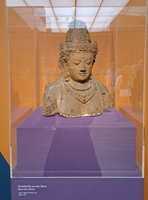
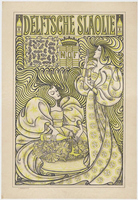
The first room, “The ‘Other’ Toorop,” began by strongly establishing Toorop’s connection to Indonesia. The first objects presented were a sculpture of Shiva (fig. 1) and Toorop’s study of it, paired with an anecdote about Toorop playing in a Buddhist temple complex as a child. The juxtaposition of the Buddhist sculpture and Toorop’s imitation of it illustrated the point of the exhibition powerfully and was a very compelling starting point. From there, the first room retold the story of Toorop’s artistic beginnings, focusing on his identity. The wall text asserted that while the artist has been whitewashed since the twentieth century, his identity as a man of color had been unmistakable during his life and was a crucial, if now overlooked aspect of his reception. After recounting Toorop’s travel to the Netherlands at age ten, the museum showed his early self-portraits, which strongly emphasize his Indonesian roots (fig. 2). These were paired with a work by Raden Saleh, whom the wall text referred to as a “founding father of Indonesian painting,” as well as with romanticized depictions of Indonesia created during Toorop’s lifetime. It also exhibited Indonesian batik textiles next to works by Toorop in which he depicts himself surrounded by such textiles. Some of Toorop’s most famous designs, such as the Slaolie poster (fig. 3) and the Oost en West design (fig. 4), were also exhibited in this room, which sought to highlight the Indonesian-inspired elements in both works. It also positioned his inspiration for these works in the context of orientalism and oppression, by, for example, showcasing a photograph of the Colonial and Export exhibition, which Toorop likely saw.
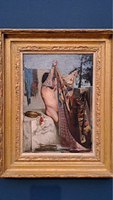

The first room delivered on the exhibition’s promise exceptionally well: it discussed Toorop’s identity in a nuanced way, while also asserting that his privileged upbringing allowed him to engage with his Indonesian heritage on his own terms; it also brought the orientalist context into focus without creating an oversimplified narrative or speaking down to the visitor. Instead, it presented the relevant objects and allowed viewers to draw their own conclusions and seek the connections between these objects and Toorop’s work. However, it was almost the last time the exhibition mentioned Indonesia.
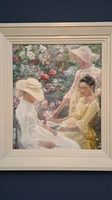
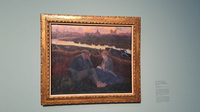
The second room, “Astonishing Young Talent,” exhibited work Toorop produced between 1882 and 1885, detailing Toorop’s move to Brussels. It touched on his encounters with Les XX, and, from a biographical standpoint, introduced visitors to Toorop’s wife, Annie Hall. The room presented paintings by three painters who significantly influenced Toorop’s early work—Whistler, Hendrik Willem Mesdag, and James Ensor—displaying their paintings side-by-side with Toorop’s and pointing out the connections between them (fig. 5). The third room, “In Search of Singularity, 1885–1890,” continued to explore Toorop’s response to the work of his contemporaries, this time focusing on his travels to London (fig. 6). It outlined his interest in depicting poverty and social issues and in the formal innovations of pointillism. As with the previous gallery, it asserted Toorop’s role as an intermediary between the European and Dutch art worlds.
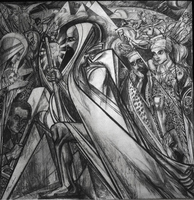
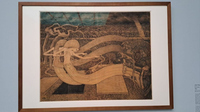
The fourth room, “An Invisible Angel Guiding Me Forward, 1905–1928,” took a stark turn and focused on Toorop’s conversion to Catholicism. Presented as a way of finding comfort in the face of an illness (syphilis), this part of the exhibition contained some of the most monumental works by Toorop, including The Pilgrim (fig. 7) and Stations of the Cross (1916–18; Church of St. Bernhulphus, Oosterbeek), fourteen wood panels that were on loan from the church of St. Bernhulphus.[3] However, it missed an opportunity to draw any connection between Toorop’s religiosity and his identity, even though the exhibition began by exploring his encounter with Buddhist art. The penultimate room, “A Man of the Modern Era, 1890–1896,” took a step back in time, focusing on Toorop’s move to Katwijk and then Loosduinen and presenting this period of his work as one of artistic maturity. The disruption in chronology was slightly disorienting for this viewer and broke with the narrative continuity established up to this point. The gallery covered Toorop’s encounter with Symbolism and the creation of his own unique visual language as he attempted to portray what the wall text described as “the deeply human struggle between acceptance and longing.” It also put Toorop in the context of other Symbolists by including works by Paul Gauguin, Odilon Redon, and Matthijs Maris. This was also the first time, since the first room, that Toorop’s Indonesian background was discussed; here, his identity was mentioned in a wall text analyzing O Grave, Where Is Thy Victory? (fig. 8).
The last gallery, subtitled “The Greatest of the Modern Dutch Masters, 1900–1928,” focused on Toorop’s final years and the public reception of Toorop following his death. This room contrasted his vibrantly colored mature works with black-and-white religious drawings and described his mentorship of younger artists. Arguably, the two most interesting aspects of this last room were the portrait of the three generations of the Toorop family by his daughter, Charley Toorop, and the sculptures of Toorop that had been executed after his death. The wall text returned to the assertion that Toorop’s racial identity played a crucial part in his reception by his contemporaries. It cited comments by Toorop’s peers that emphasized his skin tone or used racially charged language; it also questioned Gijsbert Jacobs van den Hof’s choice of ebony as the material for a statue depicting Toorop. While very relevant, the placement of this discussion at the end of the exhibition begs the question of whether such comments and biases were present throughout the entirety of Toorop’s career or raised only toward the end. Was he, moreover, received similarly in Belgium and England, or was this unique to his reception in the Netherlands? A more sustained exploration of the topic would have provided a more nuanced and comprehensive view of the prejudices Toorop might have faced in his lifetime.
The “Friends in Focus” theme was sustained throughout, helpfully demonstrating the networks and connections among various artistic figures of Toorop’s time but proved somewhat disruptive to the narrative about Toorop himself. Because the exhibition was divided so clearly between different periods of Toorop’s life and driven by chronology, one expected that each friend presented would have been particularly relevant to the period of the room in which they appeared—but that was not often the case. There were meaningful connections between, for example, the segment about Miek Janssen and the room outlining Toorop’s Catholicism; likewise, the connection between Arthur van Schendel and the first room was particularly apt.[4] In other cases, however, it felt disconnected and unsettled the exhibition’s storytelling.
At the exit, visitors were invited to view a documentary in the museum’s cinema focusing more explicitly on Toorop’s identity and the role it played in forming the exhibition, as well as on contemporaneous discussions of Dutch Indonesian identity. This aligned much more closely with the emphasis on identity that appeared in the marketing for the exhibition, as it discussed Toorop’s own feelings about his origins. The separation of the film from the exhibition itself, however, undermined this aspect of the show.
The catalogue consists of a brief introduction by Jan Rudolph de Lorm, the director of Museum Singer Laren, a longer introduction by Suzanne Veldink, senior curator of the museum, and six essays: four by Veldink, one by Laura Prins, and another by Petra Timmer.[5] The introductions by de Lorm and by Veldink, the latter subtitled “Kunstenaar tussen twee werelden” (“An Artist Between Two Worlds”), reassert the exhibition’s primary goal of highlighting Toorop’s non-European background. The remaining essays (apart from the second) generally repeat the structure of the exhibition, signaling that they are intended as an extension of each room. Similarly, some of the essays contain an extended “Friend in Focus” segment. Veldink expands significantly on Toorop’s origins in her first essay (“Javaanse elementen in het werk van Jan Toorop” [“Javanese Elements in the Work of Jan Toorop”]). While first focusing on Toorop’s biography, Veldink later analyzes various elements of his oeuvre through the lens of possible Javanese inspirations. The topic of Java is continued in the second essay, “Een tegeltableau van Jan Toorop in Surabaya” (“A Tile Panel by Jan Toorop in Surabaya”). Here, Timmer discusses a tile panel on an administrative building on the island of Surabaya, where Toorop was born. The analysis continues Veldink’s methodology of close-looking and making connections between Toorop’s work and possible Javanese influences. The examination in both essays is in-depth and compelling, delivering exactly what one would expect from the stated goal and marketing of the show. However, the next chapter returns to the structure of the exhibition, discussing Toorop’s years in Brussels and his European influences. The following essays are devoted to, respectively, his Symbolist works, his conversion to Catholicism, and his reputation and influence on subsequent generations. The catalogue closes with biographies of the various historical figures mentioned throughout the exhibition and catalogue, continuing the “Friend in Focus” motif.
As the catalogue functions primarily as an extension of the exhibition, it does not consistently focus on Toorop’s heritage, although the first two essays do provide a more in-depth—and much needed—exploration of his Indonesian roots. In that sense, the catalogue strengthens the most interesting aspects of the exhibition but does not fully amend its shortcomings. It is unfortunate that the catalogue is only available in Dutch, as the ostensible goal of the exhibition was to broaden Toorop’s perception and reception beyond the Netherlands.
The exhibition did follow through on its promise to explore Toorop’s identity and shift the existing narrative away from the notion of him as a “chameleon,” but, as I have argued here, it did this somewhat incompletely. It primarily portrayed Toorop as a consistently innovative artist very attuned to the art world of his time, taking in a variety of influences and adapting them to his own interests and, therefore, creating a unique, versatile visual language of his own. His identity surfaced primarily at the beginning and only intermittently after that. The use of galleries to divide Toorop’s different styles inadvertently reinforced the “chameleon” interpretation and resembled more standard showcases of Toorop’s oeuvre. There is still room for a more thorough exploration of the artist’s relationship to Indonesia and a larger analysis of the role his identity played in his reception. Once again, Toorop poses a problem as an exhibition subject—there is simply too much to be said about him, and Museum Singer Laren seems to have gotten distracted by the wealth of the stories one might tell about the artist. Nonetheless, the highlighting of Toorop’s Indonesian identity changes how Toorop is normally shown in Dutch museums and, hopefully, will function as a foundation for future, more nuanced discussions of his unique place in the Dutch art world.
Notes
[1] Museum Singer Laren, “De Werelden van Jan Toorop,” press release, November 11, 2025, https://mailchi.mp/.
[2] Kunstmuseum Den Haag, “Jan Toorop,” accessed August 11, 2026, https://www.kunstmuseum.nl/.
[3] The stations of the cross were only presented during a part of the exhibition, and upon the author’s visit, they were no longer exhibited; therefore, regrettably, I cannot speak to their inclusion in The Worlds of Jan Toorop.
[4] Miek Janssen was a fellow Catholic; Arthur van Schendel was also born in Indonesia.
[5] Prins recently defended her PhD on the relationship between mental illness and creativity; she is now affiliated with Utrecht University. Timmer is an independent curator and researcher.