Vignettes as Iconotextual Crossings in Nineteenth-Century Arctic Narratives
by Mark A. CheethamMark A. Cheetham is the author of books, edited collections, and articles on topics ranging from Immanuel Kant and art history to abstract art to postmodernism. He is a Guggenheim Fellow, a Fellow of the Royal Society of Canada, and professor emeritus at the University of Toronto. He published Landscape into Eco Art: Articulations of Nature Since the ’60s in 2018 and recently curated the exhibitions Struck by Likening (2017), Ecologies of Landscape (2018), Ideas of Far North (2025), and, with cocurator Isabelle Gapp, Arctic Fever: Image and Narrative in North Circumpolar Voyaging of the Long 19th Century (2026). Arctic Fever is accompanied by a full-length, coedited volume on Arctic voyaging in the nineteenth century and an online exhibition, available here.
Email the author: mark.cheetham[at]utoronto.ca
Citation: Mark A. Cheetham, “Vignettes as Iconotextual Crossings in Nineteenth-Century Arctic Narratives,” Nineteenth-Century Art Worldwide 25, no. 3 (Autumn 2026), https://doi.org/10.29411/ncaw.2026.25.3.4.
This work is licensed under a Creative Commons Attribution-NonCommercial 4.0 International License  unless otherwise noted.
Your browser will either open the file, download it to a folder, or display a dialog with options.
Vignettes as Iconotextual
“Vignette” is one of several terms in English that equally describes both a visual and a textual entity. It suggests a compact depiction, whether in prose or a visual medium. The word stems from “foliage ornament (French: vigne, ‘vine’) in a manuscript, book, or decorative carving.”[1] My aspiration in this article is to think anew about vignettes as what the French literary theorist Liliane Louvel calls “iconotexts,” and to bring her thinking to bear in a prime field of the deployment of vignettes, that of illustrated narratives of Arctic voyaging in the nineteenth century.[2] Images and texts are inseparably and powerfully intertwined in many illustrated narratives in this period, with the result that “literary critics, art historians, and historians of the book have struggled to identify a methodology for analysing and appreciating the plethora of small-scale images that accompany so many literary texts of the period,” as the editors of the recent volume Romanticism and Illustration state.[3] A proliferation of illustrated newspaper spreads, books, and journals engaged this intense period of exploration and incursion by Western actors in a geographical and cultural region. The phenomenon is also a central moment in the pivotal field of polar art history. While I do not claim to have solved these perpetual and largely productive conundrums, there are methodological and historical advantages in construing these contexts as iconotextual, that is, as not only image-and-word collaborations or oppositions but, in Louvel’s terms, as a “third” amalgam.[4]
One benefit of the iconotextual approach is the impetus it provides to understanding the workings of nineteenth-century illustrated Arctic voyaging accounts in new ways through examples of how they function in specific illustrated voyaging texts. My interpretations build on art historian Eavan O’Dochartaigh’s commitment to “the importance of interrogating illustrations as essential components of text, acknowledging the great influence they held over the nineteenth-century eye.”[5] Where she fills a large gap in the literature by emphasizing “the original sketches, watercolours, and drawings” from the searches for the British Royal Navy officer and explorer John Franklin’s (1786–1847) famously lost expedition of 1845 to find the Northwest Passage, I return to the published sources. Reception is important to my arguments; published Arctic voyages by definition had a much wider circulation than individual accounts that remained largely private.[6] A comment on vignettes by Charles Rosen and Henri Zerner is also germane to what I want to emphasize when looking closely at this category in Arctic narratives: “Apparently unassuming as an artistic form, the vignette launches a powerful attack on the classical definition of representation, a window on the world. The vignette is not a window because it has no limit, no frame. The image, defined from its center rather than its edges, emerges from the paper as an apparition or a fantasy.”[7] I want to underline that in the reception of these narratives—whether in an illustrated newspaper, a published “voyage,” or an unpublished illustrated journal—vignettes can provide dreamlike opportunities for the author’s and reader’s imagination.
Before turning to the analysis of specific examples, we need to ask what an iconotext is in Louvel’s thinking. Augmenting the scholarship of image theorist W. J. T. Mitchell and professor of literature Peter Wagner in particular, Louvel calls for an understanding of iconotexts as a third term functioning beyond the word/image dyad. In her introduction to Louvel’s Poetics of the Iconotext, Karen Jacobs notes Louvel’s affinity for Mitchell’s work while pointing to the French author’s extension of it: “W. J. T. Mitchell’s three books on text and image, beginning with Iconology (1986) and followed by Picture Theory (1994) and What Do Pictures Want? (2005), . . . together outline a project dedicated to historicizing text/image relations within the oppositional rubric of sign versus symptom while insistently expanding beyond it.”[8] For the viewer/reader, she argues, the visual and textual often interrupt and supplement one another, leading to what she calls a “pictorial third” in the viewer’s perception, a new entity that is the product of the text/image pairing but prioritizes neither. In Louvel’s theory, “the term ‘iconotext’ . . . illustrates perfectly the attempt to merge text and image in a pluriform fusion, as in an oxymoron. The word ‘iconotext’ conveys the desire to bring together two irreducible objects and form a new object in a fruitful tension in which each object maintains its specificity. It is therefore a perfect word to designate the ambiguous, aporetic, and in-between object of our analysis.”[9] She elaborates: “The pictorial contribution, an oblique flash of glazing light projected onto the text, activates the pictorial third that is actualised once an image-in-text, an in-between phenomenon, rises in the reader’s mind; it is a dynamic, oscillating between an imagistic reading and a read image. The pictorial third is this vibrant in-between, situated between text and image, just like the slash separating the two, as the terms often appear in theoretical texts.”[10] Louvel’s distinction insists that we should not look at illustrations only in and of themselves (and imagine others) or, commensurably, that a reader should read only the text in an illustrated publication. For her, iconotexts are explicitly intermedial. They vary according to context and the specifics of reader/viewer engagement. As Louvel, Mitchell, and, in a specifically nineteenth-century frame, Julia Thomas emphasize, these relations are inevitably yet productively unstable.[11] Louvel pushes previous thinking about image/word interactions toward a third image/text collaboration that is, I will argue, quintessentially present in the apprehension of visual vignettes.
Vignettes in Histories of Images
There are methodological implications for art history and visual-culture studies in my analysis of vignettes. I see iconotextual maneuvers as relative rather than essential—maneuvers of convention and context that are potentially indicative of the interactions within illustrated texts more generally at this time. Historian of visual culture Tom Gretton has claimed that “art history works by picking particular images out of the flow of imagery, pushing their effect as iterations into deep background as it concentrates on individuation and difference.” He continues, “There is probably no way of keeping both iteration and individuation alive to the intellect at the same time: and almost certainly there is no static visual representation that can do that trick.”[12] I agree with his description and implied criticism of art historical practice, and need look no further than myself to point the finger. I have often isolated an image from its visual or its textual context, but that habit is to be avoided when examining illustrated travel accounts especially.
On the other hand, I resist Gretton’s doubt that we can keep “iteration and individuation alive to the intellect at the same time,” an idea reminiscent of E. H. Gombrich’s well-known discussion of the duck/rabbit puzzle in Art and Illusion (1960). Gombrich provides a vignette that he claims we can see “as either a rabbit or a duck” and asserts that we cannot see it as both nor “watch ourselves having an illusion.”[13] If we think with Louvel’s theory of the iconotext in illustrated Arctic narratives and therefore against Gombrich and Gretton, it is possible to see an embedded vignette as a positive version of the duck/rabbit conundrum, that is, to see image and text simultaneously as a third term.[14] If we keep images and texts together as they appeared on the pages of Arctic narratives and related accounts, an art history of Arctic visual culture that includes nineteenth-century illustrated publications—or any disciplinary context in which illustrated narratives figure centrally to the history told—requires a different sort of looking than do more mainstream examples of the period’s visualities, Arctic and otherwise, especially the framed paintings on which so much of art history rests. In the examples adduced here, words and images are never completely separate. Images are not purely visual and independent (as formalist theories of art require);[15] nor are they negatively governed by text (as is often assumed by art historians and seconded by Gretton). An iconotextual analysis can avoid a version of iconography that privileges textual materials over the visual. Looking at iconotexts in contexts of nineteenth-century Arctic voyaging could—perhaps should—change how we view better-known, traditionally framed landscape paintings.[16]
While the extension of this principle is beyond the scope of this article, the example of Frederic Edwin Church’s (1826–1900) famous painting The Icebergs (1861; Dallas Museum of Art) shows that there can be equipoise between the visual and the textual. At the Goupil Gallery in New York City where it was first shown in April of 1861, the painting was titled The North: Church’s Picture of the Icebergs.[17] The artist’s modification of his title bears witness to the shifting ideological deployment of the North as a narrative reference.[18] For Church, a devout Christian and Union patriot, the North at the outbreak of the American Civil War was both a cause and a compass point centered on New York City. An iconotextual approach to the painting would retain the reverberations of its first title as an “afterimage” and acknowledge that the work as well as icebergs themselves could be understood politically.
Vignettes in Nineteenth-Century Arctic Voyaging Publications
How is Arctic voyaging in the nineteenth century representative of the complex work of vignettes? Without claiming uniqueness for this subgenre of illustrated travel publications—but emphasizing that it is exemplary of the nineteenth-century hunger for visualization[19]—British, Norwegian, and US expeditions to the geographic and magnetic North Poles and the Northwest and Northeast Passages were an obsession in these countries and elsewhere, yielding a large and eclectic range of iconotexts in published and unpublished formats. Two centuries ago, the potent combination of national competition to reach the North Pole and to chart the Northwest Passage; the heroism of individual explorers (think of Franklin, Roald Amundsen [1872–1928], and Robert Peary [1856–1920], all lionized to varying extents to this day); the fascination with Indigenous peoples; the development and deployment of innovative technologies; scientific discoveries; and endless Arctic entertainments made the region central in professional circles and the popular imagination. Attention to the Arctic was feverish in the nineteenth century to a degree matched only today, when worries about climate disruption are often focused on the poles and geopolitical machinations swirl around Greenland.
Also central to the study of vignettes is the remarkable range of media in which narratives and images of Arctic voyaging appeared, from elaborate panoramas to trading cards in cigarette packs to catalogues and photographs of various displays of relics from Arctic adventures.[20] Within the bounds of published books, such illustrations trace the rapidly evolving reproductive technologies of the time, from engravings of several types to lithography to photography. Color appeared in hand-tinted images and chromolithography. Most important, these technologies overlapped and were purposefully combined in printed materials to yield a complex media infrastructure. In official publications, the integration of image and text was a constant concern from the perspectives of book sales, national propaganda, and authors’ reputations.[21] This was even more the case when we consider the all-important coverage of Arctic themes in the new and highly popular illustrated press, whether in Britain (The Illustrated London News and many cognates); in Kalaallit Nunaat, the Indigenous name for Greenland, where the newspaper Atuagagdliutit (translated as “distributed reading matter”) boasted some of the world’s earliest color illustrations in a newspaper; and in the ephemera printed aboard ships in the Arctic. Published Arctic travels are as much about the conventions of the publishing industry and Anglo-European-Nordic reading habits as they are about the Arctic. In general, according to Ian Haywood, Susan Matthews, and Mary L. Shannon, “The illustrated edition was part of a dynamic communication circuit which linked personnel (writers, artists, engravers, publishers, entrepreneurs, readers, viewers), products (paintings, designs, engravings, books, and other forms of printed merchandise), and venues (art and literary galleries, bookshops, print shops, the printed page).”[22] Nonetheless, we can assume that the authors of both published and unpublished illustrated Arctic diaries and logs—often naval officers or surgeons—were familiar with the priorities and formats of more polished and conventionalized accounts and worked within many of the same paradigms.[23]
To engage the variety but also the common features in the use of vignettes in Arctic travel documents, I will discuss five different examples of vignettes, moving from the most widely distributed to a private logbook. Individually and in comparison, these brief case studies suggest new readings of this form in the contexts of Arctic voyaging as a central aspect of polar art history and word-image studies generally. I will consider pages from The Illustrated Arctic News, an informal, originally handwritten shipboard newspaper that was published in facsimile in London; its progenitor and frequent source for iconotextual narratives about Arctic voyages, The Illustrated London News; a consequential example of published narratives, Francis Leopold McClintock’s The Voyage of the “Fox” in the Arctic Seas; an intriguing Arctic chart by captains John Ross and James Clark Ross that includes vignettes as well as the expected cartographic information; and an unpublished and unstudied logbook by a surgeon working for the Hudson’s Bay Company, Samuel Smith Logbook: Surgeon to the Hon. Hudson’s Bay Co. Ship “Prince Arthur,” from London to Moose Fort, Hudson’s Bay, June 13 to August 24, 1857. While differently inflected in ways I will note, these cases are exemplary of the operations of vignettes in the contexts of Arctic voyaging.
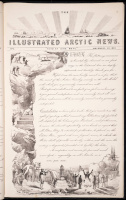
Illustrated newspapers were crucial in Arctic voyaging. They were vehicles for narrative accounts and, beginning in 1842 with The Illustrated London News (hereafter, the ILN), for images that stoked and guided public curiosity about the region and its many actors. Several papers were produced onboard ships, including the first Arctic newspaper, The North Georgia Gazette, and Winter Chronicle (1819), later printed in edited form in England. Jocular and informative, these amateur, “local” newspapers provided entertainment for icebound sailors and exemplified the intimate interaction between word and image in Arctic accounts. Miming its London model, The Illustrated Arctic News was crafted aboard HMS Resolute on a Franklin rescue mission in 1850–51, then reproduced and circulated in 1852 with plentiful black-and-white and colored lithographs intercalated with the handwritten text.[24] The picture on the front page of the issue dated November 30, 1850, is a vignette in the etymological sense because it wraps around the text on the page (fig. 1). Britannia sits regally in the middle of a snaking border of ice that depicts and conjoins a polar-bear hunt at the top and Guy Fawkes celebrations at the bottom right. She is celebrated by a band that plays and also performs vocally (perhaps the song is Rule Britannia, sung in the Royal Navy for over a century by this time). The ship at the far bottom right—amusingly shrouded by smoke from these celebrations—recalls others on the search mission depicted in the more modest vignette that serves as the header for this page of the paper’s second number. The editors’ final line of text is similarly tongue in cheek: “As occupation and exercise for the pen and mind is our object, – originality in all Articles is a sine qua non.” Only in its novelty, however, does the elaborate vignette at the left and bottom of the page relate to the text. It is not a direct illustration of the editorial but instead free-form and associative, showing a nationalistic ritual and the expected, even clichéd, polar-bear hunt.
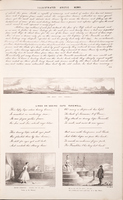
Atypical in that it is more complex than most vignettes in nineteenth-century travel publications, this example is also characteristic of the form in its unboundedness when compared with conventionally framed illustrations that literally draw a line around images, often (though as I will argue below with respect to vignettes that look like photographic stereograms, not necessarily) limiting them to their function of illustrating a passage that is also explicated discursively. For example, the other reference to the ice statue of Britannia in The Illustrated Arctic News, a wood engraving initialed by George F. McDougall in the lower right, includes a conventionally framed picture of her and is accompanied by a caption in the onlooking sailor’s voice (fig. 2). The caption is a discursive vignette, that is, an explanatory narrative description of a specific scene, but it is presented differently than the elaborate picture in figure 1. Without proposing an exact or consistent distinction between their designs and placements, here or in other publications, vignettes can be thought of as more open to a range of responses than are more strictly bounded visual illustrations, of which they are nonetheless a subset. Significantly for a reader’s/viewer’s experience with such a text, vignettes can also be dreamlike opportunities for imagination to the extent that those who encounter them may (and to an extent, must) tint them with their own thoughts. Put another way, they are in the text but not necessarily part of the narrative.
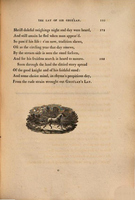
Curator David Blayney Brown argues that the prominent practitioner of British landscape painting, Joseph Mallord William Turner (1775–1851), used vignettes in this unfettered way: “In small-scale vignettes for engraving as book illustrations, whose subjects were often historical or foreign as in the case of Samuel Rogers’s poem Italy, Turner seems to have revelled in being released from reality into a realm of memory and imagination, and turned to vibrant aquamarines and crimsons in celebration.”[25] The Victorian animal painter Edwin Henry Landseer (1802–73) stated that the relationship of “a vignette to a poem, is oft times a sort of midsummer’s night’s dream, where Fancy, unrestrained by time and place, indulges in the revelry of fairy fiction.”[26] We find a precedent for this view in the vignettes of the most noted early innovators of their wood engraved form, Thomas Bewick (1753–1828) and John Bewick (1760–95). According to print scholar Hilary Thompson, in their work, “the subject-matter of the text is rarely illustrated by the image in the vignette. Instead, a vignette—especially when it follows a block of text—holds within it images which encourage exploration outside the printed text rather than mediating between the image and the text.” One of Thompson’s examples is from Fabliaux, or Tales: Abridged from French Manuscripts of the XIIth and XIIIth Centuries by Pierre Jean Baptiste Le Grand d’Aussy (1796) (fig. 3). She goes on to posit that in general, “the viewer of the engraving has been invited to participate in the illustration (by the removal of the frame), has become the narratee (the receiver of the story), and must interpret the events portrayed within the parameters of the narrative strategy of closure.”[27]
One definition of the term “vignette” is “an illustration or design (especially a photograph) that fades into the space around it without a definite border.”[28] It is frequently the vignette’s fade-out and its tangential relationship to the text that promotes relatively unspecified visualizations on the part of readers. Rather than explicating textually the details of a border zone in the vignette on the front page of The Illustrated Arctic News in November of 1850 (see fig. 1), McDougall allows for and encourages an intermedial, iconotextual sense of a patriotic and heroic Arctic rescue mission. While this vignette does not exactly fade at its edges, the ice it depicts appears fanciful because it is both structural, in that it supports the Britannia sculpture, for example, and simultaneously of the air and atmosphere in that it billows up like smoke. Other, smaller vignettes throughout The Illustrated Arctic News have no borders whatsoever. The “Arctic Sketches” in this publication refer equally and fluidly to pictures drawn, textual descriptions, and theatrical reviews, all produced on board.
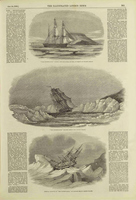
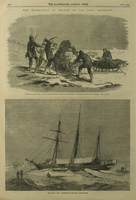
A prime source of vignettes at this time was the weekly ILN, which began publication in 1842 (figs. 4, 5). The newspaper initially capitalized on and extended the innovations in wood engraving spearheaded by the Bewicks in the 1780s, a technology also found in many other illustrated publications in the early 1800s.[29] The technique supported detailed images and was reproducible at scale because of the hardness of the wood used. As relief prints, wood engravings also allowed pictures and texts to be printed together, saving time and money. The ILN itself presented “A History of Wood Engraving” in 1844, suggesting a self-consciousness about the format it so frequently employed. A prime example of the newspaper’s unfailing promotion of the monarchy and causes of empire was the extensive coverage of Franklin’s much-anticipated expedition of 1845 to navigate the Northwest Passage. Franklin (and the Admiralty, for which he sailed) sought to chart and claim for Britain this shorter and economically expedient route to the Pacific. But Franklin’s ships were not heard from directly after they entered the Arctic Archipelago in 1845. The loss of 129 sailors was, and remains, the most catastrophic disaster in the history of polar exploration.[30] In the supplement to the ILN of October 28, 1854, the editors note that “in several Numbers . . . we have illustrated this ill-fated Expedition, and the several searches made for the missing explorers. It may be useful and interesting to recapitulate the Numbers wherein the principal of these Engravings have appeared, with a view to aid such readers as are anxious to trace the connected narrative of this most melancholy chapter in the History of Discovery.”[31] They list over twenty such entries up to this date (1854) in the search for Franklin, delivering many more up to McClintock’s definitive confirmation of Franklin’s death in 1847 (only established in 1849), and in diminishing frequency thereafter.
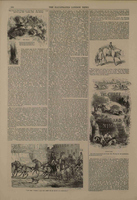
Gretton examines the varieties and uses of illustrations—including vignettes—in the popular pictorial press in Victorian Britain as well as their reception by readers, providing a necessary context for my case studies of Arctic vignettes. He argues that “the word ‘illustration’ was the primary resource through which such magazines identified themselves and defined their purpose.”[32] Specifying the vignette as a type of illustration, for example, the editors of the ILN were articulate about its specific use in their pages. Vignettes are considered part of “the present rage for the illustration of all departments of literature.”[33] In an enthusiastic review of a “sporting volume” titled The Chace, The Turf, and The Road by Nimrod, in an edition of 1843, for example, the commentator praises “how prettily the vignette feature is brought into play” in the book, a feature that is reproduced in the ILN’s illustrations accompanying the review, which include an image of the book’s title page (fig. 6). The vignettes reproduced in this review are true to the standard definition of a vignette in that they are relatively small (the diminutive in the original French term is meaningful) and they wrap around the text in an unbound manner. As we see on the illustration of the title page, the book was published by John Murray, the chief publisher of British Arctic narratives before, during, and after the Franklin mission of 1845. With the elder John Barrow (1764–1848), second secretary to the British Admiralty and powerful advocate for Arctic missions, the Murray firm created what literary scholar Adriana Craciun has aptly named a “polar print nexus” that was responsible for eighteen Arctic voyaging publications between 1818 and 1848. “This paper-built polar nexus,” she claims, “helped expand Britain’s imperial and colonial reach by selling a carefully controlled, yet unavoidably unwieldy, illusion of the unified author as explorer.”[34]
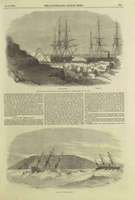
How were vignettes deployed in the ILN’s reporting on the Franklin mission? Patterns are evident, though across a range of historical readers the “particularities of spectatorship,” in Kate Flint’s phrase, remain largely speculative. For example, reviewers of published Arctic narratives were specialized interlocutors and not necessarily representative of other readers.[35] Across the pages noted in the edition of the weekly dated October 28, 1854, vignettes became full-size illustrations, often taking up half a page. Typical is an arrangement of two large pictures divided by an explanatory text. In the issue from October 22, 1853, for example, a page features a depiction of Her Majesty’s Ships “Phoenix” and “Breadalbane” Landing Stores at Cape Riley (fig. 7). At the top, we see a detailed rendition of both ships at anchor, their crews at work on the shore at the left. The bottom image, however, suggests a temporal sequence all too common on Arctic voyages, depicting The Loss of the “Breadalbane” in the ice. Both pictures use “the vignette feature” identified by the ILN to the extent that the images are not framed with lines (though ultimately, they are by the perimeter of the page itself) but instead fade out around the oval circumferences. As noted by Thomas Bewick and many times since, one effect of this format is to put visual emphasis on the theme of the image as revealed in its center.[36] We see a variation of this pattern in the issue of the following week (October 29, 1853), in a tripartite depiction accompanying an article titled “H. M. S. ‘Investigator,’ in the Arctic Regions.” Here, text frames the pictures to the left and right at the top and bottom, but there is no text around the center picture (see fig. 4).
I have emphasized the variety of vignette forms in the ILN. This range of formats includes examples of pictures in rectangular frames presented with others loosely bound but with faded-out edges. An instance notable because of the consequential events shown is Opening of the Cairn on Point Victory Which Contained the Record of Captain Crozier and Fitzjames, which accompanies the article “The Expedition in Search of Sir John Franklin” in the issue dated October 15, 1859 (see fig. 5). In the summer of 1859, McClintock’s mission found a large number of artifacts from the lost Franklin expedition, including the so-called Point Victory document, a one-page record (previously reprinted in the ILN) proving that Franklin died in 1847.[37] The image shows Lt. William Hobson—second in command—and his sledging party vigorously opening a cairn on Point Victory, King William Island. This discovery is not pictured in McClintock’s book The Voyage of the “Fox” in the Arctic Seas (1859). McClintock’s narrative of the event suggests a simpler discovery of the all-important record: “It was found on the ground amongst a few loose stones which had evidently fallen along with it from the top of the cairn. Hobson removed every stone of this cairn down to the ground and rebuilt it.”[38] The display of pickaxes could derive from Hobson’s narrative of his men’s excavation of the nearby Boat Place, where skeletons had been found and removed with these tools.[39] This is the area in which Franklin’s crew abandoned their ships, HMS Erebus and Terror, and initially set off southward on foot toward the Great Back River. The drama of the cairn picture was for the benefit of the ILN’s audience. This scene is in vignette form, but it is the same size as its companion below, The Yacht “Fox” Wintering in the Pack. This conventional portrait of a ship in rectangular format is securely framed by a bordering line. The result is a strong contrast between the relative safety of the vessel as “home” during the expedition and the chaotic opening of the cairn pictured above, a bifurcation that mirrors the relative security of those reading such accounts and the thrilling recognition of the excitement of on-the-spot Arctic adventure. The double illustration follows a lengthy textual description of the event; captions supply the only text around the images.
Whether we call these images “vignettes,” “illustrations,” or “sketches”—terms that were largely interchangeable at this time, although “sketch” is the term used by the ILN in reference to the Point Victory cairn and is discussed further below—the interplay between image and text applies to each term. This characteristic makes possible more than a simple back-and-forth comparison between a picture and a narrative and suggests a third, iconotextual relationship across these pages. If we concur with the idea that borderless vignettes can encourage an imaginative or speculative response, then on many pages of the ILN in which Franklin’s expedition is pictured (both in image and text), the lack of, or perhaps “open,” framing invites all manner of projection on the part of readers/viewers about Franklin and the Arctic generally. Given the fever for Arctic voyaging in the nineteenth century and its inseparability from aspirational heroics, both individual and national, such vignettes summon the clichés and dramatization of these quests.[40] The term “manly” appears in reviews of McClintock’s book, for example, and we witness Hobson and his men vigorously opening a cairn whose important contents they instead found on the ground, according to McClintock.[41] The rebuilding of this structure noted in the text was likely an act of homage to Franklin, but that calmer activity seemed not to provide sufficient charge for an image. The ILN typically reinforced such jingoistic interpretations in its narratives.[42] Describing the vignette Opening of the Cairn on Point Victory Which Contained the Record of Captain Crozier and Fitzjames, the editors gloss the image in the expected patriotic manner: “Who shall tell how they struggled . . . how the fainting few who reached Cape Herschel threw themselves on their knees and thanked their God that . . . He had granted to them the glory of securing to their dear country the honour they had sought for her—the discovery of the North-West Passage.”[43] It is the collaboration—not alternation—between text and image that secures this optimistic understanding of Franklin’s accomplishments.[44]
Another pertinent example of iconotextual interplay in the ILN’s accounts of the Franklin expedition is “Sketches from Captain Austin’s Arctic Expedition,” a two-page spread in the edition dated November 29, 1851 (figs. 8, 9). The second page of this report (see fig. 9) is headed by a large, unframed image of Horatio T. Austin (1800–65) addressing an “exploring party” as they head out on their sled searches, taken faithfully from the frontispiece of Arctic Miscellanies; A Souvenir of the Late Polar Search, written by the officers and seamen of the expedition (London, 1852). The original drawing is by Walter William May, an officer and highly skilled illustrator of Arctic voyages. Five lines of text in three columns separate this image from the next one below, a large oval vignette that shows the Winter Quarters of Sir John Franklin, a panoramic view of an icebound Arctic bay showing three rifle-carrying sailors near a cairn in the center. Though subtended by a running text titled “The Illustrations,” which supposedly “details the accompanying Sketches,” aside from the caption and because this text is a continuation of the general Franklin narrative begun on the previous page, there is no immediate sense that this is Beechy Island, where Franklin’s first winter camp was eventually discovered. Instead, the text discusses atmospheric phenomena pictured on the opposite page, with the effect that the vignettes on both spreads are to some extent unmoored from their discursive glosses, or at the least, that bringing text and image together requires back-and-forth looking.
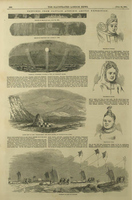
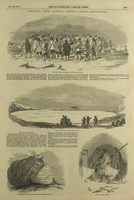
Other images across this spread include the anecdotal Esquimaux Girl (see fig. 8, center right) and “Going out to Dinner” (see fig. 9, bottom right) but also the famed “sandstone Rock” inscribed by noted British voyager William Edward Parry (1790–1855) in 1819–20 (see fig. 9, bottom left). None of these images is mentioned in the text, perhaps because there are in total twelve pictures across a mere two pages. These representations dominate the design and are structurally framed, and only sometimes glossed, by the running text. Gone are the lines that typically divided illustrated columns of text in the ILN of the early 1840s (see fig. 6), underlining Gretton’s point that in such contexts, readers are “encouraged to look at text as much as to read it.”[45] Perhaps as an indication of the large amount of Arctic imagery received in London especially; the public hunger for such details; and the experimentation in format characteristic of the ILN generally, this layout nonetheless contrasts with most pages in the ILN in the 1850s, where text is primary. What is the effect of collecting visual and textual vignettes of the Austin quest and the Arctic in general in this manner? A reader could easily peruse the images or look more carefully with the aid of the text and captions: Both expected Arctic memes (the Indigenous people and remarkable atmospheric phenomena) and specific places and searching protocols are pictured. It is hard to imagine that anyone would only read the narrative, cursory and diminutive as it is. As I have been arguing, a third option for viewers now, as in the past, is to form an overall impression of the Arctic and the specifics of Austin’s search, an iconotext by Louvel’s definition.
Another significant source for visual vignettes embedded in narrative is the proliferation of Arctic voyaging publications in the nineteenth century.[46] McClintock’s popular and highly consequential The Voyage of the “Fox” in the Arctic Seas somewhat awkwardly announces both its conventional status as an official account approved by the British Admiralty and its relative independence from the naval control of searches for Franklin: On one page is the author’s dedication to Lady Jane Franklin, who sponsored the expedition; on another is the belated “Official Acknowledgment of the Services of the Yacht ‘Fox,’” which recognized McClintock’s mission as officially sanctioned after the fact. The book was highly successful: Seven thousand copies were sold in prepublication.[47] Its twenty illustrations are mostly by May. McClintock acknowledges that his own journal—the main source for his book—was much improved for publication by the navy officer and later Admiral Sherard Osborne (1822–75) and by Jane Franklin, the widow of John Franklin, as McClintock would establish by finding, describing, and illustrating the most significant cache of relics from the Franklin mission of 1845. Jane Franklin, who was allied for the most part with the Admiralty when it was searching for her husband and was willing to support private missions when the Admiralty lost interest and balked at the expense, had a clear sense of her husband’s eminence as the discoverer of the Northwest Passage; she edited McClintock’s manuscript with this in mind.[48] The Voyage of the “Fox” in the Arctic Seas was published by John Murray, “publisher to the Admiralty,” as we see on its title page. Without speculating on who chose and guided the illustrations, it is safe to say that they were approved by Jane Franklin and—given their similarity with hundreds of such illustrations in cognate books, many of which were published by the same famous company—even paradigmatic of the pictorial dimension of Arctic voyaging publications at the time.
Pictures in The Voyage of the “Fox” in the Arctic Seas are almost invariably keyed to proximate textual accounts. The themes represented are typical of the genre: some suggest the natural beauty of the region (Moonlight in the Arctic Regions), others the dangers and thus heroics of the endeavor (The “Fox” on a Rock near Buchan Island). Facsimile of the Record Found of Franklin’s Expedition is the most significant document of the entire Franklin search because the Point Victory record from King William Island recorded Franklin’s death in 1847 and the crew’s intent to leave their ships in search of the mainland. A Funeral on the Ice, Village and Glacier, and other significant scenes are also full page, though turned vertically to allow an increase in size. The book also includes several vignettes, marked by their smaller size, faded-out edges, and comparatively anecdotal subjects. Dog Sledge or Scout Party (fig. 10) is an oval-shaped picture showing a possibly nonnative Western man driving a dog sled in an Arctic landscape. In the facing text, itself a literary vignette, we learn that a specific officer is presented (Allen Young), but a more general image of the Arctic—or what the home audience likely took as such—is conveyed in the picture. The pictorial vignette, then, floats around the narrative, allowing a reader to imagine various scenes rather than to see one in detail. Walruses—A Family Party (fig. 11) fulfills what seems to be a need to picture the Arctic’s exotic fauna in anthropocentric ways and the seascape as spectacular more than threatening. A group of four animals on an ice floe in the foreground appears to watch attentively as the Fox sails majestically in front of a large iceberg in the background. Finally, in a section of McClintock’s book titled “Geological Remarks,” we see Isolated Iceberg, engraved, according to a statement below the title, by P. Skelton, from a sketch by Captain Allen Young (fig. 12). The engraver is recognized as much as the on-the-spot artist; they depict an iceberg oddly marooned atop a tall outcropping of rock.[49] This vignette evokes McClintock’s accompanying speculation that “this land gives one the idea of its having risen within a recent geological period from the sea—not suddenly, but at regular intervals.”[50]
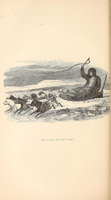
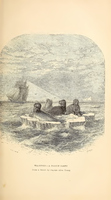
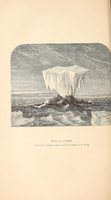
Not only are these vignettes relatively open-ended in their meanings vis-à-vis the narrative but most also have an arched or domed top and, in some cases, a faded-out lower area that stands in sharp contrast to the rectilinear format of the other illustrations here and the faded-out borders of illustrations in publications such as the ILN. This variation in design could be nothing more than an attempt to provide variety. Framing of this sort is also found in Pre-Raphaelite paintings, sometimes to suggest a Gothic architectural setting critical to the Pre-Raphaelite Brotherhood’s dedication to pre-Renaissance Western art. Photography would come to dominate Arctic-voyage books by the later nineteenth century; however, more important to my argument is the visual allusion to nineteenth-century photographs, which were often masked in this way to minimize distortions and imperfections at their top edges. Isolated Iceberg, The Fox Arriving at Beechey Island, and Esquimaux Imitating Animals to Induce Europeans to Approach also suggest an allusion to another type of contemporary photography increasingly deployed in the wide dissemination of Arctic imagery at this time. They are presented in a form identical to that of many contemporary lantern slides, that is, fully outlined with a rounded top and squared bottom. Each of these vignettes also looks like one card in a stereogram. Whether contemporary readers would have recognized this medial cross-referencing is an open question, but for a contemporary audience familiar with the extensive media presentation of Arctic (and of course other) travels in the cities of Britain, Europe, and the United States in the nineteenth century, it would have been hard to miss.
In Arctic contexts as elsewhere, the nineteenth century previewed the multimedia society of today. Oil and watercolor painting, engraving of several types, lithography, and early photography—often mixed in one publication—were common. Plays and illustrated newspapers were created and enjoyed aboard ships in the Arctic. The feverish interest in Arctic themes also manifested in an appetite for panoramas, dioramas, cycloramas, and cosmoramas, which presented the region to mass audiences in large cities and frequently traveled to smaller venues. Magic lantern slides of Arctic themes—some in the format found in McClintock’s book—were increasingly available to would-be lecturers.[51] Adding to the possibility that these vignettes in The Voyage of the “Fox” in the Arctic Seas alluded to contemporary photography and the media display of Arctic voyages is the fact that McClintock was himself an amateur photographer. He experimented with the calotype in 1854 and carried a camera on the Fox.[52] In 1860 he commissioned a set of stereograms by naval officer and amateur photographer John Cheyne picturing the relics he brought back from this expedition, most of which appeared in the domed format.[53] Again in McClintock’s publication, the pictorial vignettes—usually in contrast with their textual interlocutors—invite and support an imaginative, iconotextual response to the Arctic.
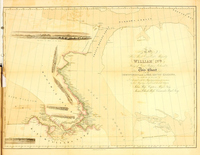
Vignettes were seen not only in extensive printed publications but also—though less commonly—on published Arctic maps and charts.[54] A leading example is the large chart included in an earlier and also acclaimed account of an extensive Arctic voyage, John Ross’s Narrative of a Second Voyage in Search of a North-west Passage [. . .] of 1835 (fig. 13). Included last and laconically titled only “Chart” in the list of illustrations, this fold-out document details in image and text the “discoveries made in the Arctic region” by Ross and his nephew James Clark Ross between 1829 and 1833. Four years is a long Arctic voyage, even in the annals of nineteenth-century expeditions; the Ross expedition was given up as lost. Its unexpected return and this lavish publication helped to rehabilitate John Ross, who was disgraced in Admiralty circles after his first Arctic trip in 1818 because he claimed to have seen mountains that blocked Lancaster Sound, later discovered to lead to a navigable route to the Northwest Passage.
This detailed, hand-colored chart is as elaborate as it is self-serving. At first disorienting because water is more readily visible than land—appropriate in this archipelago nonetheless—the map seems to be in motion. A large dedication to William IV on the right is complemented (though not balanced) on the left by six thin, island-shaped vignettes of the pertinent areas in this region. Three are neatly rectangular; three fade into the surrounding support. While the coastline bristles with minutely written place names along Ross’s route, these landscape images are more sweeping and seem to float across the chart. Prominent in the bottom center, just above King William Island where the Franklin relics were found by McClintock’s crew in 1859, is the vignette Land from the Magnetic Pole to Cape Victoria. James Clark Ross had pinpointed this elusive pole in 1831, a momentous scientific achievement that he and his uncle missed no chance to claim. Some of the vignettes are turned to follow, as well as depict within their bounds, the details of the coastline of Boothia Felix, a peninsula named after the gin merchant Felix Booth, who paid for the journey. They are not easily legible when viewing the map upright, with the dedication readable. Fully upside down in this viewing position is another sliver of coastline. A decidedly unusual compression of visual and textual information, and supremely iconotextual, we can imagine that this chart was meant to be turned, to be viewed from different vantage points by an individual or a group of readers. Today we might say that it is interactive, even performative, given that one could in this way imaginatively follow the route of the expedition. Visual illustrations were seen as desirable embellishments to Arctic narratives; publishers competed to make these books more appealing in this register by enlarging the format and adding color; using highly skilled artists, photographers, lithographers, engravers; and, in this case, coming up with a novel design for the expected map of a given voyage. Ross’s vignetted chart is not a functional navigational instrument but an entertainment and a selling point in the burgeoning travel-book commodity trade.[55]
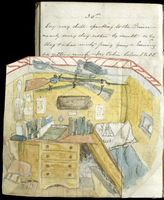
Pictorial vignettes were integral to the look and appeal of published Arctic voyages and—probably as a direct result—also appeared in unpublished, amateur, and largely private journals and logbooks. The Samuel Smith Logbook was the labor of the Hudson’s Bay Company (HBC) surgeon who gives the journal its name, created as he crossed the Atlantic from Gravesend, London, to Moose Fort (later Moose Factory) in James Bay from June to August 1857. Smith was traveling to what we might call, irony aside, an established outpost. Moose was the second of many HBC depots established in Arctic and sub-Arctic Canada since the seventeenth century. The small, octavo book has forty-nine pages neatly inscribed in pencil by Smith. Every page conveys his excitement through narrative, memorable illustrations, and their iconotextual melding.[56] He exploits the book’s diminutive, portable dimensions by pasting in tiny images (for example, the so-called diver bird that wings its way through his written lines [fig. 14]), precisely interrupting and supplementing the narrative, as Louvel suggests. He also expands the confines of the format beyond vignettes by creating inventive foldouts of varying dimensions, such as one of Moose Factory itself (fig. 15). He sometimes uses a full page for illustrations, but because he left ample blank pages in the diary, we can speculate that he had a taste for pictorial variety. Smith was clearly a talented amateur. He writes little about this pastime, however, saying only that he gave one picture to the captain of the ship. Part of the appeal of his two images of his cramped cabin (fig. 16) is the “naive” perspective (the yellow-hued diagram, as he sometimes calls his drawings, of his quarters could be a sketch for one of Vincent van Gogh’s three paintings of his Bedroom at Arles [1888–89]).
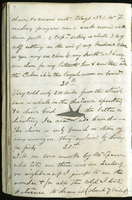
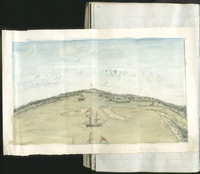
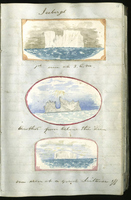
Given the range of sizes and details in Smith’s illustrations, it makes sense to specify only some as vignettes. The foldouts are more extensive in theme, detail, and scope and include landscapes, seascapes, and townscapes that augment Smith’s discursive descriptions of his new environs. By contrast, while still connected to the text, the vignettes are smaller and framed in ways that distinguish them from the foldouts. There is also a close correspondence between narrative vignettes and their pictorialization, both in terms of propinquity in the logbook and theme. In his entry for 3 a.m., July 21, 1857 (see fig. 14), Smith reports that he was awakened by a crew member “who told me there was an Iceberg in sight—Up I jump to see the wonder,” he enthuses, “and for all the cold, I took the patience to draw it (about 7 miles off).” His vignettes of the iceberg appear on the next page in the same entry (fig. 17), accompanied by minimal captions. We see the same iceberg in three views. The captions make this variation clear, but collaborating with these texts are Smith’s imaginatively drawn frames for the pictures. The top vignette shows his first impression at 3 a.m., bordered by a brown rectangle. In the middle is the iceberg in the sun, now framed in a dark red oval. At the bottom is a final, distant view, enclosed in a domed outline in a lighter red. The repetition of the arch format that we saw in McClintock’s illustrations for The Voyage of the “Fox” in the Arctic Seas must be more than a coincidence; I suggest again that both the captain and the surgeon were simply drawing on a popular framing rubric found in nineteenth-century photography and painting. This apparently slight formal overlap, however, is only one basis for the comparison of vignettes appearing at opposite ends of illustrated Arctic narratives—McClintock’s elite publication and Smith’s homey logbook, likely made mostly for his own pleasure. The connection goes much deeper to alert us to the extensive circulation of Arctic imagery and rubrics for its presentation in accompanying vignettes.
I quoted Louvel at the outset as she describes the uniqueness of the iconotext: “The pictorial contribution, an oblique flash of glazing light projected onto the text, activates the pictorial third that is actualised once an image-in-text, an in-between phenomenon, rises in the reader’s mind; it is a dynamic, oscillating between an imagistic reading and a read image. The pictorial third is this vibrant in-between, situated between text and image.”[57] While descriptive of the novel sights he was witnessing, Smith’s iconotext is more significantly his construction of his own imaginary visions of the Arctic. As I noted above, Rosen and Zerner write that the vignette as image, “defined from its center rather than its edges, emerges from the paper as an apparition or a fantasy.”[58] By comparing a range of vignette formats in published illustrated newspapers and in Arctic narratives with Smith’s logbook, we can see that pictorial vignettes—in their functions as iconotextual third terms—can be simply descriptive or in other cases evocatively imaginative. Unlike the typical published vignettes that we have seen in previous examples, Smith, for example, frames icebergs as a way to arrest what was to him an anticipated apparition, an Arctic fantasy come true. For him, and potentially for those who see his logbook and similar accounts today, these always playful, awe-inspired pictures permit the “flash,” in Louvel’s apt term, of the iconotext, a self-awareness that could not arise from either his narratives or pictures on their own. This “third” can only appear in the reader’s perception, sparked by the unique effect of vignettes in illustrated narratives.
Thought of in this expansive way rather than in binary terms as the mere illustration of textual descriptions in Arctic voyaging narratives—and potentially in cognate publications about other regions that are beyond the scope of this article—the vignette can be fully appreciated as a visual record that, with the text, constructs an extended aesthetic entity, one that is often an exploratory flight of imagination. As iconotextual, images that might seem small, incidental, and subordinate to text can take their place as central conveyances in individual publications and accounts and, more broadly, in the art history of nineteenth-century polar exploration.
Acknowledgments
I am grateful to the two anonymous readers for NCAW for many generous suggestions and to comanaging editor Isabel Taube for her adroit editorial touch. My archival research was supported by the Social Sciences & Humanities Research Council of Canada. I am grateful for conversations with librarians at the three repositories in which I consulted the materials discussed here: the Thomas Fisher Rare Book Library, University of Toronto, the Baldwin Collection of Canadiana at the Toronto Public Library, and the Caird Library and Archive at the National Maritime Museum, Greenwich, UK. I am indebted to the many graduate students at the University of Toronto with whom I have discussed the ideas here over several years.
Notes
[1] Ian Chilvers, ed., The Oxford Dictionary of Art, 3rd ed. (Oxford University Press, 2004), accessed June 19, 2025, https://www.oxfordreference.com/ [login required]. This definition demonstrates two other characteristics of the word that will become significant in this article by claiming that the “term [is] now most commonly applied to an illustration or design (especially a photograph) that fades into the space around it without a definite border,” a choice in emphasis between the visual and the textual that predictably favors the former in the context of a dictionary of art. The fade-out is also important, as I show in several examples in the main text. By contrast, The Oxford Dictionary of Literary Terms privileges the textual, defining “vignette” as “any brief composition or self-contained passage, usually a descriptive prose sketch, essay, or short story.” Chris Baldick, The Oxford Dictionary of Literary Terms, 4th ed. (Oxford University Press, 2015), accessed June 19, 2025, https://www.oxfordreference.com/ [login required]. In both definitions, “vignette” is described in part through recourse to another term—“illustration” in the first case, “sketch” in the second—that is also equally applicable in textual and visual contexts. The most common use of the term now appears to be in the field of clinical psychology. Here “vignette” is defined as “a word-picture, a brief verbal outline of a scenario, or a short story about hypothetical characters in a particular situation, to which research participants or interviewees are asked to respond. Vignettes are used in various areas of psychological research including studies related to attribution theory, and they are also used to elicit opinions, attitudes, beliefs, or judgements.” Andrew M. Colman, ed., A Dictionary of Psychology, 4th ed. (Oxford University Press, 2015), accessed June 19, 2025, https://www.oxfordreference.com/ [login required]. Central to my exploration of the vignette is the notion of the word-picture, a concatenation or collaboration that refuses the habitual ranking of word and image. True to the indivisibility of the word-picture, this definition also deploys a bivalent descriptor: outline. On the word-picture, see Peter W. Sinnema, Dynamics of the Pictured Page: Representing the Nation in the Illustrated London News (Routledge, 2012), 47.
[2] Liliane Louvel, Poetics of the Iconotext, trans. Laurence Petit (Routledge, 2016).
[3] Ian Haywood, Susan Matthews, and Mary L. Shannon, eds., Romanticism and Illustration (Cambridge University Press, 2019), 2.
[4] See Liliane Louvel, The Pictorial Third: An Essay into Intermedial Criticism, ed. and trans. Angeliki Tseti (Routledge, 2018).
[5] Eavan O’Dochartaigh, Visual Culture and Arctic Voyages: Personal and Public Art and Literature of the Franklin Search Expeditions (Cambridge, 2022), 81. The disappearance on John Franklin’s 1845 mission to navigate the Northwest Passage of his crew of 128 and his two ships, HMS Erebus and Terror—silent since they departed on the most famous quest for the Northwest Passage and whose loss was the largest official naval disaster recorded to this date—was the occasion for approximately three dozen search missions, massive press coverage in Britain and well beyond, and an extensive visual record of the Arctic from the would-be rescue ships’ crews and land-based artists and engravers in Britain, the United States, Canada, the Nordic countries, and Russia. The literature on this expedition runs to thousands of titles from circa 1848 to the present, and includes plays, songs, and films as well as both scholarly and popular accounts. See Russell A. Potter, Finding Franklin: The Untold Story of a 165-Year Search (McGill-Queen’s University Press, 2016).
[6] For a discussion of the differences between published and private accounts of Arctic voyages, see O’Dochartaigh, Visual Culture and Arctic Voyages.
[7] Charles Rosen and Henri Zerner, Romanticism and Realism: The Mythology of Nineteenth-century Art (Viking, 1984), 81.
[8] Karen Jacobs, introduction to Louvel, Poetics of the Iconotext, 4.
[9] Louvel, Poetics of the Iconotext, 15.
[10] Louvel, The Pictorial Third, 188.
[11] Julia Thomas, Pictorial Victorians: The Inscription of Values in Word and Image (Ohio University Press, 2004), 10ff. See also Anna Maria Jones and Rebecca N. Mitchell, introduction to Drawing on the Victorians: The Palimpsest of Victorian and Neo-Victorian Graphic Texts, ed. Anna Maria Jones and Rebecca N. Mitchell (Ohio University Press, 2017), 1–38.
[12] Tom Gretton, “The Pragmatics of Page Design in Nineteenth-Century General-Interest Weekly Illustrated News Magazines in London and Paris,” Art History 33, no. 4 (2010): 690.
[13] E. H. Gombrich, Art and Illusion: A Study in the Psychology of Pictorial Representation, millennium ed. (Princeton University Press, 2000), 5–6. First published in 1960.
[14] Gombrich’s analysis finds precedent in Ludwig Wittgenstein’s Philosophical Investigations (1953); both articulate an “aspect” theory of perception. To construct my own intermedial analogy, I substitute the textual component of published travel accounts for one of these terms and suggest that a viewer can—though often will not—read and look at the same time and be aware of doing so (see fig. 1 for an example). Also important to this possibility is Gretton’s point that “in these illustrated magazines, the play between image as figure and text as ground treated the magazines’ words in terms of their material existence, casting them as typographic matter rather than reading them as discourse. With these commodities, the magazine’s consumer was . . . encouraged to look at text as much as to read it.” His claim that “pictures add value not so much to the texts with which they cohabit as to the commodity which supports them both” is amply borne out in the often-lavish published accounts of Arctic expeditions. Gretton, “The Pragmatics of Page Design,” 683, 684.
[15] As James Elkins and Erna Fiorentini write, “Art history has a fundamental allegiance toward a certain understanding of formal analysis: the apparently rudimentary inventory of an image’s contents.” James Elkins and Erna Fiorentini, Visual Worlds: Looking, Images, Visual Disciplines (Oxford University Press, 2020), 349.
[16] Versions of this position have been articulated for some time. For example, Mitchell argues that images “are not exclusively visual in any important way.” W. J. T. Mitchell, Iconology: Image, Text, Ideology (University of Chicago Press, 1986), 14.
[17] For a reproduction of the painting, see The Icebergs, Collection, Dallas Museum of Art, https://dma.org/.
[18] See Jennifer Raab, Frederic Church: The Art and Science of Detail (Yale University Press, 2016), chap. 3.
[19] See, for example, Kate Flint, The Victorians and the Visual Imagination (Cambridge University Press, 2000).
[20] For a summary of this culture of display using other than Arctic examples, see Jordan Bear and Catherine Roach, “Introduction: Exhibitions in London, 1763–1851,” Huntington Library Quarterly 87, no. 2 (2025): 153–64.
[21] A prime example is George Vancouver’s negotiations for his lavish publication A Voyage of Discovery (London, 1798). See Julia Lum, “Impressions in Copper: Diplomatic Dispatches in the Engravings of George Vancouver’s A Voyage of Discovery,” in Arctic Fever: Image and Narrative in North Circumpolar Voyaging in the Long Nineteenth Century, ed. Mark A. Cheetham and Isabelle Gapp (Thomas Fisher Rare Book Library, 2026), 148–58.
[22] Haywood, Matthews, and Shannon, Romanticism and Illustration, 5.
[23] That the nineteenth-century protocols and habits of publishers, readers, and sponsors were more significant to the look of publications than the locales described or the wishes of their putative single authors is made clear in Innes M. Keighren, Bill Bell, and Charles W. J. Withers, Travels into Print: Exploration, Writing, and Publishing with John Murray, 1773–1859 (University of Chicago Press, 2015). For the British and Arctic context, see Adriana Craciun, Writing Arctic Disaster: Authorship and Exploration (Cambridge University Press, 2016); I. S. MacLaren, “From Exploration to Publication: The Evolution of a 19th-Century Arctic Narrative,” Arctic 47, no. 1 (1994): 43–53; and O’Dochartaigh, Visual Culture and Arctic Voyages. O’Dochartaigh is especially astute about how engravers, panopticists, and publishers of visual materials in the United Kingdom effected changes in source material supplied by W. W. May, William Henry Browne, and others.
[24] Facsimile of “The Illustrated Arctic News”: Published on Board H.M.S. Resolute, Captn. Horatio T. Austin, C.B. in Search of the Expedition Under Sir John Franklin, ed. Sherard Osborne and George F. McDougall (London, 1852). On polar newspapers, see Hester Blum, The News at the Ends of the Earth: The Print Culture of Polar Exploration (Duke University Press, 2019).
[25] David Blayney Brown, “Draughtsman and Watercolourist,” in J. M. W. Turner: Sketchbooks, Drawings and Watercolours, ed. David Blayney Brown, December 2012, Research Publications, Tate, London, https://www.tate.org.uk/.
[26] Edwin Henry Landseer, Lectures on the Art of Engraving: Delivered at the Royal Institution of Great Britain (London, 1807), 115–16. See also Meredith Gamer, “Vignette Watercolours c. 1826–1842,” August 2006, revised by Matthew Imms, September 2016, in Brown, J. M. W. Turner: Sketchbooks, Drawings and Watercolours, https://www.tate.org.uk/.
[27] Hilary Thompson, “Narrative Closure in the Vignettes of Thomas and John Bewick,” Word & Image 10, no. 4 (1994): 395–408, https://doi.org/10.1080/02666286.1994.10435524.
[28] Chilvers, The Oxford Dictionary of Art.
[29] On the ILN, see Martin Conboy, “Popular Pictures of Imperialism: The Illustrated London News in 1842,” in The Language of Discovery, Exploration and Settlement, ed. Nicholas Brownlees (Cambridge Scholars Press, 2020), 71–84; and Gretton, “The Pragmatics of Page Design.”
[30] The search for John Franklin, his crew of 128, and his two ships, HMS Erebus and Terror, occasioned an industry of illustrated publishing in the nineteenth century that continues to this day in many media. Excellent recent sources on this industry include O’Dochartaigh, Visual Culture and Arctic Voyages; Craciun, Writing Arctic Disaster; and Potter, Finding Franklin.
[31] “The Fate of Sir John Franklin,” The Illustrated London News, October 28, 1854, 421.
[32] Gretton, “The Pragmatics of Page Design,” 685.
[33] Anonymous review of The Chace, the Turf, and the Road, by Nimrod, The Illustrated London News, February 11, 1843, 100.
[34] Craciun, Writing Arctic Disaster, 111.
[35] Flint, The Victorians and the Visual Imagination, 22. Janice Cavell details how some readers responded to other aspects of these illustrated narratives. For his first published Arctic journey (1823), “John Franklin,” she writes, “was eager to have as many illustrations as possible, and Barrow agreed that [Edward] Finden’s work was ‘superlatively beautiful.’ These illustrations gained far more praise than had William Westall’s contributions to [Captain William Edward] Parry’s narrative. [Art critic William] Jerdan called the engravings in Franklin’s book ‘exquisite: they perfectly come up to our often-expressed idea of the style in which such illustrations ought to be executed.’” Janice Cavell, Tracing the Connected Narrative: Arctic Exploration in British Print Culture, 1818–1860 (University of Toronto Press, 2008), 107.
[36] Thompson, “Narrative Closure in the Vignettes of Thomas and John Bewick,” 406.
[37] “Fate of Sir John Franklin’s Expedition.” The Illustrated London News, October 1, 1859, 327.
[38] Francis Leopold McClintock, The Voyage of the “Fox” in the Arctic Seas: A Narrative of the Discovery of the Fate of Sir J. Franklin and His Companions (London, 1859), 303.
[39] Even as sophisticated a reader of the Franklin disaster as Craciun takes this image at face value. See Craciun, Writing Arctic Disaster, 57n85, 62.
[40] Cavell summarizes the point about inflated heroics here: “Journalists and readers actively appropriated the Arctic story, interpreting it in accordance with their own needs and preoccupations, and that it was largely through these appropriations that the broader connected narrative was constituted.” Cavell, Tracing the Connected Narrative, 10.
[41] In another example, Sherard Osborn, an Arctic voyager himself, praised the crew and captain’s “firm manly reliance in God, and their own energy; [the] proofs of a courage which no danger could daunt, and an endurance which no suffering could subdue.” Sherard Osborne, “The Voyage of the Fox,” Times (UK), December 30, 1859, 8. See Cavell, Tracing the Connected Narrative, for many similar examples.
[42] Not all publications were so supportive of the Franklin mission and myth. See Janice Cavell, “Who Discovered the Northwest Passage?” ARCTIC 71, no. 3 (September 2018): 292–308.
[43] “Opening of the Cairn on Point Victory,” The Illustrated London News, October 15, 1859, 364.
[44] It is understandable that Lady Jane Franklin, the captain’s widow and the leading sponsor of McClintock’s as well as other reconnaissance missions, promoted the view espoused by the ILN. Few others believed it at the time or since. See Cavell, “Who Discovered the Northwest Passage?,” 303.
[45] Gretton, “The Pragmatics of Page Design,” 683. For another example, see “Expedition in Search of Sir John Franklin,” The Illustrated London News, May 13, 1848, 318.
[46] There were hundreds of such publications at this time, appearing in a range of languages (and often translated). See Craciun, Writing Arctic Disaster; and Cheetham and Gapp, Arctic Fever.
[47] Craciun, Writing Arctic Disaster, 34.
[48] Craciun, Writing Arctic Disaster, 47.
[49] On the importance of eyewitness accounts and the presumed indexicality of photography, see Jennifer Tucker, Nature Exposed: Photography as Eyewitness in Victorian Science (Johns Hopkins University Press, 2005).
[50] McClintock, The Voyage of the “Fox,” 309.
[51] The J. Theobald Company’s Extra Special Illustrated Catalogue of Magic Lanterns, Slides and Apparatus, which ran to hundreds of pages and was updated frequently, included projection equipment, screens, slide sets, and instructions for the professional and amateur lecturer. Arctic scenes and adventures were frequently a part of this system of dissemination. On the technology’s centrality, see Jill H. Casid, Scenes of Projection: Recasting the Enlightenment Subject (University of Minnesota Press, 2015); and Richard Crangle, “Six (or Seven) Ways of Looking at a Lantern Slide,” in Practices of Projection, ed. Gabriel Menott and Virginia Crisp (Oxford University Press, 2020), 87–103. On the range of Arctic entertainments, see Russell Potter, Arctic Spectacles: The Frozen North in Visual Culture, 1818–1875 (McGill-Queens University Press, 2007); Ann Bermingham, “Technologies of Illusion: De Loutherbourg’s Eidophusikon in Eighteenth-Century London,” Art History 39, no. 2 (April 2016): 376–99; and Robert G. David, The Arctic in the British Imagination, 1818–1914 (Manchester University Press, 2000).
[52] See “Commander Leopold McClintock Tours Beechey Island in 1854 and Creates the First Photographic Record of the Canadian Arctic,” The Searchers (blog), June 22, 2025, https://warsearcher.com/. I am grateful to an anonymous reader for NCAW for this reference.
[53] The Scott Polar Research Institute’s set of these stereograms can be viewed online. See “John Cheyne,” Freeze Frame: Historic Polar Images, Scott Polar Research Institute, University of Cambridge, accessed April 17, 2026, https://www.freezeframe.ac.uk/. On Cheyne’s work for McClintock, see Anthony Hamber, “‘A Welcome, Though a Painful, Gift’: Lieutenant John Cheyne’s Photographic Stereoscopic Views of the Franklin Relics,” in Cheetham and Gapp, Arctic Fever, 108–23.
[54] Gerardus Mercator’s map of the Arctic with the North Pole in the center from 1595—the first such map—has vignettes in three corners. Nineteenth-century maps showing individual countries and entire continents sometimes sported anecdotal vignettes showing national dress, flora, and fauna.
[55] Gretton insists on this aspect of illustrated publications of the mid-nineteenth century. Gretton, “The Pragmatics of Page Design.”
[56] The logbook is held in the Baldwin Collection of Canadiana at the Marilyn & Charles Baillie Special Collections Centre, Toronto Public Library, and available digitally. See Samuel Smith Logbook, 1857, Digital Archive, Toronto Public Library, https://digitalarchive.tpl.ca/. My thanks to Natasha Willems, special collections librarian, for access to this fragile artifact. Thanks as well to PhD candidate and supervisee Anna Foran for conversations about the logbook. A cognate collection of illustrated whaling logbooks (from many locales) can be accessed at the New Bedford Whaling Museum. See Rachel Adler, “Introduction to Whaling Logbooks and Journals,” New Bedford Whaling Museum, New Bedford, MA, accessed April 17, 2026, https://www.whalingmuseum.org/.
[57] Louvel, The Pictorial Third, 188.
[58] Rosen and Zerner, Romanticism and Realism, 81.