Richard Dadd: Beyond Bedlam
Reviewed by Barbara Dayer GallatiBarbara Dayer Gallati
Curator Emerita, Brooklyn Museum
Email the author: barbaragallati[at]googlemail.com
Citation: Barbara Dayer Gallati, exhibition review of Richard Dadd: Beyond Bedlam, Nineteenth-Century Art Worldwide 25, no. 3 (Autumn 2026), https://doi.org/10.29411/ncaw.2026.25.3.21.
This work is licensed under a Creative Commons Attribution-NonCommercial 4.0 International License  unless otherwise noted.
Your browser will either open the file, download it to a folder, or display a dialog with options.
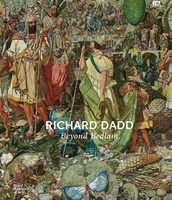
Richard Dadd: Beyond Bedlam
Royal Academy of Arts, London
July 25–October 25, 2026
Catalogue:
Natasha Fyffe, Cora Gilroy-Ware, Robert Howard, Sarah Thomas, and Nicholas Tromans,
Richard Dadd: Beyond Bedlam.
Royal Academy Publications, 2026.
160 pp.; 85 color plates and 42 color illus.; notes; index; bibliographic references.
£30.00 (hardcover)
ISBN: 9781915815194
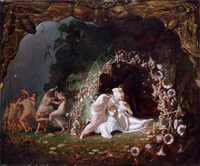
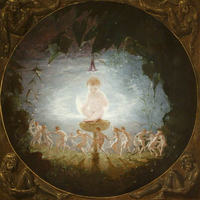
The name Richard Dadd invariably conjures images of bizarre fairylands (fig. 1) and thoughts of his violent murder of his father for which he was institutionalized from 1844 until his death. To be sure, the tragic life and fantastic imagery of the British artist persist in fascinating art historians and the general public alike, confounding efforts to separate biographical and aesthetic assessments of his art.
Dadd was more or less consigned to oblivion from the time of his incarceration, but his reputation was revived in the 1970s, largely through the efforts of Patricia Allderidge, the archivist at the State Criminal Lunatic Asylum Department of Bethlem Hospital (now Bethlem Royal Hospital), where he was confined until his transfer to Broadmoor Hospital in 1864.[1] Allderidge’s research set the bar for Dadd studies, culminating in a Tate Gallery exhibition and informative catalogue in 1974.[2] More than half a century later, Dadd has again become the focus of an exhibition of oils, watercolors, drawings, and archival material selected by a team led by Dadd scholar Nicholas Tromans and mounted by the Royal Academy of Arts.
Carrying the subtitle “Beyond Bedlam,” the exhibition’s tacit aim was to reexamine the artist’s life and output by adopting a strategy that sought to correct the overriding perception of Dadd as merely an insane painter of spectacularly and willfully strange fairy subjects. The exhibition succeeded, bringing into public view the full range of his oeuvre. For the most part, the exhibition followed a conventional, chronologically arranged survey that simply aimed, as the introductory wall text stated, “to highlight his remarkable powers of imagination and memory.”
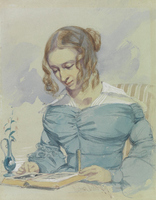
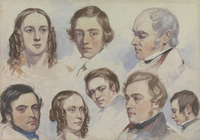
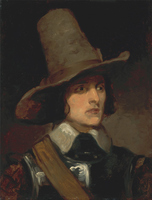
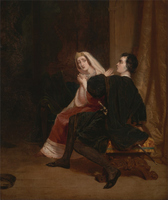
The exhibition opened with a small section highlighting Dadd’s early years. The introductory wall text provided basic information concerning the artist’s birth in Chatham, Kent; the death of his mother when he was a child; and the family’s move to London in 1834, where his father (previously a chemist) opened a gilding business on Suffolk Street in the heart of the city’s artistic officialdom. Dadd entered the Royal Academy Schools in 1837, and the student works in this section demonstrate his artistic promise. Among them were delicately handled watercolors portraying family members (figs. 2, 3) and an oil portrait of Augustus Egg (fig. 4), a fellow student with whom Dadd and others formed the “Clique,” an art club modeled after the older Sketch Club. As the large Scene from Hamlet (fig. 5) revealed, the subject matter Dadd addressed reflected the academic training he received and displayed his preference for Shakespearean themes, which were then in vogue.[3] Broadly painted and relatively unpolished, such oils nevertheless bear witness to the young artist’s ambitions to achieve academic success. Consideration of Scene from Hamlet brings up a problem that occasionally surfaced in the object labels throughout the installation. Although most of the labels had explanatory texts, the one for Scene from Hamlet did not, leaving the viewer unfamiliar with the play to wonder just what was happening in the narrative to cause the sense of emotional distress that the image transmits. In this case, the painting might portray the instant in which Hamlet sees the ghost of his father during an audience with his mother—or it might be a conflation of two moments from the same scene, the other showing an earlier moment in the narrative when Hamlet hears Polonius behind the curtain. In any event, this Shakespearean subject reveals Dadd’s early predilection for uncanny and emotionally fraught imagery.
The first gallery laid the groundwork for the subsequent sections and led easily into the next space, which explored Dadd’s penchant for fairy imagery and how it brought him critical approval.[4] The Shakespearean and other literary themes he chose to paint confirm his continued desire to maintain academic approval and allowed him to feature fairy themes; as the wall text for this gallery pointed out, Dadd looked to the work of more senior artists (specifically, Sir Joshua Reynolds and Daniel Maclise) for inspiration while putting his own imaginative touch to depictions of tried-and-true sources, especially A Midsummer Night’s Dream.
Helpful labels bearing comparative reproductions accompanied some of the works on view. For example, a reproduction of Maclise’s The Disenchantment of Bottom (1832; Wadsworth Atheneum, Hartford) was placed near Titania Sleeping (see fig. 1), the work that cemented Dadd’s reputation as a rising artistic star when it was shown at the Royal Academy in 1841. Although vastly different in mood and conception, both paintings share in visualizing the physical abandon of nude fairy dancers and the use of garland-like arrangements of goblins and sprites to establish compositional structure. Oddly, the charming Puck (fig. 6), another of the artist’s breakthrough works, did not have an explanatory label text that might have linked the work to Reynolds’s painting of an impish infant Puck, which had retained currency through print reproduction.[5]
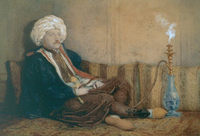
The third gallery, titled “The Eastern Mediterranean Tour,” was devoted to the drawings and watercolors Dadd produced as a result of the journey that dramatically changed the trajectory of his life. In 1842, the Welsh politician Sir Thomas Phillips hired Dadd as an artist-travel companion on a tour that would take them through Europe to the Eastern Mediterranean.[6] They set out in July 1842, and visited, among other places, Constantinople, Damascus, Jerusalem, and Egypt. By the spring of 1843, Dadd was exhibiting paranoic tendencies and a disturbing attitude of antipathy toward Phillips, who parted company with him in Paris on the final leg of their journey. Although the original plan was that Dadd would create works along the way for Phillips to document the tour, the challenging conditions of the journey prevented the artist from accomplishing much beyond making small but detailed sketches that would be the foundation for later works. Nevertheless, the trip generated a remarkable array of watercolors and drawings (figs. 7, 8), none of which seem to portend the mental breakdown that would shape the rest of his life. What is more, as the wall text noted, the tour placed Dadd within “the first wave of British ‘Orientalist’ artists of the 1830s and 40s.” What also became clear is that the sketches he made on the trip would be integral elements in his creative process for the rest of his life.
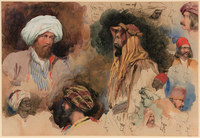
At this point in the exhibition, the chronology became slightly skewed, most likely because of the exigencies of installation design and the need to incorporate the narrative regarding the manifestation of Dadd’s psychosis. A wall text, “Illness and Hospitalisation” provided a brief summary of the facts surrounding Dadd’s mental breakdown, an extended version of which follows here.
On his return to England, Dadd’s erratic behavior became increasingly worrisome for his family, who contemplated his confinement. This was not done, however, and the end result was Dadd’s violent murder of his father, whom he stabbed in a park on August 28, 1843. The gruesome details of the dreadful event were reported widely in the British press, where it was concluded that his actions were the product of an “aberration of intellect” exacerbated by the effects of “a coup de soleil” (sunstroke) and overwork.[7] Dadd fled immediately to France, where he was apprehended and sent to an asylum near Paris. He was extradited in July 1844, and remanded to the State Criminal Lunatic Asylum Department of Bethlem Hospital, Southwark, London, the following month.
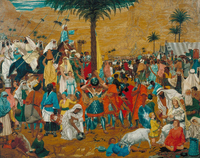
With the introduction of the events leading to Dadd’s hospitalization in place, the final portion of the “travel” gallery displayed a group of works that Dadd executed well after he was institutionalized. The Flight out of Egypt (not his title) (fig. 9) within this section came as an abrupt shock. Stylistically unique within Dadd’s oeuvre, the large work underscores the extent of the aesthetic extremes that emerged in his post-breakdown production. The riotously colored canvas is populated by a host of cartoonish figures engaged in a variety of activities. Replete with spatial incongruities and odd compositional ploys (such as the palm tree bisecting the scene), the painting defies exact interpretation. As the label stated, “The story of the Israelites being miraculously provided with a stream of water while wandering in the wilderness following their exodus from Egypt is combined with the Holy Family’s escape into Egypt.” The chaotic composition suggests the painting was born of a miscellany of disordered, fragmentary impressions—memories of his Mediterranean tour filtered through a deranged mind to create an anachronistic image blending two biblical flights in and out of Egypt.
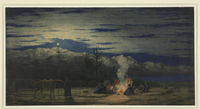
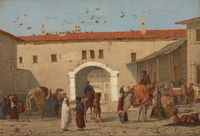
The changeable nature of Dadd’s art making was vividly substantiated by several works installed nearby, among them The Artist’s Halt in the Desert (fig. 10) and Caravanserie at Mylasa (fig. 11). Both works confirm that he maintained the ability and desire to create watercolors and oils that were relatively traditional in appearance. However, it must be noted that the paintings cited here contain what might be called Dadd’s “signature visual pranks.” In one, the point of a spear touches the moon (an orb that is literally made of paper and applied to the watercolor). In the second work, the viewer is teased by the overlapping camels’ heads, a disruptive compositional oddity that breaks the observer’s attention. It is impossible to know if these pranks can simply be considered the products of mental instability or if they were just visual witticisms that pleased Dadd.
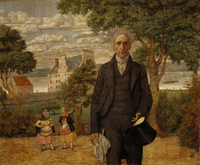
The next gallery was entirely devoted to works Dadd executed over the twenty-year period in which he was confined at Bethlem. There he was allowed to pursue his art, a privilege that may be seen as an early form of art therapy. As the introductory wall text entitled “Bethlem” stated, he was on good terms with the staff, some of whom sat to him for their portraits. Of particular note was Dadd’s ambitious portrait Sir Alexander Morison, the visiting physician for the Criminal Department in which the artist was held (fig. 12). Here the issue of observation versus memory comes to the fore. The figure of Morison is rendered relatively naturalistically, and the portrait is undoubtedly the product of several sittings. The landscape elements, however, are based on drawings of the doctor’s home near Edinburgh that were supplied by Morison’s daughter. As a result, the landscape (a product of both information and imagination) reads as a theatrical backdrop upon which the figure of Morison is superimposed. The painting echoes the format of grand manner portraits showing sitters in the context of property ownership.
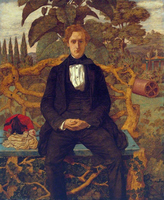
A second impressive work, Portrait of a Young Man (fig. 13) is believed to portray Dr. William Charles Hood, the physician who arrived at Bethlem in 1852.[8] However, the object label provided no commentary whatsoever. As in the Morison portrait, the sitter is positioned in a landscape—this time, one that seems entirely of Dadd’s making. The stolid figure is hieratically posed, seated on a garden bench, the twisted forms of which seem to possess a life of their own. Next to him is a red fez, which may refer to Dadd’s journey to the Middle East. The leaves of a giant sunflower (perhaps an allusion to the Egyptian god Osiris, whom Dadd believed to be his true father) frame the sitter’s head. The absence of any explanatory label text for this painting is bothersome since the iconography suggests that Dadd invested the work with highly personal content and because the catalogue authors generally agree that the sitter is Hood.[9]
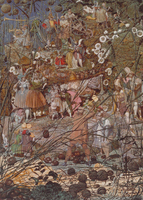
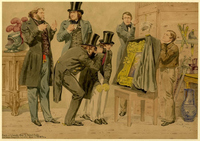
It would not be surprising if a preliminary glance around the gallery left viewers with the impression that they were seeing works by multiple artists. Turning from the solidly and broadly painted oil portraits of Morison and the presumed Hood, viewers encountered a selection of fairy pictures including the now-famous The Fairy Feller’s Master-Stroke (fig. 14), a painting announcing Dadd’s return to Shakespeare-inspired themes—in this instance, to the passage about Queen Mab from Romeo and Juliet, act 1, scene 4. Characterized by an intensely detailed, tapestry-like application of paint, the finely wrought surface works against the perception of three-dimensional forms in space. The ultimate effect is an overwhelming sense of disorientation as the eye scans an intricate maze of shapes. Perhaps, however, this method was the artist’s intended means of emphasizing the divide between the fairy world and our own. In contrast, Sketch of a Curiosity Shop (fig. 15) revealed Dadd’s facility in creating a conventional, humorous genre scene depicting a prospective purchaser’s examination of a painting with the aid of binoculars. Likely suggested by illustrations in books and magazines that Dadd was permitted to have, the watercolor provides a sly comment directed at the art world to which he had aspired and from which he was excluded.
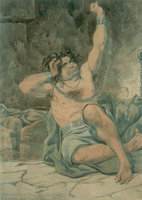
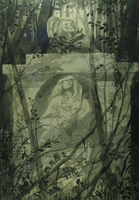
Sixteen watercolors, shown as a separate section within the gallery, were from The Passions, a series of thirty-two works executed from 1853 to 1857. The imagery centers on a panoply of human emotions and actions, organized in a manner reminiscent of traditional iconographic treatments of the seven deadly sins overlaid with nineteenth-century taxonomic systems designed to define types of mental states. Dadd’s application of remarkably diverse stylistic tactics is highlighted by pairing Sketch to illustrate the Passions, Agony—Raving Madness (fig. 16)—a singular image in Dadd’s oeuvre with its dramatic reference to the inhumane treatment once inflicted on asylum inmates—and the grisaille Sketch to illustrate the Passions. Grief or Sorrow (fig. 17). It has been speculated that Hood recommended the project to Dadd as a therapeutic exercise. Whatever the case may be, the series alone reveals the remarkable breadth of creativity that distinguishes Dadd’s art.
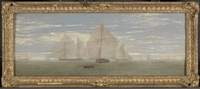
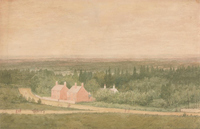
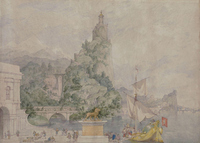
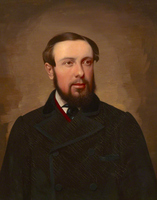
The final gallery contained works Dadd executed after his transfer to Broadmoor Hospital in 1864. Located in a rural setting near Reading, the new facility, which opened in 1863, offered expansive views of the surrounding area and was a welcome contrast to the overcrowded conditions of Bethlem. The calming surroundings seem to have had an effect on Dadd’s art in that he gave greater attention to landscape subjects. As Sailing Ships (fig. 18) and Landscape with Cottages, Broadmoor (fig. 19) demonstrate, such works were the result of combining elements derived from memory (aided by his sketchbooks), imagination, and observation of the Berkshire countryside. What was probably more important, Dadd’s stay at Broadmoor presented the opportunity for him to perform in a quasi-professional capacity; he was given his own studio and assumed the unofficial role of the hospital’s resident artist, creating murals to decorate the new facility’s bare walls. Among other things, Dadd’s projects extended to designing a drop-curtain for the hospital’s theatre (fig. 20). This rather enlightened treatment of Dadd was doubtless supervised by Dr. William Orange, whose portrait hung immediately to the right upon entering the gallery (fig. 21). When compared to earlier portraits (e.g., figs. 12, 13), Dadd’s depiction of Orange is astonishingly bland, so routine in fact, that one might suspect that it was based on a photograph. Unfortunately, no information was provided about the sitter or the circumstances behind the making of the portrait apart from the standard object label data of title, medium, and ownership.[10]
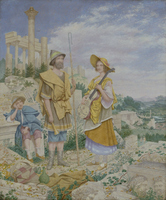
Dadd’s last oil painting, Wandering Musicians (fig. 22) furnished the closing note for the exhibition. As with Dadd’s iconography in general, the image is based on an amalgamation of sources reaching back to his travels to the Middle East while referencing his abiding fondness for music (he played the violin) and for the classical Greek pastoral poets whose names are inscribed on the fragments of low relief portraits at the bottom right of the painting. The relationship between the two static main figures and the one who glances up at them from his seated position is provocative; whereas the younger figure—possibly meant to be the son of the couple portrayed—seems to be utterly bored as he stares impatiently at the motionless man and woman who do not interact with each other and who hold, but do not play, their musical instruments. The object label for the painting suggested that the adult male resembles Dadd. If that is the case, then the following question arises: could Dadd have identified with the inert figures and equated their apparent state of suspension with his own suspended life in asylums? And could the seated boy represent the boredom and frustration that undoubtedly dogged the artist during his years of confinement? These questions will never be answered, just as the exact meaning of much of his artistic production will remain forever concealed.
That Dadd was tied to no one style or theme was made abundantly clear throughout the exhibition, proving especially that his interests went far beyond fairy subjects. One can only conclude that Dadd was truly an artist above anything else, a man whose pictures were, as his close friend William Powell Frith said, “evidences of genius, and, a lot of insanity.”[11]
Richard Dadd: Beyond Bedlam was accompanied by a richly illustrated, well-organized catalogue of the same title that includes four main essays and a series of short, one-page introductions to thematically arranged sections reproducing the objects in the exhibition.
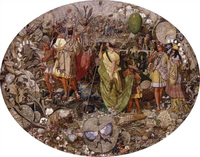
Nicholas Tromans’s lead essay, “Time out o’ mind: The Art of Richard Dadd,” enlarges upon major points introduced in the exhibition, mainly with respect to Dadd’s belief that little had changed since classical antiquity (10).[12] The essay further elaborates on events that occurred during Dadd’s tour with Phillips, conditions the artist experienced in Bethlem and Broadmoor, and, what is most interesting, how and why some of Dadd’s works reached private hands over his years of confinement while others did not. In connection with the latter, Tromans’s illuminating discussion describing how both Dr. Morison and Dr. Hood came to have sizable collections of the artist’s work was particularly notable, especially with regard to the importance of the 1870 auction of Hood’s collection, which included thirty-three works by Dadd, among them Contradiction. Oberon and Titania (fig. 23). As Tromans states, “The Hood sale was the single most important event in the rediscovery of Dadd before the arrival of the Fairy Feller (see fig. 14) at the Tate in the 1960s” (24). An account of the extent of institutional control over Dadd’s artistic output was particularly significant. It is fascinating, for example, to learn that in 1856 the administration at Bethlem forbade the release of any more of Dadd’s art from the institution and sternly told Morison to keep his Dadd collection private (25). In the end, Tromans cites the changes in the histories of psychiatry and of British art that have occurred since the Tate exhibition devoted to Dadd in 1974 and muses about whether the current project will alter our perceptions of the man and his art (31).

Sarah Thomas’s essay, “The Child’s Problem: Dadd and the Enigma of History,” provides a stimulating in-depth analysis of a single work, the baffling watercolor The Child’s Problem (fig. 24). One of the strangest compositions Dadd produced, the watercolor shows a young boy peering over a table’s edge as he reaches to grasp a chess piece to make his next move. Next to him is his opponent, an elderly man whose closed eyes suggest slumber or, as Thomas offers, may be playing the game “sans voir.”[13] Among the odd assortment of objects placed throughout the composition are three telling “images-within-the-image”—a watercolor or print based on the famous anti-slavery broadside, Am I Not a Man and a Brother?; a marble sculpture of a crouching woman identified as Ceres (based on the second century Roman Crouching Venus); and a painting of a ship at sea, which Thomas associates with the revolt aboard the Amistad and with Turner’s famous Slave Ship (1840; Museum of Fine Arts, Boston) that was shown at the Royal Academy in 1840, a year in which Dadd also exhibited. With these and the larger inventory of items she catalogues, Thomas posits that these objects lead to the conclusion that Dadd intended to communicate content focusing on abolitionism (33). She supports this theory by summarizing the continued British interest in abolition, citing the activities of the British and Foreign Anti-Slavery Society, especially the society’s major convention held in London in 1840. To this she added Dadd’s family connection with Henry Gardiner Adams, who edited God’s Image in Ebony (1854), an abolitionist publication dedicated to Harriet Beecher Stowe.[14] Dadd and Adams were also connected professionally; in 1840/42 he illustrated Adams’s Walpurgis Night and Other Stories (37).
Thomas was careful in backing up her thesis. Even when her assertions cannot be conclusively proved, her arguments are cogent and thought-provoking. The bulk of the essay is directed to an abolitionist reading, which Thomas takes as proof of Dadd’s awareness of contemporary cultural issues existing outside of his institutional environment. Yet in the end, she prevaricates, stating that the painting is filled with “tantalising details that refuse a literal reading. Here history is both everywhere and nowhere. The ‘problem’ is not only that of the child, as the work’s title would have us believe, but speaks to the riddle of the picture itself” (37).
Cora Gilroy-Ware’s essay, “A Deadly Inheritance,” examines Dadd’s prepsychosis treatment of the nude female figure. Using Titania Sleeping (see fig. 1) to anchor her discussion, Gilroy-Ware tracks the various artistic influences that affected Dadd’s depictions of the nude during the years in which his career was on the rise, noting that “the success of Dadd’s paintings arose from their conformity to long-established tastes” (38). She underscores the lack of a strong tradition of nude imagery in Britain (owing in part to Protestant prudishness) and follows this with a list of Dadd’s aesthetic forefathers. Academicians all, Reynolds, James Barry, Henry Fuseli, Thomas Stothard, Richard Westall, John Flaxman, William Etty, and Henry Howard, paved the way for critics’ acceptance of Dadd’s nude fairies.
As the author points out, however, not all of Dadd’s predecessors agreed on the manner in which the nude body should be represented. For instance, Etty’s nudes were thought by some viewers to be pornographic, while Howard, Dadd’s instructor at the Royal Academy, was known for his rather tame, anatomically inaccurate interpretations of the human form. The author concludes, “Building on both, Dadd tempers Etty’s unabashed, potentially pornographic eroticism with Howard’s self-consciously chaste and incorporeal approach to the human form” (42).
Gilroy-Ware further theorizes that the pressure to absorb a multiplicity of visual sources to which Dadd had access generated his extreme anxiety. To explain this, she refers to comments about Titania made by the nineteenth-century poet/sculptor John Lucas Tupper, who described his experience of viewing the interlaced bodies of the fairy queen and her attendants as “sleep jumbled memories of things,” saying that it seemed as if he had seen the painting before (39). From there, Harold Bloom’s concept of the “anxiety of influence” is called into play, placing “intra-[artistic] relationships as parallels of family romance” (44).[15] At this point Gilroy-Ware poses the question: “Was the weight of artistic inheritance too much for the already vulnerable [artist] to bear? Perhaps his violent act [was] an expression of a deep and unbearable anxiety of influence?” (45). Here, her argument becomes suspect as she proposes that Dadd’s murder of his father was somehow connected to a desire to kill “his anachronistic family of artistic fathers” (45).
Psychiatrist Robert Howard’s “Understanding Richard Dadd’s Illness” offers a striking contrast to the interesting, albeit ultimately speculative, psychoanalytic ideas that flow through the other essays. Written in a straightforward manner, Howard’s essay begins by establishing schizophrenia as a diagnosis for Dadd based on the available evidence and noting that two of the artist’s siblings also suffered from similar types of mental illness. Howard proceeds to trace the onset of Dadd’s symptoms, relying on Phillips’s post-tour correspondence and the artist’s rare descriptions of his feelings that he wrote after his admission to Bethlem. The events of Dadd’s life—his incarceration in France and confinement at Bethlem and Broadmoor—are interwoven with expert commentary on the behavior(s) associated with schizophrenia and the type of treatment patients received at each of the institutions. Most striking was the lack of case notes that would aid in assessing Dadd’s progress or lack thereof.
The remainder of the essay enters the realm of “what if?” by imagining a twenty-first-century Dadd and the course of treatment he would be afforded today. Considered first is the legal issue. Whereas Dadd was simply deemed an insane murderer, a lawyer today would have advised a plea of manslaughter on account of diminished responsibility, which would then result in his being sent to a hospital facility for treatment. With the benefit of antipsychotic drugs and other therapies now available, the patient’s chances for eventual release into supervised community accommodation would have been strong. Finally, Howard observes that Dadd was “eager” to explain (however irrationally) the inspiration for The Fairy Feller’s Master-Stroke (see fig. 14), yet he seems not to have been encouraged to do so by his doctors.[16] Howard asserts that had Dadd been living today, it is probable that the intensity of his delusions would have been mitigated by the recognition of the “power of art to reveal the inner journeys of people with mental illness” (52).
The four essays discussed above precede a section, titled “Catalogue Plates,” in which all of the works exhibited are reproduced in color and roughly arranged according to the sequence in which they were installed in the galleries. Each of the seven subsections is introduced by a one-page synopsis written by the Royal Academy’s Assistant Curator, Natasha Fyffe, who deftly managed to incorporate salient biographical and art historical information succinctly and clearly.
In connection with the authors, only Fyffe’s affiliation is indicated in the President’s Foreword. Having a few sentences regarding affiliations and specialties for each of the authors (perhaps at the head of the endnotes) would have been welcome.
The book design is flawed only by the reproduction of three key works (The Artist’s Halt in the Desert [fig. 10], The Flight out of Egypt [fig. 9], and Contradiction. Oberon and Titania [fig. 23]) across two-page spreads. As a result, parts of the images are lost in the valley of the spine.
On the whole, the catalogue is a fine introduction to Dadd’s life and art, but if deeper understanding of the man and his art is wanted, one must also look to Allderidge’s 1974 catalogue for the Tate exhibition, which not only functions as a baseline catalogue raisonné, but also provides extensive commentary (including inscriptions and provenance) for individual works. Together, the two catalogues form a fine basis for further Dadd studies.
Notes
[1] Founded in 1247 as a hospital for paupers, Bethlem (or Bedlam, as it became known) began specializing in housing the mentally ill by the 1300s. For a thorough account of the institution’s history, see Jonathan Andrews, ed., The History of Bethlem (Routledge, 1997). The Bethlem Museum of the Mind holds a significant body of Dadd’s art in addition to archival material. Labels in the exhibition informed viewers of this and stated also that Dadd’s medical case notes were currently on view there.
[2] Patricia Allderidge, Richard Dadd (Tate Gallery, 1974).
[3] For a survey of Shakespearean subjects in art, see Jane Martineau and Desmond Shaw-Taylor, eds., Shakespeare in Art (Merrell, 2003).
[4] For Dadd’s place in the context of fairy subject matter, see Jane Martineau, ed., Victorian Fairy Painting (Royal Academy of Arts, 1997).
[5] Reynolds’s painting was shown at the Royal Academy under the original title of Robin Goodfellow in 1789 and distributed widely in print reproduction made by C. Heath in 1827. The characters of Puck and Robin Goodfellow were interchangeable and it should be noted that Dadd was commissioned to provide illustrations to the poem “Robin Goodfellow” in Samuel Carter Hall, ed., The Book of British Ballads (Jeremiah Howe, 1842). Dadd’s drawings were translated into wood engravings by W. T. Green for the volume. An example from Green’s book was displayed in the first gallery, but there was no attempt to link it with the oil painting, Puck, in the next room.
[6] It should be noted that Dadd’s father, Robert Dadd, was a close friend of the Orientalist painter David Roberts, who, in turn, was a friend of Phillips. It is thought that Roberts recommended Richard Dadd to Phillips.
[7] “Further Particulars,” Sunday Dispatch, London, September 3, 1843, 10; and “Murder at Cobham Park,” The Examiner, September 2, 1843, 13.
[8] This is discussed as a strong possibility in Allderidge, Richard Dadd, 87, and in Tromans’s catalogue essay for the current exhibition (19).
[9] Although the author is not a proponent of iconographic readings that cannot be proven, there seems to be enough visual evidence in this painting to warrant further investigation as to what symbolic meaning (if any) Dadd may have embedded in this imagery. For example, Tromans suggests that Dadd’s fixation on Osiris, a sun god, may have some relation to the way he portrayed the sitter, presumably Hood, who held benevolent power over him in the hospital and whose head is framed by sunflower leaves.
[10] Orange joined the staff of Broadmoor in 1862 and assumed the post of superintendent in 1870.
[11] William Powell Frith, My Autobiography and Reminiscences, 2nd ed., vol. 3 (Richard Bentley and Son, 1888), 182.
[12] Tromans’s use of “time out o’ mind” in the title of his essay relates the concept of time immemorial to Dadd’s general world view: “What is true or what was true then must be true now in spite of new doctrines and religious suum cuique.” Unfortunately, his explanation is inadequate and when seeking to find the source for this, the reader is taken to an endnote that merely cites another publication by Tromans. See Nicholas Tromans, “‘Pruning a Genius’: Marginalia by Richard Dadd,” History of Psychiatry 32, no. 2 (2021): 127–45.
[13] The phrase sans voir (literally, “without seeing” in French) is used here with respect to a way of playing chess without actually seeing the board or handling the pieces. The process relies on memory.
[14] Slavery was abolished in the British Empire in 1833 through an act of Parliament.
[15] Harold Bloom, The Anxiety of Influence: A Theory of Poetry (Oxford, 1973).
[16] Robert Howard emphasizes that it was the painting’s owner, George Henry Haydon, and not Dadd’s doctors who requested an explanation of the artist’s intent. Dadd replied with a written response (“Elimination of a Picture & its Subject”), which was on view in the exhibition and reproduced in the catalogue (104).