Animal Modernities: Images, Objects, Histories edited by Daniel Harkett and Katie Hornstein
Reviewed by M. Elizabeth BooneM. Elizabeth Boone
University of Alberta
Email the author: mboone[at]ualberta.ca
Citation: M. Elizabeth Boone, book review of Animal Modernities: Images, Objects, Histories edited by Daniel Harkett and Katie Hornstein, Nineteenth-Century Art Worldwide 25, no. 3 (Autumn 2026), https://doi.org/10.29411/ncaw.2026.25.3.9.
This work is licensed under a Creative Commons Attribution-NonCommercial 4.0 International License  unless otherwise noted.
Your browser will either open the file, download it to a folder, or display a dialog with options.
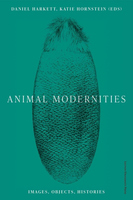
Daniel Harkett and Katie Hornstein, eds.,
Animal Modernities: Images, Objects, Histories.
Leuven University Press, 2025.
320 pp.; 99 color illus.; notes; bibliography; index.
$69.00 (paperback)
ISBN: 9789462704589
The importance of nonhuman animals to humans and to our understanding of art is beginning to be recognized, with a new anthology of essays edited by Daniel Harkett and Katie Hornstein adding to a much-needed body of literature. The collaborative product of a conference and workshop sponsored by the editors, Animal Modernities: Images, Objects, Histories, according to its back cover, “challenges the traditional human-centered focus of art history and explores how modern art, visual culture, and modernity itself emerge from relationships between humans and animals.” The premise of this volume is important: our understanding of art and modernity will be enriched if we abandon one of the most persistent binary distinctions—nature vs. culture—that contributes to our steadfast belief in human exceptionalism.
Apart from two contributors from the field of literature, the fourteen authors included in this volume are art historians who research and write about the long nineteenth century. This is the period during which artistic modernism developed, and one of the unstated messages of this volume is that the history of modern art is justifiably unsettled when humans and other animals are considered together. Most of the essays treat North American (the United States and Indigenous Canada) and Western European topics, although the two chapters that treat elephants, by Niharika Dinkar and Katherine Fein, take readers to India and sub-Saharan Africa respectively and a third, by Laura Nüffer, considers a series of Japanese pornographic images of serpents attacking women.
The anthology begins with an essay by Nina Amstutz, although the editors in their introduction discuss this at the end of their chapter presentation. This appears to be a deliberate decision, the reasons for which will become clear at the end of this review. Amstutz’s essay, “Rethinking the Animal in Art History: Charles Darwin, Karl Woermann, and the Bowerbird,” should be required reading for all scholars of art history. Beginning with the work of foundational art historian Erwin Panofsky (who is also cited in the book’s introduction), Amstutz shows how our discipline has been written to enforce and reinforce the human/animal divide. Panofsky argued that although animals create—bird nests, beaver dams, termite mounds, etc.—they fail to separate their idea (as evidenced by a premeditated plan) from their material production and therefore do not create art; they work solely by instinct. But scientists today are questioning and refining our understanding of instinct as opposed to acquired behavior; some are even asking whether instinct exists at all.[1] There are still many things that we humans do not (and may never) know about other sentient beings. And our conception of a premeditated plan may be completely different from the almost infinite number of anatomical configurations, to say nothing of creative processes, employed by the diverse range of living species that populate Earth.
Verlyn Klinkenborg makes a similar claim in a recent review of five books: Peter Godfrey-Smith’s Other Minds: The Octopus, the Sea, and the Deep Origins of Consciousness and two other volumes by him; David Scheel’s Many Things Under a Rock: The Mystery of Octopuses; and Craig Foster’s Amphibious Soul: Finding the Wild in a Tame World. Here we learn that “an octopus’s brain is distributed throughout its soft, amorphous body: nine brainlike nerve clusters, one at the base of each arm and another in its head.”[2] But the “head” of an octopus is unlike the head of a mammal; it is a mantle, one that also encloses the animal’s digestive, reproductive, and circulatory systems. The brain in the head of an octopus is no more important than the brain in any one of its eight arms. Anthropomorphism, as defined by Scheel, is “giving human shape to animal sensory and behavioral worlds.”[3] Anthropomorphism is a double-edged sword; it enables us to recognize our shared evolutionary ancestry, but it can also prevent us from recognizing and valuing alternative forms of intelligence, creativity, and art.
Amstutz, for her part, takes us back to Charles Darwin’s foundational book The Descent of Man, and Selection in Relation to Sex (1871) and Karl Woermann’s History of Art of All Cultures and Times (1900–22). Pointing to the bowerbird—a group of roughly twenty avian species native to Australia and New Guinea—Darwin argued that animals choose to mate not just because potential partners can overpower competitors but also based on physical appearance. Beauty provides pleasure, and not just in humans. Given that many species rely as much if not more on senses other than the optical—sound, smell, taste, and touch—we might expand Darwin’s point to a more capacious definition of beauty than one simply afforded by sight. Multidisciplinary artists incorporating these other senses into their work make this obvious to us today. Woermann, struggling at the turn of the twentieth century to incorporate Darwin’s ideas into a history of art, elected to classify the colorful nooks bowerbirds created, and before which the male birds dance to attract a mate, along with beaver lodges and termite mounds, as “proto-art.” He even included an illustration of these creations as the first plate in his book, following it with a discussion of prehistoric and what was then called “primitive” art, the production of Indigenous peoples and sub-Saharan Africans.
Amstutz writes that Woermann’s narrative of artistic development (one that positions the production of animals and nonwestern people as forerunners to and less developed than the art of Europe) aligns with a gross misunderstanding of Darwinian evolution. Where Woermann erred was in visualizing evolution as a linear process (like the Great Chain of Being) as opposed to a tree, with branches growing from a single trunk and developing in a multitude of directions. Today’s octopuses are the leaves that sprout from one branch of the tree, while we art historians sprout from another. Amstutz further argues that “Darwinian texts such as Woermann’s began to narrow the ontological gap between human and animal, but in so doing, they also reified racial hierarchies” (45). If we now challenge notions of Western supremacy by accepting Maasai and Zulu shields as art, should we not also begin to challenge “the idea that civilization, and respectively the fine arts, is a sublimation of nature into culture” (46)? What are these nonhuman animals creating, if not art?
From this provocative essay, the volume unfolds in less surprising but still useful ways. An essay by Rosalind Hayes reminds us that many materials—in this case those related to early photography—are derived from animal bodies, thus adding to earlier work on this topic.[4] The essays that follow begin to consider how animals, even when dead, might assert themselves in human-produced art. Traces of the animal are discussed in an essay by Hornstein about Marengo and Copenhagen—two individual warhorses ridden respectively by Napoleon and Wellington in the early nineteenth century—and interspecies entanglements are considered by Emily Gephart in connection with the game of illusion and deception played by Winslow Homer and the fish in his flyfishing watercolors. Amy Freund and Michael Yonan follow a similar path in their discussion of overlooked cats in paintings by Louis Leopold Boilly, Francisco Jose de Goya y Lucientes, Johann Friedrich Overbeck, and Gustave Courbet, among others. Several of the paintings they discuss, including Raimondo Zaballi’s Self-Portrait Painting a Cat (1841; Galleria degli Uffizi, Florence) and Henriette Ronner’s The Young Artist (ca. 1870s; private collection), which depicts a cat pawing a paintbrush placed upon a wet canvas, bring animals and painting directly together. Alysia Garrison explores William Blake’s use of birds, in particular the skylark, as a means of “leaving the picturesque human-centered way of looking behind” (194), and Maura Coughlin introduces the entangled relationship between the small, once ubiquitous Pie Noir cow and pre-industrialized Breton farming communities.
The focus of the essays in Animal Modernities shifts gradually to more predictable topics, toward the way in which animals and human-animal relationality can form “resistance to modern forms of capitalism and exploitation,” with Catherine Girard explaining the “logic of ecological coexistence” (27–28) in the Indigenous sealing practices of northern Quebec. Girard also returns us to the observation that placing too much focus on the visual can lead to a disregard for creative activity that privileges other bodily senses. Annie Ronan discusses James Henry Beard’s portrait of Remus Crowley, an “educated” chimpanzee who was also known for throwing his feces at spectators visiting the Central Park menagerie in New York; traces of his presence are found on the surface of Beard’s art. Ronan also connects Beard’s painting, titled It Is Very Queer, Isn’t It? (1885; Crystal Bridges Museum of American Art, Bentonville), to P. T. Barnum’s exhibition of Black performers, who like the chimpanzee were sometimes advertised as existing somewhere between the human and nonhuman animal. The word queer, Ronan notes, was used in the nineteenth century to describe a newly discovered species, something that had yet to be categorized. From race, the essays move to gender, as developed in an essay by Sean Weiss about the epitaphs inscribed on garden memorials dedicated to hunting dogs and lap dogs owned by elite British men and women and by Stephanie Triplett in an essay on German animal painters Anton Braith and his partner Christian Friedrich Mali.
Whether animals create art leads naturally to the question of whether animals may be artists. There is certainly a plethora of commercial books, calendars, and performances of cats, apes, elephants, birds, and even marine animals creating works that simulate our anthropocentric notion of art. There are also contemporary artists—the collaborative team Olly and Suzy, who work with wild animals such as lions and sharks, comes to mind—who invite animals to participate in their process.[5] If such ventures cause us to smirk, we should perhaps reconsider the terms of the question. The first definition for the word art in the Oxford English Dictionary is “skill; its display, application, or expression,”[6] and the creation of a bower or a dam—to say nothing of the singing of a song—certainly demands skill. Panofsky may have determined that birds and beavers do not create art, but he qualified this disavowal with the phrase, “so far as we know” (17). Which brings us back to the essay by Amstutz and the possible reason that Harkett and Hornstein, in a move away from linearity, placed her essay at the beginning of their volume but presented it at the end of their introduction. Rather than insisting on the superiority of human beings, we may find it more productive to consider what we share with and how we differ from the other artistic animals in our world. It may indeed be time to abandon one of the most persistent binary distinctions—nature vs. culture—that contributes to our belief in human superiority.
Notes
[1] For a popular science introduction to this topic, see Marlowe Starling, “Do Animals Really Have Instincts?” Live Science, April 2, 2024, https://www.livescience.com/.
[2] Verlyn Klinkenborg, “Such Flexible Intensity of Life,” New York Review of Books, October 9, 2025, https://www.nybooks.com/.
[3] Klinkenborg, “Flexible Intensity of Life.”
[4] For a recent example, see J. Keri Cronin, “Hidden in Plain Sight: How Can Art and Visual Culture Help Us Think About Animal Histories?” in Traces of the Animal Past: Methodological Challenges in Animal History, eds. Jennifer Bonnell and Sean Kheraj (University of Calgary Press, 2022), 339–56.
[5] Olly and Suzy, June 17, 2026, https://www.ollysuzi.com/.
[6] Oxford English Dictionary, “art (n.1),” accessed June 20, 2026, https://doi.org/10.1093/OED/8450596048.