A “Kind of Miniature Monument”: The Montefiore Testimonial (1842–43) and Anglo-Jewish Imperial Identities
by Maddie HewitsonMaddie Hewitson is a Leverhulme Early Career Research Fellow in the Department of Art History, Curating and Visual Studies at the University of Birmingham. Her research explores the relationship between religion, empire, and visual culture in nineteenth-century Britain. She is currently working on the Leverhulme-funded project The First Covenant: Understanding the Role of the Hebrew Bible in Victorian Art, which forms the basis of a forthcoming monograph examining how biblical narratives shaped debates about national identity, colonialism, and religious difference. Her work has appeared in British Art Studies, The Sculpture Journal, and Journal of Victorian Culture. Alongside her academic research, she is also active in curating, including most recently the exhibition Colour Revolution: Victorian Art, Fashion & Design at the Ashmolean Museum, University of Oxford, in 2023.
Email the author: m.s.hewitson[at]bham.ac.uk
Citation: Maddie Hewitson, “A ‘Kind of Miniature Monument’: The Montefiore Testimonial (1842–43) and Anglo-Jewish Imperial Identities,” Nineteenth-Century Art Worldwide 25, no. 3 (Autumn 2026), https://doi.org/10.29411/ncaw.2026.25.3.6.
This work is licensed under a Creative Commons Attribution-NonCommercial 4.0 International License  unless otherwise noted.
Your browser will either open the file, download it to a folder, or display a dialog with options.
Introduction
In February 1843, at a fashionable home on Park Lane in London, a party of thirty-two respected guests gathered to honor one of the most prominent members of the Anglo-Jewish community. The familiar ting of a knife against glass brought the chatter in the main reception room to a halt. Hananel de Castro (1794–1849), president of the Board of Deputies of British Jews, stood up, cleared his throat and turned to the owner of the house:
Esteemed Sir – We have long looked forward to the present, as a moment of high and honourable gratification, when we should come forward on behalf of the Jewish community, to present to you this manifestation of their gratitude and esteem. . . . In the name of the Jewish people, we present to you this testimonial of your great and successful labours, with the hope that the blessing of our Heavenly Father may vouchsafe to you and Lady Montefiore many, many happy years to contemplate and enjoy it.[1]
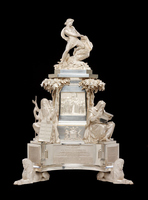
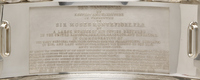
The room raised their glasses to Sir Moses Montefiore (1784–1885) and his wife, Judith (1784–1862). In front of the couple, on a table large enough to support over eighty pounds of metal, stood a silver testimonial of impeccable pedigree. This object, now known as the Montefiore Centrepiece and held at the Victoria and Albert Museum, was designed by George Hayter (1792–1871), the Principal Painter in Ordinary to Queen Victoria, modeled by the sculptor Edward Hodges Baily (1788–1867), and crafted by Mortimer & Hunt, one of London’s most esteemed silversmiths (fig. 1).[2] Its dedication plaque recorded that it had been commissioned by the board of deputies and funded by nearly nine hundred subscribers from Britain and its colonies, a selection of whom were standing in the room.
This celebration was just one of the many accolades Montefiore received during his lifetime.[3] The events the Montefiore Testimonial commemorates became known as the Damascus Affair. During the affair, Montefiore intervened to exonerate several Ottoman-Syrian Jews who had been falsely accused by the Ottoman and French authorities of ritual murder.[4] The Testimonial tells a tale of international diplomacy and religious humanitarianism, using a cosmopolitan lexicon that interweaves the iconographies of silver, sculpture, Orientalist and religious painting, and illustrated periodicals.[5] However, the Testimonial tells a much larger story than the accomplishments of one man and a single set of events.[6]
I argue that the Montefiore Testimonial utilizes iconography from the Hebrew Bible to make visible the contested processes through which Victorian Anglo-Jewish imperial identity was fashioned. This article is a case study which illuminates how minority communities used visual and material culture, among other discursive strategies, to position themselves in relation to dominant conceptions of religious difference and national identity. In nineteenth-century Britain, anti-Semitism remained pervasive, routinely casting Jews as a fundamentally foreign, stateless people defined by a Christian reading of the biblical past. Against this backdrop, however, the Hebrew Bible was recognized as a shared sacred text, which underwrote a monotheistic heritage. This theological overlap sustained a distinctive period of philo-Semitism within British Protestant millenarian culture, with which Montefiore allied himself. The uneasy coexistence of hostility and conditional acceptance shaped contemporary debates about modern Jewish cultural assimilation, both within the Anglo-Jewish community and in wider public discourse.
The Testimonial’s use of biblically literate iconographies unsettles the assumption that Victorian Jewish attitudes toward assimilation followed a straightforward path.[7] This article introduces a new methodological framework to Victorian art studies that brings Jewish hermeneutics into dialogue with close visual analysis. Drawing on broader theoretical frameworks of visual exegesis by art historian Paolo Berdini and biblical-studies scholars Martin O’Kane and J. Cheryl Exum, I reveal the dialectic between biblical texts and artists as sensitive translators as well as original interpreters.[8] Through closely reading these elements through a specifically Jewish interpretive lens, redressing an imbalance in previous visual exegesis studies which tend to read religious references solely through Christian iconographies, and responding to recent calls to integrate religion more fully into the cultural history of the British Empire, I show how the Testimonial disrupts and fractures established narratives of a collective Jewish effort toward full acculturation.[9]
Montefiore’s mission marked a turning point in Jewish participation in British diplomacy and foreign affairs. It occurred between two defining legal moments for Anglo-Jews: the abolition of slavery in 1833 and the first attempt at a Jewish Disabilities Bill in 1848. Montefiore was active in abolitionist circles in Britain, attending meetings with key figures such as William Wilberforce, Samuel Gurney, and Thomas Fowell Buxton.[10] This support placed Montefiore and many British Jews firmly within the liberal and humanitarian values of abolitionism which viewed slavery, on both religious and rational grounds, as a barbaric practice. However, Montefiore’s most significant role in the story of abolition paints a more complicated picture. In 1833, he underwrote an enormous fifteen-million-pound loan, which compensated slave owners in the West Indies.[11] The abolition of slavery also affected several of the Testimonial’s subscribers from Jamaica and Barbados who owned plantations and held other Caribbean investments.
Montefiore and others hoped their support for abolition would strengthen the case for Jewish emancipation and deliver rights such as the ability to hold public office and admission to the universities of Oxford and Cambridge, as it had for Catholics following the passage of the Catholic Relief Bill in 1829. While emancipation could offer important new liberties, it did not protect Anglo-Jews from entrenched anti-Semitism, a contradiction the Damascus Affair exposed. Moreover, the very processes that welcomed them into secular life also positioned them to further become functionaries within the expanding technocratic structures of empire. The Testimonial’s preoccupation with liberation, assimilation, and destiny reflects the political moment that Anglo-Jewry faced in the 1840s.
The Testimonial is one standout example of a broader wave of nineteenth-century silver sculpture. It was produced by the leading silver firm Mortimer & Hunt in collaboration with Hayter and Baily. The silversmiths specialized in elaborate and large-scale presentation trophies and plated silver.[12] As Angus Patterson notes, the decades between 1830 and 1870 marked the high point for the genre, and its stylistic innovations were frequently promoted at international exhibitions.[13] Testimonial silver typically commemorated military, business, or colonial achievements, embodying notions of imperial virtue in monumental form.[14] Yet due to their relatively small scale, which relegated them to private settings, and their designation as decorative art rather than sculpture, such objects have received little attention in studies of imperial visual culture.[15] I raise the importance of this object category here, particularly in reference to the Testimonial as a “miniature monument” by those involved in its creation, to highlight its unique material hybridity, which sits at the intersection of decorative and fine art and challenges art historical hierarchies through its material complexities.[16]
At the same time, I take on a different set of hierarchies to invite a reconsideration of what it means for a secular artwork to be considered “Jewish.”[17] Its Hebrew inscriptions, scriptural quotations, and iconography of patriarchs and prophets all root the Testimonial in Jewish textual traditions, but its commemoration of imperial diplomacy in a global modern age, paired with its display across Victorian London at the Great Exhibition of 1851 and the Anglo-Jewish Historical Exhibition of 1887, open it up to much larger secular cultural interpretations. My analysis builds on the material turn in religious studies which recognizes that religious identity is not only expressed through texts but also through objects that move between sacred and secular contexts.[18]
I begin with a necessarily succinct account of the Damascus Affair and the Testimonial’s narration of events, which cast Montefiore’s intervention as advancing Anglo-Jewish interests while serving British foreign policy in the Middle East. The first section examines how the Testimonial narrates Montefiore’s mission through four relief panels before turning to the sculpted biblical figures, inscribed texts, and allegorical panels that test the limits of that narrative. The presence of these figures and scenes, in dialogue with one another and with the contemporary imagery, upends a singular interpretation of Montefiore’s position on Jewish cultural assimilation, particularly through the biblical story of Ezra. Having introduced these nuanced commentaries, I consider if the Testimonial can be understood and defined as a Jewish object, made for and by Jews, and the impact of such objects on perceptions of Anglo-Jewish identity in exhibition culture at events such as the Great Exhibition of 1851 and the Anglo-Jewish Historical Exhibition of 1887.
The Testimonial is an object that tells a story with concentric meanings: personal, communal, imperial, and sacred. It offers historians of Britain the means to understand how biblical imagery, and particularly the Hebrew Bible, shaped Victorian representations of their empire. By reading this object through Jewish rather than Christian hermeneutics, this article repositions religious images as sites where the visual culture of empire was negotiated and contested. In doing so, it contributes to emerging interdisciplinary dialogues between art history and theology, demonstrating that the religious imagination was central to the fashioning of Britain’s imperial identity.
Staging Diplomacy: The Damascus Affair Panels
By the time Montefiore first learned the details of the Damascus Affair in the summer of 1840, it had already been unfolding for several months.[19] In February, Ottoman authorities were alerted that a Capuchin monk of Sardinian origin, Father Tommaso, and his Muslim servant, Ibrahim Amara, had disappeared. They had last been seen in the Jewish area of Damascus off Al-Amin Street in the old quarter of the city. In the following days, several men from prominent Jewish families were arrested and charged with murder. The authorities claimed, however, that this was not an ordinary killing but an instance of blood libel: a ritual sacrifice that the Jewish men had pursued to obtain Christian blood for their Passover bread.[20]
By spring, the European press had taken hold of the story, which had only grown as several men had made false confessions under torture. The French, who had a significant presence in Damascus and had given protection to Father Tommaso during his mission, amplified the narrative that the Jews were responsible.[21] While the British press was more cautious, anti-Semitic tropes nevertheless bubbled to the surface. One letter to The Times (UK) insisted that “the religion of the Jews was essentially a bloody one. If a Jew . . . believes in every word of the Old Testament, how could he in his secret mind believe human sacrifice a crime?”[22] This international interest brought the situation to the attention of Montefiore and the Board of Deputies of British Jews. As the historian Abigail Green has shown, while the group was horrified at the injustice that befell their coreligionists, they also recognized that with “Jewish emancipation a live issue in Britain and most of continental Europe, Western Jews could not afford to be found guilty by association.”[23]
After several meetings in London to publicly condemn the anti-Semitism that punctuated the affair, Montefiore’s nephew, Nathaniel de Rothschild (1812–70), proposed that his uncle, accompanied by other respected figures including his aunt Judith, Montefiore’s personal advisor Louis Loewe (1809–88), the abolitionist Richard Robert Madden (1798–1886), and lawyers David Williams Wire (1801–?) and Adolphe Crémieux (1796–1880), travel to Alexandria to petition the Ottoman authorities directly.[24] By this point, the fifty-six-year-old Montefiore was already a prominent public figure. Known for his success in the City of London as a stockbroker, his elevation to Sherriff of London and Middlesex in 1835 and knighthood in 1837, and his high-profile philanthropic work on behalf of Jewish communities, he was regarded by the Prime Minister Lord Palmerston and the royal court as a trusted advocate of humanitarian causes. The mission, therefore, could operate under a philanthropic guise while simultaneously asserting British influence in the Ottoman world, pushing back against French interests.
Four square relief panels, which are mounted on each side of the Testimonial’s central column, testify to the key events of Montefiore’s mission. The panels function as episodes in a visual narrative that moves, appropriately, from right to left, echoing the direction of Hebrew script, which can be found elsewhere on the object and will be discussed in more detail later. These panels, along with the rest of the Testimonial, were designed by Hayter.[25] Elaborate presentation silver was an inherently collaborative process, necessitating the expertise of formally trained artists who could integrate fine-art motifs into design. These designs were then passed on to a team of silversmiths employed by Mortimer & Hunt who could cast the piece of plate (often in several pieces), chase the relief panels, and emboss details on the freestanding sculpted figures. Mortimer & Hunt engaged Hayter, despite the fact that he had never worked in silver before.[26] He had been a student of the Swiss artist Henry Fuseli (1741–1825) while at the Royal Academy schools and built a career specializing in portraits of notable society figures, including official coronation portraits, and history painting. In 1841, he succeeded the late David Wilkie (1785–1841) as Queen Victoria’s Principal Painter in Ordinary and, to secure the loftiness of the new position, was knighted the following year.
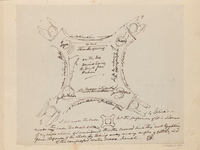
Hayter’s sketchbook reveals the intricacy of his designs for the Testimonial and includes extensive preparatory drawings as well as written descriptions (fig. 2). To understand Montefiore’s role in the Damascus Affair, he also relied on Loewe, a key interlocutor and Montefiore’s longtime advisor, who accompanied him during the entire mission. In an interview with the Anglo-Jewish newspaper The Voice of Jacob, Hayter credited his accurate depictions to “the aid of the kind information given me by Dr. Loewe.”[27] Hayter also records meeting with Loewe on at least one occasion at his studio to gather further information on the mission.[28] A trained scholar who would later become principal of the Judith Montefiore College in Ramsgate, Loewe also offered considerable theological and historical expertise to the project. He became a key collaborator as Hayter visualized the historical events and biblical analogies. This version of the events of the Damascus Affair, with Loewe’s careful guidance of Hayter during the design process, is a key context for understanding the narratives the Testimonial attempts to embody.
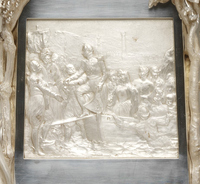
The right-hand side panel of the Testimonial depicts the Montefiore mission’s arrival at Alexandria on August 4, 1840 (fig. 3). Egypt was the seat of power of Muhammad Ali (1769–1849), the governor of Egypt and Syria who ruled on behalf of the Ottoman sultan, so the mission was directed to Ali rather than to Damascus. The composition is crowded as the chief rabbi of Alexandria greets Montefiore’s boat. The Times reported that the party was “received with extraordinary pomp by all their co-religionists.”[29] A shirtless Egyptian can be seen in the immediate foreground, submerged in the water and helping to steer the ship into the dock. Montefiore is dressed in his uniform as a deputy lieutenant of the City of London, while Lady Judith appears as the model of a respectable Victorian woman in corseted dress and voluminous skirts, flanked by Loewe, Madden, and Wire. In stark contrast, the welcoming Egyptian Jews are shown either partially undressed or in loosely draped robes, embroidered jackets, and turbans.
This representation strategy is deliberate and can be seen across all four panels which distinguish European Jews from their Eastern coreligionists, presenting the latter as “Oriental.” This visual differentiation is crucial to understanding the racial logic at play. As art historian Keren Hammerschlag has shown in her work on whiteness in Victorian history painting, Jews occupied an unstable racial position in nineteenth-century Britain: they could be incorporated into the concept of the dominant, white, Christian self yet were equally liable to be racialized as the Other.[30] The Testimonial’s panel depicting the landing of the mission at Alexandria enacts precisely this contradictory dynamic. Montefiore and his party have European features, they are formally dressed, and emphatically Victorian. They are fully legible within British racial and cultural norms, while the Egyptian Jews who greet them are depicted in Oriental costume and with non-Western physiognomies that align them with the broader European Orientalist imaginary. Despite these differences, in this panel, neither group is identified with overt signs of Jewish identity such as head coverings or tallis. Instead, it constructs a more legible, secularized binary between East and West, mobilizing racialized cultural distinction to articulate political hierarchy rather than religious difference.
Montefiore had a vested interest in emphasizing the distance between Anglo-Jewry and the Jewish communities of the Ottoman Empire. In the British context, at a moment when debates on the Jewish question remained alive, he needed to present himself and the community he represented as modern, respectable, and coded as British. Distinguishing Anglo-Jewry from Eastern Jews caught up in the Damascus Affair, therefore, served a dual function, underscoring Montefiore’s suitability as a diplomatic intermediary on behalf of Palmerston’s government while also protecting British Jews from association with the very stereotypes that fueled blood-libel accusations.
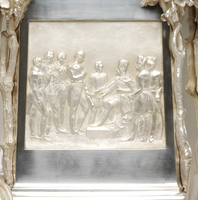
Through the European consuls in Alexandria, Montefiore negotiated an audience with Ali, who kept the mission uncertain as to whether he would appease the French or cultivate a new relationship with the British. When the audience was finally granted, Ali had decided on the latter course, and Montefiore secured the release of the imprisoned men. But he regarded release without full exoneration as insufficient. He therefore traveled on to Constantinople to petition Sultan Abdülmecid I (1823–61) directly. The Testimonial’s rear panel depicts the meeting of November 6, 1840, at which the sultan issued the firman, or decree, condemning blood libel and pledging protection for Jewish communities across the Ottoman Empire (fig. 4).[31] The panel translates this document into a moment of diplomatic ceremony. British and Ottoman identities are carefully delineated: To the left, Montefiore and his party appear in deputy lieutenant’s uniforms with heads uncovered; to the right, the sultan and his officials wear Ottoman military dress with tasseled fezzes. These distinctions operate on several visual registers, once again referencing national and cultural differences. The symmetry of the panel’s composition, a choreographed scene, also recalls the conventions of European state portraiture with which Hayter was intimately familiar through his role as Principal Painter in Ordinary, where he was commissioned to depict events such as the opening of Parliament and the visits of foreign royals and dignitaries.[32]
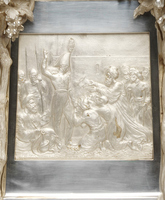
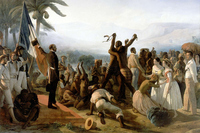
The left-hand panel, picturing the liberation of the prisoners at Damascus, offers a fictional scene, showing Montefiore just prior to his departure for home with the freed men gathered around him in grateful supplication (fig. 5).[33] In reality, Montefiore never met the men whose release he negotiated, having left Constantinople to travel to Malta and Italy before returning home to London. Yet the panel’s intention is revealing. The figures crowd around him in gestures of reverence; the chains at their ankles remain visible; and their bowed bodies are arranged in ways that heighten Montefiore’s uplifted, commanding presence. Once again, the panel insists on a clear distinction between Western emissary and Ottoman subjects who appear impoverished and physically demonstrative. This panel borrows from a broader repertoire of abolitionist imagery. For an individual such as Montefiore, who had longstanding ties to the abolitionist movement, the contrast between redeemer and newly emancipated echoes the rhetoric seen in works like Josiah Wedgwood’s (1730–95) antislavery medallions with the title Am I Not a Man and a Brother? (ca. 1787) and later works such as François-Auguste Biard’s (ca. 1798–1882) Proclamation of the Abolition of Slavery in the French Colonies, 27 April 1848 (fig. 6). In Biard’s painting, recently liberated Africans kneel, gesture, and embrace as the French proclamation is read. These bodies are marked by racialized difference and cast as grateful recipients of European benevolence. The Testimonial’s panel deploys a similar grammar of European-granted liberation.
However, the visual rhetoric on race is further destabilized by the fact that the liberated and liberators are both Jewish. The Damascus mission had been undertaken on the premise of Jews advocating for fellow Jews; nevertheless, the relief translates that intracommunal intervention into the idiom of imperial rescue. Montefiore, who was a Sephardic Jew and, therefore, subject within Britain to the racializing discourses that rendered Jews suspect or foreign, is visually elevated to the position of British triumphal hero. The Damascene Jews, by contrast, are cast within conventions typically used to depict colonized or enslaved peoples. The result is an image in which Jewish solidarity is subsumed within a narrative of British imperial authority, even as the figure at its center remains indelibly marked by the ambiguities of his own minority status.
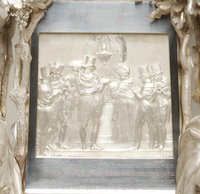
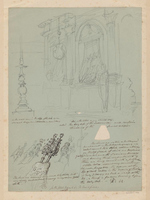
When Montefiore returned to London in the spring of 1841, he presented the firman to the queen and Lord Palmerston. An English translation of it soon appeared in the newspapers along with praise for Montefiore.[34] For weeks, Montefiore was the subject of Britain’s gratitude and celebration.[35] This moment of public recognition is echoed in the Testimonial’s front panel, positioned immediately above the English and Hebrew dedication, which depicts one of the thanksgiving services held in Montefiore’s honor at Bevis Marks Synagogue in the City of London (fig. 7). To recreate the scene accurately, Loewe invited Hayter to attend a service at Bevis Marks during the festival of Purim two years later. Hayter sketched Montefiore and the congregants standing before the Holy Ark, wearing a mixture of top hats and tricorns along with their tallis, or prayer shawls, dress which was associated with Sephardic congregations (fig. 8). Unlike the images of diplomacy, this panel presents Jewish worship in England as a legitimate, publicly affirmed religious practice. The thanksgiving service, which was attended by nearly eight hundred people, with more crowding the gates outside, is not orientalized or exoticized but presented as orderly and respectable. In this sense, the panel gestures towards the victory at the heart of Montefiore’s mission: the idea that Jewish faith and British loyalty could coexist and even reinforce one another.[36] Taken together, these four narrative panels construct a coherent and emphatically Anglocentric storyline. Montefiore appears as a British emissary acting with diplomacy and humanitarian purpose. The sequence celebrates Montefiore’s success and positions Anglo-Jewry squarely within British liberal and imperial values. It is, on the surface, a straightforward narrative of enlightened action and communal triumph.
The Testimonial was displayed at Bevis Marks and at Mortimer & Hunt’s Bond Street showroom before being returned to its owner. In 1851, the firm requested to borrow it for display at the Great Exhibition, where it appeared on their stand in the British industrial courts, Class 23, alongside other examples of silverware, jewelry, and watches.[37] Montefiore, one of the London commissioners for the Fine Arts Courts, readily agreed to its inclusion in this industrial-art context.[38] The Testimonial was accompanied by a summary of the key events it referenced.[39] Contemporary Jewish commentators were keen to frame this visibility as evidence of civic participation in the exhibition. The Jewish Chronicle praised the Testimonial as a “magnificent specimen of British art,” while related coverage drew attention to Jewish exhibitors of scientific and industrial goods, including gas meters, walking sticks, candles, pens, and embroidery for a state bed.[40] Within the exhibition, the Testimonial was folded into a national narrative of British craftsmanship and industrial achievement, valued primarily for the skilled British silverwork rather than for the minority status of its recipient.
The Testimonial does not, however, conclude with this linear narrative. The sculpted biblical figures that surround and sit alongside the panels extend and complicate the story the reliefs recount. When the realist, contemporary reportage of the reliefs is placed alongside the scriptural imagery, a different narrative emerges which questions religious and national identity and ultimately interrupts the celebratory account of imperial diplomacy. The transition from these panels to the sculpted figures marks a shift from the language of British statecraft to that of Jewish scripture, and it is in the interplay between these two visual modes that the Testimonial probes the possibilities and limits of Anglo-Jewish identity.
Scripture in Sculptural Form
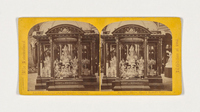
Allegory was a dominant visual language in nineteenth-century silver testimonials and typically drew on a familiar and, at times, repetitive repertoire.[41] Animals, figures such as Britannia, and personifications of virtues like Truth and Justice, conventionally represented as female, appeared frequently alongside gods and goddesses from Greco-Roman myth. These figures served as embodiments of valor, civic contribution, or imperial accomplishment. In my survey of Victorian silver, I have not encountered another major testimonial from this period that employs a similarly extensive biblical iconography. To illustrate its rarity, the now-renamed Hunt & Roskell stand at the International Exhibition of 1862 displayed fifteen testimonials which were adorned with figures of Fame, Science, Wisdom, Justice, Shakespeare, Milton, Britannia, Mars, Neptune, and Indian deities but not a single Judeo-Christian biblical character or even a religious figure such as a saint or member of the clergy (fig. 9).[42] The choice to use figures from the Hebrew Bible on this testimonial was therefore exceptional and deliberate. On one hand, it suggests the long-standing Christian stereotype that Jewish identity was essentially rooted in the Hebrew Bible, a stricture which had shaped representations of Jews long before the Damascus Affair. But more importantly, it demonstrated that its makers and viewers recognized that the link between the Hebrew Bible and contemporary events was a live one, readily comprehensible, and that scripture contained a relevant commentary for the modern day.
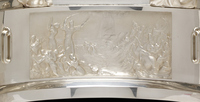
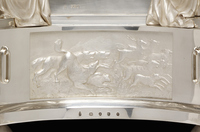
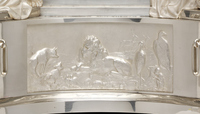
Having distilled the events of the Damascus Affair through the four narrative panels on the Testimonial, Hayter’s design shifted register. The commemoration moves away from contemporary reportage toward a more symbolic mode that draws on allegory, scripture, and biblical history. This transition is articulated through the introduction of sculpted figures as well as a complex lower zone of chased reliefs and engraved Hebrew text that mediates between the Damascus Affair panels and the patriarchal figures above. Set into the pedestal between the sculpted figures are three small, chased panels depicting episodes and visions drawn from scripture: Moses parting the Red Sea, scenes of lawless violence represented through wolves attacking flocks, and the millennial harmony in which animals coexist peacefully, both prophesied in the book of Isaiah (figs. 10–12). These panels form an intermediate visual narrative, a compressed arc from disorder and chaos, to miraculous relief, to an eschatological vision of restored harmony. Interspersed between these chased panels are passages from the Hebrew Bible engraved in Hebrew script, quoting from the books of Psalms, Exodus, Job, and Ezra.[43] These inscriptions articulate themes of integrity, steadfastness, and reliance on God’s grace, and, as we shall see, they play an active role in shaping how the sculpted figures are to be understood. Their presence is also materially significant. An article in The Voice of Jacob records that “the Hebrew raised characters are beautifully formed and do credit to Mr. Lazarus the engraver,” noting that this was “the only part of the work that has been executed by Jewish hands.”[44] Nothing further is known about Mr. Lazarus, including whether he was regularly employed by Mortimer & Hunt or was engaged specifically for this commission, but his involvement suggests that the execution of the Hebrew text, like Hayter’s reliance on Loewe, was entrusted to specialist expertise. The authority of the inscriptions is therefore equal to the imagery, a point that raises broader questions about the Testimonial’s status as a Jewish object, to which I will return.
The shift in design from the relief panels required not only a different iconographic framework but a different mode of silver craftsmanship: figurative modeling, which would draw on sculptural rather than decorative techniques and conventions. This sculptural work is where Baily’s contribution becomes central. His role as the Testimonial’s sculptor was to adapt Hayter’s designs on paper into clay models, which were then cast in plaster and passed on to the silversmiths who would execute the casts in precious metal.[45] Like Hayter, Baily trained at the Royal Academy during the first decade of the nineteenth century.[46] He was a student of John Flaxman (1755–1826) and like his tutor became associated with British academic classicism. Today, he is remembered primarily for major public monuments, most notably the statue of Horatio Nelson in Trafalgar Square, but in his own lifetime he was also associated with biblical subjects. As art historian Caroline Jordan has shown, his Eve at the Fountain (1822), a biblical subject taken from John Milton’s (1608–74) Paradise Lost (1667), enjoyed enormous popularity in the 1840s through Parian reproductions.[47] In the same year that he sculpted the figures for the Testimonial, Baily returned to the theme of Milton’s Eve in Eve Listening to the Voice (1842). He was introduced to the silversmiths Rundell & Bridge via Flaxman in 1815, and his association with Mortimer & Hunt appears to have begun in 1833.
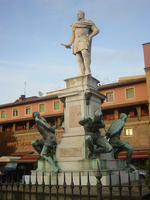
Baily’s academic training, his experience in biblical subjects, and his knowledge of contemporary sculpture clearly informed the formal choices for the sculpted figures. Hayter’s tiered design, with figures distributed across each level, shares similarities with the Monument of the Four Moors (1626) by Pietro Tacca (1577–1640) in the Piazza del Pamiglione in Livorno (fig. 13). Montefiore was born in Livorno in 1784 and returned to the place of his birth several times as an adult.[48] This monument’s story parallels that of Montefiore and the Damascus Affair in several striking ways. It commemorates the victories of Ferdinand I of Tuscany over the Ottomans in North Africa in the seventeenth century. The monument’s figures are four captives, one who appears to be West African and the other three of North-African Arab descent, who are depicted in loincloths and chains. Ferdinand stands atop the central pedestal wearing the uniform of a victorious Roman general. Baily’s figures on the Testimonial diverge from the Livorno monument in their classicized appearance, their poses, and their voluminous drapery. However, given Baily’s academic training under one of the leading monument makers of the period and the Testimonial’s link to Montefiore’s birth place, it seems likely he and Hayter drew on Tacca’s monument as a model, translating its figures into a nineteenth-century context that framed Montefiore’s story within a longer art historical tradition.
Law, Kingship and Boundary: Biblical Authority on the Testimonial
The Livorno monument’s hierarchical composition also established a visual language of masculine authority that Baily and Hayter reworked through the patriarchs and leaders of the Hebrew Bible. These founding fathers and male leaders were frequently mobilized in Protestant visual culture as ideals of masculine authority.[49] On the Testimonial, Moses and David together articulate the most outward-facing and culturally legible models of Jewish authority: a prophet and a king. These figures also work to frame Montefiore’s leadership of the Anglo-Jewish community, presenting him as a moral and political representative and fully compatible with British identity. Moses was perhaps the most frequent source of inspiration in a biblically saturated, nineteenth-century visual culture. This, in large part, was due to the influence of Christian typology, which reads the Hebrew Bible as a prophetic prelude ultimately fulfilled and superseded by the New Testament.[50] Moses was often interpreted as a type of Christ, an earlier iteration embodying the same qualities of leadership and sacrifice. Within the Jewish tradition, however, Moses remained first and foremost the leader who led the Israelites out of bondage in Egypt, received the Ten Commandments at Mount Sinai, and held the fragile nation together during years in the desert before the settlement of Canaan. Moses’s role as a liberator gained renewed relevance in the eighteenth and nineteenth centuries as debates over the abolition of slavery intensified.[51] Whereas Genesis was invoked by proslavery voices to assert racial hierarchies as divine law, Exodus provided abolitionists and enslaved peoples with a powerful scriptural language of resistance and deliverance.[52]
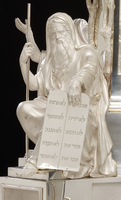
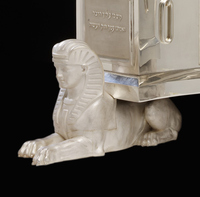
On the Testimonial, Moses appears explicitly in his role as lawgiver, a choice that foregrounds Mosaic law as the supreme authority (fig. 14). He holds two attributes: the tablets, accurately inscribed in Hebrew with the Ten Commandments, and the Staff of God. Directly below, in a small, chased-relief panel positioned between the Jew in Chains and the Jew Freed, Moses uses that staff to part the Red Sea (see fig. 10), visually extending his authority from lawgiving to liberation. The full Exodus narrative is reinforced structurally at the base, where four silver sphinxes support the entire composition (fig. 15). An explicitly Egyptological motif, the sphinxes anchor the biblical story within an identifiable ancient geography, one that was a source of particular fascination for Victorians.[53] Taken together, the figure, relief, and base establish a coherent narrative of liberation in a biblical context.
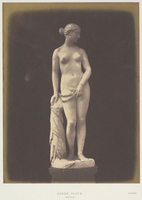
The allegorical figure of the Jew in Chains, diagonally opposite Moses, further embeds the Testimonial within the contemporary sculptural language of abolition. As art historian Caitlin Meehye Beach has shown, nineteenth-century sculpture and decorative arts circulated within complex political and material ecosystems, particularly in the Atlantic world.[54] When the Testimonial was displayed at the Great Exhibition of 1851 on Mortimer & Hunt’s stand in the industrial sections, it stood in proximity to major sculptures in the Fine Art Courts. Like the Jew in Chains, John Bell’s (1811–95) Andromeda (1851; Royal Collection Trust, Osborne House, Isle of Wight) and Hiram Powers’s (1805–73) Greek Slave (1844; Raby Castle, Staindrop) (fig. 16) relied on the visual motif of the shackled body to evoke sympathy and moral outrage.[55] Powers’s sculpture, which addressed the enslavement of white Christian women in the Ottoman Empire, framed Eastern bondage as a mark of barbarism, a logic reinforced by the Testimonial’s references to British intervention against Eastern despotism. However, the reliance on the Exodus as a visual language of emancipation sits uneasily alongside the dedication panel, which records subscribers from Jamaica and Barbados, many of whom were almost certainly indirectly connected to the transatlantic slave economy (fig. 17).[56] Their involvement, another facet of the global Jewish community, through funding the Testimonial, exposes the limits of the liberatory narrative the object promotes. As Beach cogently argues, abolitionist imagery continued to circulate within imperial structures materially and historically shaped by slavery.[57] Despite being produced by a minority community celebrating and pursuing their own emancipation, the Testimonial does not escape the unequal power and economic relations of the British Empire.
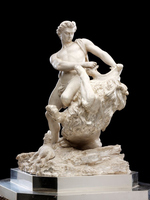
If Moses establishes a language of moral authority and liberation, the figure of David, which sits at the apex of the Testimonial, introduces a different but complementary register: kingship (fig. 18). David was the paradigmatic monarch of the Hebrew Bible, founder of the Davidic dynasty and an emblem of political sovereignty rather than priestly authority. In nineteenth-century Protestant culture, David’s significance extended well beyond Jewish tradition. The idea of the “House of David” had long been absorbed into imperial rhetoric, in which biblical monarchy was imagined as the genealogical and moral precursor to Christian kingship.[58] Within this framework, ancient Israel was recast as an earlier model that could be retrospectively claimed as part of Britain’s own imperial inheritance.
David occupies the apex of the Testimonial’s decorative program, both physically and symbolically. Rather than appearing as a static royal figure, he is shown in action, rescuing a lamb from the jaws of a lion. This episode, drawn from David’s youth as a shepherd in the first book of Samuel, foregrounds a model of kingship grounded in protection rather than conquest and a figure of vitality in contrast to the more mature figure of Moses. The scene evokes pastoral guardianship and righteous intervention, qualities that once again resonated with the justifications for Montefiore’s mission. Positioned at the summit of the Testimonial, David becomes the culmination of the object’s narrative logic: the figure through whom Jewish leadership is rendered legitimate as an ethical king rather than a sectarian power.
The prominence of David also reflects contemporary perceptions of Anglo-Jewish leadership. Jewish figures such as Montefiore, Lionel de Rothschild (1808–79), and members of the Board of Deputies of British Jews were often described in quasi-monarchical terms, as patriarchal leaders whose authority derived from communal recognition. Montefiore, in particular, functioned as a kind of uncrowned king of Anglo-Jewry, a position which the Damascus Affair only helped to cement.[59] David offers a compelling biblical analog for Montefiore himself: a leader whose authority appears compatible with British institutions. However, this model of leadership does not seek to destabilize or rival British sovereignty but instead imagines Jews as operating safely within it. David is shown as a pastoral protector, not an enthroned, triumphant Hebrew king. The Testimonial visualizes Jewish leadership as capable of occupying the same symbolic terrain as British sovereignty while remaining firmly embedded within British imperial structures.
The promise of this alignment is extended through the allegorical panel depicting the millennial harmony described in the book of Isaiah. This image draws on a visual and theological iconography closely associated with Victorian evangelical millenarianism, which imagined the restoration of the House of David in Palestine, visualized as animals coexisting peacefully, as a precursor to Christian redemption (see fig. 12).[60] One of Montefiore’s staunchest supporters at home during the Damascus Affair was Anthony Ashley-Cooper, the Earl of Shaftesbury, who mobilized millenarian efforts through political lobbying, fundraising, and letters to the press in response to the crisis.[61] Cooper and his circle regarded their support for Montefiore as part of the broader millenarian commitment to the Jewish people. Following the Damascus Affair, Montefiore’s activities in Palestine increased significantly. In 1860, he established Mishkenot Sha’ananim, the first modern Jewish settlement outside of the walls of Jerusalem, and funded projects that brought agriculture and industry to the area.[62] His charitable work, an early form of Zionism, can be understood as a particularly significant form of Jewish and evangelical convergence. The Testimonial registers this alignment visually through David, suggesting a moment in which Jewish hopes for political restoration and evangelical eschatology could briefly occupy the same imaginative space.
However, this vision of harmony remained aspirational rather than resolved. While Moses and David represent the most persuasive articulation of Jewish belonging offered by the Testimonial, a model in which difference is stabilized through the law and sovereignty, it is precisely the apparent completeness of this vision, however, that makes it vulnerable. Drawing on Homi Bhabha’s distinction between “being English” and “being Anglicised,” Moses and David can be understood as figures through whom Anglo-Jewry appears fully assimilable without fully disappearing.[63] The subsequent turn to the next sculptural figure on the Testimonial, Ezra, who was grounded not in kingship but in a dogmatic interpretation of the law and an enforcement of communal boundary, will expose the limits of this mode of belonging.
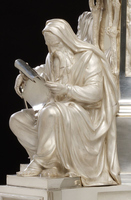
Ezra occupies a distinctive position within the decorative program, both as a comparatively less familiar biblical figure and as one whose historical role confronts the problem of communal survival under imperial rule (fig. 19). While Moses and David were widely recognized and utilized within Victorian culture as exemplary leaders and deliverers, Ezra’s inclusion signals a more inward-looking model of authority. For a nineteenth-century audience who were, on the whole, biblically literate, Ezra may have appeared as another prophet and deliverer. He was also a recognizable figure within the genre of religious art. Hayter had previously won the British Institution’s prize for history painting for an oil painting of Ezra in 1815. Crucially, however, Ezra’s story carries different interpretive weight within Christian and Jewish traditions, a distinction that shaped how his presence would have been understood. The biblical context in which his narrative unfolds, and the specific scriptural passages selected for the Testimonial, introduce a set of tensions that unsettle the object’s alternative versions of harmonious assimilation.
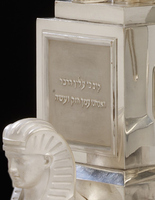
The book of Ezra takes place during the aftermath of the Babylonian exile. Within the stand-alone canon of the Hebrew Bible, the exilic period was the defining rupture in the historical account of the Israelites, displacing them from the promised land.[64] Ezra was a priest and a scribe, as signaled by the scroll he holds, who lived as part of the exiled community. He was summoned by the Persian emperor Cyrus to lead a group of Judeans back to Jerusalem and successfully reestablish them in the land. Under Persian rule, religious tolerance functioned as a strategy of imperial governance, a policy that resonates with the Ottoman firman later celebrated on the Testimonial. On an initial reading, Ezra’s mission appears to also offer a similar analog for Anglo-Jewry’s position within the British Empire: a benevolent imperial power who allows a minority community to worship freely and to flourish culturally in exchange for political allegiance. Read in isolation, this parallel would reinforce an interpretation of successful accommodation within imperial structures. However, the figure of Ezra works in close conjunction with the Hebrew inscription beneath him to fracture the apparent harmony of imperial tolerance and religious autonomy. The quoted verse, “Arise, for this matter is your responsibility; / and we are with you. Be strong and take action” (Ezra 10:4), does not commemorate a moment of liberation or restoration alone but one of internal crisis and disciplinary resolve (fig. 20). Having returned to Jerusalem, Ezra discovers that many of the Israelites have intermarried during the exile, forming families with non-Israelite women, which Ezra interprets as a violation of the Deuteronomic Code.[65] In the biblical narrative, intermarriage functions as the clearest symbol of assimilation with the imperial conquerors, not least because it would reshape the future of the community through children who would no longer be recognizable as Israelites. The Babylonian captivity itself was believed to be the consequence of disobedience to God and straying from the laws. Assimilation through changing cultural practices is perceived as an existential threat, to which Ezra responds with a radical demand: a collective act of divorce. The community heeds Ezra’s call, sending the wives and children away. Only after this painful process does the remaining community gather in the city to hear the prophet read the book of Moses, reasserting Mosaic law as the supreme authority of Israelite life.
Modern scholarship has long identified this episode as foundational for the shift from Judaism as a religion structured around tribal, cultic practices to one based in scripture. Observance of the Sabbath, circumcision, and the prohibition of intermarriage emerge at this moment as the defining markers of Jewish identity. Loewe’s suggestion to quote this precise verse on the Testimonial rather than a more conciliatory or celebratory passage fundamentally alters the object. Loewe was an experienced scholar and was later appointed the principal of the Judith Montefiore College, a theological institute for men to study the Talmud. His deep knowledge of the Hebrew Bible and Talmudic interpretation of these words from Ezra must have included a consideration of what “intermarriage” could mean in its broadest and most contemporary definition. Read in a nineteenth-century British context, this anxiety would have resonated with contemporary debates about “marrying out” of the community as well as acculturation. Loewe’s selection of this passage gives voice to an anxiety about the simultaneous risks of visibility in anti-Semitic society and the erasure of Jewish difference in order to integrate into the civic sphere. As we have seen, this concern finds visual expression elsewhere in the panels’ careful differentiation between Montefiore’s Europeanized appearance and the orientalized depiction of his Egyptian coreligionists.
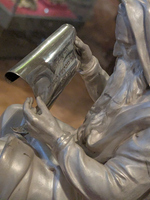
This emphasis on conditional belonging is reinforced by a second inscription on the Testimonial that often goes unnoticed. The scroll held by Ezra bears the words of verse 21 from chapter 8 of his biblical book: “The gracious hand of our God is on everyone who looks to him, but his great anger is against all who forsake him” (fig. 21). Read in conjunction with the inscription on the pedestal, the verse frames fidelity to Mosaic law as the precondition for communal survival. Whereas David and Moses articulated forms of leadership that are compatible within British national identity, Ezra insists on boundaries and inward consolidation as the conditions of communal survival.
This insistence is reinforced by the material and linguistic form of the inscription itself, engraved by Mr. Lazarus, the only Jewish artisan with direct involvement in the making of the Testimonial. Written in Hebrew, the verse establishes a threshold of access between different audiences. For Christian viewers, who might be passingly familiar with Hebrew script from other artworks such as the sign above the Crucifixion which reads “Jesus of Nazareth, King of the Jews,” it signaled biblical authority without an awareness of actual meaning. For Jewish viewers, even if they did not speak fluent Hebrew, it activated a memory and a shared culture of textual traditions freighted with questions about tradition and the price of obligation. Ezra’s presence offers an image of Jewish survival under empire while embedding a textual reminder of the limits beyond which accommodation cannot proceed without eroding communal integrity.
Viewed in relation to Moses and David, Ezra emerges as the figure who exposes the fault lines within the Testimonial’s earlier version of a promise of belonging. Moses provides a shared yet limited language of liberation, and David offers a model of sovereignty that aligns Jewish history with imperial genealogy and British inheritance. Ezra, by contrast, confronts the senior emissary of the Anglo-Jewish community with the costs of that alignment. His authority is exercised not against an external oppressor but against his own people, and it is this inward turn that gives the figure its disruptive force. Ezra transforms the object from a celebratory account of Montefiore’s achievement into a meditation on the unresolved tensions of civic integration that victory brings with it, tensions which would remain central to Anglo-Jewish life well beyond the moment of the Damascus Affair.
Afterlives of Emancipation: The Testimonial and Anglo-Jewish Memory
In 1887, more than four decades after the events of the Damascus Affair, the Testimonial was displayed at another major exhibition. It was brought from the Judith Montefiore College in Ramsgate, where it had been housed since its founding in 1869, back to South Kensington where it was now displayed in the Royal Albert Hall for the Anglo-Jewish Historical Exhibition.[66] However, unlike its earlier presentation at the Great Exhibition in 1851, the Testimonial was exhibited in substantially different contexts. The Anglo-Jewish Historical Exhibition was the first exhibition organized for and about Jews in Britain. Curated by the historians Isidore Spielmann (1854–1925), Lucien Wolf (1857–1930), and Joseph Jacobs (1854–1916), the exhibition’s aim was twofold: to trace the presence of Jews in England all the way back to the medieval period and to demonstrate their contributions to British history and empire. Staged in Queen Victoria’s Jubilee year, under whose reign Anglo-Jewry had secured emancipation and civic inclusion, the exhibition presented Jewish history, through a series of artifacts, manuscripts, and works of art, as inseparable from Britain’s own national story.
This exhibition repositioned the Testimonial away from the industrial-art framework that had shaped its display on Mortimer & Hunt’s stand at the Great Exhibition. In The Jewish Chronicle’s special supplement for the exhibition, it was referred to as the “well known Silver Trophy Testimonial,” indicating the reputation and esteem it had acquired in the intervening decades.[67] By 1887, the Testimonial was no longer anchored to Mortimer & Hunt as an example of arts manufacture, but instead its significance lay in its associations with memory and communal achievement. Moreover, Montefiore had died two years earlier, so the exhibition was now, in part, a retrospective tribute. Many members of his family were involved in the organizing committees, and an entire subsection of the exhibition was devoted to “Montefioriana,” in which the Damascus Affair was presented as one of the crowning moments of his public life. There were paintings depicting the audience with the sultan, the original firman, and autographed letters written by Montefiore from Constantinople. The Testimonial was displayed in Room 4, dedicated to written records and relics, which presented the case for historical evidence of Jewish visibility in England since the Middle Ages. However, as a piece of nineteenth-century decorative art, the Testimonial operated differently from the archival materials that surrounded it by offering a visual synthesis of the historical events alongside an allegorical visual program to interpret them. The Jewish Chronicle singled out its prominent position within the footprint of the exhibition, deemed worthy of a significant place within Anglo-Jewish history.[68] Its presence reinforced the Damascus Affair not only as a historical episode but as a moral and symbolic achievement.
The exhibition marked a moment of confidence for the Anglo-Jewish community. It was attended by senior figures of British public life, including the Prince of Wales, and received sustained coverage in the mainstream press. It was widely framed as evidence that Jewish emancipation had succeeded. Yet this narrative of acceptance masked new pressures. Earlier in the decade, pogroms in the Russian Empire triggered the large-scale migration of Eastern European Jews to London, many settling in the working-class East End. The social and cultural distance between these immigrants and the established families such as the Montefiores and Rothschilds, who lived in West London, proximate to the cosmopolitan South Kensington, were increasingly apparent. While these families directed philanthropic efforts toward the newcomers, they were often programs of Anglicization and social reform. Read against this backdrop, the Testimonial’s visual distinctions between European and Oriental peoples acquired new significance at a moment when Jewish migrants from the Russian Empire, long perceived as culturally and visually suspended between East and West, were becoming newly visible in Britain. Although removed from the present political moment by nearly fifty years, the Testimonial continued to reflect the encoded hierarchies of belonging that shaped how Anglo-Jewry understood its past and its obligations to the wider community in the present. Those questions of visibility, difference, and belonging that the Testimonial embodies remained unresolved, even in an era of formal emancipation.
It is within the context of an exhibition that explicitly made a claim for a collective Anglo-Jewish history and identity that the Testimonial’s reception as a “Jewish” object becomes newly significant. The Anglo-Jewish Historical Exhibition framed it explicitly as part of modern British history and culture. However, its organizers did not go so far as to call it Jewish art and, in fact, were at pains to argue there was no such thing, based on their narrow historical analysis of Anglo-Jewish history.[69] Their hesitation might also reflect the broader recognition that Jewishness in material culture was not easily defined by medium, style, or authorship. The Testimonial, in plain fact, was not made primarily by Jewish artists. There had been earlier attempts to commission Jews for the piece. Mortimer & Hunt initially approached the painter Solomon A. Hart (1806–81), but he declined due to existing commitments.[70] The German Jewish artist Moritz Daniel Oppenheim (1800–82) was also invited to make a design, though this proposal seemingly did not proceed.[71] A recent work by cultural historians Tom Stammers, Abigail Green, and Juliet Carey offers a potential new pathway for understanding the Testimonial’s Jewishness. They argue that the Jewish identity of places and things emerges through a networked constellation of relations.[72] In the case of this object, its status as a Jewish object is bound up in its commission by the Board of Deputies of British Jews, its textual referents supplied by Loewe, the engraving of its Hebrew inscriptions by Lazarus, the hundreds of subscribers who funded it, many of whom contributed only a shilling and, therefore, most likely came from middle- and working-class backgrounds, and the transnational Jewish networks it commemorated from Damascus to Jamaica and London.
The Testimonial moved between secular and sacred contexts, between synagogue, exhibition, private home, and public commemoration. Its meanings shifted accordingly. Displayed in 1887, it stood as both a monument to a singular individual and as a material condensation of Anglo-Jewry’s aspirations and negotiated place within the British Empire. While the exhibition presented emancipation as a historical achievement, the Testimonial—through its unresolved visual and scriptural complexities—retained the tensions that pervaded the process.
Conclusion
Across its layered visual program of panels, figures, and inscriptions, the Testimonial offers a complex reflection on the possibilities and limits of Jewish participation in British imperial and civic life in the nineteenth century. Rather than offering a straightforward narrative of emancipation or assimilation, it probes the conditions, limits, and costs of that belonging. By using imagery drawn from the Hebrew Bible, the Testimonial mobilizes themes of liberation, authority, and covenant to examine how religious identity intersected and can be entangled with imperial power. Read through Jewish hermeneutics rather than Christian typology alone, the Testimonial reveals how biblical figures such as Moses, David, and Ezra articulate distinct and, at times, competing models of leadership and communal survival. Viewed in this way, the Testimonial resists absorption into a singular imperial allegory, instead exposing the tensions between visibility and vulnerability and between the promise of integration and the persistence of exclusion. Its visual rhetoric allowed Anglo-Jewish identity to appear publicly acceptable, while simultaneously containing a coded insistence on religious difference and internal allegiance.
By situating the Testimonial within successive exhibition contexts, this article has shown how its meanings shifted over time, without ever fully resolving the tensions embedded within its design. It is neither simply British nor exclusively Jewish. Its Jewishness is relational, produced through networks of patronage, craftsmanship, and display, and mediated through the realities and imaginaries of empire. Attending closely to this object enables a reassessment of biblical imagery as a central site in the formation of imperial visual culture. The Montefiore Testimonial tells a far larger story than the events it commemorates, crystallizing the ambitions and anxieties that shaped Anglo-Jewish life within Victorian Britain.
Acknowledgments
Over the years I worked on this article I have received feedback and support from many cherished colleagues. I would like to thank Jason Edwards for taking me on my first trip to the Whiteley Silver Galleries, which led to my initial encounter with the Testimonial, and for many supportive conversations as this project progressed. My appreciation goes to Kate Nichols, Keren Rosa Hammerschlag, the two anonymous NCAW reviewers, and Isabel Taube and Petra ten-Doesschate Chu for their insightful and perceptive comments over several drafts. I also want to extend my gratitude to the organizers and participants of several seminars where I presented this work: New Directions in Eighteenth- and Nineteenth-Century Art; seminars at the University of Aberdeen’s History of Art Department; the Power Institute at the University of Sydney; and the Centre for Art History and Art Theory at the Australian National University. Support for this research was funded by a Leverhulme Trust Early Career Fellowship.
Notes
[1] Quoted in “The Montefiore Testimonial,” Illustrated London News, March 4, 1843, 150.
[2] For the purposes of this article, I will refer to the Montefiore Centrepiece as the Montefiore Testimonial, or the Testimonial. It is unclear why its name has changed, as most of the nineteenth-century reviews and scholarly literature refer to it as the Montefiore Testimonial and do not use the term “centrepiece” as a proper noun. It may be to distinguish it from the series of written testimonials Montefiore received for his one hundredth birthday, which are held in University College London’s Special Collections. The Testimonial is on long-term loan at the Victoria and Albert Museum (V&A) from the Montefiore Endowment.
[3] The scholarship on Montefiore is extensive. The most significant biographies are Abigail Green, Moses Montefiore: Jewish Liberator, Imperial Hero (Belknap Press of Harvard University Press, 2010); Paul Goodman, Moses Montefiore (Jewish Publication Society of America, 1925); and Lucien Wolf, Sir Moses Montefiore: A Centennial Biography (New York, 1885).
[4] The Damascus Affair happened in parallel with another accusation of blood libel on the island of Rhodes in February 1840. While Rhodes was also part of the Ottoman Empire and Montefiore played a role in the exoneration and protection of those Jews, this article will focus on what is represented on the Testimonial: the events in Damascus.
[5] For more on the cosmopolitan language of silver sculpture, see Jason Edwards, “The Relief of Lucknow: Henry Hugh Armstead’s Outram Shield (c. 1858–1862),” 19: Interdisciplinary Studies in the Long Nineteenth Century 22 (2016), https://doi.org/10.16995/ntn.734.
[6] The most extended discussion of the Montefiore Testimonial to date appears in Helen Rosenau, “Sir Moses Montefiore and the Visual Arts,” Journal of Jewish Studies 30, no. 2 (1979): 233–44. This article contains some factual errors, such as referring to George Hayter as “John Hayter” and Edward Hodges Baily as “Edward Baillie.” See also brief mentions of the Testimonial in Philippa Glanville, ed., Silver: History and Design (Harry N. Abrams, 1997), 63; and Angus Patterson, “‘A National Art and a National Manufacture’: Grand Presentation Silver of the Mid-Nineteenth Century,” The Journal of the Decorative Arts Society 1850–the Present 25 (2001): 59–73.
[7] See Jonathan Frankel, “Assimilation and the Jews in Nineteenth-Century Europe: Towards a New Historiography?,” in Assimilation and Community: The Jews in Nineteenth-Century Europe, ed. Jonathan Frankel and Steven J. Zipperstein (Cambridge University Press, 2004), 1–38; and David Englander, “‘Anglicized Not Anglican’: Jews and Judaism in Victorian Britain,” in Religion in Victorian Britain, ed. Gerald Parsons, vol. 1 (Manchester University Press, 1988), 235–73.
[8] Paolo Berdini, The Religious Art of Jacopo Bassano: Painting as Visual Exegesis (Cambridge University Press, 1997); Martin O’Kane, Painting the Text: The Artist as Biblical Interpreter (Sheffield Phoenix Press, 2009); and J. Cheryl Exum and Ela Nutu, eds., Between the Text and the Canvas: The Bible and Art in Dialogue (Sheffield Phoenix Press, 2009).
[9] For more on the construction of Jewish identities, see the foundational work of Linda Nochlin and Tamar Garb, eds., The Jew in the Text: Modernity and the Construction of Identity (Thames and Hudson, 1995).
[10] Green, Moses Montefiore, 51, 54, 87–91.
[11] For a transcript of the parliamentary debate concerning this loan, see “Loan for West-India Compensation,” HC Deb. (Hansard, 3rd ser.), September 4, 1835, vol. 30, cols. 1381–91. For more on the nuances of that loan and Montefiore’s motivations for underwriting it, see Abigail Green, “Slavery, Jewish Emancipation, and the English Country House,” Jewish Country Houses, March 2022, https://jch.history.ox.ac.uk/.
[12] The firm was founded as Storr & Mortimer in 1822. Upon the retirement of Paul Storr, they adopted the name Mortimer & Hunt which they operated under between 1838 and 1843. Upon the retirement of John Mortimer, the name changed again to Hunt & Roskell, which operated until at least 1889. For more on the firm’s history and notable pieces, see Philippa Glanville, Silver in England: Finance, Money, and Banking (Routledge, 2006), 129–30, 167, 179, 189, 253, 255, 290–91, 331.
[13] Angus Patterson, “‘National Art and a National Manufacture,’” 59.
[14] See John Culme, Nineteenth-Century Silver (Hamlyn for Country Life Books, 1977).
[15] A notable exception to this is Caitlin Meehye Beach’s recent study Sculpture at the Ends of Slavery (University of California Press, 2022), which examines a wide range of sculpture and decorative art to explore abolitionist narratives.
[16] “The Montefiore Testimonial,” 150.
[17] This was the topic of several papers and a plenary discussion at the Victoria and Albert Museum’s conference “The V&A and Its Jewish Heritage: Objects and Stories,” which took place on November 26, 2024. I am grateful to Rebecca Abrams, Dr. Jacques Schuhmacher, Edmund de Waal, and Tom Marks, whose discussion explored this question.
[18] See Jodi Eichler-Levine, Rachel B. Gross, Laura A. Leibman, and Laura S. Levitt, “Jewish Objects and Jewish Affects: A Conversation,” CrossCurrents 70, no. 1 (March 2021): 82–94.
[19] The definitive scholarly account of the Damascus Affair remains Jonathan Frankel’s The Damascus Affair: “Ritual Murder,” Politics, and the Jews in 1840 (Cambridge University Press, 1997).
[20] For more on the historiographic context of blood libel, see Hannah Johnson, Blood Libel: The Ritual Murder Accusation at the Limit of Jewish History (University of Michigan Press, 2012).
[21] Frankel, The Damascus Affair, 110–19.
[22] Times (UK), August 17, 1840, quoted in Frankel, The Damascus Affair, 332.
[23] Green, Moses Montefiore, 135.
[24] Although Crémieux’s role in the Damascus Affair was equal in significance to Montefiore’s, a full assessment of his contribution lies beyond the scope of this article. For more, see Noëmie Duhaut, “Adolphe Crémieux, a Secular Preacher for Justice?,” in Living Law in Jewish Studies, ed. Nomi Stolzenberg, Thomas Prendergast, and Yonatan Brafman (University of Pennsylvania Press, forthcoming).
[25] For more on Hayter, see Barbara Coffey Bryant, “Hayter, Sir George (1792–1871),” Oxford Dictionary of National Biography Online, ed. David Cannadine (Oxford University Press, 2004), published September 23, 2004; last modified September 17, 2015, https://www.oxforddnb.com/ [login required].
[26] See Barbara Coffey, Drawings by Sir George and John Hayter (Morton Morris, 1982); and Barbara Bryant, “Sir George Hayter’s Drawings at Duncombe Park: Family Ties and a ‘Melancholy Event,’” Apollo 135 (1992): 240–50.
[27] “The Montefiore Testimonial,” The Voice of Jacob, March 3, 1843, 124.
[28] George Hayter to unidentified recipient, April 28, 1842, from an album containing twenty-eight designs for the silver Testimonial to Sir Moses Montefiore, E252(20)-1990, Victoria and Albert Museum, London.
[29] “Private Correspondence: Alexandria, 7 August,” Times, August 25, 1840, 4.
[30] Keren Rosa Hammerschlag, The Chosen Race: Troubling Whiteness in Victorian Painting (University of California Press, 2026); and Keren Rosa Hammerschlag, “Christ’s Racial Origins: Finding the Jewish Race in Victorian History Painting” in The Art Bulletin 103, no. 1 (2021): 65–88.
[31] Louis Loewe, Diaries of Sir Moses and Lady Montefiore Comprising Their Life and Work as Recorded in Their Diaries from 1812 to 1883, vol. 1 (London, 1890), 278–79.
[32] Examples include Hayter’s The House of Commons, 1833 (1833–43; National Portrait Gallery, London) and his Napoleon III’s Reception at the Guildhall (ca. 1855; Government Art Collection, London).
[33] Loewe, Diaries of Sir Moses and Lady Montefiore, 280.
[34] “Weekly News,” Morning Chronicle (London), July 5, 1841, 14.
[35] See, for example, “London, 11. January,” Allegemeine Zeitung des Judentums, February 13, 1841, 83.
[36] David Feldman, “The Damascus Affair and the Debate on Ritual Murder in Early Victorian Britain,” in Judaism, Christianity, and Islam: Collaboration and Conflict in the Age of Diaspora, ed. Sander L. Gilman (Oxford University Press, 2014), 133.
[37] Hunt & Roskell, Great Exhibition 1851 (Class 23, no. 97): Catalogue of Articles Presented by Hunt & Roskell (London, 1851), 686.
[38] Geoffrey Cantor, “Anglo-Jewry in 1851: The Great Exhibition and Political Emancipation,” Jewish Historical Studies 44 (2012): 107. See also Geoffrey Cantor, Religion and the Great Exhibition of 1851 (Oxford University Press, 2011), 157–65.
[39] Commissioners for the Exhibition of 1851, Official Descriptive and Illustrated Catalogue of the Great Exhibition 1851, vol. 3 (London, 1851), 687, and plate 55.
[40] “Reports on the Jewish Contributions to the Great Exhibition,” Jewish Chronicle, April 4, 1851, 207; and “Reports on the Jewish Contributions to the Great Exhibition,” Jewish Chronicle, October 24, 1851, 23–24.
[41] See, for example, design books by Edward Barnard and Sons, AAD/2009/8, Art and Design Archive, Victoria and Albert Museum, London.
[42] London International Exhibition, International Exhibition, 1862: Catalogue of Works of Art in Silver and Jewellery (London, 1862), 46–53.
[43] Under the image of the freed Damascus Jew is Psalm 107:13–14: “And they cried out to the Lord in their trouble, and he saved / them out of their distresses. / He brought them out of darkness and the shadow of death, and / break their bands in sunder.” Under the image of Ezra is Ezra 10:4: “Arise, for this matter is your responsibility; / and we are with you. Be strong and take action.” Under the image of the chained Jew of Damascus is Job 27:5: “God forbid that I should justify you: till I die I will not remove / mine integrity from me.” Under the image of Moses is Exodus 14:14: “The Lord will fight for you, and ye shall hold your peace.” Biblical verses come from Herbert Marks, ed., The English Bible, King James Version: The Old Testament (W. W. Norton, 2012).
[44] “The Montefiore Testimonial,” The Voice of Jacob, September 22, 1842, 18.
[45] Caroline Jordan, “‘The Very Spirit of Purity and Chastity’: Eve at the Fountain by Edward Hodges Baily,” Sculpture Journal 15, no. 1 (2006): 20.
[46] For more on Baily, see Caroline Jordan, “Edward Hodges Baily (1788–1867) and the Notion of Poetic Sculpture c. 1800–1845” (PhD diss., University of Leeds, 2007); and Eunice Knowles, “‘The Most Brilliant Genius That Ever Lived. . . ?’: Edward Hodges Baily 1788–1867” (PhD diss., University of London, 1999).
[47] Jordan, “‘The Very Spirit of Purity and Chastity,’” 19.
[48] Paul H. D. Kaplan, “Italy, 1490–1700,” in The Image of the Black in Western Art, vol. 3, From the ‘Age of Discovery’ to the Age of Abolition, pt. 1, Artists of the Renaissance and Baroque, ed. David Bindman and Henry Louis Gates Jr. (Harvard University Press, 2010), 182–83.
[49] James Eli Adams, Dandies and Desert Saints: Styles of Victorian Masculinity (Cornell University Press, 1995), 25–61.
[50] For more on Christian typology in Victorian art, see George Landow, Victorian Types, Victorian Shadows: Biblical Typology in Victorian Literature, Art and Thought (Routledge Revivals, 2015). For a nineteenth-century example of Christian typology, see John Henry Newman, “Moses the Type of Christ,” in Parochial and Plain Sermons, new ed., vol. 7 (London, 1891), 118–32.
[51] Chris Coltrin, “Picturing Political Deliverance: Three Paintings of the Exodus by John Martin, Francis Danby, and David Roberts,” Nineteenth-Century Art Worldwide 10, no. 1 (Spring 2011), http://www.19thc-artworldwide.org/.
[52] See Simon Goldhill, “Genealogy, Translation, and Resistance: Between the Bible and the Greeks,” in Victorian Engagements with the Bible and Antiquity, ed. Simon Goldhill and Ruth Jackson Ravenscroft (Cambridge University Press, 2023), 21–22.
[53] Stephanie Moser, Painting Antiquity: Ancient Egypt in the Art of Lawrence Alma-Tadema, Edward Poynter and Edwin Long (Oxford University Press, 2020), 67.
[54] Beach, Sculpture at the Ends of Slavery, 3.
[55] See also Martina Droth and Michael Hatt, eds., “The Greek Slave by Hiram Powers: A Transatlantic Narrative,” special issue, Nineteenth-Century Art Worldwide 15, no. 2 (Summer 2016), https://19thc-artworldwide.org/summer16/.
[56] During the editing stages for this article, a new interpretation of the Testimonial by Professor Abigail Green and Michal Friedlander was added to the V&A’s catalogue entry on the object, which addresses the extent to which Jews in the Caribbean contributed to the subscription. For more on their research, see Abigail Green and Michal Friedlander, “What the V&A’s Montefiore Masterpieces Reveal About Jewish History,” Jewish News, May 29, 2026, https://www.jewishnews.co.uk/. For more on the historical links between the Jewish community and the Caribbean, see Richa Dwor, “Two Diasporas, One Exodus: Jewish Freedom and Jamaican Slavery in Grace Aguilar’s Sephardic Histories,” Victorian Popular Fictions 5, no. 2 (2023), https://doi.org/10.46911/PMUK7383; Sarah Phillips Casteel and Heidi Kaufman, eds., Caribbean Jewish Crossings: Literary History and Creative Practice (University of Virginia Press, 2019); Jonathan I. Israel, Diasporas Within a Diaspora: Jews, Crypto-Jews, and the World of Maritime Empires, 1540–1740 (Brill, 2002); and Holly Snyder, “Customs of an Unruly Race: The Political Context of Jamaican Jewry, 1670–1831,” in Tim Barringer, Gillian Forrester, and Barbaro Martinez Ruiz, eds., Art and Emancipation in Jamaica: Isaac Mendes Belisario and His Worlds (Yale University Press, 2007), 151–62.
[57] Beach, Sculpture at the Ends of Slavery, 11.
[58] For more on the key ideas of nineteenth-century evangelicalism, see David Bebbington, Evangelicalism in Modern Britain: A History from the 1730s to the 1980s (Unwin Hyman, 1989; repr., Routledge, 1993).
[59] Clive Kennard, “Between Types: A Symbolic Analysis of Simeon Solomon’s Hebrew Image” (PhD diss., University of York, 2022), 63.
[60] See Crawford Gribben and Timothy Stunts, eds., Prisoners of Hope? Aspects of Evangelical Millennialism in Britain and Ireland, 1800–1880 (Paternoster, 2005), 177–202.
[61] Jonathan Frankel, “‘Ritual Murder’ in the Modern Era: The Damascus Affair of 1840,” in Jewish Social Studies 3, no. 2 (1997): 12.
[62] Green, Moses Montefiore, 320–38.
[63] Homi Bhabha, The Location of Culture (Routledge, 1994), 89–90.
[64] For a critical overview of the book of Ezra, see Hugh G. M. Williamson, Ezra, Nehemiah (Word Biblical Commentary, 1985), 3–36.
[65] For a discussion of whether Deuteronomy 7:3 actually forbids all intermarriage, see Hindy Najman, Seconding Sinai: The Development of Mosaic Discourse in Second Temple Judaism (Brill, 2003), 113–14.
[66] Joseph Jacobs and Lucien Wolf, comps., Catalogue of Anglo-Jewish Historical Exhibition, 1887, Royal Albert Hall, and of Supplementary Exhibitions Held at the Public Record Office, British Museum, South Kensington Museum (London, 1887), 24; and Natalia Berger, “The Historic Anglo-Jewish Exhibition in London, 1887,” in The Jewish Museum: History and Memory, Identity and Art from Vienna to the Bezalel National Museum, Jerusalem, ed. Natalia Berger (Brill, 2018), 66–91.
[67] “The Anglo-Jewish Historical Exhibition Albert Hall,” Supplement to the Jewish Chronicle, April 29, 1887, 2.
[68] “The Anglo-Jewish Historical Exhibition Albert Hall.”
[69] Berger, “The Historic Anglo-Jewish Exhibition in London, 1887,” 83.
[70] “The Montefiore Plate,” The Voice of Jacob, September 29, 1842, 29.
[71] Elisheva Cohen, Moritz Oppenheim: The First Jewish Painter, exh. cat. (Israel Museum, 1983), 66.
[72] Abigail Green, Tom Stammers, Juliet Carey, with Silvia Divoli and Jaclyn Granick, “A Jewish and a European Story,” in Jewish Country Houses, ed. Juliet Carey and Abigail Green (Profile, 2024), 8–37.