Constable by Tim Barringer
Constable’s Year: An Artist in Changing Seasons by Susan OwensThe Hay Wain: Walking Constable’s Landscape (exhibition)
Turner & Constable: Art, Life, Landscape by Nicola Moorby
Turner & Constable: Rivals and Originals (exhibition)
Turner & Constable: Rivals and Originals (exhibition catalogue) edited by Amy Concannon
Reviewed by Michael Rosenthal
Michael Rosenthal
University of Warwick
Email the author: m.j.rosenthal[at]warwick.ac.uk
Citation: Michael Rosenthal, book review of Constable by Tim Barringer; Constable’s Year: An Artist in Changing Seasons by Susan Owens; The Hay Wain: Walking Constable’s Landscape (exhibition); Turner & Constable: Art, Life, Landscape by Nicola Moorby; Turner & Constable: Rivals and Originals (exhibition); Turner & Constable: Rivals and Originals (exhibition catalogue) edited by Amy Concannon, Nineteenth-Century Art Worldwide 25, no. 3 (Autumn 2026), https://doi.org/10.29411/ncaw.2026.25.3.16.
This work is licensed under a Creative Commons Attribution-NonCommercial 4.0 International License  unless otherwise noted.
Your browser will either open the file, download it to a folder, or display a dialog with options.
Tim Barringer, with a contribution by Nicholas Robbins,
Constable.
Yale University Press, 2025.
128 pp.; 113 color illus.; bibliography; notes; index.
$40.00 (hardcover)
ISBN: 9780300284669
Susan Owens,
Constable’s Year: An Artist in Changing Seasons.
Thames & Hudson, 2026.
224 pp.; 61 color illus.; bibliography; notes; index.
$35.00 (hardcover)
ISBN: 9780500028896
The Hay Wain: Walking Constable’s Landscape (exhibition)
Christchurch Mansion, Ipswich
July 11–October 4, 2026
Nicola Moorby,
Turner and Constable: Art, Life, Landscape.
Yale University Press, 2025.
352 pp.; 40 color illus.; bibliography; notes; index.
$35.00 (hardcover)
ISBN: 9780300266481
Turner and Constable: Rivals and Originals (exhibition)
Tate Britain, London
November 27, 2025–April 12, 2026
Catalogue:
Amy Concannon, ed.,
Turner and Constable: Rivals and Originals.
Tate Publishing, 2025.
240 pp.; numerous color illus.; bibliography; notes; index.
$60.00 (hardcover)
ISBN: 9781849769846
In 1976, what was still the Tate Gallery mounted a large John Constable retrospective to celebrate the two-hundredth anniversary of his birth. The two-hundred-and-fiftieth has prompted Tate Britain to pair the artist with Joseph Mallord William Turner in an impressive display. In Suffolk, the artist’s home county, Gainsborough’s House organized an intriguing landscape show around Constable’s The Leaping Horse (1825; Royal Academy of Arts, London), and Ipswich Museums and Art Gallery went large with three exhibitions: Constable: A Cast of Characters, a layered exploration of the artist’s local milieu, was followed by The Hay Wain: Walking Constable’s Landscapes (on display at the time of writing), and a show exploring contemporary artistic responses to his art scheduled to open in late October 2026. As anniversaries do, Constable’s has prompted various books, including Nicola Moorby’s Turner and Constable: Art, Life, Landscape and Susan Owens’s Constable’s Year: An Artist in Changing Seasons. The contrast between 1976 and 2026 is marked. That earlier show was packed with young as well as older people. The visiting demographic at Tate Britain’s Turner and Constable: Rivals and Originals suggested the former were attempting to relive their youth. Its subtitle hinted that it had been expedient to manufacture an ahistorical conflict to pique a public interest which, in 1976, could be taken for granted. Indeed, in 1976 (and in hindsight), the relatively young discipline of the history of British art seemed extremely exciting, full of potential. “Relatively young” because, as Hans Hönes points out, it hadn’t been considered worth serious attention until the later 1960s.[1]
British art had principally been the “stronghold of ‘patricians,’” private-school and Oxbridge educated, closely related in some cases to the aristocracy and “hostile to ‘theory’ and cultural-historical interpretation.”[2] Those whom Hönes dubbed the “Clerks” were focused on accumulating, not analyzing data (the former, of course, vital if you wish to base your studies on a secure empirical base). In 1969, I began a BA at the Courtauld Institute of Art, where most lecturers (there were glorious exceptions like Anita Brookner) seemed to offer exclusively formalistic fare. (I sometimes wondered if this was Anthony Blunt’s way of atoning for his treachery.) This came as an intellectual cold shower to one whose English teachers insisted William Wordsworth made no sense without some knowledge of the French Revolution, William Godwin, Tom Paine, landscape painting, and a great deal more. Only by reading Erwin Panofsky on Albrecht Dürer did I discover that there could be far more to the discipline. At the same time, tertiary education in Britain was being shaken up as the first of what were known as the plateglass universities were founded. Sussex (1961) emphasized the centrality of cross-disciplinary study, and East Anglia (1963) began putting on exhibitions, the second of which, John Gage’s astonishing A Decade of English Naturalism 1810–1820 (1969), was modestly represented by his department head, Peter Lasko, as “a kind of lecture illustrated with original works of art instead of slides.”[3]
The exhibition and its physically modest catalogue had a seismic impact. We discovered oil-sketching from nature was and traditionally had been a standard practice, as had been artists resorting to optical aids such as the camera lucida or Cornelius Varley’s newly invented graphic telescope. Gage observed that Peter de Wint’s Cornfield (1815; Victoria & Albert Museum, London) appeared in the same Royal Academy exhibition as Constable’s Boat Building (1815; Victoria & Albert Museum, London), and we were invited to see Constable’s Stour sketches of 1811 along with Turner’s Devon work of 1813 and David Cox at Hastings in 1812 as “concrete indications of the centrality of oil sketching from nature.”[4] In 1965, Graham Reynolds’s Constable: The Natural Painter revealed how interesting that artist was, and in 1969, Leslie Parris and Conal Shields’s pamphlet, John Constable 1776–1837 (a key publication, if notably modest in weight and dimensions) confirmed it.[5] Parris and Shields argued that Constable’s work was “an art of ideas,” and viewed it in the context of contemporary cultural trends.[6] Politics and political unrest, the authors suggested, played a part in directing Constable’s art. It was enormously stimulating. And, in 1971, they followed it up with the small but explosively important exhibition, Constable: The Art of Nature, with exhibits including Constable’s palette, some of his letters, his own copy of Johann Kaspar Lavater’s Physiognomy, and a selection of his works.[7] This they succeeded with the great Landscape in Britain, c. 1750–1850 exhibition (again at the Tate) in 1973, whose seminal catalogue weighed a mere 540 grams and remains the best introduction to its subject.[8] (Nicholas Alfrey eloquently confirmed these exhibitions’ extravagant impact, as have others.[9]) Landscape in Britain mustered works by the Old Masters, representative samples of germane literature, Thomas Gainsborough’s showbox, one of his slides, and much else. Shields stressed there was all to play for. “The rise of landscape painting in Britain during the eighteenth and nineteenth centuries is, surely, among the most remarkable episodes of cultural history: yet it is a phenomenon for which, so far, no convincing account can be given.” The publication of documentary materials—particularly Ronald Brymer Beckett’s volumes of Constable’s Correspondence—had “indeed begun but there is far to go.”[10]
This was more than a carrot to a young postgraduate. And Michael Kitson (Hönes writes of Blunt forbidding him to write on Sir Joshua Reynolds and directing him toward Claude Lorrain) was hugely instrumental in directing many of us—first, Gage, whose own pupils went on to make major contributions, then others—toward the study of British art (although I suspect we didn’t notice we were being directed). I grew up on the edge of “Constable Country,” knew the landscape, and had written an undergraduate paper on the dramatic variations over time in the ways the painter represented its landscapes. Kitson suggested I develop that for a doctorate. Graham Reynolds’s second edition of his catalogue of the V&A’s Constable collection (1973) was crucial for anyone wishing to study the artist seriously.[11] And the publication of Constable’s correspondence was the kind of lode you dream of—a person communicating without editing himself, throwing manifold lights on much, including the cultures embedded in his paintings. Then, in 1972, John Barrell published The Idea of Landscape and the Sense of Place 1730–1840: An Approach to the Poetry of John Clare; its impact was momentous. For those who aspired to work in an historically grounded, interdisciplinary way—and were reading Raymond Williams and Edward Thompson—it offered enticing ways of understanding the poetic as pictorial and vice versa. And Barrell himself was typically generous in guiding those (there was a short queue) who approached him for advice or with queries.
The history of art more generally was being innovatory, explorative. Michael Baxandall published Painting and Experience in 1972; T. J. Clark’s Absolute Bourgeois and Image of the People appeared the following year, and British art now attracted international interest. In the United States, Ronald Paulson, Louis Hawes, Charles Rhyne, Robert Wark, Ann Bermingham, and others were adding to the foment; one of the foremost Constable scholars, Robert Hoozee, was Belgian. 1976 saw the Tate’s bicentenary Constable exhibition, Constable Paintings Watercolours & Drawings, again curated by Parris and Shields but now joined by Ian Fleming-Williams. In 1980, Barrell published The Dark Side of the Landscape, which originated in talks on BBC radio. There was a huge public appetite for these things; Mark Girouard’s Life in the English Country House (1978) was a best-seller. The Dark Side of the Landscape was followed in 1982 with David Solkin’s Tate catalogue, Richard Wilson: The Landscape of Reaction.
Kitson characterized Solkin’s catalogue and The Dark Side of the Landscape as consequent upon “careful historical research, their arguments . . . scrupulously . . . presented, and . . . written in measured language.”[12] Not everybody shared this assessment. Solkin’s “Marxist” catalogue generated quite extraordinary opprobrium.[13] A leader in Apollo proclaimed the “pages of an official catalogue are not the right place for the expression of tendentious views, all the more so when it has been financed by Britoil,” not least because “one consequence of the Marxist approach to historical writing is that it conditions the minds of some of its readers into accepting the policies of the Soviet regime.”[14] For the Daily Telegraph, Solkin’s extensive and careful scholarship was “an especially shoddy example of politicised distortion.”[15] Speaking on the BBC radio program Critics’ Forum, the author Claire Tomalin, having rhapsodized over Wilson’s landscapes, wistfully observed “you turn to the catalogue . . . and you feel that Professor Slotkin [sic] is saying ‘why wasn’t he painting collective farms?’”[16]
The Tate could have responded by, for example, quoting George Crabbe’s 1783 poem, “The Village,” in which one of Jane Austen’s favorite writers mused that the Muses sang “of happy swains / Because the Muses never knew their pains” though “field and flocks” do indeed “have charms / For him who gazes or for him who farms,” to suggest that different people perceived the same things in different ways.[17] It chose not to. It retreated.
And, as Barrell noted in a review of the catalogue to a major Constable exhibition at the Tate in 1991 (curated by Parris and Fleming-Williams, Shields having been disappeared) the catalogues to successive exhibitions of eighteenth-century British art manifested “a tenacious refusal of curiosity about how paintings might embody and communicate meaning.” Anticipating Hönes, Barrell observed that British art had not historically “been the province of scholars who were . . . intellectuals” but those who principally valued “Englishness, a quality they recognized mainly in their own bluff unconcern with ideas.”[18]
This volume, simply entitled Constable, weighed 2.95 kilos (as against 995 grams in 1976). Physically, it presented itself as definitive, the last word. Its authors now wrote of “Constable scholarship” as though this were insulated from the history of art more generally. Indeed, this new discipline of Constable scholarship had nothing to do with what had come to be known as “the new art history.” “A variety of literary and sociological readings of Constable” had manifested, but “few of them have found their way into the main body of Constable scholarship.”[19] And instead of engaging with scholarship with which they disagreed, they simply denied it any validity. Barrell analyzed works “within his own terms”; Salisbury Cathedral from the Meadows (fig. 1), a deeply strange work with its displacement of Suffolk imagery (the clear references to The Hay Wain [see fig. 4]) to a Wiltshire where extraordinary discrepancies of scale—either the wagon is gigantic or the houses beyond it tiny—matched the wonky perspective of a cathedral being struck by lightning had, we read, “invited a motley collection of interpretations.”[20]
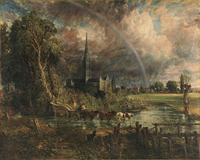
Indeed, they went so far as to edit Constable’s correspondence to excise any intimation of political engagement. Salisbury Cathedral had personal meaning for Constable. His great friend, the Reverend John Fisher, lived there; the Bishop John Fisher was one of his oldest supporters. Indeed, in 1823, the latter commissioned a view of the cathedral as a wedding present for his daughter. On its nearing completion, Constable wrote to Fisher, “I think you will say when you see it that I have fought a better battle over the Church than old Hume, Brogham and their coadjutors have done. It was the most difficult subject in landscape I ever had upon my easel.”[21] In the 1991 catalogue the passage was quoted, without the italicized clause. Fisher had been exercised about the “vulture of reform . . . turning its eyes on the Church & . . . preparing to fix its talons in her fat,” to which Constable had replied, “I am sorry to see you are again haunted by that Phantom—‘The Church in Danger.’”[22] It’s reasonable to infer that Salisbury Cathedral represented the institution, and that both Constable and Fisher detested the reforming politicians Joseph Hume and Henry Brougham. The 1991 catalogue censored that.
In 1965, Graham Reynolds suggested the iconography of Constable’s Salisbury Cathedral from the Meadows articulated the anxieties that political reform—he consistently linked radical politics with diabolical agency—provoked in Constable. When he announced his having fastened on this as a subject, Fisher wrote, “I am quite sure that the ‘Church under a cloud’ is the best subject you can take.” And in November 1831, the artist claimed Brougham had “ruined the art as well as everything else—& I who am in landscape fell first of all.”[23] So the thesis is entirely plausible. In 1991, this content appeared “to fly in the face of the overwhelmingly personal nature of Constable’s art” (despite the “personal” inevitably involving the political). The curators of the 1991 exhibition directed their readers to an article in which Edward Harwood—who did “not for a moment intend to deny the possibility of other interpretations of this painting”—went on to suggest the insertion of the physically impossible rainbow was to inject an element of hope into an iconography principally concerned with articulating Constable’s continuing grief at the death of his wife.[24] Which is indisputable. Yet the swallows flying low over the river intimate there is more rain to come (according to an old rhyme, “Swallows high, staying dry; Swallows low, wet will blow”), and the church will continue to be threatened under its cloud. To read Constable’s Correspondence is to encounter a cultured, complex intellectual, entirely invested in times that were changing at a bewildering pace and that he made manifest in the paintings he made of varieties of places.
To deny this—and to refuse to engage in any kind of scholarly debate but rather to accuse those who suggest alternative ways of seeing of “reading too much” into paintings—is, I suspect, a peculiarly English thing, and one exclusive to the fine arts. Those who have written critical accounts of Jane Austen’s novels take it as a given that they concern themselves with such issues as the status of women generally, or, in Mansfield Park, slavery and the slave trade, or, in Sanditon, a physical manifestation of modernity that, in some ways, chimes with Constable’s Chain Pier, Brighton (1827; Tate Britain, London). In 1991, the curators of the Constable exhibition were so bent on neutralizing Constable that they refused to acknowledge that a dead tree in The Cornfield (1826; National Gallery, London) indeed was a dead tree (inducing Stephen Daniels to resurrect a comedy routine involving a dead parrot).[25]
Tate Britain’s Turner and Constable: Rivals and Originals—unfortunately confined to the deeply unsympathetic Linbury galleries—exploited the remit opened up by eschewing the impossible task of supplying a double retrospective exhibition. Of course, the “rivals” aspect was fake but effective bait, with the real interest residing in the differing trajectories of the artists’ careers and artistic choices: Turner as “boy wonder,” Constable not; Turner an avid money-maker, Constable reliant on family money. Then there was the social difference. Moorby is alert to Turner’s conceivably having been disadvantaged by having a Cockney accent while wondering if Constable spoke Suffolk. The answer to that is probably not, though he could parody it. “Bargell,” in a letter he wrote his brother Golding, is the phonetic spelling of “Bergholt” in the local patois, and what has been transcribed as “dungle” but spoken as “dungull” refers to a dung hill.[26] Those familiar with Lynda Mugglestone’s wonderful ‘Talking Proper’ will know received pronunciation (or, until recently, BBC-speak) was a marker of social acceptability by the later eighteenth century, and Constable appears to have been more or less socially acceptable.[27]
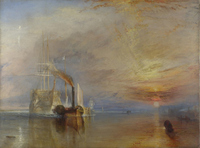
And, of course, during a period when war dictated a particular focus on the domestic scene, Turner and Constable were two among many landscapists: who interacted. Gillian Forrester has supplied a brilliant account of the relationship between Turner’s The Dort (1818; Yale Center for British Art, New Haven) and Augustus Wall Callcott’s Mouth of the Tyne (1818; private collection)—an eloquent testimony to the former’s impact on others’ artistic practice—at the Royal Academy exhibition of 1818.[28] And it is common knowledge that painters besides Turner and Constable were painting sketches in oil from nature, although Turner stands out for having done this for only a brief period and Constable for being persistent and scientific. Amy Concannon used Turner and Constable as a creative and intellectual opportunity to explore what pictorial dialogues might be generated by a hang not constrained by the need to be historically encyclopedic. This meant, for instance, that the loss of missing works—Turner’s The Fighting Temeraire (fig. 2) and Constable’s The Hay Wain—was immaterial.
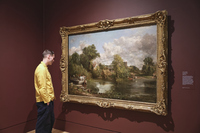
Turner and Constable offered exceptional (if uncomplicated) pleasures—the glories of Turner’s Venetian watercolors, one of the astonishing moonlit sketches Constable made in 1810, or his The White Horse (fig. 3), on loan from the Frick Collection. Constable’s Salisbury Cathedral from the Meadows was reunited with Turner’s Caligula’s Palace and Bridge (1831; Tate Britain, London), with which it had shared the Royal Academy walls in 1831; Concannon astutely observes how both “speak to a present in the grip of uncertainty and on the brink of political change” at a period of intense political instability in Britain and across the rest of Europe more generally (20–21). More mundane issues did intrude themselves. It became increasingly obvious how much each painter worked. The surface of Salisbury Cathedral from the Meadows advertised hours and days of labor, rendering the painting a monument to Constable’s own time, a chunk of his life. Turner’s imagery—there was a sensational selection of sketchbooks—revealed him to be compulsively peripatetic, covering vast distances in Britain and mainland Europe, drawing constantly. This highlighted how Constable was notably single tracked, representing his own places across his life.
There were obvious contrasts: Turner’s astonishing precocity against Constable’s far slower conquest of his craft, or the fact that, as I have mentioned, their different social origins significantly dictated the trajectories of their practices. Turner, as Solkin and others have pointed out, deliberately followed a Reynoldsian agenda and set himself up against the Old Masters.[29] Constable was as conscious of the latter but more fastidious in his cross-referencing. Turner made his money from art (predominantly prints) and took care his work attracted attention. This often meant going large: Robert Barker’s Panorama or the contemporary French art he saw on his 1802 continental tour would have alerted him to the impact of sheer size. The gallery showed a fine line of Constable’s “six-footers,” from The White Horse to The Leaping Horse, and placed them opposite Turner’s Dido Building Carthage (1815; National Gallery, London) and The Decline of the Carthaginian Empire (1817; Tate Britain, London), physically grander and chromatically spectacular in contrast. Constable left his surprise to the last, for the extraordinary Stoke by Nayland (ca. 1810–11; Tate Britain, London), with its craziness of a plough parked on a country lane, displayed an expressionistic, surface-amplified painting reminiscent of Jackson Pollock, as did the very late improvisations on the theme of Willie Lott’s farm.
The catalogue itself did not follow the conventions set out in 1976 and 1991. Some works stood alone, some directed the reader to a text essay, others, for instance the entry for Turner’s Keelmen Hauling in Coals at Night (1835; National Gallery, Washington) contained helpful explanatory notes. The essays cover various topics. Concannon’s long introductory piece is exemplary (and immaculately referenced), offering reassurance that the notion that scholarship is a collegiate, collective endeavor still more or less lives. She additionally supplied succinct scholarly introductions to the main sections of the show, as well as a short but impressively comprehensive booklist. Nicholas Robbins was extremely interesting on Constable’s skies, Joyce H. Townsend on Turner’s materials and techniques, and Richard Johns in reminding us that “Constable country remains, as it has always been, a contested field” (57), while Turner, conversely, tends to be framed as “an artist out of time” (58).
Concannon’s choice also pointed up the ways that juxtaposing works can open previously unnoticed lines of inquiry (as with Gillian Forrester, Turner, and Callcott). In 2014, Anne Lyles and I curated an exhibition of oil sketches from the Tate storerooms.[30] Because we were limited to works deemed available—and therefore could not attempt to articulate some predetermined narrative—those we were lent told their own stories. Rivers were significant, so were working scenes. There were sufficient numbers of Thames scenes to make one wonder if artists (who were mostly based in London) were meeting up and talking shop. Women artists were missing. John Sell Cotman, John Crome, and others displayed a penchant for silhouette. The ways that oil sketches offered a direct, unmediated view of an evolving modern world indirectly paid tribute to Charlotte Klonk’s brilliant aperçus about how the natural sciences and the arts were interacting.[31] Despite it being accepted that the picturesque was all the go, such subjects were notably absent. It was clear that the serious historical study of British art of this (or any) period had exciting potential, but monographic studies must confront avoidable limiting factors.
Tim Barringer’s Constable, a survey of the artist’s works at the Yale Center for British Art, is, in effect, a substitute exhibition. Despite one or two debatable assertions—for example, Constable did not decry “the changes in rural life now known as the agricultural revolution” (20) but relished and understood these developments (the country round East Bergholt always had been enclosed)—there are passages of superb writing on the works themselves, along with an awareness of the Franco-Roman roots of oil sketching, and a recognition that urban modernity was increasingly central to Constable’s view (104–28). Nicholas Robbins’s short essay on Constable’s clouds reveals an acute awareness of the paradoxical nature of sketches painted over minutes, claiming to capture a precise moment of a phenomenon constantly in flux (although, unlike Robbins, I was not discomforted by my awareness of our current ecological crisis while looking at these pictures, but that may just be my age). And the book does point up the superiority of the codex over the scroll when it comes to offering a virtual survey of works of art.
This is serious scholarship, something Moorby achieves, too, in Turner and Constable: Art, Life, Landscape despite oddities pervading her text. Attempts to counteract the actuality that Turner and Constable were not rivals but two among many landscape artists means she occasionally writes about them as though they were the principal characters in some art historical soap opera—“British landscape’s double act” (244), for instance. The book, which would have benefited from more stringent editing and less stinginess with illustrations, exasperatingly intermingles the brilliant with the rather less so. It really should not be thought necessary to define a “midden” incorrectly as “an old word for a heap of human waste” (9), not least because it’s still used. On the other hand, passages dealing with Turner’s first continental tour, as with those on the Liber Studiorum (1807), are genuinely distinguished. The book does exhibit noticeable bibliographical absences. Moorby quite correctly writes of the symbolic, quasi-mythic significance of the Thames, pertinently comparing its national grandeur and auspiciousness with the industrious modesty of the Suffolk Stour, but Andrew Hemingway’s seminal study of the Thames and river imagery during this period is unnoticed. And, when it comes to dealing with Constable’s invention of some quintessentially fictional “England,” Stephen Daniels’s canonical article on this phenomenon also goes uncited.[32]
In one passage, Moorby compares Turner’s Reynoldsian referencing of the Old Masters with Constable’s deliberately less pictorially referential vision, citing his Dedham Vale, Morning (1809; private collection), a picture on which the artist staked an enormous amount. He first painted the view west up the Stour Valley from the entrance to Fen Lane in an 1809 oil sketch. Constable then systematically worked the motif in compositional ébauches, expanding the vista, which, in the exhibited canvas, is framed by a repoussoir of trees in such a way as to intimate that here is a modern and documentary equivalent to Claude’s Arcadian fictions. (Turner’s vast England: Richmond Hill on the Prince Regent’s Birthday [1819; Tate Britain, London] could almost appear a delayed riposte.) This is no original observation, but it does undermine Moorby’s point.
Nor is it remiss to regret that the author, when discussing Constable’s famous May 1802 letter to John Dunthorne—the one in which Constable declared “there is room enough for a natural peinture”—fails to note his quoting and paraphrasing passages from the Discourses in thus representing himself as a serious painter. And there are other instances when the critical eyebrow finds itself ascending toward the receding hairline. It is taken for granted that Turner’s Fighting Temeraire is a valedictory work, an homage tinted with sadness as the glories of the past are consigned to history. That the sun is setting in the east has hardly weighed on an interpretation that dates to William Makepeace Thackeray and John Ruskin. Except, if it were rising this would allow the painting, instead, to celebrate a glorious dawn. Turner liked industrial modernity. He celebrated railway trains. Steel engraving allowed him to maximize print sales, his principal income stream (and, as Moorby points out, his cupidity did not go uncensored). And an establishment that demanded documentary prosody from historical nautical imagery had royally snubbed him over a huge painting of the Battle of Trafalgar.[33] Turner himself tended to sport a stovepipe hat, and its rhyme with the smokestack of the tug towing the Temeraire raises a possibility that he was articulating a personal stake in consigning the old world to the breaker’s yard.
As I have written, there are brilliant passages in Moorby’s book, but it communicates a worrying sense of scholarly disconnection, no sense of needing to set its narrative against the available literature: hence that odd failure to cite well-known sources. And this disconnectedness extends to her sometimes finding herself a little uneasy with the past—to the extent of her resorting to rather horrible neologisms, as when the catering for an 1813 dinner is “outsourced” to, not “supplied,” by “a local tavern” (99). Turner’s “Fallacies of Hope” is a poetical oddity. Moorby characterizes it as almost entirely alien, when, in fact, its diction is as historically remote as Samuel Taylor Coleridge’s. There is a sense that the author finding material has suddenly become strange, not part of the world she or her readers inhabit. “Suddenly,” because a 2020 BBC documentary Constable: The Rural Rebel—in which Rose Balston deftly collaged televisual treatments of Constable from the 1960s and in which it was striking that commentators of different stripes and different eras were essentially singing from the same historical hymn sheet—was rebroadcast in June 2026 and appeared to be a transmission from an alien world. Constable, it appears, is now no longer of our cultural universe. The idea that by investigating the past you are also attempting to understand the present is, apparently, no longer viable.
This disjunction also, to an extent, prevails in Susan Owens’s fine Constable’s Year (whose designer is to be applauded for the very nifty idea of reproducing a work on the recto and a detail from it on the verso of a page). A fairly comprehensive bibliography selectively focuses on Constable alone, disconnecting him from his worlds. That same May 1802 letter is presented as straightforward (it’s not). And, while the lead-up to Constable’s 1816 marriage to Maria Bicknell is fluently described—it’s refreshing to see a scholar recognizing that opposition to it partially lay in Constable’s not “even attempting to get a proper job” (33)—it omits one of its more interesting aspects. As matrimony loomed, Constable was intently painting Wivenhoe Park (1816; National Gallery of Art, Washington) and the relatively large Flatford Mill (1816–17; Tate Britain, London). So immersed was he in his work that he wrote to Maria to ask if a marriage for which each had been waiting some seven years might be postponed a little while. Her reply is one of the very few letters they wrote each other that does not survive—I’m guessing he destroyed it—and the marriage duly took place. Owens mentions none of this. And she does make odd errors, writing of “reaping” (not “mowing”) hay and its being “baled” (83, 156).
Like Moorby, Owens comes up with some strange terminology (e.g., “zhuzhing”) and is uncomfortable with James Thomson’s The Seasons (1730), one of the most popular poems ever written in the English language, to the extent that she thanks the Romantics for modernizing poetical diction and expressing their sentiments “with the kind of language you or I might use” (83)—leaving this writer wondering what she would make of William Cowper—before going on to acknowledge that “The Seasons answered a profound need” (156). Reading any historical text demands the deciphering of a superficially familiar yet alien language (hence, the helpful notes in Penguin editions of Jane Austen’s novels), and this is not normally assumed to present major problems (hence, the countless filmic or televisual adaptations of works by that same author). Both Owens and Moorby communicate a sense of rupture in a cultural continuum that accommodated Geoffrey Chaucer as comfortably as Constable, and this is augmented elsewhere.
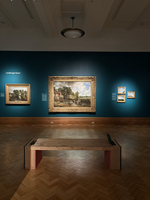
The Ipswich Hay Wain show (among other things, a testimony to the generosity of the Tate, the V&A, and the Royal Academy in loaning work) is terrific. The Hay Wain itself is hung low: it can be prospected from very close while a run of canal scenes communicates a sense of Constable having found a theme and sticking with it, suggesting that from 1819 or so his more innovative or experimental work happened in London (fig. 4). While picture groupings made sense to those already familiar with the artist, wall captions would have helped guide those who were not, but they were few and far between. And those few were misleading. Boat Building, for example, was incorrectly dated to 1815, the year it was exhibited, rather than 1814, when it was painted.
It remains striking how that picture lays out the processes of preparing timber to build a lighter, what tools are used, how one is constructed. Visitors might have liked to have had that pointed out to them, but guidance was lacking. But then, the exhibition website stated that the show was about “themes of landscape, place and walking.” So, it appears, we do not need history. It’s no longer part of the story. It’s about us, and how we personally respond or relate to Constable—something apparent, too, from an essay by Natalie Olah in the Tate Members’ magazine in which we learn, despite the recent art history wars, that the exhibition displays a “willingness to reappraise one of the safest figures in all of British art history.”[34] Particularly because those wars rumble still.
Reviewers of the Tate’s Turner and Constable were mainly hooked by the idea of the rivalry: “who’s the boss?” asked Adrian Searle in a review touching on many of the topics outlined above; Mark Hudson eventually plumped for Turner over Constable.[35] Others were concerned with different issues. Sir Ferdinand Mount, writing in The Times Literary Supplement, engagingly dubbed Turner “an inveterate ambulance-chaser” with respect to the haste with which he met a docking Victory or hied himself to the battlefield at Waterloo, but also took the time to launch a salvo at Barrell’s Dark Side of the Landscape, apparently holding him responsible for a species of art history that considers Constable as “a ruling class stooge” for managing his staffage with such care. Mount wrote of having driven through “Constable Country” in winter and not having seen a soul.[36] Well, the countryside does tend to be depopulated in winter. And it was historically far busier (as Constable’s and others’ images declare). Mechanization has reduced the need for manpower, and since much farming is now carried out by contractors, the fields are indeed often void of humanity, save for ramblers.
Of greater moment is the hostile concern with a book which is now forty-six years old, something which preoccupied the writer Bendor Grosvenor, who found Moorby’s Turner and Constable “highly enjoyable.” On visiting the exhibition, he found himself “muttering about the excesses of Marxist art history,” advising those who followed him to the show to “give some of the labels a miss” because Constable “is cast as an anti-democratic reactionary,” an accusation first leveled at him “by Marxist art historians in the 1980s.”[37] It is with a head hanging low that I must concede these possibly include me, though in mitigation I never thought striving to write an historical art history made me a “Marxist,” but so it goes. And I must admit to being puzzled by how the kind of historical contextualization that helps our understanding of works created in an unknowable past must be dismissed as inadmissible on the grounds that it’s “Marxist.” If we follow this logic through, we would refrain from consulting the documents that help our unraveling of Renaissance altarpieces. What on earth, one wonders, is going on here?
Not least, because, on reviewing Moorby, Grosvenor wrote of Turner’s fiscal links to slavery or Constable relying on family money, which could, in itself and according to his proposed understanding of the term, be interpreted as Marxist.[38] Elsewhere he again bemoaned Constable’s having been represented as “an anti-democratic reactionary” and wrote of meeting a Russian woman at the Tate exhibition (somehow I am reminded of Tomalin’s “collective farms”) who reassured him Constable was “a democratizing truth-teller of rural life.”[39] Like any complex and highly intelligent person, Constable could maintain apparently contradictory views and attitudes. He might have befriended East Bergholt plumber and atheist John Dunthorne, but his “almost every mechanick—whether master or man—is a rebel and blackguard” suggests no natural sympathy with the lower orders, and it’s significant that he was entirely indifferent to the consequences for the poor when East Bergholt Common was enclosed.[40] It is not to besmirch him to suspect his ideologies played into his art, but it’s rather strange in 2026 to be bothered by it. What was, was.
Grosvenor’s use of “Marxism” smacks of the way the authoritarian far-right in the United States attempts to delegitimize certain modes of thinking by having the public associate them “with something ‘they dislike or fear’, the ‘Marxism’ it associates with the Frankfurt School.”[41] It may, however, simply boil down to Englishness and embedded English anti-intellectualism—I don’t know other countries where being too clever by half or for your own good are frowned upon—and the fact that although a mere 7 percent or so of the population attends a fee-paying school, they exert a quite disproportionate (and not always malign) influence over life in general. Thomas Arnold, from 1828 the head of Rugby, one such school, maintained that “what we must look for . . . is 1st, religion and moral principles, 2ndly, gentlemanly conduct; 3rdly intellectual ability.”[42] As Hönes noted, it was the descendants of such men that traditionally had been the custodians of the history of British art. One explanation for the changes that took place from the 1960s lies in that monopoly having been broken. Many of those who were then getting their teeth into British art had been educated at what in the United States are termed “public schools”; and their university education came without subsequent financial encumbrance. That this began changing with the election of Margaret Thatcher’s Conservative government in 1979 is not coincidental, because, looking back from 2026, it’s clear—as the historian David Kynaston starkly observes—her notorious “there is no alternative” meant demolishing the Clement Attlee government’s post-war settlement and replacing it with a liberal capitalism that had to be spared any kind of ideological critique (hence, the “no alternative”), because that would throw its fragility and vulnerability into sharp focus.[43] Such critiques could extend to studies in the humanities, and, not coincidentally, university teaching of the humanities has been under systematic attack.[44]
British universities have become particularly vulnerable both because they are increasingly reliant on student fees and because the idea that “education” has great value not because it sustains ethical, cultural, and social values but only in the degree to which it fits a person successfully to end up in (preferably well-paid) employment has taken a pernicious hold—as has the rise of social media, which blur and intermix the kinds of issues that should be subject to objective scrutiny while allowing individuals to live through screens in personally disconnected worlds. Should I mention that kakistocracy and plutocrats wielding power and spreading myths without responsibility—I am writing this while cowering in an attic in the Islamic Republic of Cotswoldistan—cannot be defended in the kinds of terms which justify the implementation of “traditional” party politics. For Donald Trump, lies are truth. This, too, signals the dissolution of any feasible public sphere, as, too, did my comments about the disappearance of the shared world assumed in the 2020 BBC documentary, Constable: The Rural Rebel.
One might almost suspect the reaction to Solkin’s Richard Wilson fostered a kind of Orwellian collective amnesia where the relatively recent past became so completely another country it could hardly be imagined any more. It appears, for instance, that current researchers are more concerned with issues surrounding gender or ecology specifically, rather than their place in a more general politics. But hope cannot be entirely abandoned. Despite its being slightly shocking to realize it happened twenty years ago, Anne Lyles’s 2006 Tate Britain exhibition, Constable: The Great Landscapes, and its catalogue were both exemplary, while Jonathan Clarkson’s 2010 book, Constable, offers an excellent, historically grounded introduction to the artist. And through both the exhibition Turner & Constable and its excellent catalogue, Concannon revealed that the Tate might be prepared to stand up against those who would keep scholarship beige. It will be a necessary fight.
Notes
[1] Hans C. Hönes, “The Rise and Fall of the ‘Clerks’: British Art History, 1950–1970,” British Art Studies 24 (March 2024), https://doi.org/10.17658/issn.2058-5462/issue-24/hhones; Hans C. Hönes, “British Art History and the History of British Art,” Kunstchronik 75, no. 7 (2024): 343–48, https://doi.org/10.11588/kc.2022.7.102601; and Michael Rosenthal, “The Nature of British Landscape Painting, c. 1770–1830,” in Turner and Constable: Sketching from Nature, ed. Steven Parissien (Harry N. Abrams, 2014), 8–29.
[2] Hönes, “Rise and Fall.”
[3] John Gage, “Introduction,” in A Decade of English Naturalism 1810–1820 (Norwich Castle Museum, 1969), 1.
[4] Writing an essay to the catalogue of the exhibition of oil sketches from the Tate Collection, Turner and Constable: Sketching from Nature (London, 2014), curated by Anne Lyles and me, induced me to wonder quite how far scholarship had progressed since Gage.
[5] See Graham Reynolds, Constable: The Natural Painter (McGraw-Hill, 1965); and Leslie Parris and Conal Shields, John Constable 1776–1837 (Tate Gallery, 1969).
[6] Parris and Shields, John Constable, 6.
[7] Leslie Parris and Conal Shields, Constable: The Art of Nature, exh. cat. (Tate Gallery, 1971).
[8] Leslie Parris, Landscape in Britain c. 1750–1850, exh. cat. (Tate Gallery Publications, 1973).
[9] Nicholas Alfrey, “1973 and the Future of Landscape,” British Art Journal 10 (November 2018), https://doi.org/10.17658/issn.2058-5462/issue-10/nalfrey; Stephen Daniels, “‘The Field of Waterloo’: Constable 1976–1991,” Rural History 3, no. 1 (1992): 111–17; and Michael Kitson, introduction to Painting in Britain, 1530–1790, by Ellis Kirkham Waterhouse, 5th ed. (Yale University Press, 1994), xxix.
[10] Conal Shields, “Introduction,” in Parris, Landscape in Britain, 9.
[11] Graham Reynolds, Victoria and Albert Museum. Catalogue of the Constable Collection, 2nd ed. (Her Majesty’s Stationery Office, 1973).
[12] Kitson, introduction to Painting in Britain, xvi.
[13] John Barrell, “Constable’s Plenty,” London Review of Books, August 15, 1991; Kitson, introduction to Painting in Britain, xii, xvi–xvii; and Duncan Robinson, “Richard Wilson: New Haven and Cardiff,” Burlington Magazine 1337, no. 156 (August 2014): 545–47, 546.
[14] “Arcadia Lost,” Apollo, January 1983, 3.
[15] “Une Ténébreuse Affaire,” Daily Telegraph, November 8 1982. The Telegraph has never leant to the left.
[16] BBC Radio 3, “Critics’ Forum,” broadcast 5:45 pm, November 13, 1982.
[17] George Crabbe, The Village (London, 1783), 1.21–22, 39–40.
[18] Barrell, “Constable’s Plenty.” See also Stephen Daniels, “‘The Field of Waterloo’: Constable 1976–1991,” Rural History 3, no. 1 (1992): 111–17, https://doi.org/10.1017/S0956793300002958; and Michael Rosenthal, “Constable at the Tate: The Bright Side of the Landscape,” Apollo, August 1, 1991.
[19] Leslie Parris and Ian Fleming-Williams, Constable, exh. cat. (Tate Gallery, 1991), 16.
[20] Parris and Fleming-Williams, Constable, 16, 162, 367.
[21] Ronald Brymer Beckett, ed., John Constable’s Correspondence, vol. 6 (Boydell Press, 1968), 115. Emphasis added.
[22] Beckett, Correspondence, 6:110, 6:112.
[23] Reynolds, Constable, 118; and Michael Rosenthal, Constable: The Painter and His Landscape (Yale University Press, 1983), 229. See also Concannon, Turner and Constable, 38–41, 155.
[24] Parris and Fleming-Williams, Constable, 367. The article was Edward Harwood, “Constable’s ‘Church under a Cloud’: Some Further Observations,” Turner Studies 5, no. 1 (Summer 1985): 27–29.
[25] See note 8 above.
[26] Leslie Parris, Conal Shields, and Ian Fleming-Williams, John Constable: Further Documents and Correspondence (Tate Gallery, 1975), 80; and Ian Fleming-Williams, “A Runnover Dungle and a Possible Date for ‘Spring’,” Burlington Magazine 114 (1972): 386–93.
[27] See Lynda Mugglestone, ‘Talking Proper’: The Rise of Accent as Social Symbol (Oxford University Press, 1995).
[28] Gillian Forrester, “1818: Camaraderie and Rivalry on Display,” in The Royal Academy of Arts Summer Exhibition: A Chronicle, 1769–2018, eds. Mark Hallett, Sarah Victoria Turner, and Jessica Feather (Paul Mellon Centre for Studies in British Art, 2018), https://chronicle250.com/1818.
[29] David Solkin, ed., Turner and the Masters, exh. cat. (Tate, 2009).
[30] See Parissien, Turner and Constable.
[31] Charlotte Klonk, Science and the Perception of Nature (Yale University Press, 1996).
[32] Stephen Daniels, “John Constable and the Making of Constable Country,” in Fields of Vision: Landscape Imagery and National Identity in England and the United States (Polity Press, 1993), 200–46.
[33] “The Battle of Trafalgar, 21 October 1805,” Royal Museums Greenwich, accessed September 5, 2026, https://www.rmg.co.uk/.
[34] Natalie Olah, “Constable’s Untameable Nature,” Tate etc., April 9, 2026, https://www.tate.org.uk.
[35] Adrian Searle, “Turner & Constable Review—Boiling Portentous Skies Versus Two Men and a Dog,” Guardian, November 25, 2025; and Mark Hudson, “Turner & Constable, Tate Review—An Epic Confrontation Between the Ultimate British Artists,” Independent, November 24, 2025.
[36] Ferdinand Mount, “As Unlike as Ever. Turner Is on Our Banknotes, Constable in Our Hearts,” Times Literary Supplement, January 6, 2026.
[37] Bendor Grosvenor, “Tate Britain’s Turner and Constable Show Got Me Thinking About Marxist Art History,” The Art Newspaper, January 22, 2026. See also Moorby endorsement on front cover paperback.
[38] Bendor Grosvenor, “Turner and Constable: Who Really Won the Great Painterly Duel,” The Times, March 20, 2025.
[39] Grosvenor, “Tate Britain’s Turner and Constable Show.”
[40] Ronald Brymer Beckett, ed., John Constable’s Correspondence, vol. 2 (Boydell Press, 1964), 403, 167.
[41] A. J. A. Woods, The Cultural Marxism Conspiracy: Why the Right Blames the Frankfurt School for the Decline of the West (Verso, 2026), 67.
[42] Mugglestone, Talking Proper, 273.
[43] David Kynaston, Austerity Britain 1945–48: A World to Build (Bloomsbury, 2008), 1.
[44] Stefan Collini, “Squadrons of Pigs,” London Review of Books, June 4, 2026.