Illustrated Sheet Music in the U.S., 1830–1930 edited by Theresa Leininger-Miller and Kenneth Hartvigsen
Reviewed by Erika PiolaErika Piola
Library Company of Philadelphia
Email the author: epiola[at]librarycompany.org
Citation: Erika Piola, book review of Illustrated Sheet Music in the U.S., 1830–1930 edited by Theresa Leininger-Miller and Kenneth Hartvigsen, Nineteenth-Century Art Worldwide 25, no. 3 (Autumn 2026), https://doi.org/10.29411/ncaw.2026.25.3.14.
This work is licensed under a Creative Commons Attribution-NonCommercial 4.0 International License  unless otherwise noted.
Your browser will either open the file, download it to a folder, or display a dialog with options.

Theresa Leininger-Miller and Kenneth Hartvigsen, eds.,
Illustrated Sheet Music in the U.S., 1830–1930.
Bloomsbury Visual Arts, 2025.
384 pp.; 161 color illus.; list of figures; notes; index.
$108.00 (hardcover)
ISBN: 9781350450011
In the introduction to Illustrated Sheet Music in the U.S., 1830–1930, editors Theresa Leininger-Miller and Kenneth Hartvigsen propose that “each step in a composition’s life”—image, music, text—“was a space where culture performed, where individuals could create meaning” (2). In the eighteen chapters that follow, readers are provided with a multi- and interdisciplinary compilation of essays by scholars of art history, music, and popular culture that aims to show that sheet music illustrations, like other picture types of the long nineteenth century, are “vital to understanding the visual discourse” of the period (1).
As indicated throughout the text, illustrated sheet music has been frequently overlooked in visual culture and art historical scholarship.[1] Many of the qualities of this visual material—its intermediality, ephemerality, and popularity—have been misperceived as weaknesses. In fact, as this volume demonstrates, they are assets for nuanced, contextual interpretation. Sheet music illustrations are “layered, intertextual” historical sources that embody “dynamic cultural networks” (2).
Not meant to be a definitive book on the study of sheet music illustration, the editors cleverly arranged the volume to include an “intermission.” Two chapters composed of interviews with sheet music collectors serve as an interlude between two chronological parts covering the periods 1830 to 1900 and 1900 to 1930. Eight case studies form each part. Opening with a purposely brief and cogent introduction, the editors give an overview of the social, cultural, and economic history of the production, distribution, marketing, and consumption of the genre that sets the groundwork for the succeeding authors’ contributions about the “golden age of sheet music” (5).
Common to any compendium, essays fluctuate in strength of content and writing. Nonetheless, all confer meaningful and insightful nuggets of knowledge about these underexamined graphics important to our ever-evolving understanding of US visual culture of the nineteenth and early twentieth centuries. The chapters contain multiple reproductions with robust captions that consist of the names of artists, titles, publishers, and dates that dovetail, augment, and clarify the textual descriptions of covers contained in the text. By contrast, the index proves not as nuanced as one would desire, especially given the multilayered arguments presented in most of the case studies. Conversely, chapters containing numerous citations to sheet music illustrations can occasionally cause the reader to feel inundated with information and unable to fully apprehend the essay from their need to track all the referenced titles, artists, and publishers. However, the volume contains a list of figures, and select chapters include tables and inventories that diminish the instances of overload. Additionally, most studies contain section subtitles. Given the weak index and the breadth of essays, these delineations prove practical and allow for strategic browsing by those interested in discrete components of the subject matter within. And although this review focuses primarily on the authors’ observations about illustrations, analysis of corresponding lyrics and music comprise most, if not all the chapters.
Anchoring the first part, chapters 1 through 3 elucidate the crucial role of sheet music in the burgeoning early national print market. These chapters document how the medium sustained early US artists and served as visual, material, and civic agents in the creation and consumption of mass (visual) culture in the United States. These early case studies bolster the later chapters, particularly authors’ discourses about visual signs and codes; the leveraging of popular, political, and social movements in the commodification of the media; and the subversive potential of the art of illustration.
The first chapter, “Viral Pictures and Network Artistry in Antebellum Sheet Music Illustration,” authored by art historian Erin Pauwels, showcases the potency and uniqueness of sheet music illustrations for the examination of mass-produced images of the past and present, especially in devising new research methodologies. With nods to the work of art historians as well as media and literary scholars like Michael Leja, Hito Steyerl, and Ryan Cordell, the author investigates “gestures, traces, and interactions” between “clusters” of sheet music covers and complementary pictorial matter before 1860.[2] By approaching the graphics in this manner, Pauwels enumerates the generative dialogues possible betwixt, between, and surrounding “poor images” (i.e., reproductions that travel from one media to another); collective, ambiguous, and amplifying acts of creative labor; and various modes of literal and figurative mobility of pictures in early mass visual culture (13, 19, 27–28). Through concepts of “network artistry” and “adaptive reuse,” Pauwels reveals the consequential analytical outcomes possible from “looking close, but not deep” at a range of illustrations produced from imaginative models of collaboration (20, 24–25). She pays particularly close attention to those adapted by prominent Canadian-born, US lithographer Napoleon Sarony. The artist savvily modified prevalent European sources in his sheet music commissions, such as the widespread portrait of Jenny Lind, which was painted in 1846 by German artist Eduard Magnus and spurred prolific variations. These evaluations, she deftly concludes, relay evidence of patterns of use, reuse, and viral spread predictive of and informing visual information in the digital age.
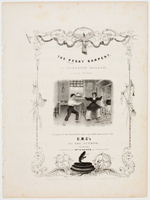
In chapter 2, “The Launch of a Marine Painter: Fitz Henry Lane’s Sheet Music Covers, 1833–41,” graphic arts scholar Georgia B. Barnhill delves into the role that the medium played in enabling Lane’s eventual success as a marine painter. Barnhill traces Lane’s evolution as an artist who leveraged the new printing process of lithography to subsidize the early stage of his career. The author astutely summarizes Lane’s growth and refinement as a sheet music illustrator who in his near-decade in the field steadily evolved to strategically craft pictures that connected aesthetic details, moods, music, and lyrics. While nautical and military drawings predominated in the artist’s covers, sentimental and metaphorical details also organically found their place in his titles, namely “Sicilian Vespers” (1833), “The Pesky Sarpent” (fig. 1), and “The Mariner’s Return” (1841). Barnhill fittingly concludes that Lane’s development into a marine painter is clearly visible in his sheet music compositions. The illustrations presage his future success and pertinent role in US visual culture.
In chapter 3, “Sounding the Spa: The Illustrated Sheet Music of Tourism in Antebellum America,” historian Alexandra Cade examines sheet music’s bimodal sensory role in representing, reflecting, and establishing a national identity with respect to “antebellum attitudes towards travel, class, and tourism” (53). Signifying the period as an “era of immense sociocultural flux,” and with a contingent focus on the woman consumer of sheet music, Cade provides a deep-dive analysis of select covers promoting four popular Northern and Southern natural landscapes and mineral spring resorts: Niagara Falls, Saratoga Springs, Natural Bridge, and Berkeley Springs (63). Within her commentary, the author juxtaposes the graphics, lyrics, and musicality of the pieces with descriptions citing the nonsensical chaos of “bumbling boaters” in “Niagara Falls” (ca. 1841); the sublime nature of well-to-do visitors traversing the grand plaza of Congress Hall in “Saratoga Galop” (1841); the aspirational view projected in “Natural Bridge Schottische” (1857); and the “theatrical setting” conveyed by the cultivated tourist destination shown in “A Day at Berkeley Springs” (1851). Cade demonstrates that not only representations of place, but also those of race, class, and gender affected and activated the national messaging found in the music adorning a woman’s parlor piano, as seen in pictorial details like the surveilled comportment of tourists or the presence of a solitary Black worker. Race, gender, status, and momentous events (historical and cultural) inform the content of this essay and those later in the text. These topical links facilitate transparent, serendipitous, and organic connections between the chapters. Within this connective framework, certain essays align together in definitive ways to convey the substantive subject matter of Illustrated Sheet Music and provide the schematic for the remainder of this review.
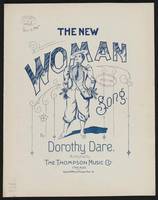
Cultural shifts and the role of gender in sheet music reappear in chapter 7, “Sheet Music Covers and the New Woman of 1895,” by Erin Smith. Visual codes are pertinent to Smith’s argument as they are to those of several of the contributors. Described by Smith as a figure of “commerce and feminism” and “scorn and fascination,” the New Woman adorned multiple covers in 1895 as she became an increasingly sensationalized topic in popular media. Scrutinizing three songs in particular, one composed by a man and two by women—Edward Holst’s “The New Woman: March and Two Step” (1895); Dorothy Dare’s “The New Woman: Song” (fig. 2); and Margaret Koenig’s “The New Woman; Song or The Woman of ’95: Song”—the author expounds upon the “intersection of both feminist and anti-feminist symbolism found” in the music and the depictions of the icon ubiquitously shown smoking, in masculinized attire, and undertaking unfeminine pursuits (134). Smith goes on to persuasively explain that the sheet music trade’s leveraging of and profiting from the New Woman—a sensational topic—reflected and spurred the contradictory and notorious pictures of the proto-feminist figure in turn-of-the-twentieth-century society.
Another iconic figure is the subject of art historian Paul H. D. Kaplan’s “Three Kings of the Orient: The Magi and Slavery in An Illustrated American Christmas Carol from 1865” (chapter 4). Kaplan sheds light on the historical, familial, and political circumstances behind the unconventional depiction of a shackled, enslaved figure as opposed to the magus Balthazar in composer Rev. John Henry Hopkins Jr.’s 1865 illustrated edition of “Three Kings of the Orient. A Christmas Carol.” Rooted in a concise and cogent history of the evolution of the Black Magus figure in Western art, Kaplan’s essay details pivotal influences on the Episcopal reverend’s iconographical choice, not the least his being the son of Rev. John Henry Hopkins Sr., the most prominent Northern apologist for slavery. Kaplan explores period portrayals of Black men, Hopkin Jr.’s and Sr.’s written works supportive of slavery as a path to conversion, and criticisms by the composer’s brother of this support to propose that the depicted figure left “room for viewers of different political opinions to interpret it according to their preference” (81).
Ruminations about the familial, socioeconomic, and cultural motives behind the works of specific sheet music creators also ground the case studies by museum curator Rebecca Bush (chapter 6); musicologist Laurie J. Sampsel and independent scholar Donald M. Puscher (chapter 16); and volume editor and art historian Leininger-Miller (chapter 17).
In “Racial Perceptions in the Sheet Music of Blind Tom and Blind Boone,” Bush delivers another case study demonstrating the importance of sheet music for understanding the visual culture of race during the nineteenth century. From provocative comparisons of the personal and professional lives of Thomas Wiggins and John William Boone—both blind, Black, young, male musicians born to enslaved mothers—Bush traces the trajectory of the racialized careers of these prodigies as encapsulated on their sheet music covers. Beginning by chronicling an 1880 joint performance with the artists, Bush illuminates their divergent career paths by correlating these with the graphics on their compositions. The author adeptly extrapolates changing white perceptions of popular and African American music by comparing the conservative illustrations visible on Wiggins’s primarily military-themed parlor music with the typically racist caricatures printed on the nascent ragtime compositions by Boone. Bush details how the men navigated divergent levels of individual freedom and economic control of their livelihoods in seeming contrast to the disseminated imagery. Leveraging this framework, Bush renders compelling biographies of the disabled Black musicians and effective analysis about the poignant illustrations on the covers camouflaging their music and their lives.
Sampsel and Puscher’s chapter, “Setting the West to Music with Realistic Illustrations: A Case Study of Estelle Philleo’s Artistic Control,” concentrates on the cover art and publishing network of Ohio-born composer Estelle Philleo. Philleo and her first publisher, Colorado-born Margaret St. Vrain Sanford, described by the authors as New Women, continue to be rarities in music about the American West. Bolstered by revealing descriptions of the personas involved and the cover art rendered to tell Philleo’s story of creative authority, the chapter explores her five-series set, Setting the West to Music, issued between 1917 and 1925. Connections to men collaborators from the West, including author and illustrator Harold Bell Wright, cowboy artist Elling William Gollings, and poet Charles Badger Clark Jr., serve as empirical threads, as do F. J. A. Forster and Charles W. Wells, the Chicago and Denver publishers of her final songs in the collection. As Sampsel and Puscher discuss, the Western creators’ reverential commemorations of life in the West are tangible in the art, music, and lyrics in all but one of Philleo’s five works. The fourth in the compilation, a love song enshrined with a colorful, art-deco view of an “Eastern” man looking at a setting sun by commercial artist Helen Van Doorn Morgan, proves a noticeable outlier. Acknowledging that Philleo’s cover art came full circle back to black-and-white pen drawings of cowboys in rural settings following the diversion of the Morgan drawing, the authors demonstrate the risk of arbitrary artistic control by composers.
Like Sampsel and Puscher, Leininger-Miller examines the complexities of artistic control over illustrations in her essay, “‘If You Don’t Get It, Tain’t No Fault of Mine’: Illustrated Sheet Music by Albert Alexander Smith in the U.S. and Paris, 1919–25.” Leininger-Miller highlights the work of an artist and musician who was one of only two Black sheet music illustrators hired by twentieth-century white publishers. She argues that although Smith, an expatriate who settled in Paris, was asked to illustrate music with standard gender and racial stereotypes, he did so shrewdly and comically through “references to superficial perceptions of white beauty, miscegenation, and racial uplift” (309). The author transmits a striking snapshot of Smith and his bold works. Using an interrogative strategy to assess Smith’s multifigure compositions teeming with layered vignettes and compelling elements, Leininger-Miller scrutinizes the artist’s use of divergent and intersecting glances, acts of performance, and depictions of literal and figurative games. Considering pieces composed or published by white and Black creators, including Pace & Handy, Shepherd N. Edmonds, and Edna Belle Alexander, she questions ambiguous and subversive portrayals of race and interracial relationships in Smith’s conceptions. Her drawings published in 1920 for Honolulu-Lou (reproduced as the volume’s cover), written by Black composer Edmonds and portraying a stylish white Hawaiian tourist, as well as those that illustrated It’s Your Move Now if You’re Going to Play Checkers, particularly resonated with the chapter’s author. The latter provocatively shows Bahamian-born performer Bert Williams in caricature and in front of a checkerboard adorned with three Black men’s heads triangularly placed as game pieces. Leininger-Miller concludes that Smith’s covers evoked far more viewer engagement with his art and ideological views than his paintings ever allowed.
Leininger-Miller also contributes “‘Are They Equal in the Eyes of the Law?’: African American Soldiers in First World War Illustrated Sheet Music” (chapter 14) to the volume. This, and another essay by co-editor Kenneth Hartvigsen entitled “‘There were Giants in the Earth’: Sheet Music Monsters in the First World War” (chapter 15) examine sheet music published during World War I. While Leininger-Miller focuses on “meaningful music covers” enacting “racially uplifting images of servicemen,” Hartvigsen explores World War I covers as pictures of propaganda showing imaginary battlegrounds inhabited by humorous mechanical giants and monsters in human and machine form (269, 288).
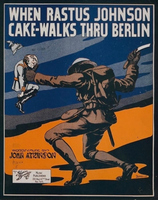
Emphasizing illustrations delineating themes of interracial comradery, multigenerational service, military musicians, and fights for equality, Leininger-Miller eloquently expresses how Black composers of World War I sheet music overrode the racism surrounding Black citizenship and military service in their covers and lyrics. As she describes, the portrayal of a razor-wielding Black warrior on “When Rastus Johnson Cake Walks Thru Berlin” (fig. 3) proves notably impactful in communicating a radical reclamation of Black resilience and strength with a prescient superhero-like figure. Hartvigsen examines superheroes of a different sort in the figure of a giant-size Uncle Sam shown in a variety of scenarios, as exemplified by his trampling Kaiser Wilhelm in “Good-Bye Germany” (1917). Contextualized by the author as not only a symbol of the federal government, but also of an exceptionalism that fed US confidence and optimism about the war, Hartvigsen extends his metaphor onto monster tanks like the one pictured on Corp. Jimmie Shea’s “The Yanks with Tanks” (1918). Symbolizing US economic growth and industrial leadership, the mechanical giants illuminated a “dramatic time of growth, destruction, and transformation” in the history of the United States (288). Given this time in our nation’s history, these chapters prove especially arresting and somber. The authors had likely not anticipated the United States’ diminished role as the leader of a coalition of nations and weakened democracy when they first wrote their narratives.
Like Leininger-Miller, Hartvigsen contributes two case studies to the volume. His other essay investigates a different critical time in the history of the nation: Reconstruction. In “The Case of Reconstruction Grand March: Horrifying Pictures, Racial Hybridity, and the Visual Modalities of American Song” (chapter 5), Hartvigsen “interrogates” the cover of Louisianian Charles Young’s Reconstruction Grand March, a song issued in 1868; little is known about its composer, production, or circulation. Hartvigsen advocates that this creates a space for the sheet music to serve as a potent “object” for conjecture about “a robust visual culture during a time charged by anti-abolitionist and anti-black rhetoric” (92). Printed by Philadelphia lithographer P. S. Duval and published by J. M. Peters of New York, the cover offers an “as it should be/as it is” tableau of horror, racial fears, and “abject monstrosity” in the form of a harmonious celestial white choir scene above one of mayhem spawned by witches and shocking, dark, hybrid creatures (92–93). Recalling the Opelousas Massacre, Black civic and political progress, and visualizations rooted in scientific racism and the macabre mass circulating in 1868, Hartvigsen posits the graphic embodied a composite of the intentions, some inadvertent, of its multiple Northern and Southern creators. All had created a vision that conveyed white fears of interracial relationships in the form of “shocking creatures,” in addition to one that denoted the domestic terrorism and racial violence for Black, nonwhite, Americans of the Reconstruction South.
Not only defining events in history, but also significance of place factors into several essays, in particular chapters 10 through 12. Paris, a world’s fair in the Midwest, and Cleveland provide the foci for art historian Emily C. Burns’s “Sheet Music, Blackface Minstrelsy, and the American Art Association of Paris, c. 1900” (chapter 10); music and fine art librarian Karen Olson’s “Education and Entertainment: The Louisiana Purchase Exposition in Sheet Music” (chapter 11); and music historian Daniel Goldmark’s “Rust Belt Alley: Cleveland as Sheet Music Nexus (1890s–1930s)” (chapter 12). Although Burns examines sheet music in a transnational context, all three authors discuss their subject matter within a framework of hierarchies and show how the examined places’ cultural ideologies, social histories, or musical legacies influenced the art surveyed.
Centered on cover illustrations of music performed at turn-of-the-twentieth-century Blackface minstrel shows of the white artist organization American Art Association of Paris (AAAP), Burns explores how the music relayed layered, multisensory, and material codes about constructions of race and national character. Influenced by the work of editor and fellow author Hartvigsen on racial anxieties evident in sheet music, concepts of “Black antics” and othering (James Smalls) and real and imagined legacies of “Blacksound” (Matthew D. Morrison), Burns conscientiously details visible incidents of conflations, counters, and transgressions of US, African American, and Caribbean cultures in the cover art and the association’s performances of their chosen minstrel songs (181, 189).[3] Historical, exported US and native French stereotypes about hierarchies of race ideologized and symbolized in the fashion, demeanor, and physicality of an upwardly mobile Black couple portrayed in the highlighted “Warmest Baby in the Bunch” (1897) and those of the mimicked primitivism of the Black body in “cakewalk” song covers and productions serve as bookend touchstones for the author. Burns adroitly argues that the AAAP’s minstrelsy exposes itself as “diasporic performance rather than cultural truth” (192).
For Olson, the place and space of a Midwest exposition as a center for the publication of sheet music comes under scrutiny as she examines specimens from over one hundred eclectic pieces issued during the Louisiana Purchase Exposition of 1904 in St. Louis. By placing the cover art into categories of high-, middle-, and lowbrow that correspond to the layout of the fair, Olson considers how exhibitions influenced US culture. Specifically, Olson traces educational and entertainment divides that paralleled class and racial divisions within the site. By mapping the musical and aesthetical styles of the sheet music to the physical exhibition, the author imparts an expository narrative. She justly ascribes how majestic renderings of the main building and thoroughfare, like those envisioned by respected architectural illustrator Vernon Bailey, captured the formality and starkness of highbrow, high-skilled piano solos. Similar formal treatments, albeit more colorfully, also comprised the images on middlebrow parlor songs meant for the average piano player. An allegorical female figure holding a map of the Louisiana Purchase garners attention, as do covers of a more complex design such as the one for “Down the Pike” (1904). Composed with a trope showing emissaries from attending nations and fair visitors promenading down the main thoroughfare, the cover communicates a racist and racialized cosmopolitan scene. Olson winds down her chapter with commentary about lowbrow, “straight forward entertainment” songs, often comic ones, including “St. Louis Tickle” (1904). Devised with a montage of Black caricatures, Olson ponders the significance of the view which insidiously situates Black figures outside of the exposition grounds in her concluding statements that incorporate an overview of St. Louis as a hub for music publishing.
In “Rust Belt Alley,” Goldmark seeks to address the “scholarly purgatory” from which sheet music illustration continues to emerge with a frank history of the trade in Cleveland, a city that he observes has had a strong national theatre and commercial art presence (215). Seeking to remedy his lament, Goldmark defines the biases and deficiencies in the critical scholarship of sheet music that have resulted from its association with the art trade as opposed to fine art. Simultaneously, he enumerates the work of fine artist Ora Coltman and commercial artist Ray Parmelee. Constructing historical and professional connections between Coltman and major sheet music publisher H. N. White—and White’s successor, Sam Fox—in addition to Parmelee, Goldmark highlights the creative heritages seen in the cover art of both men while documenting their personal and professional lives. Considerations of landscape and figure painter Coltman’s strong colors and combinations of patterns and texture in designs like the shadowy knight on horseback observable in “The Plumed Knight” (1903) dovetail with discussions about “advertising artist” Parmelee’s more flat, cartoonish style evident in his figure of a jaunty older man that appeared in “Frisky” (1919). Goldmark completes his essay by again advocating for the import of sheet music in illuminating overlooked changes in the art world as exemplified by the understudied and undervalued commercial work of Coltman and Parmelee.

The role of cultural appropriation and genre-specific sheet music comprises the core content of the remaining chapters: musicologist Sophie Benn’s “Dance, Dining, and Urban Social life in ‘Too Much Mustard’ and Its Responses” (chapter 13) and art historian Jaclynne Kerner’s “Alterity and Antiquarianism in the Illustrated Sheet Music of the Shriners” (chapter 18). As her title suggests, Benn’s essay concentrates on the derivative ragtime sheet music for “Too Much Mustard” (fig. 4), a hugely successful song that spurred multiple variations of its catchy music and cover that depicts a fashionable, aristocratic couple courting while dining out. Likewise, Kerner addresses iteration in her survey of Islamophilic motifs and symbols exhibited in the music of the Shriners, the fraternity established by elite white men during Reconstruction. Both authors address concepts of imitation and cultural appropriation in sheet music that foster a broadening and widening of a dubious access to nonwhite cultures.
Referring to scholars of ragtime and the notion of a “whitening process” of social dance, Benn’s chapter constructs a narrative about the evolution in the music genre that facilitated a perceived promise for social progressivism for women (233). She considers how the music shifted from “playful and improvisatory” to a form better denoted as commercialized, modern, and restrained. Supplemented by a table listing twenty-four titles of pieces based after “Too Much” (1911/1913) and issued between 1913 and 1916, the author examines selections of covers exhibiting visuals that mirrored and responded to the changing social, behavioral, and gender norms and dynamics expressed publicly in the era. Depicting utopic, comical, sexualized, and opulent tropes of dining, courtship, and dance—often in restaurants and cafés—the views, she contends, emblematize the conversion of these communal spaces into ones for equivocally defined, allowable interactions. Benn nimbly deconstructs the compositions of individuals smoking and imbibing cocktails, women clothed in evocative attire, and couples close dancing under the eyes of spectators. Remarking upon intersecting themes of race, age, status, and gender, including an engaging discussion about lobster palaces and the “lobster” metaphor for men taken financially and emotionally advantage of by women, Benn ably ties together her arguments about the “massification of social dance practices” that “could make a difference in a woman’s life” (232, 247).

In the concluding chapter, Kerner examines a series of repetitive tropes, pictorial details, and musical styles in the sheet music published by the Shriners between the 1890s and 1930s. The author addresses Shrinedom’s “pseudo-Islamic personae” and “Orientalized American subculture” that was rife with appropriations and fetishes that are evident in the fraternity’s sheet music (327). Within the context of the covers as “communicative agents and consumer products,” Kerner provides a history of the sheet music that early on comprised a set pattern of graphics that evinced white, wealthy men’s fantasies of the pleasure of the Middle East; appropriated Middle Eastern faiths, languages, and histories; and appeared seemingly absent of transparent racial animus (327, 341). Beginning with collages composed with prominent Shriners wearing fezzes, camels, desertscape, and “Orientalized” script epitomized in “The Shriner’s March” (fig. 5), the author traces how the iconography continued to incrementally expand over the years and bore witness to the organization’s increasing membership. Unusual details like cornstalks and roosters appeared along with references to fraternal practices and rituals like the rope used in early initiations. While depictions including the photo-collage portraits of Shriner officers riding on camels endured, by the 1930s, with a decrease in numbers of new Shriners, the music had substantially evolved. Simple corporate-derived covers predominated, often articulating the altruism with which the fraternity was associated. Kerner carefully argues that despite the domesticating image conveyed of Middle Eastern life within Shriners’ printed and material culture, ultimately, Shrinedom’s transculturalism primarily furnished a pretense for elite, white men to feel like rebels against societal norms.
As mentioned earlier, chapters 8 and 9 tie the chronological parts together. Interviews with collectors Kevin Hugh Lynch, proprietor of the Lynch Archives of American and British sheet music and website FirstEpoch.com; and Sandy Marrone, retired photojournalist and compiler of the largest US private collection of sheet music (over 600,000 items) comprise the content. This “Intermission” proves an affective junction between the two sections. The conversations convey the personal perspectives of the collectors on when, why, and how they started collecting. The format enables Lynch and Marrone to converse about the strengths and organization of their holdings; their “holy grail” pieces, including Confederate music and an 1853 song about the Underground Railroad; and how they share their collections within and outside their networks. The chapters foster an anecdotal bridge in understanding the human element of the past and present consumption and reception of these works. As succinctly put by Marrone, “That’s why I love sheet music. I love the people” (175).
Illustrated Sheet Music captures the breadth and depth of the meaningful research possible from the study of sheet music in the understanding of US history, society, and (visual) culture. The diversity of the subjects undertaken by the authors from a myriad of backgrounds highlights the multiple conjectural approaches and historical insights possible in the research of these underappreciated primary sources of mass distributed and consumed illustrations. An exemplary nexus of interdisciplinary approaches, arguments, and assessments, the volume introduces a preponderance of new, re-envisioned, and nascent theories about these kinds of pictures. The volume leaves readers with a trove of ideas to advance their knowledge of the many cultural agents that comprised the “golden age of sheet music.”
Notes
[1] The few titles published include Nancy Reynolds Davison, American Sheet Music Illustration: Reflections of the Nineteenth Century: A Guide to an Exhibition in the Museum of Art, October 12–November 18 (William L. Clements Library, University of Michigan, 1973); Donald William Krummel, “Philadelphia Music Engraving and Publishing, 1800–1820: A Study in Bibliography and Cultural History” (PhD diss., University of Michigan, 1958); and Richard J. Wolfe, Early American Music Engraving and Printing: A History of Music Publishing in America from 1787 to 1825 with Commentary on Earlier and Later Practices (University of Illinois Press, 1980).
[2] Michael Leja, “Fortified Images for the Masses,” Art Journal 70, no. 4 (2011): 60–83, https://doi.org/10.1080/00043249.2011.10791072; Hito Steyerl, “In Defense of the Poor Image,” e-flux Journal 10 (November 2009), https://www.e-flux.com/; and Ryan Cordell, “Reprinting, Circulation, and the Network Author in Antebellum Newspapers,” American Literary History 27, no. 3 (Fall 2015): 417–45, https://doi.org/10.1093/alh/ajv028.
[3] Kenneth Hartvigsen, “Patriotism, Race, and Gender Bending through American Song: Cover Illustrations of Popular Music from the Civil War to the World War” (PhD diss., Boston University, 2014); Matthew D. Morrison, “Race, Blacksound, and the (Re)Making of Musicological Discourse,” Journal of the American Musicological Society 72, no. 3 (2019): 781–823, https://doi.org/10.1525/jams.2019.72.3.781; and James Smalls, “Visualizing Racial Antics in Late Nineteenth-Century France,” in Blacks and Blackness in European Art of the Long Nineteenth Century, eds. Adrienne L. Childs and Susan H. Libby (Ashgate, 2014), 145–74.