Land into Landscape: Art, Environment, and the Making of Modern France by Kelly Presutti
Reviewed by Alison SymeAlison Syme
University of Toronto
Email the author: alison.syme[at]utoronto.ca
Citation: Alison Syme, book review of Land into Landscape: Art, Environment, and the Making of Modern France by Kelly Presutti, Nineteenth-Century Art Worldwide 24, no. 3 (Autumn 2025), https://doi.org/10.29411/ncaw.2025.24.3.17.
This work is licensed under a Creative Commons Attribution-NonCommercial 4.0 International License  unless otherwise noted.
Your browser will either open the file, download it to a folder, or display a dialog with options.
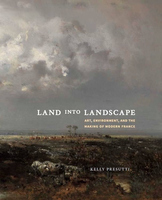
Kelly Presutti,
Land into Landscape: Art, Environment, and the Making of Modern France.
Yale University Press, 2024.
232 pp.; 97 color and 8 b&w illus.; bibliography; notes; index.
$65.00 (hardcover)
ISBN: 9780300273946
Kelly Presutti’s Land into Landscape: Art, Environment, and the Making of Modern France opens with a paradox: “despite numerous claims locating both abstract nationhood and individual rights in the land, for much of the nineteenth century, it was not clear what that land looked like or even how a national landscape was meant to appear” (1). Landscape representations proliferated in the period, as Presutti’s examples—including two- and three-dimensional maps, diagrams, porcelain, lithographs, engravings, and photographs as well as paintings—attest, and the book traces the process through which certain picturesque tropes and representational strategies came, over the course of successive political regimes in post-Revolutionary France, to define the nation’s territory and identity. The Service des départements, a set of dessert plates created in the 1820s at Sèvres, the state-sponsored porcelain manufactory, offers a telling example of the vicissitudes of this gradual coalescence of the terrain and image of France. The service, which attempted to encompass distinctive local sites in a standardized format, adapted popular imagery from voyages pittoresques (picturesque voyages) as well as military cartography to luxury porcelain, and naturalized the roughly chequerboard administrative units created by the Revolutionaries, was rejected by Charles X, the Restoration monarch for whom it was intended, and by Louis Philippe, the Citizen King, after him, nicely encapsulating Presutti’s claims about landscape’s uneasy and incomplete workings across media, regions, and aesthetic and political milieux, particularly in the first half of the century.
In situating landscape painting within a “broader interdisciplinary and intermedial inquiry into the nation’s ground” driven by a range of interests including “patriotism, privatization, preservation, [and] profit” (183), the book puts administrative and artistic projects in dialogue, charting moments of intersection as well as opposition. Much of the administrative history invoked concerns agencies such as the Service forestier and the Restauration des terrains en montagne, whose land reconfiguration projects often worked to the detriment of local inhabitants and lifeways dependent on commons, but Presutti is attentive to the state’s patronage of art as well as to artists’ own environmental politics and navigation of the market. And, while focused on France’s continental territory, she traces the colonial tropes invoked to justify the appropriation and transformation of French land into more productive territories. Each chapter of the book explores a specific landscape typology that posed problems to the imposition of representational and/or administrative ideals and, as such, was frequently associated with an un-French otherness (Algerian, Tahitian, and South American in different instances) and was thus seen as in need of civilizing influence.
The first chapter treats the deceptively self-evident subject of mountains, introducing popular nineteenth-century understandings of them as stable forms that, in ranges, constitute “natural” borders, and the geological, demographic, and political realities that undermined such ideas: mutable geometries resulting from erosion, flooding, and resource extraction; movements of peoples, diseases, armies, and illegal goods across them as well as the existence of regional dialects in mountain communities; and competing national claims to peaks such as Mont Blanc in the Alps and the aptly named Mont Perdu in the Pyrenees. Presutti explores diverse representational practices artists, administrators, and engineers employed in their attempts to manage the challenges posed by the scale, complex and changeable geometries, and porosity of mountains. Eugène Viollet-le-Duc, for instance, made use of the teleiconograph—a blend of camera obscura and telescope invented by Henry Révoil in 1869—to draw detailed contours of peaks with measurable angles. The Restauration des terrains en montagne used photography as part of its efforts to monitor its restoration projects, including the terracing of barren, unstable slopes caused by deforestation.
To my mind, the most fascinating example in the chapter is the two-volume lithographic Album de deux frontières, published ca. 1850 and dedicated to the Pyrenees, by Blanche Hennebutte, a drawing instructor and lithographer based in Bayonne in the late 1840s. Before the border with Spain was officially defined in 1868, Hennebutte attempted to delineate national boundaries by separating each state into its own volume with captions in French or Spanish, respectively. Presutti’s fine analysis of the lithographs and text reveals how they frequently undo this attempted containment by illustrating threshold-crossings of various sorts and through the medium itself. The soft imprecision of lithography—widely used to popularize views of the Pyrenees—embodied the difficulty of mountain representation: “the stone of the lithographic plate, like the stone of a mountain itself, was not adept at holding clear lines” (44). The lines some commentators were drawing in the case of the Pyrenees were, moreover, as Presutti shows, racialized ones as well as territorial borders, as Spain and the Pyrenees were frequently troped as the gateway to Africa.
Chapter 2, “Coasts,” turns to another permeable zone where French national identity and territory were negotiated and ostensibly solidified through different forms of landscape representation. The chapter is anchored in the contrast between Joseph Vernet’s mid-eighteenth-century series of large-scale paintings, Les vues des ports de France—commissioned by Louis XV and glorifying France’s imperial expansion and trade—and Louis Garneray’s considerably more modest etchings, Vues des côtes de France, which were begun in 1820 for subscribers and undertaken after the losses of Saint-Domingue and other colonies. Garneray was the official painter of the navy, but his views, in contrast to Vernet’s prospective ones that look outward from ports onto an implicitly French, militarized, maritime world, trace the contours of a personal journey around France’s shores and create an image of Frenchness through the picturesque accumulation of coastal scenes.
Efforts to compensate for lost territory, educate the public about maritime interests, and inspire future glory come through more strongly in other projects Presutti examines, including the neglected Musée de la Marine with its monument to an antipodean shipwreck; Jacques-Ignace Hittorff’s designs for the Place de la Concorde and adjacent bridge with ship-decorated columns and a statue commemorating the slave-trader and naval officer René Duguay-Trouin; wood-and-plaster topographic maps of naval strongholds that Napoleon valued more for their symbolic than their strategic value (to the point that several were taken as spoils of war by Prussian soldiers in 1815); the unrealized project to make Paris a port de mer (seaport) via a canal; and Théodore Gudin’s large-scale paintings commemorating the inauguration of the port of Cherbourg (1861; Musée national de la Marine, Paris) and of Napoleon III Visiting Genoa in 1859 (1865; Musée national de la Marine, Paris), in which the painter navigates British naval domination and French ambition and alliances for the “freedom of the seas” (94). Presutti concludes this chapter with a brief consideration of the occupation of France’s coasts by tourists in the later nineteenth century, arguing that Eugène Boudin’s fashionable figures on beaches are “no less participants in a culture of surveilling France’s bounds and ensuring its commercial success than the soldiers and sailors had been in prior images” (103) and suggesting that the state’s purchase and display of Gustave Courbet’s The Stormy Sea (1870; Musée d’Orsay, Paris), with its material wall of water, among more academic works at the 1878 Universal Exhibition is indicative of their investment in “stabilizing French waters” (105).
Chapter 3, “Forests,” examines the processes through which, by the end of the nineteenth century, France had come to cultivate two distinctive forest landscapes: geometrically ordered industrial plantations—usually of pines in which squares were harvested at regular intervals and which stood for state authority and private interests—and diverse, entangled, old-growth woods symbolizing France’s natural heritage (particularly in the form of oak trees), which were celebrated by the Barbizon school. The elimination of royal protections of forests with the 1827 Code forestier, which redefined woods as accumulated capital, resulted in significant changes in sylvicultural management as well as use. It had material consequences for those who inhabited and worked in forest regions and whose lifeways were affected by encroachment on commons; it also affected artists and administrators who engaged in the difficult task of picturing forests, the density of which confounded sightlines and oversight. Paul Laurent, an artist who taught at the École forestière in Nancy throughout the second quarter of the nineteenth century, advocated for schematization and distance over any effort to approach the actual forest, and forest management generally entailed plotting bounds on map-compatible grids. Barbizon artists such as Théodore Rousseau, by contrast, attempted to capture something of the forest’s materiality through his experimental approaches.
Building on the foundational work of Greg Thomas, Presutti offers compelling readings of several paintings by Rousseau, in particular a group depicting transhumance, or the movement of cattle between pasturages, in the Jura. Mostly in portrait rather than landscape format, these works—especially The Descent of the Cattle in the Haut-Jura Mountains (1834–35; Mesdag Collection, The Hague)—dramatically oppose the ideal, geometrical abstractions of modern sylviculture with precipitous site-specificity and recognition of the forest’s social and environmental value. Presutti contends that “something like belonging to the forest is at stake here, rather than defining a forest by to whom it belonged” (129), in Rousseau’s depiction of animal-human-forest entanglements, in his paintings’ tactile rendering of what a traveling companion described as “a stream of velvets that carried with it pink muzzles” (126), and in his use of bitumen, which materially evokes the soil and terrestrial contingency in the way it has darkened the canvas over time. The Descent was rejected from the Salons of 1836 and 1838, possibly for the challenge it represented to the state’s forest vision. While acknowledging the ways in which Rousseau’s work opposed state land management practices in this period, Presutti nevertheless shows how his conservationist efforts—which resulted in a fraction of Fontainebleau being preserved by Napoleon III as reserves artistiques (artistic reserves) in 1863—along with the Barbizon artists’ penchant for depicting the edges of woods thus seemingly contained, offer up the forest for visual consumption and tourism, with the image of old-growth woods eliding the expansion of timber monocultures and harvesting.
The fourth and final chapter, “Wetlands,” focuses on the Landes de Gascogne, whose marshy landscapes—widely deemed empty, unproductive, poor, and unhealthful—and populace, including shepherds who herded flocks on stilts, were, by the later nineteenth century, considered in need of modernization and Frenchification through a logic and practice of internal colonization. Napoleon III ordered the Landes to be drained and wooded in 1857, a project that entailed loss of commons through sale to private enterprise when municipal governments could not finance the mandated drainage. Artists and landowners adopted different representational modes to engage with these changes. Joseph Abadie’s cartographic atlas Succès en dessèchemens de marais (1853) charted ongoing “improvements” by juxtaposing abstracted, colorful, squiggly “before” maps with orderly “after” ones. In a not dissimilar fashion, Barbizon artists Rousseau and Jules Dupré, who visited the region in 1844, created works showcasing both the traditional Landes and more recent developments. Dupré’s paintings, full of shimmering reflected light and “slippery materiality” (161), attest to the uncertain terrain of the wetlands. In contrast, Rousseau’s Swamp in the Landes (1852; Musée du Louvre, Paris), which was shown at the 1853 Salon, offers a finely painted, pastoral vision of a managed landscape in which stands of planted pines suggest increasing order and productivity.
Presutti argues that “the measure of success in drainage was the naturalization of a substitute landscape” (175), both that of the actual pine plantations and the importation of the Barbizon aesthetic, which served as a model for the Bordeaux school; she reads local artist Louis-Augustin Auguin’s Landscape in the Landes (1874; Musée des beaux-arts de Bordeaux, Bordeaux) as adapting tropes developed at Fontainebleau to the region. In contrast to representations that highlighted the “improved” Landes—and perhaps in sympathy with the locals who resisted the moral and physical reformation of their habitat by firing pine stands—amateur photographer Félix Arnaudin’s glass-plate collodion negatives of flood plains in the region, along with the interviews and local folk tales and songs he collected, sought to preserve a vision of the vanishing wetlands and their lifeways. His photographs of different sites throughout the region highlight an overarching emptiness that is positioned as a positive aesthetic quality. But they also contain much foreground detail that insists on the nature of the local ground, which Presutti uses to challenge triumphalist narratives of reform.
The outlier status of the Landes, Presutti argues, “makes apparent the extent to which codes of Frenchness in the landscape had been established and naturalized over the course of the nineteenth century” (152), and the conclusion to the book reviews the fraught processes of making pays (country) into paysage (landscape) through policy, infrastructure, and representation while pointing ahead to the twentieth century and the institutionalized evocation of the regional and natural through terroir (environment) in the face of ongoing processes of centralization and homogenization. Highlighting the resistance and ambivalence that attended the creation of the French landscape, Presutti reminds us that if landscape painting took “possession of France” (183), as Jules Castagnary put it, it did so in the interests of the bourgeoisie, primarily as tourists and investors, and that if art did contribute to the preservation of certain pockets of landscape, it did so through a highly selective, nationalist aesthetics. Presutti ends, however, on a positive note, insisting that the attentiveness art can encourage might “still change the world” (189).
In its deft intertwining of visual cultural, political, and environmental histories; attention to the materiality of the media and terrains it explores; and dwelling on the colonial inflections of France’s territorial reformations, Land into Landscape has many strengths. The juxtapositions of “avant-garde” work with less well-known representational approaches is frequently compelling (though I am still mulling over the teleiconograph and Paul Cézanne’s paintings of Mont Sainte-Victoire). But the most captivating aspect of Presutti’s book is her close reading of more obscure yet telling objects—Hennebutte’s album, Arnaudin’s photographs, or Emile Gallé’s Flore fossile vase (1892; Musée des arts décoratifs, Paris)—and the way they encapsulate frictions as well as what are often material connections between abstraction and specificity, land and landscape. The history of tensions Presutti traces between the realities of place and the often mutually reinforcing work of landscape representation and state-led land transformation is erudite and astute, providing a superb contribution to the history of nineteenth-century French art.