In Your Wildest Dreams: Ensor Beyond Impressionism
Reviewed by Lotte KremerLotte Kremer
Independent scholar
Email the author: lotte_kremer[at]hotmail.com
Citation: Lotte Kremer, exhibition review of In Your Wildest Dreams: Ensor Beyond Impressionism, Nineteenth-Century Art Worldwide 24, no. 3 (Autumn 2025), https://doi.org/10.29411/ncaw.2025.24.3.23.
This work is licensed under a Creative Commons Attribution-NonCommercial 4.0 International License  unless otherwise noted.
Your browser will either open the file, download it to a folder, or display a dialog with options.
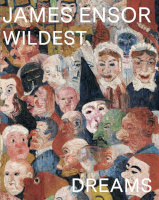
In Your Wildest Dreams: Ensor Beyond Impressionism
Royal Museum of Fine Arts Antwerp (KMSKA)
September 28, 2024–January 19, 2025
Catalogue:
Herwig Todts ed.,
James Ensor: Wildest Dreams.
Hannibal Books, 2024.
272 pp.; 230 color illus.; notes.
€49.50 (hardcover)
ISBN: 9789464941449
The “Ensor Year” of 2024 swept across Belgium. The Royal Museum of Fine Arts Antwerp (KMSKA) concluded it impressively with their expansive exhibition, In Your Wildest Dreams: Ensor Beyond Impressionism. The exhibition aimed to shed new light on the artist typically defined by his masks and an overabundance of psychoanalytic readings. By showcasing Ensor’s works alongside the art and contemporaneous culture that influenced him, the exhibition highlighted his ability to take ideas and images and morph them into something wholly his own through continuous experimentation. A catalogue expanded upon this with seventeen chapters of varying lengths by both established experts and emerging scholars, accompanied by an abundance of illustrations.
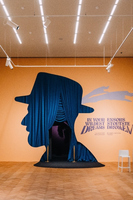
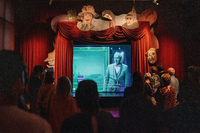
The tone of the exhibition was set right from the get-go. Visitors quite literally entered through Ensor’s head in the form of a silhouette filled with blue drapes (fig. 1). The introductory space was dark, mimicking a theater, and the eye was first drawn to a feathered hat hanging in the air, lit dramatically, its shadow cast on the back wall. This was of course the flowered hat in Ensor’s famous self-portrait (1883; Mu.ZEE, Ostend). Then, visitors encountered a screen surrounded by red curtains and enlarged, cut-out faces from Ensor’s works and on which curator Herwig Todts introduced the imagination of Ensor through an animated film (fig. 2).
As a research curator at the KMSKA and leader of the Ensor Research Project, Todts has been a driving force in Ensor research in recent decades. It is no surprise then that the exhibition and its catalogue read as a continuation and crystallization of his 2013 PhD dissertation and its subsequent publication in 2018 under the title James Ensor, Occasional Modernist: Ensor’s Artistic and Social Ideas and the Interpretation of His Art (Brepols). His assessment that the key to the analysis of Ensor’s work is to view his oeuvre “as a collection of diverse projects” in which he explores “the diverse possibilities of a specific stylistic, iconographic or technical approach” echoed throughout the rooms of the exhibition.[1]
Todts’s catalogue chapter “Ensor’s Art in a New Perspective” functions as a de facto introduction. Here, Todts characterizes Ensor’s work by its versatility. To investigate how and why Ensor’s versatility came about, he goes against the regular invocation of Ensor’s biography as the “only significant motivation for his surprising artistic journey” (11). Acknowledging the versatility of Ensor’s oeuvre is an important step in putting his work into a new perspective. Nevertheless, it remains easy to get lost in the woods when it comes to defining throughlines and groupings within his style and iconography. The exhibition and catalogue do an admirable job of trying to find the balance between chaos and clarity amidst a wealth of information. The exhibition followed a somewhat chronological path through Ensor’s work, framed first within a section emphasizing the artist’s stylistic and technical development and then within a section delving into his iconography and cultural context. Meanwhile, the catalogue offers a range of perspectives. Throughout the many chapters, the contributors shine their wide-ranging expertise on specific aspects of the artist’s practice. Thus, a visitor wanting to read more on a specific work from the exhibition might have difficulty finding the information they are looking for. But in diving into both the catalogue and the exhibition, one finds a wealth of interconnecting and complementary material. The works in the exhibition are all discussed, sometimes in groupings similar to those in the exhibition, sometimes not.
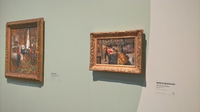
The exhibition began chronologically, with Ensor’s roots in nineteenth-century realism and naturalism. Visitors were invited to compare Ensor’s ocean waves with those of Gustave Courbet and his drunkards with those of Jean-François Raffaëlli. For the first few rooms, the set-up for the works was largely based on this one-on-one comparison between a work of Ensor’s and that of another artist. These did not always suggest a direct influence of the other artist on Ensor; the invitation was more to discover the connecting styles and techniques, as with Ensor’s The Bourgeois Salon (sketch) and Henri De Braekeleer’s Siesta (Sleeping Model) (fig. 3). In both paintings, the light hits the various textures of the bourgeois interiors. Their models are secondary to the play of light and color, texture and shape. Ensor’s numerous bourgeois interiors, often occupied by various members of his family, fit among the shared visual culture of Les XX. As Noémie Goldman writes in her catalogue essay, their interiors generally depicted the semi-public living quarters of the salon or dining room, where social life takes place, rather than more intimate rooms. The exhibitions of Les XX looked, in turn, like private apartments or salons, adding to this oscillation of intimacy and sociality (56–60).
From there, the French Impressionists and Edouard Manet entered the picture. The beige and gray shadows were replaced by unmixed colors applied directly to the white canvas. Adam and Eve Expelled from Paradise (1887; KMSKA) was put forth as Ensor’s first painting to establish clearly his acquaintance with the technique, construction, and palette of the French Impressionists (87). It bears strong similarities to Monet’s View of Bordighera (1884; Hammer Museum, Los Angeles), which was exhibited at Les XX in 1886. For this Biblical subject, Ensor borrows elements from John Martin’s engravings with scenes from John Milton’s Paradise Lost (1825/27), as well as from old masters such as Rubens and Michelangelo. The exhibition invited us to delve into this part of Ensor’s creative process with a little print cabinet in front of the painting (fig. 4).
Ensor remained fascinated by light and color but wanted to move beyond merely mirroring reality. In his search for new ways of drawing and painting the expressive qualities of light, he found inspiration at the same 1886 exhibition of Les XX, where the French Symbolist Odilon Redon showed his dark and fantastical lithographs. During the subsequent months, Ensor produced a series of black and white drawings depicting scenes from the life of Christ. In 1887, he exhibited six of these under the title The Aureoles of Christ or The Sensibilities of Light. Each drawing bears a title emphasizing not just the Christian iconography, but also the accompanying expressive quality of light: from alive and radiant to sad and broken. As Catherine Verleysen writes in her comprehensive outline of the Visions’s genesis, Ensor continued exploring the possibilities of light throughout his career (103).
Contemporaneous critics linked the series to Redon and Rembrandt, though not entirely favorably (105–8). A single Redon print in the room was meant to illustrate this germination, but Ensor’s large, multilayered drawings were the main players here. This was a wonderful opportunity to see several of the Visions together as we might have seen them in 1887. Rembrandt’s Hundred Guilder Print (ca. 1647–49; Royal Library of Belgium, Brussels) also offered an apt comparison in its use of light and dark, but unfortunately it hung on a wall with no great sightline to any of Ensor’s Rembrandtian drawings.
The twin positioning of Ensor’s Children at their Morning Toilet (1886; Museum of Fine Arts, Ghent) with Edvard Munch’s Starry Night (1893; Von der Heydt-Museum, Wuppertal), as well as the addition of Jean Delville’s The Angel of Splendor or Allegory of Hell (1899; The Phoebus Foundation, Antwerp) further emphasized Ensor’s flirtation with Symbolism and its atmospheres. Delville’s presence was an interesting example of the nuances within Ensor’s artistic opinions and practice. Ensor was dismissive of Delville’s work, finding it too conservative and shuddering at his passion for pseudo-profound ideas. In 1895, Ensor criticized its banality and lack of Flemish qualities after Delville won the Prix de Rome.[2] Yet certain overlaps in style and subject between the two are undeniable.
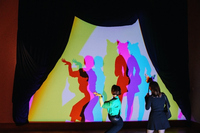
There followed a larger room in which landscapes, still lifes, and interiors by Ensor and various other artists highlighted Ensor’s experiments in color and light (fig. 5). Visitors were invited to play with an interactive display using colored lights and silhouettes (fig. 6), an activity that may have done little for understanding Ensor’s experimentation but did inspire one’s own creativity and sense of fun. It is one of several occasions where the exhibition’s design may have provoked finger-wagging on the part of old-school academicians and enthusiasm from Instagrammers seeking interactive and photogenic experiences.
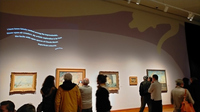
The hanging of the artworks themselves was largely traditional. One notable pairing on the rear wall of the large gallery consisted of two versions of The Bourgeois Salon, one from 1881 and the other from ca. 1910 (fig. 7). In the twentieth century, the artist reworked several of his earlier paintings; the new versions are noticeably lighter. The exhibition suggested that Ensor might be trying to emulate the luminous, colorful style of popular, younger artists such as Rik Wouters. Ensor also applied paint in a thinner impasto and flattened the pictorial space. Whether this later style was an improvement upon the original is open to question, but the exhibition offered substantial opportunities to explore Ensor’s later developments. A similar, second version in the same room, Afternoon at Ostend of 1911 (original, 1881), was more interesting because of its chaotic use of short, linear, and almost drawn brushstrokes in many colors and directions. In the catalogue, Adriaan Gonnissen reflects on Ensor’s light effects in his later work. He argues against the teleological art history of avant-garde advancement as applied to Ensor. There is no trace in Ensor’s writings to suggest that his later works are rooted in the pursuit of any “modern,” “spiritual,” or “Expressionist” light. There is, however, ample evidence for his naturalistic convictions. Light and atmosphere, found in abundance in Ostend, were consistently earthly sources of inspiration for Ensor. The artist’s bright-white, iridescent effect in his later pictorial practice is a conscious, conceptual innovation by an artist continuously searching and paraphrasing himself (211–19).
The Ensor Research Project received its own dedicated space and deservedly so. This project, run by the KMSKA and the University of Antwerp, investigates the myths that have sprung up around the artist’s life and work. The project was launched in 2013 and combines art historical research with scientific studies of techniques and materials. Aided by technology, the researcher team has uncovered hidden layers of paint that reveal conceptual choices. This is especially valuable in considering an artist who used remarkably few studies for his works, which has given the mistaken impression that his oeuvre was mostly improvised. As Annelies Rios-Casier, Geert Van der Snickt, Koen Janssens, and Todts point out in the catalogue, this research not only offers a better understanding of Ensor’s artistic practice but also contributes to the knowledge of conservation and restoration of his work (240).
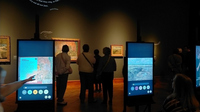
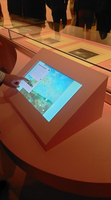
The exhibition offered several interactive video screens, set up on easels, presumably to emphasize the research project’s focus on the creative process (fig. 8). The screens provided the results of the Ensor Research Project’s research on individual works, which hung on the walls in front of them. This was a clever set-up that encouraged active engagement, far more so than long wall texts with reproductions of X-rays would. The number of visitors the exhibition attracted, however, meant that many had to observe at a distance, waiting their turn, or only half able to follow the presentations on the screens.
A gate of hell—reproduced from the Parisian Cabaret de l’Enfer—led into a narrow space, its dark-red wall filled with carnival masks made slightly ominous by dramatic lighting. From an emphasis on formal aspects of color, technique, and light, the exhibition moved on to a more iconographic approach, emphasizing the world of modern entertainment and its influence on Ensor’s oeuvre. In the theatrical cafés of fin-de-siècle Paris and Brussels, the comic and the eerie went hand in hand. Ensor similarly combined themes such as satire, caricature, and the macabre. As Evelien Jonckheere writes in the catalogue, Ensor’s work is often typified by a clash between joyfulness and gloom, as noted by the critic Emile Verhaeren. Jonckheere puts his inspiration for ambiguous spectacles in the context of these variety theaters and the dark underbelly of Bruxellian entertainment (115–23). The proto-cinema of the magic lantern was similarly offered as a cultural phenomenon that placed Ensor’s layered phantasms into perspective. Ensor and other artists mixed elite and popular culture to create new art. They looked to all sorts of alternatives to classical aesthetics, such as folklore, the Middle Ages, Japanese and Chinese art, puppet theater, and carnival parades. Though the exhibition focused mostly on popular culture, Ensor’s use of specific Japanese prints, as well as the Far East wares present in his family home and store, was succinctly summarized in the catalogue by Yuri Nagai (185–91). A beautiful little collection of his multilayered drawings, such as À la Fenêtre (ca. 1888; private collection) showcased the way in which Ensor began to play with reality by adding fanciful elements to his realistic drawings.
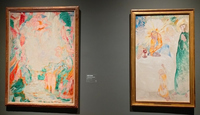
Some expected and unexpected comparisons were drawn with contemporaneous artists. Ernst Josephson is an unusual name in the Ensor pantheon. The combination of Josephson’s The Holy Sacrament with Ensor’s The Deliverance of Andromeda demonstrated parallel developments in different countries (fig. 9). According to the wall text, Josephson, like Ensor, was an admirer of Rembrandt and Courbet and sought more depth and expression than he could find in French Impressionism. In contrast, the swirling masses of fellow Vingtist Henri de Groux were an unsurprising yet welcome comparison. De Groux’s work recalled several descriptions in the catalogue of period anxieties regarding the crowd, whether in Timothy Clark’s discussion of Ensor’s anarchism (39) or Susan Canning’s social contextualization of The Temptation of Saint Anthony (1887–88; The Art Institute of Chicago, Chicago) (203).
Toward the end of the exhibition, an entire room was dedicated to the latter work (fig. 10). This is not undeserved. Where the painting Christ’s Entry into Brussels in 1889 (1888; Getty Museum, Los Angeles) is generally deemed Ensor’s magnum opus, its counterpart in his body of drawings might well be The Temptation. With the help of a collection of cards, visitors could find different details in its overwhelmingly packed composition and read about their context. On another wall, smaller works by Ensor, Francisco de Goya, Martin, Félicien Rops, and Redon offered similar grotesques and sensual temptresses (fig. 11). The spectacular culture of the fin-de-siècle era and its cross-fertilization of art, literature, and theater is on full display here. It was a time when the temptation of Saint Anthony was a popular subject for comical puppet shows, artists, and literary novels alike (118–20, 193–200).
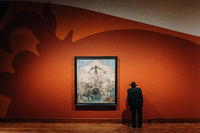
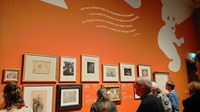
Just preceding the room with The Temptation was a gallery with two seemingly separate themes. On the one hand, compositions such as The Fall of the Rebel Angels (1889; KMSKA) depict well-worn Christian iconography with a whirlwind of color. On the other, interiors and still lifes became stages for skeletons to act out their scenes in paintings such as Skeletons Trying to Warm Themselves (1889; Kimbell Art Museum, Fort Worth). They were united by a quotation of Ensor, projected on the wall: “I work on infernal, seductive scenes. I spend joyful periods constructing horrible monsters, which stroll peacefully through a foreign town, terrifying the hidebound bourgeoisie.” Ensor was not alone in his interest in skeletons and demons. Reminiscent of sin and the transience of life, poets and artists repurposed these figures at the end of the nineteenth century to glorify everything strange, eerie, or decadent. The exhibition illustrated this with Félicien Rops’s Death at the Masked Ball (1895; Musée Félicien Rops, Namur) as a likeminded usage of skeleton iconography. In the catalogue, Véronique Carpiaux and Patrick Florizoone expand on the similarities between Rops’s and Ensor’s engravings (137–40).
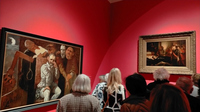
Moving past The Temptation into the next room, the exhibition delved further into Ensor’s satirical works and framed them with Parisian and Belgian burlesque exhibitions, as well as Zwanse humor. The term Zwans comes from the Brussels dialect, referring to a form of mockery or farce.[3] In one corner, Louis Ghémar’s Parody of Louis Gallait’s ‘The Sentencing to Death of Counts Egmont and Hoorn’ is put together with another work by Gallait, The Last Honors of Counts Egmont and Hoorne (fig. 12). Ghémar exhibited parodies of iconic contemporaneous artworks in his Musée Fantaisiste. Ensor’s Gendarmes (1892; Mu.ZEE, Ostend) similarly parodies the exhibited work by Gallait but also adds a layer of social critique by transforming the bodies of the two noblemen into those of fishermen from Ostend killed by police fire during an uprising in 1887. Patrick Florizoone’s catalogue essay on Ensor’s hatred of vivisection shows that this intermingling of caricatural forms and societal critique was no one-off in the artist’s career (243–47).
On another wall, Charles Mertens’s Ensor’s Art/The Dried Herring (1885–90; private collection) revealed the origins of Ensor’s hareng saur (pickled herring) alter ego, while Jan Toorop’s Self-Portrait with False Nose added the context of similar self-portraiture by a fellow Vingtist with a touch of self-mockery. To their right, Ensor’s Self-Portrait with Flowered Hat and The Skeleton Painter showed the artist’s penchant for reworking existing works in a humorous way—whether through the addition of a flowered hat on an existing self-portrait or painting a skeletonized version of a photograph of Ensor in his studio (figs. 13, 14).
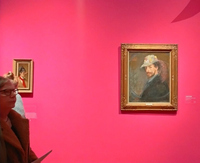
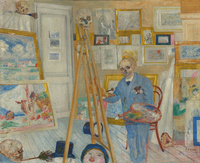
It would have been remiss not to dedicate a room to Ensor’s many masks, most of which come from the Flemish carnival. The exhibition boldly put earlier and later works together, from Scandalized Masks (1883; Royal Museums of Fine Arts of Belgium, Brussels) to The Great Judge (1898; private collection) to Ensor and the Masks (1935; private collection). Ensor used the mask not to conceal, but to expose his subjects: to reveal the true face of humanity. He animated them as actors in a play. The artist shared this fascination with international contemporaries such as Witold Wojtkiewicz and Edvard Munch, as well as countryman Eugène Laermans. Similarly, Emil Nolde’s expressive colors and masks betray the influence of Ensor on German Expressionists. Astrid Becker argues in the catalogue that Nolde and Ensor furthermore shared a self-conscious stance of the misunderstood yet steadfast artists, deliberately nurturing a cult around their own personalities (259–67).
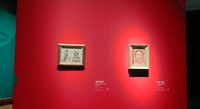
The choice to place Man of Sorrows in this room is a strong one. The tendency of earlier literature to interpret the work as a self-portrait of a tormented artist was challenged by placing the panel on a wall with The Grotesque Singers of the same year (fig. 15), thus emphasizing Ensor’s animation of masks and his experimentation with small, bold panel paintings of that time. As Todts writes: “It is true that there are more than a few works in which Ensor chose to identify himself with Christ. . . . Equally, however, it would be impossible to argue that every time Christ appears in Ensor’s oeuvre, he was intended as the misunderstood artist’s alter ego” (19). Nagai also demonstrates that Man of Sorrows is based on a photograph of a mask of the Japanese folkloric demon, Hannya (190). Combined with the bloody iconography of the subject, such as that found in Albrecht Bouts’s Man of Sorrows ([1500–25]; KMSKA), this creates a striking and expressive image.
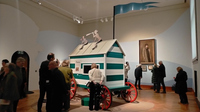
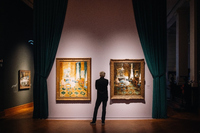
The final exhibition room felt rather anticlimactic (fig. 16). This was a shame, as it contained some truly beautiful works, but the smaller ones were overshadowed by the exhibition design. In the middle of the room stood a beach cabin reminiscent of Ensor’s early painting Bathing Hut on the Beach (1876; KMSKA). Looking through its window, one saw an interior with projected animation referencing My Favorite Room (1892; Tel Aviv Museum of Modern Art, Tel Aviv), which was not in the exhibition but pictured in a wall plaque on the cabin. Directly behind the cabin hung works featured within this painting. It was not a bad idea, but it was dubiously executed with no clear sightline. Thus, the hanging of Isidore Verheyden’s portrait of Ensor with Ecce Homo—Christ Among the Critics, Carnival in Brussels, Skeletons Fighting Over a Pickled Herring, and The Frightful Musicians beneath it remains less than the sum of its parts. Before leaving the exhibition, viewers were treated to Marlene Dumas’s Klaus Kinski Meets Ensor, Andy Warhol Meets His Maker (2002; private collection), which translates Ensor’s dreamscape into the present.
The exhibition provided a journey through the artist’s head and career that was at times frustrating and overwhelming because of both the diversity of the artist’s oeuvre and the overbearing exhibition design. However, the love and impressive research that laid the groundwork for the exhibition shined through. By weaving through the artist’s many inspirations, contemporaries, and cultural influences, we gain a better understanding of his creative process. Timothy Clark puts it rather well: “Perhaps it is true that an artist’s influences should not interest us much (Ensor’s wish to drop the subject has my sympathy) unless what they give rise to in the work we are looking at is baffling yet immediately persuasive; and at the same time an achievement that, once seen, seems to upend our view of the tradition being drawn on—putting that tradition in a new light. This is what a good Ensor does” (33). The catalogue further represents a culmination of recent Ensor research based on thorough, empirical studies and interpretations that leave room for the artist’s agency. This opens up new possibilities for future research. The Ensor Year may be over, but we are far from done with the artist.
Notes
[1] Herwig Todts, James Ensor, Occasional Modernist: Ensor’s Artistic and Social Ideas and the Interpretation of his Art, XIX. Studies in Nineteenth-Century Art and Visual Culture (Brepols, 2018), 62–73.
[2] James Ensor, “Le Prix de Rome,” Le Coq Rouge: Revue Littéraire 1, no. 8–9 (1895–96): 439–40.
[3] Jacques van Lennep, “Les Expositions Burlesques à Bruxelles de 1870 à 1914. L’Art Zwanze—une Manifestation Prédadaïste?,” Bulletin Musée Royaux des Beaux-Arts de Belgique 19, no. 2 (1970): 132.