Nel Duerinckx and Rik Wouters: Collaborative Creation, Domestic Work, and Building a Legacy
by Apolline MalevezApolline Malevez is an art historian and postdoctoral researcher at Ghent University, where she is a member of the research group The Inside Story: Art and Interior, 1750–1950. Her research project, “Support Systems: The Hidden Labor Behind Art Making (Belgium, 1880–1920),” explores relationships which enabled and sustained artists’ work and careers in late nineteenth- and early twentieth-century Belgium. She holds a PhD from Queen’s University Belfast (2022). Her dissertation focused on representations of domestic interiors in Belgium at the end of the nineteenth century, which she studied from the perspective of gender.
Email the author: apolline.malevez[at]ugent.be
Citation: Apolline Malevez, “Nel Duerinckx and Rik Wouters: Collaborative Creation, Domestic Work, and Building a Legacy,” Nineteenth-Century Art Worldwide 24, no. 3 (Autumn 2025), https://doi.org/10.29411/ncaw.2025.24.3.3.
This work is licensed under a Creative Commons Attribution-NonCommercial 4.0 International License  unless otherwise noted.
Your browser will either open the file, download it to a folder, or display a dialog with options.
Introduction
In the epilogue to his biography of the Belgian painter and sculptor Rik Wouters (1882–1916), the journalist Eric Min provides a brief overview of the life of his wife, Hélène (Nel) Duerinckx (1886–1971), after her husband’s death. He concludes: “It could be a new book, but it is not necessary.”[1] These words—“it is not necessary”—made me pause for what they reveal about the still-prevalent hierarchies and blind spots that plague the field of art history. It is impossible to tell the story of Wouters’s career or to fully comprehend his art without consulting Duerinckx’s writings. She wrote a book about the years they spent together, La vie de Rik Wouters à travers son art (The life of Rik Wouters [seen] through his art) (1944), as well as several unpublished manuscripts and hundreds of letters to amateurs, scholars, and collectors that recount aspects of his life. She also wrote at length about her own experiences as the artist’s partner, his model, his manager, and the curator of his legacy. Scholars have mined these writings mostly for facts about Wouters’s life and artistic career but have failed to read them for what they reveal about Duerinckx’s inextricable role in both. Indeed, she was indispensable to his creative process and essential to building his reputation.
The approach I take in this article builds on scholarship that questions the concept of single, autonomous authorship in art. In his foundational book Art Worlds (1982), the sociologist Howard Becker redefined art as a collective endeavor, emphasizing that each contributor to a work of art plays an equally necessary, if not equally important, role. According to Becker, “the craftsmen who help make art works are as important as the people who conceive them.”[2] His book opens with a quote from Anthony Trollope, who wrote that he owed more to the old groom who brought him his morning coffee “than to anyone else for the success I have had.”[3] Becker’s fruitful insights have had a great impact on historians of contemporary art,[4] but they have also influenced those who study the art of earlier periods. Laurence Riviale and Jean-François Luneau’s edited volume L’invention partagée (Shared invention) addresses cocreation and coauthorship from the thirteenth to the twenty-first century, containing several chapters on nineteenth- and early twentieth-century art.[5] Furthermore, two newer and thriving research strands have contributed to undermining the myth of the lone (male) creative genius. Recent literature on models challenges the prevalent conception of their role as passively submitting to the artist’s creative will and instead recasts them as active contributors to the creative process.[6] Spouses, relatives, friends, and colleagues of artists have also provided fodder for a more “relational” account of art history.[7] Research on this topic has multiplied in recent years, as manifest in exhibition catalogues such as Maman: Vuillard & Madame Vuillard; Pre-Raphaelite Sisters; Léon Monet: Frère de l’artiste et collectionneur (Léon Monet: The artist’s brother and collector); Femmes chez les Nabis: De fil en aiguille (Women among the Nabis: From thread to needle); and Manet: A Model Family, as well as Hans Luijten’s book on Jo van Gogh-Bonger.[8] These examples demonstrate a shift in perspective, moving away from celebrating the individual creative genius and toward analyzing and acknowledging the role of the artist’s entourage.
This article continues the research trend described above. Indeed, most artists rely on social and structural support to succeed, such as a network of people who provide the material conditions that enable them to create art as well as provide practical help, ideas, emotional support, and so on. Building on Becker’s concept of art worlds, I refer to this as an artist’s support system, which acknowledges the collective nature of art production while also taking into account the power relationships that structure society. The dynamics and inequalities of gender, class, race, and age, among others, help explain why some members of an artist’s support system are more readily acknowledged than others. Duerinckx’s ambivalent legacy is a prime example of these mechanisms at work. Her prolific written documentation of her life with Wouters provides direct insight into, and complicates the assessment of, her role in Wouters’s creative process and the legacy of his work. A careful and critical reading of Duerinckx’s writings, paying attention to questions of self-mythicizing, provides key insights into the symbiotic relationship between her and Rik Wouters that is reflected, directly and indirectly, in his paintings and sculptures.
First, I provide a brief biographical sketch of Duerinckx and Wouters, focusing on the period of their marriage. I then examine how art historians in the recent past have evaluated Duerinckx’s role in Wouters’s life as an artist, and consider whether they may have underestimated it. Finally, drawing on a close reading of passages and anecdotes from her writings, I shed light on the various ways in which Duerinckx supported Wouters during his career through collaborative creation and domestic work, and how she shaped his legacy after his death.
Nel Duerinckx and Rik Wouters
Nel Duerinckx is primarily known as the principal model for her husband’s paintings and sculptures. Born and raised in the suburbs of Brussels (first Schaerbeek, then Koekelberg), Duerinckx grew up in a modest, French-speaking environment. Her father was a postal worker, and her mother, who probably looked after the household, was registered as unemployed.[9] In her unpublished, fictionalized memoirs, “Le roman de la Vierge folle” (The novel of the mad maiden) (1952), Duerinckx claims that she attended school until the age of fourteen, developing a passion for reading by borrowing books from the local library.[10] Sent to work as an apprentice in a sewing workshop, she was dismayed by the dusty, dirty, and poorly lit kitchen in which she had to work, and she quit immediately. She was subsequently hired on a trial basis by a typewriter company.[11] Wouters came from the Flemish city of Mechelen, where he worked in his father’s furniture workshop after leaving school at the age of twelve.[12] Following a brief artistic education in his hometown, he moved to Brussels in 1900 to study sculpture at the Academy of Fine Arts, with Charles van der Stappen (1843–1910) as his teacher.
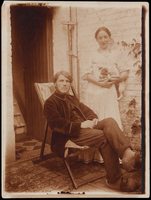
Duerinckx and Wouters likely met sometime around 1903. While it is not known how they met, Duerinckx appears to have frequented artistic circles to which he belonged.[13] They got married on April 15, 1905. Without financial resources, they temporarily settled in Mechelen, living with Wouters’s father. In June 1906 they moved back to Brussels, but Duerinckx’s chronic respiratory illness forced them to leave the city soon afterward. They moved to a small workers’ house in Boitsfort, near Brussels, where they stayed until 1914 (fig. 1). Initially, they scraped by through a combination of loans, support from neighbors and friends, and day jobs. Wouters worked for other sculptors, a photographer, and the porcelain manufacturer Maison Vermeiren-Coché,[14] while Duerinckx posed for the artist Jacques de Lalaing (1858–1917) in 1907.[15] From 1912 onward their financial situation improved, as Wouters was under contract with Georges Giroux (1862–1923), who owned an important art gallery in Brussels.[16] The period from 1912 to 1914 was one of the artist’s most productive. Soon, the couple was able to afford a new, slightly larger house in Boitsfort, for which Wouters drew up the plans; they moved in in March 1914.
Less than a week before Belgium entered World War I, on July 31, 1914, Wouters was mobilized. He was taken prisoner two months later during the Siege of Antwerp and imprisoned in a camp in the Netherlands, first in Amersfoort and then in Zeist. His declining health probably contributed to his conditional release in spring 1915. Meanwhile, Duerinckx had sought refuge from the war in the Dutch village of Scheveningen. Upon being reunited, the couple moved to an apartment in Amsterdam. Wouters underwent several operations there before dying from cancer of the upper jaw on July 11, 1916.
Duerinckx returned to Belgium in 1919, after the war. She remarried twice: first to Jules Moreau in 1921, whom she divorced on grounds of infidelity in 1932; then to Jules De Carnière in 1935. Having dedicated herself to the career of Wouters, she did the same with Moreau, investing in the medical journal Archives Franco-Belges de Chirurgie (French-Belgian archives of surgery), of which he was the editor-in-chief.[17] With her third husband, she adopted a different strategy: She bought land and pivoted to agriculture, enlisting his help.[18] At age forty-nine, she had returned to nature, one of her most enduring loves. Looking back, she wrote to Roger Avermaete (1893–1988), a writer with whom she collaborated: “I have lived like an instrument that has been played. Now I see something else: the roses in my garden, the trees swaying in the wind, the calm that surrounds me. These are things that are close to my heart, and I am happy with them.”[19]
Duerinckx in the Art Historical Literature
In the literature on Wouters, Duerinckx is portrayed in two stereotypical ways: On the one hand, she is glorified as his muse;[20] on the other hand, she is criticized for appearing too prominently in discussions of the artist’s work. Two contributions in the catalogue of the retrospective of Wouters’s work held at the Musées Royaux des Beaux-Arts de Belgique in 2017 are written from the latter, more critical perspective. Stefaan Hautekeete warns against “the danger of a romanticizing interpretation of [Wouters’s] œuvre,”[21] referring to the foregrounding of Duerinckx’s presence as a model, lover, and muse in Wouters’s sculptures and paintings, particularly his interior scenes. He insists that Wouters must not be considered solely as a painter of the interior, since he also painted still lifes, landscapes, and self-portraits. However, according to Hautekeete’s calculations, around half of Wouters’s paintings depict domestic scenes, most of which feature his wife.[22] Duerinckx was clear about what Wouters’s different genres of painting ultimately meant to her personally: The days when he painted a still life were her rare days off as a model.[23]
Herwig Todts goes further in questioning Duerinckx’s role in Wouters’s life as well as her depiction of it in her biography of Wouters. He describes La vie de Rik Wouters à travers son art as “a claim, an appropriation by the lover of her husband’s work.”[24] Published in 1944, almost thirty years after Wouters’s death, the book is indeed self-serving at times and, moreover, frustrating when used as a biographical source, given, for example, Duerinckx’s tendency to censor or rework extracts from the letters she quotes.[25] Yet, while the book cannot be considered as an unmediated testimony of their life together, there is also no reason to dismiss it entirely. Begun as a way to process her grief, the first draft, which focused on the beginning of the war, probably dates from 1916–17.[26] Her book was part of a lifelong commitment to promoting Wouters’s work as well as to negotiating her place within its narrative. A comparison with “Le roman de la Vierge folle,” preserved in the collections of the Bibliothèque Royale de Belgique (KBR) in Brussels, is enlightening. Akin to a fictionalized autobiography, its main character is called “Nele.” The manuscript reveals what Duerinckx preferred to keep private (mostly her childhood memories, arguments, and self-doubts), and it provides a key to reading La vie de Rik Wouters, in which she shared what she felt suitable for a broader audience. The two sources combined offer rare insights into the life of an artist’s intimate companion who played a crucial and complex role in his creative process. Therefore, rather than reading La vie as a biography of Wouters, I would argue that it is best read as an autobiography of Duerinckx, bearing in mind the ways in which it contributes to her self-mythicizing. Instead of dismissing Duerinckx’s published book as a “source of unverifiable information,”[27] I advocate a close reading of individual passages to reveal information about the creative process that is usually left untold. More broadly, I consider how seemingly unimportant anecdotes can open the door to lives and stories that are underrepresented in traditional (art) historical narratives.[28]
Both Hautekeete and Todts caution against giving Duerinckx the central role in the genesis of her husband’s work that she claimed for herself. Their judgment may be colored by the informal tone of Duerinckx’s writings, which appears to have been intentional. She stated that she did not want to be a “bluestocking” and that her book’s “lack of literature” was part of its charm.[29] Even during her lifetime, Duerinckx was aware of attempts to discredit her perspective. In response to the publication of Rik Wouters by Avermaete she wrote: “People think there is too much about me in your book, but that does not matter, Rik has said a lot more about me in his work, and I am delighted about that.”[30] Her ubiquitous presence in her husband’s artworks indeed is a material testimony to her investment in his work. Therefore, dismissing her on the grounds that she figures too prominently in the reception of Wouters’s work disregards material evidence. This dismissal is rooted in hierarchies of gender, class, and emotions (male/female, artist/model, active/passive) that this article seeks to redress, both in the specific case of Duerinckx and more broadly.[31]
Collaborative Creation: “Like an Instrument That Has Been Played”
Throughout La vie de Rik Wouters à travers son art, Duerinckx asserted her pivotal role in her husband’s work, particularly as his model:
Right from the start, I was Rik’s model; he could not conceive of a woman’s figure without translating it into my features and attitudes. It always seemed very simple to me to help Rik in his task and even today I am happy to have been his constant model. Without my constant presence, Rik would certainly not have been able to produce such a fruitful body of work.[32]
This statement is all the more interesting given that in “Le roman de la Vierge folle” Duerinckx reveals that posing did not come naturally to her.[33] When Wouters first asked her to pose, she hesitated, fearing she would disappoint him by not having a good body and feeling particularly insecure about the “dimples on each side of her buttocks.”[34] The day before her first modeling session, she observed herself in the mirror and noted which body parts she did not approve of:
She had examined herself in a mirror, looking for any deformities. Her hips were a little wide and the two dimples worried her a great deal. At last she was going to keep her word and make the first sacrifice to art, that of her modesty.[35]
This poignant sharing of her self-doubts reframes modeling as an embodied experience which requires trust and vulnerability. Ultimately, Duerinckx made the choice to sacrifice her modesty to art and “tried to fulfil her role better than a professional model.”[36] Given the difficulty of finding models and the couple’s lack of funds, this sacrifice was particularly crucial: “If he [Wouters] had had to pay for a model,” Duerinckx wrote to Avermaete, “his work would not have been as important, because we did not have the money to pay for models.”[37]
As well as being available almost constantly, Duerinckx also highlighted her willingness to try experimental poses as another thing that set her apart from professional models:
A professional model would never have agreed to a pose where the violent tension of all the muscles was necessary to give the impetus that Rik demanded. Every effort required the total elasticity of the muscles. Just the time to take a long breath and the arms would fall back, tired. . . . An hour of this exercise would tire the model to the point of discouragement. Sometimes I would tell Rik, but then he would look at me with such conviction, saying that he was just beginning to see clearly, that I would resume the pose in a furious movement that would draw the movement with greater vigor. And the session continued.[38]
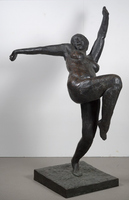
Reflecting on her experience of posing for the sculpture The Mad Maiden (fig. 2), Duerinckx emphasized the physical exertion and fatigue involved in modeling. Inspired by a dance performance of Isadora Duncan in Brussels in 1907,[39] the sculpture depicts a pose that would have been impossible to hold for more than a few seconds. The result of a shared trial-and-error research process, the artist and his model experienced the statue differently: for Wouters it expressed joy, while for Duerinckx it represented a cry of pain.[40]
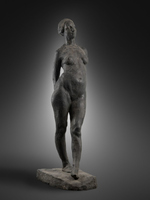
In the case of The Mad Maiden, Duerinckx’s discomfort came from the challenge of maintaining a difficult pose, but in other cases it was her suffering that inspired the artwork (fig. 3). For example, the sculpture Reverie (fig. 4) was inspired by her weary gestures as she posed for the work while affected with a fever.[41] In “Le roman de la Vierge folle,” she recalled how Wouters loved her expression of anger when she voiced frustration at being the only person caring for the household;[42] it provided him with the perfect opportunity for making a drawing or a sketch. Any movement, emotion, or task on Duerinckx’s part could arouse the artist’s interest, prompting him to ask her to pause and hold a pose or a facial expression. This practice raises challenging questions about consent, privacy, and exploitative labor. Indeed, it seems there was hardly any limit to Duerinckx’s husband’s access to her, no matter whether she was ill, angry, or engaged in private acts such as sleeping or bathing (fig. 5). He observed and recorded the most intimate moments of her life: “While I slept, washed and ate, Rik was there, pen in hand, like the vigilant sentinel of my life.”[43] This would ultimately lead her to an identity crisis upon Wouters’s untimely death: “Nobody follows me any more with painting or drawing materials. I’ve lost my reason for living.”[44]
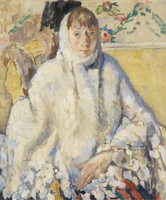
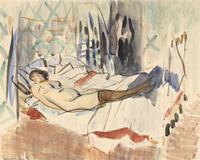
Duerinckx’s posing for Wouters was different from her “professional” posing for Lalaing.[45] Posing for Wouters was part of her daily life, and, in turn, that life became a kind of performative act. Her actions and movements formed the basis of much of Wouters’s work. This “extractivist” relationship took on its most extreme form in sexuality or allusions to it. In Duerinckx’s words—speaking about herself in the third person, as she often did in her memoir—Wouters “kneads her body with caresses,” adding that “he wants to keep the imprint of her shape in the palm of his hand so that he can better extract her beauty.”[46] For Wouters, according to Duerinckx’s recollection of his words, desire expressed itself through touch, existing in a continuum between caressing a living body and creating one out of clay: “Every nudge I make in the clay will be a cry of adoration for your beautiful little body.”[47] Wouters’s promise to her, “how I will work, how I will love you!,” further deepened this sense of interchangeability between a woman’s body made of inanimate material with one made of flesh.[48] In “Le roman de la Vierge folle,” Duerinckx dissociated herself from her role as a model, whom she envied because this “double” received most of Wouters’s attention: “His model! Nele is jealous of her as if she were another woman. This model who is a duplicate of herself.”[49] However, any hint of jealousy is absent from La vie de Rik Wouters à travers son art, in which she insisted instead on her willing collaboration with Wouters: “However, he was neither a brute nor an ingrate, even if he sometimes made a mistake, he realized that I shared his passion for his art.”[50]
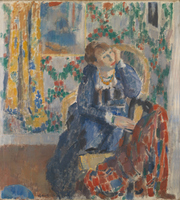
Although most references to modeling in Duerinckx’s writings speak of her ready submission to Wouters’s whims, moments of agency also occurred. When tired of posing for the sculpture The Mad Maiden, for example, she resorted to wearing colorful clothing and jewelry to entice the painter to switch to painting, for which she found modeling easier (fig. 6):
Sometimes, when I got tired of posing for The Mad Maiden, I would slyly incite Rik to paint. Having lived with him for so long, I had become familiar with his taste for color and the arrangement of a painting. It seemed to me that I could direct his emotions toward color rather than form. The amber of a necklace, or the opal reflections of an earring on a vermilion earlobe, were the tiny spark that caught Rik’s vision and gave him the irresistible urge to paint. A pink, red or blue dress in the familiar surroundings of our home was such a joy for Rik that he could not resist the urge to bring this luminous spot to life on canvas.[51]
Here, Duerinckx was playing an active role in her husband’s creative process, presenting him with irresistible visual stimuli. Later, when Wouters was suffering from cancer, she used the same approach to distract him from his pain:
Nele took out her amber necklace and stood next to him in favorable lighting, reading to him. Her illuminated hair had tawny highlights. Her earrings caught the light. A navy-blue dress with a pink tulle collar ending in a big bow formed an ensemble that Rik could not resist. She knew that with his healthy eye, he was studying the picture that she was offering him, as in the happy days.[52]
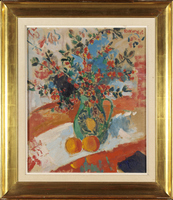
Beyond posing, Duerinckx also contributed to Wouters’s artworks in more subtle ways. This included tasks that some might consider to be stretching the notion of collaborative creation, such as staging herself or the interior of their home. Occasionally, she brought home new bibelots, which were “new enchantments for Rik’s eyes.”[53] She also arranged bouquets that the artist found too beautiful not to paint. Their friend the painter Fernand Verhaegen (1883–1975) “saw him [Wouters] stop in front of a bouquet of flowers, always tastefully arranged by that extraordinary Nel, pick up his palette and set to work by the light of a paraffin lamp.”[54] Though often taken for granted, flower arranging required an expertise which was perceived as more suited to women than men. If we consider flower arranging to be an art form, then Wouters’s floral still lifes modeled after Duerinckx’s bouquets can be viewed as examples of cocreation.[55] This leads to the question of Duerinkx’s artistic practice. A painting held by the Musées Royaux des Beaux-Arts de Belgique is signed jointly by “Rik and Nel” (fig. 7). On its reverse Duerinckx wrote: “the bouquet was painted by Nel in 1912 / and corrected by Rik Wouters / it is the only study that has survived / Mrs Widow R Wouters / 1939.”[56] The extent of Duerinckx’s own creative practice is unknown, and this is the only work signed by both that I have been able to identify. The Archives et Musée de la Littérature in Brussels holds a notebook containing drawings by Wouters and Duerinckx, made in the days leading up to the painter’s death in Amsterdam in 1916.[57] According to Duerinckx, Wouters made her promise that she would be the only person to touch his materials after his death and, as a result, she took up painting for a while:
I kept thinking about him, I was lost, I had nothing to do, and then I remembered Rik’s insistence that I paint and draw. He used to say “Nele, no one else can use my equipment. You have to paint and keep all your attempts, you will see that you will succeed.” So one day I took Rik’s worst paper and started to learn how to draw. Then, emboldened, I did little still lifes and one day I started a portrait of myself, all in memory of Rik.[58]
Although she soon abandoned painting, keeping Wouters’s memory alive remained an important goal throughout Duerinckx’s life, a topic I explore later in this article. I first turn to the ways in which the domestic work performed by Duerinckx and others contributed to the staging of Wouters’s interiors and gave him the ability to focus on art making.
Domestic Work: “Order, Cleanliness, Sunshine, and Flowers”
Wouters’s paintings of interiors often evoke a sense of domestic cheerfulness through their bright colors, everyday furnishings, and relatable occupants. Often depicting Duerinckx, they represent her looking at herself in the mirror, admiring a view through a window, reading, or engaging with a child, among other activities. They convey an atmosphere of calm and enjoyment in which “no occupation is presented as labor, as efforts for which one would want to receive a wage.”[59] This pleasant, cozy, feeling is echoed in testimonies of visitors to the couple’s home, in particular the small workers’ house on the outskirts of Brussels where they lived between 1907 and 1914 and where Wouters created his best-known works. Jules Elslander (1865–1945), the manager of the Galerie Giroux, described this interior as “cheerful.”[60] A couple, visiting the house to buy an artwork, was surprised by its welcoming interior. In Duerinckx’s words:
Mr. C. [Guillaume Charlier] came to see us, accompanied by his wife. They were astonished by our cheerful, clean interior. The clean, shiny tiles, the furniture, the well-polished brass and pewter gave a feeling of well-being. We didn’t look unhappy at home! So, the care I took with the housework did us a disservice.[61]
The last sentence is clearly tongue-in-cheek, as Duerinckx seems to have taken great pride in their neat interior. When interviewed toward the end of her life, she confided:
You know, when people say that artists are careless, messy, etc., it is not true. At least, it was not true for us. [Our home] was a little jewel, shining like a new penny, and I looked after it with such ardor! And Rik also loved order, cleanliness, sunshine, and flowers.[62]
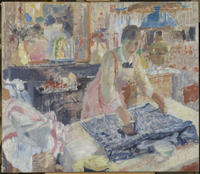
The ardor to which Duerinckx refers has largely been overlooked: Visitors admired the result, but even if they had remembered to congratulate the mistress of the house on her lovely home, they probably would not have considered the hard work that went into it. Chores were not given much prominence in Wouters’s paintings either: Aside from ironing (fig. 8), representations of much of the heavier and more energetic domestic work is confined to the artist’s sketches and drawings. While this makes sense from a technical point of view—a painting required a model to hold longer, more sustained poses—it also results in domestic work appearing to be an afterthought when looking at Wouters’s characteristic paintings of interiors. Yet, domestic labor was essential to the creation of both the type of environment that Wouters liked to represent and the material conditions in which he could work. Since interior scenes make up the bulk of Wouters’s painterly work, he needed access to a clean, cheerful, and well-decorated interior that would provide the right setting for his creativity to unfold.
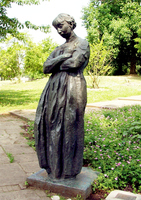
Duerinckx may have found recognition for her domestic work in Wouters’s sculpture Domestic Worries (fig. 9), which she described to the curator of the Musée des Beaux-Arts in Lyon as follows:
She is the woman of our time, living our lives and in whose heart of hearts the worries are the same as ours. For her, there is no goddess title evoking Olympus, no, Domestic Worries is man’s affectionate companion, concerned about the care with which she surrounds him, living among us and for us. All of Rik’s love is written in it with gravity.[63]
She held the sculpture as proof of Wouters’s love and as an important recognition for women like her, who were devoted to their husbands.[64] Moreover, she admired Wouters for depicting a housewife in her everyday attire, complete with apron, on such a grand scale.[65] Created in 1913, when the couple was faring better financially, the sculpture can be seen as a form of tribute to Duerinckx’s efforts and ingenuity in getting them through years of hardship. It depicts her in a thoughtful, static pose, and conveys the “mental load” associated with domestic work.[66] Yet, both the title and the iconography of the sculpture may not fully convey the gravity of Duerinckx’s concerns. She often wrote openly about the couple’s difficulty affording food. This basic need seemingly did not affect Wouters: “Misery never touched Rik. Whether or not he had food, mended pants or clogs to wear. None of that touched him.”[67] Conversely, Duerinckx struggled when posing “with an empty stomach” and envied her husband’s ability to solely focus on work.[68]
Domestic Worries remains an ambivalent tribute to Duerinckx. On the one hand, it visualizes the work that usually happens in the “background” of artistic creation,[69] but on the other it reinforces the stereotypical association of women with domestic matters by underscoring Duerinckx’s ultimate responsibility in this area. Although Wouters contributed to the household finances by taking on additional work and selling his art as he became more successful, he still benefited from the privilege of delegating household concerns and maintenance to a wife, partner, or domestic servant.[70] For example, it was Duerinckx who had to come up with inexpensive recipes to feed them both.[71] This is a form of “privileged irresponsibility,” a notion developed by the political scientist Joan Tronto. She argues that traditional divisions of labor and social values allow some individuals to “escape” from care tasks.[72] Although Tronto did not apply this concept to artists or historical figures, it proves productive in this context.[73] In the case of Wouters, “privileged irresponsibility” enabled him to dedicate himself fully to his art, unfettered by the domestic concerns which preoccupied Duerinckx.
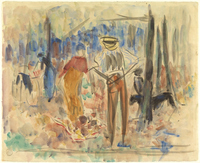
The sculpture Domestic worries suggests that Duerinckx was the sole caretaker of the artist. Yet, despite their financial struggles, the couple hired help for cleaning: Marie Decat, in 1910, and a woman known as Stans (fig. 10).[74] The latter remained in contact with Duerinckx for the rest of her life and helped her put the interior of the house in Boitsfort in order when Duerinckx returned from the Netherlands.[75] The work of Ducat and Stans gave Duerinckx more free time, which she could dedicate to modeling or other tasks. Moreover, both women and their respective children posed for Wouters. As with Duerinckx, their suffering inspired him: He painted a portrait of Stans, for example, when she had just lost her two-year-old child.[76] Avermaete wrote that Wouters “saved her [Stans] from oblivion.”[77] But would the story of Stans have survived if Duerinckx had not written about it? Although this article focuses on Duerinckx, it is important not to allow her to overshadow the other, less visible figures who enabled Wouters’s career and artistic production in meaningful, albeit seemingly small, ways.
Building a Legacy: “In Memory of Rik”
Following Wouters’s death, Duerinckx worked relentlessly to ensure that her late husband’s reputation thrived. She began writing down her memories of her life with Wouters immediately following his passing.[78] She answered questions raised by critics and art historians, authenticating or rejecting works attributed to Wouters. She arranged for his body to be repatriated to Belgium and buried in Boitsfort.[79] She fought a long legal battle with the Galerie Giroux, to try and keep control of Wouters’ estate.[80] She made an inventory of his works, eventually selling its publication rights to the Palais des Beaux-Arts in Brussels.[81] A few years later, her file cards formed the basis of the catalogue raisonné of Wouters’s works, organized and written by Avermaete.[82] The list of her efforts could go on. By taking charge of her husband’s legacy, Duerinckx secured a livelihood for herself. However, this does not appear to have been her primary goal.[83] She was concerned that relying solely on the income generated by selling Wouters’s works might devalue them.[84] By remarrying twice, and by working in agriculture, she sought to maintain some financial independence from Wouters’s estate.
In the framework of this article, it is the personal and emotional aspects of caring for an artist’s legacy that specifically interest me.[85] This can be seen, for example, in the arguments Duerinckx used to identify potential forgeries of Wouters’s work. They refer to details of her life with Wouters and are grounded in her intimate knowledge of his subject matter, especially when it came to paintings of interiors in which she appeared and had lived. “I have never had a thin waist, never wearing anything but straight dresses. The dark belt—I have never worn a belt like this on my striped dress;”[86] or, “there are seats that we never had, an oval mirror on the wall that did not exist.”[87] In her effort to authenticate artworks she also often referred to her gut feeling, or, more accurately, to her close collaboration with Wouters over the years:
I can say that I contributed to Rik’s work not with my hands, but with my heart, and it is this intimacy that emanates from his work. There were two of us, but at work we were one. In these fake drawings, that something is missing, they are soulless, without warmth. I can smell it like a dog smells meat. It makes me uncomfortable.[88]
Emotions also surfaced on the occasions when Duerinckx felt that Wouters’s work was not receiving the recognition it deserved. She could not conceive of the publication of a catalogue raisonné that did not include his sculptures, arguing that “this seems to me to considerably diminish the significance of Rik Wouters.”[89] When the Koninklijk Museum voor Schone Kunsten (KMSKA) in Antwerp refused to purchase a work by Wouters, she replied: “You most certainly know that Rik Wouters does not need you or your commission to be what he is.”[90] Duerinckx aimed to place Wouters’s works in the hands of those who valued him and his art.[91] The physician Ludo van Bogaert (1897–1989), with whom she developed a close relationship after Wouters’s death, was one such person. He became one of the biggest collectors of Wouters’s works, a few of which he—ironically—donated to the same KMSKA.[92]
As a final tribute to Wouters’s life, Duerinckx decided to create and sell new casts of The Mad Maiden and Domestic Worries in order to raise funds for the creation of a foundation, La Fondation Rik et Nel Wouters. The statutes of the association were published in June 1967. Its aim was to award an annual prize to an individual specializing in cancer research, the disease that caused Wouters’s death. Collectors were apparently irritated by her initiative, as it reduced the value of their own casts.[93] However, as she approached the end of her life, Duerinckx’s only concerns were financing a good cause and preventing researchers from experiencing the same financial insecurity she had faced in her youth.[94] Throughout her life, caring for Wouters’s legacy was not only a way to promote his work but also a “safe space” to which Duerinckx could retreat: “Life has been so hard on me, and yet I still have this wonderful refuge. It’s Rik and his work. There’s such a sense of serenity there. Everything is clear. There are no bad dreams. There is beauty, light and happiness.”[95]
Conclusion
In her later letters, Duerinckx frequently returned to the subject of being disliked, being perceived as ungrateful, or being dismissed as an “old bore.”[96] She believed that this was a consequence of her decision to avoid social engagements and live a secluded existence in the countryside. Yet, she was confident that her image would improve over time: “In 20 years, people will talk about me in a different way—time rounds off so many angles.”[97] The reality is perhaps more disheartening: The rich insights into Duerinckx’s life and work as an artist’s partner offered by her writings have not been valued in their own right until now. Nevertheless, her accounts have the potential to open doors to rarely recorded experiences and transform art historical narratives more broadly.
The life and legacy of Duerinckx is representative of the often invisible yet crucial roles played by family members, collaborators, and domestic servants in enabling an artist’s lifestyle and artistic career. It is revelatory of the social support artists (predominantly male) often receive in order to establish and pursue their careers. While Duerinckx’s case is representative, it is also exceptional due to the wealth of archival material offering a rare account of the life of an artist’s partner; often such material has been lost or destroyed or is held in private collections.[98] This extensive archive allows for a nuanced exploration of her central role in Wouters’s life and career through the close reading of personal anecdotes, focusing on what might be considered more unexpected aspects, such as her lived experience and agency as Wouters’s model, the role of domestic labor in providing him with both optimal working conditions and subject matter for his paintings and sculptures, and the emotional dimensions of curating his legacy.
Acknowledgments
For their helpful feedback on this article, I thank Petra Chu, Jenny Reynaerts, Marjan Sterckx, and the anonymous reviewer.
Notes
All translations are my own.
[1] “Het zou een nieuw boek kunnen opleveren, maar het hoeft niet.” Eric Min, Rik Wouters: Een biografie (De Bezige Bij, 2011), 393. Throughout this article, I use Duerinckx’s maiden name for the sake of consistency.
[2] Howard S. Becker, Art Worlds (University of California Press, 1982), ix.
[3] Quoted in Becker, Art Worlds, 1.
[4] Glenn Adamson and Julia Bryan-Wilson, Art in the Making: Artists and Their Materials from the Studio to Crowdsourcing (Thames and Hudson, 2016); and Anne Sauvageot, Le partage de l’oeuvre: Essai sur le concept de la collaboration artistique (L’Harmattan, 2020).
[5] Laurence Riviale and Jean-François Luneau, eds., L’invention partagée: Élaboration plurielle dans les arts visuels (XIIIe–XXIe siècle) (Presses Universitaires Blaise-Pascal, 2019).
[6] See Susan Waller, The Invention of the Model: Artists and Models in Paris, 1830–1870 (Ashgate, 2006); Denise Murrell, Posing Modernity: The Black Model from Manet and Matisse to Today (Yale University Press, 2018); Anne Lafont, Une Africaine au Louvre en 1800: La place du modèle (Institut National d’Histoire de l’Art, 2019); Margaret MacDonald, The Woman in White: Joanna Hiffernan and James McNeill Whistler, exh. cat. (Yale University Press, 2020); and Jenny Reynaerts, Geesje & Anna: De wereld van Breitners beroemde modellen (Rijksmuseum, 2024).
[7] Whitney Chadwick and Isabelle de Courtivron, Significant Others: Creativity and Intimate Partnership (Thames and Hudson, 1993); Jane Alison and Coralie Malissard, eds., Modern Couples: Art, Intimacy and the Avant-Garde, exh. cat. (Prestel, 2018); and Sharon Hecker and Teresa Kittler, eds., Art and Intimacy in Modern Italy: Entangled Lives (Bloomsbury, 2025).
[8] Francesca Berry, “‘Maman Is My Muse’: The Maternal as Motif and Metaphor in Edouard Vuillard’s Intimisme,” Oxford Art Journal 34, no. 1 (March 2011): 55–77; Francesca Berry, “Living Together, Working Together: The Mutuality of Vuillard and Madame Vuillard,” in Maman: Vuillard & Madame Vuillard, ed. Francesca Berry and Mathias Chivot, exh. cat. (Paul Holberton, 2018); Jan Marsh et al., Pre-Raphaelite Sisters, exh. cat. (London: National Portrait Gallery, 2019); Géraldine Lefebvre, ed., Léon Monet, frère de l’artiste et collectionneur, exh. cat. (RMN-Grand Palais; Musée du Luxembourg, 2023); Diana Seave Greenwald, ed., Manet: A Model Family, exh. cat. (Princeton University Press, 2024); Charlotte Foucher Zarmanian, Femmes chez les Nabis: De fil en aiguille, exh. cat. (Éditions Faton, 2024); and Hans Luijten, Jo van Gogh-Bonger: The Woman Who Made Vincent Famous (Bloomsbury, 2022).
[9] Marriage certificate of Hélène Philomène Leonardine Duerinckx to Henri Emile Wouters, April 15, 1905, Watermael-Boitsfort, Agatha (website), record no. HUVLB-HUBRU-00374931-0, accessed March 11, 2025, https://agatha.arch.be/.
[10] Nel Duerinckx, “Le roman de la Vierge folle,” 1952, 3, 13, FS XXXVI 177, Bibliothèque Royale de Belgique (hereafter KBR), Brussels.
[11] Duerinckx, “Le roman de la Vierge folle,” 5.
[12] For a biography of Wouters, see Min, Rik Wouters.
[13] Duerinckx, “Le roman de la Vierge folle,” 5–6.
[14] Olivier Bertrand and Stefaan Hautekeete, Rik Wouters: Jalons d’une vie (Pandora, 1994), 6–22.
[15] Catherine Leclercq, Jacques de Lalaing: Artiste et homme du monde (1858–1917) (Académie Royale de Belgique, 2006), 74–75. De Lalaing helped them finance their move to Boitsfort in 1907. See Min, Rik Wouters, 77.
[16] Bertrand and Hautekeete, Rik Wouters, 57–60.
[17] Min, Rik Wouters, 401.
[18] Duerinckx, “Le roman de la Vierge folle,” 54.
[19] “J’ai vécu comme un instrument dont on a joué. A présent je vois autre chose, les roses de mon jardin les arbres qui se balancent au vent, le calme qui m’entoure. Ce sont des choses qui me vont au cœur et je m’en contente.” Nel Duerinckx to Roger Avermaete, August 26, 1962, ML 2626/71, Archives et Musée de la Littérature, Brussels (hereafter cited as AML).
[20] She also assumes the role of Wouters’s muse in a comic book (Lies Van Gasse and Peter Theunynck, Nel: Een zot geweld [Wereldbibliotheek, 2017]); a play (Frans Ceusters, Het Zotte Geweld, 2016); and a documentary (Le testament amoureux de Nel, directed by André Dartevelle [Halolalune Production, 2010], DVD).
[21] “Le danger d’une interprétation romanticisante de l’œuvre.” Stefaan Hautekeete, “Rik Wouters, peintre de la couleur et de la lumière,” in Rik Wouters: Rétrospective, ed. Laurent Germeau and Lola Vandenbusche, exh. cat. (Musées Royaux des Beaux-Arts; Somogy Éditions d’Art, 2017), 53.
[22] Hautekeete, 53.
[23] Nel Wouters, La vie de Rik Wouters à travers son œuvre (Éditions Lumière, 1944), 28.
[24] “une revendication, une appropriation par l’amoureuse du travail de son époux.” Herwig Todts, “Entrer dans le monde de l’art: La réception de l’œuvre de Rik Wouters,” in Germeau and Vandenbusche, Rik Wouters, 263.
[25] See Roger Avermaete, Rik Wouters (Éditions de l’Arcade, 1962), 65.
[26] This first draft, written in two notebooks, is held at the KBR. See FS XXXVI 177, KBR, Brussels.
[27] “Une source d’informations invérifiables.” Todts, “Entrer dans le monde de l’art,” 263.
[28] When using anecdotes as historical sources, it is important to consider the strategies of mythmaking employed by the artists and their contemporaries. This includes the stereotypical ways in which artists are presumed to have found their calling. On the use of anecdotes for historical research, see Edward Muir, “Introduction: Observing Trifles,” in Microhistory and the Lost Peoples of Europe, ed. Edward Muir and Guido Ruggiero (John Hopkins University Press, 1991), vii–xxiii; and Jill Lepore, “Historians Who Love Too Much: Reflections on Microhistory and Biography,” Journal of American History 88, no. 1 (2001): 129–44.
[29] “Je n’ai pas la prétention d’être bas bleu.” Nel Wouters to Roger Avermaete, March 29, 1961, ML 2626/6, AML. “Comme je ne vise pas à faire une œuvre littéraire j’étais persuadée que vous aviez comprit [sic] que c’est surtout mon manque de littérature qui a fait le charme de cette sorte de livre.” Nel Duerinckx to Angèle Manteau, April 26, 1944, M 224 / B, Archives of Angèle Manteau, Letterenhuis, Antwerp.
[30] “On trouve qu’on parle trop de moi dans votre livre, mais qu’importe, Rik en a parlé bien plus encore dans son œuvre et je m’en félicite.” Nel Duerinckx to Roger Avermaete, January 23, 1963, ML 2626/76, AML. In reality, Avermaete’s book does not frequently mention her.
[31] A fairer appraisal of Duerinckx’s importance to Wouters’s career can be found in Francisca Vandepitte’s essay in the catalogue for Wouters’s retrospective in 2017: “On ne soulignera d’ailleurs jamais assez la contribution de Nel à la maturation de son art et au développement de sa carrière. Muse, épouse, secrétaire, biographe et propagandiste: elle assume tous les rôles. Elle tient lieu de modèle professionnel dans l’atelier de sculpture, mais le caractère privé des activités domestiques inspire également à l’artiste quelques-uns de ses portraits les plus sensibles et les plus profonds.” (Nel’s contribution to the maturation of his art and the development of his career cannot be overstated. Muse, wife, secretary, biographer and propagandist: she took on every role. She acts as a professional model in the sculpture studio, but the private nature of domestic activities also inspires some of the artist’s most sensitive and profound portraits.) Francisca Vandepitte, “La sculpture impressioniste de Rik Wouters, à l’aube d’une nouvelle époque,” in Germeau and Vandenbusche, Rik Wouters, 205.
[32] “Dès les débuts de Rik, j’avais été son modèle; il ne pouvait concevoir une figure de femme sans la traduire par mes traits et dans mes attitudes. Il m’a toujours paru très simple, d’aider Rik dans sa tâche et aujourd’hui encore je suis heureuse d’avoir été son modèle constant. Car, sans ma continuelle présence, Rik n’eut certainement pu réaliser une œuvre aussi féconde.” Wouters, La vie de Rik Wouters à travers son œuvre, 12–13.
[33] Duerinckx is often said to have worked as a model before meeting Wouters. Min mentions that she posed for the artist Ferdinand Schirren prior to posing for her future husband, although he does not cite a source to support this claim. Min, Rik Wouters, 46–47.
[34] “de chaque côté des fesses une fossette.” Duerinckx, “Le roman de la Vierge folle,” 9.
[35] “Elle s’était examiné dans une glace, cherchant à découvrir ses malformations. Ses hanches sont un peu larges et les deux fossettes l’inquiétaient beaucoup. Enfin elle va tenir parole et faire le premier sacrifice à l’art celui de sa pudeur.” Duerinckx, “Le roman de la Vierge folle,” 10.
[36] “qui essayait de remplir son rôle, mieux qu’un modèle de profession.” Wouters, La vie de Rik Wouters à travers son œuvre, 25.
[37] “S’il avait dû payer un modèle son œuvre n’aurait pas eu cette importance puisque l’argent pour payer les modèles nous faisait défaut.” Nel Duerinckx to Roger Avermaete, December 8, 1962, ML 2626/72, AML.
[38] “Jamais un modèle de profession n’eut voulu consentir une pose où la tension violente de tous les muscles était nécessaire pour donner l’élan que Rik exigeait. Chaque effort demandait l’élasticité totale des muscles. Le temps de respirer longuement et les bras retombaient, fatigués. . . . Une heure de cet exercice fatiguait le modèle jusqu’au découragement. Quelquefois je le disais à Rik, mais alors il me regardait avec une si grande conviction, en disant qu’il commençait seulement à voir clair, que je reprenais la pose dans un mouvement rageur qui dessinait le mouvement avec plus de vigueur. Et la séance continuait.” Wouters, La Vie de Rik Wouters à travers son œuvre, 24.
[39] Herwig Todts, “‘En cette chair secouée habite, semble-t-il, toute la fièvre de la trépidante existence moderne’: Vierge folle/Het Zotte Geweld [Frasques folles] de Rik Wouters (1912),” in Bacchanales! Ivresses des arts au XIXe siècle, ed. Adriana Sotropa and Sara Vitacca (Presses Universitaires de Bordeaux, 2018), 95–107.
[40] Wouters, La vie de Rik Wouters à travers son œuvre, 38.
[41] Wouters, La vie de Rik Wouters à travers son œuvre, 13, 55–56.
[42] Duerinckx, “Le roman de la Vierge folle,” 30.
[43] “Pendant mon sommeil, à ma toilette, durant mes repas, Rik était là, la plume à la main, comme la sentinelle vigilante de la vie.” Wouters, La vie de Rik Wouters à travers son œuvre, 19.
[44] “Personne ne me suit plus avec le matériel pour peindre ou dessiner. J’ai perdu ma raison de vivre.” Duerinckx, “Le roman de la Vierge folle,” 52.
[45] See note 15.
[46] “Il pétrit son corps de caresses. . . . Il veut garder l’empreinte de ses formes dans le creux de sa main afin de mieux pouvoir en extraire la beauté.” Duerinckx, “Le roman de la Vierge folle,” 11 (emphasis added).
[47] “Chaque coup de pouce que je mettrai dans la terre sera un cri d’adoration pour ton beau petit corps.” Duerinckx, “Le roman de la Vierge folle,” 10.
[48] “Comme je vais travailler, comme je vais t’aimer !” Duerinckx, “Le roman de la Vierge folle,” 10.
[49] “Son modèle! Nele en est jalouse comme s’il s’agissait d’une autre femme. Ce modèle qui est le dédoublement d’elle-même.” Duerinckx, “Le roman de la Vierge folle,” 31.
[50] “Il n’était cependant ni une brute, ni un ingrat et s’abusait quelquefois, il se rendait compte que je partageais sa passion pour son art.” Wouters, La vie de Rik Wouters à travers son œuvre, 56.
[51] “Quelquefois, lasse de poser pour ‘la Vierge folle,’ j’incitais malignement Rik à peindre. À force de vivre avec lui, ses goûts pour le coloris ou l’arrangement d’un tableau m’étaient devenus familiers. Aussi me semblait-il pouvoir diriger son émotion vers la couleur plutôt que vers la forme. L’ambre d’un collier, ou les reflets d’opale d’une boucle sur le lobe vermillon de l’oreille étaient la minuscule étincelle qui accrochait la vision de Rik, lui donnait l’irrésistible envie de peindre. Une robe rose, rouge ou bleue dans le cadre familier de notre intérieur était pour Rik une si grande joie qu’il ne pouvait résister au besoin de faire vivre cette tâche lumineuse sur une toile.” Wouters, La vie de Rik Wouters à travers son œuvre, 28.
[52] “Pour lui Nele sortait son collier d’ambre et se plaçait près de lui dans une lumière favorable elle lui faisait la lecture. Ses cheveux illuminés ont des reflets fauves. Ses boucles d’oreille accrochent la lumière. Une robe bleu marine avec un col de tulle rose se terminant en un gros nœud forme un ensemble auquel Rik ne peut résister. Elle sait que de son œil valide, il étudie le tableau qu’elle lui offrait comme aux beaux jours de bonheur.” Duerinckx, “Le roman de la Vierge folle,” 44.
[53] “nouveaux enchantements pour les yeux de Rik.” Wouters, La vie de Rik Wouters à travers son œuvre, 21.
[54] “Je l’ai vu tomber en arrêt devant un bouquet de fleurs disposé toujours avec goût par cette extraordinaire Nel, prendre la palette, et se mettre au travail à la lueur d’une lampe à pétrole.” Fernand Verhaegen, quoted in Avermaete, Rik Wouters, 45.
[55] The flower paintings by Wouters often depict a single species of flower such as roses or tulips. The few composed bouquets he painted may have been based on Duerinckx’s flower arranging. For an (incomplete) overview of Wouters’s flower paintings, see Avermaete, Rik Wouters, 204–12.
[56] “Le bouquet a été peint par Nel en 1912 / et corrigé par Rik Wouters / c’est la seule étude qui est restée / Mme Vve R Wouters / 1939.” “Nel en Rik Wouters, Bouquet de fleurs,” Collections, Musées Royaux des Beaux-Arts de Belgique, accessed March 11, 2025, https://fine-arts-museum.be/.
[57] Nel Duerinckx and Rik Wouters, sketch book, n.d., ML 03004, AML.
[58] “Je pensais à lui toujours, j’étais perdue, je n’avais rien à faire puis je me rappelais l’insistance de Rik pour me faire peindre et dessiner. Il disait souvent ‘Nele personne d’autre que toi ne peut employer mon matériel. Tu dois peindre et garder toutes tes tentatives tu verras que tu y parviendras.’ Je pris donc un jour le plus mauvais papier de Rik et je me mis a [sic] apprendre à dessiner. Puis enhardie je fis des petites nature mortes puis un jour je commençai un portrait d’après moi-même tout celà en souvenir de Rik.” Duerinckx, “Le roman de la Vierge folle,” 54.
[59] “Geen enkele bezigheid wordt voorgesteld als arbeid, als inspanningen waarvoor men een loon zou willen ontvangen.” Herwig Todts, “Levenslust & Levensstijl: De iconografie van Rik Wouters,” in Lust for Life, ed. Valérie Herremans et al. (Hannibal, 2016), 14.
[60] “Comme cette chambre est gaie dans sa bonne lumière.” Jules Elslander, Figures et souvenirs d’une belle époque (La Renaissance du Livre, 1940), 58.
[61] “M. C. vint nous voir, accompagné de sa femme. Notre intérieur gai et propre les étonna. Le carrelage net et luisant, les meubles, les cuivres et les étains bien astiqués donnaient un sentiment de bien-être. Nous n’avions pas l’air malheureux chez nous! C’est ainsi que les soins que j’apportais au ménage nous desservirent.” Wouters, La vie de Rik Wouters à travers son œuvre, 25.
[62] “Vous savez, lorsqu’on dit que les artistes sont négligents, malpropres, etc., ce n’est pas vrai. En tout cas, ce ne l’était pas pour nous. C’était un petit bijou, elle brillait comme un sou neuf et je l’entretenais avec une ardeur! Et Rik aussi aimait l’ordre, la netteté, le soleil et les fleurs.” Marcel Vermeulen, “Rik raconté par ‘Nel’ son épouse et son modèle,” Le Soir, February 24, 1966, 6.
[63] “C’est la femme de notre époque vivant de notre vie et au fond de laquelle les soucis sont semblables aux vôtres. Pour elle point de titre de déesse évoquant l’Olympe, non Soucis domestiques c’est la compagne affectueuse de l’homme et préoccupée des soins dont elle l’entoure vivant parmi nous et pour nous. Tout l’amour de Rik y est inscrit avec gravité.” Nel Duerinckx to René Jullian, n.d., FS XXXV 1.706 C, KBR, Brussels.
[64] In 1912, Duerinckx tried to sell watercolor prints by the painter Edgard Tytgat to artists in her network, because he was “broke” and did not have a wife to support and encourage him. See Bertrand and Hautekeete, Rik Wouters, 47–48.
[65] Wouters, La vie de Rik Wouters à travers son œuvre, 73. Wouters’s Domestic Worries may have been influenced by Antoine Bourdelle’s Penelope (1907), of which ten copies were cast in the workshops of the Fonderie Nationale des Bronzes in Brussels in 1910. See Vandepitte, “La sculpture impressioniste de Rik Wouters,” 215–16.
[66] Allison Daminger, “The Cognitive Dimension of Household Labor,” American Sociological Review 84, no. 4 (August 2019): 609–33, https://doi.org/10.1177/0003122419859007.
[67] “La misère n’a jamais touché Rik. Qu’il ait ou non à manger, qu’il ait un pantalon tout raccomodé [sic] ou des sabots pour se chausser. Tout cela ne le touchait pas.” Duerinckx, “Le roman de la Vierge folle,” 30.
[68] Nel Duerinckx to Roger Avermaete, May 16, 1962, ML 2626/62, AML.
[69] Sara Ahmed, Queer Phenomenology: Orientations, Objects, Others (Duke University Press, 2007), 31–32.
[70] Ahmed, Queer Phenomenology, 30–31.
[71] Vermeulen, “Rik raconté par ‘Nel’ son épouse et son modèle.”
[72] Joan C. Tronto, Who Cares? How to Reshape a Democratic Politics (Cornell University Press, 2016), 29.
[73] For how the concept of care has been applied to the field of history, see Clyde Plumauzille and Mathilde Rossigneux-Méheust, “Le care, une ‘voix différente’ pour l’histoire du genre,” Clio, no. 49 (July 2019): 7–22, https://doi.org/10.4000/clio.16058.
[74] Stans is probably a nickname or a shortened version of the woman’s first name. I do not have more information about her full name or her identity.
[75] See Bertrand and Hautekeete, Rik Wouters, 25; Duerinckx, “Le roman de la Vierge folle,” 54; and Nel Wouters to Roger Avermaete, January 23, 1963, ML 2626/76, AML.
[76] “C’est en restant assise sur sa chaise abrutie par la douleur et silencieuse que Rik a pris une toile et s’est mis à la peindre. Elle était rassurée de ne pas devoir parler et Rik très impressionné peignait sans dire un mot.” (While she [Stans] was sitting silently in her char, numb with pain, Rik took a canvas and started to paint. She was relieved not to have to speak, and Rik, very impressed, painted without saying a word.) Nel Duerinckx to Roger Avermaete, June 27, 1962, ML 2626/66, AML.
[77] “Rik Wouters l’aura sauvée de l’oubli.” Roger Avermaete to Nel Duerinckx, February 2, 1963, ML 2626/185, AML.
[78] She was encouraged to do so by her friend Ludo van Bogaert, as she wrote to Avermaete: “Le Docteur Van Bogaert sait bien que c’est grâce à ses encouragements que je l’ai terminé car déjà en 1916 je l’avais commencé, non pour en faire un livre mais pour revivre mon passé.” (Dr. Van Bogaert knows very well that it was thanks to his encouragement that I finished it, because I had already started it in 1916, not to turn it into a book but to relive my past.) Nel Duerinckx to Roger Avermaete, June 20, 1961, ML 2626/13, AML.
[79] Bertrand and Hautekeete, Rik Wouters, 188; and Min, Rik Wouters, 403.
[80] See Olivier Bertrand, “Rik Wouters et Georges Giroux: L’artiste et le galeriste,” in Germeau and Vandenbusche, Rik Wouters, 267–75.
[81] File containing correspondence from or to Roger Avermaete, Dr. Ludo van Bogaert, Robert Giron, J. van Lerberghe, Nel Wouters, and Emile Langui, related to the possible publication of a catalogue of Rik Wouters’s works by the Palais des Beaux-Arts, ML 02628 CR, AML.
[82] Avermaete, Rik Wouters, 22.
[83] The letters of Duerinckx to her publisher, Angèle Manteau, which date from April 1943 to January 1945, show that Duerinckx followed closely the publication process for her book La vie de Rik Wouters à travers son œuvre; opposed changes to its text; and sought to raise the exposure of the book. For example, she suggested including a mock-up of the book in a retrospective exhibition of Wouters organized in Antwerp in February 1944. She also considered strategically withholding copyrights to other authors who were preparing books about Wouters, in order to ensure that her book would appear first. Yet, this could not have been motivated solely by financial concerns: Duerinckx earned a fixed rate for the publication of the book, regardless of its success. The letters from Duerinckx to Manteau are held in the Letterenhuis in Antwerp. See Nel Duerinckx to Angèle Manteau, 1943–45, M 224 / B, Archives of Angèle Manteau, Letterenhuis, Antwerp. Duerinckx’s situation can be usefully compared with that of Jo van Gogh-Bonger, who opened a boarding house after becoming a widow. In this way, she ensured that she would have an income regardless of sales of Vincent van Gogh’s artworks. See Luijten, Jo van Gogh-Bonger, 134–36.
[84] Nel Duerinckx to Roger Avermaete, December 2, 1961, ML 2626/38, AML.
[85] On the emotional aspects of curating family archives, see Jane Hamlett, “Mothering in the Archives: Care and the Creation of Family Papers and Photographs in Twentieth-Century Southern England,” Past & Present 246, no. 15 (2020): 186–214, https://doi.org/10.1093/pastj/gtaa036.
[86] “Je n’ai jamais eu la taille fille, ne portant jamais que des robes droites. La ceinture sombre – je n’ai jamais porté une ceinture de ce genre sur ma robe à rayures.” Nel Wouters to Roger Avermaete, March 29, 1961, ML 2626/6, AML (underlining in original).
[87] “Il y a des sièges que nous n’avons jamais eu[,] une glace ovale au mur qui n’existait pas.” Nel Duerinckx to Roger Avermaete, October 16, 1961, ML 2626/28, AML.
[88] “Je peux dire que j’ai collaboré à l’œuvre de Rik non pas par les mains, mais par le cœur, et c’est cela [sic] surtout qui se dégage de ses œuvres, cette intimité. On était deux mais au travail on ne faisait qu’un. Dans ces faux dessins, ce quelque chose manque, ils sont sans âme, sans chaleur. Je repère celà [sic] comme un chien sent la viande. Celà [sic] me met mal à l’aise.” Nel Duerinckx to Roger Avermaete, December 4, 1961, ML 2626/39, AML.
[89] “Ceci me semble diminuer considérablement la signification de Rik Wouters.” Nel Duerinckx to J. van Lerberghe, n.d., ML 2628/31, AML.
[90] “Vous savez certainement que Rik Wouters n’a pas besoin de vous ni de votre commission pour être ce qu’il est.” Nel Duerinckx to Dr. W. Vanbeszlaere, September 18, 1863, ML 2626/84, AML.
[91] Nel Duerinckx to Roger Avermaete, April 8, 1961, ML 2626/7, AML.
[92] It is also thanks to Ludo van Bogaert that the Archives et Musée de la Littérature has letters and manuscripts by Nel Duerinckx.
[93] Min, Rik Wouters, 410.
[94] Nel Duerinckx to Ludo van Bogaert, May 22, 1964, ML 2626/132, AML.
[95] “La vie m’a réservé tant de coups durs et pourtant, j’ai toujours ce merveilleux refuge, c’est Rik, son œuvre, il y a là une telle sérénité, tout y est clair, pas de mauvais rêves, beauté lumière bonheur.” Nel Duerinckx to Roger Avermaete, March 3, 1962, ML 2626/52, AML.
[96] “une vieille radoteuse.” See, for example, Nel Duerinckx to Roger Avermaete, April 8, 1961, ML 2626/7, AML.
[97] “Dans 20 ans, on parlera de moi d’une autre manière[,] le temps arrondit tant d’angles.” Nel Duerinckx to Roger Avermaete, January 2, 1963, ML 2626/75, AML.
[98] See Zoë Thomas, “Marriage and Metalwork: Gender and Professional Status in Edith and Nelson Dawson’s Arts and Crafts Partnership,” in Precarious Professionals: Gender, Identities and Social Change in Modern Britain, ed. Heidi Egginton and Zoë Thomas (University of London Press, 2021), 153–54.