New DiscoveriesDitlev Blunck, A Street Scene, 1828
by Kasper LægringKasper Lægring
New Carlsberg Foundation Researcher in Art History
Aarhus University.
Email the author: kl[at]cc.au.dk
Citation: Kasper Lægring, “Ditlev Blunck, A Street Scene, 1828,” Nineteenth-Century Art Worldwide 24, no. 3 (Autumn 2025), https://doi.org/10.29411/ncaw.2025.24.3.6.
This work is licensed under a Creative Commons Attribution-NonCommercial 4.0 International License  unless otherwise noted.
Your browser will either open the file, download it to a folder, or display a dialog with options.
In the spring of 2022, I taught a course on the history of genre painting. Halfway through the course, I discussed A Street Scene by the Danish artist Ditlev Blunck (1798–1854), a painting that had been exhibited at the Charlottenborg exhibition in Copenhagen in 1828 but soon after disappeared into a private collection and was henceforth only known through a black-and-white photograph. Serendipitously, the painting resurfaced at exactly the time I had discussed it in class.
The work was sold at Bruun Rasmussen Auctioneers in Copenhagen on March 1, 2022, as lot no. 906/13; the hammer price reached DKK 700,000—far exceeding the estimate of DKK 100,000–150,000 and almost on a par with similar works by Christoffer Wilhelm Eckersberg (1783–1853), the so-called father of Danish painting.[1] The buyer was a private individual from abroad, and no export ban was imposed by the Danish state, despite this being a possible course of action.[2] The fact that the work was not acquired by a public museum (in Denmark or abroad) and was allowed to leave the country testifies to the underappreciation of Blunck as an artist and of genre painting as a phenomenon within the so-called Danish Golden Age (1801–64), even though both have recently gained more attention as subjects of research.[3]
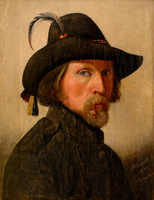
Ditlev (Detlef) Conrad Blunck (fig. 1) was born on June 22, 1798, in Münsterdorf in the Duchy of Holstein, which at the time was under the Danish crown. In 1814, he was admitted to the Royal Danish Academy of Fine Arts in Copenhagen, where he studied under Christian August Lorentzen (1749–1828) and advanced to the model school in 1816.[4] He won a small silver medal in 1817, but the following year, feeling a need for more training, he enrolled at the Academy of Fine Arts in Munich, where he became acquainted with the art of the Nazarenes.[5] Blunck returned to the academy in Copenhagen in 1822, now as a student of Johan Ludvig Lund (1777–1867), and steadily won more medals: a large silver medal in 1823, a small gold medal in 1825, and a large gold medal in 1827. He also took private lessons from Eckersberg.[6]
Winning the large gold medal was linked to a travel grant, so Bunck journeyed to Italy via Berlin, Dresden, and Munich. In Dresden, he met the Romantic landscape painters Johan Christian Dahl (1788–1857) and Caspar David Friedrich (1774–1840).[7] Blunck stayed in Rome for ten years, from 1828 to 1838, becoming part of the circle around the famed Danish sculptor Bertel Thorvaldsen (1770–1844).[8] In 1831–32, he visited Perugia, Florence, Venice, and Vicenza.[9] In 1838, Blunck returned to Copenhagen with Thorvaldsen and became an associate member (agré [sic]) of the academy, but his joy was short-lived, as he was expelled from the country in 1840, allegedly for having committed sodomy. However, no official charge or verdict can be found in the archives.[10]
Until 1848, Blunck resided in German-speaking countries, mainly in Munich, Berlin, and especially Vienna. Between 1848 and 1851 he lived closer to Denmark, in Lübeck and Kiel, from where he took up arms against his former country by joining as a volunteer in the Schleswig-Holstein uprising, which led to the First Schleswig War.[11] He spent his final years in Hamburg, beginning in 1851, and died there on January 7, 1854, from a hemorrhage.[12]
After his death, Blunck was gradually written out of Danish art history. Later generations have attributed this to his double transgression against Denmark, but other explanations can also be offered, such as the declining demand for history painting, in which Blunck specialized, as well as the uneven quality of his work and the Nazarene style in which he often worked.
Details and Provenance of the Painting
A Street Scene (En gadescene) (fig. 2), an oil painting on canvas, measures 24 3/4 × 18 7/8 in. (63 × 48 cm) without the frame. This makes it a relatively large work compared to the typical painting sizes during the Danish Golden Age, when smaller and more portable formats became popular, as they suited the walls of the Biedermeier apartments in Copenhagen. The painting is signed and dated D. Blunck 1828 on the red-brick wall on the left side of the image. The inscription is located slightly below the upper edge of the soldier’s black riding boots.[13]
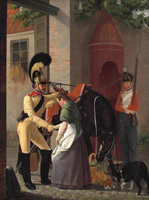
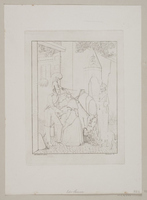
The painting was exhibited at the annual Charlottenborg exhibition of Danish artists’ works in 1828 as “[no.] 53. A Street Scene. Owned by Mr. Secretary Thiele.”[14] This tells us that the work had already been purchased by Just Mathias Thiele (1795–1874), who was the secretary of the Royal Danish Academy of Fine Arts. During Thiele’s ownership, A Street Scene was exhibited at the University of Copenhagen during the Christmas season of 1843 as no. 96.[15] An etching based on A Street Scene was created by Blunck’s fellow student Edvard Sonne (1804–78), titled The Horse Guardsman Bids Farewell (fig. 3).[16]
Due to his position at the academy, Thiele was central to the Danish art scene and was himself an art collector and connoisseur. After completing a grand tour of Europe, he was appointed secretary and librarian of the academy in 1825, a position he held until 1871. From 1835, he was an inspector at the Royal Collection of Prints and Drawings, and from 1861, he could call himself its director. Starting in 1838, he also served as private secretary to the art-loving Crown Prince Christian Frederik, the future King Christian VIII (r. 1839–48). In addition to his multiple jobs, Thiele was well-known as a scholar and a writer.
After Thiele’s death in 1875 the painting disappeared, but in 1901 it was included in the Raadhusudstillingen af dansk Kunst til 1890 (City Hall Exhibition of Danish Art Until 1890), where the painting was listed as the property of Peter Erasmus Müller (1840–1926), royal chamberlain and head forester.[17]
When A Street Scene resurfaced again, it was at a Winkel & Magnussen auction in 1934 as lot no. 160/21 and again at Winkel & Magnussen in 1935 as lot no. 185/59. Before its reappearance in 2022, the painting had been auctioned one more time at Bruun Rasmussen in 1976 as lot no. 354/28.[18]
Unpacking the Painting’s Subject
Standing in a gateway paved with cobblestones, an officer shakes hands with a kitchen maid. He is dressed in a tan-colored uniform, which contrasts sharply with the black of his glossy riding boots and knapsack as well as the red of his collar and epaulettes. An imposing helmet adorned with a golden scroll and a plume of black feathers covers his head. He leans against his dark-brown horse, on which he has temporarily placed both his sword and his rifle. The horse is equipped with a red saddle trimmed with white. The girl, who is much shorter than the soldier, looks downward while shaking his hand, as if saying goodbye. She is dressed in a working-class woman’s clothing—a lavender-gray dress with a white apron that she lifts slightly in curtsying—and a green shawl. She also wears what could be either wrist warmers or strips of fabric for protection against work injury. The expressions of the two figures are partly hidden by the shadow of the soldier’s helmet and the angle at which the girl, depicted in profile, is shown. The soldier appears friendly, while the girl’s demeanor is shy. She has placed her woven basket on the ground to her right and does not notice that the horse has started to eat the carrots from the basket while a dog is sniffing at the onions, pretzels, eggs, and mushrooms that have fallen out, likely due to the horse’s foraging.
The figures seem to be standing near a military barracks, judging by the red sentry box marked by Frederick VI’s (r. 1808–39) crowned monogram in gold. The armed guard in front of the box wears a uniform that is different from the soldier’s—blue trousers and a coat in red and white—and his small kepi with gold trim is less imposing. He is watching the scene and smiles slyly.
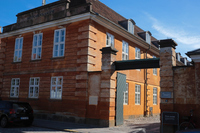
It is very likely that the scene is set near the Hestgardekaserne (Horse Guards Barracks) (fig. 4), which at that time was located on Frederiksholms Kanal and still exists there today. The barracks was built in the neoclassical style in 1792 based on designs by Andreas Kirkerup (1749–1810) and rebuilt by the same architect after a fire in 1798. What we see in Blunck’s painting is, in all likelihood, not the main portal facing the canal but rather a more modest gateway facing Vester Voldgade. Just to the right after passing through this gate was the hay magazine, a building that is still extant. If one stands in the same position that Blunck presumably occupied, one can glimpse the façade of the hay magazine inside the walls. However, the recesses seen in the wall today are not depicted by Blunck; nor does the hay magazine have a roof where Blunck has painted one, so perhaps it is another gateway on the barracks premises, or Blunck has taken some artistic liberties.
The officer’s uniform indicates that he is a ritmester (cavalry captain) in the Livgarden til Hest (Royal Horse Guards), who were stationed at this location in Copenhagen at the time. The girl’s simple clothing and the basket of vegetables and groceries she has placed on the ground next to her suggests that she is a kitchen maid who has been out shopping. Their encounter is one of different genders and social classes as well as different lifestyles—military versus civilian. However, the title of the work as submitted and exhibited at Charlottenborg, A Street Scene, reveals nothing about the social nature of the interaction; nor can Blunck’s intention with the work be discerned from it. This the work shares with other innovative genre scenes from painters of the same generation, who often anonymized their colleagues and family members in works exhibited at Charlottenborg.
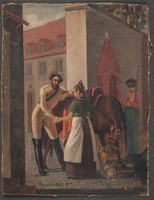
An oil sketch with an almost identical motif, titled Street Scene. A Cavalryman Bidding Farewell to a Girl, can be found in the Statens Museum for Kunst in Copenhagen (fig. 5), measuring 6 7/8 × 5 3/8 in. (17.5 × 13.5 cm).[19] The work, which was part of the collection of Johan Bravo (1797–1876), Danish consul in Rome, who, like his friend Blunck, also hailed from Holstein, came to the museum in 1876 as a bequest. Its attribution to Blunck is credited to the late German art historian Wolfgang Zeigerer, who dated the work to 1820, which would place this so-called preliminary sketch eight years before the date of the final piece.[20] However, since Blunck only returned to Copenhagen in 1822, this cannot be the case. Given the clumsiness of the execution of the sketch—both its proportions and its perspective leave a lot to be desired—one would be hard-pressed to consider it to be even an early attempt by Blunck.
Whoever the author may be, the sketch provides insight into how Blunck decided to frame his chosen setting. While the main focus and cast of characters reappear in the sketch, there are several differences in detail between the anonymous sketch and Blunck’s work. Architecturally, the gateway offers viewers a greater glimpse into the courtyard of the barracks, allowing us to see not just a single window but three sections of a building, with its roof and dormer windows visible as well. A door with the inscription No. 6 above it can also be seen. We can also see enough of the wall to the right to identify the beginning of a flanking opening with steps below and a small canopy above. In this version, the cavalryman does not sport a mustache but a full beard, and instead of a helmet he wears a simple beret. However, in both versions of the scene the chestnut tree towers above the rendezvous.
Although the facial expression of the sentry cannot be discerned here, he is included in the composition as an observer; thus, the oil sketch mirrors Blunck’s narrative. However, the two main figures appear to be more socially equal, if the assumption of the soldier’s status holds true. Compared to the sketch, Blunck has emphasized and dramatized the social disparity in his work.
It is tempting to relegate the mysterious sketch to the status of an inferior copy after Blunck, were it not for the fact that its creator, like Blunck, must have had firsthand knowledge of the site in order to render details not present in any of Blunck’s verified works (i.e., the painting and the etching). Thus, its role, if any, in the creation process remains a mystery, as does the identity of its author.
The Reception History of the Painting
A Street Scene was one of several genre pieces that garnered positive attention at the Charlottenborg exhibitions in the latter half of the 1820s. Many found buyers and some were even purchased by the royal family. The increased presence of genre painting at the exhibitions signaled the formation of a national school of genre painting, which had been largely absent from Danish art, aside from a few attempts by Jens Juel (1745–1802) and Lorentzen, Blunck’s first teacher. Many of the new genre painters of the 1820s, such as Wilhelm Bendz (1804–32), Constantin Hansen (1804–80), Albert Küchler (1803–86), Wilhelm Marstrand (1810–73), Martinus Rørbye (1803–48), and Blunck himself were close to Eckersberg, a popular teacher and eventually director of the Royal Danish Academy of Fine Arts, who increasingly experimented with genre painting himself.
The annual exhibition at Charlottenborg, headquarters of the academy, was becoming institutionalized. At the same time, the writings of the period’s first true art critic, Niels Lauritz Høyen (1798–1870), were crucial both for the increased attention directed at national art and for the emerging interest in genre painting:
History painting, applied to scenes from daily life in smaller works, has in recent times been given the name of genre painting. The more successfully the artist knows how to choose such motifs from the life surrounding him, which are most easily understood by and elicit sympathy from the viewer, the greater the effect he will produce.[21]
In Høyen’s review of the exhibition in 1828, however, he responded to Blunck’s A Street Scene with a certain ambivalence:
There is a rare truth in the composition and expression of this group; but why has the artist chosen to spoil our enjoyment by introducing the sentinel, who with his crude grin plays the role of the chorus badly? Who could possibly take pleasure in such a scene? And why must this filler figure—and he is nothing more than that—so coldly intrude upon the feelings and judgment of every observer?[22]
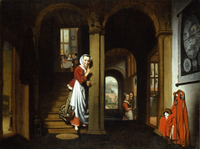
This statement is noteworthy. Høyen is referencing ancient Greek tragedy, in which the chorus was expected to amplify the main sentiment. Taken together with his standard beliefs in the academic conventions for figure painting, where coherence of action was the desired outcome, Blunck’s work, in his eyes, fails on both these counts: emotionally and compositionally. Had Høyen instead contextualized A Street Scene within the conventions of Dutch genre painting rather than those of history painting, he would perhaps have seen the “filler figure” in a different light, for a painter like Jan Steen (1626–79) frequently employs secondary figures that are disconnected from the main narrative yet still react to it. In many such Dutch works, the protagonists in the picture have varying degrees of insight into the proceedings, leading to an uneven distribution of sensory orientation and situational awareness among them. Nicolaes Maes’s (1634–93) series of Eavesdropper paintings (fig. 6) is the most advanced example of this. This mechanism, however, is hardly ever called upon in street scenes, and therein lies Blunck’s singular contribution to pictorial language. William Hogarth (1697–1764), ever the innovator, had employed this tactic (also to comic effect), yet his works remain indebted to Dutch group scenes with a multitude of characters cut from the Steenian cloth.
In any case, the sentinel, who smirks at the sight of the farewell scene, possibly in the know about the demise of the groceries due to the maid’s absentmindedness, is more than just a filling figure. His presence as a witness complicates the relationships of the gazes in the painting and enhances the liveliness of the street scene. If we were instead confronted solely with the conversation between the couple, our perspective would more closely resemble that of a voyeur. Instead, the scene takes on the realistic sheen of a public, urban encounter.
Other aspects of Høyen’s review are more indicative of a sea change in the judgment of art than his formal nitpicking. His ekphrastic description, in particular, warrants closer attention:
A tall, strong, handsome cavalryman seems to have been in the act of mounting his horse when he is interrupted by a well-dressed maid, his sweetheart, who, at the moment we approach the painting, is about to make a confession to him, which he does not hear with any more engagement than many a galloping rider in romances does to his sweetheart’s lament; but it causes her to sink to her knees in sorrow and despair. Both are so entirely occupied with themselves, he with a certain embarrassment, she with pain, for her last hope is perhaps already dashed, that neither of them hears how pretzels and eggs crack against the ground due to the eager horse’s investigation of the girl’s vegetable basket.[23]
Sociologist Anthony Giddens has noted a parallel between the emergence of the novel and the cultural impact of romantic love, both of which share a common narrative that serves individual self-realization.[24] Høyen’s interpretation of the motif corresponds precisely to this cultural breakthrough, since he not only fails to consider important the blatant class divide between the couple but also references the genre of romance as an interpretive key.
No other contemporary assessments of the work are known. Although it did not find its way into the royal collections, it clearly appealed to Thiele’s taste as a connoisseur.
Thiele must also have exhibited A Street Scene in 1860 at a special exhibition held at Charlottenborg, organized as a fundraising initiative following the fire at Frederiksborg Castle in 1859.[25] For the soon-to-be towering literary critic Georg Brandes (1842–1927), who would become instrumental in the so-called Modern Breakthrough movement, the highlight of the exhibition was none other than Blunck’s A Street Scene, which Brandes described as follows:
After the table, I went up to the exhibition, and in the most heartfelt sense of the word, I enjoyed the magnificent paintings, [and] in a piece called “Farewell,” where a cavalryman and a maid bid farewell to each other, the painter has revealed so much that no comic poet could have provided such fine psychological nuances.[26]
Somehow the romantic theme must have caught up with the painting, since it was now exhibited explicitly as a farewell scene, shifting the emphasis from physicality to emotionality. Perhaps the title of Sonne’s etching, The Horse Guardsman Bids Farewell, had superseded that of the original, and at the 1843 exhibition at the University of Copenhagen, Blunck’s creation had been renamed The Cavalryman and His Girlfriend.
Surprisingly, Brandes—like Høyen before him—is not taken aback by the class difference between the two main characters, which would otherwise have been objectionable to the bourgeois morality of the time. Yet unlike Høyen, he takes delight in the comical dimension of the work. This is puzzling, for elsewhere Brandes condemns a painting in the same comic spirit, The Drunkards Leaving the Cellar from 1834 (private collection) by Marstrand, arguing that the subject matter—drunkards—is unworthy of art.[27] As Pil Dahlerup notes, Brandes’s view of art at this time was extremely traditional, and the clue to his enthusiasm for Blunck’s creation might be that the painter manages to connect with time-honored comedy while at the same time making the scene instantly recognizable by any Copenhagener.[28] Brandes would later come to think differently about genre painting.[29]
In the seventeenth-century Dutch tradition of veiled symbolism, which boasted a different or at least ambiguous morality than the one of Brandes’s time, the soldier and the maid are both cast stereotypically in a dubious light—the former for his prodigality, the latter for her flirtatiousness.[30] This moral code was no longer available to a nineteenth-century audience, which—in the wake of Théophile Thoré’s Les Musées de la Hollande (1858–60)—was prone to a socially realist interpretation out of lockstep with the actual pattern of reception in the seventeenth century.[31] Kasper Monrad points out that the humorous layer in the painting, embodied in the smiling sentinel, dampens the sentimentality that would otherwise result from a simple love story.[32] In fact, as it turns out, Blunck’s painting is culturally embedded in a short-lived craze for anything comedic around 1830 that made its mark on most genre paintings of the time, regardless of theme.[33] The theatrical (as hinted at by Høyen) was very much part and parcel of this outburst of comic creativity. Thus, while Brandes’s appreciation of the comic element aligns with earlier (and popular) patterns of reception, his emphasis on psychology instead reflects contemporary concerns, mainly tied to the rise of realism as an aesthetic ideal.
While Monrad identifies a newfound playfulness in Blunck’s painting, and Henrik Bramsen identifies a witty “battle-of-the-sexes” dynamic, earlier art historians were more reserved.[34] Sigurd Schultz, for example, found the humor too coarse, despite his high praise for the pioneering feats of Danish genre painting of the 1820s and 1830s.[35]
The Iconography of a Soldier’s Farewell
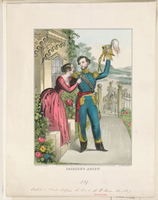
The soldier’s farewell was, in 1828, a relatively new theme in art, although as the nineteenth century progressed it became more common in popular imagery (fig. 7). As a pictorial trope, it was contingent upon the upheavals of the time of the French Revolution and the subsequent Napoleonic Wars, during which the nation-state gradually supplanted the feudal order. Consequently, patriotism and, later, nationalism emerged as the overarching value systems of society, just as the citizen-soldier replaced the mercenary. Blunck’s painting came into being at a time when the tides were truly turning from patriotism to nationalism.
Early modern depictions of a couple’s farewell are scarce. One is the watercolor A Cavalier Bidding Farewell to a Lady (fig. 8) of 1678 by Hendrick Verschuring (1627–90); another is Edward Harding’s (1755–1840) engraving of 1796 after Lady Diana Beauclerk’s (1734–1808) design, A Knight Bids Farewell to a Young Lady (fig. 9), made at the dawn of the Romantic era. Yet none of these otherwise diverse creations—one realistic, the other dreamlike—mirrors the newfound role of the dutiful citizen-soldier that Blunck has brought to life on canvas. Unlike both the seventeenth-century Dutch guardroom scenes populated with neglectful mercenaries and the aforementioned vivid depictions of couples’ farewells, Blunck’s scene can only be understood with the very real possibility of dying for king and country as a backdrop. The painter has cleverly included the royal monogram as a reminder of the cavalryman’s duty.
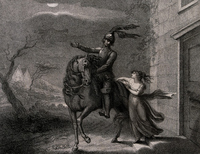
Moreover, while nothing in the iconography of the soldier’s leave-taking necessarily implies that the soldier in question is engaged or married, what unites the typical couple’s farewell during the Romantic era with the corresponding iconography of the soldier’s farewell is the growing interest in and acceptance of romantic love in society, which the Sturm und Drang movement had paved the way for, as Giddens notes.
This redefined role of the soldier in the Napoleonic era and later feeds into the fact that Blunck’s work allows for a range of speculations about the seriousness of the farewell. Is the officer merely going on active duty and thus leaving the capital? Is he breaking up with the girl? Or does she confide in him that she is with child—perhaps even out of wedlock?
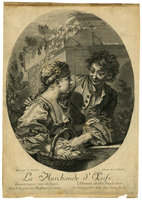
The broken egg, which, along with others, has fallen out of the basket, could serve as a clue.[36] Iconographically, broken or stolen eggs were well established at this time as symbols of lost virginity. François Boucher’s (1703–70) The Egg-Selling Girl (La marchande d’oeufs) of ca. 1740–50, engraved by Jean Daullé (1703–63) (fig. 10), is the prototype for this connotation, and should the viewer be in doubt, it is quickly dispelled by the accompanying inscription.[37] Foodstuffs as symbolic indicators of sexual encounters is a tradition that can be traced back to Dutch genre painting.[38] In Blunck’s painting, the dog’s bent front paw seems to mirror the officer’s corresponding posture, making it tempting to interpret the dog’s confrontation with the broken egg as an allegory of the protagonists’ relationship; however, the girl is also kneeling. It remains speculative, though, whether Blunck was aware of the Rococo’s erotic connotations of the egg (and other broken objects, as seen in works by Jean-Baptiste Greuze [1725–1805], such as The Broken Vessel [ca. 1771–72; Musée du Louvre, Paris]) and whether such symbolism would have been perceptible to contemporary audiences. Nonetheless, prints after Boucher and Greuze were widely available. Høyen’s imaginative remark that the supposed “confession” of the girl “causes her to sink to her knees in sorrow and despair,” which is a far cry from her actual pose of curtsying, is a strong indicator that the girl is pregnant and that this erotic symbolism still had currency.
Regardless of the nature of their liaison, the assertiveness of the soldier reflects the redefinition of male sexuality in the emerging civic society:
But the practitioners of civil society were out to change the world, so to speak, and at least conceptually, they released the foundation of their new society, the male individual, from his social “fetters” and reconceived him according to dynamics they understood as “natural.” Not surprisingly, they built upon the traditional sexual associations, and their creation became the sexually potent, desiring, self-determining individual fit for active citizenship.[39]
Here, Isabel V. Hull is tracing a cultural change in Germany during the Enlightenment and the Napoleonic Wars, yet, as is clear from her wording, her conclusion about the codification of sexuality extends well into the nineteenth century. Likewise, the entanglement of sexuality, masculinity, and emergent civil society resonate with broader transformations beyond Germany. Hull’s commentary on the role of the woman reads as follows:
Her derivative social status was mirrored in her derivative sexual nature: not independent, emancipated, or a citizen, she could not be sexually self-determining, she could not “posit” her own desire, will it, and act upon it (in Fichte’s phrase). The resulting schematic dichotomy of male-active/female-passive is familiar to any observer of the nineteenth century.[40]
What we see in the pose of the girl is exactly a subjugation of this kind.
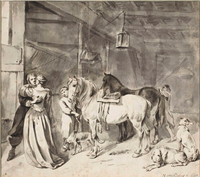
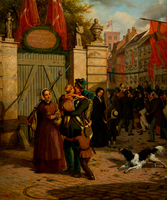
Blunck’s theme in A Street Scene was significant enough to set a precedent. Variations on the motif—whether of parting or reunion—recur in the works of Eckersberg and David Monies (1812–94), in their more well-known and very differently conceptualized works from 1840 and 1850, respectively: A Sailor Says Farewell to His Girl (fig. 11) and The Soldiers’ Homecoming to Copenhagen (fig. 12). Monies’s work, which is wholly steeped in blissful sentimentality, foregrounds a soldier and a woman whose status as a married couple with children (and a dog) is beyond doubt. Behind them, cloaked in shadow, stands a widow with child, offering a poignant counterpoint to the sunlit, idealized military family in the foreground. In Eckersberg’s creation, by contrast, such shadow play performs a different yet no less symbolic function: Not only is there a prominent shadow from a street lamp whose form becomes distorted but the shadows of the couple merge on the wall, which has led to a symbolistic interpretation of the work. Interestingly, a flowering horse chestnut tree also towers over the wall here, just as it does in Blunck’s work.
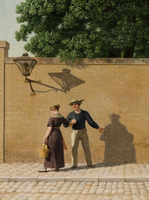
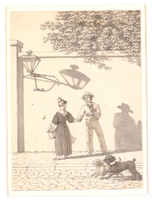
In Eckersberg’s preliminary sketch for the work (fig. 13),[41] the shadow of the couple is less prominent; instead, the mirroring presence of a canine pair running in the street conveys a similar meaning. Their inclusion testifies to the painter’s awareness of symbolic conventions in earlier Dutch painting, where fornicating dogs often alluded to the sexual act between humans—a subject that decorum forbade to be depicted outright.[42] Therefore, it is plausible that this knowledge and practice of veiled symbolism was passed on by Eckersberg to pupils such as Blunck.
As we have established, somehow A Street Scene became a Farewell in the course of the nineteenth century, thus mirroring the overall shift in the painting of the Danish Golden Age from the empirical toward the sentimental. Today’s expansive definition of that period can include the interrelated works of Blunck, Eckersberg, and Monies, which are united by an interest in the urban encounter. As such, Blunck’s pioneering effort turned out to be emblematic of a recurring fascination of the Danish Golden Age painter.
Notes
All translations, unless otherwise noted, are my own.
[1] Fine Art and Antiques: Paintings and Drawings, auction cat. (Copenhagen: Bruun Rasmussen, March 1, 2022), n.p., lot 906/13, https://bruun-rasmussen.dk/.
[2] Due to the anonymity of the client relationship and considerations regarding General Data Protection Regulation (GDPR), it has not been possible to verify whether one or more museums (Danish or otherwise) bid on the work at the auction, let alone identify the buyer.
[3] Previously, the Danish Golden Age was typically defined as spanning the years 1810 to 1848. Since a major exhibition in 2019, a broader periodization has been favored in recent publications on the subject and will also be adopted here. See Peter Nørgaard Larsen and Magnus Olausson, “World Art Between Disasters,” in Danish Golden Age: World-Class Art Between Disasters, ed. Cecilie Høgsbro Østergaard (Statens Museum for Kunst, 2019), 17; and David Jackson, Danish Golden Age Painting (Yale University Press, 2021), 18–23.
[4] Karin Bechmann Søndergaard, Blunck: En biografisk og kulturhistorisk fortælling om en anderledes guldaldermaler og hans samtidige, exh. cat. (Nivaagaards Malerisamling, 2017), 23.
[5] Søndergaard, Blunck, 28–33.
[6] Søndergaard, Blunck, 45.
[7] Søndergaard, Blunck, 73.
[8] Søndergaard, Blunck, 148, 173–74.
[9] Søndergaard, Blunck, 124–29.
[10] Søndergaard, Blunck, 184–85.
[11] Søndergaard, Blunck, 240–42.
[12] Søndergaard, Blunck, 253.
[13] Until the recent auction in 2022, the dating of the painting fluctuated considerably: At auctions in 1935 and 1976, it was described as being from 1820, while at an auction in 1934 it was dated to 1823. In her monograph of 2017 on Blunck, Karin Bechmann Søndergaard maintains the date of 1820, both in the text and the catalogue raisonné, despite the fact that the late Kasper Monrad, an authority on Danish Golden Age painting, had assigned it the date 1828 in 1989 and again in 2013. However, as Søndergaard herself documents, Blunck had not even returned to Copenhagen by 1820—that only happened two years later. Søndergaard, Blunck, 44, 311; Kasper Monrad, Hverdagsbilleder: Dansk guldalder—kunstnerne og deres vilkår (Christian Ejlers’ Forlag, 1989), 122; and Kasper Monrad, Dansk guldalder: Lyset, landskabet og hverdagslivet (Gyldendal, 2013), 158.
[14] “53. En Gade-Scene. Tilhörende Hr. Secr. Thiele.” Fortegnelse over de ved det Kongelige Akademie for de skjönne Kunster offentligen udstillede Kunstværker, exh. cat. (Copenhagen, 1828), 6, https://kunstbiblioteket.kb.dk/.
[15] Fortegnelse over de Kunstgjenstande, der udstilles paa Universitetet i Julen 1843, exh. cat. (Copenhagen, 1843), 7, cat. no. 96, https://kunstbiblioteket.kb.dk/.
[16] See Edvard Sonne, Hestegardisten tager afsked (The Horse Guardsman Bids Farewell), SMK Open, accessed June 10, 2025, https://open.smk.dk/. For reasons unknown, Karin Bechmann Søndergaard assigns the year 1825 to the etching in her monograph, but an inscription at the bottom of the work—“D:C: Blunck pinx:” and “C:E: Sonne Sc:”—clearly states that the etching was made after the painting, and since the painting is dated 1828, the print must be from this year or later. Søndergaard, Blunck, 64. The National Gallery of Denmark adheres to the date 1828.
[17] Raadhusudstillingen af dansk Kunst til 1890, exh. cat. (F. E. Bording, 1901), 15, cat. no. 185, https://kunstbiblioteket.kb.dk/. Müller was married to Thiele’s daughter, Augusta Sophie Thiele (1851–1928), who must have inherited the painting.
[18] Fine Art and Antiques, n.p., lot 906/13, https://bruun-rasmussen.dk/.
[19] Ditlev Blunck, Gadescene. En kavalerist tager afsked med en pige (Street Scene. A Cavalryman Bidding Farewell to a Girl), SMK Open, accessed June 10, 2025, https://open.smk.dk/.
[20] Zeigerer is credited with this date in the Statens Museum for Kunst’s entry for the work.
[21] “Historiemaleriet, anvendt paa Scener af det daglige Liv i Arbejder af mindre Omfang, har i den senere Tid faaet Navn af Genre-Maleri. Jo heldigere Konstneren her véd at vælge saadanne Motiver af det ham omgivende Liv, som lettest forstaaes af og vække Deltagelse hos Beskueren, desto større vil Virkningen være, som han frembringer.” Niels Laurits Høyen, “Nogle Bemærkninger over de paa Charlottenborg udstillede Konstsager” (1828), in Niels Laurits Høyens Skrifter, ed. Johan Louis Ussing (Copenhagen, 1871), 1:61.
[22] “Der er en sjælden Sandhed i denne Gruppes Composition og Udtryk; men hvorfor har Konstneren villet fordærve os Nydelsen ved at henstille den Skildvagt, der med sit raa Grin slet spiller Chorets Rolle? Hvo vilde kunne gotte sig ved sligt et Optrin? Og hvorfor skal denne Udfyldnings-Figur—og Andet bliver han dog ikke—saa koldt gribe ind i enhver Betragters Følelse og Dom?” Høyen, “Nogle Bemærkninger over de paa Charlottenborg udstillede Konstsager,” 1:62.
[23] “En høj, kraftig, smuk Hestgarder synes just at have været i Færd med at bestige sin Hest, da han blev opholdt af en velklædt Tjenestepige, hans Kjæreste, der, i det Øjeblik vi træde hen for Maleriet, er i Begreb med at gjøre ham en Tilstaaelse, som han ikke hører paa med synderlig mere Deltagelse, end mangen bortridende Rytter i Romancerne paa sin Kjærestes Klage; men som bringer hende fast til at synke i Knæ af Sorg og Undseelse. Begge ere saa ganske beskjæftigede med sig selv, han af en vis Forlegenhed, hun af Smerte, thi hendes sidste Haab er maaske alt skuffet, at Ingen af dem hører, hvorledes Kringler og Æg smaldre mod Jorden ved den lystne Hests Undersøgelse af Pigens Grønkurv.” Høyen, “Nogle Bemærkninger over de paa Charlottenborg udstillede Konstsager,” 1:61–62.
[24] “The rise of romantic love more or less coincided with the emergence of the novel: the connection was one of newly discovered narrative form.” Anthony Giddens, The Transformation of Intimacy: Sexuality, Love and Eroticism in Modern Societies (Stanford University Press, 1992), 40. This development can be traced in both art and criticism: “The increasing idealization of love between spouses is evident in print culture from the mid-eighteenth century. . . . Moral commentators in Britain, North America, and France attacked marriages made purely to further financial interests.” Joanne Bailey, “Family Relationships,” in A Cultural History of Childhood and Family in the Age of Enlightenment, ed. Elizabeth Foyster and James Marten (Bloomsbury, 2010), 22–23.
[25] Pil Dahlerup, “Georg Brandes’ billeder,” Fund og forskning i Det Kongelige Biblioteks samlinger 48 (2009): 197, https://doi.org/10.7146/fof.v48i0.41221. Bruun Rasmussen did not mention this in connection with the catalogue for the auction on March 1, 2022, but the exhibition was brought to light by Pil Dahlerup in her studies of Georg Brandes as an aesthetician and art critic. Thiele’s exhibition of the work and Brandes’s reception of it challenge the notion of Blunck’s supposed exclusion from the artistic discourse of the period in the wake of the First Schleswig War due to the late painter’s lack of national sentiment.
[26] “Efter Bordet gik jeg op paa Udstilling, nød i Ordets inderligste Forstand af Hjertet de herlige Malerier, i et Stykke ‘Afsked’ kaldet, hvor en Gardist og en Tjenestepige tager Afsked med Hinanden har Maleren lagt saa meget for Dagen at ingen comisk Digter havde kunnet give saa fine psykologiske Nuancer.” Georg Brandes, “Nogle Bemærkninger om Allegorie og Symbol. Foredrag, holdt i ‘Nutzhorns Bande’ 23.–25. Sept. 1860,” 1860, sec. IV, no. 19, 2r–v, Georg Brandes Archive, Royal Danish Library, Copenhagen.
[27] Brandes, “Nogle Bemærkninger om Allegorie og Symbol,” 3v–4r.
[28] Dahlerup, “Georg Brandes’ billeder,” 234.
[29] Dahlerup, “Georg Brandes’ billeder,” 237.
[30] Wayne E. Franits, Dutch Seventeenth-Century Genre Painting: Its Stylistic and Thematic Evolution (Yale University Press, 2004), 60–63, 83, 118–19, 155.
[31] Frances Suzman Jowell, “From Thoré to Bürger: The Image of Dutch Art Before and After the Musées de la Hollande,” Bulletin van het Rijksmuseum 49, no. 1 (2001): 43–60.
[32] Monrad, Dansk guldalder, 158.
[33] Jesper Svenningsen, “From Obscure Wit to Popular Jokes: Humour in 1820s and 1830s Painting,” in Østergaard, Danish Golden Age, 248–65.
[34] Monrad, Dansk guldalder, 159; and Henrik Bramsen, Ny dansk kunsthistorie: Fra rokoko til guldalder (Forlaget Palle Fogtdal, 1994), 3:168.
[35] Sigurd Schultz, Dansk Genremaleri (P. Haase & Søns Forlag, 1928), 8.
[36] William Gelius, “En erotisk situation? C. W. Eckersberg: ‘En Matros, som tager Afsked med sin Pige,’ 1840,” in Kunstværkets krav: 27 fortolkninger af danske kunstværker, ed. Ernst Jonas Bencard, Anders Kold, and Peter S. Meyer (Forlaget Palle Fogtdal, 1990), 106; and Søndergaard, Blunck, 63.
[37] “Dans ce panier tout est fragile. / D’un Villagois ces Oeufs sont le trésor. / L’Honneur est plus fragile encor [sic]: / Le bien garder n’est pas chose facile.” (In this basket everything is fragile. / For a villager, these eggs are the treasure. / Honor is even more fragile: / To guard it well is not an easy task.)
[38] Franits, Dutch Seventeenth-Century Genre Painting, 118–19.
[39] Isabel V. Hull, Sexuality, State, and Civil Society in Germany, 1700–1815 (Cornell University Press, 1996), 410.
[40] Hull, Sexuality, State, and Civil Society in Germany, 410–11.
[41] C. W. Eckersberg, En matros, der tager afsked med sin pige (A Sailor Says Farewell to His Girl), SMK Open, accessed June 10, 2025, https://open.smk.dk/.
[42] Franits, Dutch Seventeenth-Century Genre Painting, 124, 206.