Plunder? How Museums Got Their Treasures by Justin M. Jacobs
Reviewed by MacKenzie MallonMacKenzie Mallon
Nelson-Atkins Museum
Email the author: mmallon[at]nelson-atkins.org
Citation: MacKenzie Mallon, book review of Plunder? How Museums Got Their Treasures by Justin M. Jacobs, Nineteenth-Century Art Worldwide 24, no. 3 (Autumn 2025), https://doi.org/10.29411/ncaw.2025.24.3.14.
This work is licensed under a Creative Commons Attribution-NonCommercial 4.0 International License  unless otherwise noted.
Your browser will either open the file, download it to a folder, or display a dialog with options.
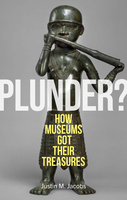
Justin M. Jacobs,
Plunder? How Museums Got Their Treasures.
Reaktion Books Ltd, 2024.
216 pp.; 49 b&w illus.; bibliography; notes; index.
£18.00 (hardcover)
ISBN: 9781789149487
Plunder? How Museums Got Their Treasures by Justin M. Jacobs, published by Reaktion Books and distributed by the University of Chicago Press, was released in hardback and ebook in 2024, with a paperback following in 2025. Jacobs, a professor of history at American University, specializes in East Asian history, archaeology, and antiquities. His previous publications include The Compensations of Plunder: How China Lost Its Treasures (2020, University of Chicago Press) and Indiana Jones in History: From Pompeii to the Moon (2017, Pulp Hero Press), among other contributions.
While the ethics of collecting have long been studied in academic museology, public interest in how objects entered museum collections has grown in recent years. The traditional perception of museums as neutral guardians of priceless objects is giving way to a critical assessment focused on provenience, provenance, and historical inequalities in museum collections. In Plunder? How Museums Got Their Treasures, Jacobs argues that this shift in focus has led to a divergence of views, setting the conventional idea of museums as educational repositories for justly acquired objects against a new perception of museums as hoarders of ill-gotten loot. Jacobs disputes this polarization, calling instead for a more nuanced interpretation. He suggests that most antiquities in museum collections today left their source communities through mutually agreed, quid pro quo transactions. He further asserts that many calls for repatriation are not based on the facts of the removal, are often unwarranted, and should be reserved for objects taken under circumstances of violence or duress.
Following an introduction to the topic, the book includes three substantial chapters and a conclusion. In the main body of the text, Jacobs considers four methods by which objects often left their source communities: as diplomatic gifts, as military plunder, through dealers, and as the result of archaeological excavations. Drawing primarily from examples in China and Egypt, he attempts to reconstruct the value systems that informed these transactions, arguing that many locals willingly engaged with—and even welcomed—Western collectors. Jacobs refers to this dynamic as a “compensation of cooperation” (183). Within this system, source communities—who he claims often considered these objects as trade goods rather than treasures—viewed exchanges as opportunities to acquire financial, social, or political resources. Therefore, they willingly traded antiquities when offered something, be it tangible or intangible, that they considered more valuable. Jacobs argues that this collaboration is often overlooked by contemporary critics of museum practice who attempt to project modern values onto historical contexts. This disconnect between historical and contemporary interpretations, he suggests, is the source of friction in public discourse about modern stewardship of museum collections.
Jacobs proposes a consideration of how both the source communities and the recipients of objects viewed these exchanges at the time, arguing that their values should take precedence over contemporary ethics in an evaluation of the validity of these transactions. Utilizing what he calls “an historian’s approach” (20), Jacobs looks to surviving documentation for evidence of these voices. Provenance researchers working in museums use this methodology to understand object histories and the methods by which objects have been removed from their cultures of origin. Likewise, they also encounter difficulties in reconstructing source communities’ motives because of a lack of primary sources. The imbalance of the archival record is one of the most significant challenges in this type of research: the views of those who removed objects are typically better preserved than those of the communities from which objects were removed.
This disparity is addressed in Jacobs’s first chapter, which considers diplomatic gifts. In his description of the removal of a moai statue from Easter Island by British soldiers in 1868, he acknowledges that “we lack any unmediated native perspectives on their removal” (28). He attempts to extrapolate the islanders’ views from the accounts of the British, taking, for example, one soldier’s description of how the islanders offered “many willing hands” to help move the statue and cheered when it was lifted aboard the ship, as evidence of their approval (28). The potential bias of the British soldier’s description complicates its interpretation in this example and illuminates the complexity inherent in this kind of “cooperation.” Without primary documentation for the source community’s views, it remains uncertain whether participation in an exchange equated to their sanction of the objects’ removal.
In contrast to diplomatic gifts, the rest of the first chapter explores military plunder and how wartime ethics changed over time. Jacobs focuses on contemporary motivations for restituting plundered objects and cautions against projecting modern concepts of “nation,” national identity, and collective memory onto historical cultures that did not recognize such ideas. He argues that objects removed as military plunder should be repatriated because their taking “involved the use of blood-spattered swords and firearms and did not involve the voluntary consent of any native stakeholders” (73). He also suggests that such repatriations serve a primarily symbolic or ethical purpose, rather than correcting historical injustices as we currently view them. To illustrate this, Jacobs draws on examples from China, including the looting of the Yuanmingyuan (Old Summer Palace) in Beijing by British and French soldiers in 1860 during the Second Opium War. He argues that the removal of these treasures targeted the emperor, not the Chinese people, who had no knowledge of or access to the palace collection and were therefore not injured by their removal. Since a united Chinese nation-state did not exist in 1860, Jacobs suggests that there was no national identity that could lay claim to the palace collection.
This thought-provoking argument raises questions that could inform further exploration of the topic. In the case of the Summer Palace, are there additional voices, besides those of the Western soldiers and the emperor, that could contribute to an expanded study of the event? Must a defined political construct, such as a nation-state, be in place before a community can lay claim to antiquities, or can a shared cultural identity determine prerogative?
In the second chapter, Jacobs considers the antiquities trade in the late nineteenth and early twentieth centuries, exploring the cultural, legal, and economic conditions necessary to a dealer’s success. As colonial networks expanded and new modes of transportation made travel easier, increasing numbers of wealthy Western tourists visited countries such as Egypt and China, fueling demand for cultural objects. Jacobs’s discussion in this chapter is an important assessment of these trading networks’ complexities with a focus on the local and regional people who took part in the translocation of objects prior to their export from source communities. These included laborers, middlemen, government officials, customs agents, and dealer proxies. His emphasis on the impoverished people at the beginning of these networks, who are often described as illicit looters today, is a valuable reminder of how antiquities are often removed from the ground by people driven by material necessity rather than malicious intent.
Jacobs argues that the collective participation of source communities on all economic and social levels of the antiquities trade, working through “compensation of cooperation” rather than violence, injustice, or coercion makes a case against the repatriation of these objects. He maintains that, even after laws passed in Egypt (1912) and China (1914) that vested ownership rights of antiquities in the state, objects continued to leave source communities along these networks because they were viewed primarily as trade goods and not as cultural property; thus, the laws were rarely enforced and sometimes outright ignored. Jacobs illustrates this through several case studies from China, such as the sale of wall murals from the Guangsheng Temple in Shanxi Province by its monastic community, the post-World War II provenance of the Chu Silk Manuscript, and the international commercial network created by C. T. Loo—one of the most influential dealers in Asian antiquities during the twentieth century, whose network extended to his galleries in Paris and New York and involved numerous intermediaries both inside and outside of China.
Jacobs begins his final chapter by examining how objects left their source communities as the result of archaeological excavations and associated expeditions. He differentiates archaeologists from dealers by suggesting that the former valued antiquities for their cultural and pedagogical significance and thus considered them priceless, whereas the latter saw them primarily as commodities and assessed their value based on market demand. By way of example, Jacobs suggests that fictional archaeologist Indiana Jones, whose adventurous pursuit of cultural artifacts is featured in several Hollywood films, resembles a dealer more than an archaeologist because he acquired objects in exchange for a commission from his university’s museum. Although Indiana Jones might more accurately be described as an acquisition agent than a dealer, Jacobs’s broader point is that the academic nature of an archaeologist’s work uniquely connects them to an object’s final disposition in a museum collection. Whereas dealers relied on their money, soldiers on their weapons, and diplomats on their promises, scholars had to prove their scientific credibility to both the local community, whose consent they required before they could conduct their excavations, and to their Western academic and financial sponsors, whose future support was often predicated on an expedition’s result.
Drawing again on Egypt and China as examples, Jacobs focuses his discussion on the relationships archaeologists built with every level of a source community, arguing that excavations were, in most cases, a mutually beneficial arrangement rather than one of exploitation. Returning to his idea of “compensation of cooperation,” he discusses how archaeologists hired local peasants as laborers (sometimes called “subsistence diggers”), paying them better wages than other local employers. Jacobs also highlights how excavations benefited the local merchant community, from whom archaeologists and their supporting crew would buy supplies, hire transportation, or offer employment as guides or translators and that the “native elites” in a source country, many of whom were local or regional officials, often shared an interest in the scientific focus of an excavation (135). Jacobs cites Aurel Stein and Paul Pelliot’s excavations in Xinjiang province in the early twentieth century as an example, referencing surviving correspondence between them and local magistrates in which Stein and Pelliot are praised for their academic integrity. He argues that the willingness of local officials to grant excavation permits, assist with hiring local labor, and express gratitude upon receiving scholarly publications signaled their support for archaeological excavations. For Jacobs, these “cooperations” illustrate that the export of antiquities often took place with consent and cannot always be defined as unjust, as contemporary opinions sometimes suggest.
In his conclusion, Jacobs suggests that the modern view of museums as hoarders of looted objects has its origins in the post-World War I period, when newly-formed, non-Western nations—often governed by Western-educated elites—tried to create national identities based on Western cultural values. This included the idea that objects in museums are symbols of their source communities and therefore inherently priceless. This value shift laid the groundwork for the assumption that no one would willingly part with such treasures, and, therefore, that they must have been unjustly taken. As Jacobs argues against this view in Plunder? How Museums Got Their Treasures, his call for nuance and advocacy for considering the historical complexities of object translocations is a noteworthy contribution to the contemporary debate. Jacobs’s “historian’s approach”—emphasizing the voices of historical participants as evidenced by archival documentation—is a valuable methodology for considering these issues and one that is often employed by provenance researchers working in museums today. Jacobs acknowledges that this approach is unavoidably limited by the lack of surviving archival material delineating the perspectives of source communities, leaving primarily the voices of those in power during the transaction for a researcher to consider.
The inherent complexity of these events, in which power structures rarely exhibit the duality of giver/receiver or victim/assailant relationships, invites exploration of additional perspectives. For example, Jacobs’s framing of diplomatic gifts and military plunder as two sides of the same coin—one a voluntary transaction, the other the result of force or coercion—risks oversimplifying the power dynamics at play in these relationships. Object transfers often occupied a gray area. We cannot assume, for example, that not objecting equates to acceptance, even in cases where exchanges were made; power dynamics may have deterred communities from raising alarm bells. Being aware of these power imbalances is not just a present-day ideal. Even nineteenth- and early twentieth-century dealers and archaeologists sometimes expressed uncertainty and regret for their roles in dispossessing other cultures. If they recognized these disparities in their own time, then contemporary reassessment is not only valid but necessary. Ultimately, Jacobs persuasively illustrates how the path that an object travels from a source community to a museum collection is often complicated, and how contemporary discussions about repatriation are best approached through a consideration of the broader historical context. Plunder? How Museums Got Their Treasures is a meaningful contribution to these ongoing debates, offering a historically focused perspective that invites further dialogue.