Thomas Sully’s Philadelphians: Painting the Athens of America by Peter Conn
Reviewed by Rachel StephensRachel Stephens
University of Alabama
Email the author: rachel[at]ua.edu
Citation: Rachel Stephens, book review of Thomas Sully’s Philadelphians: Painting the Athens of America by Peter Conn, Nineteenth-Century Art Worldwide 24, no. 3 (Autumn 2025), https://doi.org/10.29411/ncaw.2025.24.3.16.
This work is licensed under a Creative Commons Attribution-NonCommercial 4.0 International License  unless otherwise noted.
Your browser will either open the file, download it to a folder, or display a dialog with options.
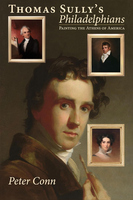
Peter Conn,
Thomas Sully’s Philadelphians: Painting the Athens of America.
American Philosophical Society Press, 2025.
216 pp.; 38 color and 4 b&w illus.; notes; bibliography; index.
$39.95 (hardcover)
ISBN: 9781606180495
Before committing to Peter Conn’s Thomas Sully’s Philadelphians, it is important to know what this book is and what it is not. This might help set expectations regarding this volume that purports to center on the work of perhaps the most prolific and successful portraitist in the United States during the nineteenth century. Rather than being a study of Sully’s work directly, however, the book offers a study of the personages that Sully painted in Philadelphia. Conn argues that Sully’s portraits offer a new kind of history painting because, collectively, they allow the history of Philadelphia to be read through his portraits. This is a small, well-illustrated volume, with glossy pages and full-color illustrations, and it offers a biographical history of a selection of Philadelphians who happened to sit for Thomas Sully. Although the well-researched book provides a rich history of these people and their endeavors, it is not a scholarly, art historical monograph. Most of the book’s content describes the biographical and historical backgrounds of Sully’s sitters and the institutions in which they participated in Philadelphia. There is limited wider context or historical analysis offered beyond historical fact and aesthetic judgment. Thomas Sully’s Philadelphians is also not a catalogue raisonné of Sully’s Philadelphia work, nor is it cutting-edge art history scholarship, but it does not pretend to be that. Rather, from the first page, it establishes itself as a traditional text, quoting, as a definitive statement, art historian Milton Brown who called Sully “the best portrait painter of his generation” (1).[1]
If a reader is looking to learn about who Sully painted across his long Philadelphia career, and to see those portraits illustrated alongside those people’s history and biography, this is a great resource. But Conn’s focus is certainly not trained on widening interpretations about Sully’s career or viewing his work through an interpretive or methodological lens. Conn instead establishes himself from the beginning as a fan of Sully’s portraits, without placing his work within the context of other scholars and without the kind of information that might be expected in art historical scholarship, such as knowledge about the commission, reception, or provenance of each portrait. There is also little analysis of Sully’s style and its potential nuances and changes based on sitter and period. Rather, Conn’s visual descriptions draw from his observations. For example, Conn typically says of the self-taught geologist William Maclure that, “Sully has given us another image of a man preoccupied with his own thoughts” (129), and he describes the portrait of University of Pennsylvania Provost John Andrews as “another example of the artist’s mastery” (140). He concludes that Sully’s portrait of Peter Stephen Du Ponceau “is another in his gallery of fine masculine portraits” (97). If a reader is seeking a contextual history of Sully’s work and its larger place within the history of art, this is not the book; but as a gathering of information about many of Sully’s Philadelphia sitters, it does offer histories that are not always directly available in portraiture studies.
Conn’s book has a set formula. After a disjointed introduction that bounces among multiple topics, chapter 2 provides the factual events of Sully’s life in “A Brief Biography.” After this, the author delves into a string of brief chapters about various people and organizations from historic Philadelphia, ending each with an illustration of a Sully portrait. The chapters are not linked or connected in any way but rather offered as stand-alone factual studies of topics about Philadelphia history that are related to one or more Sully portraits. Each chapter provides deep historical background on the organization, the sitter, or both. A wide selection of chapters detail a variety of aspects of nineteenth-century Philadelphia, especially institution building. These meatier histories about “The Second Bank of the United States” (chapter 4), for example, are often driven by a discussion of the individuals who managed them, in this case the bank’s president, Nicholas Biddle. These histories and biographies are usually followed by a brief (often one short paragraph) visual description of the associated sitter’s portrait accompanied by the illustration. Conn’s portrait descriptions are not based on contextual analysis; on the contrary, he describes how Sully’s portraits look and what they include. Conn’s focus is often placed on the sitter’s likeness and whether he believes it to be accurate.
Conn is also unabashed in his use of terminology that has become outdated. He relies on “America” as a synonym for the United States, and he uses other terms that could be replaced to be more inclusive, including gender binary designations—“men and women,” “masterpiece,” “insane,” “mental derangements,” and “madness.” Even the chapter entitled “The Jews of Philadelphia,” might simply be retitled “Jewish People of Philadelphia.”
Because Sully had such a long life and career and gained so much success, his personal network and adjacent participation in so much of Philadelphia’s history is remarkable. This becomes clear in the volume through the profusion and wide range of patrons and sitters for whom he worked as well as in the wide time span of the portraits the book illustrates. Sully lived for generations before and well after the Civil War, and he played witness to many of the significant aspects of US history. If Conn would have widened the book’s coverage—or would have offered an overarching history of Philadelphia—it would have helped situate the much narrower discussions of the sitters that dominate the book within a more encompassing view of the city and the nation more generally. There are many places in the book that demonstrate missed opportunities to make connections between the portraitist and the history he witnessed and participated in. Furthermore, much of the volume’s interesting subject matter seems to beg for these associations as well as deeper analysis. Conn repeatedly dangles intriguing information and ideas without further comment. It becomes clear through reading the biographies of Sully’s Philadelphia sitters, that many of them were interconnected in interesting ways, which could include anything from mercantile activity to literary organizations, to church attendance, to politics. So many of them knew each other and participated together in institution and community building, and this information emerges through their biographies. All of them were also connected through Sully, but Conn does not compel these connections for the reader. An analysis of these networks and the circles of the people in power would have helped deepen the significance of this study by connecting people and power and the direction of history.
Indeed as Conn shows, Philadelphia was a major leader in the development of learned institutions and forms of knowledge from the first half of the seventeenth century. Relatedly, there are some very intriguing and problematic concepts in the book that center on Philadelphia and perhaps deserve greater attention as well. For example, both Philadelphia’s racial history and so-called natural history (and the interconnections between the two) emerge as significant aspects in the lives of many of Sully’s sitters that Conn describes. The treatment of these histories locally in Philadelphia was significant on a national scale that could be addressed with greater depth and sensitivity. The author notes that the collecting of artifacts from around the world interested many in historic Philadelphia, and he describes the personal histories of many collectors whose portraits Sully painted. Much of this was facilitated by global trade—a subject that presents the opportunity for Conn to discuss the links among trade, colonialism, and enslavement. Furthermore, many of the sitters Conn describes were “merchants.” Mercantile activity in the nineteenth century was often deeply implicated in the slave trade or the labor of enslaved people; however, Conn does not explore potential links between commerce and trade or enslavement and colonization. And in an almost shocking example of this lack of sensitivity, Conn illustrates a display case of “human and monkey” skeletons without explaining the possible implications of doing so.
In addition, Sully’s relationship to people of color is an interesting and timely subject that deserves greater attention and analysis. In fact, so much of the content of this book can be linked back to questions of race, the place of slavery in Philadelphia and the United States, the multitude of merchants who sat for Sully who were either enslavers or whose work was implicated in the slave trade, and more, but Conn does not make these connections for the reader or address these ideas head on. Instead, slavery receives only a passing mention throughout the volume. For example, before even addressing enslavement in Philadelphia, the author says most of the patients at the city’s almshouse were enslaved people, but he offers no further comment. Rather, the volume relies heavily on secondary quotations, and its frequent quotations, both primary and secondary, are often offered without comment or analysis. This seems especially glaring when it comes to Sully’s beliefs about slavery. Conn quotes Sully’s journal, “I can no longer go to our Church; Mr. Furness has driven me away with his abolition sermons” (153). Claims like this seem to demand further context. Although Conn does not explain this, he does note that Sully had lifetime membership in the Pennsylvania Colonization Society, for whom he painted the portraits of several members. Although the book offers a very rich and helpful discussion of the American Colonization Society, little analysis is offered to connect this history and Sully. Conn also briefly mentions a Black man named Robert Douglass Jr. who Sully took on as a student and who would likely be of great interest to readers if more information were offered about him. Two portraits of Black sitters, Daniel Bashiel Warner and Edward James Roye, are included in the book, but these are lumped together (even though all the others are discussed separately), placed at the book’s very end, and dismissed as being based on photographs. Conn seems unwilling to delve in any depth into the implications of Sully’s variety of endeavors that involved people of color. There are other topics, too, that seem to beg for more direct attention regarding race and more. For example, Conn notes that Sully painted the actress Fanny Kemble over a dozen times, and he enticingly tells of Kemble’s marriage to and divorce from a Georgia planter and major enslaver and her long friendship with the Sully family, but he does not connect this to Sully and slavery at all. He also dances around discussions of LGBTQ+ individuals, not mentioning Charlotte Cushman’s queer status directly, even though she was romantically linked to prominent artists like Harriet Hosmer and even Sully’s daughter Rosalie.
In conclusion, at a time when scholarship is expanding in many directions, this volume refuses to engage with diversity. It praises Sully’s talent in portraiture and dangles many intriguing ideas without fully investigating them for the reader. At the end, Conn even states that one of his main points is that “most of Sully’s best pictures . . . are his gallery of male subjects” (170). The book closes without a conclusion, offering instead a judgment of Sully’s style, this time regarding a portrait of George Mifflin Dallas: “The evidence of later photographs suggests that Dallas’s good looks are his own, not Sully’s contrivance” (170). There are no overarching concluding statements, and the author chose to close with his repeated style of judging Sully’s sitters on appearance. Although this book does not provide the nuance and depth to Sully’s work that at least this reader thinks he deserves, for a casual reader seeking a biography of historic Philadelphia illustrated with portraits of some of its major personages, this book may be just the thing.
Notes
[1] Milton W. Brown, American Art to 1900 (Harry N. Abrams, 1977), 229.