Sorolla: Cien años de modernidad (Sorolla: One Hundred Years of Modernity)
Reviewed by Andrew GingerAndrew Ginger
Northeastern University
Email the author: a.ginger[at]northeastern.edu
Citation: Andrew Ginger, exhibition review of Sorolla: Cien años de modernidad (Sorolla: One Hundred Years of Modernity), Nineteenth-Century Art Worldwide 24, no. 3 (Autumn 2025), https://doi.org/10.29411/ncaw.2025.24.3.22.
This work is licensed under a Creative Commons Attribution-NonCommercial 4.0 International License  unless otherwise noted.
Your browser will either open the file, download it to a folder, or display a dialog with options.
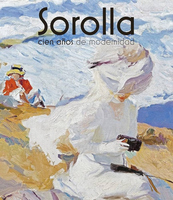
Sorolla: Cien años de modernidad (Sorolla: One Hundred Years of Modernity)
Galería de las Colecciones Reales, Madrid
October 17, 2024–April 20, 2025
Catalogue:
Blanca Pons-Sorolla, Consuelo Luca de Tena, and Enrique Varela Agüí, eds.,
Sorolla: Cien años de modernidad.
Madrid: Ediciones El Viso, 2024.
232pp.; 148 color illus.; bibliography.
€38.00 (softcover)
ISBN: 9788412886351
Joaquín Sorolla was once widely considered one of Europe’s greatest living artists. Born in 1863 in Valencia, on Spain’s eastern Mediterranean seaboard, he rose to international fame in the mid-1890s. Lauded in his lifetime from Paris to the United States, Sorolla has been admired for his brightly lit paintings of the Valencian coast featuring elegant beachgoers, children in the sea and on the sand, and local workers. After his death in 1923, however, his prestige went into steep decline, eclipsed by high modernism and the avant-garde, as well as by his compatriot, the mercurial Pablo Picasso. Since the turn of this century, Sorolla’s star has risen once more with increasing numbers of exhibitions, not just in Spain but internationally. Surely, of his generation of Spanish artists, Sorolla is now the most often exhibited; of those prominent in the first decade of the 1900s, he is rivaled only by Picasso. The centenary of Sorolla’s death launched a wave of exhibitions and events, with a program beginning as early as 2022 in Milan and concluding as late as December 2024 in Madrid, taking in along the way Dallas, New York, Rome, and Havana alongside a multitude of Spanish cities. The culminating exhibition, under review here, took place in the impressive, spacious rooms of the Galleries of the Royal Collection in Madrid, a huge extension to the Palace complex that opened in 2023.
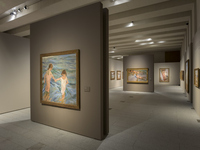
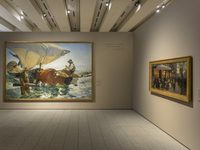
Sorolla: One Hundred Years of Modernity took a conventional approach to displaying the artist’s work: a succession of oil paintings across well-lit rooms, arranged by major themes and proceeding from his earliest works to his final paintings (figs. 1, 2). The effect—desired and achieved—was to enable the viewer to see the multiple facets of Sorolla’s artistry in oils with literal and metaphorical clarity. The first section—“On His Way to Success”—offered us works from 1890 to 1903, including examples of his Naturalist-like “social paintings,” recently contextualized in the vast display Art and Social Transformations at the Prado.[1] The second—“The Sea, Ever New”—presented a large selection of his celebrated seaside scenes from 1902 to 1919, with the welcome inclusion of later views that Sorolla painted in locations other than Valencia, such as Ibiza and San Sebastián. The third—“Sensing the Portrait”—mixed images dated 1895 to 1920 of his family and wife with commissioned paintings of celebrated Spaniards of the time. From here, the exhibition turned to a selection from the Vision of Spain, the massive group of huge wall panels commissioned by Sorolla’s US admirer Samuel Huntington in 1910 for the Hispanic Society in New York. This project took up most of the latter part of his career but has only rarely been shown in Spain. Finally, “Landscapes and Gardens of Joaquín Sorolla” displayed a range of images from across Spain, from Asturias in the north to Granada in the south, beginning in 1904 and ending with visions of Sorolla’s own garden at his house in Madrid in 1920, now part of the Sorolla Museum. The catalogue provides excellent, large-scale color reproductions of the paintings on display in the exhibition. Additional color illustrations accompany the catalogue essays, showing other works both by Sorolla and his international contemporaries to lend further context. Moreover, the catalogue includes numerous photographs, especially of Sorolla at work and at leisure and of early displays of his paintings. As well as an essay to accompany each of the exhibition’s sections, the catalogue offers three overviews, Consuelo Luca de Tena’s “Sorolla, Modern Painter,” Blanca Pons-Sorolla’s history of international exhibitions of Sorolla, and Enrique Varela Agüí’s account of the planning and implementation of the centenary celebrations.
The subtitle of the exhibition sets out the stakes: the centenary was to consolidate the artist’s renewed standing as one of the great painters of “modernity.” Several catalogue essays provide a concise definition of this term modernity, which might have been helpfully summarized for visitors in the exhibition itself. The term modernity—meaning, specifically, visual modernity—is assigned a now venerable meaning in art historiography and criticism: that the fundamental concern of visual art is finally recognized to be the medium of visual art itself.[2] The origin of this “modernity,” we are told, is to be found in the nineteenth-century Impressionists (31) that Sorolla would have encountered in his regular visits to Paris beginning in 1885 (27, 30). (Of course, many historians date this visual “modernity” earlier still to Gustave Courbet and Edouard Manet in France.) The astute, well-informed catalogue essays offer a twofold contribution to the revaluation of Sorolla’s “modernity,” challenging some assumptions about the proper trajectory of modern art and artists. On the one hand, they lucidly explain how Sorolla was neglected because his work did not fit with a series of ideological and aesthetic assumptions about the trajectory of modern art that became increasingly dominant in the twentieth century, in Spain and beyond (17, 33–34, 119, 145). On the other hand, they gently pry the trajectory of Sorolla’s art free from the assumption that he attains his singular, mature style as the “master of light” with his Valencian maritime images and that all else was either secondary or a preliminary to his achieving this style. The Sorolla who appears here is an artist of multiple styles, of continual reinvention. The overlapping chronology of the exhibition’s diverse sections showed how Sorolla often pursued quite distinct artistic concerns at any given time. To put this at its most obvious, by the early 1900s, the dark, confined interiors of many of his portraits contrast starkly with the dazzling, dynamic blues and whites of the Valencian open seas.
Sorolla: One Hundred Years of Modernity sought to consolidate and develop the growing vogue for this artist, free from the art-historical prison within which he has been trapped for so long. As befitted the celebratory tone of a centenary, the catalogue essays understandably set aside more uncomfortable questions about Sorolla, or addressed them indirectly so as to suggest, intelligently, that the questions were not well posed. Nonetheless, it is worth recalling the historic case against that, while undoubtedly accomplished and not without interest, his work offers few compelling innovations relative to his contemporaries and predecessors and has nothing substantially distinctive to say about what art can or should do. If there were merit to the case against, questions would arise not just about Sorolla’s art-historical standing—his “one hundred years of modernity”—but about the present vogue for displaying and viewing his art. Sorolla’s prominence would signal a taste for art that is sufficiently complex to engage an educated viewer without being overly challenging. These matters—to which I will return—do not admit of simple answers, and it is to the credit of the curators and the authors that they raise sophisticated challenges even to posing the questions in this way. Yet it is not necessarily to Sorolla’s detriment to raise these issues directly, insofar as they lead us to reflect on what his achievement amounts to, and what, if anything, it has to do with the vexed question of modernity.
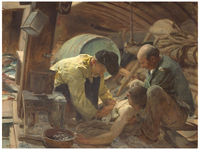
At the heart of these questions is Sorolla’s relationship to nineteenth-century art. In his catalogue essay on Sorolla’s early art, Carlos Navarro delivers a jolt to understandings of the artist and his trajectory. First, Navarro argues, Sorolla was largely an artist of the nineteenth century, not the twentieth. Second, Sorolla aimed to be a cosmopolitan painter, immersed in modern trends of European art, at least as much as a successor to a Spanish lineage traced back through Francisco de Goya and Diego Velázquez. Navarro singles out two points of origin for the myth of a Sorolla who reached maturity as a distinctively Spanish painter in the iconic year of 1901. These are the Marquess of Lozoya’s biography of him and the tendency, at least since Juan Antonio Gaya Nuño’s Ars Hispaniae series, to place him in the history of twentieth-century art. Navarro points out that, of the sixty years of Sorolla’s life, nearly forty belonged to the nineteenth century (47–48). Sorolla was extremely well established nationally and internationally and had produced major paintings well before 1900. His ¡Otra Margarita! (Another Margarite!, 1892; Mildred Lane Kemper Art Museum, St. Louis) secured the first medal by a unanimous vote in the Spanish National Exhibition of 1892, before attaining a medal of honor at the Chicago World’s Columbian Exhibition in 1893 and being sold to the Mayor of St. Louis. The literally dark image, with echoes of French Naturalism, shows a woman, seen from an awkward angle, escorted under arrest in a third-class railway carriage. The intercession of a Royal supporter, the Infanta Paz de Borbón, provided Sorolla with the opportunity to exhibit the work in Germany by 1892. Sorolla’s entry into the Spanish Olympus—as Navarro puts it—occurred when another social painting, his ¡Aún dicen que el pescado es caro! (And They Still Say Fish is Expensive!; fig. 3) was bought by the Spanish state in 1895 to be exhibited in the Prado Museum. That same year, following the Paris Salon, Sorolla attained the singular honor of the French state purchasing a large work for the Luxembourg Museum: La vuelta de la pesca (Return from Fishing, 1894; Musée d’Orsay, Paris), an image of Valencian fishermen bringing in their boat with the aid of oxen. In Sorolla’s mind, this moment was crucial to his career (52). All of this occurred well before the event that is so often assumed to be the launch of his international fame: the triumph of his painting ¡Triste herencia! (Sad Inheritance!, 1899; Fundación Bancaja, Valencia) at the 1900 Universal Exhibition in Paris, and the subsequent award of the French Légion d’Honneur and the Spanish Civil Order of Alfonso XII in 1901. Sad Inheritance!—an image of disabled boys on a beach accompanied by priests—combined two of Sorolla’s interests from the 1890s: the light and color of the Valencian coast and the representation of social issues.
Navarro’s essay, and the varied images displayed in the first section of the exhibition, set the scene for the rest of Sorolla: One Hundred Years of Modernity. Navarro emphasizes that Sorolla did not follow a single linear trajectory to one mature style. Rather, he searched for recognition and prizes to consolidate his career (47–48). If, in 1890, he tried out a fashionable Parisian scene of leisure in his Boulevard de París (Boulevard in Paris, 1890; private collection), with a combination of artificial and natural lighting, two years later he drew on Lawrence Alma-Tadema, Jean-Léon Gérome, and Jules Bastien-Lepage to create a brightly illuminated nude with sharp lines and a limited palette (Después del baño [After the Bath], 1892; Museo Sorolla, Madrid) (48–50). This variation was not merely a matter of youthful experimentation before Sorolla found his way. For the 1895 Paris Salon, Sorolla offered his Parisian viewers not only his shimmering Valencian seaboard scene and athletic seamen but also, contrastingly, the cramped, crowded, dark interior of his Trata de blancas (White Slave Trade, 1894; Museo Sorolla, Madrid) depicting prostitutes transported by train under the watchful eye of a madam (52–53). A year later, the magnificent Cosiendo la vela (Sewing the Sail, 1896; Fondazione Musei Civici di Venezia, Venice)—not displayed in the exhibition, but reproduced in the catalogue—offered dazzling, complex plays of light and shade, a triumph at the 1897 Paris Salon. But Sorolla: One Hundred Years of Modernity starkly reminded viewers that this did not amount to a definitive adoption of a new style, by including the less-well-known Los pimientos (The Peppers, 1903; The Hispanic Society of America, New York)—a dark interior illuminated by a slight shaft of light, as a girl gazes on a bag of the eponymous fruit. For Navarro, all these works underline Sorolla’s concern to be perceived as—and to be—a cosmopolitan artist, as well as to adapt and progress with style throughout his life. Once his contemporary José Jiménez Aranda won a surprise success in Paris with a Naturalist image of a hospital, Sorolla began to echo similar techniques and subject matter in some works, just as he later emulated the ongoing mode for open-air painting in Sewing the Sail. There seems to have been an element of calculation in Sorolla’s choice of styles and subject matter: Navarro comments that the artist carefully planned his strategy for the 1895 Paris Salon with his close friend Pedro Gil (51–52). In her catalogue essay on Sorolla as a modern painter, Consuelo Luca de Tena cites his correspondence, travels, and artistic production as evidence that he sought to be immersed in modern European trends. His reaction to seeing paintings by Adolph Menzel and Bastien-Lepage in Paris in 1885 was decisive in his life choice to be a modern painter (27). By 1900, Sorolla wrote proudly to his wife Clotilde from Paris that he was much more part of the general trend than most of his compatriots (31). This was quite the exaggeration: there were many other artists who were just as immersed in European trends, not least those who spent time between Barcelona and Paris.
The suggestion that Sorolla was a nineteenth-century painter has a resonance beyond the first stages of his career and the opening section of Sorolla: One Hundred Years of Modernity. It reminds us of key reasons why he was later so overlooked and takes us to a central issue of the Sorolla revival. There is really nothing in his post-1900 work that does not relate closely to well established nineteenth-century trends. When his famous coastal paintings do not directly echo the Impressionists—as one of two paintings titled El bote blanco. Jávea (The White Boat. Javea, 1905; private collection) responds in composition and technique to Claude Monet’s paintings of Belle-Île (30)—they seem closely related to other nineteenth-century European painters. The catalogue essays single out, for example, Albert Edelfelt’s Children Playing on the Shore (1884; Ateneum, Helsinki) and Peder Severin Krøyer’s Summer Evening on Skagen Beach (1893; Skagens Museum, Skagen) (29–30). If Sorolla’s Vision of Spain came to be seen as reactionary, that is surely because its images of local, folkloric types from around the country so obviously belong with decades-long traditions of figurative painting and drawing of that very subject matter. In 1865, the Andalusian painter Valeriano Bécquer—brother of the great poet Adolfo Bécquer—was paid by the Spanish government to tour the country depicting customs that were on the verge of dying out. The artistic project is remarkably similar to Sorolla’s in the 1910s. Looked at this way, Sorolla may innovate in the twentieth century, but he does so within the compass of nineteenth-century art. For example, Javier Barón shows how, in his Sombra del Puente de Alcántara (Shadow of the Alcántara Bridge, 1906; private collection), Sorolla emulated Monet’s interest in the reflections of bridges in water but removed the bridge itself from the picture. Even in the 1890s—as the catalogue essays note—he steered clear of the French vanguard and was at best ambivalent toward, and at times hostile to, the Impressionists. He never saw himself as a member of the avant-garde (28, 31–34). Interviewed in 1911 in Chicago, Sorolla was asked who the greatest painters of the last half century were; he paid tribute to James McNeill Whistler and Edgar Degas (both born in 1834), to Menzel, to Jean-François Millet, and especially to Goya (who had died in 1828) (31).
“At a distance of a hundred years from his death,” Luca de Tena reasonably remarks, “we ought to ask where, for us, does his modernity lie” (27). By extension, we might ask, was it possible for a painter in the early twentieth century to make important art by evolving and developing nineteenth-century trends? Conversely, is it any more helpful to expect a dramatic change across Spanish art in 1900 than to proclaim, in similarly epochal fashion, that it was the moment that Sorolla matured? Taken together, the catalogue essays make two large points about Sorolla’s inventiveness that help illuminate these issues. The first is about the relationship of Sorolla, and of several of his European contemporaries, to the claim that art should fundamentally be concerned with the medium of art. The second broadly concerns Sorolla’s preoccupation with joy or happiness (felicidad) during the 1900s and 1910s, the major theme of Carlos Reyero’s recent book-length study of the painter and his life.[3]
For Luca de Tena, Sorolla is one of several artists who came to prominence in the later nineteenth century and for whom attention to the medium of paint, and more broadly to that of light, was to be counterbalanced by a continuing commitment to line, the solidity of matter and of bodies, and, in that sense, to realism. Among these were Anders Zorn and John Singer Sargent, with whom Sorolla associated. Luca de Tena cites Tomàs Lloréns to argue that art historiography has unjustly marginalized the nineteenth-century Naturalist school to which these artists belong. The skewed assumptions against Naturalism prevent us from appreciating Sorolla’s version of modernity and what Luca de Tena sees as the “intensity, the vitality which is manifest in his relationship with ‘the natural,’ the passion of his gaze” (32–34). By extension, in her catalogue essay on the maritime paintings, Cristina Doménech argues that “it is precisely in the capture of movement [of the sea and of beachgoers], influenced no doubt by cinema, that Sorolla attains the most absolute mastery and most advanced modernity” (73). In turn, in his essay on the portraits, Reyero argues that, perhaps under the influence of his friend Arias Anglés, Sorolla stripped the concerns of the genre back to the artist’s emotional connection to the sitter, on the one hand, and, on the other, the aesthetic value of the artist’s work independent of the subject (111). Later critics anachronistically privileged the latter, devaluing Sorolla’s achievement, whereas “in Sorolla’s lifetime, the duality was clear.”[4] On this basis, Reyero reasserts the artistic importance of this dimension of Sorolla’s oeuvre. He emphasizes how Sorolla’s dual preoccupations come together in the painted, transitory instant of an intimate encounter (112–13, 119).
This strategy for revaluing Sorolla’s “modernity” is not without its risks. Situating the painter between two poles—“Naturalism” or “realism” and “vanguard” or “modernity”—can make him seem attractively middlebrow, such that the argument against him is not so much overturned as it is rephrased in positive language. At times, the formulation risks being excessively capacious: a balance between attention to art and evocation of subject matter has been struck by innumerable painters over the centuries, not least Velázquez and Goya. The notion of a duality or balance still assumes that “modernity” can be defined as attention to the medium itself, that a historical “vanguard” championed such visual “modernity” in its own right, and that the position of any modern artist should be understood relative to that interpretation of the “vanguard.” These are a lot of assumptions. It is not a given that the most significant historical divide in Spain in 1900 should be found between that kind of vanguard and other sorts of art. Conceptually, such a definition of modernity is fraught with difficulties. It seeks to draw a sharp distinction, a step change, where there are only differences of degree or kind: how would one specify the correct extent and nature of attention to the medium that separates the artists of modernity from any number of artists interested in aesthetic form and artifacts? Even were such a distinction clearly specified, it is only by a circular argument that it could be considered a more radical, fundamental departure than any other dramatic shift of emphasis in art. The assumption is that signs are the very basis of culture, and that therefore they should be attended to in their own right. Toril Moi has aptly dubbed this assertion “the almost mystical belief in the ‘materiality of the signifier.’”[5] There are many other possible approaches to culture and to art.
Setting aside this vexed notion of “modernity,” it is possible to restate Sorolla’s paths to innovation in ways that recognize the catalogue’s apt emphasis on both visuality and physicality. Take And They Still Say Fish is Expensive! of 1894. The viewing position is from within the small interior of a boat, pressed up close to the injured or dying fisherman and his companions. We are observing from the heart of a scene of working people’s lives as if we were packed in there with them. In other words, we are socially situated observers. But our position of observation is uncomfortable: we are cramped in at an awkward angle with the bodies of the fisherman almost in our faces. To make things all the more unsettling, despite the apparently intimate proximity of our gaze, they look only toward themselves, the face of the central figure is scarcely seen, and the eyes of the fishermen are hardly visible. Their lack of acknowledgement of our gaze is a signal of the scene’s social realism, as if they were not actually being viewed, as if they were not in a painting. But the effect of the cramped viewpoint suggests otherwise: that, despite the lack of acknowledgement, we are somehow there and watching. We become disconcertingly aware of the role of the socially situated observer in painting. That awareness has a sensual physicality to it: the knee, the reclining head, and the tipping wooden hull and its contents are pressed up toward us and lurch into the viewer’s space, as if intimately and physically connecting us to them. The brushstrokes are broad and sensual, forming thick, almost muscular patches of color that give shape to the workers and their surroundings. As the ground tips up toward us, it again disconcerts, taking on elements of a hallucination; the dead fish at the back seeming to float up in the eerie angles of the scene. Like the best Spanish “realist” novelists of the 1880s and 1890s, Sorolla presents sensual, socially situated observation as something on the edge of an unsettling dream—or, in this case, nightmare—infused with unnerving self-awareness.
Arguably, Sorolla sensed that to sustain his exploration of the socially situated observer—and of the artist in that role—he must be careful about how far he distorted physical and human forms and about how much descriptive detail he omitted from his images. Go too far and he might lose the effect of physical, sensual connection to a lived, observed situation. Often, Sorolla’s work exhibits a marked difference in emphasis from some of his Spanish contemporaries in the 1890s and 1900s, for example, the slightly older Darío Regoyos, or the much younger José Gutiérrez Solana. At times, both of these artists favored much more overt spatial disorientation and distortion of human and animal forms influenced by Goya’s caricatures and dark paintings, the great nineteenth-century artist Eugenio Lucas Velázquez, and El Greco, among others. However, as the range of works displayed made clear—and as we shall see later—the distinction between Sorolla and such artists was not and could not be hard and fast.
Viewed sympathetically, Sorolla’s stylistic choices can be understood as a distinct approach to art, not as a halfway house between a purer Naturalism and a putative vanguard. An artistic statement to that effect is to be found in his group portrait, La familia (The Family, 1901; Museo de la Ciudad, Valencia). This painting combines obvious echoes of both Velázquez’s Las Meninas (1656; Prado Museum, Madrid) and Goya’s La familia de Carlos IV (The Family of Carlos IV, 1800–01; Prado Museum, Madrid). In the shallow depth, the artist appears at the back, captured in a mirror and painting the posed figures who stare at us, the boy, in turn, drawing an image of his younger sister. Sorolla signals here his affiliation with art that entails a painterly realism cast in loose brushstrokes that evinces a sophisticated self-awareness of the situation of the observer and that—explicitly or by implication—explores the (imagined or real) encounter in the world between the artist (and viewer) and the subjects of the image. Reyero notes that, while Sorolla drew on the Old Spanish Masters, he did not believe that their works alone held sufficient answers to achieving such things in the present day, nor was he pursuing an exclusive artistic nationalism. Rather, he looked to an international repertoire of portraiture over the centuries: Hans Holbein, Rembrandt van Rijn, Anthony van Dyck, Thomas Gainsborough, Joshua Reynolds, Giovanni Boldini, and Whistler, to name a few (111–12, 116).
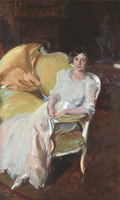
To view the later portraiture alongside the paintings of the 1890s is to see enduring concerns across otherwise very different art, just as there are close parallels between Reyero’s account of this sphere of Sorolla’s activity and the catalogue essays’ discussion of social painting. Sorolla’s 1910 painting of his wife Clotilde sentada en un sofá (Clotilde Sitting on a Sofa, fig. 4) shows his sitter in an elegant shimmering, pearl- and pink-white dress, perched on the edge of a luxuriously upholstered golden sofa. She and it are brightly illuminated against the dark interior backdrop. The portrait, with its delight in the play of light on expensive fabric, its intimacy, and its celebration of personal wealth, seems far removed from the stricken fisherman of And They Still Say Fish Is Expensive!. Yet the image, observed from a vertical diagonal, once more tilts as if to spill into the viewer’s space, and Clotilde’s face—as with so many of Sorolla’s sitters—presses right up to the fore of the painting, as if we might go nose-to-nose with her. The rest of the sofa looms up at an angle, almost as if it were floating, and its broadly painted fabric emerges from behind Clotilde like some bellowing balloon. To the combined effect of intimate, physical connection and of reality-turned-hallucination, Sorolla adds intense, direct eye contact—observer to observer—from a pursed-lipped face that offers few easy emotional cues, a repeated feature of his portraits. The experience of observing one another so closely, that personal connection of sitter to artist and viewer—highlighted in Reyero’s essay—is redolent with uncertain emotional possibility.
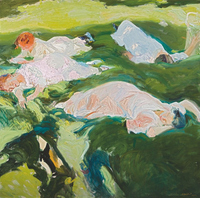
Sorolla’s landscapes, monumental views, and gardens bear out a key claim of the catalogue essays: that he saw himself as an ever-evolving artist and that this is pertinent to how the historiography of modern Spanish art might be rewritten. While they have rarely been a focus of critical attention, Barón remarks, these paintings include some of Sorolla’s most exciting works (161). Among the most remarkable of those displayed was La siesta (The Siesta; fig. 5), painted in the summer of 1911 in the high-class resort town of San Sebastián in the Spanish Basque Country. It shows four women lounging on the grass. We find ourselves gazing from an angle toward the ground, and it presses up toward us: there are no surroundings, no sky, no horizon, just grass and bodies. Even as we observe so directly, we are denied eye contact in this drowsy scene: the women’s eyes are hidden or closed, their facial features blurred even where they are close. There is something of Wonderland about the scene: a summer’s leisurely outing mutating into a dream. The four bodies are arranged at divergent angles, their arms extending or retracted, on thick strokes of green that curve as if the ground itself were undulating, as if the women were floating on green waves or nestled in soft, verdant cushions. To the lower left, the rising and sinking ground breaks into fragmentary, darkening colors. Sorolla’s concern with evolving his artistry has two implications here. First, even as he ventured into divergent kinds of image and genre, he worked through and reworked the concern with embodied, situated observation that had emerged in his paintings of the 1890s. Sorolla was exploring a question—how to evoke a sensual connection to a lived, observed situation—not proffering a definitive answer on what that undertaking should involve. Second, therefore, there was scope for overlap with those Spanish artists who, at the turn of the century, emphasized spatial disorientation, the distortion of physical shapes, and the drastic reduction of descriptive detail, even as Sorolla elsewhere marked his difference from them. Neither Sorolla nor the history of Spanish art are well served by the notion of a hard and fast divide between opposing groups of artists.
The question of Sorolla’s felicidad—his joy or happiness—affected both his art-historical fate and how influential contemporaries situated him relative to other artists. It is relevant both for how we might assess his work now and for what we might make of the current vogue for displaying it. From the early 1900s, Sorolla avoided depicting unpleasant or disturbing subject matter. As Blanca de la Vólgoma notes in her essay on the Vision of Spain panels, his work fell foul not only of those who preferred Picasso and other aggressively experimental artists based in Paris, but of prominent currents in Spanish thought and taste that were hostile to Picasso and his kind. While the influential philosopher and writer Miguel de Unamuno recognized Sorolla as a major painter (and loathed Picasso), he was far more engaged by art that explored the universal and Spanish “tragic sentiment of life.”[6] Unamuno found greater profundities of the artistic spirit in the somber Basque painter Ignacio Zuloaga, who otherwise shared Sorolla’s continuing interest in descriptive observation. By implication, Sorolla was a fine but more superficial painter. (As a revelatory exhibition at the Sorolla Museum showed in 2022, in his earliest years Sorolla had actually produced a lot of work which was either religious or about religion but stopped doing so after Sad Inheritance!, with the exception of an image of St. Joseph commissioned by a Catholic Church in 1912.[7]) De la Vólgoma explains how hostility from the two sides left Sorolla’s work caught in a critical pincer movement. To make things worse, foreign critics saw in his oeuvre merely an addendum to French Impressionism and Naturalism.
It is reasonable to doubt whether artistic significance must entail emotional and intellectual disturbance. But it is not unreasonable to doubt whether pleasant, not overly challenging images merit major exhibitions on the grounds of artistic significance (as opposed to historical interest). The question of Sorolla’s approach to felicidad, and of how that felicidad is presented, thus offers a further angle on the question: is this all rather middlebrow? De la Vólgoma’s account of the Vision of Spain and Doménech’s essay on the seaside paintings make valiant efforts to persuade us otherwise. De la Vólgoma argues that the folkloric figures and settings are not retrograde nostalgia: Sorolla firmly rejected la españolada—kitschy, reductive stereotypes of Spain (think bullfighters and castanets). Rather, the panels respond to contemporaneous debates about Spain’s Regeneration after 1898, when the state lost most of its remaining overseas empire to the United States. While the panels of the Vision—destined for the Hispanic Society in New York—are not all filled with smiles and celebration, they are far removed from tragic meditations on the fate of humanity and of Spain. This is because Sorolla was closer to the thoughts of his leftist, liberal friend Rafael Altamira, who argued for a more optimistic approach to national renewal, drawing on the soul of the state’s diverse localities. Sorolla likewise followed intellectuals associated with the prominent, nonstate educational establishment: the radical Institución Libre de Enseñanza (Free Establishment of Teaching), founded in 1876. De la Vólgoma especially spies the influence of Francisco Giner de los Ríos in Sorolla’s interest for regional ethnography and landscape as the means to recapture lost values discerned in fading customs (146–47). Sorolla was engaged in a struggle to conjure a vision of Spain that incorporates but is not fractured by its diverse components (148, 153). The vertical panels, painted on site in different parts of the metropolitan state, sit alongside an even more massive horizonal depiction of Castile, fourteen meters wide and featuring about a hundred figures. This arrangement echoes how contemporaneous intellectuals explored the dominant historic role of the Castilian state, for ill and good, in relation to the rest of the country (149–51). At the level of the localities and their population, Sorolla wrestles with a parallel dynamic, seeking at once to convey the individuality of his sitters while giving shape to their generalized ethnographic type (150).
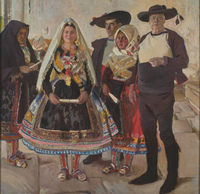
It is worth noting that these were iterations of debates and concerns that went back decades into the nineteenth century and even beyond. A potent reason why Sorolla might press on with nineteenth-century artistic trends is that the new century brought less an epochal break than a revisiting of long-standing preoccupations. In Óscar Vázquez’s recent laconic formulation, 1898 had brought only “the end again.”[8] In Tipos de Lagartera (Types from Lagartera; fig. 6), we find Sorolla innovating once more within well-established artistic modes as he now casts himself—and the viewer—as ethnographic observer. As De la Vólgoma notes, the monumental folk figures now occupy almost the entire canvas (146). Like figures in other Sorolla paintings, they loom up in the shallow space—the ground tilting—pressed right to the fore, putting us nose to nose with the bride. Several of them eyeball us pointedly and at close quarters, as we observe them and they us. If that recalls Sorolla’s portraiture, so do their pursed-lipped faces and the lack of straightforward emotional cues. Our intense encounter with the diverse souls of Spain’s diverse peoples is beyond any simple summary or surmise. They resist controlling scrutiny and mastery, even as we experience an intimate physical, sensual connection to them and their location.
If the visions of Spain pointedly avoid pessimism or tragedy, it is the seaside paintings that most obviously evince Sorolla’s enthusiasm for happiness and health. In the most famous works—with children on the shore and in the sea, and white-clothed beachgoers—Doménech notes the combination of photographic composition and attention to transitory movement and light combined with invocations of the classical cultures of the Mediterranean. Among an array of contextual evidence, she cites Sorolla’s remark in 1915 that Valencia had something Greek about it. For Doménech, Sorolla’s vision of the eastern seaboard is that of a sempiternal idyll of purity evoked in “modern” painting techniques. She recalls the provocative thoughts of Sorolla’s contemporary Leonard D. Abbott, who found in such paintings an incarnation of pagan pantheism. Abbott saw in the components of these bright images the primordial elements of life: water, sunlight, and the body (70–73). Their luminous effects are brought about in strokes of blue, flesh, white, and sand—that liminal substance made by land, dead organic matter, and sea. Doménech associates this sensibility with the tastes of Sorolla’s good friend, the politician, journalist, and popular writer Vicente Blasco Ibáñez, who later came to enjoy similar international fame: the cinematic adaptation of his Cuatro jinetes del apocalipsis (Four Horsemen of the Apocalypse, 1916) is an early Hollywood classic made in 1921. Blasco hoped to make of Valencia a new Athens and had a neoclassical house built on the seafront with Sorolla’s assistance (72). Sorolla’s Corriendo por la playa. Valencia (Running Along the Beach. Valencia, 1908; Museo de Bellas Artes de Asturias, Oviedo) resembles nothing so much as a modernized antique frieze, with three delighted youths in a flat horizontal line to the foreground, in near symmetrical poses, the muscled boy utterly naked, the two girls in simple, flowing Hellenic dresses. Barón observes how Sorolla went so far as to encase paintings in frames featuring Ionic and Doric columns and classical friezes (163).
The neoclassicism of the seaside paintings deserves further investigation to determine how far its implications and resonances really go, how much more there is to their felicidad than evocations of modern and classical elegance and leisure. Blasco Ibáñez had been a Federalist Republican agitator against the reigning constitutional monarchy since the 1890s. In part, his classical tastes were a repudiation of the two-millennia history of the Catholic Church. Similarly, another radical writer, Carmen de Burgos enthused on her journeys to Italy in 1906 and 1910 about the classical nude, which she saw as emblematic of young, happy, free peoples untroubled, in her eyes, by two thousand years of Christianity.[9] Is it too far a stretch to compare such musings with Sorolla’s images (without assuming he shared their entire outlooks)? After all, Blasco’s seaside house fused classicism with elegant, modern beach life. And there are certainly plenty of naked young bodies in Sorolla’s joyful seaside paintings—especially those of boys. (Incidentally, the possibly more disturbing implications of this predilection, perhaps related to an interest in ancient Greece, might merit at least some consideration.) We might recall Sorolla’s disinclination after the early 1900s to evoke a tragic sentiment derived from the Catholic legacy. Such tortured sensibilities co-existed with revived European interest in Dionysos—god of wild, drunken passion, rival of Apollo—following Friedrich Nietzsche’s Birth of Tragedy (1872).
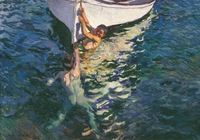
Is it at all possible that Sorolla, consciously or otherwise, chose to push back and pursue a deliberately Apollonian aesthetic? Often depicted as a muscular naked young man, Apollo was—after all—the god of light, knowledge, and form. He was the great illuminator. Among the seaside paintings on display, were the other of two works entitled El bote blanco. Jávea (The White Boat. Jávea; fig. 7), undertaken on the coast of Alicante. Here, the toned, nude body of the young male in the foreground melts into or fuses with the luminous green-blue in which he floats, as if light, water, and flesh were one in him. As so often with Sorolla’s paintings, a sensual physical encounter with the subject matter is pressed upon us. We face the sea, the boat, and the bodies head-on as they loom into our space; we have no sight of the horizon or the sky, just as in The Siesta we stare only at the bodies and the grass. In recent reflections on such images of the sea, cited in the catalogue, the contemporary Valencian writer Manuel Vicent comments that Sorolla’s “light has an inexhaustible intensity that emerges as the firmest foundation of matter.”[10] The bright water to the top right gives us an indication of what Vicent means, with its thick, sumptuous brushwork. Perhaps here, where sensuality, physicality, and illumination (metaphorical and literal) are one and the same, Sorolla spies a reconnection to some ancient, embodied knowledge. In Spanish as in English to illuminate is to render visible; to be illuminated is to be made visible, to be lit up, and to be enlightened. In this illumination, we see and we know what it is to experience observation in the world. But the joyous clarity is not reductive simplicity. Playfully, Sorolla once more toys with our gaze: we may look closely at the boy in the foreground, but we see only the back of his head; meanwhile, his companion on the boat gazes out, but his eyes are obscured in the light. In our embodied perception, the world we inhabit has hallucinatory qualities: a boy appears to melt in the water. And from where, we might wonder, could we be watching this scene?
What, then, are we to make of Sorolla following the centenary of his death? It might seem that we should shed every doubt about him, about the way he continues nineteenth-century trends well into the twentieth, about the way his later art evades tragedy’s perturbations. But if I have returned to such concerns once and again in this review, it is not because they serve as a convenient straw person, but because there is a case to be considered, even if it must be reformulated. Undoubtedly, Sorolla is a far more inventive, thoughtful, and varied artist than he was, for a long time, acknowledged to be. A later art historiography, built on a particular interpretation of the European vanguard, set unreasonable terms by which to judge his work and that of many other artists. Arguably, even the preoccupation with artistic “modernity,” and whether any given artist does or does not belong to it, proves unhelpful. But it is worth pondering again both the question of Sorolla’s felicidad and the question of where he stands relative to Picasso’s and others’ bold innovations in the early twentieth century. Sorolla was a thoughtful, inventive painter. So too were many other talented artists active in Spanish-held territories through these years, who also worked closely in relation to a variety of nineteenth-century trends, Gutiérrez Solana, Regoyos, and Zuloaga among them. Many of them did not buy into Sorolla’s felicidad and some of their works are not nearly as easy on the viewer’s eye. It is not unreasonable to wonder whether—centenary or not—Sorolla is getting relatively more airtime and prominence than some of his Spanish contemporaries because his work is more comforting than theirs, and whether that preference is lent respectability by his visual sophistication. It is one thing to revive Apollonian art, quite another to privilege it.
Questions may—and have been—raised about the older preference for, say, Picasso’s Cubism over Sorolla’s approach on the grounds that the former more truly addresses the medium of painting itself. But even if we set aside that modernist framework, we can ask simply: what substantial vision does an artist like Sorolla have for what painting can do, for what art can be? As we have seen, there are interesting answers to be had to that question. There is not a stark abyss between the significance of the supposed true apostles of modernity and that of the many other talented artists of the 1890s and early 1900s in Spain. But, by the same token, we may ask: does Sorolla quite so substantially reimagine what art could be as does (say) Picasso? A glance across from Picasso’s Cubist experiments, or his earlier Demoiselles D’Avignon (1907; Museum of Modern Art, New York), or his own reimaginings of Hellenic antiquity, such as Boy Leading a Horse (1906; Museum of Modern Art, New York), to Sorolla’s oeuvre suggests the answer is: very likely not. We do not need the modernist historiographical framework, or the old cult of the vanguard, to explain how Picasso—for all his well-known faults—was, on balance, a more significant artist. Nor do we need the argument that people like Sorolla were more wed to the nineteenth century and, for that reason, trapped in a limited compass of art. In fact, like many early twentieth-century experimentalists born in Spain, whether writers or visual artists, Picasso continually revisited important aspects of nineteenth-century visual culture. To take just a couple of evident examples: Picasso’s Family of Saltimbanques (1905; National Gallery of Art, Washington) echoes Manet’s The Old Musician (1862; National Gallery of Art, Washington); his Massacre in Korea (1951; Musée National Picasso, Paris) takes up the baton of Goya’s El 3 de mayo de 1808 (Third of May 1808, 1814; Prado Museum, Madrid) and Manet’s Execution of the Emperor Maximilian (1868–69; Kunsthalle, Mannheim). Picasso’s very ethos of reconstructing and reworking the legacies of historic art and styles was an extension of nineteenth-century Spanish sensibilities. It is just that Picasso was even more creative in how he reinvented these things.
None of this should detract from a wonderful culminating exhibition of Sorolla’s centenary and an excellent catalogue filled with astute, informed essays. On the contrary, the success offers immense encouragement to those who re-think the history of art in Spain and the terms in which we judge it. The curators and scholars involved in the exhibition—and their predecessors in the Sorolla revival—have shown that something important and special can be achieved: a Spanish artist who became prominent in the nineteenth century, and was once unjustly neglected, can be widely exhibited and appreciated again. It is only natural to hope that Sorolla’s return opens the door to others. For now, to engage with such a rich selection of his art, and with such thought-provoking essays was, well, a joy.
Notes
[1] See Andrew Ginger, Exhibition review of Arte y transformaciones sociales en España 1885–1910 (Art and Social Transformations in Spain 1885–1910), Nineteenth-Century Art Worldwide 24, no. 1 (Spring 2025), https://doi.org/10.29411/ncaw.2025.24.1.19.
[2] Modernity here may be taken as meaning “the state of being modernist.” The usage conflates the conditions giving rise to the modern with modes of expression that respond to being modern, presumably because the conditions include a concern with modes of representation. For comparable usage, see for example David Peters Corbett’s commentary on “the conventional identification of modernity in the visual with the emergence of formal modernism in French painting,” and his claim that “the definition of modernity can be rethought by attending to the history of English painting,” The World in Paint: Modern Art and Visuality in England, 1848–1914 (Penn State University Press, 2004), 8.
[3] Carlos Reyero, Sorolla; o, La pintura de la felicidad (Cátedra, 2023).
[4] En vida de Sorolla, la dualidad estaba clara.
[5] Toril Moi, Revolution of the Ordinary: Literary Studies After Wittgenstein, Austin, and Cavell (Chicago University Press, 2017), 116.
[6] This is the title of one of Unamuno’s most influential works, El sentimiento trágico de la vida (1912). The work is available in English, notably in the translation by Unamuno’s British friend J. E. C. Flitch. A recent republication of this translation is available as The Tragic Sense of Life (Adansonia Publishing, 2018).
[7] Luis Alberto Pérez Velarde, ed., Sorolla: Tormento y devoción (Ediciones El Viso, 2021), 22.
[8] Oscar Vázquez, The End Again: Degeneration and Visual Culture in Modern Spain (Penn State University Press, 2016).
[9] Mirella Romero Recio, “La Antigüedad vista por dos escritores anticlericales: Carmen de Burgos y Vicente Blasco Ibáñez,” Veleia 36 (2019): 73–94.
[10] La luz tiene una intensidad inabarcable que se constituye en el más firme fundamento de la materia (24).