Esperpento: Arte popular y revolución estética (Esperpento: Popular Art and Aesthetic Revolution)
Reviewed by Andrew GingerAndrew Ginger
Northeastern University
Email the author: a.ginger[at]northeastern.edu
Citation: Andrew Ginger, exhibition review of Esperpento: Arte popular y revolución estética (Esperpento: Popular Art and Aesthetic Revolution), Nineteenth-Century Art Worldwide 24, no. 3 (Autumn 2025), https://doi.org/10.29411/ncaw.2025.24.3.21.
This work is licensed under a Creative Commons Attribution-NonCommercial 4.0 International License  unless otherwise noted.
Your browser will either open the file, download it to a folder, or display a dialog with options.
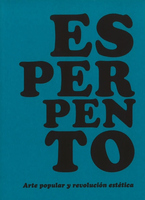
Esperpento: Arte popular y revolución estética (Esperpento: Popular Art and Aesthetic Revolution)
Museo Reina Sofía, Madrid
October 9, 2024–March 10, 2025
Accompanying book:
Pablo Allepuz, Rafael García, Germán Labrador, Beatriz Martínez Hijazo, José A. Sánchez, and Teresa Velázquez, eds.,
Esperpento: Arte popular y revolución estética.
368 pp.; 129 color illus.
€45.00 (softcover)
ISBN: 9788480266635
Esperpento is an important term in discussions of Modernism—its antecedents, and its successors—in the Spanish-speaking world. All but untranslatable, the word evokes a kind of grotesque estrangement. Though it is closely associated with the remarkable author, Ramón del Valle-Inclán, it was coined earlier in the nineteenth century and has been used both in everyday and artistic language with respect to things other than Valle’s literary works.[1] The association with Valle-Inclán arose because he used the term explicitly to describe some of his most famous creations, notably the play Bohemian Lights: Esperpento (Luces de Bohemia: Esperpento, 1920–24), and three dramas collected as Carnival Tuesday: Esperpentos (Martes de carnaval: Esperpentos, 1935), which included the earlier The Horns of Don Friolera: Esperpento (Los cuernos de Don Friolera: Esperpento, 1921–25).[2] In the course of these plays, some characters make statements about aesthetics that either directly reference or may be taken to reference the notion of an Esperpento. In both Bohemian Lights and The Horns of Don Friolera, those characters underline the connection to nineteenth-century art by invoking the oeuvre of Francisco de Goya. Born in Galicia in 1866, Valle was a child when the last of Spain’s successful nineteenth-century revolutions took place in 1868, overthrowing the Bourbon constitutional monarchy and spawning a succession of unstable regimes, among them a cantonalist republic. He became something of a visual icon, with his vast, thin beard and his missing arm, amputated after a punch-up in a café in 1899. Valle’s eventful adult life largely corresponds to the Restoration period of 1875 to 1931, first with the Bourbon monarchs presiding over a corrupt, managed democracy in which two institutional parties alternated in power and then, as this system fell victim to domestic and colonial crises, the dictatorship of General Miguel Primo de Rivera from 1923 to 1930. During the 1920s, Valle spent time in Mexico, a country that had embarked on a new revolutionary trajectory. He lived through the founding of the Spanish Second Republic in 1931, but died in January 1936, spared the outbreak of the violent Civil War later that year.
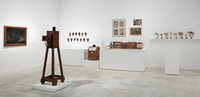
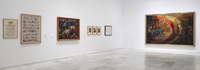
The Museo Reina Sofía’s exhibition Esperpento: Popular Art and Aesthetic Revolution (figs. 1, 2) marked the centenary year of Bohemian Lights, the first work to use Esperpento in its title. The anniversary year likewise saw a highly successful production of that play at the Teatro Español in Madrid. The curators of Esperpento set themselves a bold agenda: to explore the notion of esperpento through the visual arts, to display its genealogy from the nineteenth century onward, and to demonstrate its resonance and applicability to works well beyond those of Valle-Inclán himself. The gambit was that the term esperpento would open discussions and provide insights beyond the notion’s original and historical meanings. By implication, it should sit alongside terms from other languages such as the Russian ostranenie (defamiliarization) or the German Verfremdungseffekt (distantiation). The first section—“Before the Esperpento”—displayed a range of nineteenth-century visual culture, from oils by major painters—such as Leonardo Alenza and Eugenio Lucas Velázquez—to caricatures and optical devices. The subsequent sections were each linked to a major aspect of Valle-Inclán’s work, presented as a guide to a range of artwork. “Vision of Midnight” drew on Valle’s account of World War I battlefields in Midnight: Stellar Vision of a Moment of War (Medianoche: Visión estelar de un momento de guerra, 1917), as well as his oneiric aesthetic manifesto The Magic Lantern: Spiritual Exercises (La lámpara maravillosa: Ejercicios espirituales, 1916). “Puppet Stages” was inspired by Valle’s growing interest in puppet theater during the 1920s. “Carnival Tuesday” and “Bohemian Lights” looked to the resonances and genealogies of those eponymous creations. “Altarpieces” picked up on Valle’s several evocations of religion, including his great play Divine Words (Divinas palabras, 1919), which culminates with a parodic version of Bosch’s The Haywain (1512–15; Prado Museum, Madrid). From here, we turned to “Tyrant,” under the shadow of Valle’s novel of Latin American dictatorship The Tyrant Banderas (Tirano Banderas, 1926), conceived during his time in Mexico. Finally, “The Iberian Ring” was inspired by Valle’s late, incomplete historical novel cycle of the same name, El ruedo ibérico (1927–32); here, ring refers both to the bullring and to historical repetition.[3]
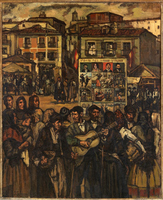
The displays were interspersed with reminders of the nineteenth-century genealogy of esperpento and the enduring legacy of nineteenth-century visual culture. The section “Carnival Tuesday” included a set of nineteenth-century images that accompanied one of the popular romances de ciego (blindman’s ballads). The cartoon-like sequence (n.d.; La Mirada Ingenua Foundation, Huesca) appears to show a married woman joining her lover in murdering her husband and children before being apprehended and executed. We were able to see how a very similar work appears at the heart of the scene in El cartel del crimen (The Crime Poster; fig. 3) by the goyesque painter José Gutiérrez Solana. “Altarpieces” featured a dream-like anonymous votive painting from the nineteenth century (n.d.; La Mirada Ingenua Foundation, Huesca)—a vision of the Virgin and Child protecting a Spanish boat—notable for a lurching, curving perspective, improbable angles, and outsized figures and objects. In the final section, we came to one of the possible beginnings of esperpento: a print from Goya’s Tauromaquia (published 1816).
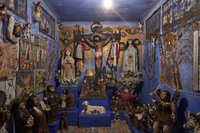
The curatorship was bold in its treatment of chronology and geography and in its collection of such diverse objects under the heading of a Spanish aesthetic term. The organizers thus put into practice their belief that esperpento has a wide explanatory power and can be used to describe a major, distinctive lineage of visual art. There were a range of countries represented; the exhibition included, for example, British painter Paul Nash’s war painting After the Battle (1918; Imperial War Museums, London); photographs of productions from the Italian puppet group Teatro dei Piccoli in the 1920s; and Mexican painter José Clemente Orozco’s satire of dictatorship and sycophancy, Pomada y perfume (Pomade and Perfume, 1946; Museo de Arte Carrillo Gil, Mexico City). In returning repeatedly to the nineteenth century, the exhibition cut across the conventional chronological divide between the Prado Museum (historical) and the Reina Sofía (modern), which is messianically—and unhelpfully—demarcated by Pablo Picasso’s date of birth (1881). From the nineteenth century, we traveled as far forward as 2024 to photographs of work by the collective Lagartijas al sol—inspired by Tyrant Banderas—showing a life-size doll being abused and dismembered: No tengo por qué seguir soñando con los cadáveres que he visto (There’s no reason I should go on dreaming of the corpses I have seen, 2024).[4] Through the halls of the display, the visitor encountered carnival masks, puppets, outsider-art installations (from Tía Sandalia’s museum of religious works in Villacañas, Spain; fig. 4), film stills, posters, printed caricatures, drawings, and photographs. Amid all this, the visitor also found occasional reminders of Valle-Inclán’s own visual effects, notably images from productions of his plays, as if these were best explored in dialogue with other art across time and place. (Many of Valle’s plays could not be performed in his lifetime, or for decades later, due to a combination of censorship and the technical limitations of theaters.)
The accompanying printed volume shares in the exhibition’s spirit of daring. It has some of the elements of a classic catalogue—reproductions of many of the artworks displayed and accompanying text and analysis—but it is also an object in its own right. The section that most resembles a catalogue ends with a QR code that takes the reader to a sound mosaic by Maricel Álvarez (2024) based on Valle’s Fair Poster (Cartel de Ferias, 1925). In the latter part of the tome, we come to a series of commissioned texts, each printed on distinctive colored paper with its own typeface. These exemplify the assertion that esperpento is a dynamic, expansive notion: it continues to spawn creativity and reflection. Like the curatorship of the exhibition, they present esperpento as an ongoing practice, whether that is the practice of exploring its implications by juxtaposing objects or the practice of unfurling its possibilities through thought and creative writing. First up, in pink, we have the Spanish thinker and writer Santiago Alba Rico’s essay “Tragedy, Farce, Destiny: The Esperpento” (“Tragedia, farsa, destino: El esperpento”). Then, on much smaller pages and in yellow, we find the Galician writer and director Esther F. Carrodeguas’s puppet-like script for Pealed Melon: Non-Infantile Farce for Box of Dolls (Melón pelado: Farsa no infantil para Caja de Muñecas). After this, the pages resume their normal size and turn dark brown, but now they are printed as if on an old typewriter, for the Mexican novelist Mario Bellatin’s prose sequence “Little Princes of Esperpentos” (“Principitos de esperpentos”). Finally, we come to the mauve pages of “Pharmacy: Refugium Peccatorum” (“La Farmacia: Refugium Peccatorum”) by the art historian and practicing artist Gloria G. Durán. This work narrates the role of women in the Farmacia café, founded in the gardens of Madrid’s Buen Retiro in 1875, and frequented by intellectuals and artists.
For the purposes of Nineteenth-Century Art Worldwide, I will dwell on two closely related aspects of the exhibition and book. The first is how we might perceive the nineteenth century—not least the Spanish nineteenth century—if we foreground its role in esperpento. At stake here is how Spanish nineteenth-century art is curated, presented, and appreciated, and how it connects to other art, not least in twentieth-century Modernism and beyond. The second issue is what we are doing when we use a term such as esperpento to connect the art of one place and time to that of another. At stake here is an important aspect of art-historical and curatorial practice.
By foregrounding Lucas and Alenza, Esperpento reasserted a vibrant connection from mid-nineteenth-century Spanish art to High Modernist experimentation in one direction and back to Goya’s grotesques in the other. This corridor of innovation—so to speak—used to be central to the presentation of nineteenth-century Spanish art and its relationship to the Modernist period. Recently, in some scholarly quarters, the balance has tipped toward proportionately greater coverage of academic art, such as history paintings, society portraiture, and the kinds of moderately innovative landscapes that were often sanctioned by the academy in the second half of the century. Some treatments of other major mid-century artists—Eduardo Rosales and Mariano Fortuny—now underplay works that were previously deemed proto-Modernist. The former’s near-abstract figurations in Ofelia (Ophelia, ca. 1871; Prado Museum, Madrid) are a case in point.
There is a potential explanation for this shift: a conflation between two distinct considerations in art history. Broadly speaking, Lucas—and, by extension, Alenza as his immediate predecessor—were previously coopted into a story about art history’s progress from Goya toward High Modernism. Art was valued to the extent that it was akin to or led to French Impressionism and then to Cubism, or even to later abstract art. This was a story of progress toward a recognition that the true subject of painting is the medium of paint itself, which the Impressionists’ experiments were thought to demonstrate. For example, the influential art historian José Camón Aznar settled on Lucas’s construction of paintings out of fragments of colorful impasto and declared this to be “instantism,” which he saw as an early Spanish equivalent of French Impressionism.[5] Many reasonable questions have been raised about such an approach to art history. Even leaving aside whether the above interpretation of Impressionism is correct, the Modernist story of nineteenth-century art tended to undervalue other kinds of painting, including academic history painting. It shoehorned some artists into the mold of the Impressionists despite clear evidence that their approach to art was very different from them. And it left contemporaneous artistic innovations beyond nineteenth-century France—the Pre-Raphaelites or the machiaiolli for example—in an unenviable catch-22. If they were different from Impressionism or proto-Impressionism, they were failures, and if they were the same, they added nothing. It followed from these objections that some revaluations of nineteenth-century art were in order, including for some art previously dismissed as conventional or academic, such as Paul Delaroche’s history paintings. It followed too that we might question some of the grounds on which an artist like Lucas was celebrated: for example, that his “instantism” was a sort of proto-Impressionism and thus led toward High Modernism.[6]
It is here that the conflation may arise. Just because specific painters or artworks were once celebrated in this Modernist story, it does not follow that our appreciation for them should decline once the Modernist story is removed. Just because a few academic painters were once deemed less significant than they ought to have been, it does not follow that they all were. The removal of the Modernist framework risks, unintentionally, giving prominence to more comforting visions of nineteenth-century art than were offered by the old Modernist framework. By this I mean, art that has—or appears to have—a less disrupted surface, or that deals with less sordid topics, or that presents us with putatively attractive people in attractive clothing, or that seems to tell a compelling story or some combination of these things. Downplaying Lucas and Alenza in favor of more academic art, even when combined with selections from Rosales and Fortuny, unintentionally risks that comforting effect, despite the latter two’s significance. The effect is reinforced when some of Rosales’s and Fortuny’s works that were previously deemed proto-Modernist are also downplayed. Fortuny can be seen as attractively colorful, delicate, and bright; Rosales paints gently in his portraits and sometimes depicts momentous historical tales.
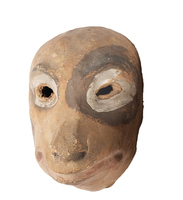
The exhibition drew our attention back to the unsettling visual world of Lucas and Alenza and to why it matters. The corresponding section of the accompanying book emphasized three relevant characteristics of esperpento. First, there is estrangement and distancing relative to the subject matter. Second, there is systematic distortion of the image. Third, both those aspects crystallize grotesque social and political situations and behavior (20–21). Instead of emotional cues that might lead us to empathize with what we see, the Lucas paintings displayed in Esperpento offered mask-like visages and blurred and erased faces and bodies. Some of the characters in the mysterious religious scene Sermón de las máscaras (Sermon of the Masks; fig. 5) are literally wearing eye-masks as if they were attending a ball, thus echoing both societal fashion and Goya’s Caprice 6 (“Nadie se conoce,” either “No-one knows themself” or “No-one knows anyone else,” 1797–98). More often in Lucas, there is so little detail—perhaps no more than black marks for eyes, nose, and mouth—that the faces resemble the eerie, blank, twisted features of the nineteenth-century Spanish carnival masks also on display in the exhibition (fig. 6). We see that effect not only in Sermon of the Masks but in Capricho alegórico: La avaricia (Allegorical Caprice: Avarice; fig. 7) and in the violent clash of pilgrims seen in El rosario de la aurora (Dawn Procession, ca. 1860; Carmen Thyssen Museum, Malaga). (The title translated literally to “The Rosary of the Dawn,” an expression that also means to come to blows because of the frequent fights at such dawn events.)[7] Sometimes, the facial features are all but erased, as in the wider mass of people in the latter painting. In the Episodio de la Revolución de 1854 en la Puerta del Sol (Episode of the 1854 Revolution in the Puerta del Sol, before 1870; Madrid History Museum, Madrid) that technique is combined with a diminution of the revolutionaries into tiny, doll-like creatures dwarfed by their surroundings, as if to undermine the emotional resonance of their historic deeds.[8] The puppet and mask-like images evoke a society that is acting out, that has become physically indistinguishable from grotesque performance.
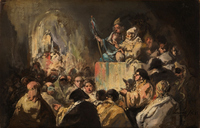
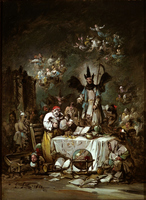
As the Spanish satirist Mariano José de Larra declared in the title of a famous article of 1833: “The whole world is a masquerade. It’s carnival all-year round.”[9] In some paintings—such as Mascarda (Masquerade, ca. 1860; Private collection), not on display in Esperpento—Lucas puts in playful, cameo appearances as a carnivalesque figure. Often, what is performed on Lucas’s canvases is a pastiche of historical and contemporaneous imagery. In the Allegorical Caprice, we find—among other citations—a monk with testicular moneybags adapted from Goya’s Caprice 30 (“¿Por qué esconderlos?,” “Why Hide Them?,” 1797–98) near a ruined building from Romantic cliché. There are soaring but distorted figures who combine echoes of Catholic church ceilings—a floating woman, for example, in a typical pose of exaltation—with references to sinister airborne beings from the Caprices. (The two figures to the top left might be distorted reworkings of those in number 74 “¡No grites tonta!” [“Don’t Scream Foolish Girl!,” 1797–98). In Episode from the Revolution, a moonlit sky out of some Gothic landscape hangs over a celebratory political scene with small figures of a kind familiar from the fashionable genre historique (historic genre) but, here, shrunken. Sermon of the Masks proffers a reworked version of the Inquisition preacher from Goya’s Caprice 23 (“Aquellos polvos,” “That Dust,” an expression referring to the consequences of misdeeds,[10] 1797–98) along with a blurred version of the picturesque Catholic church scenes made fashionable by the Romantic artist Genaro Pérez Villaamil (who had been Lucas’s mentor).[11]
In such paintings, we are plunged into visual history: into a radically historicized vision of art and identity. The society we see is nothing but the combination and manipulation of existing modes of representation, played out as a masquerade. If it is mashed together out of pictures, it is, likewise, made manifestly out of paint. Often, the distorted figures and objects—like those of the Sermon of the Masks or Episode of the Revolution—are visibly constituted of irregular lumps of impasto. At times, the image literally flows in and out of a great, abstract wash of blurred paint such as we find at the heart of Dawn Procession between the bulk of the two fighting factions. The streaked pulpit in Sermon of the Masks evokes a spillage of paint. In each painting, Lucas evokes customs and events; the Allegorical Caprice likely alludes to concerns about corruption and self-enrichment, a live issue as speculative finance poured into Spain’s first railways during the early 1850s. The sketchy technique might suggest the forceful, immediate, first impression of such customs and events, as described in contemporary art manuals. But the fragmentation and blurring goes beyond anything such manuals permit even for sketchy works, leaving us with images that disintegrate and even dissolve. Just as the masquerade inhibits emotional identification, so the paintwork militates against coherent understanding of what we are seeing. In turn, the accumulations of diverse pastiches, often from distinct contexts—caricatured clergy and picturesque architecture, for example—present us with enigmas, leaving us unable to grasp the precise sense of the paintings or the apparent meaning of history’s masquerade. Characteristically for Lucas, several faces in Sermon of the Masks stare gnomically, quizzically back at the viewer’s gaze: the experience of viewing is rendered unsettling.
Lucas draws not just from Goya—whose techniques he often further exaggerates, blurs, fragments, and distorts—but from his more immediate predecessor Alenza. Esperpento displayed one of Alenza’s most obviously grotesque creations, La crítica (Criticism, 1835–40; National Museum of Romanticism, Madrid), which dwells on the act of depicting Spanish society and of viewing such images. The work evokes the practice of painting for public success, alongside public critical writing—depicted as a toothy, diabolic figure clutching the easel—and a widening of audiences, evoked by a small group of visitors to the back. The caricatured artist—turned into a monkey, a mere mimic—deploys an absurdly huge brush to depict iconic folk customs—in every sense, he paints de brocha gorda (literally, “with a broadbrush,” or roughly). In the studio, there are two models in stereotypical lower-class costumes and a donkey, to whom the artist has turned his back.[12] La crítica presents the production and consumption of a supposed national imaginary as an unhappy, risible circle from models and makers to audiences and commentators and back again. This grotesquery is all viewed through the lens of Alenza’s own vision for art. Alenza favors a painterly realism—occasionally, as here, augmented by an element of fantasy—in which an easily recognizable, rough-and-ready scene of Spanish life is cast in broad, rough brushwork (or, in his drawings, with squiggles and patches of penwork). The effect is to balance a degree of sympathetic identification of social behavior with evident distortion, and thus distance. Like Larra’s writing, painting is envisaged as critical observation, undertaken from a position of both engagement and estrangement. Unsentimentally, it explores the image people have, and present, of themselves and of their mores.
The curators placed great emphasis on esperpento in popular visual culture, as the subtitle to the exhibition indicates. In reasserting the importance of such objects, the accompanying book suggests—with forgivable exaggeration—that the conventional nineteenth-century fine arts never attained such heights of radicalism even in the unsettling images of Lucas and Alenza (23). Several prints by the mid-nineteenth-century caricaturist Francisco Ortego—a very welcome inclusion here—shared in the critical exploration of social imaginaries and visuality exemplified by Lucas and Aleza. Ortego’s gentler grotesque El tuti-li-mundi (The Tutilimundi, 1861; University of Cantabria Museum Collection, Santander) shows two men staring into the eponymous machine, as other people mill around in Madrid’s Plaza Mayor, either observing them or gathering in groups nearby and looking at each other. Playfully, Ortego not only denies us sight of what is inside the machine—the object of visual fascination—but has us look head-on at the rear ends of both viewers rather than at their hidden faces. A soldier’s gaze seems to settle on one of the backsides. (The posture and orientation are strikingly close to Goya’s much earlier aquatint Tutilimundi from the 1820s; with more ribald playfulness, Goya includes a man who stares gleefully at the backside of one of the onlookers through a pair of split trousers.) With humorous critical distance, Ortego’s image evokes how visual media, and what we do and do not desire to see displayed, play a constitutive but complex role in national customs and social behavior. That includes our own behavior as viewers of prints like this one: such images were a lure for nineteenth-century consumers, an object of visual desire.[13] Here, the mass-reproduced visual technology is showing us local customs, outfits, and behaviors in an iconic square in Madrid, beneath the gaze of a monumental image of past national power, the equestrian statue of King Felipe III. The statue had been transferred to the Plaza Mayor by royal order in 1848, but no one in the print is looking at it.
In the catalogue, the curators make the powerful observation that the popular visual arts “were already putting into effect revolutionary strategies of representation—deformed or deforming—that the history of canonical artistic modernity has attributed to the vanguard movements of the late nineteenth century” (24).[14] Estrangement arises from such visual effects: the world as we usually see it twists, distorts, and mutates. Rather than evoking perspectival realism, optical tricks and devices cast it aside (24, 26). The curators especially draw attention to the transmutation of human bodies. An anamorphic image by the Paris-based Walter brothers (1869; Museum of Cinema, Gerona) offers us the stretched-out torso and head of the Imperial Prince Louis Eugène Napoleon Bonaparte above a red circle. The catalogue emphasizes the visceral, bodily nature of these distortions and metamorphoses, sometimes vicious, sometimes scatological (26). In a perplexing mid-nineteenth-century magic-lantern image—Panadero y demonio (Baker and Demon, 1850–80; Museum of Cinema, Gerona)—a smiling humanoid demon, with a vast horned head, is led along by his extremely long, phallic nose. The colorfully dressed human accompanying him carries a collection of nose-like—or phallus-like—baguettes in a basket. Much space in the exhibition was given to the extraordinary, gaudily colored, satirical grotesques in widespread circulation during the last quarter of the century. Pride of place was taken by those from the Republican, anti-clerical journal The Mutiny (El Motín), founded in 1881 and published during (and in opposition to) the Spanish Restoration. In one such image—Ideas que tienen en las sacristísas de los redactores de EL MOTÍN (Ideas Held in Sacristies about the Editors of the THE MUTINY, 1883; National Reina Sofía Museum, Madrid)—two journalists, shown as scruffily dressed giants, dine greedily on priests’ corpses. The latter have been transformed into a plate of bloody stew—the morsel of a head about to be munched down—into a rare roast sliced for eating, into choice cuts hung from hooks, and even into bottle stoppers for the wine. The curators emphasized the crossing of boundaries among the human, vegetable, and animal kingdoms in many such grotesques (26–27). A self-explanatory instance was El Motín’s large caricature, Los loros del gobierno charlando, y los gansos de la mayoría aplaudiendo (The Parrots of the Government Chatting, and the Geese of the Majority Applauding, 1886; National Library of Spain, Madrid) showing an animalized theater performance and its public. Similarly, in a matchbox illustration of the early 1870s, the fallen Bonapartist Empress Eugenia finds herself transformed into a wiry bird with a gigantic human head (fig. 8).
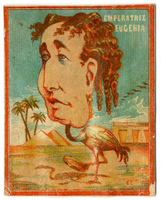
Just as notable as the mutation among species is the use of shallow perspective in The Parrots of the Government to the point of almost total flattening, an aspect of many of El Motín’s caricatures. The transmuted or tortured bodies are pressed physically up against the viewer, collapsing space. Stark, two-dimensional geometries shape the weird creatures before us, whether by parading them in static lines—as with the parrots—or arranging their body parts in collections of diagonals, as with the geese, giants, and remaining bodies of priests. Even as the viewer has an intense, close-up encounter with the contemporary political world, they experience its transmutation into sets of lines and angles as much as into other species, rendering it at once flesh and not.[15] Through satirical vision, human realities transfigure into dehumanized shapes. The effect is oneiric even as it is estranging. A hallucinatory version of political reality is pressed upon us, with unsettling resonances, a dreamworld beyond the direct political message. In this visual world, geese pay to see parrots who talk politics and stand around with their necks and beaks at awkward angles; bottle stoppers take their round shapes from priests’ heads. As in Lucas’s masquerades, or in the magic-lantern vision of a demon’s nose, the estrangement resists reductive interpretation.
By prefacing and interlacing the wider exhibition with such images, Esperpento boldly reconnected Spanish nineteenth-century visual culture to twentieth- and twenty-first century artistic experimentation. The effect of juxtaposing images across these centuries was to show the dynamic, ever-reinvented relationship between them. The nineteenth century appeared, not as a closed book of techniques and concepts to be imitated or left behind, but as a continuing, challenging stimulant for later artists, curators, and audiences who would seek to imagine what art and visuality could be. The Crime Poster (see fig. 3) by Gutiérrez Solana is a powerful case in point. The somewhat sordid street scene, done in a style that combines painterly realism with the outright grotesque, recalls Alenza’s work. The shallow space with lined-up figures, as if stacked geometrically next to each other, echoes the oneiric dehumanization of the satirical cartoons. The irregular impasto facture and mask-like faces draw on Lucas’s reinvigoration of goyesque techniques. The obvious iconographic citations carry on Lucas’s art-historical masquerades and the self-conscious use of visual media in nineteenth-century prints. Alongside all the above allusions, we have the outsized crime-narrative poster flanked by national symbols (the Spanish flag) and an urban reworking of Goya’s tapestry cartoon, El ciego de la guitarra (The Guitar-Playing Blindman, 1778; Prado Museum, Madrid). The lined-up humans with distorted bodies to the fore, pressing up against us in the shallow space, call to mind El Greco’s sixteenth-century masterpiece El entierro del señor de Orgaz (The Burial of the Lord of Orgaz, 1585; Church of Saint Tome, Toledo). But, set side by side with any of these, Gutiérrez Solana’s painting looks utterly different and explores provocative, new artistic possibilities. The characteristic lugubrious, muddy tones that absorb the entire painting evoke a deathly viewpoint, as if the light has been sucked from the world. It is as if we were seeing the world through the shadows of its mortality and as if these people and this place were captured in their literal and metaphorical death and dying. The roughly hewn, vague features of the faces have the outline and bone-like simplification of the nineteenth-century carnival masks that the artist collected (see fig. 6). There is an air of the undead about them. Like the faces, the composition is organized as if out of a series of similarly roughly hewn, near-geometrical blocks stacked together, some eerie conglomerate form into which living reality has been transfigured. The vision is physically pressed upon us in the shallow depth, as if some terrible order were revealed in the world’s mortality, some cadaverous, embodied knowledge were observed from across the grave.
The great advocate of esperpento, Valle-Inclán, had a similarly dynamic conception of the nineteenth century’s legacy. The most inventive Spanish playwright of the first half of the twentieth century and one of the period’s most innovative prose writers, Valle returned again and again to the century in which he was born. In his early work—the Sonatas (1902–05) and the Barbaric Plays, or Damn Good Plays (Comedias Bárbaras, 1907–23)—Valle evinced a fascination with aging Carlist veterans, defenders of a rival absolutist branch of the Bourbon monarchy who launched three civil wars against nineteenth-century liberalism. The last erupted in Valle’s childhood, during the brief republic in 1872, and lasted until the early Restoration in 1876. Valle dedicated a series of historical novels to The Carlist War (La Guerra Carlista, 1907–10) early in his career. Later, in Bohemian Lights: Esperpento, Valle modeled Max Estrella, the leading character and advocate for a grotesque aesthetic, on the late nineteenth- and turn-of-the-century naturalist and bohemian writer Alejandro Sawa (though the play is set some time after Sawa’s death). Mention is made of Max’s friendships with the young poet Paul Verlaine and the aging polymath Victor Hugo (131). Valle’s last great experiment in prose—the incomplete novel cycle The Iberian Ring—not only begins at the end of Isabel II’s reign in 1868 but also takes imagery directly from popular satirical and propaganda material of the time, including the visual arts. In the opening sections, for example, we read that the revolutionary “General Prim caracoled his playing-card horse in all the rummage sales of lithographic prints.”[16]
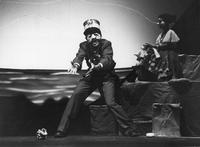
Esperpento included black-and-white photographs of performances that show Valle and his later producers channeling the nineteenth-century visual legacy. Fernando Suárez’s shot of Carlos Vide and Luis G. Carreño’s 1986 production of The Horns of Don Friolera (fig. 9) presents the anti-heroic, cuckolded protagonist reaching out from the shallow depth into the spectator’s space. We see a near featureless, distorting mask atop the jagged, histrionic angles of a body. In Gyenes’s image from José Tamayo, Emilio Burgos, and Manuel López’s version of Divine Words (1961; CDAEM, Madrid), the brazen protagonist Mari-Gaila thrusts her chest from her wide-open blouse as a crowd of villagers forms a near-perfect, shallow curve around her. With improbably extreme expressions of outrage, the actors adopt an array of angled shapes, their arms extended, their bodies bending in multiple directions. There is much that is familiar here: the masked or distorted visages, the doll-like masses, the shallow depth, and the bodies pressed to the fore, arranged in awkward, near-geometrical patterns. Through Valle’s later dramas, and productions of them, all these elements of esperpento are revisited. The plays are energized by visual possibilities latent in such techniques. But they look quite different from nineteenth-century dramas and performances. The curators point to a widespread revolt in the West against the preoccupations of realist theater with psychology, and a desire to retheatricalize drama (85). Throughout the nineteenth century, it had been common to assume that actors both could and should channel emotion by adopting stark geometrical poses, and that they had the gift of transmutation, the ability to shift between seemingly opposing shapes. That is apparent in theatrical photography of the time.[17] In those twentieth-century photographs of Valle performances, the extreme emotional intensity from the characters’ perspective involves such correspondingly extreme distortions of the body as to become alienating even as it is impactful from an audience perspective. Theatrical esperpento occurs at the tipping point between overwhelming feeling and outright dehumanization.
As we have seen throughout this review, the exhibition and accompanying volume use the term esperpento to connect and group together art from different times and indeed places: the display included French, Italian, German, British, and Latin American objects. Not least among the dynamic relationships shown was that between the nineteenth century and much later—as well as much earlier—visual art. After all, the hand and string puppets, the carnival masks and antics, and even some of the optical devices were scarcely new to the nineteenth century. As the curators also remind us, Spain had many earlier inspirations for grotesque, estranging imagery in its sixteenth- and seventeenth-century picaresque (23). Gathering and interrelating such diverse visual objects via a single term is an important practice both for art history and for curatorship. It is even more transformative when the term involved comes from locations and/or creators that have found themselves on the margins of the canon. However, it is scarcely an unproblematic practice, and it requires careful reflection.
There are many rabbit holes into which the unwary can rapidly descend. What was the relationship of the nineteenth-century objects displayed to esperpento? Historically, it is a stretch to say they were considered esperpentos in their time. While Santiago Alba Rico’s essay makes valiant efforts to identify nineteenth-century uses of the word esperpento (261), the term was so novel and infrequently employed that it does not even appear in the Royal Academy Dictionary of 1899. The nineteenth-century objects might be considered antecedents or precursors of esperpento (23). However, to describe them as such risks reducing them to a mere step on a trajectory toward something definitive. That would be at odds with claims for the extent of their innovations in their own right—for instance, that examples of something resembling esperpento in the nineteenth-century popular arts had already achieved effects later attributed to the high-art vanguard. And the objects seem to match with the descriptions of esperpento offered in the exhibition and accompanying volume. Should we describe them as influences on Valle’s approach to esperpento? Several of them presumably might fit that category—some of the nineteenth-century satirical prints for example—but tracing historical connections from Valle to all the specific instances of nineteenth-century visual culture would prove impossible. Are they, then, an influence in a different sense: that is, are they examples of a general phenomenon with certain characteristics that in some way shaped his mindset, whether or not he was familiar with particular branches or instances? This is a very different claim, and the question of what it might amount to draws our attention to the notoriously elusive meaning of influence itself. The connections described by the term influence are not rigorously causal: nineteenth-century satirical prints did not cause Valle to write The Iberian Ring. Influence can be used to describe a multitude of very different connections from a general or even peripheral awareness to a close, attentive interest. At all events, none of these could ultimately account for what Valle did in his esperpentos. Perhaps we might more modestly say that the nineteenth-century works gathered here simply share family resemblances with what Valle did, but that is very different from considering them as precursors or influences.
Similar issues arise when we seek to trace connections among Valle, the nineteenth century, and other artworks of the twentieth century. Is some direct historical connection via Valle necessary for something to truly be classed as an esperpento? A clear instance would be the title of Xosé Conde Cabral’s Luces de Bohemia. Madrid absurdo, brillante y hambriento (Bohemian Lights. Absurd, Brilliant, Hungry Madrid, 1966; Conde Escudero Family Archive). But it would presumably be a struggle to make that case for Georges Pitöeff’s optically distorted scenography for Eugène O’Neill’s Le Singe velu (The Hairy Monkey, 1929; National Library of France, Paris). Should we speak, then, of a matrix of historical connections: general phenomena and influences that could encourage individuals (say O’Neill and Valle) to innovate in similar ways even where there is no apparent, direct historical connection among the artists in question? If so, is Valle simply one instance of a multitude of such connections that might bypass him partially or entirely, and that together constitute the phenomenon of esperpento? In Hungarian Mexican Kati Horna’s photograph of the Spanish Mexican artist Remedios Varo (1957; National Reina Sofía Museum, Madrid), we see the latter posed as a double-headed humanoid, her human face in profile while an elongated, spout-mouthed mask aside her stares at us. We could relate this image back to nineteenth-century and earlier masquerades without necessarily invoking Valle. That is all the more true of outsider art such as Tía Sandalia’s misshapen, outsized religious images (see fig. 4). These could be linked to popular ex-votos such as the distorted nineteenth-century image of a boat mentioned earlier. Perhaps, instead of focusing on connections between artworks and artists, we could look to an underpinning social structure as the source for the cultural similarities. At times, contributors to the book Esperpento seem tempted by an old idea: that Spanish or Hispanic obscurantism and backwardness provoked advanced innovations in grotesquery in the arts (17, 265). However, such sweeping pronouncements about the social, economic, and political context have long been refuted by historians.[18] At all events, even were the negative view of Spanish history true, it would not help us to understand the inclusion of non-Hispanic esperpentos. That would require a vast historical map across wide geographies. And like influence, in the end, it could not explain how esperpento was caused. It all becomes rather dizzying.
It is tempting to resolve such problems by setting out watertight definitions of cultural terminologies. We could then quasi-scientifically test which artworks belong within a given category and thus determine which ones are esperpentos. This approach risks circularity: the definition of esperpento is what is decided to be the definition of esperpento. Perhaps, then, we might ask which artworks across time and place match Valle’s historical definition of esperpento. Intriguing as this exercise might be, it would risk adding nothing that we did not know from the definition itself. At all events—and despite the best efforts of the curators and many scholars—there are well-known problems with seeking to crystallize a definition of esperpento from Valle’s writings. In a letter from Mexico written in 1921, Valle declared he was pursuing a new direction: dramas for puppets, not actors, which he would call esperpentos (85). The subsequent Bohemian Lights: Esperpento is, however, written for actors. The two most famous definitions are offered by the protagonist Max Estrella in the latter play and by Don Estrafalario, a viewer of a puppet performance in The Horns of Don Friolera. Their accounts are very different from one another. Estrella references the curved mirrors installed for popular entertainment in Madrid’s Callejón del Gato. He states that his new aesthetic, esperpento, involves a mathematical deformation of classical heroes, analogous to the distortion effected by such mirrors. He specifically links this aesthetic to Spain’s place in Europe, not just by invoking Goya, but by stating, “Spain is a grotesque deformation of European civilization.”[19] Meanwhile, Don Estrafalario references hand puppets, as well as Goya and El Greco. He describes the esperpento in general—metaphysical terms, rather than as a product of Spain’s circumstances. On this account, esperpento involves viewing human life from the vantage point of death, such that there is “an overcoming of pain and laughter” akin to that of angels, including Satan.[20] Estrella’s version does not require such emotionless, angelic distance: rather, his esperpento is a result of human activity, and it conveys “the tragic sense of Spanish life.”[21] Whereas Estrella speaks from the heart of Castile, in Spain’s capital Madrid, Don Estrafalario claims that esperpento is alien to the Castilian temperament and is found instead in Portugal, Cantabria, and perhaps Catalonia. Intriguingly, Don Estrafalario omits Galicia, Valle-Inclán’s homeland, and Aragon, Goya’s.
These contradictory accounts of esperpento may be taken as a positive invitation to trace—to curate—connections across the history of culture without the need for final definitions and definitive histories of cause and influence. Valle is asking us to reflect on and explore the possible resonances of the term esperpento, rather than unequivocally endorsing the opinions of his fictional characters. The latters’ names might make us wary of their views: in contemporary English, we might render the dejected, rejected writer Estrella as Super Star, and Don Estrafalario as Mr. Weirdo. When he makes his declarations about esperpento, Estrella is extremely drunk and extremely unwell; there is a suggestion that Don Estrafalario is also inebriated, though he seems to deny it. Both are accompanied by sidekicks—Don Latino and Don Manolito, neither of whom seems entirely persuaded by their utterings, and neither of whom is entirely reliable. The exchanges about esperpento are more like eccentric philosophical dialogues than treatises. As such they might be taken as provocations to be mulled over and considered.
Broadly speaking, Valle’s uses of the word esperpento set it apart from Bertolt Brecht’s slightly later Verfremdungseffekt (distantiation) or Viktor Shkolsky’s slightly earlier ostranenie (defamiliarization). Valle’s emphasis is on the (visual) experience of systematic, estranging deformation itself, not upon (say) a refreshed perception of the world or surveying social structures from a distance.[22] But Valle left open, and continued to explore through his own practice, what that experience of estrangement might involve, through which kinds of art it might be experienced, when and where, and to what ultimate effect. It was there in the goyesque, of course; it might also be spied in El Greco, or in a lithograph, a puppet play, or a distorting mirror. It might be tragic, or it might be emotionless and deathly. In some versions, it speaks to Spain’s specific circumstances, and, in others, not. As the visitor ventured across the Esperpento exhibition halls, they could see the many possible ways that our visual experience could be deformed and estranged, from a Lucas oil painting to the staging of an O’Neill play, from a French anamorphic drawing to a collection of outsider religious art, from an old carnival mask to Valle-Inclán. The visitor could see the effect of bringing all these together, of experiencing the many connections and variations across all this visual estrangement and deformation.
The exhibition Esperpento was boldly curated and accompanied by a similarly bold publication. Doubtless both had their flaws, for example in fully articulating the rationale for the selections and combinations of art displayed. But flaws are an occupational hazard of innovation. The curators showed an admirable creative willingness to explore the visual possibilities suggested by the word esperpento, to bring together Spanish and foreign, old and new, popular and (supposedly) high art in significant, resonant combinations through curatorial practice. For those of us concerned with nineteenth-century art worldwide, Esperpento refreshingly reasserted the dynamic, exciting connections between challenging, unsettling Spanish art of that century and later (and earlier) experimental creations. This is not a nineteenth century confined to historical study nor one to be superseded or overcome; it is a nineteenth century that is a continual provocation to thought and practice. We do not need Modernist frameworks and talk of triumphant vanguards as a permission to dwell upon important connections from the twentieth and twenty-first centuries to the nineteenth; nor is the absence of Modernist frameworks an impediment to appreciating those relationships. We need a sensitivity to and appreciation of innovative vision, of discomforting creativity.
Notes
Unless otherwise noted, all translations are by the author.
[1] The full surname is Valle-Inclán. In standard usage, this is sometimes shortened to Valle, as is done at times in this review essay.
[2] There are various English and bilingual editions of Bohemian Lights. It is included in María Delgado, trans., Ramón del Valle-Inclán: Plays I (Berg, 2007). The Horns of Don Friolera is available in Dominic Keown and Robin Warner’s translation as Mr. Punch the Cuckold (Aris & Phillips, 1991).
[3] The Spanish titles of the sections are respectively: Antes del Esperpento; Visión de medianoche; Tablado de marionetas; Martes de carnaval; Lucas de Bohemia; Retablos; Tirano; El ruedo ibérico.
[4] The group maintains a website on which the photographs can be viewed: Lagartijas Tiradas al Sol, “No tengo por qué seguir soñando con los cadáveres que he visto,” accessed August 20, 2025, https://lagartijastiradasalsol.com/.
[5] Eugenio Lucas y su mundo: Discurso leído por el Excmo. Sr. Don Enrique Pardo Canalís el día 13 de junio de 1976 y contestación del Excmo. Sr. Don José Camón Aznar (Real Academia de Bellas Artes, 1976), 59.
[6] For a longer treatment of these historiographical and curatorial shifts, see my review of the Prado’s 150th anniversary exhibition of Eduardo Rosales: Andrew Ginger, exhibition review of Eduardo Rosales (1836–1873) en el Museo del Prado (Eduardo Rosales [1836–1873] in the Prado Museum), Nineteenth-Century Art Worldwide 23, no. 2 (Autumn 2024), https://doi.org/10.29411/ncaw.2024.23.2.21.
[7] See the useful account at “The Dawn Procession,” Museo Carmen Thyssen Málaga, accessed August 20, 2025, https://www.carmenthyssenmalaga.org/.
[8] This work, and the canvas displayed in Esperpento, has a complex history. The Madrid History Museum catalogue states that it is a copy of the original, but also dates it as before 1870, that is, within Lucas’s lifetime (see “Episodio de la Revolución de 1854 en la Puerta del Sol,” Memoria de Madrid, accessed August 20, 2025, https://www.memoriademadrid.es/). The original painting was displayed in 1855 at the Universal Exhibition in Paris, alongside a bullring painting with which it may well have formed a pair: the revolution in Madrid began at the bullring and proceeded to the Puerta del Sol; the latter is the setting for the painting displayed in Esperpento. Assuming that the work belonging to the Madrid History Museum is indeed a copy, the location of the original seems to be unknown.
[9] Mariano José de Larra, “El mundo todo es máscaras. Todo el año es carnaval,” El Pobrecito Hablador. Revista Satírica de Costumbres, March 1833, https://www.cervantesvirtual.com/.
[10] The full expression is “de aquellos polvos, estos lodos,” literally “from that dust, this mud.”
[11] The Prado catalogue notes that the image to the right might be a paso—a religious image carried on a platform in a procession (https://www.museodelprado.es/). In that case, it is emerging from an arch or doorway. However, the image is ambiguous and could as easily be a religious statue in an alcove or chapel inside a church.
[12] The National Museum of Romanticism’s catalogue suggests the satire may particularly be aimed at Villaamil. See Colecciones en Red, inventory CE7317, accessed September 1, 2025, https://ceres.mcu.es/.
[13] For the complex self-reflexivity exhibited in the products of nineteenth-century Spanish print technology, see Lee Fontanella, La imprenta y las letras en la España romántica (Peter Lang, 1982).
[14] ya estaban poniendo en funcionamiento revolucionarias estrategias de representación—deformada o deformante—que la historia de la modernidad artística canónica ha atribuido a los movimientos de vanguardia de finales del siglo XIX.
[15] I borrow the phrase from David Foster Wallace, Both Flesh and Not (Penguin, 2013). Foster Wallace had in mind a more transfigurative scenario than these grotesqueries.
[16] El General Prim caracoleaba su caballo de naipes en todos los baratillos de estampas litográficas. Diego Martínez Torrón, ed., El ruedo ibérico (Cátedra, 2017), loc. 1069.
[17] Andrew Ginger, Instead of Modernity (Manchester University Press, 2020), 65–67, 72–75.
[18] See, for example, Adrian Shubert, A Social History of Modern Spain (Routledge, 2003); David Ringrose, Spain, Europe, and the “Spanish Miracle,” 1700–1900 (Cambridge University Press, 2010); and Isabel Burdiel and María Cruz Romeo, “Old and New Liberalism: The Making of the Spanish Revolution: 1808–1844),” Bulletin of Hispanic Studies, 55 (1998): 65–80.
[19] España es una deformación grotesca de la civilización europea. Ramón del Valle-Inclán, Luces de Bohemia (Renacimiento, 1924), 225.
[20] Una superación del dolor y de la risa. Ramón del Valle-Inclán, Martes de Carnaval: Esperpento (Iberoamericana, 1930), 102.
[21] El sentido trágico de la vida española. Valle-Inclán, Luces de Bohemia, 224.
[22] By way of comparison, see Bertolt Brecht, “On Chinese Acting,” trans. Eric Bentley, The Tulane Drama Review 6, no. 1 (1961): 130–36; and Viktor Shklovsky, “Art as Technique,” trans. Lee T. Lemon and Marion J. Reis, in Modern Criticism and Theory: A Reader, ed. David Lodge (Longman, 1988), 16–30.