Van Gogh and the End of Nature by Michael Lobel
Reviewed by Genevieve WesterbyGenevieve Westerby
University of Delaware
Email the author: gwesterb[at]udel.edu
Citation: Genevieve Westerby, book review of Van Gogh and the End of Nature by Michael Lobel, Nineteenth-Century Art Worldwide 24, no. 1 (Spring 2025), https://doi.org/10.29411/ncaw.2025.24.1.16.
This work is licensed under a Creative Commons Attribution-NonCommercial 4.0 International License  unless otherwise noted.
Your browser will either open the file, download it to a folder, or display a dialog with options.
Michael Lobel,
Van Gogh and the End of Nature.
New Haven, CT: Yale University Press, 2024.
200 pp.; 77 color and 7 b&w illus.; notes; bibliography; index.
$45.00 (hardcover)
ISBN: 9780300274363
Michael Lobel has endeavored to take a fresh look at the work of Vincent van Gogh, which is no small feat. Perhaps it is thanks to the author’s background—as neither a specialist of nineteenth-century European art generally nor of Van Gogh specifically—that allowed him to see the artist anew. Working in an environmentally oriented (or maybe even ecocritical) framework, Lobel’s deeply researched reassessment of Van Gogh draws on a vast existing art historical scholarship, introduces new context from the history of science and the environment, and consistently returns to close observations of the works themselves.
In his new book, Lobel wants, above all, to disabuse us of the notion that Van Gogh was “the quintessential painter of nature” (1). His point of departure is first made clear in the book’s title, which evokes the work of the environmentalist Bill McKibben. In his 1989 book, McKibben warned that we would need to give up our sentimentalizing view of nature—as enduring and untouched by human activities—to address looming climate crises.[1] Lobel similarly argues against what he sees as a sentimentalizing of Van Gogh’s work:
the romanticized vision of Van Gogh as the consummate nature painter is, in my view, doing real damage. For it allows us to engage in the fantasy of an artist living at a time of rampant industrialization, an era that in many ways set the stage for our own, who somehow managed to sidestep or even wholly avoid its far-reaching and at times destructive effects. (1)
Indeed, over five chapters, Lobel introduces us to a Van Gogh who was just as engaged with the subject of modern industry—and its often-deleterious environmental effects—as he was with the natural world.
In his first chapter, Lobel takes up the themes of smokestacks and air pollution. We learn about the pervasive presence of smokestacks—and their plumes of smoke—in Van Gogh’s pictures, as well as the groundbreaking work of John Aitken, a Scottish engineer and inventor, who studied the role of particulate matter in the formation of fog. Focusing on the artist’s time in Arles (from February 1888 to May 1889), Lobel reminds us that Van Gogh ostensibly fled Paris to escape city life in favor of the restorative potential of the sun-drenched southern clime, where he hoped to build an artists’ community. However, Van Gogh did not simply immerse himself in nature. Lobel points to example after example in which the artist included smokestacks, that quintessential signifier of modern life, industry, and, when attached to a train rushing through the countryside, a growing reliance on coal and synchronized time. In Van Gogh’s Landscape with Carriage and Train (1890; Pushkin State Museum of Fine Arts, Moscow), for example, Lobel finds a range of juxtapositions and tensions, among nature and agrarian life in the foreground, the slower pace of the horse-drawn cart in the middle ground, and the speed of the train in the background.
Observing the trails of smoke that stretch across a surprising number of the artist’s works, one gets the impression that “the vaporous discharges and smoky emissions held as much interest for [Van Gogh] as the clouds they replace in the sky” (20). These effects of modern life were of interest to John Aitken as well. Lobel recounts Aitken’s study of pollution in London, where he calculated the amount of sulfur that coal fires produced daily, and his trip to Hyères in southern France, where he studied the long-ranging effects of coal pollution from Toulon on the summit of Mont Fenouillet. Lobel links the significant health effects of the former to Van Gogh’s personal experience—he was in London during the deadly 1873 “Cattle Show Fog”—and suggests he was a direct witness to an episode that “served as one of the more powerful warning signs of the increasingly destructive effects of air pollution in the nineteenth century” (56). The author admits that many of Van Gogh’s smokestacks are merely familiar fixtures of the landscape, included without any apparent environmental comment. In the pictures he made in The Hague in 1882, however, the artist seems to be communicating a more pointed message. In watercolors such as View of The Hague with the Nieuwe Kerk (1882, private collection), belching smokestacks, objects of modern worship, rise in the background to compete with the sacred edifices of the past while a figure, burdened by their emissions, walks bent over in the foreground.
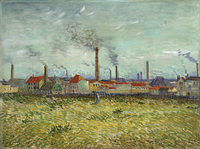
Extraction, and Van Gogh’s depictions of it, is the focus of chapter 2. Examining paintings of stone quarries—at the base of the hill of Montmartre and near Saint-Rémy—and drawings of mine workers, Lobel argues that extraction, like smokestacks, is another lesser-known theme that pervades the artist’s work. He locates this interest in the artist’s time in the southern Belgian region of the Borinage where the deleterious effects of the region’s coal mines, on workers and the surrounding landscape, were infamous, even in Van Gogh’s time. A desire to minister to working-class communities brought Van Gogh there in late 1878, but a devastating mine explosion the following spring inspired him to learn more about the industry and tour the Agrappe mine. Lobel contends that this experience deeply affected the artist, and its enduring impact is evident in his 1887 depiction of factories at Clichy (fig. 1). Comparing this work to a watercolor Van Gogh made of a coal processing factory in Borinage nearly a decade earlier, the author argues that while the Clichy view, with its vibrant hues and loose brushwork, is a testament to Van Gogh’s time in Paris, the repetition—or reinterpretation—of the earlier piece equally shows a certain continuity with the artist’s past. Lobel concludes with Van Gogh’s The Bearers of the Burden (1881; Kröller-Müller Museum, Otterlo), a large, highly developed drawing of women carrying sacks filled with scavenged material from the edge of a mine. A small shrine the artist included encourages a religious reading; however, the author wants instead to highlight the subject of industrial waste. It pollutes the atmosphere, scars the Borinage landscape, and burdens the women in the drawing.
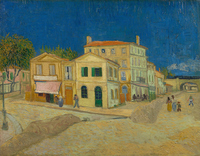
Turning again to Van Gogh’s time in Arles in chapter 3, Lobel focuses specifically on the autumn of 1888, which he suggests should be known as the artist’s gaslight period, owing to the prevalence and significance of gaslight in Van Gogh’s work during this pivotal time in his career. Van Gogh was certainly not unique in tackling novel lighting as an artistic subject, and the author discusses the same theme in contemporaries Georges Seurat and Louis Anquetin. Lobel contends, however, that the way in which Van Gogh consistently contrasted gaslight with other types of illumination was distinct. Gaslight’s brilliant illumination allowed Van Gogh to “capture the night’s rich palette of colors” (94) in pictures such as Terrace of a Café at Night (1888; Kröller-Müller Museum, Otterlo), whereas in Gauguin’s Chair (1888; Van Gogh Museum, Amsterdam) gaslight takes on a metaphorical role as well as an illuminating one. In these examples, gaslight is also juxtaposed with other types of illumination: starlight and candlelight, respectively. The author adds a further interpretative layer by linking gas lighting to coal production—the gas was a by-product of the processing of coal into coke—and to industrial waste and pollution. In discussing The Yellow House (The Street) (fig. 2), the author draws our attention to the streetlamp on the far left and the smoke-trailing train on the right—visual devices that frame the yellow house in the center—and the mounds of disturbed soil that signal the recent installation of gas pipes, all of which speaks to Arles’s growing status as a modern, industrial locale. Lobel concludes with a nod to today’s meaning of the term gaslight—that is, when someone is manipulated into questioning their own sense of reality. This term is, therefore, doubly productive in the context of the author’s approach. Lobel urges that we should not “let ourselves be misled—or even mislead ourselves—into avoiding the less appealing realities conveyed in [Van Gogh’s] work” (101).
In chapter 4, the author trains us to see water in Van Gogh’s works anew—as not simply an example of unspoiled nature, but rather as further evidence of industrialization’s impingement on and pollution of the landscape. Remaining in Arles and with gaslight, Lobel begins with Van Gogh’s drawing The Roubine du Roi Canal with Washerwomen (1888; private collection), which depicts the Arles gasworks in the distance and a line of washerwomen along the canal’s bank in the foreground. Lobel argues that since the canal is part of the built environment (an attempt to manage a nearby marshland) and the water had already at that time been polluted for at least a century (with sewage from Arles and with industrial waste), we should not read the scene as a contrast between industry and nature. Before it was covered in the twentieth century, the canal visibly emptied into the Rhône, not far from the site of Van Gogh’s Starry Night over the Rhône (1888; Musée d’Orsay, Paris), which gave the author a chance to draw connections between the coal delivered via the canal to the gasworks and the gaslight illuminating the townscape in his starry night scene. In such pictures, Lobel writes, “water takes on a key role, becoming a means to highlight the presence of industry, and even at times to suggest the ascendancy of industrial over natural forms” (118).
Lobel then shifts to a discussion of another major polluter of waterways: pigment and dye factories. Factories producing artificial pigments—like Paris green, garancine, and chrome yellow—were popping up across Europe in the nineteenth century and increasingly polluting waterways. Visual evidence of this contamination, seemingly, made its way into modern paintings. Lobel offered the example of Edouard Manet’s Argenteuil (1874; Musée des Beaux-Arts, Tournai), which Van Gogh had the opportunity to see at the 1875 Paris Salon. Expanding on observations made by T. J. Clark decades ago, Lobel discusses the too-bright blue Seine in Manet’s picture, the caricature by Paul Hadol that connects it with industrial runoff from synthetic dye factories upriver, and an official government study commissioned that summer to study pollution in that same section of the Seine.[2] Another Salon critic suggested the blue was the result of the bluing agent laundresses used to brighten white fabric, which brings us back to Van Gogh’s depiction of the Roubine du Roi canal, but this time the painted version of the scene with which Lobel began. The vivid blue of the water curving through The Roubine du Roi Canal with Washerwomen (1888, private collection) now “takes on a wholly different cast” (130). The relationship between Manet’s blue Seine and Van Gogh’s blue canal, however—whether Van Gogh did see Manet’s work and if he would have made the connection to water pollution—is left unresolved.
Lobel continues his discussion of synthetic pigments in the final chapter. Coal-tar, a by-product of coke and coal gas manufacturing, went from a foul-smelling waste product to a seemingly endless source of organic compounds in the nineteenth century. These compounds would eventually provide the basis for a range of products, from perfumes, dyes, and pigments to artificial flavorings, medicines, and explosives. Lobel focuses on eosin, a coal-tar color first synthesized in the 1870s. Its bright red color was used by the food industry to mimic the natural world—enhancing the color of wine (with deadly consequences) and canned tomatoes, for example. Beginning with his move to Arles, Van Gogh similarly, and perhaps ironically, relied on this industrially produced pigment, in the form of geranium lake, in his replication of nature. With its use, he brought “the bright colors, the vividness and intensity, of the South to Paris” (146). The pigment is, however, extremely light-sensitive, even among the infamously fugitive lake pigments. Van Gogh was aware of this drawback of the new synthetic pigments and, perhaps, intensified the coloration of his work in response. Lobel highlights the example of Van Gogh’s The Bedroom (1889; Art Institute of Chicago, Chicago). In 2016, their conservation team studied the artist’s use of fugitive pigments, including geranium lake, and produced a recolorized visualization approximating the picture’s original appearance.[3] While Van Gogh was far from unique in his use of this pigment, he seems to have knowingly forfeited the long-term aesthetic experience of his work in favor of the short-term, yet bold effect the pigment provided, which Lobel attempts to connect to our current environmental crises: “many of us are finally waking up to the kinds of real damage such short-term thinking—a focus on the immediate ends rather than long-term consequences—can cause” (150). The author makes a stronger association in his closing example. Taking a series of drawings that the artist made of medieval ruins on Montmajour using a fugitive purple ink, which has almost completely faded away, Lobel argues that there is “a striking concordance between their own physical circumstances and the subjects they depict” (153). The physical ruins and decaying drawings are testaments to the limits of human endeavors.
In his coda, the author brings Van Gogh’s legacy up to the current moment with the Just Stop Oil protest of 2022 at the National Gallery in London, when activists threw tomato soup onto one of Van Gogh’s sunflower pictures. The activists insisted that Van Gogh’s work had nothing to do with climate change; it was chosen simply because of its canonical status. Yet, from the materials he used and the subjects he pictured to the industrial accidents he witnessed first-hand, this book ultimately argues that Van Gogh, and his art, are inextricably linked to industrialization and its detrimental environmental effects.
Lobel acknowledges and credits a wide range of Van Gogh scholarship to which his study is indebted; however, there are significant lacunae including Maura Coughlin’s 2013 ecocritical approach to Van Gogh’s depictions of stone quarries and Christa DiMarco’s 2015 dissertation on Van Gogh’s time in Paris (1886–1888).[4] Furthermore, in the author’s introduction, he mentions the many recent exhibitions that focus on nature as the primary source of Van Gogh’s inspiration. Perhaps mounted too late for inclusion in Lobel’s project, it is worth highlighting the Van Gogh Museum’s 2023–24 exhibition, Van Gogh along the Seine, organized in partnership with the Art Institute of Chicago. With a focus on the Paris suburb of Asnières, the exhibition endeavored to highlight a nature/industry dualism in Van Gogh’s work, alongside that of Paul Signac, Georges Seurat, Emile Bernard, and Charles Angrand (though the exhibition admittedly took less of an ecocritical focus than did Lobel’s project). It is also worth commenting on the author’s rather ambiguous chapter titles—air, earth, fire, water, and color—which are, in reality, focused on air pollution, extraction, non-electric illumination (particularly gaslight), water pollution, and poisonous and fugitive coal-tar colors, respectively. Perhaps chosen with a mass-appeal in mind, it seems a missed opportunity to alert the reader to the actual focus of each chapter.
Overall, the author’s clear and accessible writing, with an almost journalistic flair, makes this text an approachable and pleasant read, allowing readers from the seasoned expert to those with only a passing interest in the artist to see Van Gogh in a new way. Taking a wide view of the artist’s production—discussing paintings, drawings, and letter sketches alongside each other—another strength of Lobel’s text is his formal analysis (particularly in the earlier chapters), which evinces his studied, close observation of Van Gogh’s work. Finally, as an ecocritical reevaluation of a canonical artist’s career, this text would be a valuable resource in the classroom for any professor seeking to expand and complicate their approach to nineteenth-century Europe.
Notes
[1] Bill McKibben, The End of Nature (New York: Random House, 1989).
[2] See T. J. Clark, The Painting of Modern Life: Paris in the Art of Manet and His Followers (New York: Knopf, 1984), 168–73.
[3] Inge Fiedler, Ella Hendriks, Teio Meedendorp, Michel Menu, and Johanna Salvant, “Materials, Intension, and Evolution,” in Van Gogh’s Bedrooms, ed. Gloria Groom, exh. cat. (Chicago: Art Institute of Chicago, 2016), 68–103.
[4] Maura Coughlin, “Cézanne and Van Gogh’s Quarries: Wasted Landscapes as Modern Art,” in Aesthetic Fatigue: Modernity and the Language of Waste, eds. John Scanlan and John F. M. Clark (Newcastle upon Tyne: Cambridge Scholars Publishing, 2013), 159–72; and Christa DiMarco, “Painting in Paris: Vincent Van Gogh, 1886–1888” (PhD diss., Temple University, 2015).