Rebuilding St. Paul’s Outside the Walls: Architecture and the Catholic Revival in the 19th Century by Richard Wittman
Reviewed by Jessica BascianoJessica Basciano
Independent Scholar
Email the author: basciano.jessica[at]gmail.com
Citation: Jessica Basciano, book review of Rebuilding St. Paul’s Outside the Walls: Architecture and the Catholic Revival in the 19th Century by Richard Wittman, Nineteenth-Century Art Worldwide 24, no. 1 (Spring 2025), https://doi.org/10.29411/ncaw.2025.24.1.8.
This work is licensed under a Creative Commons Attribution-NonCommercial 4.0 International License  unless otherwise noted.
Your browser will either open the file, download it to a folder, or display a dialog with options.
Richard Wittman,
Rebuilding St. Paul’s Outside the Walls: Architecture and the Catholic Revival in the 19th Century.
Cambridge, UK: Cambridge University Press, 2024.
421 pp.; 16 unnumbered pages of plates; 20 color and 105 b&w illus.; maps; plans.
$130.00 (hardcover)
ISBN: 9781009414524
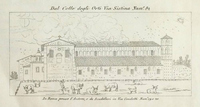
On a hot night in July, the bells ringing the Ave Maria can be heard across the swampy countryside. A church, sheltering the remains of one of Jesus’s greatest and earliest followers and its origins reaching back to the first Christian emperor, hulks in the sweltering darkness. Despite the church’s epic importance, it is so run down that it threatens to collapse. The monks have all but abandoned it for the season, fearing malaria, and many of the neighboring farmers have left the area for the same reason. On this night, the handful of witnesses notice nothing unusual until around 1 a.m., when a herdsman tending animals observes that the roof of the church is glowing (fig. 1). Alarmed, he runs to the monastery to warn its remaining residents. The groundskeeper is roused from his sleep and sends his foreman to the city for help, while he and two monks struggle to rescue what they can from the sanctuary before the increasing flames force them to flee. The roof collapses, and by the time firefighters arrive after 3 a.m., the church is engulfed by a raging inferno. The sound of columns exploding from the heat pierces the heavy night air. Firefighters save the apse, eastern chapels, and adjacent monastery with help from the wind, but the fire burns until the next day (41–47). Such is the dramatic opening scene of the events of Richard Wittman’s Rebuilding St. Paul’s Outside the Walls. The church destroyed in the fire of July 1823 was dedicated to Saint Paul, theologian and missionary, who, after almost twenty-five years of itinerant preaching, joined Saint Peter in Rome. Co-protectors and patron saints of the city, Peter and Paul are believed to have been martyred on the same day between 65 and 67 CE and share the same feast day. Soon after Paul’s death, his tomb attracted devotees. A modest basilica was erected over it in the early fourth century, likely sponsored by Emperor Constantine, and replaced by a larger one at the turn of the fifth century. It was known as San Paolo fuori le mura because of its location outside the Aurelian city walls (1, 251–52).
Rumors and speculation about the meaning and cause of the fire swirled like sparks around the smoldering ruins. Church leaders viewed the destruction of San Paolo as one of a litany of traumas to befall the Catholic Church in living memory—from the Enlightenment to the French Revolution, to two French occupations of Rome. Political liberalism was on the rise, Catholic observance was down, the Church had less power abroad, and the Papal States verged on financial ruin. The city had suffered from the destruction of many churches and the removal of art and archives (3–4, 49–50). Another calamity in a long list, the fire at San Paolo was seen as a metaphor for the Catholic Church’s ebbing fortunes, and as a portent of worse disasters to come (50, 59). While it was probably caused accidentally by workmen on the roof, conspiracy theories abounded (1). In one, the fire was the work of arsonists, part of a plot to destroy Rome’s sacred monuments. In another, it was set by northern European Protestants posing as antiquarians. In yet another, it was ordered by a member of the Rothschild banking family (59–61).
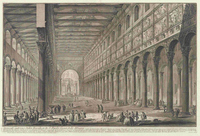
Old San Paolo, the debate over its reconstruction, and the new San Paolo are all worth studying. The old church (fig. 2) was among the most important in the world and, after Saint Peter’s, the second most important pilgrimage destination in Rome (1). Architecturally speaking, San Paolo was neglected, yet on the eve of its destruction it was the best preserved of Rome’s Early Christian churches. A vast basilica, memorably described by a visitor as “naked and almost rude,” its original features were exposed, free of Baroque encrustation (43). These features included ancient spolia columns in the nave arcade, a series of frescos of the popes in roundels above the arcade, and wooden trusses supporting the nave roof (43–44). The fire ignited not only rumors about the cause, but a public debate on the form of the reconstruction. That San Paolo would be rebuilt seems never to have been in doubt, but how it would be rebuilt was a highly charged question (2, 65). One option was a classical church, consistent with Roman tradition and contemporary taste and norms (97). The other was the reconstruction of the Early Christian basilica in its original, pristine form: “the in pristinum option” (2). The reconstruction launched because of the pope’s 1825 decision to adopt the in pristinum option would be larger and more expensive than any other building project in Rome since Saint Peter’s in the sixteenth and seventeenth centuries. Not only that, but never in Europe had there been an effort to rebuild a destroyed building almost exactly as it had been (2, 65). Along with this distinction, the reconstruction was unprecedented in that it was supported by “the first global fundraising drive”—not just in architecture, but in any sphere—and, as a result of the campaign, San Paolo was the first building with “a genuinely global public” (152). While these aspects of the reconstruction may be considered successes, another may not: that of the attempt to launch an international Catholic revival associated with Saint Paul. Still, though not tied to Paul, there was an increase in religious practice in the nineteenth century, and, as Wittman argues, the reconstruction was part of Church leaders’ education in effective engagement with lay Catholics in the modern era, a lesson for their widespread endeavors in support of the revival (7–8).
The scope of the book is broader than San Paolo, and therefore it will appeal to a broader audience. It is about Roman architecture, Catholic thinking about history, and the Catholic Church’s relationship to modernity in the nineteenth century (382). Accordingly, it will be of interest to scholars of architecture and of Church history. Regarding the first theme—Roman architecture—the book is a corrective to the inattention of architectural histories to early nineteenth-century Rome, dismissed as a “reactionary backwater,” and to the prevailing view that European modernity was monolithic and happened first in Paris, London, and Berlin, before arriving, in reduced form, in Rome (5). It is true that Rome was reactionary, but antimodern positions such as those in support of the reconstruction of San Paolo are, as Wittman states, “necessarily modern themselves” (5). Wittman shows that Rome was hardly a backwater, but that its architecture and architectural discourse possessed an “intellectual richness” (6). Romans were confronted with economic, political, and cultural change like their contemporaries in Paris, London, and Berlin; and Roman architects were engaged with questions around the relationship of the past to the radically different present, similar to architects in other European cities. They too had a “historicist consciousness,” but unlike their contemporaries elsewhere, they could not reject classicism in favor of a local tradition such as the Gothic, for classicism was their local tradition (6). The book not only upends assumptions about modernity as “northern and secular” (383), it disrupts the view that “a modern historicist consciousness of time as linear and inert” was foreign to Rome and contrary to “the providentialist temporality of Catholic tradition” (6). Instead, the book’s exploration of its second theme—Catholic thinking about history—reveals that such an awareness of time informed the reconstruction of San Paolo, as well as the Holy See’s approach to Christian archaeological sites that distanced the present and the past from which they came (6, 373). Regarding the third theme—the Catholic Church’s relationship to modernity in the nineteenth century—the book highlights the paradox that the Church vocally opposed modernity yet adopted it on its own terms (58). While Pope Pius IX concluded his 1864 Syllabus of Errors with the error of reconciling with “progress, liberalism and modern civilization,” he liberalized press freedoms, brought gas lighting to Rome, and introduced railroads and telegraph lines in the Papal States (306, 370). These broad themes envelop the core of the book, which is a detailed examination of competing projects for the reconstruction of San Paolo and debates surrounding them from 1825 to 1854. A main argument is that while San Paolo failed to inspire a Pauline Catholic revival, it was an important experiment in the possibilities of modernity and the role of architecture within it, a trial that Church leaders would build on in support of the Catholic revival that took off after 1850 (4, 8, 378). Another main argument is that the choice of the in pristinum option reveals a shift in Church leaders’ conceptions of history from the traditional, in which the past was close and accessible, to the modern, in which the past was distanced from the present by a yawning chasm (369, 377).
The book is organized chronologically in sixteen chapters grouped in four parts. Part 1 covers topics progressing from changing attitudes toward Early Christian architecture in Rome to the key projects and decisions for San Paolo from 1823 to 1825. Chapter 1 reveals a rise in “Early Christian mania” in the eighteenth century, accompanied by the renovation of ancient churches and a disregard for their historical fabric (14–15, 17). After the French Revolution, seen as a rupture with history, and after the French occupations between 1798 and 1814, during which Rome experienced a significant loss of religious patrimony, a new sense emerged that preserving Christian architecture was akin to preserving Catholic identity, and new research was published on Early Christian churches in Rome, including San Paolo (17–18, 23, 26–30). Chapter 2 describes old San Paolo, narrates the story of the fire of 1823, and summarizes contemporary accounts of the fire’s cause and meaning. In chapter 3, we are introduced to early projects for the reconstruction. First was the in pristinum reconstruction by architect and antiquarian Angelo Uggeri, which would see San Paolo rebuilt, and, in Uggeri’s view, made better than ever. The nave columns would support an entablature instead of an arcade, “the more correct classical solution,” which, had the Early Christians had the necessary stone, they would surely have adopted themselves (28, 65, 69). Second was the proposal of architect Giuseppe Valadier for a small classical church on the foundations of the old transept and apse, with a north-facing temple-front façade. It would reuse fragments that survived the fire and leave the area of the old nave as a humble service courtyard (65, 77). And third was the proposal of engineering inspector Gianbattista Martinetti that would likewise build the church on the foundations of the old transept, but keep it oriented to the west and facing onto a parvis consisting of the ruins of the old nave—left as ruins (80–87). If Uggeri’s project opened a portal to the past, refuting the fire and the trials of the Church facing modernity, and if Valadier’s project was conventional and small, consistent with the papal government’s limited budget, then Martinetti’s design was a powerful statement of Romantic nostalgia and mourning (80–87, 97).
In Chapter 4 we encounter a revised version of Valadier’s project that incorporates elements of Martinetti’s, such as the orientation to the west and a courtyard surrounded by an arcade in the place of the old nave. This would be approved by Pope Leo XII in 1824, with Valadier as architect director, on the condition that the nave ruins were preserved. We then learn about a student architecture competition in 1824, at the Academy of Saint Luke, on the subject of the replacement of San Paolo, and its controversial outcome (84, 87–88). Chapter 5 uncovers the successful campaign to sway Leo XII in favor of the in pristinum reconstruction and the fundraising that would make it possible, leading up to Leo’s official choice of the in pristinum option in the Chirograph on the Reconstruction of the Basilica of San Paolo of 1825, and Pasquale Belli’s subsequent replacement of Valadier as architect director (120–21). Leo appealed to the faithful for donations by comparing the construction of new Saint Peter’s in the sixteenth century to the rebuilding of San Paolo in the nineteenth: while Saint Peter’s evoked papal authority in response to Protestantism, San Paolo called forth international evangelism in response to secularism (111–12). In chapter 6, Wittman explains what he means when he says that the in pristinum project was Romantic: in contrast to Valadier’s designs, which embodied an international classical ideal and supposedly universal values of the Enlightenment, the reconstruction manifested the subjective associations of a specific place, reflecting a new relativism internalized by Church leaders (125, 131–32, 135).
In Part 2, chapter 7 explores the fundraising drive, specifically how it was coordinated bureaucratically and promoted through publications to the Church hierarchy and ordinary Catholics around the world, including by printing donor names, gifts, and pledges (141–46). The next two chapters investigate the practical challenges of implementing the Chirograph’s directive that “no innovation shall be introduced . . . unless it be to exclude some small thing that in later times was introduced through the whim of a subsequent era” (120). Among the topics debated were which stone to use for the replacement nave columns and whether to raise the floor to protect the church from flooding (162, 191). Chapter 8 covers up to Belli’s submission of his master plan in 1830, and chapter 9 covers the period after (158), introducing Luigi Poletti, who assisted Belli and then succeeded him as architect director when Belli died in 1833 (188, 207). Poletti shifted the goal of the project so that it was no longer “to recreate the old basilica of San Paolo” but to “create an ideal Early Christian basilica” (190).
Part 3 covers Poletti’s directorship until the Revolutions of 1848. Chapter 10 presents Poletti’s strategies to achieve the rational and unified building he envisioned, free of mismatched historical elements. Poletti’s 1834 master plan included a campanile at the east end, a temple-front west façade with a portico opening onto a colonnaded quadriporticus to recall San Paolo’s former atrium, and a baptistery opposite the façade (220–21). Chapter 11 concerns the themes of Roman primacy and papal authority that resonated with the then-Pope Gregory XVI’s ultramontanist worldview and were communicated by the more prominent representation of Peter and Paul as a pair in the new church and by a new pontifical throne designed by Poletti (247, 255–57). Within the context of the Catholic appropriation of Etruscan and Egyptian history, chapter 12 focuses on Poletti’s integration of materials from the old church and ancient Roman columns into the new one, as well as his planned use of Egyptian alabaster in a new ciborium, leading up to the consecration of the transept and high altar in 1840 (265–66, 279–80). The fall and rise of Poletti’s influence in the 1840s is chronicled in chapter 13. During a period when the pontifical government was financed by loans and when, at one point, more than half of San Paolo’s workforce consisted of forced prison laborers, Pope Gregory XVI cancelled Poletti’s plans to remove the surviving old narthex and build the quadriporticus, baptistery, and a coffered nave ceiling, favoring exposed timbers instead (217, 296, 298). Following Gregory’s death in 1846 and the surprise election of Pius IX, the new pope reversed Gregory’s decisions and reinstated the coffered ceiling (309). San Paolo’s fate during the Revolutions of 1848 is revealed in chapter 14. Despite its presentation in a popular Turin magazine as a national icon—a would-be Cologne Cathedral for a unified Italy—and the workshop’s employment of laborers and artisans as a government public works project, workers chanted “death to the priests” and flew a tricolor Italian flag over the basilica on election day in January 1849. Still, San Paolo survived the conflict relatively unscathed (323, 326, 328).
Part 4 begins with chapter 15, which addresses Pius IX’s return from exile in Gaeta and Poletti’s unsuccessful attempt to lobby Pius to reinstate the temple-front façade, confronting Romanticism’s rising stock in Rome and its proponents’ criticism of his work at San Paolo (333, 340). Chapter 16 brings us up to the consecration of the basilica in 1854, which, in the end, is an anticlimax compared to the proclamation of the dogma of the Immaculate Conception of Mary two days earlier. Juxtaposed, the two ceremonies are a metaphor for Paul’s inability to compete with Mary for the hearts of the faithful and for the Church’s nineteenth-century turn from rationalism to revelation, from an emphasis on sin and guilt to love and inclusion (350, 358). As we have learned, the Pauline revival that San Paolo was intended to stimulate never happens, but the Marian revival certainly does, as is attested to by the crowds of pilgrims who flocked to shrines dedicated to Mary, especially at Lourdes.
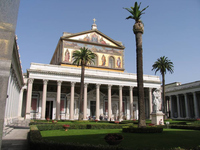
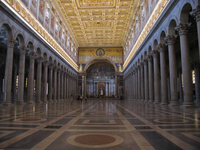
The book draws extensively from nineteenth-century archival and published sources, building trust with explicit reference to them, like the “bundle of documents” in an archive that enabled Wittman to identify the steps of the fundraiser in a branch of the Roman government (145). Wittman cites recent publications on the new San Paolo, particularly those of Elisabetta Pallottino and Michael Groblewski, and occasionally positions his interpretation in relation to theirs, confirming, for example, Groblewski’s view that the wooden model of San Paolo currently in the basilica is the original of 1834 (220). Beyond this, a comprehensive statement on the book’s distinctive contribution to the area of study would be appreciated. Wittman’s approach foregrounds the reconstruction’s architects and large cast of clerical patrons and overseers, shedding light on the famously opaque world of the Curia. Characters come to life, like the “abrasive, deeply pious, [and] conservative” Commissioner of Antiquities Carlo Fea (19, 100). “Seriously!?” Fea exclaims, in response to plans to raise the basilica’s floor level, practically shouting off the page (192). Discussion of the building’s function focuses on major events, namely the consecrations of 1840 and 1854. Elaboration on everyday use and resident and pilgrim users could complete the picture. Led on intriguing detours into the Nazarenes and Etruscan and Egyptian archaeology (there is even a trip up the Nile), the reader strays from San Paolo, but never from the book’s broader themes (282). Engaged by alternating exposition and narrative, the reader is carried from detailed, play-by-play accounts of debates to vivid storytelling, and to close analysis of primary source texts and architectural plans reproduced in the book. First-hand accounts—such as Poletti’s vision of Mary—and invitations to enter the minds of main characters—like Pope Gregory XVI, standing alone on the worksite contemplating Poletti’s model—offer a sense of immediacy (298, 363). Clear and straightforward prose is interspersed with passages of unexpected and haunting beauty, like the evocation of “delicate architectural mummies that whispered reassuringly of timelessness and shelter from change” (22). Signposts help readers situate themselves, including reminders of what they have seen and foreshadowing of what is to come, sometimes creating suspense. Beyond the summaries provided, an overview of the work at San Paolo during the book’s time frame and after would help the reader to understand the overall reconstruction and present-day basilica (figs. 3 and 4). Resolving the outcome of Poletti’s divisive ciborium would also be welcome.
As we have seen, Wittman’s book makes the bold claims that the in pristinum option represents the first attempt to rebuild a destroyed building as it was before, that the reconstruction was supported by the first global fundraising campaign, and that the campaign resulted in the first building with a global audience (2, 7, 139). It also argues that Church leaders applied what they learned at San Paolo to their activities fostering the Catholic revival after 1850, sparking questions (beyond the book’s scope) about the lessons for the clergy about architecture (4). What did they learn about mobilizing history in church building? About the potential of church building as a response to trauma and historical rupture and as a catalyst for the recovery and resurgence of the Church? What did they learn about church building as reengagement with the faithful? About fundraising for church construction, especially bureaucratically organized and broadly publicized fundraising that inspired ordinary Catholics to donate even if they would never see the church? And what were the lessons for how fundraising could foster a sense of belonging to a global community of Catholics, thereby expanding Catholic influence? In other words, the book prompts many questions about the lessons of San Paolo for Church leaders on the possibilities of modernity for church building. The “remote, fragile, and mysterious” past beckons to discover the answers (373).