Horace Vernet
Reviewed by Katie Hornstein and Daniel HarkettKatie Hornstein
Dartmouth College
Email the author: katherine.s.hornstein[at]dartmouth.edu
Daniel Harkett
Colby College
Email the author: daniel.harkett[at]colby.edu
Citation: Katie Hornstein and Daniel Harkett, exhibition review of Horace Vernet, Nineteenth-Century Art Worldwide 24, no. 1 (Spring 2025), https://doi.org/10.29411/ncaw.2025.24.1.20.
This work is licensed under a Creative Commons Attribution-NonCommercial 4.0 International License  unless otherwise noted.
Your browser will either open the file, download it to a folder, or display a dialog with options.
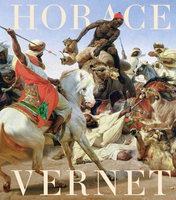
Horace Vernet
Château de Versailles, Versailles
November 14, 2023–March 17, 2024
Catalogue:
Valérie Bajou, ed.,
Horace Vernet (1789–1863).
Dijon: Faton – Château de Versailles, 2023.
448 pp.; 300 color illus.; chronology; exhibition list; bibliography; index of names.
€54.00 (hardcover)
ISBN: 9782878443448
The recent exhibition devoted to the prolific artist Horace Vernet (1789–1863) at the Château de Versailles was long overdue. Although acknowledged even by Vernet-hater Charles Baudelaire as the “most complete representative of his age,” the painter was last the subject of a monographic exhibition in 1980 at the French Academy in Rome, the institution he directed from 1829 to 1834, and at the École des Beaux-Arts in Paris.[1] The Versailles exhibition shows us just how much has changed in art history and how much has stayed the same since 1980.
Anyone who has worked on Vernet at all has encountered the polite condescension of colleagues worrying about whether he’s a “good enough” artist to spend time with. (For all the impact of the social history of art, the aesthetic canon still organizes many of our discipline’s conversations.) “Like the memory of rancid butter at the back of the mouth,” as a reviewer of the 1980 show and future British Museum director Neil MacGregor put it, Vernet’s reputation has not stood the test of art-historical time.[2] Unlike his contemporaries Jean-Auguste-Dominque Ingres and Eugène Delacroix, whose posthumous art-historical reputations continue to generate a rich historiography complete with monographs and museum exhibitions, Vernet’s status is suspect. Where Ingres pursued an idiosyncratic classicism and Delacroix a bravura of gestural Romanticism that still attract curiosity, Vernet opted for a different path. Starting in the late 1810s and continuing into the 1860s, Vernet courted the adoration of the amorphous abstraction known as “the public” while ingratiating himself with the rich and powerful. He painted battles large and small for monarchs and bourgeois patrons, designed fashion plates, and—after the fall of Napoleon in 1815—made lithographs that spoke to a population disaffected by military defeat. He participated in the period’s Salon exhibitions and liked a party. Writing during Vernet’s lifetime, critic Théophile Silvestre noted the artist’s popularity among the “vulgar” and predicted his reputation would stay with them in “the common grave.”[3] In a nineteenth-century art-historical story of path-breaking Modernists, an artist like Vernet—whose work risks appearing facile, superficial, glib, and pliable—has had little footing.
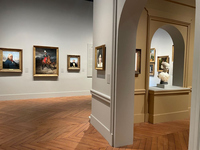
The Versailles exhibition attempted to make a case for Vernet as an important artist of his time and laid out the terms of a possible revaluation. Several thematic sections organized the hang of works and proceeded roughly in chronological order: “The Family Culture,” “The Romantic Vernet,” “Napoleon’s Influence on the Work of Horace Vernet,” “The Restoration and July Monarchy Commissions,” “Impressions of the Orient,” a small cabinet room with drawings and sketches, “Horace Vernet and the Africa Rooms,” “Portraits” (fig. 1) (which included a sub-section dedicated to Louise Vernet), “Italy!,” and “Ubiquitous Vernet.” Through these sections, the exhibition mapped an artistic biography that began in the Louvre—where Vernet’s famous artist family was lodging at the time of his birth—and ran through his notoriously exuberant Restoration atelier, his period as a propagandist for the Orléans family and French imperialism, and his time as director of the French Academy in Rome. Everywhere Vernet jumped off the walls as a painter of restlessness. Early pictures in every genre, painted quickly with simple but arresting compositions, gave way to the gigantic North African scenes, packed with incident and detail, before another shift to the sharp portraits of the Roman era onward.
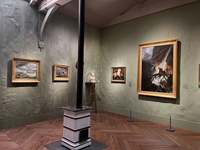
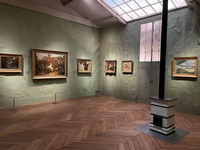
One of the most positive aspects of the exhibition was the opportunity to see many paintings that are normally sequestered in private collections, including an image of Horace and his father climbing Mount Vesuvius, a stunning seascape from a British private collection, and most excitingly, the atelier scene with the young artist having the time of his life fencing, smoking, and painting among friends. This iconic painting, and others from the late 1810s and early 1820s, sparkled in a gallery that recreated the ambience of an early nineteenth-century studio, complete with rough, peeling plaster walls, a fake stove, and an illusionistic skylight (figs. 2, 3). The gallery’s mise-en-scène, reminiscent of the theatricality of a panorama, focused attention on Vernet as a young, rebellious, Romantic artist who forged his career amid the political polarization and rancor of the Bourbon Restoration. This is the version of Vernet that is easy to like, since it fits comfortably within the parameters of an art history that looks kindly upon Romanticism’s experimentation and rule breaking.
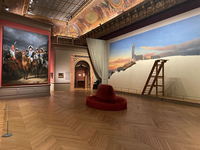
The following suite of galleries demonstrated Vernet’s shift toward the powerful and his increasing focus on large-scale works for his most reliable and powerful patron, King Louis-Philippe. An unfinished battle painting, The Capture of Tangier (fig. 4), stunned with its dramatic landscape absent of any human action. For a painter who is understood to be fast and facile, the display of this abandoned canvas (rolled up since the nineteenth century!)—complete with a ladder to emphasize its impressive scale—focused much-needed attention on Vernet’s process. Its presence also helped to demonstrate the contingencies of French revolutionary politics and the ways in which Vernet’s practice as a history painter depended on government patronage because work on it was brought to a halt by the Revolution of 1848. The wall panel that introduced this unwieldy gallery, entitled “The Restoration and July Monarchy Commissions,” made it clear that Vernet was adept at navigating the quickly changing political winds of the nineteenth century. The wall text characterized his “political ideas” as opportunistic and asserted that Vernet served in the National Guard and “rallied the people” in February of 1848, then “took part in the fighting” for the forces of order in June. Some skepticism is required with these assertions, given that Vernet was 59 years old at the time and was known for exaggerating his military service as part of his personal style and affect; his only documented military service occurred in 1815.[4] Over the course of his life, Vernet worked to maintain a reputation as a “national” painter of the French military through the performance of a militaristic kind of masculinity: the claims related to participating in the ousting of Louis-Philippe’s government in February 1848 and “fighting” on the side of order a few months later take Vernet’s (alleged) political alignments at face value and ignore his lifelong pattern of participating in his own hagiography (406).[5]
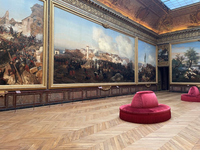
The monumental paintings in the Salles d’Afrique (fig. 5)—which had been open during the Louis-Philippe exhibition in 2018 but were previously closed to the public for decades—overwhelmed, impressed, and appalled, rendering indifference impossible. In the exhibition rooms, all this undeniable energy added up to a claim, introduced and supported by the wall labels, for Vernet’s Romanticism, and with it a place—at last—in the nineteenth-century pantheon. If the exhibition leaned into the enjoyable Romantic Vernet, it pulled its punches when it came to the Orientalist Vernet, in some ways uncritically reproducing the very exoticism that characterizes elements of his practice. The wall text made this especially apparent. Vernet “discovered Algeria in 1833,” we learned from the opening panel, and developed “an interest for the inhabitants and their colorful clothes as well as a strong spirit of conquest.” Within the run of the exhibition, a second moment of theatrical immersion, following the earlier reconstruction of Vernet’s Restoration atelier, centered on the artist’s “Turkish Room,” an Orientalist dreamspace Vernet originally built in the upper reaches of the Villa Medici in Rome. At Versailles, visitors were invited to step in and enjoy stories of craftsmanship, as if they were viewing a colonial pavilion at one of Paris’s numerous nineteenth-century expositions universelles. To us, it felt like a misstep where it could have been an opportunity to think about the complexity of Vernet’s racial, ethnic, and gendered performances at this pivotal point in his career. Later, we found the framing of the Salles d’Afrique similarly lacking, a vague reference in the wall text to Vernet’s “prejudices” served as the weakest of nods toward a critical stance. We of course understand that this is Versailles, an ocean liner of a public institution, exposed and difficult to turn, operating within innumerable constraints that stem from its status as a repository of national memory. But we also believe in the power of thoughtful curation—at times in partnership with contemporary artists—to bring even casual audiences to a place where they can reflect productively on difficult histories and pictures shot through with racist assumptions. The cues to such reflection need not operate in the language of aesthetic condemnation (“the racist art is bad art”) but might start by acknowledging skill, popularity, and the capacity to thrill before also asking viewers how certain kinds of pleasure might be entwined with the exercise of power. After all, Vernet is nothing if not a purveyor of visual pleasure.
We also wonder if Vernet’s status as one of the most important artists of his era would have benefitted from a willingness to show his work alongside the work of other artists from the period. The exhibition at Versailles was resolutely monographic. Apart from a monumental bronze sculpture of Vernet displayed in the Smalah gallery, a bust of Louise Vernet, and a few photographs of the artist at the exhibition’s conclusion, all the works on view were made by Vernet. This framework did our understanding of Vernet no favors, since it uprooted him from the rich ground out of which his practice emerged. It also deprives audiences of the opportunity to view Vernet in dialogue with other artists of his time, which is also the case in France’s other national repository of early nineteenth-century painting, the Louvre. In the famous “Salles Rouges” of this latter institution, Vernet’s pictures don’t hang next to those of Théodore Géricault or Delacroix; instead, Vernet’s own Raphael at the Vatican (1832; Musée du Louvre, Paris) hangs high up on the wall in the room that connects these two galleries that are reserved for the most important large-scale works of French painting from the first decades of the nineteenth century. All on his own in the Versailles exhibition, Vernet appeared a bit drab and derivative (one wall panel informs visitors that Géricault was Vernet’s mentor). Vernet’s isolation here contrasts with the approach taken in another recent show devoted to an overlooked nineteenth-century artist, Guillaume Lethière (The Clark Art Institute/Louvre). Although still broadly monographic, the Lethière exhibition curators were not afraid to place the artist in conversation with friends, colleagues, and students. This choice successfully evoked the circles and worlds he navigated, giving his work the opportunity to hold its own. It would have been equally fitting to set Horace Vernet’s work next to that of his grandfather, Joseph Vernet, and his father, Carle Vernet. A willing departure from the isolating strictures of the monographic would have framed Vernet as sociable and shape-shifting and open to new contexts and questions, rather than leaving him stranded in the juste milieu.
Appropriately for an artist whose career was measured by volume as well as quality, the show at Versailles was accompanied by a supersized catalogue, comprising fifty-one (fifty-one!) thematic essays that make ample use of primary source material and synthesize extant scholarship. The catalogue’s introductory essay, written by the exhibition’s curator Valérie Bajou (who also wrote seventeen of the catalogue’s other essays), presents an overview of Vernet’s career, highlights many of his works, and summarizes the criticisms he received during his lifetime. Bajou rehashes many of the same ideas put forth in Robert Rosenblum’s introduction to the 1980 exhibition catalogue, including most notably Vernet’s career as bifurcated between an early “romantic” rebellion and a mature phase of pandering to Orleanist propaganda (18).[6] One gets the sense from reading Bajou’s introduction that she might share some of the sentiments that were leveled against the artist during and after his lifetime. She asks, for example, whether Vernet’s early career, understood as a “romantic revolt,” was “merely a façade” (19). The Versailles commissions after 1836, may have, she suggests, “killed” Vernet’s art; he favored the part over the synthetic whole, and so on (20–22). It’s convenient to imagine Vernet’s most problematic paintings as “just bad,” but it’s also a type of avoidance. What if we instead begin—however uncomfortable it may be—from the idea that these later works met important needs for viewers?
The thematic essays in the catalogue pose and answer a variety of questions. “Did Horace Vernet Form a School?” asks Bajou. (He had “collaborators” but did not form students [318–22].) Sidonie Lemeux-Fraitot’s essay, “Impressions d’Orient,” surveys some of Vernet’s representations of individuals from North Africa, including the Metropolitan Museum of Art’s Vernet portrait of Roustam, while an informative essay from Jennifer Sessions delves into the politics of Vernet’s orientalism. An essay by Alain Messaoudi discusses the iconography of Vernet’s representations of “the Orient” and concludes that Vernet “never departed from his support for the government of Louis-Philippe” (288).[7] We learn that Vernet painted many horses, that he had links to the revolutionary brotherhood of Carbonari, and that he participated in Orleanist propaganda efforts. We see stunning reproductions of works that are relatively unknown, including a landscape, Flight of the Kabyles in Algeria (1839; Riga, Latvijas Nacionala makslas muzeja kolekeja). A host of information is provided, but it feels scattered. Given that this will likely be the only Vernet exhibition for decades to come, it is unfortunate that the catalogue did not take a more systematic approach that could serve researchers in the future. Claudine Renaudeau’s doctoral thesis (which is useful, but incomplete), published in 1999 and difficult to access, remains the sole source for scholars who want to consult the exhibition and publication histories for all of Vernet’s known works.[8] With so many works in this exhibition being shown for the first time, it is a missed opportunity for these works not to be accounted for in a more comprehensive way, such as is the case in the tour-de-force catalogue published for the Lethière exhibition.[9] There, each painting exhibited receives a detailed entry with a thematic short essay and, in what will surely be a boon to research into the life and work of Lethière, a comprehensive bibliography and exhibition history. The extremely detailed and useful timeline of Vernet’s life at the conclusion of the Versailles catalogue gives a tantalizing taste of the kind of documentary and research acumen that could have been used in the service of making this publication more beneficial for future generations of researchers.
And, while many questions are asked, are they the important ones? As editors of a recent volume of essays on Vernet that imagined him as a key player in a variety of discourses, we had hoped that the exhibition and its catalogue would continue to tackle a set of provocative issues, among them the artist’s relationship to reproducibility and the development of mass media, his public reception and the diverse modes of spectatorship encouraged by his work, his relationship to modernities repressed by art history’s valorization of artistic modernism, and especially the politics of representing French imperialism. These are questions we believe to matter now, though they were not the focus of this show.
Notes
[1] Charles Baudelaire, “Le Salon de 1846,” in Oeuvres complètes, vol. 2, ed. Claude Pichois (Paris: Gallimard, 1976), 471.
[2] Neil MacGregor, “Horace Vernet, 1789–1863. Paris: École nationale supérieure des beaux-arts,” Burlington Magazine 122, no. 931 (October 1980): 709.
[3] Théophile Silvestre, Histoire des Artistes vivants. Études d’après nature (Paris: E. Blanchard, 1857), 36.
[4] Nina Athanassoglou-Kallmyer, “Truth and Lies: Vernet, Vaudeville, and Photography,” in Horace Vernet and the Thresholds of Nineteenth-Century Visual Culture, eds. Daniel Harkett and Katie Hornstein (Hanover, NH: University Press of New England, 2017), 210–12.
[5] The evidence given in the timeline of the catalogue does not support any assertion of “fighting” in the National Guard in June or February of 1848.
[6] Robert Rosenblum, introduction to Horace Vernet: 1789–1863 (Rome: De Luca, 1980).
[7] “ne s’est jamais départi de son soutien au gouvernement de Louis-Philippe.”
[8] Claudine Renaudeau, “Horace Vernet (1789–1863): Chronologie et catalogue raisonné de l’oeuvre peint” (PhD diss., Université de Paris–Sorbonne, [Paris IV], 1999).
[9] Esther Bell and Olivier Meslay, eds., Guillaume Lethière (New Haven: Clark/Yale University Press, 2024).