Louis-Adolphe Hervier, 1817-1879: Biographie et catalogue de l’oeuvre gravé by Jan W. van den Noort
Reviewed by Gabriel P. WeisbergGabriel P. Weisberg
University of Minnesota
Minneapolis
Email the author: vooni1942[at]aol.com
Citation: Gabriel P. Weisberg, book review of Louis-Adolphe Hervier, 1817-1879: Biographie et catalogue de l’oeuvre gravé by Jan W. van den Noort, Nineteenth-Century Art Worldwide 24, no. 1 (Spring 2025), https://doi.org/10.29411/ncaw.2025.24.1.15.
This work is licensed under a Creative Commons Attribution-NonCommercial 4.0 International License  unless otherwise noted.
Your browser will either open the file, download it to a folder, or display a dialog with options.
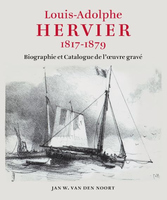
Jan W. van den Noort,
Louis-Adolphe Hervier, 1817–1879: Biographie et catalogue de l’oeuvre gravé.
The Hague: Erven Berserik Uitgeverij, 2023.
488 pp.; 90 color and 152 b&w illus. in the text; illus. of 144 etchings, 93 lithographs, 1 monotype, and 14 wrongly attributed prints; bibliography; notes; index; appendices.
$195.00 (hardcover)
ISBN: 9789081227834
Jan W. van den Noort’s Louis-Adolphe Hervier, 1817–1879: Biographie et catalogue de l’oeuvre gravé is a detailed biography and catalogue raisonné of prints by the little-known French painter, watercolorist, and printmaker Louis-Adolphe Hervier. At 488 pages, it is an authoritative book that has been almost a half-century in the making. The long duration of its preparation reflects the difficulty of piecing together the life and graphic work of an artist who was completely forgotten after his death. Van den Noort’s impeccably researched and exhaustively detailed book is testimony to the author’s perseverance and dedication to the project.
When I first met Jan van den Noort in the Netherlands in 1979, I was preparing the exhibition The Realist Tradition: French Painting & Drawing, 1830–1900 at the Cleveland Museum of Art where I served as Curator of Art History and Education.[1] I knew that van den Noort was researching as well as collecting works by Hervier and hoped that he owned some works that we might borrow for the exhibition. My wife Yvonne and I immediately clicked with Jan and his wife Agnes van den Noort-van Gelder, who were involved in the research of mid-nineteenth-century Dutch and French artists including Anton Mauve,[2] Rodolphe Bresdin, and François Bonvin, about whom I had published a book earlier that year. We remained in touch with them and followed their progress on the preparation of the Hervier book, which was finally published in 2023.
Van den Noort was first introduced to Hervier by the Dutch artist Willem Minderman. At the time, Hervier was known exclusively to a small group of artists, collectors and art historians. Among the latter was Jean Adhémar, who was for many years a curator in the print department of the Bibliothèque nationale de France before becoming head of that department in 1961. A few Parisian print dealers were also aware of Hervier’s art including Marcel Lecomte, Paul Prouté, and R. G. Michel. In the introduction to his book, van den Noort stresses their help in developing his knowledge of the artist’s work, something I fully understand since most of my own work on little known artists of the nineteenth century would not have been possible without the assistance of the same and other dealers.
The preparation of the catalogue raisonné of Hervier’s prints involved locating the prints and their various states, as well as dating them. There were no books on the artist and the few available articles and small exhibition catalogs were fragmentary and often incorrect. So how did van den Noort proceed? He visited all the museums and private collectors who owned works by Hervier, and fine art print dealers who sold them, and little by little developed a corpus of works that defined the different phases in the artist’s career. It was painstaking work, but not as painstaking as creating a detailed chronology for Hervier’s graphic oeuvre. As the artist did not date his prints, it was only by carefully comparing them and seeing how they were interrelated that van den Noort was able to piece together a tentative timeline. On the basis of that work, he proceeded to write Hervier’s biography. Because many of his prints represent landscapes or scenes from rural life, their geographic identification helped reconstruct Hervier’s whereabouts at certain times. This information, combined with biographic details gleaned from archives and contemporary literary sources, allowed the author to reconstruct the course of Hervier’s life.
Trained by his father, a painter of miniature portraits and by the history and portrait painter Léon Cogniet, Hervier left the latter’s studio in 1838 to devote himself to painting landscapes and rural life. He began submitting works to the Salon in 1837, but all were rejected until 1849. As the 1840’s came to a close, France experienced increasing political and economic discontent, leading to the revolution of 1848. Hervier was in Paris at the time and witnessed the street fighting, the barricades, the destruction, and the killing. Like Ernest Meissonier, he recorded these scenes in unflinching detail in his drawings, watercolors, and oil paintings.
Perhaps because Hervier had little success in getting accepted to the Salon, he embarked on printmaking some time in the 1840s. His lithographs and etchings soon attracted attention from other artists, such as Charles Jacques and Rodolphe Bresdin. In 1862 he became a member of the Société des Aquafortistes (1862–67), an organization founded by Alfred Cadart that promoted printmaking—especially etching—and sold works by participating artists from its Parisian headquarters.[3] Some print publishers also became interested in Hervier’s work and produced small portfolios of his etchings, such as Essais d’eaux-fortes par Hervier (Paris: Cadart & Chevalier, Editeurs, 1862), and Lithographies artistiques composées et dessinées, A. Hervier, Album de 12 planches (Paris: A. Latouche, Paris, 1866).
Yet, by the time of his death in 1879, Hervier’s work was still largely unknown and championed by only a few. Though there was a flicker of interest in his work in the 1890s—as a result of an exhibition at the Gallery Laffitte in Paris in 1895[4]—Hervier’s work remained unexplored except by a few collectors or specialists of nineteenth century art.
Jan van den Noort’s book has, at last, put Hervier on the art historical map, focusing attention on an artist who undoubtedly deserves a place in the nineteenth-century art historical canon. The book, in addition, provides a model of catalogue raisonné scholarship, if only for the fact that the author appears to have examined almost every work discussed in the book in person. Louis-Adolphe Hervier begins with the artist’s biography (chapters 1 and 2), then focuses on his prints (chapters 3, 4, 5, and 6), which include etchings, lithographs, gelatin or celluloid engravings, and a monotype. The book’s seventh and final chapter deals with Hervier’s posthumous reputation immediately after his death (1879–95). Several useful appendices augment the information provided in the chapters. They include portraits and descriptions of the artist, examples of his signature, Hervier’s Salon exhibitions, information about the dépôt légal (which demanded that all printers and editors deposit each work published by an artist at the Bibliothèque nationale), auction sales of Hervier’s works, public sales of collections, addresses of Hervier’s sons, genealogy of the Hervier family, and information about his father Charles Hervier.
Through this exhaustive information, Hervier comes alive as a person and as an artist—one who is very much of his time, a realist who found his subjects in nature, the streets of Paris, and the little hamlets in the French countryside, especially Normandy where he traveled repeatedly. His prints exhibit not only a great power of observation, but also a whimsical spirit, akin to but also different from the prints of contemporary artists like Rodolphe Bresdin with whom his works have sometimes been compared. Van den Noort’s book is a model of scholarship and will certainly solidify Hervier’s position in the history of mid-nineteenth century art.
Notes
[1] The Realist Tradition: French Painting and Drawing, 1830–1900, exh. cat. (Cleveland: The Cleveland Museum of Art, 1980).
[2] The couple prepared a catalogue raisonné of Mauve’s etchings for the catalogue of the exhibition Anton Mauve in 2009–10, jointly organized by the Teyler Museum in Haarlem and the Singer Museum in Laren.
[3] For information on Cadart see Janine Bailly-Herzberg, L’eau-forte de Peintre au dix-neuvième siècle. La Société des Aquafortistes 1862–1867, 2 vols. (Paris: Léonce Laget, 1972).
[4] The director of the gallery was Lucien Moline. This exhibition gave rise to several articles on Hervier: Gustave Geoffroy, “Adolphe Hervier,” L’Art d’aujourd’hui, November 23, 1895; Raymond Bouyer, “Petits maîtres oubliés: Adolphe Hervier,” Gazette des Beaux-Arts, July 1896; and Roger Marx, “Cartons d’artistes, Maîtres et petits maîtres du XIXe siècle, Adolphe Hervier 1817–1879,” L’Image, December 1896.