Positioning the Artist: James Ensor’s Use of Humor in His Self-Portraits
by Lotte KremerLotte Kremer is an art historian specializing in fin-de-siècle Belgium and France, focusing on themes such as identity formation, intermediality, comedy, and canonization. She holds a research master’s degree in art history from Utrecht University, where her thesis examined strategies of identity construction in James Ensor’s self-portraiture. Kremer works as an independent scholar and a writer and editor for various museums, cultural organizations, and publications, which have included the Museum Boijmans Van Beuningen, Stichting FAAM, and the Anton Pieck Museum. For the last three years, she has served as secretary of SALON – Society for the Arts of the Long Nineteenth Century, assisting in their seminars and conferences. She presents her research at international conferences such as those of HNA (Historians of Netherlandish Art) and IAWIS (International Association of Word and Image Studies), and her publications have appeared in NCAW and Junctions. She received the third annual Surrealism Fund stipend offered by the Museum Boijmans Van Beuningen.
Email the author: lotte_kremer[at]hotmail.com
Citation: Lotte Kremer, “Positioning the Artist: James Ensor’s Use of Humor in His Self-Portraits,” Nineteenth-Century Art Worldwide 25, no. 2 (Summer 2026), https://doi.org/10.29411/ncaw.2026.25.2.4.
This work is licensed under a Creative Commons Attribution-NonCommercial 4.0 International License  unless otherwise noted.
Your browser will either open the file, download it to a folder, or display a dialog with options.
The art of James Ensor (1860–1949) is inextricably linked not only to his biography but also to his frequent self-representation, whether recognizable or metaphorical, in his work. By the time he had established himself as an artist, self-portraiture had come to be seen as an important art form that both confirmed the exceptional position of artists and fulfilled the public’s desire to gain access to their lives and work. Writing on self-portraiture during this period generally focused on the psychology of artists and viewed their self-portraits as providing direct access to their very souls.[1] Ensor played into this desire in his work and his self-promotion, actively helping form his image as an artist.
Literature on self-portraiture over the last several decades has taken a broader and more diverse look at the genre. Self-portraiture can function as self-examination, public self-fashioning, artistic experimentation, and more. Artists have represented themselves in multiple roles, depending on the time and the circumstances. Similarly, we have come to look at identity as a constructed and multifaceted concept. The artist is a social being, embedded in a network of ideologies and economies.[2] With this in mind, it pays to examine Ensor’s self-portraits as sites of interaction in which a variety of intentions, cultural ideas, and social relations play out.
One way to explore this is through the framework of humor.[3] The artistic biotope of fin-de-siècle Belgium is rich in its references to zwanze (a form of humor involving absurdism, sarcasm, and self-mockery), carnival, commedia dell’arte, Flemish foolish heroes, and so on. Humor can both include and exclude audiences. This can be purposeful, with references to inside jokes that create a sense of community, or unintentional, such as when a humorous tone in a work of art fails to resonate with the viewer. Comedy in art can add nuance to tragic motifs and allow the circulation of subjects between “high” and “low” art; it can also be related to nationalistic ideas about artistic identity and genre. As will be shown below, Ensor’s subject and style, his active engagement with art criticism, and his active positioning of his work within the art historical canon are strongly tied to comedy in its various forms. By decoding the reference points and unpacking the dynamics of humor, we can understand the artist and his audience in new and valuable ways.
Nationalistic Characteristics
In the contemporary writings on Ensor, there are numerous mentions of his humor in the broadest sense of the word, including satire, sarcasm, irony, laughter, mockery, grotesques, and deadpan, among others. Jules Du Jardin (1863–1910), for example, writes that he used to imagine Ensor as a rebel in an open war with society, but that, instead, he has come to realize that the artist has fun and laughs at everything he observes, which is, in turn, useful for the construction of his inventions and the expression of his thoughts.[4]
Critics regularly cited Ensor’s dual heritage as both English and Flemish in an effort to pin down the characteristics of his personality and his art. Eugène Demolder (1862–1919), for example, did this as early as 1892 in his monograph on the artist.[5] This was repeated in the collection of essays in James Ensor, peintre et graveur, published in 1899 by the journal La plume. Most of its authors generally hailed Ensor as a representative of a typically Flemish tradition, sometimes grouped with the Dutch, while others also highlighted the English—or Anglo-Saxon—aspects of his art and personality.[6] Writers often compared the artist’s roots in terms of their nationally characteristic humor. Ensor purportedly had the exuberance of the Southern Netherlands and old Flemish laughter on the one hand, and the phlegm of the English on the other.[7]
Ensor perpetuated and carefully controlled this image of himself as a humorous artist. He joked with his friends and gave speeches filled with wordplay. At the same time, he took care to present his work in the way he intended, repeatedly stressing the importance of his titles in order to convey the meaning of his subjects. Similarly, he could be noticeably strategic in emphasizing or playing down humorous aspects of his work or character. For example, in promoting his work for the English market, he emphasized his art’s similarities to native English satire.[8]
Likewise, he turned to his “English dignity” when writing to Maurice des Ombiaux (1868–1943) concerning the author’s piece for James Ensor, peintre et graveur. Ensor was concerned that one of his quoted speeches contained too many risky passages: “People could judge me singularly and take me for a terrible party animal and I sovereignly despise party animals and zwanzeurs [hoaxers].”[9] The word zwanzeurs is derived from the Brusselian term zwanze, which I will discuss in more detail below. This sort of base humor might be fitting for a dinner with young, like-minded people, but for a larger audience of critics and potential buyers Ensor did not want to be associated with the unserious. These instances demonstrate the tactical way in which he deployed various forms of humor and their corresponding cultural associations or norms in order to curate his image as an artist.
Beyond Biography
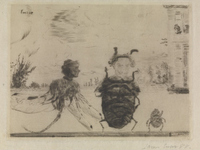
Many of Ensor’s humorous self-portraits are connected to his relationships with others, whether they were friends, foes, or art critics. In Insectes singuliers (Peculiar Insects) (fig. 1), his friend Mariette Rousseau (1850–1926) is pictured with the body of a dragonfly while Ensor has represented himself with the body of a beetle. Most scholars have connected the print to the poem “Die Launen der Verliebten” (The whims of lovers) by Heinrich Heine (1797–1856), based on the recollection of Blanche Rousseau (1875–1949)—a writer and the niece of Mariette’s husband, Ernest Rousseau (1831–1908)—published in La plume, of hearing a passage from the poem read aloud among friends.[10] The poem tells the story of a beetle who is in love with a fly. In a letter, Ensor refers to the print as “mon portrait en hanneton” (my portrait as a beetle).[11] The hanneton, or June bug, was a destructive pest in Europe at the time. Laurence Madeline claims that the word hanneton is linguistically related to insanity, by way of the French expression “il a un hanneton dans le plafond,”[12] which, according to dictionaries of the time, meant that a person is mad.[13] Through his choice to place his head atop the body of such an insect, Ensor takes on the role of a fool or madman and lowers himself even further compared to Mariette—whom he has already transposed from the fly in Heine’s poem to a dragonfly, an insect generally well-loved for its beauty. Multiple scholars have suggested that Ensor harbored an unrequited love for Mariette.[14] It must be kept in mind that this biographical reading, although made plausible by the work’s connection to Heine’s poem and the artist’s choice of insects, is subject to irony. Ensor might have found humor and delight in his “portraits” of himself and Mariette as fictional insects rather than as real-life humans. The simple fact that he casually wrote to Mariette about the print as “my portrait and yours as insects” removes from it much of the aura of romantic yearning.[15] Additionally, Heine’s poem is not entirely about a beetle pining for a fly; the joke is mostly on the fly, who acts as if she were engaged to the beetle despite having previously rejected him and ending up dead and rotten while the beetle sits for years on a distant pile of manure.[16]
By taking inspiration from a literary source—one he and his friends were familiar with—and then altering its content by his choice of visual motifs, Ensor created something uniquely his. Many of his contemporaries in Belgian avant-garde circles would have recognized the faces of Ensor and Mariette. They might also have noticed the print’s relationship to the works of other artists who had pictured similar metamorphoses, such as Odilon Redon (1840–1916) or J. J. Grandville (1803–47). Still others presumably knew about Mariette’s work in mycology and taxonomy,[17] but only Ensor’s close friends might have recalled laughing together about Heine’s poem.
Art’s Defender
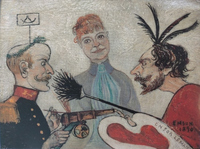
At times, Ensor used the clearly recognizable visual language of caricature, where visual shorthand is key to its readability, in combination with flat color planes and clear lines. An example is his work picturing the artist’s discussion on painting with the general Gérard Leman (1851–1920) (fig. 2), with Mariette Rousseau listening. According to the Belgian artist, filmmaker, and art critic Paul Haesaerts (1901–74), Ensor and Leman often violently quarreled about art.[18] Ensor utilized attributes to indicate their respective professions and affiliations. Leman is in his uniform with a laurel wreath on his head, aiming a tiny cannon at Ensor. Atop his head is a sign with a pair of compasses, which can refer to Leman’s renown as a mathematician as well as to the Freemasons.[19] Ensor carries a large, bushy brush and a palette as if they were his sword and shield, putting his finger into the cannon and causing it to backfire toward Leman. Ensor thus pictures himself as a defender of the art of painting they are discussing. He is the creative force standing against the reason, careful measurements, and established power that Leman represents. This is further supported by the caricatured shapes of their heads. Ensor has given Leman a bulging forehead and exaggerated his own sloped one. This could reflect the contemporary interest in the human visage and its physiognomic indications of character, here reduced to a shorthand for rational and industrious intelligence on the one hand versus spontaneous wit and innate talent on the other.[20] In the background, between the two men, Mariette looks on, perhaps akin to a lady awaiting the outcome of a knights’ joust, swayed by the opinion of the winner, or perhaps as a localizer, letting us know this allegorized discussion is taking place in the Rousseau home.
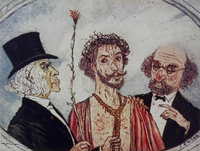
Similar stylistic elements can be seen in three of Ensor’s depictions of the artist as Christ, specifically Ensor’s persecution by his critics. Ecce Homo (fig. 3) bears especially strong similarities to Ensor and Leman Discussing Painting in its medium and composition. Ensor-Christ appears in the center of the painting, surrounded by the critics Édouard Fétis (1812–1909) and Max Sulzberger (1901–44). Ensor described the work as “another droll painting: The artist garroted, resigned and bloody, delivered to two decrepit and old executioners with ape-like and angry faces. We recognize two art critics who attacked the artist hatefully and without measure.”[21] This clash between “droll” and the violent description of the scene itself leaves the intended tone open to interpretation.
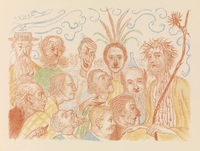
In Ecce Homo and Ensor and Leman Discussing Painting, Ensor positions himself as a defender of art against those who represent a conservative establishment. This becomes more nuanced in the other two depictions: Calvary (1886; private collection) and Le Christ livre aux critiques (Christ Delivered to the Critics) (fig. 4). The latter, a lithograph, depicts Ensor, in the guise of Christ, accompanied by multiple art critics from various sides of the critical spectrum.[22] Ensor wrote to the Flemish writer and art historian Ary Delen (1883–1960)—who can be seen on the top row, fourth from the left, with plants sprouting from his head—that Delen is represented in the work, but in good company,[23] suggesting that the tone should be read as benignly humoristic. In this later stage of his career, Ensor bore his critics no ill will, despite regularly returning to this topos of the artist as a tormented Christ.
Hareng saur (Pickled Herring)
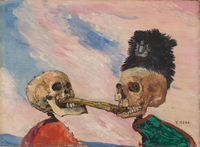
Any discussion of Ensor’s self-representation and humor would be remiss without mentioning the hareng saur, or pickled herring. It takes central stage in Squelettes se disputant un hareng saur (Skeletons Fighting over a Pickled Herring) (fig. 5), which reminded Émile Verhaeren (1855–1916) of two cruel enemies of the painter beating down on him.[24] The painting functions as a symbolic self-portrait in which the artist is taken apart by different parties, each of whom wants a piece of him or interprets him differently. The fact that the panel is strongly similar to Ecce Homo in terms of its composition and technique further heightens the interpretation of its subject as a comment about the relationship between the artist and his critics. In other works, Ensor places the attribute of the pickled herring in proximity to his self-portrait, especially when dealing explicitly with himself as an artist.[25] The cultural baggage, or intertextuality, that accompanies the use of the hareng saur as a sign or symbol deserves further investigation.
The hareng saur’s connection to Ensor traces back to the Great Zwans Exhibition of 1885 in Brussels. This exhibition was organized by the members of the artist group L’Essor and was one of a number of burlesque exhibitions that contained caricatural, satirical, and parodical art forms. The catalogue mentions a pastiche of Ensor titled L’har engsaur by Franc Masson—pseudonym of an unidentified artist and a play on the French Franc-maçon or Freemason. Ensor, in turn, appropriated the herring for his own image as an artist. In addition to the artist being parodied at these burlesque exhibitions, his art has also been connected to their zwanze spirit.[26] The term zwans or zwanze belongs to the Southern Netherlandish and, more specifically, the Brusselian dialect. It means joke, jest, or fib and denotes a kind of mockery or prank. The zwanzeur, likewise, is a hoaxer. The Rousseau family had a penchant for zwanze, and Ensor participated in pranks with Ernest Rousseau Jr.[27] In 1944, the Belgian poet and art critic Paul Fierens (1895–1957) categorized zwanze as one of the elements of Ensorian humor.[28]
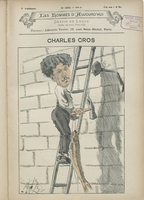
The hareng saur has appeared in a variety of cultural contexts. During the Prussian siege of Paris, the city’s famished people became overly familiar with the food. The pickled herring, typically a food for the penniless, was also well-known to French bohemians. For example, the poet Charles Cros (1842–88) composed a fumiste’s (practical joker’s) monologue titled “Le Hareng saur,” which was later published in 1880.[29] The connection between hareng saur and Cros became iconic enough that he was caricatured with the fish at least twice (fig. 6).[30] Cros moved in the Parisian spheres of the Hydropathes and the Incohérents, whose exhibitions were connected to those of the Brusselian zwanze.
The hareng saur also has a historic connection to the theater, clowns, and puppetry. The Pickelhering was a popular social type who ignored and disdained social norms, and a stage figure who, as the fool, was in a position to speak the truth to anyone, regardless of social level, and unmask human weakness without fear of retaliation. The Pickelhering was associated with heavy drinking—the pickled herring was served as a cheap drinking snack—and appeared nominally and pictorially in works by painters such as Frans Hals (1580–1666) (see his Peeckelhaering [1628–30; Gemäldegalerie Alte Meister, Museumlandschaft Hessen, Kassel] and Merrymakers at Shrovetide [ca. 1616–17; The Metropolitan Museum of Art, New York]). Food was a major source for comic stage names, and several theatrical characters across Europe adopted fish-based names.[31] The clown Pickelhäring in Germany was supplanted by Harlekin and Hanswurst, and all three had commonalities with the commedia dell’arte.[32]
In the second half of the nineteenth century, French-language texts feature many examples of the Pickelhering being translated or transformed into a hareng saur, both the food and the marionette or stage figure. He is named together with figures such as Jean Posset, Tyl Uylenspiegel, and Hans Wurst.[33] These cultural connotations add layers of meaning to Ensor’s use of the visual pun hareng saur. The iconography connects zwanze satire, fumiste bohemians, and foolish heroes of the stage.
Flemish Foolish Heroes
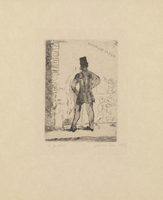
Ensor’s print Le pisseur (The Pisser) (fig. 7) similarly carries multiple layers of meaning. The top hat and the mustache of the pisser in question suggest a self-portrait of the artist. Although Ensor frequently used scatological imagery in his works—including defecation, urination, and spewing—he rarely showed images of himself participating in these base activities. Whether or not the pisser is Ensor, the text on the wall, “Ensor est un fou” (Ensor is a fool), inescapably pulls the artist into the image. The man is “urinating” his disdain for any public defamation. As Susan Canning has stated, Ensor linked his own image as an artist to the scatological legacy of the Belgian figures of Tyl Uylenspiegel and Manneken Pis.[34] The old folkloric figure of Uylenspiegel was in use in nineteenth-century progressive milieus in Brussels, as the spokesman for good-humored, antibourgeois satire. Charles De Coster (1827–79) cemented the figure as “the spirit of Flanders” with his novel of 1867, La légende d’Ulenspiegel (The Legend of Ulenspiegel), which had become widely popular in Belgium by the 1890s.[35]
De Coster’s Uylenspiegel at one point urinates on his enemies. This association with urination prevailed. In 1907, the Belgian painter, curator, and art historian Louis Maeterlinck (1846–1926) wrote about Pieter Brueghel the Younger’s (1564/65–1637/38) Proverbs (1627; Frans Hals Museum, Haarlem): “The old Gallic jokes are not forgotten there, because, in the foreground, a descendant of Thyl Uylenspiegel, having taken off his breeches, pours out his contempt for the world through the window.”[36] Similarly, there are several legends about Manneken Pis in which the boy urinates on his enemies and saves Brussels or Brabant. Maeterlinck, again, in discussing the Twelve Proverbs on Plates (1558; Museum Mayer van den Bergh, Antwerp) by Pieter Brueghel the Elder (ca. 1525–69), calls a urinator “an ancestor of ‘manneken-pis.’”[37] In a speech commemorating Brueghel the Elder in 1924, Ensor himself asks Manneken Pis to baptize him and his fellow painters, connecting the icon to De Coster and other writers and thus harking back to the supposed satirical nature of his Flemish cultural roots.[38] Whether as hanneton, hareng saur, Uylenspiegel, or Manneken Pis, Ensor employs his liberties as a fool figure to speak truths and get away with doing so through a joke.
Yes, and . . .
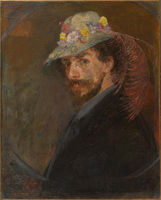
As a final thought, I turn to Ensor’s representation of himself in Autoportrait au chapeau fleuri (Self-Portrait with a Flowered Hat) (fig. 8), a reworking of an earlier self-portrait. The most commonly accepted reason for Ensor’s addition of the extravagant hat and other flourishes in the later work is that the artist wanted to align himself with Peter Paul Rubens (1577–1640), though he did so in his signature tongue-in-cheek fashion. Elisabeth Louise Vigée-Lebrun’s (1755–1842) Self-Portrait in a Straw Hat (after 1782; National Gallery, London), itself a tribute to Rubens, might have been an influence as well, given the flowers and feathers adorning the artist’s hat. Ensor definitely knew of Vigée-Lebrun, naming her and other female artists as his favorite painters later in life.[39] But Rubens, giant of the Flemish tradition, seems a more likely predecessor for Ensor to youthfully challenge. Already in 1884, one critic had sarcastically called Ensor “the giant of Les Vingt [The Twenty], the Rubens of modernity.”[40] Ensor includes no fantasy elements in his self-portrait of 1883/1888; no hands in the act of creation; and no friends or foes. Rather, his self-representation comprises his facial features, his painterly technique, and a playful reference to tradition.
Through this discussion of various self-portraits by Ensor, I have explored both the intentional way in which the artist positioned himself within the cultural landscape and the more ambiguous, multifaceted meanings of his pictures. By analyzing the various forms of comedy that Ensor utilized, such as irony, caricature, and inside references, a layer of nuance has been added to the biographical reading of his self-portraits. Though we will never truly be able to know all his intentions, the way he employed parody, homage, and mockery in equal measure adds to our understanding of his active self-fashioning as both an artist rooted in the art historical canon and an avant-gardist opposed to it.
Notes
All translations are my own.
[1] See, for example, Wilhelm Waetzoldt, Die Kunst des Porträts (Hirt, 1908), 309–412.
[2] See, for example, Erika Billeter, ed., L’autoportrait à l’âge de la photographie: Peintres et photographes en dialogue avec leur propre image, exh. cat. (Musée Cantonal des Beaux-Arts, 1985); Oskar Bätschmann, The Artist in the Modern World: The Conflict Between Market and Self-Expression (DuMont, 1997); Anthony Bond and Joanna Woodall, eds., Self Portrait: Renaissance to Contemporary, exh. cat. (London: National Portrait Gallery, 2005); and Rachel Esner, Sandra Kisters, and Ann-Sophie Lehmann, eds., Hiding Making—Showing Creation: The Studio from Turner to Tacita Dean (Amsterdam University Press, 2013).
[3] For the purpose of brevity, the words “humor” and “comedy” will be used interchangeably. For comedy as a mode of analysis, see Jan Hokenson, Idea of Comedy: History, Theory, Critique (Fairleigh Dickinson University Press, 2006); Angela Rosenthal, ed., No Laughing Matter: Visual Humor in Ideas of Race, Nationality, and Ethnicity (Dartmouth College Press, 2016); and Matthias Haldemann, ed., Komödie des Daseins: Kunst und Humor von der Antike bis Heute (Hatje Cantz Verlag, 2018). On Ensor, see Claire Moran, “Word, Image and Modernity in James Ensor,” in La Belgique entre deux siècles: Laboratoire de la modernité, 1880–1914, ed. Nathalie Aubert, Pierre-Philippe Fraiture, and Patrick McGuinness (Peter Lang, 2007), 107–23; and Xavier Tricot, “James Ensor, Painter of the Macabre and Comic Grotesque,” in The Grotesque Factor: Essays, ed. Valerianno Bozal Fernández et al. (Museo Picasso, 2012), 123–51.
[4] Jules Du Jardin, “À propos de James Ensor,” in James Ensor, peintre et graveur (Paris, 1899), 51.
[5] Eugène Demolder, James Ensor: Mort mystique d’un théologien (Brussels, 1892), 5–6.
[6] See Camille Lemonnier, “James Ensor: Peintre et graveur,” in James Ensor, peintre et graveur, 1.
[7] See, for example, Théo Hannon, “James Ensor,” in James Ensor, peintre et graveur, 15.
[8] “Mon art possède de réelles et indiscutables ressemblances avec l’art anglais, le vrai, . . . des grands maîtres paysagistes et satiriques tels Turner, Constable, Crome, Gainsborough, Hoghard [Hogarth], Rowlandson etc., etc. . . . Ma vision, ma manière et mes qualités de peintre me rapprochent de ces maîtres soit dans le paysage, soit dans la satire.” (My art possesses real and undeniable similarities to English art, the true one . . . of the great landscape and satirical masters such as Turner, Constable, Crome, Gainsborough, Hogarth, Rowlandson etc., etc. . . . My vision, my style, and my painting skills bring me closer to these masters, whether in landscape or in satire.) James Ensor to Pol De Mont, Ostend, October 4, 1900, in James Ensor: Lettres, ed. Xavier Tricot (Labor, 1999), 151–52.
[9] “Les gens pourraient me juger singulièrement et me prendre pour un noceur terrible et je méprise souverainement les noceurs et zwanzeurs.” James Ensor to Maurice des Ombiaux, November 13, 1898, in Tricot, James Ensor, 238–41.
[10] See, for example, Robert Hoozee, Sabine Bown-Taevernier, and J. F. [Jan Frederik] Heijbroek, James Ensor: Tekeningen en Prenten (Fonds Mercator, 1987), 207; and Blanche Rousseau, “Ensor intime,” in James Ensor, peintre et graveur, 27–28.
[11] James Ensor to Valère Gilles, December 4, 1890, in Tricot, James Ensor, 422–23.
[12] Laurence Madeline, “Ensor is Eternal: The Painter and His Image,” in James Ensor, ed. Anna Swinbourne, exh. cat. (New York: Museum of Modern Art, 2009), 114–15.
[13] See, for example, L. Paul Delinotte and Th. Nolen, Dictionnaire français-néerlandais des expressions proverbiales, figurées et familières de la langue française (Rotterdam, [ca. 1900]), 189.
[14] See, for example, Francine-Claire Legrand and Gisèle Ollinger-Zinque, Ensor cet inconnu (Renaissance du Livre, 1971), 19.
[15] “mon portrait et le vôtre en insects.” James Ensor to Mariette Rousseau-Hannon, Ostend, June 9, 1892, in “Avec le noble crayon”: Lettres de James Ensor à la famille Rousseau, ed. Jean-Philippe Huys and Xavier Tricot (Royal Museums of Fine Arts Belgium; Peter Lang, 2021), 330.
[16] Heinrich Heine, “Les caprices des amoureux,” from the cycle “Le livre de Lazare,” in Poëmes et legends, trans. not identified (Paris, 1855), 368–70, https://gallica.bnf.fr/. “Les caprices des amoureux” is the French translation of “Die Launen der Verliebten.” I have opted to use this translation because it echoes Ensor’s and Rousseau’s references, in French, to the poem.
[17] Jean-Jacques Symoens and Henri J. Dumont, “Une famille belge de la belle époque: Les Hannon et les Rousseau, leur activité et leur héritage scientifique,” Les naturalistes belges 93, (2012): 1–28.
[18] Paul Haesaerts, James Ensor (Elsevier, 1957), 111.
[19] Maurice des Ombiaux, Le général Leman (Bloud & Gay, 1916), 8–12, https://gallica.bnf.fr/.
[20] Alan Davison, “Franz Liszt and the Physiognomic Ideal in the Nineteenth Century,” Music in Art 30, no. 1–2 (2005): 133–44, http://www.jstor.org/ [login required]; and Henry Frith, How to Read Character in Features, Forms and Faces: A Guide to the General Outlines of Physiognomy (London, 1891), 71–75.
[21] “Une autre peinture drolatique: L’artiste garroté, résigné et sanglant, livré à deux bourreaux caducs et vieillots à la face simiesque et rageuse. On reconnaît deux critiques d’art qui attaquèrent l’artiste haineusement et sans mesure.” James Ensor to Pol De Mont, undated [late 1894–early 1895], in Tricot, James Ensor, 130–31.
[22] Xavier Tricot, James Ensor: Scenes from the Life of Christ (Petraco-Pandora NV, 2020), 8.
[23] James Ensor to Ary Delen, Ostend, September 11, 1919, in Tricot, James Ensor, 108–9.
[24] Émile Verhaeren, James Ensor (Van Oest, 1908), 94.
[25] See, for example, La vierge consolatrice (The Virgin of Consolation) (1892; Museum of Fine Arts, Ghent) and Les cuisiniers dangereux (The Dangerous Cooks) (1896; private collection).
[26] Herwig Todts, “Ensor’s Art in a New Perspective,” in James Ensor: Wildest Dreams, Beyond Impressionism, ed. Herwig Todts, exh. cat. (Hannibal; Royal Museum of Fine Arts, Antwerp, 2024), 22.
[27] Jacques Van Lennep, “Les expositions burlesques à Bruxelles de 1870 à 1914: L’art zwanze—une manifestation prédadaïste?,” Bulletin Musées Royaux des Beaux-Arts de Belgique / Koninklijke Musea voor de Schone Kunsten van België 19, no. 2 (1970): 131–38, 144.
[28] Paul Fierens, Les dessins d’Ensor (Apollo, 1944), 24.
[29] The term fumiste literally means a chimney-sweep, but it can also refer to a fraudster or a hoaxer. Similarly, fumisme literally means to blow smoke in someone’s eyes, but it also refers to a Parisian fin-de-siècle art movement characterized by satire, black humor, and absurdism and featuring mostly ephemeral artworks and performances. The movement was strongly connected to the literary club of the Hydropathes, the exhibitions of the Arts Incohérents, and the Montmartre cabaret scene of the Chat Noir and the Quat’z’Arts. See, for example, Daniel Grojnowski, Aux commencements du rire moderne: L’esprit fumiste (J. Corti, 1997).
[30] Daniel Grojnowski, “Du ‘hareng saur’ à l’art en sort ou le sort de l’art,” Poétique 188, no. 2 (2020): 211–29.
[31] John Alexander, “The Dutch Connection: On the Social Origins of the Pickelhering,” Neophilologus 87 (2003): 597–604, https://doi.org/10.1023/A:1025485924085 [login required]; and M. A. Katritzky, “Stefanelo Botarga and Pickelhering: Fishy Italian and English Stage Clowns in Spain and Germany,” in Theatre Cultures Within Globalising Empires: Looking at Early Modern England and Spain, ed. Joachim Küpper and Leonie Pawlita (De Gruyter, 2018), 15–39.
[32] Chris Ritchie, “‘Who do you think you are kidding...?’: German Comedy from the Tenth to the Nineteenth Centuries,” Comedy Studies 5, no. 2 (2014): 159–60, http://dx.doi.org/10.1080/2040610X.2014.969069 [login required].
[33] Alphonse Royer, Histoire universelle du théâtre, vol. 2 (Paris, 1869), 357–58, https://gallica.bnf.fr/; Paul Eudel, Collections et collectionneurs (Paris, 1885), 225, https://gallica.bnf.fr/; and Jean-Paul [Friedrich] Richter, Poétique ou introduction à l’esthétique, vol. 1, trans. Alexandre Büchner and Léon Dumont (Paris, 1862), 361, https://gallica.bnf.fr/.
[34] Susan M. Canning, “The Ordure of Anarchy: Scatological Signs of Self and Society in the Art of James Ensor,” Art Journal 52, no. 3 (1993): 47–48, https://doi.org/10.2307/777368 [login required].
[35] Marnix Beyen, “The Schizophrenia of an Icon: The Impact of Thyl Uylenspiegel on National and Gender Identities in Belgium in the Nineteenth and Twentieth Centuries,” in Image into Identity: Constructing and Assigning Identity in a Culture of Modernity, ed. Michael Wintle (Rodopi, 2006), 147–49.
[36] “Les vieilles plaisanteries gauloises n’y sont pas oubliées, car, à l’avant-plan, un descendant de Thyl Uylenspiegel, ayant mis bas les chausses, verse par la fenêtre son mépris pour le monde.” L[ouis] Maeterlinck, Le genre satirique dans la peinture flamande (G. Van Oest, 1907), 325.
[37] “un ancêtre de ‘manneken-pis.’” Maeterlinck, Le genre satirique, 283.
[38] James Ensor, “Discours prononcé à l’occasion de la commémoration Breughel à Bruxelles, le 31 mai 1924,” in Écrits de James Ensor de 1921 à 1926 (Éditions de “La Flandre Littéraire,” 1926), 16.
[39] James Ensor, “Interview,” in Écrits de James Ensor de 1921 à 1926, 5.
[40] “le géant des Vingt, le Rubens de la modernité.” Gustave Lagye, “L’art jeune: Exposition des XX,” La fédération artistique, March 1, 1884, 156.