The Feasts of War: Ensor’s Comical Repast (Feast of the Lean)
by Alison HokansonAlison Hokanson is curator of nineteenth- and early twentieth-century European painting at the Metropolitan Museum of Art. Her areas of oversight include British, central and northern European, and academic painting. She has mounted exhibition projects on American Golden Age collectors of French Salon painting; J. M. W. Turner; Pre-Raphaelite and Aesthetic art and design; and the painters around sculptor Auguste Rodin. Most recently, she cocurated the exhibition Caspar David Friedrich: The Soul of Nature and coauthored the accompanying catalogue. She received her PhD from the Institute of Fine Arts, New York University, for her dissertation on nineteenth-century Belgian interior scenes.
Email the author: alison.hokanson[at]metmuseum.org
Citation: Alison Hokanson, “The Feasts of War: Ensor’s Comical Repast (Feast of the Lean),” Nineteenth-Century Art Worldwide 25, no. 2 (Summer 2026), https://doi.org/10.29411/ncaw.2026.25.2.7.
This work is licensed under a Creative Commons Attribution-NonCommercial 4.0 International License  unless otherwise noted.
Your browser will either open the file, download it to a folder, or display a dialog with options.
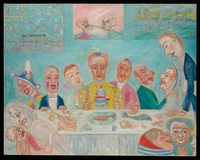
In December 1915, a little over a year into World War I, with almost all of Belgium under German occupation, the authorities in Ostend convicted fifty-five-year-old James Ensor (1860–1949) of creating subversive art. On December 11, after three days in prison, Ensor was released, thanks to some sympathetic Germans serving in a volunteer medical unit that famously included the artist Erich Heckel (1883–1970). This incident is well documented, but its aftermath is not.[1] Notably, much is unexplained about Comical Repast (Feast of the Lean) (fig. 1), said to be created in the wake of Ensor’s detention for one of his German benefactors, the artist Anton Kerschbaumer (1885–1931).[2] The size and formal complexity of Comical Repast indicate that Ensor conceived it as a major artistic statement, but what he intended to convey is opaque. Scholars describe the painting as an evocation of the tragicomedy of war; a critique of the near-famine conditions created by the conflict; and a mockery of the German aggressors.[3] The nuances of Ensor’s iconography, however, are elusive. By situating Comical Repast more precisely in relation to the art, events, and people that coalesced in December 1915, this article argues that the painting may be understood as a rich and specific reimagining of Ensor’s wartime experience.
The artwork that led to Ensor’s arrest was confiscated and is currently unlocated. Accounts in primary sources vary, but there is general agreement that it was a war scene intended as thanks for the food aid that US businessmen and politicians helped coordinate for Belgium.[4] Together with their Belgian counterparts, they distributed food across conflict lines in order to compensate for the British naval blockade and the Germans’ punitive control of supplies. This undertaking, one of the war’s most high-profile relief programs, averted humanitarian disaster. Although hunger remained dire in Belgium throughout the war, expressions of gratitude were manifold.[5]
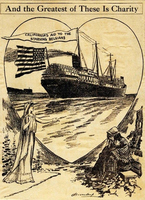
The most complete description of Ensor’s picture appears in an interview from 1939. He describes “a maiden representing America and with her finger pointing to ships bringing food to the Belgian coast. In the background, Mars, god of war, surrounded by skeletons seated on horses.”[6] This composition, as described by Ensor, has much in common with relief propaganda (figs. 2, 3).[7] As evident in Belgium’s World War I archives,[8] the nation’s graphic imagination was shaped by German persuasion campaigns and censorship, on the one hand, and, on the other, by anti-German images, which were smuggled into the country and/or circulated through the underground press.[9] The ubiquity of certain motifs—such as skeletons on horseback—among artists and even across battle lines, indicates a shared symbolic repertoire.[10] This body of imagery may fruitfully be brought to bear on Comical Repast.
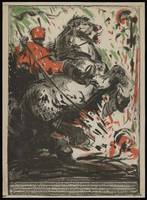
Despite Ensor’s claim that he did not intend to offend the occupiers, the Germans interpreted his skeletons on horseback as a sendup of the Totenkopfhusaren (Death’s Head Hussars). These cavalry soldiers wore hats emblazoned with a skull and crossbones, headgear also adopted by the German high command.[11] Ensor claimed that he gained his freedom by presenting the authorities with a corpus of his images of skeletons and masks, presumably demonstrating thereby that the offensive figures were simply his usual material.
Ensor’s liberty was secured, behind the scenes, by Walter Kaesbach (1879–1961).[12] In civilian life a curator of modern art at the Nationalgalerie in Berlin, Kaesbach was, in the early years of the war, head of a unit of German volunteer medics, roles conferred with a degree of neutrality within the conflict. About mid-May 1915, Kaesbach’s medical unit was transferred from near the front at Ypres and assigned to transport soldiers in Ostend to hospitals inland. Much is known about the extracurricular activities of the unit, which counted among its members Heckel, Kerschbaumer, the artist Otto Herbig (1889–1971), and, by March 1916, the artist Max Kaus (1891–1977) and the poet Ernst Morwitz (1887–1971). Kaesbach afforded the men as much time and resources as could be spared for creative pursuits. These included regular visits to Ensor, whom Kaesbach and Heckel had sought out even before the unit arrived in Ostend.[13]
The second half of 1915 was a propitious moment to solidify a friendship. Ostend, not far from the front, was a militarized harbor, subject to Allied naval and air bombardment and defended by shorefront artillery batteries. But in comparison with the brutal combat and dismal conditions elsewhere, the city was a haven. Much of the medics’ duties involved the minor needs of healthy soldiers stationed along the coast. That spring in particular, a lull in the fighting at Ypres brought a stretch of calm, and in the summer, troops flocked to the city’s beaches.[14]
For Ensor, the mid-teens were a difficult period. Simultaneously with the war, close family members died, financial worries set in, and his horizons constricted.[15] He was nonetheless a warm host to his German guests; sitting amid his artworks and knickknacks, he told stories and played his musical compositions on the harmonium. In early November 1915, the medics moved into new accommodations, so close to Ensor’s home that Heckel could hear the artist’s parrot and see the shells and other souvenirs in the downstairs shop window.[16] It was this bond of mutual regard that motivated Kaesbach to intervene on Ensor’s behalf in December, first with military command and then with a high-ranking connoisseur.[17]
Soon thereafter, near the end of May 1916, Kaesbach was promoted to Red Cross delegate and left Ostend. He nonetheless remained in regular contact with Heckel, the newly appointed head of the unit, who continued to engage with Ensor and promote his work.[18] Heckel, Kerschbaumer, and Kaesbach, amongst others, acquired Ensor’s work (he sometimes reciprocated), visited him, and contributed to exhibitions and scholarship on his art, until the rise of National Socialism in the 1930s crushed most artistic modernism in Germany.[19]
The coda to Ensor’s imprisonment in 1915 is recounted by Theodor Kiefer, a German doctor, World War I veteran, and art critic who interviewed Kerschbaumer’s wife, Friederike, and Heckel. Kiefer reports that after his arrest, Ensor lapsed into depression. To stimulate the artist, Kerschbaumer supplied him with canvases. The outcome was one or two still lifes and the painting now called Comical Repast (Feast of the Lean).[20] The initial part of the title reflects the painting’s first documented publication, in the catalogue of Ensor’s oeuvre from 1922, as Repas comique (Comic Repast).[21] The latter part of the title derives from the painting’s next appearance, in an Ensor exhibition in Mannheim in 1928. Lent anonymously by Kerschbaumer, it was called Gastmahl der Mageren (Feast of the Lean), which has also been translated as Banquet of the Starved/Starving.[22] Both sources date the painting to 1918. Xavier Tricot notes the existence of an old photograph of the painting annotated in Ensor’s handwriting with “Repas comique, 1917.”[23]
Comical Repast has proved resistant to interpretation. The foundational account of the picture, published by Kiefer, has been amended and elaborated, but it remains mostly unchanged—and largely puzzling.[24] Gathered around a table are thirteen figures, many based on masks that Ensor owned.[25] They enact a transgressive Last Supper. The subject was apropos for Ensor’s German counterparts, some of whom shared his interest in modern religious subjects,[26] and who approached their own meals and parties with a sense of occasion.[27] On the table are mollusks, crustaceans, and fish, some of them staples of Ensor’s still lifes: Clockwise from left are a skate, a shrimp, a crab, a snail, a dried plaice or red mullet, and an oyster. An onion, what may be cabbage (next to the skate), and two carrots on an undulating plate or shell complete the meal. Interspersed among them are a bee or wasp, a dragonfly, and a dead parrot, a counterpart to the bird overheard by Heckel.[28]
Presiding over this indigestible banquet are versions of three works by Ensor. At left is the gouache Les squelettes jouant au billard (The Skeletons Playing Billiards) (1903; Collection Alychlo, Belgium), a motif he often associated with imperial machinations. On the right is the gouache Les squellettes pissant (The Skeletons Pissing) (ca. 1915; currently unlocated). At center is the now-iconic Squelettes se disputant un haring saur (Skeletons Fighting over a Pickled Herring) (1891; Royal Museums of Fine Arts of Belgium, Brussels), commemorating an earlier denunciation of Ensor’s art.[29] He omitted the fur hat that appears in the original painting, perhaps because it resembles the Totenkopfhusaren helmet. This phalanx of rampaging skeletons, one of Ensor’s trademarks, underscores the themes of human absurdity and mortality. The quoted artworks also constitute a type of self-portraiture, and, most topically, recall the skeleton imagery at the center of his court-martial.
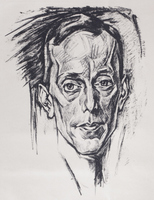
The banquet guests have largely eluded explication. Building on the scholarship of Kiefer and others, their identities may be partially clarified by considering them in relation to Ensor’s earlier art and to the milieu of wartime Belgium.[30] At center, moonlighting as Jesus, is said to be Johann Wolfgang von Goethe (1749–1832),[31] the paragon of German Romanticism, in an ornamented yellow shirt evocative of Chinese imperial robes.[32] Goethe’s Faust was issued in pocket editions to German soldiers in World War I, and his likeness, especially his portrait by Joseph Karl Stieler (1781–1858) (1828; Neue Pinakothek, Munich), was widely reproduced.[33] His inclusion in Comical Repast may have duly resonated with the German medics—and all the more so in that Ensor’s Goethe resembles Kaesbach, the intellectual leader of the medical unit and Ensor’s personal savior (fig. 4).
To the right is a Belgian appellate judge, identified here for the first time. Targets of Ensor’s earlier political critiques,[34] magistrates in occupied Belgium held ambiguous roles and could represent both collusion with and resistance to the Germans.[35] The reason for the judge’s intimacy with the protagonist in Comical Repast is uncertain (entreaty? advice?). The man beside him may be an anti-Semitic caricature, or another stereotype, the businessman—perhaps an allusion to the entrepreneurs who engineered Belgian food relief, or, less benignly, to a war profiteer.[36] The woman he embraces wears a white tunic, wimple, and hat that suggest a religious habit or a nurse’s uniform; Christian sisters served widely in healthcare roles during the war, and religious and medical attire sometimes overlapped, contributing to the popular image of women as “angels of the front.”[37] Leaning on the table is a waiter in a black coat and collared white shirt, with a menu under his arm. He is regularly identified as Kerschbaumer, but this is difficult to confirm, since his features derive from Ensor’s masks.[38] The trio at bottom right have been called a fishwife and gossips, both traditional types connoting coarse behavior. On the left, two figures fight over a leek.
Vomiting on the table behind them is a harlequin wearing a peaked, plumed hat in the French national colors. This accessory, popularized in Napoleonic caricatures as a symbol of political hubris, was a stock motif for Ensor, who was fascinated by the French general.[39] The hat also appeared in World War I cartoons that parodied the German Emperor Wilhelm II by presenting him in the guise of Napoleon, so it seems within bounds to interpret Ensor’s sick harlequin as (German) imperial ambition abased by its own greed.[40] Next to this unfortunate fellow are a tuxedoed man, sometimes called a civil servant, and a woman holding a pink rose, who places a hand on Goethe’s shoulder; her short, sleek hairstyle, small mouth, arched eyebrows, and high-necked garment channel the fashionable ideals of the “modern woman” of the early war years.[41] It is unclear what unites these incongruous characters.
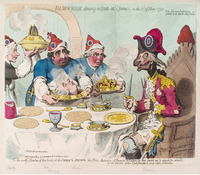
Susan Canning gains traction on Comical Repast by connecting it to Ensor’s Gourmandise (Gluttony), from his print series Les sept péchés capitaux (The Seven Deadly Sins), which depicts a skeleton waiting on two diners even as they vomit from overeating.[42] Tricot, in turn, relates the motif of gluttony in Ensor’s work to precedents such as James Gillray’s (1757–1815) Dumourier Dining in State at St. James’s, which depicts English politicians serving the head of Prime Minister William Pitt on a platter to French general Charles François Dumouriez (fig. 5).[43] The combination of bodily and political appetites was also a standard part of the World War I satirical repertoire,[44] and assuredly familiar to someone as well-versed in caricature as Ensor.
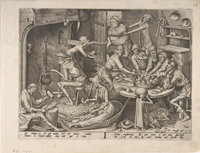
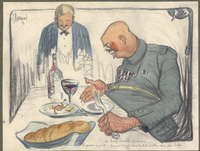
As Canning points out, however, Comical Repast is a scene of want, not of abundance. A more apt precedent lies in images such as Pieter Brueghel the Elder’s (ca. 1525–69) Thin Kitchen (fig. 6), in which an underfed and hectic household dines on a skimpy meal of mussels, bread, and root vegetables, their hunger pointedly contrasting with the obscenely well-provisioned home in the pendant Fat Kitchen.[45] This imagery is echoed in caricatures of the Belgian food crisis that overlay the moral implications of hunger with contemporary social significance. Although it is not known whether Ensor was familiar with the specific cartoons illustrated below, their themes and visual motifs illuminate Comical Repast. The painting’s central drama, for example, is also enacted in a caricature depicting a German officer complaining about his scanty meal. His waiter mutters that when the eagle is cooked—that is, when Germany is defeated—the portion will be more generous (fig. 7). The cartoon highlights the power dynamics that could inhere in a scene of dining out: served and server, consumer and provider, occupier and occupied.
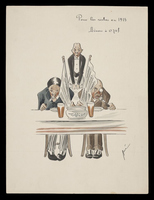
In another cartoon, a waiter attends two wealthy diners in spats who skulk behind newspapers as they scarf down potatoes (fig. 8). The image is one of a group depicting the meals of different socioeconomic classes,[46] a linkage of class and food that preoccupied wartime Belgium. Each social group fixated on the perceived privileges of the others, whether poor people’s entitlement to aid, farmers’ proximity to food, or the middle- and upper-classes’ purchasing power.[47]
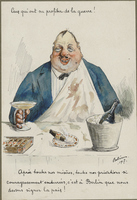
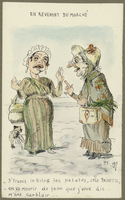
The class identities lampooned by Belgian caricaturists are also cued in Comical Repast. Even today, the tuxedo (like spats) is an attribute of wealth. By the same token, the man with a fat cigar and the bulbous, red-tipped nose of a drinker has counterparts in parodies of petit bourgeois and businessmen—most conspicuously, war profiteers—enjoying the pleasures of the table (fig. 9). The women at bottom right in Ensor’s painting resemble satires of lower-class consumers, as in a drawing showing tawdrily dressed shoppers (one toting a bag celebrating Belgian independence in 1880) bemoaning the cost of potatoes (fig. 10). The convergence of social types, including the judge and the sister/nurse, in Comical Repast suggests a political subtext. More than a haphazard horde, this cast of characters enacts some of the social roles that defined the Belgian food crisis.
The rowdy quality of the assembly suggests the unrest that the crisis provoked. The dispute over the leek, especially, seems to channel the hostility unleashed by the food shortages, which resulted in riots.[48] Similarly violent interactions are evoked in caricatures, including one depicting two farm laborers, dressed as boxers, prepared to battle over peas and carrots.[49] By 1917, conditions in Belgium were approaching famine, and soup kitchens, initially restricted to the poor, were opened to the entire population.[50] The social mixing and leveling seen in Ensor’s painting was now an essential truth: Everyone had a seat at the same awful buffet. Tellingly, in Ensor’s staging, both the beleaguered Belgians and the Germans are confronted with the same meager fare: root vegetables, including onions, leeks, and carrots, which were broadly parodied as emblems of the scrimpy wartime diet.[51] Little better off than the people they have conquered, the purveyors of the war are reaping what they have sown.
The cumulative associations of Comical Repast outlined in this article point toward an unrecognized dimension of the painting’s meaning. Following the censorship of Ensor’s allegory of hunger, he reprised the subject, in an enigmatic satire with substantial personal and political significance. The painting may be seen as an ironic, and defiant, testimonial to his wartime exploits. It is true that a parody of the appetites of war, invoking the resentments of occupied Belgians, might seem like a questionable recompense to a German medic, however neutral that medic might be. But this dynamic was perhaps mitigated by the friendship between Ensor and Kerschbaumer, each caught in circumstances beyond their control. Indeed, as the war stretched on, hunger crossed battle lines. Kaus recalled that as rations dwindled in quantity and quality, Heckel, Kerschbaumer, and others tried to offset the situation by printing ironically worded, illustrated menus—a satirical exercise worthy of Ensor.[52] The vision of shared misery in Comical Repast was, to some extent, a reality.
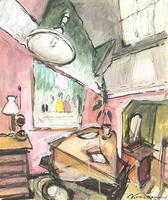
Kerschbaumer seems to have appreciated the picture. According to Kiefer, the artist was in possession of Comical Repast by the end of the war on November 11, 1918.[53] In 1923, Kerschbaumer painted a watercolor which shows Ensor’s painting in his live-in studio in Berlin, down the street from Heckel (fig. 11).[54] After Kerschbaumer died in 1931, Comical Repast remained with Friederike. She sold the painting in 1937,[55] as the world moved toward an even more unimaginable cataclysm.
Notes
All translations are mine unless otherwise indicated.
[1] Lieven Van Den Abeele, Erich Heckel in Flanders, exh. cat. (Museum of Fine Arts Ghent, 2024), 100–102, 251n79. See also Van Den Abeele’s article “James Ensor’s Friendship with Erich Heckel During World War I” in this special issue.
[2] Theodor Kiefer, J. Ensor (Aurel Bongers, 1976), 121–23. The painting’s title derives from its initial publications, in French and German, respectively, during Ensor’s lifetime. See my discussion below.
[3] Kiefer, Ensor, 122; and Changes in Perspective: 1880–1925, exh. cat. (New York: Grey Art Gallery, 1978), 17.
[4] Van Den Abeele, Heckel, 100–101.
[5] Antoon Vrints, “Food and Nutrition (Belgium),” October 8, 2014, 1914–1918–Online: International Encyclopedia of the First World War, ed. Ute Daniel, Freie Universität Berlin, https://doi.org/10.15463/ie1418.10267. For tributes, see, for example, the drawing made after a tapestry representing America feeding the nine Belgian provinces, 1915, Keym 058-043, Images et histoires des patrimoines numérisés, Archives de la Ville de Bruxelles, Fédération Wallonie-Bruxelles, http://numeriques.cfwb.be/. Eugène Keym (1861–1920), a municipal official in Brussels, collected artworks and objects documenting daily life in the city during World War I.
[6] Ed. L., “Een Gesprek met Kunstschilder Baron James Ensor,” De Zeewacht, May 13, 1939, quoted and translated in Van Den Abeele, Heckel, 101.
[7] On Ensor’s engagement with military imagery, see Debora Silverman, “Ensor’s Panache: Army and Empire in ‘The Temptation of Saint Anthony’ and in Belgium, 1887,” in James Ensor: The Temptation of Saint Anthony, exh. cat. (Art Institute of Chicago, 2014), https://publications.artic.edu/.
[8] For a selection of drawings and illustrations related to World War I in Belgium’s national archives, see Bernard Wilkin, Inventaire de la collection iconographique concernant la Première Guerre mondiale. IV: Dessins et illustrations, 1914–1925 (National Archives of Belgium, 2017), https://agatha.arch.be/ [login required].
[9] Sophie De Schaepdrijver, “Occupation, Propaganda and the Idea of Belgium,” in European Culture in the Great War: The Arts, Entertainment, and Propaganda, 1914–1918, ed. Aviel Roshwald and Richard Stites (Cambridge University Press, 1999), 271–72; and Bénédicte Rochet, “Propaganda at Home (Belgium),” May 24, 2022, 1914–1918–Online: International Encyclopedia of the First World War, ed. Ute Daniel, Freie Universität Berlin, https://doi.org/10.15463/ie1418.11549.
[10] John. J. Michalczyk, “Occupied Belgium: The Art of War,” in A New Key: Modern Belgian Art from the Simon Collection, ed. Jeffery Howe, exh. cat. (McMullen Museum of Art, 2007), 125–37; and Jennifer Farrell, World War I and the Visual Arts, exh. cat. (Metropolitan Museum of Art, 2017).
[11] “German Death’s Head Busby,” Missouri State Museum, Over There: Missouri and the Great War, Missouri State Library, accessed February 1, 2026, https://missourioverthere.org/.
[12] Walter Kaesbach links Ensor’s imprisonment to erotic drawings in an interview by Roman Norbert Ketterer, April 1959, in Dialoge: Bildende Kunst, Kunsthandel (Belser Verlag, 1988), 2:24. These drawings were discovered after his arrest. See Van Den Abeele, Heckel, 101–102. Kiefer states that Heckel and Kerschbaumer also advocated for Ensor (Kiefer, Ensor, 121), but as Van Den Abeele notes, Heckel was in Berlin from December 3 to 17 (Van Den Abeele, Heckel, 251n79).
[13] Van Den Abeele, Heckel, 54–56, 74–87, 98–103.
[14] Van Den Abeele, Heckel, 78–79, 86–87.
[15] Van Den Abeele, Heckel, 98–99.
[16] Max Kaus, “Mit Erich Heckel im ersten Weltkrieg,” Brücke-Archiv, no. 4, Erich Heckel zum Dank und Gedenken, ed. Leopold Reidemeister (Hartmann, 1970), 10; and Van Den Abeele, Heckel, 98.
[17] Kaesbach, interview, 24.
[18] Hermann Gerlinger and Thomas Bauer-Friedrich, eds., Kriegszeit 1914–1918, exh. cat. (Kunstmuseum Moritzburg, 2014), 113.
[19] Inge Herold, “Ensor and German Artists: His Impact on Colleagues,” in James Ensor, ed. Inge Herold and Johan Holten, exh. cat. (Kunsthalle Mannheim, 2021), 32–35; and Van Den Abeele, Heckel, 100–106, 112–13.
[20] Kaus, “Mit Erich Heckel,” 10; Kiefer, Ensor, 122; and Xavier Tricot, James Ensor: The Complete Paintings (Hatje Cantz, 2009), nos. 491, 497 (each with prior owners). Kaesbach possibly owned no. 497.
[21] Grégoire Le Roy, James Ensor (G. Van Oest, 1922), 195.
[22] James Ensor, exh. cat. (Kunsthalle Mannheim, 1928), no. 40; and Herold, “Ensor and German Artists,” 42–46.
[23] Tricot, James Ensor: Complete Paintings, no. 499.
[24] Kiefer, Ensor, 122; Francine-Claire Legrand, Ensor, la mort et le charme (Fonds Mercator, 1993), 35; and Xavier Tricot, James Ensor: Satire Parodie Pastiche (Pandora, 2024), 160.
[25] Marie-France Boyer, “Volte Face,” The World of Interiors, October 2024, updated April 4, 2026, https://www.worldofinteriors.com/.
[26] Van Den Abeele, Heckel, 94–97, 106–12, 151–54.
[27] Kaus, “Mit Erich Heckel,” 9; and Van Den Abeele, Heckel, 99, 106–7, 153–54.
[28] For depictions of Ensor’s inner circle as insects, see Xavier Tricot, James Ensor: The Complete Prints, exh. cat. (Frank Deceuninck; Defiac, 2010), 114–15, 124–25. The parrot appears sporadically in Ensor’s work alongside masks and skulls. Katherine Nahum, “Ensor’s Parrot,” in Howe, New Key, 105–7.
[29] Xavier Tricot, James Ensor: Satire, 160. See Lotte Kremer’s discussion of this image in her article “Positioning the Artist: James Ensor’s Use of Humor in His Self-Portraits” in this special issue.
[30] See note 24.
[31] This identification seems to have originated in Kaus, “Mit Erich Heckel,” 10.
[32] See Petra ten-Doesschate Chu’s article “James Ensor’s La petite Chinoise” in this special issue.
[33] Jutta Assel and Georg Jäger, “Goethe-Motive auf Postkarten: Stielers Goethe-Bildnis und seine Adaptionen,” updated February 2016, Goethezeitportal, Institut für Deutsche Philologie, Ludwig-Maximilians-Universität, http://www.goethezeitportal.de/; and Corinna Schubert and Evelyn Höfer, eds., Nietzsche – Goethe – “Faust,” exh. cat. (Nietzsche-Archiv/Klassik Stiftung Weimar, 2025), 9, https://doi.org/10.26013/ksw.pub_00000878 [login required].
[34] Xavier Tricot, “Ensor and English Art,” in James Ensor, 1860–1949: Theatre of Masks, ed. Carol Brown, exh. cat. (Barbican Art Gallery, 1997), 104, 124.
[35] Sophie De Schaepdrijver, “Belgium,” esp. the sections “Occupation” and “Belgium: 1917–1918,” updated July 18, 2018, 1914–1918–Online: International Encyclopedia of the First World War, ed. Ute Daniel, Freie Universität Berlin, https://doi.org/10.15463/ie1418.11285.
[36] This figure is discussed below.
[37] Paula Kitching, “Four Faces of Nursing and the First World War,” The Historian (Autumn 2013), 32–35; Jennifer Sue Montgomery, “Sisters, Objects of Desire, or Barbarians: German Nurses in the First World War” (master’s thesis, University of Tennessee, Knoxville, 2013), 4–5, 12–13, 58; and Luc De Munck, Altijd troosten: Belgische verpleegsters tijdens de Eerste Wereldoorlog (Amsterdam University Press, 2018). For images of nursing habits see, for example, “Habit, Nun’s,” Heinz History Center, Pittsburgh, PA, accessed March 23, 2026, https://heinzhistorycenter.emuseum.com/.
[38] Boyer, “Volte Face.”
[39] Tricot, “Ensor and English Art,” 114; and Bart Verschaffel, Mock Humanity (A&S, 2018), 48–49.
[40] See, for example, Le Théâtre de la Guerre: Ich spiel der Ampoleon (Theater of War. I Play Ampoleon), [1914; artist currently unidentified], and E. Guiot, L’impérial soulagement du 11 novembre 1918! (The Imperial Relief of November 11, 1918!), both in Wilkin, Inventaire de la collection iconographique concernant la Première Guerre mondiale. IV, nos. 150, 17, https://agatha.arch.be/ [login required]; and https://agatha.arch.be/ [login required].
[41] Legrand, Ensor, 35, likens this figure to Ensor’s patron and confidante Mariette Rousseau (1850–1926).
[42] Susan M. Canning, The Social Context of James Ensor’s Art Practice: “Vive la Sociale!” (Bloomsbury Visual Arts, 2024), 158–59.
[43] Tricot, “Ensor and English Art,” 107–9.
[44] See, for example, Edgar Lumor, Les “Zentralen” (The “Food Controls”), 1917, Keym 048-008, Images et histoires des patrimoines numérisés, Archives de la Ville de Bruxelles, Fédération Wallonie-Bruxelles, http://numeriques.cfwb.be/.
[45] Jeroen Luyckx, “The Thin Kitchen and the Fat Kitchen,” in Bruegel: The Complete Graphic Works, ed. Maarten Bassens and Joris Van Grieken (Thames & Hudson, 2019), no. 20. The high-ranking connoisseur who arranged Ensor’s release met Kaesbach at a lecture he gave on Brueghel. See Kaesbach, interview, 24; and Van Den Abeele, Heckel, 102.
[46] René, Pour les pauvres en 1915. Dîners à l’œil (For the Poor in 1915. Free Dinners), 1915, Keym 064-042, Images et histoires des patrimoines numérisés, Archives de la Ville de Bruxelles, Fédération Wallonie-Bruxelles, http://numeriques.cfwb.be/; and René, Pour les employés en 1915. Dîners à 0.45 f. (For Employees in 1915. Dinners at 0.45 francs), 1915, Keym 064-043, Images et histoires des patrimoines numérisés, Archives de la Ville de Bruxelles, Fédération Wallonie-Bruxelles, http://numeriques.cfwb.be/. The former is lamentably racist.
[47] Vrints, “Food and Nutrition (Belgium).”
[48] Vrints, “Food and Nutrition (Belgium).”
[49] René, Bruxelles sport: Tous les jours au marché matinal . . . Nos paysans sur la défensive. (Brussels Sport: Every Day at the Morning Market . . . Our Peasants on the Defensive), 1918, in Wilkin, Inventaire de la collection iconographique concernant la Première Guerre mondiale. IV, no. 77, https://agatha.arch.be/ [login required].
[50] Vrints, “Food and Nutrition (Belgium).”
[51] See, for example, André [?], Plantation de guerre . . . ! Premières pousses (War Plantation . . . ! First Shoots), 1917, Keym 044-040, Images et histoires des patrimoines numérisés, Archives de la Ville de Bruxelles, Fédération Wallonie-Bruxelles, http://numeriques.cfwb.be/; and Corbugy, Les oignons à 3 francs la botte (Onions at 3 Francs a Bunch), 1917, Keym 121-060, Images et histoires des patrimoines numérisés, Archives de la Ville de Bruxelles, Fédération Wallonie-Bruxelles, http://numeriques.cfwb.be/.
[52] Kaus, “Mit Erich Heckel,” 9–10.
[53] Kiefer, Ensor, 123.
[54] For an interactive map of Berlin during the Die Brücke era with pins showing the locations of artists’ studios, see “Brücke in Berlin,” Brücke-Museum, Berlin, 2026, https://www.bruecke-museum.de/.
[55] Comical Repast (Feast of the Lean), Met Collection, The Metropolitan Museum of Art, 2026, https://www.metmuseum.org/.