James Ensor’s Vision and the Social Narrative of Light
by Susan M. CanningSusan M. Canning is an independent scholar and professor emerita, College of New Rochelle. Her research and curatorial activities focus on the nineteenth-century Belgian avant-garde, the exhibition society Les XX (The Twenty), and its artist-members Fernand Khnopff, Henry van de Velde, and James Ensor. She has published numerous articles and catalogue essays on Ensor and has also served as a curatorial consultant and co-organizer for exhibitions on the artist at The Drawing Center and the Museum of Modern Art in New York, the Art Institute of Chicago, and the Municipal Museum of Contemporary Art and the Museum of Fine Arts in Ghent, Belgium. She is the recipient of two Fulbright Fellowships, a NEH Fellowship, and research grants from the Flemish Cultural Ministry. Her book-length study The Social Context of James Ensor’s Art Practice: “Vive la Sociale!” (Bloomsbury, 2022) is now out in paperback.
Email the author: provonyc[at]rcn.com
Citation: Susan M. Canning, “James Ensor’s Vision and the Social Narrative of Light,” Nineteenth-Century Art Worldwide 25, no. 2 (Summer 2026), https://doi.org/10.29411/ncaw.2026.25.2.3.
This work is licensed under a Creative Commons Attribution-NonCommercial 4.0 International License  unless otherwise noted.
Your browser will either open the file, download it to a folder, or display a dialog with options.
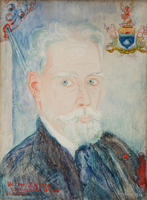
When James Ensor (1860–1949) was made a baron in 1929, he chose for his coat of arms the motto Pro luce nobilis sum—“I am noble for the light”—later incorporating it into his painting Baron J. Ensor, son diable et son blason (Baron J. Ensor, His Bad Angel and His Coat of Arms (fig. 1). Light played a significant role in his art practice, signifying both his vision and his expressive engagement with modern life.
For Ensor and many of his contemporaries, light made visible the dynamic exchange between the artist, the environment, and contemporary experience. As he wrote in an essay from 1882, artistic vision arises from careful observation and inquiry, developing from crude observation and basic visual perception to the sophisticated interplay of color and light, culminating in light as the embodiment of modernity.[1] Starting with studies of light and atmosphere and gradually moving toward more expressive pictorial methods, Ensor’s artistic vision found purpose and meaning through the belief that light was a transformative force—capable of elevating everyday sights and disclosing deeper social realities. Examining Ensor’s use of light uncovers an added layer of understanding: Here, technique, choice of subject matter, and expressive interpretation serve as vehicles for social allegory and as a means to illuminate the complexities of everyday life and the values of modern Belgium.
Realist Light
Ensor’s fascination with light was deeply rooted in his native surroundings along the Belgian coast and in the town of Ostend on the North Sea. Here, he captured the ever-changing light and atmospheric conditions of the sky, shore, and sea, revealing through his technique and choice of subjects both the fleeting nature of modern life and the enduring beauty of the natural world.
Ensor first encountered Realist theory and practice through his exchanges in painting sessions and conversations with the artists Louis Artan de Saint‑Martin (1837–90), Périclès Pantazis (1849–84), Félicien Rops (1833–98), and Guillaume Vogels (1836–96), who regularly visited the Belgian coast in search of new perspectives. Using direct observation, swift strokes, dabs of paint, and the palette-knife technique of Gustave Courbet (1819–77), these Realists made small painted studies that sought to capture the dynamic, changeable light of the North Sea. Working outdoors, often side by side, they shared a Realist ethos and spirit of camaraderie, as seen in Ensor’s painting Les dunes (The Dunes) (1885; Charlier Museum, Brussels), a collaboration with the Belgian realist Guillaume van Strydonck (1861–1937). Ensor’s understanding of Realist theory deepened with his friendship with artist, poet, and playwright Théodore (Théo) Hannon (1851–1917) and his reading of Hannon’s essays on Courbet in L’artiste. Hannon’s own practice of painting directly from the motif further encouraged the younger Ensor to cultivate his Realist eye and temperament, and the two often painted together, as seen in Ensor’s depiction of Hannon at work in Dans les dunes (Le peintre et son modèle) (In the Dunes [The Painter and His Model]) (1882; Senate of Belgium, Brussels).
As his plein-air seascapes make clear, for Courbet, nature is the central subject, with the artist positioned as a mediator in this visual experience. Emphasizing freshness and directness and celebrating process, Courbet instills his depictions of land, sea, and sky with spontaneity through his use of the palette knife, varied marks and gestures, and quick execution. This identification with place underscores Courbet’s unique response as an observer, aligning his individual social identity and subjectivity with modern experience.
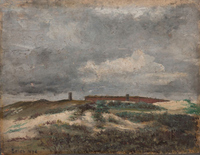
Ensor’s postcard-size studies on hard cardboard, often inscribed on the back with the date and time of their execution, acknowledge his early engagement with Realist technique and practice.[2] In these initial explorations, Ensor, working directly from nature with tight brushstrokes using warm grounds and a tonal palette of grays, pale blues, and greens, imbued the Belgian coast and its dunes with an immersive wildness. At the same time, he naturalized the narrative of Belgium’s recent past, intertwining this native milieu with the region’s recent history by including the brick forts and rampart fortifications built during the Napoleonic era in paintings like Fort Wellington (fig. 2) and Fort Napoléon (1876; Mu.ZEE, Ostend).
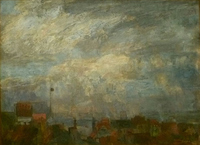
Returning to Ostend after his studies at the Royal Academy of Fine Arts in Brussels (1877–79), Ensor brought together Realist theory, scientific observation, and the artist’s distinctive gaze. From his attic studio, he painted scenes looking down at the street in Rue de Flandre sous la neige (Rue de Flandre in the Snow) (1880; Foundation Socindec, Vaduz, Liechtenstein) and Rue de Flandre sous le soleil (Rue de Flandre in Sunlight) (1881; private collection); or gazing out over rooftops in Grande vue d’Ostende (Toits d’Ostende) (Large View of Ostend [Rooftops of Ostend]) (fig. 3). These painterly glimpses record with both brush and palette knife moments of perception and sensation in changing light, joining Ensor’s vision with changeful and transient modernity.
Modern Light
While in Brussels studying at the academy, Ensor was introduced to a vibrant creative and intellectual community that included writers from La Jeune Belgique (The Young Belgium) literary movement and members of the artist collectives Société Libre des Beaux-Arts (Free Society of Fine Arts), La Chrysalide (The Chrysalis), and Les XX (The Twenty)—the latter of which he helped found. At the salons hosted by his friends and patrons, Mariette Hannon Rousseau (1850–1926) and Ernest Rousseau (1835–1905), Théo Hannon’s sister and brother-in-law, he met scientists, politicians, and others allied with left-leaning progressive and socialist beliefs. These contacts introduced him to new philosophies and artistic innovations, deepening his engagement with contemporary debates and the interwoven realms of art theory, science, politics, and social activism. As he expanded the perceptual and expressive dimensions of his vision and refined his understanding of light and subjectivity, Ensor’s immersion in this dynamic cultural milieu as well as in Brussels’s lively theater, popular entertainments, and bustling street life, reinforced the performative and critical dimensions of his distinctive artistic vision.
Ensor’s investigation of light also intersected with ongoing scientific research on perception and consciousness. As Jonathan Crary has shown, nineteenth-century philosophical debates regarding the link between external reality and subjective experience paralleled scientific studies on the retina and optic nerve, encouraging a more physiological understanding of vision and a greater emphasis on temporality and subjectivity.[3] Thinkers like Johann Wolfgang von Goethe (1749–1832) and Arthur Schopenhauer (1788–1860) argued for perception as an autonomous and personal process, experienced through time. This perspective positioned both the body and eye as sites of power, truth, and process, prompting artists like Ensor to shift their focus toward the experiential and temporal. Increasingly, he and other contemporaneous artists sought to make evident in their work the simultaneity of their optical and personal realities by manipulating pictorial elements such as perspective, spatial discontinuity, flatness, and modeled depth.
Drawing from the practice and techniques of Courbet and Edouard Manet (1832–83)—whose work he may have encountered in Paris—and in paintings by Belgian and French Impressionists (many of whom exhibited at Les XX), Ensor created a number of large paintings depicting interior scenes drawn from observation of his home and surroundings. Filled with subtle atmospheric light filtered through curtains, windows, or reflected in mirrors and rendered with an increasingly prismatic color palette, these rooms, both public and private, convey the perceptual and material aspects of modern experience. Highlighting both the vibrancy of contemporary life and the dynamics of class and gender within these spaces, these paintings offer an incisive social narrative that encourages viewers to observe and reflect upon the values and priorities of modern Belgium.
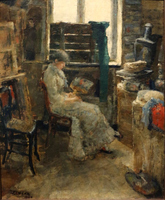
Une coloriste (A Colorist) (fig. 4) presents a contemporary subject: an interior view of a woman—Ensor’s sister Mitche (Marie Ensor, 1861–1945)—painting a fan. Sunlight, filtered through a partially obstructed window, illuminates the narrow and cluttered attic studio space with shifting patterns of light and shadow. This backlighting accentuates Mitche’s face, hands, clothes, and the fan she decorates, drawing attention to her domestic work, as the fan is likely destined for the family souvenir shop. By including a mirrored self-portrait in the background along with a palette and brushes at the lower right, Ensor inserts himself in this attic studio, inviting the public to adopt his perspective and identify with this shared social space. Through this loop of observing and making, Ensor connects perception, expressive individuality, work, and artistic creation, transforming this domestic moment into a thoughtful exploration of labor, artistry, and creativity.
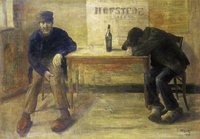
In Les pochards (The Drunkards) (fig. 5), bright light entering from a window on the left floods the bare tavern interior with colorful atmospheric light while the two men seated at a table seem oblivious to its warmth and brilliance. Wearing wooden shoes and dark clothing indicative of their working-class status, they barely interact. One man collapses onto the table with his head in his arms while the other faces forward. A bottle sits on the table between them, and an empty glass—proof of heavy drinking—lies on the floor. The sunny ambiance of the setting accentuates the workers’ tired, inebriated poses and distant gazes, creating a sharp contrast with present-day reality as suggested by the poster for a bankruptcy auction on the wall behind them, visually linking the men’s intoxicated state with the loss of possessions and dignity. This sensitive and detailed evocation of color and light transforms this scene drawn from everyday life into a social allegory as Ensor makes visible the problem of alcoholism among Belgium’s working class.
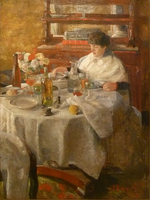
A dining room serves as the setting for La mangeuse d’huîtres (The Oyster Eater) (fig. 6), a masterly evocation of the multifaceted, experiential plein-air light and spectacle of modern bourgeois life. A warm light rendered in quick, gestural brushstrokes of red, yellow, and orange enters through curtained windows reflected in the sideboard mirror. The subtle ambiance of this interior view combines with the complex patterns of opaque, transparent, and reflected light at play on the bottles, glasses, and plates displayed on the cloth-covered table at the center of the composition to accent the scene’s sensual and material appeal and its intimate view of middle-class life. The solitary diner, again posed by Mitche, sits at the table gazing intently at her meal of oysters, her relaxed posture and engagement with this lush environment of color and light underscoring the sensory pleasures associated with bourgeois life. In the foreground, a chair for Mitche’s recently departed dining companion leaves space at the table for the viewer to join the meal. Rather than offering a critical point of view, Ensor celebrates the intimacy and privacy circulating within the light and ambiance of this bourgeois space.
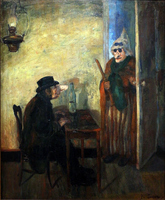
A single oil lamp lends dramatic effect and psychological tension to Les masques scandalisés (The Scandalized Masks) (fig. 7), a scene that takes place not in a tavern or salon but in Ensor’s studio. The lamp, with its arc of glowing gaslight and deep shadow, intensifies the confrontation between two figures, a man seated at a table and a woman entering through a doorway holding a clarinet. Both are dressed in simple working-class attire, their faces masked. The unsettling presence of masquerade combines with the lamplight to add an element of artifice and theatrics, elevating the painting’s expressive impact beyond conventional realism. Instead of portraying the sensory and pleasurable aspects of everyday life, Ensor now draws attention to the studio’s constructed environment, blending observation, exaggeration, and invention to craft a staged narrative filled with themes of travesty, alienation, and violence—provocations meant to challenge or perhaps “scandalize” middle-class audiences.
The oil lamp that draws attention and intensifies the atmosphere in Les masques scandalisés also exemplifies how advancements in lighting technologies influenced visual culture in the late nineteenth century. In venues such as café-cabarets, theaters, burlesque revues, circuses, and sideshows, innovations including spotlights, stage lighting, and magic-lantern projections—powered by oil, gas, and ultimately electricity—broadened and redefined everyday experience through enhanced dramatic effect, simulation, illusion, and the evocation of dreamlike or fantastical environments.[4] As a regular patron of these spaces, Ensor was drawn to the performative spectacle of the street, where hidden and magic-lantern projections using glass slides, silhouettes, moving screens, and colored light effects staged scientific demonstrations, Jules Verne’s adventures, Saint Anthony’s temptation, and other supernatural illusions.
Symbolic Light
By the mid-1880s, interiors filled with naturalistic light and atmosphere gave way in Ensor’s work to paintings where the studio becomes the space of invented narrative with proscenium layouts, stage lighting and spotlights, costumes, masks, puppets, and mannequin-like figures. Rather than descriptive evocations of the contemporary world, the painted space now describes a “theater of artifice” where arrangements combining imagination and invention, performance and theatrical display transform Ensor’s subjectivity and contrary individualism into expressive social allegories of modern experience.
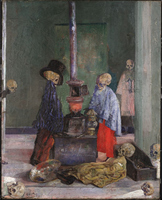
In Squelettes voulant se chauffer (Skeletons Trying to Warm Themselves) (fig. 8), Ensor turns his studio into the setting for a macabre show filled with theatrical staging and light. At the painting’s center, puppet-like figures—made from cloth and crowned with skulls—gather around a stove, surrounded by more skulls, skeletons, and decorative objects symbolizing social status, creativity, and the arts. These skeletal actors, dependent solely on their attributes and costumes, dramatize the artist’s journey in pursuit of sustenance, warmth, and potentially, inspiration. Brought to life through dramatic lighting and vibrant color, this absurd staged performance of skeletons seeking heat makes visible Ensor’s vision of artistic creation and bourgeois life.
For Ensor, light embodied not only observation and experience but also emotion and feeling. This dual aspect of light drew him to Rembrandt (1606–69), whose work he encountered in the print room of the Royal Library in Brussels and during a trip to Holland in 1883. Ensor was also drawn to the paintings of Joseph Mallord William Turner (1775–1851), which likewise joined intense opticality with perceptual autonomy. At the salons of Les XX, Ensor encountered the moody etchings of London by James McNeill Whistler (1834–1903) and lithographs by Odilon Redon (1840–1916), which fused light with imagined spectacles populated by biomorphic forms derived from science. As print historian Izanna Mulder demonstrates in her insightful essay on Ensor’s etchings, his experiments with intaglio processes and technique led him to discover new ways to treat light as both an observed phenomenon and a symbolic form.[5]
While these and other artists encouraged Ensor to explore the expressive and symbolic potential of light, Symbolist artists, writers, and playwrights, turning inward, used subjectivity and invention as means of visualizing inner states of experience. Brussels was a key center for Symbolism, staging new plays, including puppet works by Maurice Maeterlinck (1862–1949) and Charles van Lerberghe (1861–1907). Rejecting naturalism, these productions drew on marionette-like movement, stylized gesture, spoken text, and mime to evoke the expressive and symbolic within the everyday. A comparable strategy appears in the monodrama The Juror by Edmond Picard (1836–1924), presented at the Les XX salon of 1887—likely seen by Ensor—in which offstage narration was paired with an installation of Redon’s drawings. White‑faced Pierrot performances similarly privileged symbolic form over plot, using pantomime and deliberately stiff, expressive gestures on theatrically lit café and theater stages.
Nineteenth-century popular culture often paired light with spirituality, circulating these associations through entertainments, pamphlets, and public performances. As cultural historian Evelien Jonckheere has shown, hidden-lantern shows helped negotiate the relationship between modern life and spiritual belief by turning light into phantasmagoric illusion. Projections, special effects, and immersive spectacles visualized forms of spiritualism—especially Spiritism, which sought contact between the living and the dead—as well as occultism, which linked ancient doctrines to contemporary science.[6] The founder of Theosophy, Helena Blavatsky (1831–91), whom Ensor may have encountered during her stay in Ostend from July 1886 to May 1887, likewise wrote extensively on connections between science and light’s symbolic meanings.[7]
While Ensor’s sharply observed paintings of his contemporary milieu and his theatrical inventions of performance and artifice use light to probe the spectatorial and expressive dimensions of modernity, his series of large‑format drawings entitled Visions: Les auréoles du Christ ou les sensibilités de la lumière (Visions: The Halos of Christ or the Sensibilities of Light) focuses on light as both a perceptual and a symbolic force allied with spirituality. Blending history and religious allegory with light, atmospheric effects, and descriptive details drawn from contemporary experience, Visions presents Ensor’s distinctly personal and original representation of Christ’s life. As suggested by the titles La gaie (The Gay), La vive et rayonnante (The Lively and Radiant), La crue (The Cruel), La triste et brisée (The Sad and Broken), La tranquille et sereine (The Tranquil and Serene), and L’intense (The Intense), each drawing joins the materiality and sensation of observed light with emotional states of being. Inspired in part by Rembrandt’s etchings, which also associate Christ with light, Ensor uses illumination in Visions as a metaphor for Christ’s spiritual and social mission and the embodiment of his own subjective sensation and self‑identification with Christ.
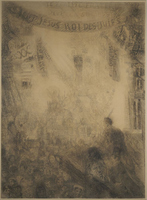
In the first and largest drawing of the series entitled La vive et rayonnante: L’entrée du Christ à Jérusalem (The Lively and Radiant: The Entry of Christ into Jerusalem) (fig. 9), light operates as description and symbol, observation and interpretation, personal experience and collective spectacle. Shifting the biblical episode to a modern metropolis resembling Brussels and casting Christ’s arrival as occurring during a workers’ demonstration, Ensor links the claustrophobic crush of the crowd with the current anxieties surrounding mass politics and fear of mob rule. Signs, banners, and flags fill the scene with competing discourses that connect Flemish socialist politics with the languages of commerce, contemporary art, and religious debate. At the front of the procession, a collaged portrait copied from a photograph of the French positivist Émile Littré (1801–81) associates the “lively and radiant” light in this drawing with socialism and Littré’s scientific and social thought. Reimagining Christ’s entry as part of the street’s spectacle, with light serving as a vehicle for perception and expressive interpretation, Ensor immerses his audience in the dynamic luminosity of modern experience and contemporary debates over religion, spirituality, and social activism.
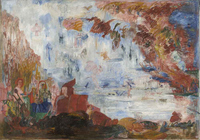
Les tribulations de saint Antoine (The Tribulations of Saint Anthony) (fig. 10) returns to the North Sea, the site of Ensor’s earliest encounters with light, where perception and subjectivity first coalesced into his distinctive artistic vision. Here, light again functions as a social allegory. Saint Anthony sits on the shore behind an open book, surrounded by garbage and debris, nudes, and grotesque creatures embedded in a thick, repellent surface of bilious brown, bloody-red, and manure-yellow paint. As devils and hybrid monsters foul the water and spread contagion, the saint’s struggle for spiritual clarity amid temptation is set within the shimmering light of the North Sea and sky. Now, rather than describing the changeful atmosphere of the natural world, Ensor allies his vision with expressive revelation.
For Ensor, to be “ennobled by the light” is to highlight its transformative role—shaping observational studies and expressive techniques, elevating perception, and revealing social truths. In Ensor’s work, light embodies sensation and feeling, makes visible the social narratives and values within modern experience, and articulates the artist’s quest for spiritual transformation. Through the interplay of technique, subject matter, and interpretation, Ensor’s vision gains agency and meaning as light illuminates the social and spiritual life of modern Belgium.
Acknowledgments
A warm thank you to Patricia Berman, Petra Chu, Robyn Roslak, Herwig Todts, Cathérine Verleysen, and Sabine Taevernier for their advice, comments and assistance.
Notes
[1] See Ensor’s essay “Reflections sur l’art,” which was first published in 1892 but dated 1882 in the special issue of La Plume in 1898 dedicated to Ensor. This essay was given the same date of 1882 when published in James Ensor, Mes écrits (Éditions Nationales, 1974), 50. For an insightful discussion of Ensor’s writings on vision and aesthetics, see Herwig Todts, James Ensor, Occasional Modernist: Ensor’s Artistic and Social Ideas and the Interpretation of His Art (Brepols, 2018), 200–11.
[2] These works mostly measure 7 1/8 in. by 9 1/2 in. (18 x 24 cm). In his discussion of these paintings, Todts lists twenty-six “cartons roses” (Todts, James Ensor, Occasional Modernist, 294–97), as does Xavier Tricot in his catalogue raisonné, James Ensor: The Complete Paintings (Hatje Cantz, 2009), 230–35.
[3] Jonathan Crary, Techniques of the Observer: On Vision and Modernity in the Nineteenth Century (MIT Press, 1990).
[4] For a discussion of the technological advances in oil, gas, and electrical lighting in the second half of the century, see Wolfgang Schivelbusch, Disenchanted Night: The Industrialization of Light in the Nineteenth Century (University of California Press, 1988). See also Vanessa R. Schwartz, Spectacular Realities: Early Mass Culture in Fin-de-Siècle Paris (University of California Press, 1998).
[5] Izanna Mulder, “‘Sublime by Mystery’: On Ensor’s Quest for Light,” in James Ensor and the Graphic Experiment, ed. Willemijn Stammis and Izanna Mulder, exh. cat. (Museum Plantin-Moretus, 2024), 77–99.
[6] Evelien Jonckheere, “‘Hidden Lanterns’ in Fin-de-Siècle France and Belgium: (Dis)Belief in Spiritualist Apparitions at the Fairground, Music Hall, and Artistic Cabaret,” in Faith in a Beam of Light: Magic Lantern and Belief in Western Europe, 1860–1940, ed. Sabine Lenk and Natalija Majsova (Brepols, 2022), 225–40.
[7] See, for example, Helena Blavatsky, The Secret Doctrine, the Synthesis of Science, Religion and Philosophy, 2 vols. (London, 1888).