James Ensor’s La petite Chinoise: A Case Study of Modernist Chinoiserie
by Petra ten-Doesschate ChuPetra ten-Doesschate Chu is professor emerita at Seton Hall University. She has published extensively on nineteenth-century art, including books, edited volumes, exhibition catalogues, and scholarly articles. She is the cofounding editor of Nineteenth-Century Art Worldwide.
Email the author: petra.chu[at]shu.edu
Citation: Petra ten-Doesschate Chu, “James Ensor’s La petite Chinoise: A Case Study of Modernist Chinoiserie,” Nineteenth-Century Art Worldwide 25, no. 2 (Summer 2026), https://doi.org/10.29411/ncaw.2026.25.2.6.
This work is licensed under a Creative Commons Attribution-NonCommercial 4.0 International License  unless otherwise noted.
Your browser will either open the file, download it to a folder, or display a dialog with options.
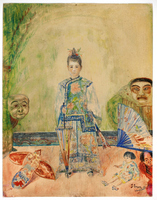
James Ensor’s (1860–1949) Portrait of the Artist’s Niece in Chinese Costume (fig. 1), in the collection of the Art Institute of Chicago, is among the artist’s lesser-known works. Yet, it is likely that La (or Ma) petite Chinoise (The [or My] Little Chinese Girl), as Ensor referred to it, was a work he cherished. He may have kept it until his death,[1] sending it only to select exhibitions, like the Salon des Peintres et Sculpteurs de L’Enfant (Salon of Painters and Sculptors of the Child) at the Musée Moderne of Brussels (1905).[2] His attachment to the watercolor was no doubt related to his fondness for his niece, who for much of her childhood lived in the Ensor family home in Ostend. Ensor frequently referred to her in his letters, always in endearing terms, though often using words that emphasized her biraciality, like petite Chinoise, or petit diable chinois (little Chinese devil).[3]
In this article I propose to look at Ensor’s portrait of his niece as a case study of modernist chinoiserie and, by extension, as a key example of Ensor’s “occasional” modernism.[4] The notion of modernist chinoiserie was introduced in 2015 in British Modernism and Chinoiserie, a volume edited by the British literary scholar Anne Witchard.[5] The book argues that a renewed interest in Chinese art and literature immediately after the turn of the nineteenth century is an important yet largely overlooked aspect of British modernism—in art, design, and literature as well as theater. Though focused on the United Kingdom, Witchard’s book has broader European and even North American implications. It is one of several publications, all from the last two decades,[6] that have demonstrated that chinoiserie is not an exclusively eighteenth-century phenomenon that died a slow death in the course of the nineteenth century, as asserted by well-known historian of Chinese art Michael Sullivan in 1972,[7] but rather a prolonged, living tradition that went through several phases, roughly aligned with the Rococo, Romanticism, Realism, and modernism. Modernist chinoiserie, as Witchard’s book demonstrates, differs from previous forms of chinoiserie in its ambiguity: the way in which, in art as well as literature, the traditional happy fantasy of China repeatedly bumps up against the country’s turn-of-the-century wretched reality. Ambiguity and indeterminacy are, of course, major aspects of modernism generally, as numerous literary critics and art historians have successfully argued.[8] Among the latter, the art historian Dario Gamboni was the first to propose “ornament and the art of the Far East” as important sources for these modernist qualities of Ensor’s work.[9]
Ensor’s portrait of his niece is one of numerous works by the artist—portraits and still lifes—that contain Chinese (and, less frequently, Japanese) objects. Their presence is often accounted for by the ready availability of such objects in his parents’ store,[10] but Ensor was keenly aware that his interest in Chinese art and his adaptation of Chinese motifs was part of a long tradition. That is suggested by his use of the term “Chinoiserie(s)” in the title of several of his still lifes, such as Chinoiseries, Fans and Fabrics, 1880 (Koninklijk Museum voor Schone Kunsten Antwerpen, Antwerp); Still Life with Chinoiseries, 1906–7 (Koninklijk Museum voor Schone Kunsten Antwerpen, Antwerp); Still Life with Chinoiseries, 1907 (Museum Dhondt-Dhaenens, Deurle); or Skeleton Looking at Chinoiseries, ca. 1910 (Wallraf-Richartz Museum, Cologne), to name only a few. The term “chinoiserie(s)” in the title of these paintings no doubt has a double, or perhaps better, an elastic meaning. According to Larousse’s Grand dictionnaire universel du XIXe siècle, the word “chinoiseries,” in lower case, referred to “small luxury and fancy objects coming from China or executed according to Chinese taste.”[11] That traditional meaning of the term still resonates strongly in the titles of Ensor’s paintings. But during his lifetime, the term “chinoiserie” (often written with a capital “C”) had also come to refer to a European aesthetic, characterized by playfulness and fantasy, that found much of its inspiration in Chinese decorative arts. That “aesthetic” (some would call it a style), which originated in the eighteenth century and survived in modified form throughout the nineteenth, was increasingly recognized as an artistic tradition in Ensor’s time.[12]
La petite Chinoise
Ensor’s Portrait of the Artist’s Niece in Chinese Costume is a watercolor over graphite, retouched with pen and ink, measuring 25 1/8 x 19 5/8 in. (63.8 x 49.7 cm). Looking older than her age—she was six when Ensor portrayed her in 1899—little Alex, as she was known, stands at the center of what looks like a small stage. She is dressed in a Chinese Manchu outfit comprised of a silk embroidered jacket over a floor-length skirt. In her right hand she holds a parasol, in her left a folded fan. The foreground is strewn with toys: a Chinese kite on the left, two Japanese dolls on the right. One is a jointed ichimatsu, the first “play” doll developed in Japan. Uncommonly, the doll is not dressed in a kimono but in leisure pajamas, and on her feet she wears Chinese shoes rather than the Japanese split-toe socks and sandals. The other is probably a Japanese display doll, whose partly shaven head suggests that of a Samurai warrior.[13] Flanking Alex are two figures wearing masks. The figure with the smiling mask, on the left, dressed in a tight, striped shirt, peeks from behind a stage curtain; the figure with the dour mask, on the right, partly hidden by a large, open fan, wears a loose, green-and-red-striped smock with a white bonnet and a white shawl decorated with what might be round, colored flowers. The placement of that figure is difficult to define, as it seems to rise from behind a blue plinth decorated with red fish at the far end of the stage.
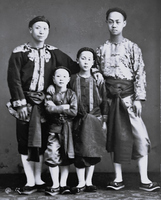
Ensor’s niece Alex, whose full name was Mariette Alexandrine Jeanne Taen (1893–1966), was the daughter of his sister Marie, nicknamed Mitche, and Alfred John Taen (1861–1938), himself the son of a British mother, Frances Alice Poolman (1839–1921) and a Chinese father, Arr-Hee Taen (d. Shanghai, May 27, 1890).[14] Born in Nanjing,[15] Arr-Hee Taen had come to the United States in the early 1850s.[16] There, he had joined a troupe of Chinese jugglers and acrobats that was led by Tuck Quy, who may have been Vietnamese. Alternatively called the Chinese Magicians, the Chinese Jugglers, or the Chinese Artistes, the troupe toured the Eastern seaboard, as several extant broadsides and newspaper advertisements bear out.[17] Sometime in the mid-1850s, Arr-Hee traveled in England, where, on July 1, 1857, having assumed the Western first name Albert, he married Francis Poolman.[18] The couple had two sons, Frederick George, who bore the Chinese name of Er-Toung, born October 24, 1859, and the aforementioned Alfred John (Hee-Tseu),[19] born November 3, 1861 (fig. 2).
In England, Arr-Hee formed his own troupe. A broadside poster from 1860 (fig. 3) has him at the Theatre Royal in Devonport, now part of Plymouth, together with a certain Ahsam, performing various magic tricks. For the next twenty years or so, he successfully toured the United Kingdom and the European continent. An undated broadside for the Harry Ransom Theatre (1870s) announcing the “Final Tour” of the “Great Original Troupe of Chinese” boasts that it had performed in France, Switzerland, Spain, Italy, Austria, Russia, Holland, Germany, Norway, Sweden, and Belgium.[20]
Fig. 3. “The Original Chinese Musicians and Jugglers,” 1860. Letterpress poster. Image in the public domain; courtesy of Potter & Potter Auctions, Chicago (sold February 25, 2023, lot 221).
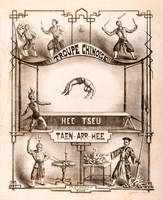
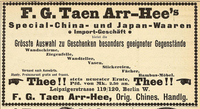
Arr-Hee’s younger son, Alfred/Hee-Tseu, joined his father’s business, becoming an acrobat. An undated poster showing the names of him and his father, printed in Milan (fig. 4), shows him doing somersaults while other members of the Troupe Chinoise execute magic tricks, swallow swords, or perform knife feats. Meanwhile, also in the early 1880s, Alfred’s brother Frederick, perhaps with the financial backing of his father, established an Asian-import store in Berlin, under the trade name F. G. Taen Arr-Hee Original Chinesische Handlung.[21] Eventually, both Albert/Arr-Hee and Alfred/Hee-Tseu appear to have joined Frederick’s thriving business, which operated in the wholesale as well as the retail markets and expanded with a branch store in Dresden, as seen in an advertisement (fig. 5).[22]
According to a letter from Ensor to his friends Ernest and Mariette Rousseau, Alfred Taen and Mitche Ensor met in March 1891.[23] Apparently well-to-do by that time, Alfred may have visited Ostend as a tourist, or he may have come as a representative of the family business, offering Chinese and Japanese wares to the Ensors for their souvenir shop. In a letter to Ernest and Mariette Rousseau of May 1891, Ensor announces Mitche’s engagement and reports on Taen’s visit to Ostend to ask for her hand:
The other day I was quietly working in the studio. . . . Suddenly I hear noises, softly first then getting louder. It resembled a riot. There was whistling, stamping of feet, energetic hurrahs, crazy racing, endless screaming. I rush to the window and see a Chinese in a marvelous costume, escorted by several policemen and preceded and followed by a moving crowd, coming toward the house. When the crowd came too close, the Celestial tossed out fistfuls of money and the crowd threw themselves on it.[24]
Later in his letter Ensor praises Taen for his worldliness (he spoke five languages) and his cooking skills, but complained that he had a hard time convincing his future brother-in-law to exchange his Chinese clothes for Western dress.
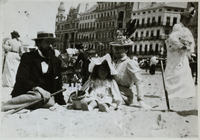
Mitche and Alfred married half a year after they met, on August 31, 1891, in the house of the British consul in Ostend. Though the marriage was initially a success, it had failed by the time Alex was born fewer than two years later, on March 26, 1893, some five months after Mitche had moved back to Ostend from Dresden, where the Taens were living. The little girl grew up with her mother, her uncle, her grandmother, and great aunt Mimi in the Ensor house on Vlaanderenstraat (fig. 6).
Ensor’s Portrait of the Artist’s Niece in Chinese Costume and Modernist Chinoiserie
In his essay “China and the Formation of the Modernist Aesthetic Ideal,” David Porter articulates the difference between eighteenth-century and early twentieth-century chinoiserie as a contrast between pure fantasy, on the one hand, and an invention that is “steeped in a civilizational nostalgia that colours its whimsical flight of fancy with a palpable sense of loss and a pronounced ambivalence towards the triumphs of modernity” on the other.[25] Porter’s point is that, while Western interest in Chinese art and civilization continued and even expanded during the late nineteenth and early twentieth centuries, China was also the victim of Western imperialist exploitation that masqueraded as modernization. At the same time, as Chinese people immigrated into the United States and Europe in ever larger numbers, China and the Chinese were increasingly seen suspiciously as “yellow peril.”[26]
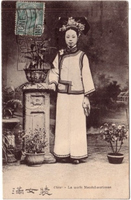
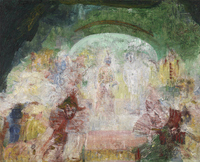
Ensor’s La petite Chinoise exemplifies the ambiguity of turn-of-the-century attitudes toward China and the Chinese. On the one hand, we see a portrait of a beautiful, exotic little girl, dressed in a richly embroidered Manchu outfit, her hair elaborately done up with ribbons and silk flowers. The parasol and fan she holds in her hands and the Chinese toys strewn on the ground create an ambiance of outlandish luxury. On the other, there is the racial Other put on display. The image recalls turn-of-the-century postcards of Chinese women and the traditional fashions in which they are presented (fig. 7). The theatrical setting of the painting recalls at once a photographer’s studio and a small-town stage. We are reminded of Alex’s father and grandfather appearing on stages all over the United States and Europe (see figs. 3, 4). The composition of La petite Chinoise may be compared with that of Ensor’s two versions of Theater of Masks, the first painted in 1889 (fig. 8), ten years before the portrait of his niece, the second nine years later, in 1908 (Museo Nacional Thyssen-Bornemisza, Madrid). Both paintings feature a stage with race on display, as spectators watch a white Pierrot presenting a black-masked Harlequin. As Robert Hornback has shown, the Harlequin, with his black mask or blackface makeup, was a typical “theatergram” for a fool, invoking a tradition of associating blackness with buffoonery that can be traced back to Hellenistic theater.[27]
Ensor’s painting likewise evokes a longstanding Western racial stereotype, that of the (underage) Chinese woman as a doll, a topos that goes back at least to the eighteenth century and continues to this day. Indeed, the very title of the watercolor, La petite Chinoise, is found in numerous novels, poems, and plays. Parnassian poet José-Maria de Heredia (1842–1905) in his sonnet “L’écran” (The screen; 1868) evoked “the little Chinese girl/woman with an ivory face”; his colleague Claudius Popelin (1825–92), in a sonnet called “Chinoiserie,” has “the little Chinese girl/woman with slanted eyes” daintily eating rice with her chopsticks.[28]
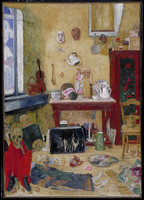
Spectators are lacking in La petite Chinoise, but the painting does contain two masked figures, who appear to be watching the main figure from behind-stage. Both are highly expressive, in contrast to the apparent blank impassivity of the girl (which, of course, is expressive in its own way, signaling both fear and pride). The realistic, Caucasian-featured smiling mask on the left belongs to a small figure dressed in a striped outfit, whose manly shoes confirm his masculinity. The same or a very similar mask is seen on the cover of Ensor’s print series The Seven Deadly Sins and in his painting Skeletons in the Studio (fig. 9). The dour mask on the right looks vaguely exotic, like a Chinese shamanic mask, but it also could be seen as a sad clown or even an angry old woman.
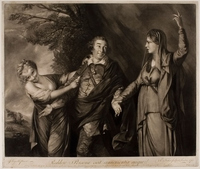
In the context of the theatrical setting of the painting, the two masks may be read generically as comedy and tragedy, along the lines of Joshua Reynolds’s (1723–92) portrait of David Garrick Between Comedy and Tragedy, well-known through numerous mezzotint reproductions (fig. 10). Broadly interpreted, the two figures could represent the ambivalent position in society of biracial children—both joy (gioia) and sorrow (dolore), following the libretto of Giacomo Puccini’s (1858–1924) Madama Butterfly of 1904.[29] But if the mask on the left represents Ensor himself, as Gert Schiff posited in an article of 1980–81 for a similar mask in Skeletons in the Studio,[30] and if Ensor saw himself as the child’s main champion, the other mask could also represent the world of prejudice—condemning the child as the product of a miscegenational blunder—against which he sought to protect her.[31]
A final word about the toys—a Chinese kite and two Japanese dolls—and their ambiguous meanings. The most obvious interpretation is that these are toys sent to the child by her father and uncle, selected among the wares in their store. What distinguishes Ensor’s portrait from other portraits of girls of the period, including Ensor’s own Girl with Doll of 1884 (Wallraf-Richartz Museum, Cologne) is that the child is not engaging with the toys but that they are lying, discarded on the ground. There are various ways to explain this difference: one is the child’s apprehension of the toys as inadequate substitutes for parental love; another is to view the child as a plaything herself—a toy among toys in a shop-window display. It is also tempting to think of the discarded Chinese and Japanese trinkets as a reflection on the loss of the European dream of China at the hands of Western consumerism. That notion is clearly expressed in a contemporary novella called Blank en geel (White and yellow) by the Dutch writer Lodewijk van Deyssel, first published in 1891 in installments under the title “Kruising van Rassen” (Crossing of races).[32] In thinly disguised form, the novella tells the real-life story of the love affair between Alfred Taen’s brother Frederick and the author’s cousin Mia Cuypers, daughter of the well-known Dutch architect Pierre Cuypers (1827–1921). In the novel, May, Mia’s fictional alter ego, falls instantly and madly in love with Tseng-Ki Harr (Frederick), whom she meets at the International Colonial and Export Exhibition of 1883 in Amsterdam. When May first sees him, Tseng-Ki Harr, dressed in his “rich national attire” with a long braid falling down his back, receives his aura (in May’s eyes) from the Chinese goods among which he is standing—slender herons, dreamy floating women, black lacquerware with red-and-gold landscapes, and mother-of-pearl moons.[33] Later, however, when she is about to marry Tseng-Ki Harr, May gets cold feet and suddenly has visions of herself living behind a store in which her husband sells “Chinese . . . rubbish of fans and fabrics and screens and teasets,”[34] or, worse, standing behind the counter forced to pick up the change that clients leave on it.
So where does this leave us? The modernism of Ensor’s Portrait of the Artist’s Niece in Chinese Costume appears to lie in its ambiguity, its ambivalence, and its openness to multiple interpretations. Little Alex stands stock-still on the stage, at once proud of her new dress and aware of its and her own exoticism—in the quite literal sense of “outsiderness.” A product of miscegeny, she is an import into Europe but one that has lost its value through the crossing of bloodlines, just as the trinkets at her feet as well as the fans and parasol surrounding her have lost their purity by their mass production for Western consumers. Indeed, this dainty petite Chinoise is not set in a distant land on a half-moon bridge but stands on a small-town European stage to be gawked at. With its subject both proud and petrified, admired and maligned, strikingly exotic and bizarrely different, Ensor’s portrait of his niece is chinoiserie made modern and brought up to date.
Acknowledgments
For their advice and help, I thank Susan Canning, Hsiao-Yun Chu, Jay Clarke, Marguerite V. Hodge, Robyn Roslak, Isabel Taube, Herwig Todts, Cathérine Verleysen, and Emily Ziemba.
Notes
All translations are mine unless otherwise indicated.
[1] The watercolor’s complete provenance is unknown. Ensor drew a small reproduction of it in a sketchbook, likewise in the Art Institute of Chicago (1955.1021), in which he recorded works still in his possession. That drawing may be dated circa 1929. It is unknown when the watercolor became part of the collection of the Belgian economist and politician Camille Gutt (1884–1971). It was sold after Gutt’s death by Sotheby’s, London, on April 12, 1972 (see Impressionist & Modern Watercolours & Drawings – Part I, auction cat., lot 87), to “Hale” (according to the price list) and resold that same year by E. V. Thaw, New York, to the Art Institute of Chicago. I am grateful to Jay Clarke and Emily Ziemba at the Art Institute of Chicago for this information.
[2] No. 52 in the catalogue for the exhibition, the portrait was titled Ma petite Chinoise. It was referred to as “une amusante aquarelle” (an amusing watercolor) in a review of the exhibition in the Revue de Belgique. Louis Dumont-Wilden, “Chronique artistique: Constantin Meunier – Exposition des peintres et des sculpteurs de l’Enfant,” Revue de Belgique, 2nd ser., April 1905, 498.
[3] James Ensor to Emma Lambotte, August 7, 1906, cited in Danielle Derrey-Capon, ed., James Ensor, Lettres à Emma Lambotte, 1904–1914 (Centre International pour l’Étude du XIXe Siècle, 1999), 107.
[4] I am using the term made current by Herwig Todts in his James Ensor, Occasional Modernist: Ensor’s Artistic and Social Ideas and the Interpretation of His Art (Brepols, 2018).
[5] Anne Witchard, British Modernism and Chinoiserie (Edinburgh University Press, 2015).
[6] See, among others, Petra ten-Doesschate Chu and Jennifer Milam, Beyond Chinoiserie: Artistic Exchange Between China and the West During the Late Qing Dynasty, 1796–1911 (Brill, 2019); Noel Fahden Briceño, “The Chinoiserie Revival in Early Twentieth-Century American Interiors” (master’s thesis, University of Delaware, 2008); and Sarah Cheang, “What’s in a Chinese Room? 20th Century Chinoiserie, Modernity and Femininity,” in Chinese Whispers: Chinoiserie in Britain 1650–1930, exh. cat. (Brighton: Royal Pavilion & Museums, 2008), 74–81.
[7] Michael Sullivan, The Meeting of Eastern and Western Art, rev. and expanded ed. (University of California Press, 1989), devotes one page (116) to nineteenth-century relations between China and the West.
[8] See, among others, Christoph Bode, Äesthetik der Ambiguität: Zu Funktion und Bedeutung von Mehrdeutigkeit in der Literatur der Moderne (Max Niemeyer Verlag, 1988). For art, see Dario Gamboni, Potential Images: Ambiguity and Indeterminacy in Modern Art (Reaktion, 2002).
[9] Gamboni, Potential Images, 79.
[10] On this subject, see especially Norbert Hostyn, “De familie van James Ensor” in Bij Ensor op bezoek, exh. cat. (Mu.ZEE, 2010), 121.
[11] “petits objets de luxe et de fantaisie venus de Chine ou exécutés dans le goût chinois.” Pierre Larousse, ed., Grand dictionnaire universel du XIXe siècle, vol. 4 (Paris, 1969), under “Chinoiserie.”
[12] The historiography of chinoiserie remains to be written. Among the first books to describe it as an art historical phenomenon is Henri Cordier, La Chine en France au XVIIIe siècle (Henri Laurens, 1910), but usage of the term as a stylistic one appears earlier, as in, for example, Salomon Reinach, “La Représentation du galop dans l’art ancien et moderne,” pt. 6, Revue archéologique, ser. 3, vol. 39 (July–December, 1901), 1–11.
[13] I am grateful to Marguerite V. Hodge for identifying these dolls. Marguerite V. Hodge, email message to the author, August 2, 2024.
[14] “Alfred John Taen He-Tsen (Arrhee),” Geneanet, accessed April 2, 2026, https://gw.geneanet.org/.
[15] According to the article “Action Against the Proprietor of the Raglan Music Hall” in The Era, June 8, 1873, dealing with a legal action of Arr-Hee against a certain Mr. Hart, the proprietor of the Raglan Music Hall, Arr-Hee’s birthplace was Nanjing.
[16] Arr-Hee Taen may have arrived in 1852, when a series of crop failures in southern China caused a mass emigration. In San Francisco, the main destination for emigrating Chinese, 25,116 people passed through the city’s custom house in 1852. Smaller numbers went to Hawaii or Panama.
[17] An advertisement in the Pittsburgh Post of January 17, 1853, p. 2, has “Tuck Quy” and “Arr Her [sic]” performing in the Pittsburgh Athenaeum from January 19 to 22, as part of a performance of “Oriental Magicians and Chinese Jugglers.” A broadside for “[Chinese] New and Amusing Exploits” to be performed at the Walnut Street Theatre in Philadelphia in February 1853 (reproduced in The Ricky Jay Collection, Part III, auction cat. [Chicago: Potter & Potter, August 17, 2024], n.p., lot 112) also mentions the names of both Tuck Quy and Arr-Hee.
[18] “Francis Alice Taen Arr-Hee (born Poolman), 1839–1921,” MyHeritage, accessed April 2, 2026, https://www.myheritage.com/. See also “Alfred John Taen He-Tsen (Arrhee).”
[19] The Chinese name of Alfred Taen is spelled in different ways: Hee-Tseu, Hee-Tsen, and He-Tseu. At the time, there was no standard alphabetical transliteration of Chinese characters. To make things worse, the pronunciation or “sounding out” of the characters would vary widely in different parts of the country. I followed the spelling of the name as it appears in the poster illustrated in figure 4: Hee-Tseu.
[20] See “Great Original Troupe of Chinese / Arr-Hee and Troupe” (broadside), undated, Harry Ransom Center, University of Texas, Austin, accessed December 14, 2025, https://hrc.contentdm.oclc.org/.
[21] The earliest advertisement for the store that I have been able to uncover was in Schorer’s Familienblatt 5, no. 25 (1881), Beilage (appendix), n.p.
[22] The Berlin store was located at 119/120 Leizigerstrasse; the Dresden store in the Victoriahaus on the Waisenhausstrasse.
[23] James Ensor to Ernest and Mariette Rousseau, Ostend, May [1891], in “Avec le noble crayon”: Lettres de James Ensor à la famille Rousseau, ed. Jean-Philippe Huys and Xavier Tricot (Royal Museums of Fine Arts Belgium; Peter Lang, 2021), 302–3.
[24] “Dernièrement j’étais tranquille à l’atelier travaillant à une composition bizarre. . . . Subitement, j’entendis des rumeurs vagues d’abord, puis croissant. Cela ressemblait à une émeute. C’était des sifflements, des trépignements, des hurrahs énergiques, des courses folles, des clameurs sans fin. Je me précipite à la fenêtre et je vois un chinois en costume merveilleux escorté par plusieurs agents de police et précédé et suivi par un flot de monde, se diriger vers la maison. Quand la foule le pressait trop vivement, le céleste jettait [sic] des poignées d’argent et la foule se ruait dessus.” James Ensor to Ernest and Mariette Rousseau, Ostend, May [1891], in Huys and Tricot, “Avec le noble crayon,” 301–2. Note that “le céleste,” or “the Celestial,” refers to an inhabitant of the Celestial Empire, a traditional way of referring to China. Nineteenth- and early twentieth-century references to Chinese people as “Celestials” often have a mocking or even derogatory connotation.
[25] David Porter, “China and the Formation of the Modernist Aesthetic Ideal,” in Witchard, British Modernism and Chinoiserie, 20.
[26] The term “yellow peril” (péril jaune) was first used in 1897 in the title of an article by Jacques Novikow in the Revue internationale de sociologie that was subsequently published as a book: Jacques Novikow, Le Péril jaune (Paris: Giard and Brière, 1917). As Herwig Todts has kindly informed me, Ensor was familiar with the expression. In 1938, he painted two nearly identical still lifes on small panels (each measuring 5 1/2 x 7 in. [14 x 18 cm]; both in private collections), in the center of each of which a miniature copy of the Medici Venus, set against a bright yellow background, faces a small African sculpture and what looks like a Chinese porcelain figurine. Imaginative “live” figures, including pink nudes, Chinese-inspired dancers, and monsters of various kinds flank the central still life. Both paintings are inscribed in the lower right with the words Péril extra jaune (extra-yellow peril). For one version, see James Ensor, Péril extra jaune, 1938, MutualArt, accessed April 2, 2026, https://www.mutualart.com/.
[27] Robert Hornback, Racism and Early Blackface Comic Traditions (Palgrave/Macmillan, 2019), 35–69.
[28] “la petite Chinoise à figure d’ivoire” (Heredia); and “la petite Chinoise, à l’oeil oblique” (Popelin). Both poets quoted in William L. Schwartz, The Imaginative Interpretation of the Far East in Modern French Literature, 1800–1915 (Champion, 1927), 41, 42.
[29] In act II of the libretto for Madama Butterfly, “Sharpless” asks Butterfly’s son for his name. She answers for him: “Today my name is Sorrow. But when you write to daddy, tell him that the day he returns I shall be called Joy, Joy!” (Oggi il mio nome è Dolore. Però, dite al babbo, scrivendogli, che il giorno del suo ritorno Gioia, Gioia mi chiamerò).
[30] Gert Schiff, “James Ensor: Skeletons in the Studio,” Annual Bulletin of the National Gallery of Canada 4 (1980–81), https://www.gallery.ca/.
[31] Ensor’s famous work The Intrigue (1890; Koninklijk Museum van Schone Kunsten Antwerpen, Antwerp; and a version of 1911 in the Minneapolis Institute of Art) has often been read as a visual depiction of blunder. It shows a young couple, who could be seen as biracial—European and Chinese—being mocked by a crowd. An old woman in the foreground, yelling, holds a floppy Chinese doll up to them. However, the earliest version of the painting is dated 1890, before Mitche’s marriage to Taen. As Herwig Todts has informed me, the painting has been submitted to numerous scientific tests and does not show signs of later reworking.
[32] The novella was serialized in five installments in the popular weekly Eigen Haard in 1892. In March 1894, it appeared in book form under the initials A. J., which correspond neither to the author’s real name, Karel Johan Lodewijk Alberdingk Thijm, nor to his pseudonym, Lodewijk van Deyssel.
[33] Lodewijk van Deyssel, Blank en geel (Bert Bakker, 1979), 106–7.
[34] “de . . . Chinese rommel van waaiers en lappen en tochtschermen en theeserviezen.” Van Deyssel, Blank en geel, 121.