The Delirious Aesthetics of James Ensor
by H. R. BlakeleyH. R. Blakeley received her PhD in art history from Princeton University, where she is now a faculty member in the Princeton Writing Program. Her current book project explores how Belgian artists James Ensor and Léon Spilliaert transformed carnival from a social practice into a radical artistic strategy, offering a new and emphatically visual conception of the carnivalesque. She has published “Le 17e siècle de Rops: Vers la modernité” with the Musée Félicien Rops in Belgium and recently recorded a short video interview with leonspilliaert.be. Her research has been supported by the Fulbright Scholars program and the Belgian American Education Foundation.
Email the author: blakeley[at]princeton.edu
Citation: H. R. Blakeley, “The Delirious Aesthetics of James Ensor,” Nineteenth-Century Art Worldwide 25, no. 2 (Summer 2026), https://doi.org/10.29411/ncaw.2026.25.2.5.
This work is licensed under a Creative Commons Attribution-NonCommercial 4.0 International License  unless otherwise noted.
Your browser will either open the file, download it to a folder, or display a dialog with options.
The philosopher Friedrich Nietzsche (1844–1900) writes in his Twilight of the Idols (1889), “If there is to be art, if there is to be any aesthetic doing and seeing, one physiological condition is indispensable: frenzy.”[1] Nietzsche imbues a variety of frenzies with this creative power, from that induced by extreme movement, sexual arousal, and feasts and festivity to that arising from cruelty, destruction, and narcotics. This conception of creativity as frenzy had appeared in Nietzsche’s work almost two decades earlier in The Birth of Tragedy (1872), where he introduced the dueling forces of the Apollonian and Dionysian as essential to art making and used “the analogy of intoxication” to explicate the Dionysian.[2] Both comprise a sort of frenzy, but while the Apollonian engages the eye, form, line, and reason, the Dionysian encompasses transformation and metamorphosis, harnessing the energy of inebriation and ecstasy.
In the original German, the word Nietzsche uses for this vital creative catalyst is Rausch, translated into English as “frenzy” by Walter Kaufmann in the 1950s.[3] A newer Stanford translation interprets the word instead as “intoxication.”[4] Depending on the dictionary, Rausch might also mean “ecstasy,” “rapture,” “high,” “drunkenness,” or “exhilaration,” a nexus of translations that describe the out-of-body, otherworldly sensations Nietzsche associates with the making of art.[5] I propose that we think about this force as “delirium”—a word chosen for its period connotations—and use it to articulate what I term a delirious aesthetics in the work of Belgian artist James Ensor (1860–1949). In nineteenth- and early twentieth-century Belgium, délire (delirium) was a matter of cultural and political urgency, as commentators linked delirium not only with drunkenness but also with madness and societal degeneration. While intoxication was part of everyday life and festivals in Belgium during this period, contemporary literary, popular, and medical discourses increasingly expressed anxieties about the relationship between alcohol and national identity, sensationalizing the outward symptoms of altered perceptual states. In his art, Ensor mobilizes the fraught visual idiom of intoxication while also, following Nietzsche, envisaging delirium’s hallucinatory possibilities as preconditions to art making. As Ensor wrote in 1935, articulating his artistic aims, “A good painting reflects, to the extreme, the varied stages of life: its images, its sorrows, its frigidities, its intoxications [ivresses], and its delights.”[6] Ensor thus engages delirium as both subject matter and creative stimulus, a force essential to his artistic production and identity.
A thirst for drink “always . . . everywhere, and under all circumstances, seems to be the national characteristic of the Belgian,” pronounced the governor of the Provincial Council of Hainaut in 1903.[7] In a study of turn-of-the-century Belgium, English social reformer and industrialist Benjamin Seebohm Rowntree (1871–1954) dedicates an entire chapter to the excesses of Belgian drinking. He expresses astonishment at the quantities of wine, beer, and jenever—the gin-like “national spirit” of Belgium—consumed by the average Belgian worker, an alcohol intake which exceeded that of almost every other European nation.[8]
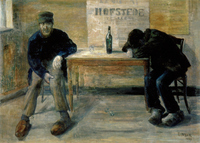
Drinking often took place in traditional Flemish pubs, or estaminets, a practice that Belgian writer Camille Lemonnier (1844–1913) identifies as an “immutable custom” of Brussels life.[9] He describes how “important people, burgomasters, [and] ministers of the king,” unfailingly “do their estaminet,” considering it no breach of etiquette “to leave a dinner at the Palais to sit before a glass of lambic.”[10] In his painting Les pochards (The Drunkards) (fig. 1), Ensor explores the social and economic impact of these drinking behaviors on Belgium’s working class, depicting two men sharing a bottle of jenever. Dressed in coarse coats, caps, and trousers, these rural laborers slouch against a table, their bodies twisting clumsily atop small, mismatched chairs. One man has slumped over, capitulating to drunken weariness, while his glass has fallen and rolled, curiously intact, to the center of the floor. His companion glances across the room with unfocused eyes, right hand gripping his thigh as if to steady himself, a last tether to the physical world. Bright light filters into the tawny-hued pub, the flush of morning or midday signaling the drinkers’ idleness at peak working hours.[11]
A poster behind the two men advertises an evicted farm, or hofstede, for rent, cluing alcohol’s threat to job stability, social station, and property ownership.[12] This precarity is echoed in the workers’ bodies, which Ensor has closed into a corner, cropping the painting tightly around their heads and feet. The floor climbs up the canvas, narrowing the space of the room and sliding the figures toward the viewer. Signs of imbalance are everywhere—in each worker’s tenuous seat on his chair, the glass’s suspension on the floor, the sleeping figure’s rolling ankle—destabilizing drinkers and viewers alike with a deceptively constructed space. Both men seem primed to drop forward at any moment, preserved only momentarily in place like the fallen glass.
In an 1884 article in La jeune Belgique, Lemonnier disparages the “stupor” wrought by excessive carnival drinking, voicing a more explicit critique of the imagined reader’s “senseless” intoxication: “Reason spins within you, and we see your body oscillating on an unstable base, full in the belly, empty in the head. . . . You undergo . . . a kind of ecstasy. . . . It’s a drinker’s hallucination, heavy, feverish, crawling, sloppy, raucous.”[13] Lemonnier’s vivid descriptions of this “delirium” rhyme with the ways in which alcoholism was pathologized at the time.[14] Medical discourse on delirium tremens, an acute condition precipitated by an alcoholic’s sudden abstention, surged in the nineteenth century. Valentin Magnan (1835–1916), a pioneer of psychiatric medicine in France, conducted extensive laboratory and clinical studies on the effects of absinthe and “alcoholic madness,” which included “hallucinatory disturbances,” “profound terror,” “manic, melancholic, and stupid” physiognomies, and a range of “sensory disturbances.”[15] He describes auditory distortions alongside changes to patients’ vision, which becomes “blurred, darkened, with dazzling flashes of light; there are sparks, flames, various colors, shadows, trembling objects, phantoms.”[16] Documenting the symptoms of one of his alcoholic patients, Magnan notes “vertigo,” “convulsions,” and “a delirium with frightening hallucinations.”[17]
Sensational language infiltrated the popular press, too, furnishing a vivid lexicon of the perceptual and physiological effects of delirium. The Journal de Bruxelles reported on the condition of “poor drunks” who “resembled real savages.”[18] As a self-proclaimed medical man asserted in Le peuple in December 1900, one can diagnose alcoholism through “the fixed gaze,” “tremors, . . . sensitivity disorders, [and] dream hallucinations.”[19] And the debilitating effects of alcoholism didn’t stop with the drinker him- or herself; commentators voiced fears that drunkenness—particularly, and unfairly, that of the working class—would lead to cultural degeneracy and weakening of the nation.[20] Quoting a lecture delivered at the Pavillon Malibran in Ixelles in 1882, a journalist describes how in the first generation of an alcoholic’s lineage, symptoms include “immorality, degradation, . . . [and] moral stupor. In the second generation: . . . manic fits, general paralysis. In the third . . . : hypermania, . . . homicidal tendencies. In the fourth . . . : idiocy, and the probable definitive extinction of the race.”[21]
These cultural elisions of intoxication, madness, and degeneracy raise the stakes of delirium, imbricating its terms—the hallucinatory, the vertiginous, the depraved—with anxieties about cultural identity and social disorder. In a single image, Les pochards collapses this cycle of drink, bankruptcy, unemployment, and decline sensationalized in the press, its subjects physically debilitated by knocked knees and torqued feet while mentally enfeebled. Delirium was accorded the sinister power of altering individuals’ interiority, vitiating hereditary inheritance and undermining the functioning of society.
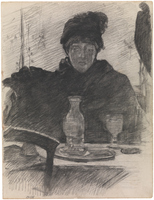
The effects of absinthe, in particular, fueled popular and pictorial imaginations, as artists such as Edouard Manet (1832–83) and Edgar Degas (1834–1917) in France and Félicien Rops (1833–98) in Belgium represented drinkers of absinthe or other liqueurs as socially downcast and desolate or as streetwalking femmes fatales. Ensor, too, draws an absinthe drinker in the 1880s, taking a realist, socially critical attitude (fig. 2). In Ensor’s charcoal rendering, a woman sits before a glass and a small carafe, the top of an empty chair carving a sharp corner in the bottom left of the sheet. Ensor heavily shades the drinker’s face and clothing, trailing streaks down both cheeks that give the impression of tears or a striated, unhealthy complexion. With one arm dangling over the back of the bench, the woman sinks into troubled contemplations, a grimace playing at the corners of her mouth. In this work, as in Les pochards, we are excluded from the visions that render the drinker pallid and perturbed, witnesses only to alcohol’s physiological and social consequences.
In other works, however, especially those featuring Saint Anthony, Ensor wrests the inside out, opening this interior world to us and envisioning delirium as a hallucinatory reality. Over the course of several decades, he depicted Anthony’s visions across a variety of media: three paintings, a large drawing-collage, two smaller drawings, and an etching. Ensor was hardly the first to seize on this subject; the story of Saint Anthony and his temptations in the Egyptian desert have proved popular throughout Western art history, including in famous works by Hieronymus Bosch (ca. 1450–1516), Martin Schongauer (ca. 1430–91), Matthias Grünewald (ca. 1470–ca. 1530), and Jacques Callot (1592–1635), as well as in Gustave Flaubert’s (1821–80) novel La tentation de saint Antoine (The Temptation of Saint Anthony) from 1874, all of which influenced artists such as Ensor. Each of these works features Anthony’s visions of demonic monsters hatching, flying, and excreting in hellish landscapes, elements that Ensor folds into his own renditions of the episode.
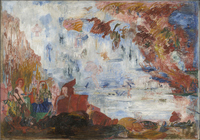
Ensor made his two most significant representations of Anthony in 1887, in an oil painting and a large drawing-collage. In the painting, Les tribulations de saint Antoine (The Tribulations of Saint Anthony), Ensor depicts the red-cloaked saint, enthroned in a mound of muck, clutching a large book (fig. 3). Distracted from his meditations, Anthony turns his face—pale, blotchy, and scabbed, with a slice of flesh for a lip and a beaked red nose—to the left, displaying a profile grizzled by pox or leprosy. Fantastical figures cluster around him, a Boschian assemblage of winged, horned, multilimbed creatures playing instruments, brandishing drinks, and oozing bodily fluids. Signs of modernity mix with classical architecture, collapsing markers of time: an anthropomorphized hot-air balloon floats toward the top of the composition while a tray of drinks presented by a nude woman at the left evokes an urban café.
Ensor inscribes his creatures in the same pictorial plane as the saint whose vision has conjured them, not differentiating spaces of reality and fantasy. As the figments of his religious reverie solidify around him, Saint Anthony’s own body disintegrates. In addition to his crumbling face, his hands become almost translucent as they curl around the cover of his book, the physical world dissipating as delirium mounts. In his frenzy, Saint Anthony engenders images of grotesquerie, a creative unleashing that recalls Nietzsche’s Rausch as a precondition of art making. As an art historical subject—evident in centuries of visual renderings—Saint Anthony’s transformative hallucinations offer a metaphor for the artistic process itself, duplicating the unresolved tension between internal vision and external display at the heart of artistic production.
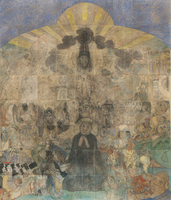
Nietzsche’s Apollonian-Dionysian dualism also informs technical qualities of Ensor’s work. The artist’s other major depiction of Saint Anthony comprises fifty-one sheets of paper, joined and laid on canvas, measuring 99 7/16 x 169 11/16 in. (252.6 x 431 cm).[22] La tentation de saint Antoine (The Temptation of Saint Anthony) shows a somber saint with hands tented in prayer, surrounded once more by fantastical creatures (fig. 4). Worked in colored pencil, Conté crayon, chalk, and watercolor, the drawing also plays with scale and pictorial depth, flattening the proliferation of monsters into a shallow plane. Anthony, enormous in contrast to the human and hybrid figures teeming around him, closes his eyes as if concentrating on the face of Christ floating directly above. Again, Ensor populates a hallucinatory landscape with grotesque figures, including women with distended bellies, undulating worms and sirens, and bodies gashed, flayed, or beheaded. In many passages he sacrifices visual clarity for the sake of miniscule and faintly rendered detail, especially in the middle third of the work. Here his overwrought shading and pulsating tendrils of smoke, flame, and fabric expose his own frenetic making of the work, obsessive in its repetition of line and form. Running vertically between Christ and Anthony and extending left for several sheets, filling all possible background space, is a mass of heads: skulls, masks, and cursory circles marked with eyes, noses, and mouths form a frothing sea of faces.
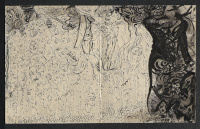
In a letter of 1887, Ensor describes his progress on La tentation, writing, “I’ve added a few hundred more figures: atrocious devils, horrible animals, infected and obscene monsters. I am very pleased.”[23] Perpendicular to and obscuring large portions of the text of the letter, Ensor has reproduced his proliferating heads, arranged in columns and trailing across the page in a swarm of even more tightly compressed faces (fig. 5). The “erratic form” of the letter, written soon after a host of physical and psychological trials for the Ensor family, including Ensor’s own ordeal with a tapeworm and his father’s mental collapse and death after an assault, might also signal the artist’s own “disturbed mental state” as he drew and painted Saint Anthony’s tribulations.[24]
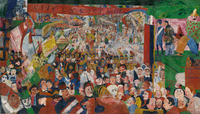
Ensor fixates on line again in making L’entrée du Christ à Bruxelles en 1889 (The Entry of Christ into Brussels in 1889) (fig. 6) a year later, as noted in the J. Paul Getty Museum’s conservation report. The conservators observe how, when painting, Ensor “carefully filled in the lines of his extensive [under]drawing and was certainly not prone to bursts of spontaneity or change,” identifying passages of the canvas where “bordering colors of paint do not overlap, or . . . even touch,” a handling of medium that evinces Ensor’s meticulous control.[25] We might see in the artist’s fastidious attention to detail and contour a feature of the Apollonian, and in his transfigurative delirium that of the Dionysian. In these works, Ensor creates technical borders of line and form while transgressing greater boundaries between perceptual planes, annihilating, as Nietzsche claims of the Dionysian, “the ordinary bounds and limits of existence.”[26]
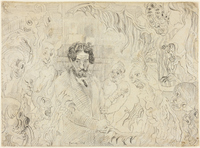
The slippage between Anthony’s and Ensor’s visions collapses entirely when Ensor substitutes himself for the saint. In a series of self-portraits made between 1888 and 1898, Ensor depicts himself surrounded by demons. In the first drawing, he stands off-center, gripping his left hand or wrist tightly with his right (fig. 7). The gesture is ambiguous: Perhaps the artist is steeling himself, bracing the edges of his body against the creeping infiltration of demons. Or perhaps Ensor has rendered himself as in a mirror, with his right, creative hand held or suppressed, as if to keep his inner fantasies contained. Nonetheless they burst free, swirling to taunt him.
Demons fill the space of the composition, with their heads and torsos emerging from all corners. Though the monsters crowd Ensor, laying clawed or tentacled fingers on his arms and shoulders, their touch is light and threatens little physical violence. The contact seems rather to tether the demons to Ensor’s person, a visual sign of their issuing forth from his imagination. Ensor’s expression, too, is trepidatious rather than tortured, as he peers with one raised brow and a furled forehead to lock eyes with the creature in the bottom left corner. The look is tentative, vulnerable, perhaps supplicating, as Ensor waits to see what these, his own inner demons, will unleash or inspire.
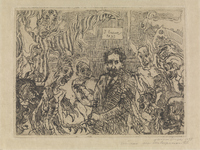
Much of the composition stays consistent across versions of this work as it evolves from drawing to etching to lithograph. Ensor arranges the same assemblage of devils around himself, the grouping capped by the many-eyed monster’s distinctive striped wings. In a black-and-white etching, Ensor adds a plaque with his name and date to the background plinth and darkens his contours and shading, creating a muddier, denser foreground (fig. 8). A colored etching of the same year vivifies the figures, highlighting the contrast between red, yellow, and white monsters and the dark blue solemnity of Ensor’s bourgeois costume (fig. 9). And in a monochrome lithograph, everything becomes looser, sketchier, with details dropping away (fig. 10). Ensor’s face also changes from work to work, shifting from the deferential gaze of the drawing to a more bewildered, furrowed brow in the etchings, to the skeptical, cocked eye of the lithograph. And in the color lithographic poster that Ensor made for the Salon des Cent in Paris in 1898, the artist finally looks directly at us, awaiting judgment (fig. 11).
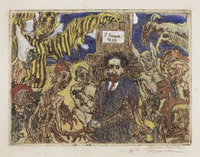
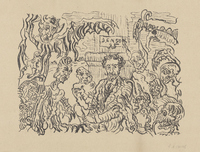
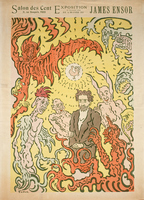
Scholarship on these works foregrounds Ensor’s desire to present himself as an outsider, a tormented artist-martyr, though Susan Canning persuasively argues this was an image cultivated by Ensor and not, in fact, reflected in most of his professional and personal relationships.[27] In my reading of the works, Ensor’s exploration of internal demons as an artistic theme did far more than promote claims of strategic self-representation; in these self-portraits Ensor reconfigures the motif of the antagonized artist by representing his demons not as cruel tormentors but as indispensable elements of his artistic process. Forgoing the intercession of Saint Anthony, Ensor claims these internal, creative demons as his own. Ensor’s drawings, prints, and paintings of phantasms taunting himself and Anthony not only offer meditations on vision, perception, and the thin veil between reality and fantasy but also crucially represent hallucinatory states of delirium as metaphors for—and agents in the production of—artistic vision.
In Ensor’s delirious aesthetics, the artist visualizes altered states that transgress everyday reality and perception. His works responded to and amplified contemporary anxieties about drink, madness, and degeneration while also foregrounding delirium’s creative potential. Some of Ensor’s works represent the dissociative perils of delirium, figuring intoxication as disruptive and dangerous, but this force also catalyzes the very production of his work, as well as its visual enthrallment for viewers. The dissolution of stable categories creates space for new associations and perspectives; when wielded in the service of art making, delirium generates and transforms as much as it destroys. By positioning delirium as both subject matter and creative mode, Ensor’s works—especially when placed in conversation with Nietzsche’s Rausch—claim the transformative and imaginative power of altered consciousness in its materialization of inner visions into external forms. Ensor’s delirious aesthetic ultimately proposes that art can serve as a portal between coexisting realities, revealing the spectral possibilities that haunt the margins of everyday perception.
Acknowledgments
Research for this article was made possible by pivotal funding from the Fulbright US Student Program in Belgium and the Belgian American Education Foundation. I am grateful to both programs for providing financial and institutional support for my 2022–23 academic year in Ghent. Heartfelt thanks, too, to Bridget Alsdorf and Marjan Sterckx for their support of my work; to Isabel Taube and Robyn Roslak for their comments on a draft of this article; and to Herwig Todts and Cathérine Verleysen for their kind invitation to the symposium “Celebrating James Ensor’s Modernity: New Perspectives” in 2024, at which I first presented a version of this essay.
Notes
All translations are my own, except where otherwise indicated.
[1] Friedrich Nietzsche, The Portable Nietzsche, trans. and ed. Walter Kaufmann (Penguin, 1988), 518.
[2] Friedrich Nietzsche, “The Birth of Tragedy” and “The Case of Wagner,” trans. Walter Kaufmann (Vintage, 1967), 36.
[3] Nietzsche, The Portable Nietzsche, 518.
[4] Friedrich Nietzsche, “The Case of Wagner”; “Twilight of the Idols”; “The Antichrist”; “Ecce Homo”; “Dionysus Dithyrambs”; “Nietzsche Contra Wagner,” trans. Adrian Del Caro, Carol Diethe, Duncan Large, George H. Leiner, Paul S. Loeb, Alan D. Schrift, David F. Tinsley, and Mirko Wittwar (Stanford University Press, 2021), 92.
[5] “Rausch,” dict.cc, accessed April 1, 2026, https://www.dict.cc/; “Rausch,” WordReference.com, accessed April 1, 2026, https://www.wordreference.com/; and “Rausch,” Linguee, accessed April 1, 2026, https://www.linguee.de/.
[6] “Une bonne peinture reflèta [sic] à l’extrême, les états variés de la vie, ses images, ses tristesses, ses froidures, ses ivresses et ses chatouillements.” Hugo Martin, ed., James Ensor. Mes écrits, ou les suffisances matamoresques (Éditions Labor, 1999), 84. Thanks to Herwig Todts for suggesting the relevance of this quotation. See also Herwig Todts, James Ensor, Occasional Modernist: Ensor’s Artistic and Social Ideas and the Interpretation of His Art (Brepols, 2018), 199.
[7] Quoted in Benjamin Seebohm Rowntree, Land and Labour: Lessons from Belgium (Macmillan, 1911), 412.
[8] Rowntree, Land and Labour, 416, 411.
[9] “Un fond de mœurs inamovible.” Camille Lemonnier, La vie belge (Bibliothèque-Charpentier, 1905), 108.
[10] “Des personnages importants, des bourgmestres, des ministres du roi, ‘faire leur estaminet’ . . . et n’estimer point déroger en quittant un dîner au Palais pour s’asseoir devant un verre de lambic.” Lemonnier, La vie belge, 108. Lambic is a wheat ale that has been brewed in the Pajottenland region, in Flemish Brabant, since the thirteenth century.
[11] For further discussion of light as social allegory in Ensor’s oeuvre, see Susan Canning, The Social Context of James Ensor’s Art Practice: “Vive la Sociale!” (Bloomsbury Visual Arts, 2024), 118–22; and Susan Canning, “James Ensor: Carnival of the Modern,” in James Ensor, ed. Anna Swinbourne, exh. cat. (New York: Museum of Modern Art, 2009), 33–35. See also Canning’s contribution to this special issue of Nineteenth-Century Art Worldwide, “James Ensor’s Vision and the Social Narrative of Light.”
[12] An Vleugels, Narratives of Drunkenness: Belgium, 1830–1914 (Pickering & Chatto, 2013), 56–57. See also Canning, The Social Context, 112; and Marnin Young, Realism in the Age of Impressionism: Painting and the Politics of Time (Yale University Press, 2015), 177.
[13] “l’abrutissement”; “stupide”; “La raison pivote en vous et l’on voit osciller, sur une base instable, votre corps plein au ventre, vide à la tête. . . . Vous subissez . . . une sorte d’extase. . . . C’est une hallucination de buveur, lourde, fiévreuse, rampante, débraillée, rauque.” Camille Lemonnier, “Le carnaval,” La jeune Belgique, March 15, 1884, 214–15.
[14] “le délire.” Lemonnier, “Le carnaval,” 215.
[15] “la folie alcoolique”; “troubles hallucinatoires”; “une terreur profonde”; “maniaque, mélancolique, stupide”; “troubles sensoriels.” Valentin Magnan, Étude expérimentale et clinique sur l’alcoolisme: Alcool et absinthe, épilepsie absinthique (Paris, 1871), 32–33.
[16] “La vue se trouble, s’obscurcit, avec des éblouissements; il survient des étincelles, des flammes, des couleurs variées, des ombres, des objets tremblotants, des fantômes.” Magnan, Étude expérimentale, 34.
[17] “les vertiges”; “convulsions”; “un délire avec hallucinations effrayantes.” Magnan, Étude expérimentale, 37–38.
[18] “Ces pauvres ivrognes ressemblaient à de véritables sauvages.” “Causerie scientifique,” Journal de Bruxelles, January 31, 1878, 1.
[19] “le regard fixe”; “tremblement, . . . troubles de la sensibilité, hallucinations du rêve.” “Chronique scientifique: L’alcoolisme,” Le peuple, December 10, 1900, 1.
[20] Liesbet Nys, “Groene toverdrank of gebottelde epilepsie? Absint in België omstreeks 1900,” Tijdschrift voor Sociale Geschiedenis 27, no. 4 (2001): 427. Peter Scholliers discusses how Belgian temperance unions strategically blamed the working classes for their excessive drinking, though the upper classes drank about the same amounts, only replacing wine for gin. Peter Scholliers, “‘Een vijand dien men kennen moet’: Jenever in België in de 19de en vroege 20este eeuw,” in Jenever in de Lage Landen, ed. Eric van Schoonenberghe (Stichting Kunstboek, 1996), 152.
[21] “Immoralité, dégradation, . . . abrutissement moral. À la deuxième génération: . . . accès maniaques, paralysie générale. À la troisième . . . : hypémanie [sic], . . . tendances homicides. À la quatrième . . . : l’idiotisme, et, la définitive extinction probable de la race.” “Chronique scientifique,” 1.
[22] Canning believes Tribulations was the first of two representations of Anthony that Ensor made in 1887, calling it the artist’s “initial exploration” of the subject in The Social Context, 131. This was also the year that Ensor began work on L’ entrée du Christ. Susan M. Canning, “Revelation, Resistance, and Resilience: (Re)presenting James Ensor’s ‘The Temptation of Saint Anthony,’” in James Ensor: The Temptation of Saint Anthony, exh. cat. (Art Institute of Chicago, 2014), para. 7.
[23] “J’ai ajouté encore quelques centaines de figures: diables atroces, animaux horribles, monstres infects et indécents. Je suis très satisfait.” James Ensor to Ernest and Mariette Rousseau, September or October 1887, in “Avec le noble crayon”: Lettres de James Ensor à la famille Rousseau, ed. Jean-Philippe Huys and Xavier Tricot (Royal Museums of Fine Arts Belgium; Peter Lang, 2021), 239.
[24] Patrick Florizoone and Nancy Ireson, “The Trials of ‘The Temptation’: The Genesis of James Ensor’s Saint Anthony,” in James Ensor, para. 35.
[25] Mark Leonard and Louise Lippincott, “James Ensor’s Christ’s Entry into Brussels in 1889: Technical Analysis, Restoration, and Reinterpretation,” Art Journal 54, no. 2 (Summer 1995): 21, https://doi.org/10.2307/777458 [login required].
[26] Nietzsche, Birth of Tragedy, 59.
[27] Canning, The Social Context, 215.