The browser will either open the file, download it, or display a dialog.
|
 |
"The secessionists are the Croats. They've |
|
|||
|
||||||
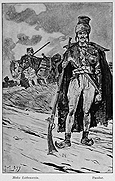
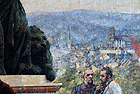
| Who would have expected art from a country of pandours and bears (fig. 1)? Certainly not the editor of the Berlin paper Das Volk. Writing on the occasion of his visit to the Croatian pavilions at the 1896 Millennial Exhibition in Budapest, he tells us that what little was known about the small country of Croatia consisted of stories of fierce men and animals. Neither he, nor any of his countrymen, had ever entertained the thought that pandours might be painters. At the Millennial Exhibition, however, this apparent impossibility became reality. For the Croats came to Budapest armed not with long rifles and yataghans, but with works of art. It was a calculated attack that shocked Europe into recognizing that there was artistic life—sophisticated artistic life—in Croatia and that, consequently, it must be a civilized country. With art as its most powerful weapon, Croatia went to battle for cultural autonomy within the Hungarian state of which it was a part. | ||||||
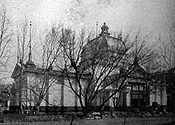
| The 1896 Millennial Exhibition in Budapest was a grand affair of national scope, celebrating one thousand years of Hungarian statehood.2 Semi-autonomous Croatia, an increasingly unwilling subject of Hungary, participated in the fair with four of its own pavilions: History and Art, Industry, Forestry, and a drinking hall (fig. 2). In International Exhibitions both before and after the Budapest Exhibition, Croatia was commonly subsumed within the pavilions of Hungary, so having pavilions of its own—and on the very turf of its rulers at that—represented a rare opportunity for Croatia.3 | ||||||
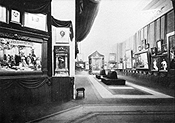
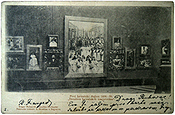
| The exhibition of contemporary art housed within the Croatian Pavilion of History and Art attracted a great deal of press, dispelling the notion that Croatia was a cultural wilderness.4 Under the dynamic leadership of Vlaho Bukovac (1855–1922), a Dalmatian who had studied with Alexandre Cabanel (1823–1889) and had established a successful career in Paris as a Salon painter and portraitist, Croatia acquired for itself a strong artistic presence.5 As the head of a group of artists who had been working together in Zagreb for just over one year, Bukovac had made sure that their first international appearance would be an effective strike. Thanks largely to the efforts of this charismatic artist, who had selected and arranged the works in the exhibition and whose own paintings dominated it, Croatia was seen by critics to be in possession of its own, autochthonous artistic identity (fig. 3).6 An article in the Allgemeine Kunstchronik declared: "the Budapest exhibit too has its secession … The secessionists are the Croats. They've been given their own pavilion…"7 | ||||||
| This was a triumph in the history of Croatian art on both a cultural and political level. The separateness of the Pavilion of History and Art as a building of culture, and its success in evidencing a unified "Zagreb school," was a clear assertion of Croatian difference from Hungary, which had ruled the South Slavic kingdom since the twelfth century.8 In this article, I intend to show that Bukovac, through his own work and his efforts for the pavilion, attempted to advance the cause of Croatian cultural and territorial sovereignty within the framework of Hungarian Imperialism. The artist sought to use the occasion of the Budapest Millennial Exhibition to manufacture a form of synthetic Croatian national identity within the Austro-Hungarian Empire in which the Croats were kept apart. | ||||||
| Bukovac's native Dalmatia did not participate in the 1896 Millennium Exhibition in Budapest because it was neither part of Hungary nor Croatia. Dalmatia was a region administered as separate by Austria. As I shall suggest, Bukovac's cultural battle to incorporate the land of his birth into the national body of Croatia was the main point of his artistic program at the fair. In the cultural circle in which Bukovac was a participant, Austrian Dalmatia, with its center, Dubrovnik, had come to function as the heartland of Croatia and, therefore, possessed unparalleled potential for articulating and claiming an autonomous Croatian national identity. The symbolically generative role of Dubrovnik in the cultural landscape of late nineteenth-century Croatia was, in fact, embodied in the person and work of Vlaho Bukovac at the Budapest Exhibition. The subjects Bukovac chose for his major paintings shown at the fair, (particularly his Gundulic's Dream of 1894, Glory to Them of 1896 and Dubravka of 1894), either fused the divided coastal and continental regions literally, or implied a continuity of culture from the past in Dubrovnik to the present in Zagreb. An examination of the many reviews of the Croatian exhibition of art reveals that his efforts were supported by his painting style which, seen in the context of the fair, possessed a politically radical nature. Indeed, it appears that the artist's French-inspired style of plein-air painting had a charged character in what emerged as one of the privileged sites for the production of a Croatian identity. | ||||||
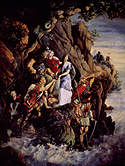
| Throughout the nineteenth century, continental Croatia had fought for unification with Dalmatia, which was seen as the culture's unjustly-separated historical core. In the last decades of the nineteenth century, the territorial fragmentation of Croatia was a central problem to those who were striving to define a national identity—a group that included several Croatian artists. A number of painters, beginning with Ferdinand Quiquerez (1845–1892), worked on the theme, "Arrival of the Croatians," in which the first settlement of their Slavic ancestors was invariably situated on the Dalmatian coast (fig. 4).9 The fictional recreation of this remote past was used as an argument for unifying Dalmatia and Croatia—how could Croatia be separated from the land of its most distant ancestors? | ||||||
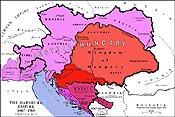
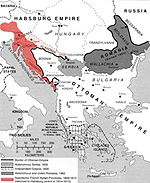
| From the Middle Ages until the end of the nineteenth century, the territory of the modern nation of Croatia had been divided and governed by a series of foreign powers (fig. 5). Its particular geography of two thin arms, the one stretching south along the Adriatic coast and the other reaching east across the Pannonian plain, made geographic and cultural unification a real challenge. The urgency for Croatian political and cultural unification was increasingly felt in the last decades of the nineteenth century as, one by one, nations of the Balkan Peninsula began to emerge as independent, modern nation-states after centuries of Ottoman rule. Croatia, frustrated, fragmented, and absolutely absorbed within Austria-Hungary, would not obtain any territorial unity until after World War I, when it was incorporated in the kingdom of Yugoslavia. Indeed, particularly strident hardliners would argue that it did not attain cultural autonomy until after the recent war in the 1990s, which made Croatia an independent country at last. | ||||||
| Croatia had only been a unified entity of the Pannonian and Dalmatian territories for a brief period in the 11th century. This medieval kingdom, known as the Triune Kingdom, became for intellectuals, artists and writers the symbol of the Croatian nation, a nation that was now lost and shattered, the remains of the remains. Throughout the nineteenth century, a synthetic and idealized Croatian past was given form in writing and art. The creation of a grand historical narrative that included both Croatia and Dalmatia—such was the program of Bukovac's, Glory to Them, as we shall see—which were administered separately within Austria-Hungary, was aimed at establishing not only cultural unity, but territorial unity in the reconstitution of the Triune Kingdom (fig. 6). | ||||||
| If artists like Vlaho Bukovac welded the fragmented regions of Croatia together in an idealized nationalist mythology, they remained fragmented in political reality. Croatia, the territory represented at the Millennial Exhibition, had been linked to Hungary under the Hungarian kings since the 12th century.10 At the end of the 18th century, Croatia had virtually lost its cultural autonomy as Hungary tried to impose cultural, linguistic and legislative hegemony, even trying to make Croatia adopt Hungarian as its national language. The 1867 Ausgleich (Compromise), which transformed the Hapsburg Empire into the Austro-Hungarian Empire, put Croatia ever more at the mercy of Hungary's control. Some degree of autonomy, including establishing Croatian as the official language, was retained with the Nagodba (also meaning Compromise)—a miniature version of the Ausgleich between Hungary and Croatia.11 However, this compromise was seen as unfortunate by many, because Hungary was still in the position of ultimate jurisdiction, controlling Croatian finance and appointing the most important political leader, the Ban (governor). At the time of the 1896 Millennial Exhibition, Zagreb had developed as Croatia's capital of culture and politics. Croatia was politically divided between Unionists, who supported the historical union with Hungary, and Rightists, who claimed that Croatia had the right to dissolve that union. The exhibition of contemporary Croatian art was clearly more sympathetic to the latter, portraying an autonomous Croatia, a Croatia that wanted to expand its territory to include Dalmatia. | ||||||
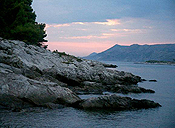
| Far in the south of Dalmatia lay the object of greatest desire: the fair, walled city of Dubrovnik, the birthplace of those illustrious Croatian ancestors who had written works in the Renaissance which, in the nineteenth century as today, were considered the foundational literary treasures of the nation and the basis for the modern language. Bukovac, importantly, was a son of Cavtat, or Ragusa–vecchia (Old Dubrovnik) which was considered by Croatian intellectuals to be an even purer source of origin than the city of Dubrovnik which lay just to its north (fig. 7).12 The weight given to the fact that Cavtat was the original Dubrovnik assigns historical legitimacy to that small coastal city and to the painter Bukovac as generators of culture. | ||||||
| Unlike most of Dalmatia, which, since the Middle Ages, had been largely under Venetian rule, the Republic of Dubrovnik, as an Ottoman vassal, had long remained a "free city," independent from the Venetians, and had prospered as a society of merchants, scholars, writers and artists. For most Croatians in the nineteenth century, the history of Dubrovnik stood in contrast to the political reality of Imperial absorption. Its past represented a high point in the history of the Croatian people, an ideal of a flourishing and independent Slavic society. | ||||||
|
In 1797, the Serenissima Republica of Venice came to an abrupt end with the result that Venetian Dalmatia was annexed by Austria. Soon after, Dalmatia was invaded by Napoleon. Dubrovnik held out for a while, but officially lost its independence in 1808, becoming for a brief period part of the Illyrian Provinces (fig. 8).13 In 1815, Dalmatia was reincorporated into Austria. From the moment that Dubrovnik lost its status as a free republic, the culture of that once-proud republic began to experience a rapid decline. The Austrian Dalmatia it was a part of was a backwater in the Hapsburg Empire. If, in the middle of the nineteenth century, some still dreamed that the city might regain its former glory, by the late 1870s, when a culture of painting began to be developed earnestly if modestly in the continental capital, it seemed that Dubrovnik's only hope to continue living was to give its heritage to the city of the Croatian future—Zagreb.14
As is clear in the above quote from the Budapest paper, Neuer Pester Journal, the Hungarian capital held low expectations for the performance of their invited Croatian guests, and did not anticipate their art exhibition to amount to much. The quote is, in fact, a good example of the transition from disbelief to surprise, followed by admiration, found in many of the foreign reviews of the Croatian exhibition of art. And who could blame the world for being surprised? After fitful and halting starts, artistic culture was only finally, in the last decades of the nineteenth century, being fostered and sustained programmatically in Zagreb.16 A few individual painters were known abroad, especially in Munich and Vienna, cities in which those painters were students, but a formidable group giving the impression of a national whole had been previously unthinkable. The humble Zagreb art scene benefited greatly in this regard from the arrival of the already-famous Bukovac, who diffused his views and techniques to his colleagues, and had grand ideas of what they might achieve. Zagreb held its breath. It was hoped in those cultural circles that had been dreaming of "Croatia art" appearing on the world stage that this artist's fame could be extended to his countrymen. |
||||||
| Positive foreign reception of the Croatian Exhibition of Art was a point of pride in the local Croatian papers, such as Prosvjeta and Narodne Novine, especially when it was understood to have been grudgingly won from their skeptical Hungarian rulers.17 The number of foreign articles translated and printed in Croatian papers is good evidence of what Balkan historian, Maria Todorova, has rightly noted: "[A]ll Balkan nations are intensely conscious of their outside image."18 | ||||||
|
Of particular interest to us is a substantial review devoted to the Croatian exhibition written by the famous Hungarian critic, Ludwig Hevesi (1843–1910), best-known for his defense of the Vienna Secession artists.19 The champion of the Moderns found much to admire in the works he saw in Budapest:
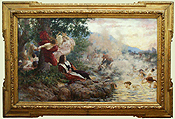
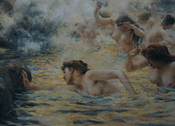
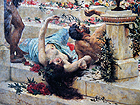
The paintings shown by Bukovac in the Croatian pavilion, such as Gundulic's Dream of 1893 (fig. 9), were executed in an academic style tempered by Impressionist influences, particularly manifest in the artist's preoccupation with the depiction of the effects of light.21 Gundulic's Dream portrays Dubrovnik's most famous seventeenth-century poet, Djivo Gundulic (1588–1638), in carefully-studied historical costume imagining his epic poem, Osman, which narrates the downfall of the Ottoman Sultan, Osman II, and his war with Poland in 1622.22 Visions of the poem appear to the poet in the mist over the water as he looks out, aided, no doubt, by the three muses levitating rather heavily behind him. In the foggy center of the painting, a fainting woman is being abducted from her burning thatch-roofed home by several dark-skinned, turbaned Turks. Her father has collapsed just left of her, weeping helplessly. Proceeding from that sad scene and following the curve of the coastline, a multitude of nude women burst forth from the deep illusionistic perspective of the painting before a small number of pursuing Turkish soldiers. The heavy impasto of the shimmering water encases the thinly-washed bodies, trapping and freezing the women at the edge of the foreground where the viewer may regard them at leisure, while the poet remains removed and aloof on his elevated rocky barrier (fig. 10). Scenes of the sorrow of the captured and soon-to-be-captured women—in a rather jarring juxtaposition in which the crowding of one image upon another confuses the careful painterly work to establish the illusion of depth—appear behind the tree in the extreme left side of the painting like so many representations of their psychological states. The past violence of the Ottomans may very well have served as an allegory for the Imperialism of Austria-Hungary over Croatia. |
||||||
|
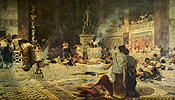
The pathetic emotion, the sensual, Orientalist appeal, and the light palette coupled with clearly demarcated outlines and anatomical correctness in the figures, place Gundulic's Dream firmly within a practice of tempered academicism. It is noteworthy, however, that neither Hevesi nor any other critic of the 1896 exhibition discusses Bukovac as an academic painter.23 All of the reviews of his work praise him for breaking with tradition, although tradition was something in which the artist was clearly invested.24 The brand of tempered French academicism practiced by the artist functioned in a radical way in Budapest as it contrasted sharply with the "German" style of those influenced by the style of Karl von Piloty (1826–1886).25 Critics recognized this "German" style in Bacchanalia (1893), one of the paintings shown in Budapest by Bukovac's compatriot Medovic, who had made the work prior to coming under Bukovac's influence, as a finishing thesis at the Munich Academy of Fine Arts (fig. 11).26 | |||||
| Vlaho Bukovac brought French plein-air painting from Paris to Zagreb, influencing both young artists in Zagreb and the more established Medovic, whose change in style and lightening of palette in paintings subsequent to Bacchanalia was duly noted by critics.27 Bukovac had lived in Paris for seventeen years (1877–1893), which, for nineteenth-century Croatian artists born within the Austro-Hungarian Empire, was extremely unusual and financially risky. Most aspiring artists went to the Academies of Vienna or Munich, supported by government stipends, learning there to paint in the officially safe style identified back home as "German."28 Bukovac's Parisian training was perhaps the single most important factor in the strong effect of difference he and his followers, the artists of the so-called "Zagreb school," produced at the fair in Budapest. His French form of academicism seemed to renounce any organic connection with Austria-Hungary. In his article on the Croatian exhibition, Hevesi continued, "Bukovac is a self-sufficient master…so agile that he'd find his footing right away if today's fad for plein-air should change. He is a true analyzer of the sun's light, from which he extracts numerous effects."29 | ||||||
| Hevesi's emphasis on Bukovac's "self-sufficiency" is important as it suggests that the critic feels that the artist is not a slavish follower of his teacher, Cabanel, or, for that matter, the French Impressionists, but very much his own man. Elsewhere in his article, perhaps thinking of the play of direct and reflected light in Gundulic's Dream, he praises Bukovac for the originality of his nudes: "He is also attracted by the mystery of the nude, and he solves it in his own way, for he did not learn this from Cabanel" (fig. 10).30 Thus Hevesi emphasizes the Parisian context from which Bukovac comes—Cabanel's studio—but ultimately acknowledges that the artist has freed himself from dependence on his master. Indeed, Hevesi describes the artist as "true" and independent of trends. As he sees it, the most important element in the work of the painter, whom he dubs "Dalmatian," is the artist's emphasis on conveying the effects of sunlight. Hevesi's acknowledgement of Bukovac's pleinairism and his Dalmatian identity merit pause here, for they are two qualifiers that figure prominently in the criticism of the 1896 Millennial Exhibition.31 | ||||||
| In many contemporary reviews, the French fashion for plein-air painting seen in the works of Bukovac and his followers is presented as a natural fit for the geography of Dalmatia. By the late nineteenth century, that region was becoming known to travelers as a haven of sun, sea, and Roman ruins.32 In many of the foreign reviews, Hevesi's included, Bukovac's bright, airy, light-colored canvases are described as the artist's direct response to the Dalmatian climate.33 The emphasis on Bukovac's ethnicity in foreign reviews is noteworthy because it evidences outsiders' perceptions, at least to some degree, of Dalmatia's generative role in Croatian culture. | ||||||
| The artist's Dalmatian identity is, in fact, crucial to understanding the part he played in the Budapest Exhibition, Croatian artistic life, and the politics of late nineteenth-century Croatian culture. It is as a Dalmatian that he became the leader of the Zagreb school. And the implicit subject of his paintings is the importance of Dubrovnik, the traditional epicenter of Dalmatia, for the formation of Croatian culture. In his public life, as well as his paintings, Bukovac embodied the long-standing desire to unify the coastal lands of Austrian-controlled Dalmatia with continental Croatia. He made manifest the kinship between the still fragmented Croatian lands which claimed Dubrovnik as the site of Croatia's golden past, and Zagreb her bright future.34 | ||||||
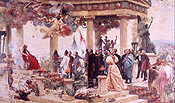
| Synthesis and reconstitution through transfer—the fusion of coastal Dalmatia and continental Croatia—was the central theme of Bukovac's, Glory to Them, a ceremonial curtain for the new National Theater (built 1894–1895) in Zagreb, and arguably the most important public commission he received during his residence in that city (fig.6).35 Bukovac's oil sketch of the curtain, along with a model of the theater, was displayed prominently in the center of the Croatian Pavilion of History and Art. Glory to Them depicts an imaginary meeting in which a formal procession of mid-nineteenth-century Illyrians pay homage to the Croatian past, personified by Djivo Gundulic.36 Perhaps more than any other writer, Djivo Gundulicembodied the idea of a golden age of Croatian literature in the imagination of the nineteenth century and was the primary fixation of Bukovac's historical compositions.37 | ||||||
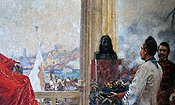
| The setting in which the figures move about is a Classical hemispherical colonnade, in clear reference to the "Adriatic Athens," an epithet of Dubrovnik that referenced it as the site of a golden age.38 In the left background, the walled city of Dubrovnik juts into the sea (fig. 12). On the right is Zagreb, its medieval old town rising at the right border of the composition (fig. 13). The Srd Mountain climbs above the walled city of Dubrovnik becoming one with the hills around Zagreb. The landscapes of Dubrovnik and Zagreb are thus merged into a unified panorama of Croatian territory, a panorama in which power is hAndjed from left to right. | ||||||
| In the left foreground of Glory to Them, a nymph and a drunken satyr are sprawled on the steps of the colonnade, throwing fallen flowers at the procession of Illyrians (fig. 14). This element, which speaks of decadence and debauchery, may well have alluded to the sorry state of Dubrovnik in the present. The once prolific and proud city was relegated to the most backward region of the Austro-Hungarian Empire, and its citizens were profoundly aware of their loss.39 Dubrovchans thought of themselves increasingly as sentinels at the tomb of their city. A local writer at the turn of the century described the history of nineteenth-century Dubrovnik through the allegory of a decomposing body: "first, the fall and death of Dubrovnik; second, the state of that mortal body after death; third, the present age, when it has completely decomposed and the stink commences."40 It was after Dubrovnik lost its independence that the city began to become, for Croatian intellectuals and artists, a powerfully nostalgic symbol of Slavic freedom. Descriptions and depictions of the decay of Dubrovnik reinforced the idea that its golden age had passed. As is clear in Glory to Them, its former greatness is inherited by Zagreb.41 | ||||||
|
The importance of Dubrovnik as the source of Croatian culture was the main theme of Bukovac's Dubravka, another important work that was shown in the Croatian Pavilion of History and Art (fig. 15). The painting's title is derived from a famous play by Gundulic, Dubrovnik's famous poet.
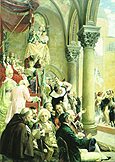
Such was the exuberant praise by the Croatian writer, Ksaver Sandor-Gjalski (1854–1935), in the Zagreb illustrated magazine Vienac, upon seeing Bukovac's painting, Dubravka, in Zagreb prior to its exhibition in Budapest. Sandor-Gjalski's praise included Bukovac, Gundulic and the city of Dubrovnik. A symbolic synthesis of the city's cultural and political legacy, Dubravka depicts a gathering of some thirty illustrious personalities—patricians, writers, and church figures—from different periods in Dubrovnik's history. They are crowded under the portico of the late Gothic Rector's Palace in Dubrovnik watching a performance of Gundulic's pastoral play, Dubravka—aptly, an allegory of freedom. |
||||||
|
|
||||||
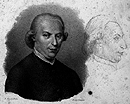
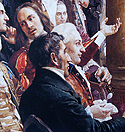
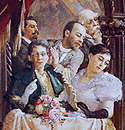
| Bukovac drew on his Parisian academic training to tackle the elaborate subject. He sketched the figures after engraved portraits on the pages of an 1841 publication, Galleria di ragusei illustri (Gallery of Illustrious Dubrovchans), studying the heads of his famed historic compatriots from different angles (figs. 16 and 17).43 Seated under the red canopy in Dubravka, Bukovac's major subject, Gundulic, holds the place of highest honor. On the back wall of the arcaded porch of the Rector's Palace in the top left corner of the painting is an arched window out of which five contemporary figures watch the play. Bukovac is at the center, boldly claiming his fame as one of those illustrious sons of Dubrovnik who had much to pass on to his northern countrymen (fig. 18). | ||||||
| The painting, which depicts the former government seat in Dubrovnik, was commissioned for a spot in a current government palace in Zagreb—the Department of Religion and Education.44 It was a symbolic location, which suggested the transfer of cultural freedom from the city of the "golden age" to the city of the present. A relationship of past and present—of dead and alive—between the two cities symbolic of Croatian culture was to be created by placing this painting of Dubrovnik in Zagreb. This transfer from south to north through painting was, however, never realized, for Dubravka was bought by Budapest's art museum during the Millennial Exhibition. The Zagreb paper, Narodne Novine proudly explained the painting's new function of battling for the recognition of Croatian culture in the eyes of Hungary: "as testament to the artistic development in the Croatia of the new era."45 | ||||||
| These three major paintings exhibited by Vlaho Bukovac at the Fair in Budapest—Gundulic's Dream, Dubravka and Glory to Them—demonstrated that the borders of Croatia included Austrian Dalmatia. The historical role of that region in the nation's culture was the subject of those paintings that indeed seemed to be painted in a sunny, Dalmatian style. Bukovac's work fused the fragmented Croatian regions into a unified historical-national narrative, battling for cultural autonomy and forming the nucleus of the first Croatian national style at the 1896 Millennial Exhibition in Budapest. | ||||||
| Though the Croatian Art Exhibition at the Budapest Millennial Exhibition was a resounding success, achieving for the nation the acknowledgement in the world that it craved,46 it is well to remember that it almost did not happen. Many Croatian artists were hesitant about participating in the Budapest exhibition as they feared it would necessarily underscore Croatia's dependent political position.47 It was Bukovac who pushed for the Croatian Art Exhibition. There is little doubt that he did so because he thought it could help the cause of Croatian independence, if not political at least cultural. But to his fellow artists, as we shall see, he argued for their participation by outlining a bold plan which, if successful, would secure a lasting treasure for their people—something which would permit their continued growth in esteem in the eyes of the world. | ||||||
| After spending almost two decades in Paris as a successful Salon artist, Bukovac moved to Zagreb in 1893. His decision to leave Paris was prompted, in part, by the success of an exhibition, a year earlier, of several of his works in Zagreb at the Academy of Science and Arts and many commissions from patrons in that city, both of which were indicators of potential financial security in the Croatian capital.48 However, the move was motivated as well by a sense of patriotic obligation. His presence in Zagreb attracted many younger Croatian artists, who left their government-sponsored studies at the Fine Arts Academies of Munich and Vienna, and came to the capital to participate in the exciting emerging art scene in Zagreb.49 In 1894, they held their first "Croatian National Art Exhibit" in the Academy of Science and Arts, and, in 1895, they formed the first "Art Society" in Croatia.50 The government asked this group, by now famous in the local press, to participate in the Millennial Exhibition in Budapest with an exhibition of their works.51 | ||||||
| The participating artists, most of whom had lived in cosmopolitan centers of Europe, were acutely aware of the political importance of the Millennial Exhibition. Many of them were leery of accepting the invitation to exhibit as their participation might be interpreted as colonial subservience. Indeed, as Vera Kruzic-Uchytil has noted, a great part of the Croatian public did not approve of Croatian artists' involvement in this "Hungarian manifestation."52 | ||||||
|
The artists too felt that their participation might logically emphasize that Croatia was a part of Hungary, but in the end decided their participation had the potential to do more good than harm. A few lines from Bukovac's autobiography suggest why they changed their minds. By agreeing to exhibit, the artists hoped they could gain a pavilion of art for their city, so that the first-ever permanent exhibition hall might be erected in Croatia53:
In his autobiography, Bukovac also recounts how he wanted Croatian soil to be "heaped around the pavilion" in Budapest, so that the building would stand on native soil.55 The plan was not carried out, but in its potentiality, it was a strikingly physical conception of territoriality. Heaped earth, like fortress walls, could defend the pavilion from its temporary foreign environment. Enough native soil might make the Hungarian ground the pavilion stood on Croatian. |
||||||
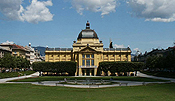
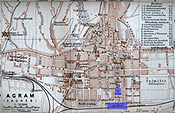
| After the closing of the Millennial Exhibition, the Croatian Pavilion of History and Art was stripped down to its metal skeleton and transported, by railway, from the Budapest fairgrounds to Zagreb (fig. 19). Renamed the "Art Pavilion," it was reconstituted with a permanent exterior by the popular Viennese architects, Ferdinand Fellner and Hermann Helmer, in a rapidly modernizing section of Zagreb,56 directly across from the railway station. This location near the city's travel center emphasized the fact that it had been transplanted from its foreign place of origin (fig. 20).57 It was fairly common practice in World's Fairs to design and build some pavilions as permanent structures that could house collections of art or ethnology. But the move of pavilions to other locations was not a common occurrence, the Crystal Palace of the 1855 World's Fair in London being, of course, a famous exception. The Art Pavilion remains in Zagreb to this day as a relic of the fair. | ||||||
| But what kind of relic? Was it a Hungarian gift that arrived via the railway that linked Croatia to the authority of Budapest? Or a trophy won, a spoil of war from the battlefield of the Millennial Exhibition, a monument to cultural independence? I rather think that the pavilion, and the artists' desire to use it, illustrates what Native American Studies scholar, Sidner Larson, has called, "the potential for negative capability;" that is, drawing strength from the re-appropriation of a dominant power's imagining of the Other's identity.58 It was not important that the structure, of a fine neo-classical style, designed by Hungarians and rebuilt by Austrians, did not look particularly Croatian on the outside.59 The artists used this neutral building as a vehicle. They claimed cultural autonomy with the radical exhibition housed inside, surprising Europe with a strong national style that seemed to spring from the sunny Dalmatian climate, that was recognized by critics as the "colorful Zagreb school."60 The building would house countless exhibitions of Croatian art after the closing of the fair, and this is why Bukovac and the other artists agreed to participate. They appropriated from Hungary the first Art Pavilion for Zagreb, which was at that time, as Bukovac wrote with pride, "the only one in the Slavic South." In 1898, they held the first "Croatian Salon" in it (fig. 21).61 | ||||||
|
The Zagreb magazine, Prosvjeta, in an article entitled, "The Success of our Artists," defended the artists' participation in the 1896 Exhibition in Budapest and made a passionate case for why their exhibition of art—indeed the production of art itself—might do more to help Croatia's subjugated position in the Austro-Hungarian Empire than anything else:
In an understanding typical to the second half of the nineteenth century in Croatia, art has the potential to elevate to equality a nation considered inferior in the eyes of other nations.63 However, such a role for art in the cultural landscape of nineteenth-century Croatia had been, up to the time of the Millennium Exhibition in Budapest of 1896, relegated to the pages of history. The past glories of Dubrovnik were lost to the present, "In this place [Dubrovnik] our people were their own people, not bound by anyone else's influence. In this small place [our people] proved that they were capable of fulfilling all the world's conditions for culture."64 Zagreb dreamed of inheriting Dubrovnik's former ability to produce its own respected culture and finally, with the appearance of Bukovac on the scene as a strong leader from the land of past brilliance, armed with French training, this dream saw the possibility of being realized. |
||||||
| The Exhibition of Croatian Art at the fair in Budapest was faced with the difficult task of asserting selfhood within the framework of an Empire that both held Croatia in low esteem and sought to absorb the country. The work of Vlaho Bukovac, which gave a unifying tone to the exhibition, proved to be most effective in denying inferiority and asserting a particular Croatian identity. His painting manifested a striking plein-air quality and depicted grand historical subjects that delineated the borders of an autonomous Croatian nation that depended on Hungary not at all. Bukovac's battle to fuse his native Dalmatia with Croatia with a synthesis of style and subject matter that aided his cause, and to insist on their cultural independence, was won. | ||||||
|
Note: All translations are mine unless otherwise noted. 1. So begins the translation printed in the Zagreb paper, Narodne Novine, of an article by the editor of the Berlin paper, Das Volk. "Njemacki glas o hrvatskoj izlozbi," Narodne Novine no. 167 (1896), 4: 2. The Millennial Exhibition was held from May 2 – October 31, 1896 3. One exception was the Grand International Exhibition in Trieste of 1882, in which Croatia had one separate pavilion that seems to have housed mostly exhibitions of industry. For a description of the pavilion, see "Umjetnost: Hrvatski pavillon za trscansku izlozbu," Hrvatska Vila no. 5 (1882), 111. 4. In the paragraph following the opening quote, the editor of Das Volk continues by overturning the myths his countrymen hold true about Croatia, namely, about the brutality of soldiers and the ethnicity of mouse-trap sellers, neatly taking a stab at Hungary. "Njemacki glas," 4: 5. Interest in the 1896 Millennial Exhibition was revived in Hungary in 1996 at the one hundred-year anniversary of the Millennium exhibition. Because it was a national exhibition, the fair has not been included in the various indexes of World's Fairs produced in response to growing scholarly interest in these exhibitions in English-language scholarship. There are no studies written in English that look at the Croatian participation in this fair. 6. Twenty-nine of the 85 paintings on display were Bukovac's. See the section "Umjetnost i Vjestine" in Kraljevine Hrvatska i Slavonija na Tisucgodisnoj Zemaljskoj Izlozbi Kraljevine Ugarske u Budimpesti 1896 ( Zagreb: Tiskarski Zavod "Narodnih Novina," 1896), 1–3. 7. Translation of an article from the Austrian, Allgemeine Kunstchronik, in the Zagreb paper Obzor. "O hrvatskom slikarstvo," Obzor no. 149 (1896), 3. The full paragraph reads as follows: 8. A notice in Narodne Novine about the Croatian artists' invitation to participate the following year in an international art exhibition in Copenhagen fixes upon the importance of having a separate pavilion "in which, if they accept [the invitation], there will be a separate hall. (u kojoj ce biti za njih, ako se odazovu, rezervirana posebna dvorana.) ." "Nasih umjetnici izvan domovine," Narodne Novine no. 251 (1896), 2. 9. Ferdinand Quiquerez's large oil painting (300 x 200 cm.), Arrival of the Croatians (Dolazak Hrvata), was made two years after a painting of the same theme by his teacher, the German Hungarian painter Joseph Franz Mücke (1819–1883). Mücke's proto-Croatians, however, arrived in a wooded landscape of continental Croatia. Other painters after Quiquerez who painted the Arrival theme—always situated in Dalamatia—include Mato Celestin Medovic (1903) and Oton Ivekovic (1905). See Marijana Schneider, Historijsko slikarstvo u Hrvatskoj (Zagreb: Povijesni Muzej Hrvatske, 1969). Also see a poem inspired by the painting published in the Zagreb magazine, Vienac, by Fr. Ciraki, in which the poet connects the rivers of continental Croatia to the Adriatic sea, claiming all these bodies of water for the Croatian people: "Dolazak Hrvata na obalu sinjega mora," Vienac no. 41 (1870), 648. 10. The Vojna Krajna (Military Frontier) represented a particularly sore spot for Croatians, who petitioned for its incorporation into Croatia throughout the 19th century. During the late 16th and 17th centuries, the depopulated land along the border between the Ottoman Empire, (mainly modern-day Bosnia-Herzegovina), and Croatia began to be settled by Vlachs, predominantly of the Eastern Orthodox faith, who had been brought there by the Ottomans to colonize the border. The Vojna Krajna constituted a territory almost equal in size to Civil Croatia, and was given autonomy by the Hapsburgs early on because of the essential role it played as a buffer zone between the two empires. In 1630, the Vlach Statutes granted the land of the military frontier to the Vlachs absolutely, and it was organized into a separate Austrian province although it was technically on Croatian lands. The inhabitants were independent from the feudal system, freed from paying Church tithes as in Croatia, and also enjoyed religious freedom, making it an attractive place to live. See Ivo Goldstein, Croatia: A History (London: C. Hurst, 1999), 56–57. 11. Ibid., 40–41. 12. See, for example, these two excerpts from the literary magazine, Slovinac, which was published in Dubrovnik from 1878–1884. "The pure Dubrovnik dialect is today spoken only in Cavtat In the other outlying areas it is changing from day to day… (Cisto se dubrovacki i danas govori samo u Cavtatu, po ostalom se predjelu mijenja od dana do dana…)." "Dubrovacki dijalekat," Slovinac no. 17 (1883), 271; "Valtasar Bogisic was born in 1834 or 1835 in old Cavtat, in that little town where our old customs and the Dubrovnik dialect are better maintained than in Dubrovnik itself. (Valtasar Bogisic rodio se god. 1834 ili 1835 u starom Cavtatu, u onoj varosici gdje se nasi stari obicaji i dubrovacki dijalekt bolje uzdrze nego u samom Dubrovniku.)" "Valtasar Bogisic," Slovinac no.2 (1880), 27. Valtasar Bogisic (1834–1908) was a famous man of letters, historian, and lawmaker. 13. Napoleon's army invaded Dalmatia in 1806. Dubrovnik relinquished its independence in 1808. 14. See, for example, this impassioned declaration at the end of an article by the famous Croatian writer and editor August Senoa, that describes a new painting in the collection of the Bishop Josip Juraj Strossmayer. The painting in question is Bukovac's early amateur work, The Young Sultaness (1877), which Bukovac had sent to Strossmayer in gratitude for a sum of money which saw him off to Paris. "Oh Zagreb! Zagreb! You intend to take the name of our celebrated Dubrovnik and call yourself our Athens… (O Zagrebu! Zagrebu! ti kanis preuzeti zvanje slavnoga nasega Dubrovnika i nazvati se nasom Athenom…)." August Senoa, "Nove slike u galeriji preuzvisenog biskopa Strossmayer," Vienac no. 21 (1877), 338. 15. Translation of an article from the Budapest paper, Neuer Pester Journal, printed as "Hrvatski umjetnicki paviljon u Budimpesti," in: Narodne Novine no. 154 (1896), 5: 16. The exhibition of Croatian art at the 1896 Millennial Exposition at Budapest was the culmination of more than a half-century's work to cultivate a national art as a means to achieving the universal value of civilization in the eyes of Western Europe. Poets, aristocrats and intellectuals had been quietly dreaming of exhibiting "Croatian art" before the eyes of the world since the time of the Illyrian movement of the 1830's. One particularly vivid record of late nineteenth-century Croatia's particular vision of art in the manufacture of nation at home and abroad is an anonymous article (signed by "M.") in the Zagreb magazine Vienac, entitled "It's About Time," in which the author argues for investing in art. Such an investment, as could be seen from the examples of Italy and France, was the best path to national self-awareness, (in the Italian case, enabling Unification) and world recognition. M., "Skrajnje je vrieme," Vienac no. 7 (1874), 111–12 and no. 8 (1874), 124–26. 17. An article published in the Zagreb magazine, Prosvjeta, credits the artists with doing great work to enlighten the prejudiced Hungarians. "but our artists forced that [Hungarian] press not only to write about us more fairly, but to acknowledge our exceptional ability, highly-developed taste and solid endeavors, so that we could show ourselves on a healthy foundation without discussing things blindly. For this success… we congratulate the worthy artist[s] and their Croatian people." ("pak su nasi umjetnici i tu stampu prisilili, da o nama ne pise samo pravednije, nego da nam priznaje vanrednu sposobnost, visoko razvijeni ukus i solidno nastojanje, da se na zdravoj podlozi bez sljeparije prikazemo. Na ovom uspjehu … cestitamo vriednim umjetnikom a i hrvatskomu narodu." ) "Uspjeh nasih umjetnika," Prosvjeta no. 11 (1896), 351. 18. Maria Todorova, Imagining the Balkans (New York: Oxford University Press, 1997), 60. 19. For an examination of Hevesi's career, see Ilona Sármany-Parsons, "Ludwig Hevesi—mehr als ein Österreichisch-ungarischer Kunstkritiker, Chronist und Wegbereiter," Alte und moderne Kunst 203 (1985) 30–31. 20. Translation of an article by Ludwig Hevesi in the Budapest paper Pester Lloyd, published as "Hrvatska umjenost," in Narodne Novine No. 160 (1896), 4: "plein-air-slikarstva slavi prave orgije. Dva rodjena Dalmatinca izticu se ondje, ceka ih bez sumnje svjetska slava… Jedan je Celestin Medovic, koga poznajemo iz Monakova, drugi Vlaho Bukovac, Cabanelov ucenik iz Pariza." My thanks to Kruzic-Uchytil, who brings attention to the article in her "Prvi nastupi," 194. 21. On the various compromises between academicism and independent styles such as romanticism throughout the nineteenth century, see Albert Boime, The Academy and French Painting in the Nineteenth Century (New Haven: Yale University Press, 1971), especially chapter 1, "The Crystallization of French Official Art," 1–21; Patricia Mainardi, The End of the Salon: Art and the State in the Early Third Republic (Cambridge: Cambridge University Press, 1993) especially 92–121 on the assimilation of modernist trends in the Academic Triennal of 1883; and, finally, the despicable, fictional character of Fagerolles in Emil Zola's novel, L'Oeuvre, Thomas Walton, trans. (London: Paul Elek, 1950). 22. Gundulic held Poland in the highest esteem as the perfect model of a free and Catholic Slavic nation and Osman is generally interpreted within the contexts of Slavophilism and the Counter-Reformation. See Zdenko Zlatar, The Slavic Epic: Gundulic's Osman (New York: P. Lang, 1995). 23. Criticism at home, in Croatia, also tended to describe Bukovac's style as non-academic. See, for example, Sandor-Gjalski, "Umjetnicka izlozba u Zagrebu – Decembar 1894. i januar 1895," Vienac no. 3 (1895), 43. "The painting [Dubravka] is characterized by its richness of colors—beautifully brought together in harmony, and, nevertheless, not taking on even for a moment any academic unnaturalness, falsity or molds. (Slika se odlikuje bogatstvom boja—krasno svedenih u harmoniju, a da ipak ova harmonija niti caskom ne prima nista od akademijske neprirodnosti, neistine i sablone.)" 24. Bukovac espoused his belief in traditional painting practices based on the academic training he received under Cabanel. He exhibited alongside his teacher, Cabanel, at the Triennal exhibition of 1883. His feelings about this and modernist trends (Impressionism, of which he was a great admirer, excluded) are described in this passage from his autobiography: 25. Bukovac's relationship to the Academic tradition was interpreted differently in Central Europe than it would have been in France. On the French context, see Marc Gotlieb's, The Plight of Emulation: Ernest Meissonier and French Salon Painting (Princeton: Princeton University Press, 1996) which exposes how fraught with tension and central the questions of copying and originality were within the French tradition. Also see Mainardi, The End of the Salon for a discussion of the political aspects of adhering to or breaking with tradition. 26. On the difference of Bacchanalia from subsequent work by Medovic, see, for example, F. Cherubin Segvic, "Zagreb, augusta 1896," in the Sarajevo magazine, Nada no. 17 (1896), 335–36: 27. Segvic, "Zagreb, augusta 1896," 335–36. 28. Bukovac's journey to obtain his artistic training beyond the German-speaking Academies of Vienna or Munich to Paris was rare among artists from the Croatian lands. Being from Austria-Hungary, his training in the French capital was done without the support of a government stipend. Some of the styles and lifestyles Bukovac brought home from Paris that became carriers of marked difference from the officially safe "German" style include his formation of a "school" of painting focused on plein-air, and his insistence that the city of Zagreb build studios for the artists. On the training of Croatian artists in the nineteenth century, see Schneider, Historijsko slikarstvo and Grgo Gamulin, Hrvatsko slikarstvo XIX Stoljeca (Zagreb: Naprijed, 1995). The majority of these artists trained at the Academies of Vienna or Munich. A good number of artists from Dalmatia continued to train in Italy (usually Venice), although Dalmatia was no longer part of the Venetian Republic as of its collapse at the end of the eighteenth century. The population continued to have strong ties with Italy and Italian continued to be spoken as an official language while under Austrian administration. Bukovac's first instinct, in fact, was to train in Rome. 29. "Hrvatska umjenost," 4: "no Bukovac je samostalniji majstor… On je tako oktretan, da bi se i onda namah mogao snaci, kad bi danasnja plein-air moda okrenula na protivno. On je pravi analitik suncanog svijetla, iz koga vadi mnogo efekta." Hevesi's invocation of the effects of sunlight bears similarity to Edmond Duranty's discussion of Impressionist painting in his essay, "The New Painting," reproduced in translation in Art in Theory: 1815-1900, ed. Charles Harrison and Paul Wood with Jason Gaiger (Oxford: Blackwell Publishers, 1998), 577–85. 30. "Hrvatska umjetnost," 4: "I njega privlaci i mami zagonetka ljudske nagosti, i on ju na svoj vlastiti nacin riesava, jer toga nije naucio od Cabanela." 31. See, for example, "Rus o hrvatskoj izlozbi," 2: "The first place among the artists, whose products are exhibited here, falls without doubt to the Dalmatian, Bukovac… the foreground of his painting, Long Live the King!, is filled with the blinding flash of the southern sun. (Prvo mjesto medju umjetnici, ciji su proizvodi ovdje izlozeni, pripada bez dvojbe Dalmatincu Bukovacu … a prvi dio njegove slike: "Zivio kralj!" sav je zaliven zasliepljujucem bljeskom juznog sunca.) It is almost as if the critic finds Bukovac to be bringing his Dalmatian sun with him in his painting, for the sun in continental Zagreb, in which the painting is situated, is anything but southern and blinding. Hevesi also ruminates about the artist's seemingly overly-abundant love of the sun. "Vlaho Bukovac," Obzor, 3: "Among Bukovac's portraits, the portrait of the King takes the highest place. He [Hevesi; here the newspaper momentarily puts Hevesi in third person] only wants to know why it is that the artist illuminated him so brightly, as if he were standing under the noon sun. (Medju portretima Bukovcevim stoji na najvisem mjestu portret kraljev u krasnoj crvenoj uniformi. Pita se samo, zasto ga je umjetnik tako sjajno osvietlio, kao da stoji pod podnevnim suncem.)" 32. See, for example, Karl Baedeker, Austria-Hungary, Including Dalmatia and Bosnia: Handbook for Travelers (Leipzig: Karl Baedeker, 1905). 33. It would be too strong to argue that critics claim outright that the plein-air style is Dalmatian; it is rather in the slip-shod putting together of the two categories, plein-air and Dalmatian, that the confusion occurs. Confusion was not universal. In a review published in the Bosnian illustrated magazine, Nada, F. Cherubin Segvic clearly recognizes Bukovac's style as French ("Zagreb, augusta 1896," 335): "Medovic and Bukovac represent our two schools, the first German (of Munich) and the second French. Some like the first better, some the second; in the end it is a question of taste. (Medovic i Bukovac prestavljaju u nas dvije skole, prvi njemacku (monakovsku), drugi francusku. Nekima se svigja prva, nekima druga; najzad je to pitanje ukusa.)" F. Ch. Segvic, "Zagreb, augusta 1896," Nada no. 17 (1896),335. 34. My interpretation of the symbolic role of Dalmatia in Croatian culture is indebted to Ivo Banac's, "Ministration and Desecration: The Place of Dubrovnik in Modern Croat National Ideology and Political Culture," Nation and Ideology: Essays in Honor of Wayne S. Vucinich (New York: Columbia University Press, 1981), 149–75. 35. The new National Theater in Zagreb was part of the broad transformation and modernization of the growing city of Zagreb. It was erected by the popular Viennese architects Ferdinand Fellner and Hermann Helmer, who built nearly half of all new theater buildings in turn-of-the-century Central Europe. As in many cities in Europe and the Americas, the last decades of the nineteenth century marked a period of major changes and modernization in the growing capital city of Zagreb. Among them were the founding and building of new cultural institutions, such as the new National Theater, in eclectic architectural styles, the creation of parks and new squares and the shifting of the city center from the old medieval quarters to the new part of town connected to the train station. See Vladimir Bedenko, "The Croatian National Theater in Zagreb," in: Jacek Purchla, ed., Theater Architecture of the Late 19th Century in Central Europe (Krakow: International Cultural Centre, 1993), 65–72. 36. For a study of the Illyrian movement, see Elinor Murray Despalatovic, Ljudevit Gaj and the Illyrian Movement (New York: Columbia University Press, 1975). The Illyrian Movement of the 1830s and 1840s was the first major wave of national revival in nineteenth-century Croatia. Its leader was Ljudevit Gaj (1809–1872). The adjective Illyrian came from the name of the Roman province of Illyricum, and was intended to unite all the South Slavic speakers in the western territory of the Balkan region under one name. However, it remained mainly a Croatian movement and ideal, largely ignored by both the neighboring Serbs and Slovenes. 37. Gundulic's plays were frequently performed in Zagreb and a pilgrimage to Dubrovnik, with a visit to the poet's house, was popular among intellectuals. See Banac, "Ministration and Desecration," 151. 38. William Brooks Tomljanovich, "Bishop Josip Juraj Strossmayer: Nationalism and Modern Catholicism in Croatia" (Ph.D. diss, Yale University, 1997), 334. 39. See, for example, "Valtasar Bogisic," Slovinac no. 2 (1880), 27: "The most common complaint among we Dubrovchans and the foreigners who get to know us is of our laziness and carelessness, our offense becomes even more forceful when one compares our life today with the energetic work of our ancestors three or four-hundred years ago during the best period of the Republic of Dubrovnik. (Opca je tuzba i kod nas Dubrovcana i tugjinaca kad se s nama sponzaju, na nasu ljenost i nemarljivost; jos jace upada u oci taj nas veliki grijeh, kad se usporedi nas danasnji zivot s energicnom radinosti nasih starijeh nazad trista cetirista godina u najbolje doba dubrovacke republike.)" 40. Banac, "Ministration and Desecration," 150. 41. Senoa, "Nove slike," 338. 42. Sandor-Gjalski, "Umjetnicka izlozba u Zagrebu," 44: "Gundulic je svojom "Dubravkom" slavio Dubrovnik i njegovu slobodu, a Bukovceva slika … jasno i glasno slavi velecinu Dubrovnika, mocnim i zivnim crtama podize slavnoj Atini hrvatskoga duha spomenik…[…] A divni grad nas na zalu Adrije moze sretan biti, sto je rodio takva dva sina, koji ga tako slave i proslavljuju." 43. Pier-Francesco Martecchini, Galleria di Ragusei illustri (Ragusa: P.F. Martecchini, 1841). Bukovac also apparently made a certain number of small models of the heads from which to better study the portraits from various angles. Ivanka Bukovac, "Uspomene na mog Oca Vlaha Bukovca" (Unpublished text in the archives of the Vlaho Bukovac Museum, Cavtat 1976), 18–19. 44. The painting was commissioned by Isador Krsnjavi. The precise conditions of the commission—Bukovac was charged with the task of depicting thirty personages within the proscribed dimensions for the painting (300 x 216 cm)—explain partially why the composition is so crowded. Kruzic-Uchytil, Vlaho Bukovac, 217. 45. "Nasih umjetnici," 2: "kao svjedoci umjetnickog razvitka u Hrvatskoj od novijeg doba." Along with Dubravka, the Szepmuveszeti Museum in Budapest also bought one painting by Medovic and one by Bukovac's young colleague, Bela Cikos-Sesija (1864–1931). On the purchase of Croatian paintings by the the Szepmuveszeti Museum in Budapest during the 1896 Exhibition, see Ferenc Matits, "Hrvatske slike 19. stoljeca u Muzeju likovnih umjetnosti u Budimpesti," Zivot umjetnosti 31, no. 58 (1996), 124–29. 46. See footnote 17. 47. Kruzic-Uchytil, "Prvi Nastupi," 194. 48. Bukovac, Moj Zivot, 174. 49. The cultural patrimony of Dubrovnik was passed on to Zagreb not only symbolically, through paintings, but also in the living body of Bukovac himself. The artist's physical presence in the capital facilitated a transfer of culture, through the act of teaching, from the coast to continental Croatia. He passed on his experience and patrimony to the younger artists, all of whom were from the northern territories of Croatia and Slavonia. The register of contemporary artists showing in the Croatian Pavilion of Art and History, lists 20 painters and 6 sculptors. All are from parts of Hungarian Croatia-Slavonia, especially Zagreb and Osijek (six artists from each), with the exception of Bukovac, Medovic and Rendic. Their regional provenance is made clear in the entries, by stating that place of birth is in Dalmatia in the case of Medovic and Rendic, and the association of Cavtat (as "Old Dubrovnik") to Dubrovnik in the case of Bukovac. Author, Kraljevine Hrvatske i Slavonia, 1–3 50. Vera Kruzic-Uchytil, Mato Celestin Medovic (Zagreb: Graficki Zavod Hrvatske, 1978), 29. 51. Kruzic-Uchytil, "Prvi Nastupi," 194 52. Kruzic-Uchytil, "Prvi Nastupi," 194. 53. It is unclear, however, whether the decision to transport the Art Pavilion to Zagreb at the close of the Millennial Exposition was due to Bukovac's insistence. He sought and obtained a guarantee from the government that the Croatian artists in Pest would exhibit in a separate pavilion, under Croatian name and flag. It is impossible to be sure from the quote above whether "seizing" the pavilion and "the pavilion or we don't exhibit" refer to simply exhibiting in a separate building from the Hungarians or physically possessing it at the end of the fair. It is certain though that the decision to move the pavilion to Zagreb was made before the Exhibition opened in Budapest, and that Bukovac knew that decision was official. 54. Bukovac, Moj Zivot, 183: 55. Bukovac, Moj Zivot, 184: "…hrvatska zemlja mora da bude prenesena i obasuta okolo paviljona." 56. See Marusevski, "Gradnja Umjetnickog Paviljona," 263. Fellner and Helmer built nearly half of all new theater buildings in turn-of-the-century Central Europe, including the National Theater in Zagreb, which was the home of Bukovac's curtain, Glory to Them. See also Vladimir Bedenko, "The Croatian National Theater in Zagreb," and Dieter Klein, "Theater Construction at the Turn of the Century in Germany and in the Austro-Hungarian Monarchy," in Purchla, Theater Architecture of the Late nineteenth Century, 65–72 and 39. 57. Laurencic, The Millennium, 144. 58. See Sidner Larson, "House Made of Cards: The Construction of American Indians" 21–38, in Captured in the Middle: Tradition and Experience in Contemporary Native American Writing (Seattle: University of Washington Press, 2000). 59. My thanks to Dr. Drew Armstrong for his expert help in identifying the style of the pavilion. 60. Kruzic-Uchytil, "Prvi Nastupi," 194 and 198. 61. Bukovac, Moj Zivot, 188:" jedini na Slavenskom Jugu." On the 1898 "Croatian Salon," see also Lea Ukraincik, ed., Hrvatski Salon 1898 (Zagreb: Umjetnicki Paviljon, 1998). 62. "Uspjeh nasih umjetnika," 351: 63. The degree to which Croatia perceived that it was viewed by other nations as inferior can be seen, for example, in the poem "Inferiorna rasa," by Jovan Hranilovic published in Vienac no. 10 (1892), 145. The poet calls for a revival of ideals in order to gain for Croatia the respect of the foreigners who despise it. 64. Anonymous, "Dvor dubrovackoh knezova," Vienac no. 28 (1874), 441: "Na ovoj tocki bijase nas narod svoj, ne spregnut nicijim uticajem, na ovoj maloj tocki dokazao je, da je vrstan izpunjavati sve uvjete culture svjetske."
|