The browser will either open the file, download it, or display a dialog.
|
 |
The Puzzle of Olympia |
|
|||
|
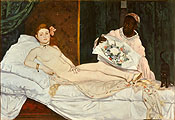
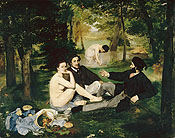
When Edouard Manet sent Olympia (fig. 1) to the salon of 1865 he fully expected it to achieve the acclaim denied Le déjeuner sur l'herbe (fig. 2) two years earlier. Although the jury admitted Olympia into the exhibition, critics, to Manet's shock and surprise, again found cause to rebuff it. As the artist complained to Charles Baudelaire shortly after the exhibition opened:
After the Salon rejection of Le déjeuner sur l'herbe in 1863 and the scandal that followed its exhibition at the Salon des Réfusés, why would Manet, who had been deeply shaken by those events, invite the same scurrilous attacks by taking up another "modern" nude in a contemporary, erotic context? "What continues to astonish after so many years" observed George Heard Hamilton in 1969, "is that Manet, bitterly resenting the notoriety which Le déjeuner sur l'herbe had brought him . . . should have again offered the public the same affront: this was the same model, still nude."2 An astute reviewer of the 1865 exhibition, however, attributed the critical fury surrounding Olympia to a misapprehension of the artist's intentions:
Contemporaneous critics and the scholars succeeding them have repeatedly pinned on Olympia the general label of "prostitute." In 1932 Paul Valéry wrote, "She bears dreams of all the primitive barbarism and animal ritual hidden and preserved in the customs and practices of urban prostitution.4 In 1981 Beatrice Farwell tagged Olympia a "shameless prostitute"5 and in his thorough and innovative assessment of the painting, T. J. Clark characterized her in similar terms albeit distinguished by choices and pretensions to a higher class: "Olympia was a prostitute, and that fact alone presented the viewer with difficulties in 1865"6 . If we accept the customary view that Olympia portrays another prostitute, we must certainly puzzle at Manet's naiveté. |
||||||
| Yet, if such had been his purpose, to simply depict another "prostitute," why should Manet have anticipated a reaction different from that which greeted Le déjeuner sur l'herbe? As Theodore Reff observed in his 1977 study of the painting, most interpretations fail to explain ". . . how astounded [Manet] himself was by the violent reaction to Olympia, and how undandyish was the self-pity he expressed . . . to Baudelaire."7 This essay seeks to account for Manet's bewilderment through a re-interpretation of this painting, one that necessitates re-treading some familiar territory, resituating Olympia in the context of mid-nineteenth-century French culture, history, and fashion. | ||||||
|
Manet called his second major nude Olympia. The painting was probably baptized by Zacharie Astruc with the first stanza of La fille des îles, a poem dedicated to Edouard Manet, printed in the Salon livret.
Other verses, though, illuminate Manet's intentions, as will become evident in the subsequent discussion. |
||||||
| According to Alexandre Parent-Duchâtelet 's well-known study of prostitution, first published in 1831, Olympia was one of the noms de guerre that courtesans chose for their professional persona—pseudonyms that both protected the families left behind and advertised their unique charms.9 Dividing these fictive names into a "classe inférieure" and a "classe élevée", Parent-Duchâtelet identifies Colette, "La Courtille," "Brunette" as designations adopted by the lower classes, while Angelina, Flore and Olympe signified those of a higher echelon.10 Several critics surmised that both the title and poem connoted someone aspiring to a higher class and sardonically labeled her an "auguste jeune fille," (an august young woman) querying, "who represents Olympia? Olympia? What Olympia? A courtesan no doubt"—11 . Théophile Gautier felt the title awakened memories "of that great Roman courtesan on whom the Renaissance doted [La Dona Olympia]."12 | ||||||
|
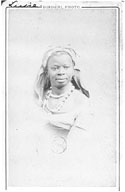
The diverse attributes and visual signs Manet assembled within the image invoked the high rank of courtesans to which Olympia belonged. The interior decor of her bedroom varies little from that of a Second Empire bourgeois home. The intricate, richly flocked wallpaper and satin drapery shielding the bed, adorned the apartments of many an upper-class visitor to the Salon of 1865. The embroidered silk shawl, lavish bedding, elegant mules, adornments of earrings, necklace and bracelet, and certainly the attendant maid (fig. 3), intimated the subject's financial well-being.13 Physiologies of women, such as Auguste-Jean-Marie Vermorel's Ces dames, published in 1860, differentiates a higher-class courtisane by the companionship of a "nègre." Referring to a courtesan called Finette, Vermorel wrote,
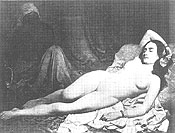
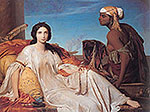
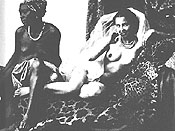
As is now well established, pictorial precedents existed for women, usually nude, attended by a black maid, such as the eighteenth-century painting by Jean-Marc Nattier, Mlle De Clermont en Sultane 1733,15 The Odalisque, by Charles Jalabert of 1842 (fig. 4) or Esther with Odalisque by Léon Benouville (fig. 5). During the nineteenth century an odalisque and later a courtesan with an attendant negress usually designated unbridled eroticism. In his Dictionnaire des idées reçues Gustave Flaubert declared that the negress was "more amorous than white women."16 The stereotype inspired early erotic photographs, such as F. J. A. Moulin's of 1853, one of many sources identified for Olympia (fig. 6). |
||||||
| The second black "messenger," the cat, called up associations with Les fleurs du mal, the object of an obscenity trial in 1857.17 By the 1860s the cat was "intimately linked in the popular imagination with promiscuous and potentially dangerous sexuality, evidenced in its most benign form by the use of the word 'chatte' to describe the female genitals. But, the term could also designate a cocotte, one of the many euphemisms for a registered prostitute."18 | ||||||
| These features certainly reinforce a habitual reading of Olympia as a "courtesan", yet don't answer the question why Manet should have been at all surprised when "insults rained upon him like hail." A careful reevaluation of the painting and a study of some of its details may shed more light on this puzzle. Manet began Olympia in the spring of 1863, probably after completing Le déjeuner sur l'herbe, although there is considerable evidence that both were conceived together.19 Referencing Antonin Proust, David Alston observes that Manet intended these two paintings to be modern interpretations of the historic nudes of Giorgione and Titian.20 In 1853, while visiting the Uffizi, Manet made the requisite copy of Titian's Venus. And he told Proust "When we were at [Couture's] studio I copied Giorgione's women, the women with musicians. That painting is dark. The undercoat has come through. I want to do it over, but do it in the transparency of daylight, with figures like the ones over there."21 | ||||||
| Victorine Meurent modeled for both Olympia and Le déjeuner sur l'herbe, astonishing when her respective portrayals are set side by side. While painted in the same year, the appearances that gaze out from these two canvases are distinctively dissimilar in features and character. Alongside Olympia, the nude of Le déjeuner sur l'herbe is undeniably cruder: hair and hairdo, facial features; the proportions of her figure, and even the brushwork with which they are recorded are coarser counterparts to the elegantly coiffed and bejeweled Olympia. While Olympia lies upon luxurious white sheets and an embroidered crepe-and-silk shawl, in Le déjeuner a tissue-thin chemise shields Victorine's naked body from what we can only presume to have been very damp ground. Surrounded by not one but two clothed suitors, the nude here clearly joins the realm of the lower class prostitute. Sent to the Salon of 1863 under the title Le Bain, Manet identified Le déjeuner in a later inventory as Partie carrée a designation signifying—according to Alan Krell's research on nineteenth-century slang—a "four-way debauch, involving two men and two girls, who sleep together, go for walks together, eat together and kiss"22 . In "Manet and the Demoralized Viewer," John House has drawn attention to an often overlooked detail within the naturalistic still life in the lower-left corner of the painting23 : a small green frog, or grenouille. Given the work's open-air setting, a frog might not be unremarkable, but, as John House observes, in 1863 grenouille was student slang for a particular type of prostitute.24 Described in Les courtisanes du Second Empire, this physiognomic type corresponds closely to characterizations that Manet's painting otherwise conveys. A grenouille was among the most brazen of the femmes insoumises (carefree women). She was not above feigning pregnancy and extorting financial support for the child she borrowed to carry out the deceit. "The grenouille was not pretty," the author of Les courtisanes tells us, "but she belonged to that category of women of pleasure in whom a certain spiritedness took the place of everything else. . ."25 | ||||||
|
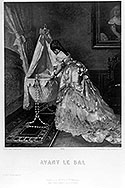
If the grenouille suggests that the nude in Le déjeuner represents a more common prostitute, can we find comparable signifiers in Olympia that designate her as a paramour of a different order? The gold bracelet with locket, which assumes a prominent place both in Manet's painted and etched copies of the work, may be such a marker. In the Portrait of Zola Manet included a photographic reproduction of Olympia above the desk. Within the reproduction, the bracelet and locket have a distinctive presence, and the bracelet is conspicuous in various etchings and watercolors Manet made after the painting, suggesting its importance in disengaging the painting's meaning. Writing in L'Oeil in 1983, Alain Clairet identified this very article of jewelry as a bracelet once worn by Madame Manet that preserved a lock of Edouard's hair.26 According to Shirley Bury, bracelet lockets, which contained a portrait (photographic rather than painted beginning in the 1850s) and or a lock of hair of a beloved (child, husband or betrothed) were very popular at mid-century.27 A similar locket is worn by the mother in Auguste Toulmouche's painting Avant le bal (fig. 7). Manet adorned Olympia with this trinket to allude to her prosperous rank and denote a recent fashion, but the bracelet-locket also furthers our understanding of the owner's personality and character. This nude is not merely an object of physical pleasure; she receives and cherishes sentimental keepsakes and tokens of remembrance. When juxtaposed with the nude in Le déjeuner sur l'herbe, Olympia's partner is not visible—rather he is conjured up with delicacy and even tenderness. An abundant bouquet signifies his affections, if not his imminent presence on the scene. In contrast to the earthy free-spirited grenouille the nude Olympia receives tokens of affection from her lover and adorns herself with a locket that the viewer imagines holds a photograph or lock of her beloved's hair. | |||||
|
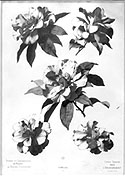
A second attribute of Olympia, equally prominent in etched reproductions of the painting, is the bloom in her hair. While Theodore Reff identified it as an orchid28 , I believe it to be a single-flower camellia, popular in the nineteenth century before the hybridized double-flower form known today. Illustrated here (fig. 8) is a typical mid-century specimen, which resembles Olympia's ornament in size and shape. Contemporaneous botanical texts, moreover, describe and illustrate the single-flower camellia as salmon pink in color. | |||||
|
The identification of the flower may be decisive in discerning Manet's purpose for the painting. In Ces dames, a contemporaneous guide to various "filles de joie," Vermorel identifies a camélia as a woman distinguished by her devotion and fidelity to a single lover.29 The type had its origins in the heroine of Alexandre Dumas' novel, La dame aux camélias, first published in 1848 with numerous adaptations following. Again, Vermorel's Ces dames delineates the character:
The camélia was defined as a "lorette dans la prospérité," in Pierre Larousse's Grand dictionnaire universel du XIXe siècle, which also traces her origin to Dumas' La dame aux camélias.31 |
||||||
| By themselves Olympia's locket-bracelet and blossom might not persuade us that Manet intended the painting to represent a camélia, yet, the ensemble of the painting's visual signifiers support such a reading. Ever since it was first exhibited, Olympia has impressed viewers by two distinguishing features: the position of her hand and the directness of her gaze. As T. J. Clark has observed: Olympia's hand "enraged and exalted the critics as nothing else did."32 Its placement at the center of the composition underscores its importance. Ernest Chesneau observed in his salon review that Olympia's hand, "in the form of a toad, provokes hilarity."33 Other critics commented on this strange hand—"her hand for a fig leaf"34 and ". . . the hand, which is flexed in a sort of shameless contraction."35 J. K. Huysmans detected "an irritating enigma" in Olympia's demeanor.36 T. J. Clark found Olympia vacillating and uncertain: "Surely Olympia's sexual identity is not in doubt. It is how it belongs to her that is the problem." And he designated her control over her body and her sex "Olympia's choice."37 Françoise Cachin saw the visualization of power in her claw-like appendage as analogous to the gripped hand of Ingres' Monsieur Bertin.38 | ||||||
|
As for Olympia's gaze, Beth Brombert sums up several contemporaneous observations by noting that the nude's expression was critical to the work: "What may have offended the viewer of 1865 far more than the painting's disregard for established techniques of modeling and half tones is the brazen look that defies the male gawker. 'You may buy my favors,' she seems to be saying, 'if I choose to grant them, but only I own me.'"39 Vermorel's assessment of the camélia type elucidates the nineteenth-century significance of both the hand and the glance:
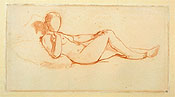
In a red-chalk preparatory sketch Manet depicted Olympia with right knee raised blocking a clear view of her genitals (fig. 9), suggesting that from the beginning Manet intended Olympia to personify restraint; she was not a cipher of commercial prostitution. Was not the camélia a modern embodiment of Venus, a nineteenth-century goddess of love? Dumas's description of Marguerite, the original camélia and heroine of La dame aux camélias, clarifies the allure that this type held for Manet and his contemporaries.
Additional verses of Zacharie Astruc's poem La fille des îles, whose first stanza appeared in the salon catalogue, may further delineate Manet's design:
Describing her body as virginal, asking "Who judges the charms of your slender shape?" and "On what gilt illusion gaze your tranquil eyes?" Astruc's verses conjure a special partner for this camélia's favors. If Manet indeed sought to represent in Olympia an inamorata rather than a common prostitute, a mistress rather than a lower class "fille de joie", someone who embodied fidelity and self-sacrifice, we can begin to understand his irritation at the negative reception of his painting. And there may have been other reasons as well for his expectation that the public would have understood Olympia to embody sexual norms different from those in Le déjeuner. Described as a skeleton43 and puny, Olympia was markedly thin, particularly in contrast to her earthy counterpart in Le déjeuner. Baudelaire detected a distinctive modernity in her build: "Thinness is more naked, more indecent than fat."44 Marguerite Gautier, the heroine of Dumas' La dame aux camélias, was also slender in build, consumptive and anemic in pallor, and as Vermorel observed ". . . many have been inspired by her."45 |
|||||
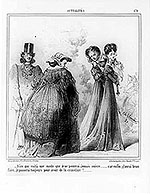
| The mid-century fashion for thinness (fig. 10) was also advanced by Napoleon III's current mistress Marguerite Bellanger, who was "[b]elow average in size, slight, thin, almost skinny."46 Significantly, the author of Les courtisanes du Second Empire identified Marguerite Bellanger as the most famous camélia of the day.47 Her nom de guerre was said to have been inspired by Dumas' heroine, and she was renowned for wearing daisies (marguerites) (figs. 12). Born Julie Marie Leboeuf, in the village of Ville-Bernier, by 1858 she had settled in Paris and assumed her pseudonym.48 In the early 1860s, she allied herself with the lorettes on the Avenue de la Motte-Picquet near the Ecole Militaire, and became a favorite of military officials and the imperial guard. | ||||||
While there are many accounts—some most likely romantic exaggerations—of the beginning of their affair, Marguerite appears to have met Napoleon III in the early 1860s. Baron d'Ambès, in his memoirs, describes a conversation he had with Napoleon III at Vichy on 4 July 1861. "Scarcely was he indoors when he confided to me his impressions by the way and asked me if there was anything in the nature of fun to be found. The question struck me as disquieting. He mentioned the fair Marguerite with a laugh." The reference was to Mlle Bellanger, the Emperor's mistress at this period.49 Hector Fleischmann's Napoleon III and the Women he Loved does not date the relationship's origin, but his chronology suggests it was in the early 1860s.
Support for this version appears in the form of a police document, dated 9 January 1861, which granted Marguerite permission to wear male clothing, which would have enabled her freer movement on the Tuileries grounds.51 |
||||||
| In their journal, the Goncourt brothers report that on 22 April 1863 Marguerite Bellanger shared a theater loge with the imperial guard Gramont-Caderousse which, one biographer deduced, indicated Marguerite's liaison with the officer at the time.52 Yet, the guard's presence might also signify the protection the Emperor granted his favorite. | ||||||
| Emperor Napoleon III's liaison with Marguerite, whose tenure was longer than that of any of his other mistresses, "seems to have involved genuine affection . . . "53 according to John Bierman's Napoleon III and his Carnival Empire. She accompanied the Emperor while he "took the waters of Vichy," on his annual visit to watch army maneuvers at Chalôns-sur-Marne where, she boasted to a friend, "she entertained him enormously by dressing up in the uniform of a colonel of the hussars."54 By 1865 their liaison was so well known that the British ambassador Henry Cowley wrote Lord Clarendon on 6 January " . . . Fancy the Empress taking Mocquard's brother, a notaire, getting into a brougham and going off to Marguerite Bélanger [sic] to whom she made a scene, offering to settle I do not know what upon her if she would leave Paris." Cowley wrote home on 1 May 1865, that the Emperor left for a six-week sojourn to Algeria and that some "connect this journey with a desire to see Mademoiselle Bélanger [sic] more at his ease. It seems certain that she has gone to Marseilles, and I hear that she is to proceed to Algiers. . ."55 Lord Clarendon replied: "His way of carrying it on with Mlle Bélanger was bad enough at Paris but if he takes her to Algiers where he will be living in a lantern and everything he does at every hour of the day and night must be known, it really will be too bad—there is plenty of toleration for such doings, but even he will hardly be able to brusquer les convenances (reject proprieties) with impunity."56 | ||||||
|
|
||||||
| When Manet began Olympia in 1863 the name and reputation of Marguerite Bellanger were just becoming known, but most accounts point out that the Emperor shielded her from public scrutiny.57 He installed Margot in a guarded house on the rue du Bac, after Empress Eugénie discovered her husband's secret room—nicknamed le pas des biches (the darlings' corner)—in the palace. He then moved her to number 1 rue des Vignes in the village of Passy. "Je veux vous voir chez vous," he wrote, "dans une charmante villa que j'ai achetée et fait meubler à votre intention."58 Consequently the name Marguerite Bellanger appears to have been more renowned than her face during the early 1860s.59 Manet, however, moved in circles where the Emperor's escapades with his current mistress would have been discussed: his father had been a government official in the Ministry of Justice, and his brother also held a government post. The lubricious gossip in the popular press was another probable source for information about their relationship.60 | ||||||
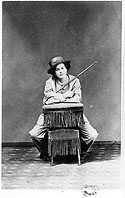
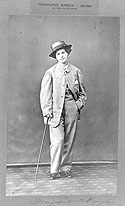
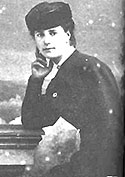
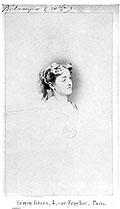
| I suggest that Manet intended the physiognomy and body type of Olympia to evoke this notorious and contemporary camélia. Delton & Co. photographed Marguerite Bellanger in male costume with a direct, uninflected stare that resembles Olympia's expression (figs. 11, 12).61 Disderi's image of Marguerite (fig. 13) also captures a visage similar to that of Olympia. An Erwin Frères photograph, labeled in a contemporary hand "Bélanger (Mlle.)," (fig. 14) represents a woman whose thin face, square jaw, and the angle and carriage of her head bear a striking resemblance to Olympia. While it represented another Bellanger, Anna, rather than Marguerite,62 I believe that as Marguerite was shielded from public scrutiny during the period of her assignation with the Emperor, Manet may have conflated these photographs in imaging Olympia's physiognomy. Erwin Frères' Mlle Belangér is adorned with daisies, or marguerites, so its sitter could easily have been understood to portray a woman named Marguerite. Furthermore, in the preparatory chalk sketch (fig. 9), Manet left the facial features blank, suggesting that the precise details were to be added later, possibly from an external source like a photograph. | ||||||
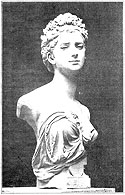
| If Manet intended Olympia to allude to the specific camélia Marguerite Bellanger, how did such a resemblance augment his artistic aims? How might it be read within the artistic practices of the time? The convention of contemporary mistresses either serving as models or being portrayed as allegorical and classical characters was surprisingly common at mid-century.63 Beatrice Farwell dates the popularity of such "nude portraiture" to the 1840s, when Théodore Chassérieau depicted his mistress Alice Ozy in various paintings, including a life-size Sleeping Bather (Musée Calvet, Avignon), which he sent to the Salon of 1850.64 Manet's teacher Thomas Couture used his mistress and future wife as a model for the central nude in Romans of the Decadence (1847) and the courtisane Mogador appears as well within the painting's ancient orgy.65 Marguerite Bellanger herself posed for one of the allegorical sculptures of the four seasons (fig. 15) that Albert Carrier-Belleuse modeled in the 1860s.66 It was an evident commonplace that the classical Venuses and nude goddesses shown at the annual Salons flaunted visages of chic and renowned courtesans. Pierre-Joseph Proudhon found Paul Baudry's Pearl and the Wave (said to portray the cocotte Blanche d'Antigny) "the very image of prostitution: Wicked blue eyes like those of Eros, provocative face, voluptuous smile; she seemed to say, like the street-walkers of the boulevards, 'Do you want to come and see me?'"67 | ||||||
| Manet's struggle to carve himself a place within painting's history may well have inspired him to adopt this popular convention for Olympia—to use a fashionable demi-mondaine as source for his second major nude, just as the devoted camélia served as a modern incarnation of the mythic Venus. | ||||||
| To further emphasize that Olympia was no ordinary prostitute, Manet based his painting on Titian's Venus of Urbino, which he had copied in the Uffizi in his youth. Manet drew numerous parallels between Titian's Venus and his modern courtesan. The interior décor, slippers, jewelry and shawl were mid-century equivalents of the Renaissance prototype; the negress, the modern courtesan's servant while, as I have pointed out above, the bracelet locket, and camellia were contemporaneous ciphers of fidelity updating the Renaissance lap dog, just as allusions to the camellia type were a means to portray a modern embodiment of Venus as love. According to Charles Blanc's well-known Histoire des peintres, the model for Titian's Venus was a renowned courtesan, leading Manet to confer on Olympia the likeness of a fashionable equal.68 And further, Hippolyte Taine described Titian's Venus in Voyage en Italie as a "seductive nude [who] represented the mistress of a patrician, reclining on a bed, adorned and waiting. . . She is une courtisane, but she is a lady; in those days the first occupation did not exclude the other."69 | ||||||
| Manet's attempt to establish an artistic lineage for Olympia was underscored by his other submission to the Salon of 1865, as Theodore Reff first observed.70 Along with Olympia Manet exhibited The Mocking of Christ. Just as the former was based on Titian's Venus of Urbino, so the latter was inspired by [Titian's] Christ Crowned with Thorns.71 Pairing a sacred image with a profane one—in the genres in which male and female nudity were commonly cast—according to Reff, "had an additional more private significance.72 " Titian was also said to have selected pairs of paintings to impress an important patron. Charles Blanc recounts that Titian brought Christ Crowned with Thorns and a Venus to Charles V to flatter his patron by evoking "feelings of devotion and sensuality at the same time."73 The legend was popular with mid-nineteenth- century artists and first included in Northcote's Life of Titian, published in 1830."74 | ||||||
| Is it possible that Manet, by exhibiting Marguerite Bellanger in the guise of a traditional Venus together with The Mocking of Christ, was seeking to flatter Napoleon III, just as Titian had sought the approbation of Charles V?75 In 1865 Napoleon III was the most influential patron of the arts, responsible for considerable purchases from the annual Salons, both for the national museums and his private collection. Not surprisingly he favored pictures of pretty women, as Patricia Mainardi reports in The Salon and Politics of the Second Empire, confirmed by photographs of state purchases from the 1865 Salon.76 From the 1863 exhibition the Emperor purchased Cabanel's Birth of Venus and Baudry's The Pearl and the Wave.77 Or was Manet naively emulating Titian's example, aspiring to mark his own place alongside the Venetian painter's historical standard, seeking critical esteem for his cleverness yet oblivious to imperial patronage? Each question leads to the same answer: Manet had reason to believe that his submissions to the 1865 Salon would be valued, at least by the artistic cognoscenti. | ||||||
|
1. Cited in Françoise Cachin, Manet 1832-1883. Exh. cat. (New York: Metropolitan Museum of Art, 1983), p. 181. 2. George Heard Hamilton, Manet and His Critics, (New York: W. W. Norton, 1969), p. 67. 3. A. Bonnin, review in La France, 7 June 1865, cited in T.J. Clark, The Painting of Modern Life: Paris in the Art of Manet and his Followers, (New York: Knopf, 1985), pp. 83-84, 284, (French translation in note, p. 284) "Il n'a exposé que des ébauches. Cependant nous ne partageons pas l'opinion, trop répandue, que cette négligence soit un parti pris, une sorte de défi ironique jeté au jury et au public. Le jury eut certainement distingue une charge d'atelier d'une oeuvre malheureuse, et il luit eût fermé la porte du palais des Champs-Élysées. D'une autre côte, un artiste ne peut traiter légèrement le public sans compromettre sa réputation, qui reste parfois à jamais atteinte; et M. Manet, qui paraît à chaque Exposition, poursuit certainement autre chose que la triste célébrité que l'on peut acquérir par ces procédés périlleux. Nous aimons mieux penser qu'il s'est trompé. Maintenant, quel est son but? Ses toiles son trop inachevées pour qu'il soit possible de l'apercevoir." 4. Cited in Cachin, p. 174. 5. Beatrice Farwell, Manet and the Nude, (New York: Garland, 1981), p. 224. 6 . Clark, 100. 7. Theodore Reff, Manet: Olympia, 1977, (New York: Viking), p. 44. The hail of criticism included that of Jules Claretie, who in L'Artiste in May 1865 identified Olympia as "a courtesan no doubt" (une courtisane sans doute.) A few days earlier, Le monde illustré used the epigraphic poem by Zacharie Astruc to sardonically brand this "auguste jeune fille," a courtesan. A French dictionary published in 1873 describes a courtesan as "toute femmes de mauvaise vie qui est au-dessus des simple prostituées." (All women of vice who are above the simple prostitutes.) Cited in Alan Krell, "The Fantasy of Olympia," Connoisseur 195 (August 1977), p. 298. 8. Cited in Cachin, p. 179. According to Clark, p. 283, the poem was dropped from the second edition of the Salon catalogue, "presumably at Manet's or poor Astruc's request!" Adolphe Tabarant, Manet et ses oeuvres, (Paris: Gallimard, 1947), p. 105 credits Astruc as the author of the painting's title, and he reprints the poem in its entirety. 9. Cited in Krell, 1977, p. 298: "[These noms de guerre] offrent de grandes dissemblances, suivant les classes des prostituées, et donnent à eux seuls une idée de ce que peuvent être les sociétés qu'elles fréquentent, les lectures qu'elles peuvent faire, l'éducation qu'elles ont acquise, et la valeur qu'elles attachent aux expressions." 10. Ibid. 11. Clark, p. 86. The critical assessment of Olympia's class is taken at face value: "To more than one critic in 1865 she seemed to occupy a quite determinate place in the Parisian class system: she was an "Olympia from the Rue Mouffetard," "the wife a cabinetmaker" a "coal lady from Batignolles." All of these references were meant to be funny, of course, but the jokes depended on Olympia's being placed, to some extent unequivocally in the world of the faubourgs and the working class." (pp. 87-88) My reading of these comments is the opposite: the critics read the higher-class status implied, and thus linked her ironically with the working class prostitute. Alan Krell, Manet and The Painters of Contemporary Life, (London: Thames and Hudson, 1996) and especially Beth Archer Brombert, Edouard Manet: Rebel in a Frock Coat, (Boston: Little Brown, 1996), p. 140, observe that Olympia was meant to evoke a higher class courtesan: "The upper class of the profession bore high-flown names taken from epic poems or the ancient world: Armide, Arthémise, Aspasie, Isménie, Lucrèce, Octavie, Olympe. As noms de guerre they went back to the courtesans of Rome and Venice." Charles Bernheimer in "Manet's Olympia: The Figuration of Scandal," Poetics Today 10, no. 2 (Summer 1989), pp. 262-263, writes: "The various categories of the sexualized and/or venal woman cannot be as neatly subsumed as Clark would have us believe under the master classifications of the unrepresentable fille publique and the ultrarepresentable courtisane." Bernheimer, 1989a, p. 263, emphasized the uncertainty of this figure's class as part of its disturbing quality. The mobility within the economic status of the period extended even more dangerously to uncertainty surrounding moral identity: "Recognition of this social mobility has damaging consequences for Clark's argument, since it suggests that Olympia's subversion of the courtesan category need not entail the revelation of a class identity once hidden. Olympia's class origins remain unreadable because her nakedness is a dangerous instance not of class, as Clark would have it, but of the way sex suggests the irrelevance of class." 12. Cited in Clark, p. 86. Charles Bernheimer, 1989a, pp. 266-267, emphasizes the classical association with the name Olympia and its "troubling indeterminacy" "There is, of course, a classical echo, probably meant to be heard parodically here—Mount Olympus, home of the gods; Olympia, consort of Zeus—but also a purely modern one: 'Olympe' is listed by Alexandre Parent-Duchâtelet in his authoritative study of 1836, De la prostitution dans la ville de Paris, as one of the noms de guerre frequently assumed by upper-class prostitutes." 13. A period photograph (inscribed Lucie) may be the model for the servant who has been identified as Laure. Adolphpe Tabarant, cited in Reff, p. 93, identifies the model as a "Laure, a very beautiful Negress." See also Griselda Pollock's discussion of the model Laure in Differencing the Canon: Feminine Desire and the Writing of Art's Histories, (London/New York: Routledge, 1998), pp. 277-281. 14. Auguste-Jean-Marie Vermorel, Ces dames, physiognomies parisiennes, (Paris: Tous les Librairies, 1860), p. 28. "Il ne manque rien à Finette, rien, pas même un nègre! un nègre dont elle parle à tout propos! un nègre qui n'appartient qu'à elle et n'obéit qu'à elle. Elle l'aime tant, son nègre!." (English translation by the author) 15. Reff, p. 93 reproduced in Beatrice Farwell, "Courbet's Baigneuses and the Rhetorical Feminine Image," Art News Annual, 38 (1972), pp. 65-9, and in Pollock, p. 288. 16. Cited in Krell, 1977, pp. 298. See also S. L. Gilman, "Black Bodies, White Bodes: Toward an Iconography of Female Sexuality in Late Nineteenth-Century Art, Medicine and Literature," in H. L. Gates, Jr. ed., 'Race,' Writing and Difference (Chicago and London: Chicago University Press, 1986), pp. 223-61. Gilman analyzes contemporaneous medical literature, that attributed these qualities to physiological differences. These issues are also discussed in Pollock. 17. Hamilton, p. 79 observed: "But the cat is too intimately a Baudelariean symbol not to have wakened in the minds of the spectators of 1865, just as it cannot fail to now, memories of those cats who stalk through the pages of the Fleurs de mal." Many of the caricatures and the satirical reviews highlight the cat's presence in the painting. The poem most often associated with Olympia is "The Cat," in which Baudelaire's mistress and the animal are one, cited in Kathleen Kete, The Beast in the Boudoir, (Berkeley: Univ. of California Press, 1994), p. 113: "Come, superb cat, to my amorous heart; / Hold back the talons of your paws / When my fingers leisurely caress you, / Your head and your elastic back, / And when my hand tingles with the pleasure / Of feeling your electric body, / In spirit I see my woman. Her gaze / Like your own, amiable beast, / Profound and cold, cuts and cleaves like a dart, / And, from her head down to her feet, / A subtle air, a dangerous perfume, / Floats about her dusky body." Reff, 1977, pp. 89-92 also discusses verses from the anthology that correlate with Olympia. 18. Krell, 1996, p. 59. See also Kete, p. 120. She quotes Alphonse Toussenel, who wrote in 1855 of using the image of a cat to describe female promiscuity. "'The [female] cat is essentially antipathetic to marriage,' Toussenel explained. 'She accepts one, two, three lovers,' and if denied by her domesticity the freedom to love, 'she goes to reclaim that freedom in the wild.'" John F. Moffitt, "Provocative Felinity in Manet's Olympia," Source, 14, no. 1 (1994), pp. 21-31 discusses extensively the association of the cat with sexuality. 19. Several authors note that as both paintings were nudes and both were inspired by Renaissance sources, Manet may have begun one and in the process conceived a second. See Anne Hanson, Manet and the Modern Tradition (New Haven: Yale, 1979). Reff, p. 44, remarks that they were both begun in 1863. 20. David Alston, "What's in a Name? Olympia and a Minor Parnassian," Gazette des Beaux-Arts, 91 (April 1978), p. 149, discusses a poem by George Marcy published in L'artiste, in 1861, first cited by Hanson: "Olympia / Si nous vivions au siècle ou l'art vénitien / Dans son manteau royal drapait la Renaissance, / Elle aurait inspire Giorgione et Titien, / Dont l'ardente couleur et la magnificence / Auraient divinisé son idéal païen." 21. Cited in Brombert, p. 125. 22. Krell, 1996; Ed Lilley, "How Far Can You Go? Manet's Use of Titles," Word and Image, 10 (1994), p. 165. Both Krell and Lilley cite Alfred Devau, Dictionnaire érotique moderne (Bruxelles: Freetown, 1864) for this translation of the title. Théophile Gautier wrote a novel with this title, published in 1851, with numerous revisions thereafter. M. E.G.M. Théaulon de Lambert's one-act vaudevillian play of the same name dates to the early nineteenth century and the comic opera Partie carrée by Lucien Augé de Lassus premiered in 1884. 23. George Mauner also draws attention to the frog, but interprets it, paired with the soaring bullfinch, as a sign of the duality of human nature: "Manet used a bird and a frog which, like the figures they help us to interpret, do not struggle for the dominant position but serve to call attention to man's condition, to the inevitable paradox of life." Cited in Brombert, p. 129. 24. John House, "Manet and the De-Moralized Viewer," in Paul Hayes Tucker, ed., Manet's Le déjeuner sur l'herbe, (Cambridge: Cambridge University Press, 1998) p. 86 and n. 22, p. 89: "Murger's grisettes, abandoning their independence and their gaiety, have become, according to the term used by students, grenouilles de brasseries"; Macé, quoted in J. P. Colin and J. P. Mével, Larousse, Dictionnaire de l'argot (Paris: 1992), p. 317. 25. [Léopold Stapleaux ?], Les courtisanes du Second Empire, (Bruxelles: Office de Publicité, 1871), p. 70: "La Grenouille n'était pas jolie, mais elle appartenait à cette catégorie de filles de plaisir chez lesquelles un certain entrain tient lieu de tout . . . ." (English translation by the author). 26. Alain Clairet, "Le bracelet de l'Olympia: Genèse et destinée d'un chef-d'œuvre". L'Oeil 333 (April 1983) p. 36-41. 27. Shirley Bury, Jewellery 1789-1910: The International Era, (Woodbridge, Suffolk, England: Antique Collectors' Club, 1991), vol. 2, p. 105: "Lockets, usually comprising two parts hinged together with glazed recesses for mementoes, were increasingly fashionable, but pendants were still often fitted at the back with gold-rimmed, glass-fronted boxes. From the late 1840s and early 1850s both lockets and pendant lockets sheltered photographs more frequently than painted miniatures, though the traditional curls of hair remained popular." And vol. 2, p. 363: "The persistent vogue for lockets, at its peak from the 1860s to the 1880s, gave rise to a long series of patents." Bury describes innovations such as an early form of plastic frame to protect the contents of the locket, and the shaping of the locket box to receive mementoes. 28. Reff, p. 108. 29. Popular illustrations of the camélia type represented her with a camellia flower at her breast. Grandville's popular illustration Camélia is in the collection of the Bibliothèque de la Musée des Arts Décoratifs. Marie Duplesssis, a courtesan said to be the prototype of Violetta in La Traviata is also shown with a camellia at her breast in a print from the Bettman Archive, NY, reproduced in Paul Henry Lang and Otto Bettmann, A Pictorial History of Music, (New York: W.W. Norton, 1966). Nicholas John, ed., Violetta and her Sisters: The Lady of the Camellias, Responses to the Myth, (London: Faber and Faber, 1994) records that after the novel's publication in 1849, the first production of a dramatic play was in 1852, a second in 1867, followed by Verdi's opera La Traviata. Reff, p. 105, cites a number of imitations that referenced the source in their titles, such as Delacour and Thiboust, Diane de lys et de camellias and H. Craimeaux and Jamie fils, La bonne aux camélias. According to Nils Sandblad, Manet: Three Studies in Artistic Conception, (Lund: C. W. K. Gleerup, 1954), pp. 97-98 Manet was close to Dumas fils at the time of the play's production and he may have been more familiar with the text than scholars have recognized. 30. Vermorel, pp. 99-101. "Depuis le succès populaire de la pièce de M. Alexandre Dumas fils, on appelle dames aux camélias, ou simplement camélias, les biches qui se laissent dominer par un amour exclusif et prolongé. . . . On a souvent bafoué les Camélias. On a mis en doute leur sincérité et leur désintéressement. Il faut reconnaître cependant que les amours violents ne sont point aussi rares chez ces dames qu'on pourrait le croire. Et alors une métamorphose complète s'opère en elles; elles sont susceptibles de tous les sacrifices et de tous les dévouements, elles semblent dépouiller l'enveloppe de marbre qui recouvre leur cœur et deviennent des modèles de tendresses et de fidélité." (English translation by the author). 31. Pierre Larousse, Grand dictionnaire universel du XIXe siècle, (Paris: Librairie classique Larousse et Boyer, 1867), entry on Camélia. 32. Clark, p. 135. 33. "Salon de 1865," Le Constitutionnel (16 May 1865), cited in Reff, p. 58. 34. Cited in Clark, p. 96. 35. Ibid., p. 94. 36. Cited in Reff, p. 28. 37. Clark, p. 83. 38. Cachin, p. 180. 39. Brombert, p. 145. 40. Vermorel, p. 108. "Il en est d'elle comme de certains objets dans le salon d'exposition de l'Hotel de la Rue Drouot: on les voit de loin et on est attiré vers eux. Il y a bien une inscription: n'y touchez pas." (English translation by the author). This reading is indirectly substantiated by Seymour Howard, "Olympia Says 'No'", Source: Notes in the History of Art, 7 (Fall 1987), pp. 21-24, in which he observes that Olympia's gesture corresponds to the Chinese calligraphic sign "fu" which means no or signifies a contradictory or negative expression. 41. Brombert, p. 142. In a letter to The Burlington Magazine, 50 (March 1927), p. 166, Thomas Bodkin wrote that "many who saw the picture on its first appearance . . . connected the sitter" with La dame aux camélias. While Bodkin deduces that those allusions were based on an association between Olympia and the minor character of the same name in La dame aux camellias, it could be that early viewers who linked Olympia with the novel read the painting as an image of the camélia type embodied by the heroine Marguerite Gautier. 42. Tabarant, p. 105. Where do you draw these airs of slave or of sultane, 43. A. J. Lorentz in Revue galopante au Salon, cited in Clark, pp. 96-97. 44. Farwell, 1981, p. 111. 45. Vermorel, p. 106. "Marguerite Gautier était poitrinaire, et beaucoup se sont inspirées d'elle." (English translation by the author). 46. Reff, pp. 57-58. 47. [Léopold Stapleaux?], p. 56. 48. Hector Fleischmann, Napoleon III and the Women he Loved, (London: Holden and Hardingham, 1915), p. 211. John Bierman, Napoleon III and his Carnival Empire (New York: St. Martin's Press, 1988), p. 242, identifies Julie as Justine Leboeuf. These sources also indicate that she left home at a young age for Angers, where she met a "wholesale dealer," who installed her at Nantes and showed her its marvels. According to Hector Fleischmann it was in Nantes that Julie Leboeuf joined the town grisettes seeking customers near the Graslin Theater, before leaving for Paris to seek her fortunes. 49. Baron d'Ambès, Intimate Memoirs of Napoleon III: Personal Reminiscences of the Man and the Emperor, edited and translated by A. R. Allinson (London: Stanley Paul, 1912), p. 287. 50. Fleischmann, pp. 215-216. According to Xavier Demange, a historian currently writing on the demi- monde, in a conversation with the author in June, 2001, the passage refers to Davilliers who was in charge of security in the Emperor's household. 51. Intermédiaire des chercheurs et curieux, 930 (15 May 1901): pp. 830-831. Here her address was given: 39 Blvd. des Capucines, and she was described as 21 years old with gray eyes, and chestnut hair. Other accounts described her as blond, with black eyes, which gives some indication of the ambiguity surrounding her appearance. 52. Edmond et Jules de Goncourt, Journal: Mémoires de la vie littéraire, ed. Robert Ricatte, (Paris, Flammarion, 1959), vol. 1, p. 1065, Adrien Dansette, Les amours de Napoleon III, (Paris, Librarie Arthème Fayard, 1938), p. 245 dates the beginning of their relationship to June 1863. 53. Bierman, p. 242. 54. Ibid., p. 243. 55. Bierman, p. 242, and Henry Richard Cowley, The Paris Embassy during the Second Empire (London: Butterworth, 1928), p. 282. 56. Cowley, p. 283. 57. For example, the inventory of Disderi's photographs (Cabinet des Estampes, at the Bibliothèque Nationale) lists Mme Bellanger as a client almost every year between 1857 and 1863. Then there is a break between 1863 and 1865, perhaps affirming her seclusion from public scrutiny. Disderi again photographed her several times in 1866, 1867 and 1868. 58 Fleischmann, p. 211. His account is among the most detailed and apparently reliable, although others have followed (none of which has been as well documented). 59. Her seclusion may account for her image not being readily identified by critics when Olympia was exhibited, and yet numerous depictions of demi-mondaines that were recognizable among the Venuses were not mentioned in exhibition reviews either. Beth Brombert, p. 112, also writes: "When contemporaries of Manet's painted their own mistresses from the demi-monde as Dianas or naiads, there was no public outcry, because to have recognized the model would have been to incriminate oneself." The practice also affirms that identification of these women was not for public consumption, but rather a sport for a select group. 60. According to researcher Xavier Demange, in a conversation with the author in June 2001, discussion of the relationship also appears in the unpublished diary of Ludovic Halevy in the entries for 31 August 1863 and 11 November 1863. 61. Charles Bernheimer, Figures of Ill Repute: Representing Prostitution in Nineteenth-Century France (Cambridge: Harvard University Press, 1989), p. 111, cites precedents for Olympia in the erotic photography of the period: "Although these images evidently had no place in the official salons, they did circulate widely among male spectators of salon pictures. Hence, their conventional modes of representing female sexual availability—among them the direct, uninflected stare characteristic of Olympia's gaze—would have constituted a covert frame of reference for many of the painting's viewers." 62. Le Petit Homme Rouge, in The Court of the Tuileries 1852-1870, (London: Chatto and Windus, 1907), p. 202 may also have confused these two women named Bellanger/ Bélanger as he states that Marguerite was an actress for "the little Théâtre Beaumarchais, and she subsequently obtained employment in a similar capacity at the Opera-house. Being clever, she soon rose in her profession, and appeared in various pieces at the Folie Dramatique as an ingénue." According to unpublished archives at the Musée Carnavalet, Anna Bellanger was an actress with the Opéra Comique. Since Manet occasionally worked in the print collection of the Bibliothèque Nationale and since photographs were part of the depôt légale, they may have been available to him for study. 63. Among famous mistresses of the past whose features are portrayed as Virgins or Venuses, there is Jean Fouquet's Renaissance Virgin in the Melun Diptych said to represent Agnes Sorrel, mistress of his patron, Charles VII. Similarly Titian's Venus of Urbino was seen as portraying a similarly well known courtesan of his day. During the mid-nineteenth century Paul Baudry painted the famous cocotte La Paiva as the allegorical figure of night in Day Hunting Night on the ceiling of her Champs-Elysées apartment salon in 1864. See Bernheimer, 1989a, p. 238 and Bernheimer, 1989b, p. 106. Cachin, p. 178 observers: "More provocative nudes had flirted with scandal at the Salon. First there was Clésinger's sculpture Woman Bitten by a Serpent, 1847 (Musée du Louvre, Paris), in which everybody had recognized the model Mme Sabatier; but the scandal was contained within high society . . . Chassériau painted his mistress, the courtesan Alice Ozy, in the nude (Musée d'Avignon), and suffered nothing worse than admiration and a few bawdy but flattering verses." 64. Farwell, p. 42. 65. Ibid., p. 43. Paul Baudry sent a monumental penitent Magdalene (Nantes, Musée des Beaux-Arts) to the Salon of 1859 using the demi-mondaine Blanche d'Antigny as model. Examples of this practice are numerous and include other works not mentioned by Farwell: Charles Marchal showed Phryné and Pénélope in contemporary dress at the Salon of 1868 (Clark, p. 113). Phryné bears a strking resemblance to the demi-mondaine, Léontine Massin. A photograph and biography of Léontine Massin can be found in Frédéric Loliée, La fête impériale, (Paris: F. Jouven, 1907), p. 236. Albert Carrier-Belleuse modeled a near life-size figure of La Comtesse de Castiglione (former mistress of Napoleon III) en costume de reine d'Etrurie, (Musée des Beaux-Arts et de la Dentelle, Calais,) in 1864, a classicized variation of the costume she wore (and was photographed in) for a ball at the Tuileries in 1864. See De Carpeaux à Matisse. Exh. cat.. (Lille: Edition de l'Association des Conservateurs de la Région Nord-Pas-de-Calais, 1982), pp. 140-141. 66. Fleischmann reproduced one of the sculptures in his history of Napoleon's mistresses and attributed it to Carpeaux. Léon Carrier-Belleuse later identified these works as by his father, Albert Carrier-Belleuse, in L'Intérmediare des chercheurs et curieux 65, no. 1331 (20 June 1912), pp. 802-803. Fleischmann recounts that Count Horace de Viel-Castel (responsible for acquisitions to the Louvre) and a rival of M. de Nieuwerkerke, advised the Superintendent of Fine Arts to purchase these busts. "'Works of art,' he added 'of which one of my friends is obliged to dispose.' Nieuwerkerke, who, as a matter of fact knew as much about art as a cat knows of music, offered the work to the Empress and invited her to come to admire it with the Emperor. 'Their Majesties did not admire it for long: the Emperor withdrew stroking his moustache, the Empress was in a rage and banged the doors. The four busts represented Marguerite Bellanger, the Emperor's latest fancy, in four different positions." Most likely the busts were created prior to Marguerite's affair with Napoleon, as there is a photograph of one of the series dated 1860 in the Cabinet des Estampes. Carrier-Belleuse seems to have been a sculptor favored with requests for this type of portraiture, and images of Marguerite are particularly prevalent in the roles of Diana, Venus and other classical goddesses in the 1860s. 67. Cited in Reff, p. 54. 68. Charles Blanc, Histoire des peintres de toutes les écoles, (Paris: Vue J. Renouard 1849-76). Manet's interest in the Blanc history has been well documented by Anne Hanson and others. The artist owned the complete set and the volumes seemed to have served as a kind of bible for Manet. 69. Cited in John F. Moffitt, "Provocative Felinity in Manet's Olympia," Source, 14 (Fall 1994), pp. 21-22. 70. Reff, pp. 45-46. 71. Ibid., p. 46 72. Ibid., p. 47 73. Ibid., p. 47 74. Reff, p. 47. Both Olympia and The Mocking of Christ echo real and modern equivalents for their historic antecedents. Even more scandalous than Manet's painting was the publication in 1863 of Ernst Renan's Vie de Jesus. Just as the idealized Venus is reframed in the guise of a contemporary camellia type, the nude Christ portrayed Jesus as a living historical personage, just as Renan's history described him. 75. If we accept that Manet intended Olympia to represent this infamous demi-mondaine, the presence of the bracelet may have a double significance here. While Marguerite Bellanger terminated her relationship with the Emperor in 1865: "Not long after that, Marguerite signed a statement declaring that a child she had born in 1864 was not the emperor's, received a handsome cash settlement, and left Paris to take up residence in a remote country château." Bierman, p. 243. Several subsequent histories conclude that Charles Leboeuf, born 24 February 1864, was indeed the offspring of this union, and Marguerite's letters renouncing the emperor's paternity was simply to protect both herself and her child. In his youthful artistic work—Olympia is a transitional one in this regard—Manet often associated himself with artistic biographies, as in La Pêche (1860-61) in which his self-portrait becomes the figure of Rubens and Suzanne's features appear in place of Ruben's wife Hélène Fourment. Such paintings demonstrate Manet's self-conscious concern with modernizing art and history and his place within it, supporting the portrait allusion in this modern Venus he called Olympia. 76. See photographs of the acquisitions in Clark, pp. 118-119. 77. Farwell, p. 42.
|