


X
Please wait for the PDF.
The browser will either open the file, download it, or display a dialog.
The browser will either open the file, download it, or display a dialog.
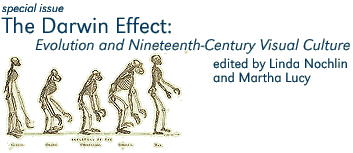

Darwin's influence on nineteenth-century visual culture is nothing if not diverse, cropping up in a variety of unexpected places—from moody seascapes to representations of the horse.

Williams Rimmer's illustrations for his drawing book, Art Anatomy (1877), document the impact of Darwin's theories of evolution and expression of emotion in man on the practice of life drawing.

A look at the central role of Darwin in Redon's references to evolution and degeneration.

The so-called "progress of man" was represented and celebrated at the classicizing world's fairs that flourished in the United States between 1893 and 1915.

Degas's unusual revision to the classicizing "Young Spartans" marks an important moment in his negotiation of the modern body.

The graphic art of Max Klinger reveals themes of sexuality, mankind's links with his animal and human progenitors, and manifestations of violence and domination in contemporary society.

In "Wary Game," Carl Rungius's 1908 painting of six dall rams, what is strong is always weak, what is fertile is always barren, and what is alive is always dead. "Wary Game" shows that there is more to some animal painting than may first meet the eye.

The twin poles of evolutionary discourse, of humankind as developing toward a spiritual culmination or devolving into a lower order, can be collapsed into the ambivalent image of a woman.