The browser will either open the file, download it, or display a dialog.
|
 |
Moritz von Schwind's Cinderella (1852–1854): The Beginning of Fairy Tale Painting and Aspects of Marketing Strategies in Germany's Art Scene |
|
|||
| When artists in nineteenth-century Germany no longer had the economic security of working permanently either for the Church or the Crown, and thus had to face the challenges of the open art market, they had to invent marketing strategies in order to stand out above the keen competition at art exhibitions. They also had to satisfy the demands of the new buying class—the culturally interested and wealthy bourgeoisie. While the artists tried to fulfill their artistic ideals first, and were anxious not to commit themselves to short-lived fads or to commercial art, these challenges greatly affected their paintings, both in the choice of their subjects and in their execution. All the more interesting are the different means of promotion the artists devised to create a market for paintings truest to their artistic goals. | ||||||
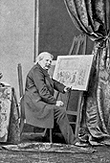
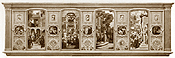
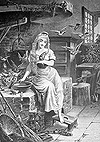
| Moritz von Schwind's (1804–1871, fig. 1) marketing of his painting Cinderella (Aschenbrödel, 1852–1854, fig. 2),1 was particularly resourceful and ranged from the choice of an unconventional topic for a painting to its presentation at a most recognized exhibition. But, the painting's subject, fairy tales,2 were also one of Schwind's major artistic interests throughout his life. He was convinced that German folk tales should not be "despised"3 so readily. And so fairy tale motifs, such as in the Phantom in the Forest (Die Erscheinung im Walde), or in preliminary sketches for his fairy tale paintings Cinderella and The Seven Ravens (Die Sieben Raben), date back to the beginnings of his art career in the early 1820s, when fairy tales were just being rediscovered in Germany.4 Even when Schwind finally started work on the painting of Cinderella in 1852, fairy tales were not yet considered at all suitable for the highest of the painting genres, and generally had been limited to the graphic arts and book illustrations. Hence, his selecting so exceptional a motif was as risky as it was ambitious. It guaranteed that he would stand out from his competitors in the open art market and therefore attract the attention of the critics as well as potential buyers. Moreover, if the viewing public accepted German fairy tales as a subject of history paintings, he would be able to increase his work on fairy tales, definitely a favorite painting subject of his. But on the other hand, if his painting failed to win acceptance at exhibition, Schwind would have gained nothing but bad press, uncovered expenses, and the certainty that there was no market for his fairy tale paintings.5 Consequently, Schwind would not be able to successfully combine his own artistic goals with the demands of the open art market, and, so, he sought to assure the success of his first fairy tale painting, Cinderella, by additional marketing strategies. | ||||||
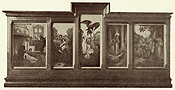
| How well aware Schwind was of the necessity to promote his paintings in general is shown not only in his correspondence,6 but also in his actions; for example, he finished his second popular fairy tale cycle, The Seven Ravens, deliberately in time for the Major German Art Exhibition in the Munich Glaspalast in 1858, a high-profile event which guaranteed wide international recognition and which was, therefore, a promotionally most successful platform for artists. One can assume that Schwind chose the Munich Art Exhibition (1855) with similar care in order to effectually display his Cinderella. Moreover, by presenting the Cinderella painting in an architectural wooden framework as if it were a model for a mural (the art medium Schwind deemed the highest of all painting mediums), Schwind also suggested to the viewers that he was willing to accept a commission to execute the cycle in a mural. | ||||||
| Although Schwind played a risky game, he succeeded. When Cinderella was first displayed in 1855, the critics not only praised his painting, but fairy tales became a popular subject for paintings in general, and Schwind was commissioned to decorate a ballroom with a Cinderella cycle in the late 1860s. Moreover, he had gained a lasting reputation as Germany's most popular fairy tale painter by the general public, fellow artists, and art historians as well.7 | ||||||
| The Fairy Tale Topic: The Introduction of a New History Painting Subject The renaissance of fairy tales in Germany in the nineteenth century has to be seen in the context of the rediscovery of German folk literature in the late eighteenth century, influenced most notably by Johann Gottfried Herder (1744–1803).8 Herder edited a collection of folk songs in 1778/1779, the Stimmen der Völker in Liedern (Voices of the Peoples in Songs)9 because he regarded folk songs, legends and fairy tales as "Naturpoesie" (poetry of nature) preserving the so-called "Nationalgeist" (spirit of the nation). Considered to be found in its purest form in the poetry of the Middle Ages, the "Nationalgeist" remained alive, only among the lower classes, in folk poetry, which was thought to be the literature of the childhood of mankind. Folk poetry was considered to have survived through the ages, initially going back to an idealized, paradise-like distant past, a golden age, when men still lived in harmony with nature. In the political and socially disturbing times in Germany during the nineteenth century, scholars of the Romantic movement such as Friedrich Schlegel (1772–1829) and the brothers Jacob (1785–1863) and Wilhelm Grimm (1786–1859) regarded "Naturpoesie" as the remedy for the cultural crisis—as the only way to re-unite a nation that had first been ripped apart by Napoleon I, and then socially transformed by progressing industrialization. Scholars therefore focused their studies on Germany's ancient history, especially the Middle Ages, and its folk culture. They collected, edited, and preserved the traces of the "Nationalgeist" of a formerly strong and proud Germany, which they felt should become the model for the future.10 |
||||||
| In order to found a national identity by restoring national feeling, the brothers Jacob and Wilhelm Grimm edited their first volume of their collection of fairy tales in 1812.11 The Kinder- und Hausmärchen (Children and Household Stories) claimed to be a scientific tribute to German archaeology and not a book for children, even though this was the way the book was received. Despite Herder's highly influential concepts of folk poetry, fairy tales were often still regarded as "Ammenmärchen," nursery tales, told solely for children and without any literary value. So, the success of what is the most popular fairy tale collection of today did not come until 1825 when the Grimms edited a revised edition of only fifty fairy tales, with no scientific annotations,12 with texts slightly revised to minimize their sexual or violent content and—most importantly—with illustrations by their brother Ludwig Emil Grimm (1790–1863). They thereby complied with the general demands of the children's literature market which required that books, above all, be illustrated. Further revisions, edited primarily by Wilhelm Grimm, were published until 1857. | ||||||
| By the second half of the nineteenth century, the collection of the Grimms' fairy tales was widely known and considered to be the best collection among the fairy tale books, such as Ludwig Bechstein's Deutsches Märchenbuch (German Fairy Tale Book, 1845) illustrated in 1853 by Ludwig Richter whose xylographs were highly influential on the idyllic fairy tale conceptions of nineteenth-century Germany. But even though folk tales were extremely popular with the German public in the mid-nineteenth century, the fairy tales included in Grimms' collections had been depicted only in graphic arts—in book illustrations, so-called "Bilderbogen"13, and large etchings for art societies.14 Paintings did not appear until around 1830 and then in so scarce a number that they are to be considered as outliers that had no impact at all on the contemporary art scene.15 And even though Schwind's interest in German fairy tales dates back to the very beginnings of his career in the late 1820s when he started work on his second popular fairy tale cycle The Seven Ravens (completed in a large multipart watercolor in 1857)16, he did not actually create his first painting on a German fairy tale, Cinderella, until 1852 (finished 1854). So, when Cinderella was exhibited in 1855, fairy tale paintings were more or less a novelty to the art scene in general; as history paintings—which is how Schwind presented his Cinderella—they were completely unheard-of. | ||||||
| In nineteenth-century Germany, the catalogue of subjects suitable for history paintings—history, the Bible, Christian legends, classical mythology—had been extended with motifs of German folk sagas such as the Nibelungen.17 As not only the story-telling, but the "delectare et prodesse" were necessary aspects that qualified a painting as a history painting, Schwind portrayed his Cinderella not in a mono-scenic painting depicting the key scene of the fairy tale, but in a highly narrative way: a cycle. Moreover, he worked in the same "modus" (Jan Bialostocki) in which he had executed his history paintings on Christian legends, such as the legend of St. Elisabeth, or on German folk sagas such as the Wilkina saga for castle Hohenschwangau.18 By applying to his fairy tale painting these formal aspects that were generally attributed to history paintings, he made it more acceptable for art critics to view his Cinderella as a history painting. | ||||||
| Thus, one critic promptly asked,—even though rhetorically: "What is to be gained for the fine arts by these legendary subjects that are often only of provincial and local interest and do not convey any message of general human concern?"19. He thereby reflected the common opinion of fairy tales which were not thought to be, generally, up to accomplishing the dual purpose of art (to give enjoyment, and to educate) and so he alluded to the reputation of fairy tales as mere nursery tales without any deeper meaning or educational importance. But then, only a few lines later, he proved this preconception wrong and confirmed that Schwind had chosen well: His Cinderella is different. It is a story worth listening to, because it conveys a genuine truth: That in the end, after long suffering, virtue and humbleness are rewarded.20 | ||||||
|
The Visual Narrative: The Re-Invention of Three Fairy Tales and Their Combination
Significantly, Schwind did not base his fairy tale versions on a single text source but created three completely new stories by combining several different traditions: Cinderella is based on Charles Perrault's Contes de fées (Fairy Tales, 1697), the Brothers Grimm's Kinder- und Hausmärchen, and the dramatized version of Der gläserne Pantoffel (The Glass Slipper, 1823) by Count August of Platen Hallermünde all extended by the motif of the fairy Perachta who derives from a completely different legend.21 The Sleeping Beauty is based on the version passed down by the Brothers Grimm and extended by an additional scene (IIId) that is most probably inspired by Platen Hallermünde's Der gläserne Pantoffel which, itself, combined the fairy tales of Cinderella and Sleeping Beauty. Apart from one alteration (IIa) that is possibly an invention of Schwind himself, Amor and Psyche follows Apuleius's Metamorphoses. |
|||||
| So, by not sticking to one single tradition, Schwind proves to be no mere illustrator; he does not simply visualize three fairy tales as they are known, but he tells them anew: exactly like every narrator or poet. Thereby Schwind trifles with the expectations of the viewer who has to "read" again, carefully, the popular but surprisingly different stories. More importantly, Schwind gives an indication of his idea of the old ut pictura poësis-dispute; literary tradition is only the material he works with. In the end, he creates a new story in his paintings. And so the epithet Schwind had earned in the art history of the early twentieth century turns out to be appropriate: Schwind is in fact a "Malerpoet"22 (painter-poet). | ||||||
| Moreover, by adding two other fairy tales, whose content correspond with Cinderella and each other, Schwind leads the viewer to "read" the three cycles parallel to each other. Otherwise, by "reading" the three fairy tales successively, the viewer would not understand the relation of the three cycles. To quote Schwind, the (visual) story of the painting is therefore not told "dramatically"23 around a thrilling climax, but "narratively,"24 which allows much more reflection. By this "narrative" effect the cycles of Cupid and Psyche and of The Sleeping Beauty become "Arabesken" (arabesques): formally, in the manner in which murals were traditionally structured, by providing the decorative framework for the main cycle; and also in content, as defined by the scholars of the Romantic Movement and translated into the design of murals by Peter von Cornelius (1783–1867), for they enhance the message of the Cinderella tale.25 | ||||||
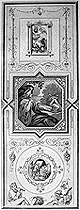
| In order to make the painting easy to "read" by its viewers, Schwind embedded the three cycles in the classical compositional system for murals. Schwind created a formal distinction between the main cycle of Cinderella and the additional arabesque cycles of Cupid and Psyche and Sleeping Beauty by the means of their modi. Thus, Cupid and Psyche, an ancient roman folk tale, is shown in the style of the ancient Roman frescoes, framed by small classical aediculas. Its composition is based on the mural cycle Schwind designed for the garden pavilion of Dr. Heinrich Wilhelm Leberecht Crusius in Rüdigsdorf in 1838, influenced by Rafael's frescoes in the loggia of the villa Farnesina in Rome (1517).26 Sleeping Beauty and Cinderella are both painted rather realistically and set in the Middle Ages, in the Staufer dynasty, to be precise. The Middle Ages, which were considered Germany's most nationalistic period, had therefore been established as the epoch after which illustrators modeled the fairy land of German folk tales throughout the nineteenth century.27 But then, Sleeping Beauty, whose panels are framed by decorative rose tendrils, is painted en grisaille and it is only the Cinderella panels that are colored in an illusion of life. By differing the modi of the cycles, Schwind lessened the importance of the additional cycles letting them serve as an arabesque decorative framework for the main cycle. | ||||||
| As the additional cycles mirror the contents of Cinderella, the general message of Cinderella is also emphasized. Schwind summarized this narrative in a letter to his friend Eduard von Bauernfeld dated October 25, 1852: "As the subject itself does not provide anything for adornment, I decided to add the story of Cupid and Psyche above, and the round panels depicting the story of The Sleeping Beauty beneath, in order to enhance the impression that oppressed beauty, which had been covered by thorns for a century and is represented by Cinderella as a German, would be victorious. If I tell you that the adornment in the middle corresponds to b [IC] in a way that the clock in the tower shows midnight, in a [IIc], Psyche watches the sleeping Cupid and in c [IIIc], Sleeping Beauty is lying in slumber with all of the royal household overgrown by brushes, you will understand that these pictures are related to each other. This is the case with all of these five image groups".28 So the additional cycles are to be seen as "Arabesken" as they were re-interpreted in the Romantic Movement as well: they initiate reflection, and universalize the image's message that is now conveyed and underlined by the two additional stories. Schwind had learned this narrative concept from Peter von Cornelius, who saw arabesque scenes in murals not only as a decorative framework for the main panels, but as a means to enhance their message; he followed this plan in designing the murals for the Neue Pinakothek in Munich. | ||||||
| The first of Schwind's painting's messages that is bound to this arabesque story-telling of the three fairy tales is a simple but genuine truth: Virtue—represented by the three loving heroines—will finally be rewarded. Consequently, a critic praised Schwind's Cinderella as "Passionsmärchen (passion-tales) of innocence and beauty,"29 acknowledging the proximity of Schwind's tales to Christian legends. Much to this purpose, Schwind had modeled the facial features of his Cinderella on the visual tradition of St. Mary, just to emphasize her virtue and innocence. And, in the end, the parallel between the three fairy tales and Christian legends transforms the fairy tale of Cinderella from a devalued nursery tale to a story of universal meaning, suitable for the highest of the painting genres: the history painting. | ||||||
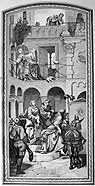
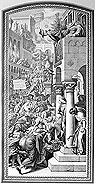
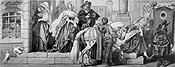
| The Metaphor of Germany: The Satisfaction of Nationalistic Desires Even though the universalized message of the painting made it relatively sure that the critics would not reject the painting as unsubstantial, Schwind added to the painting a second layer of meaning: Cinderella is also a metaphor for contemporary Germany, full of nationalistic desires. Schwind mentioned in the previously quoted letter to his friend Bauernfeld that he regarded Cinderella as the representation of Germany, a nation that had been lying in a "Sleeping Beauty slumber" for too long, but was to blossom anew, he hoped, in the not-too-distant future. The pivotal images for this interpretation are the first and the last pictures of the large Cinderella cycle (IA, ID; figs. 4, 6) illustrating the servitude and the redemption of Cinderella. Both pictures show Cinderella's home: a large, palatial example of late Italian Romanesque architecture with arcades, capitals adorned with acanthus, and a nearby equestrian statue modeled on Uccello's, Donatello's, and Verrochio's famous Renaissance examples. Schwind wanted to allude to the medieval era of the Staufer dynasty, which he mentioned in his letter to Bauernfeld, and throughout which parts of Italy had actually belonged to the Holy Empire of the German Nation. This architecture is most noteworthy because such an Italian setting does not fit with the idea of a German fairy tale realm. In book illustrations the palatial architecture had always been depicted as German Gothic or Romanesque, often modeled after rediscovered Rhine castles and ruins. Consequently, the critic of the Deutsches Kunstblatt wondered why Schwind had not set the fairy tale in the established Gothic surroundings with linden trees and lilac bushes.30 |
||||||
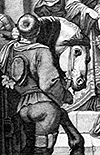
| The answer is to be found in the first image (IA) showing the departure for the ball. There, in the foreground next to a great white stallion, stands a groom with his back to the viewer, wearing a belt with the following inscription: "W Lindensch[mit]" (fig. 5). Wilhelm Lindenschmit the Elder (1806–1848) was a German history painter whom Schwind had probably gotten to know while they were both working on the murals at the Royal Residence in Munich (1832–34).31 Consequently, art historians explained the inscription of "Lindenschmit," if they did so at all, by the friendship of both artists, although without any written evidence for the assertion.32 I believe, however, that his friendship with Lindenschmit was not Schwind's reason for identifying him with the groom in (IA) and letting the groom reappear in (ID), rejoicing euphorically about Cinderella's redemption. | ||||||
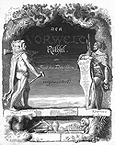
| Lindenschmit, besides his activity as an artist, published a treatise in 1846 about the roots of the German people: Die Räthsel der Vorwelt, oder Sind die Deutschen eingewandert? (The Mysteries of the Ancient World, or Did the Germans Immigrate, fig. 7). Until today, this treatise has not been recognized as the key source of the nationalism Schwind wove into his painting, even though it was mentioned in Hyacinth Holland's monograph about Schwind in 1873, and Schwind quoted Lindenschmit in his letter to Bauernfeld dated October 25, 1852.33 | ||||||
| In his treatise, Lindenschmit tried to prove that the Teutons initially inhabited Europe, that they influenced the ancient cultures of the Romans and the Greeks and then were driven away by other ethnic groups. The "Nationalgeist" of the ideal Teuton—who was, in Lindenschmit's opinion, the white, tall, blue eyed, blonde, proud, fearless and courageous, pacifistic, God-fearing, and chaste man—was preserved only in the German race: "The German man is the real white man [i.e. Teuton],"34 Lindenschmit was convinced. | ||||||
| Lindenschmit's idea that the Germans were the "original inhabitants of Europe" (which Schwind later recounted in a letter to Bauernfeld)35 forms the basis for Schwind's Italian architecture: Schwind could now regard Italy, or "the beautiful south"36 as he put it, as the primary homeland of the German people. Italy was therefore suitable as a German fairy tale realm even without the reference to the Staufer era. But this is not all. Lindenschmit's treatise also provided Schwind with the myth of the fairy Perachta, who helps and protects oppressed original inhabitants as well as displaced persons, and who represents homesickness and the rights of natives. Even the motif of the fairy resting near a hazel bush in the middle of the night, as seen in (Ie, fig. 8), derives from Lindenschmit. | ||||||
| But the most stunning parallel is that Lindenschmit had also compared the political and cultural situation of contemporary Germany with the fairy tale of Cinderella.37 While to state that it was Lindenschmit's treatise that motivated Schwind to take up the Cinderella story would be leading too far, Lindenschmit's treatise was in accord with Schwind's own political and nationalistic desires. It is well known that Schwind was most conservative, if not reactionary, in his political opinions: he once stated, on the democratic aspects of the March Revolutions of 1848, that he would rather live under the reign of Jesuits than be ruled by a revolutionary mob.38 Although Schwind preferred a world ruled equally by the Crown and the Church,39 Schwind shared with the majority of the German public at least the nationalistic wish for a proud German nation, and Lindenschmit's treatise reflected this wish. Neither the political events of the Congress of Vienna with the German Confederation in 1814/1815, nor the National Assembly in Frankfurt during the March Revolutions in 1848, had brought the German people the long-wanted nation-state in the form of the so-called "großdeutschen Lösung" (Greater German Solution). The realization of that political idea would have unified all the scattered parts of Germany, including Austria, and would therefore have been a resurrection of the powerful Holy Roman Empire of the German Nation as it had been in the past, during the Staufer dynasty for example. As this political idea was not to be achieved in reality, it was satisfied symbolically in literature, art, and music in which the hope of the bourgeoisie for a strong nation state was expressed, just as it is visualized in Schwind's Cinderella. Thus, by fulfilling the nationalistic desires of the mid-nineteenth century, the painting's political topicality further contributed to its success. | ||||||
|
The Model : The Visual Proposal of a Mural |
||||||
| The complex layers of meaning Schwind wove into his painting made his Cinderella suitable for the most prestigious of the public rooms of every villa. In a letter dated April 26, 1852 to his friend Franz von Schober, Schwind wrote that he initially planned to execute the cycle as a mural for a ballroom but could not get an accordant commission: "For the lack of a ballroom that are to be always decorated with half naked stuff, I thought of a way to exhibit [Cinderella] without having to wait for a building that is obliging enough to let itself be painted."41 Schwind now hoped that the way he presented his cycle might persuade someone to order the Cinderella mural from him. Thus, Schwind's cycle is not only an autonomous painting, but was—as Christopher Frayling called it in the case of Henri Fuseli's paintings—a "trailer for the main feature"42 as well, an "appetizer" for an even more rewarding project, if he succeeded. | ||||||
|
Schwind's visual proposal to execute his fairy tale cycle as a mural was finally accepted some ten years after the successful exhibition of the painting at the Munich Art Exhibition in 1855. In 1865, Dr. Georg Friederici asked Schwind to decorate the ballroom of his so-called "Roman House" in Leipzig with a Cinderella cycle. The wording of the contract and the dimensions of the ballroom are lost, but Schwind designed a new cycle (fig. 9) in a longitudinal rectangular format that differs from the first cycle in some important aspects: Schwind reduced the complex narrative of the three fairy tales to that of Cinderella only, which is now told "dramatically"43 and without the nationalistic allusions to Lindenschmit. These alterations of the iconographic scheme might have been requested by Friederici but were most probably a decision by the artist himself resulting from the success of the Seven Ravens in 1858 and its "dramatic" narrative. The now-relinquished layers of interpretation as well as the complex tripartite narrative had formerly contributed to secure the acceptance of the new painting subject that was still regarded suspiciously in the art scene at the time of its first exhibition. The great success of the Cinderella painting made them redundant. | |||||
| Although Schwind composed his following cycles, The Seven Ravens and The Story of Melusine (watercolor, 1868/69),44 as miniature murals, he enhanced neither with additional cycles or political metaphors. Nonetheless, they were most positively received: Peter von Cornelius, for example, praised the Seven Ravens in a letter to Schwind dated January 22, 1862: "You knew to transform a simple folk tale into a wonderful work that will always remain as a true treasure for the German nation. In addition to truth, nature, and life, it is entirely suffused with grace and soul; and what I appreciate most about it: it has entirely been executed with true style. This shows in every detail of this work, in every curl of hair, in every crease of garment. I repeat what I told you once in Munich that this work of yours is the one I consider the best of all the works I saw at that time."45 | ||||||
| The new Cinderella cycle ties in with the visual concept of the second popular fairy tale cycle, The Seven Ravens, which Schwind deliberately finished in time for the Major German Art Exhibition in the Munich Glaspalast in 1858 where it was successfully displayed.46 The new Cinderella cycle is focused on telling a more or less idyllic story of passion and virtue, neither trying to universalize its meaning by additional stories nor to express nationalistic hopes, but to satisfy the common middle-class desire for escapism. The new Cinderella cycle now provided the illusion of a fairy tale realm whose contemplation allowed the viewer to step away from disturbing reality and into a better world for at least a short period of time. Schwind's new cycle, however, was never realized.47 | ||||||
| By Schwind's death in 1871 it had become fashionable for the bourgeoisie to decorate the public and the private rooms of their villas with fairy tales. In 1873/1874, Schwind's student Julius Naue, executed the 1854 pictures of the Cinderella cycle in the ballroom of the "Roman House" in Leipzig, partially alternated with the new inventions of Schwind's 1865 cycle, and adapted to a vertical rectangular format.48 In 1870, the brothers Paul and Franz Meyerheim decorated a room of the villa of the financier Magnus Herrmann in Berlin with two pendants showing scenes of Cinderella, Little Red Riding Hood, The Sleeping Beauty and Snow White and the Seven Dwarfs.49 One year later, Ludwig Burger painted the Lady's room of the Thiele-Winkler palace in Berlin with motifs of the Grimms' fairy tales, followed by similar projects by the artists Anton von Werner, Gustav Spangenberg, Arthur Fitger and others. Only in the case of public buildings, such as the Kaiserpfalz in Goslar, with murals by Hermann Wislicenus, were fairy tales still interpreted as nationalistic metaphors.50 —Schwind's Cinderella had cleared the way for this trend of decorating private and public rooms with German folk tales. | ||||||
| The End: Lasting Success by Ensured Popularity The success of the Cinderella painting is due not only to the popularity of fairy tales in the mid-nineteenth century and its prominent exhibition at the Munich Art Exhibition in 1855, but also to the xylographic reproduction of the painting in the 1870s. Julius Thaeter engraved the facsimiles of the painting for a portfolio published by Alphons Dürr in Leipzig in 1873 (figs. 4–6, 8). The Seven Ravens had been published even earlier; as early as 1861, Schwind had asked the royal Bavarian court photographer Joseph Albert to photograph his tripartite watercolor in order to publish reproductions of this well-received second fairy tale cycle. These reproductions were widespread and made the paintings even more famous: Peter von Cornelius congratulated Schwind on The Seven Ravens after he had seen Albert's reproductions, and Josef Gabriel Rheinberger was inspired by them to compose his opera of the same title in 1862.51 The reproductions guaranteed that the images remained accessible to the public even though the paintings were actually sold to a private collector and therefore no longer publicly available. The Cinderella painting, for example, had been sold in October of 1854 to Baron Franckenstein of Ullstadt, before it was displayed at the exhibition in Munich. The lasting success of Schwind's Cinderella must be due, at least in part, to the availability of these reproductions. But most of all, Schwind managed to create a painting that was first of all true to his own concept of art and, simultaneously, whose subject and interpretation fulfilled both the nationalistic and escapist desires of his time. |
||||||
| So, Cinderella easily helped to establish a fairy tale fashion that affected not only the fine arts, but also many other cultural sectors. Other artists exploited Schwind's success and depicted different motifs of the fairy tales of the Brothers Grimm in over 150 paintings and watercolors up to the turn of the century which were popular in their time but are mostly forgotten and missing nowadays.52 Most are single mono-scenic paintings by artists unknown today, such as Ernst Bosch, Joseph Burda (fig. 10), Elise Goebeler, Roland Risse, and Albert Tschautsch, whose work basically show the key scenes of the most popular fairy tales (such as Cinderella, Snow White and the Seven Dwarfs and Little Red Riding Hood) in an iconography that had been established in book illustrations. But in consequence of their subjects—such as Snow White serving roast in the house of the dwarfs or Cinderella sorting the lentils with the doves—most of these paintings are more influenced by the visual tradition of genre paintings than by the story-telling role of history paintings. Only a few fairy tale paintings after Schwind portrayed their stories in the narrative structures of cycles and in the modus of history paintings: Arthur von Ramberg's Frog Prince (1862), Eduard von Steinle's Snow White and Rose Red (1868, fig. 11), and Ernst Erwin Oehme's Sleeping Beauty (1880s) and Cinderella (1880s) followed in Schwind's footsteps.53 | ||||||
| In addition to being a popular subject for the visual arts: fairy tales were even elaborately staged at operas and theatres. And when the art society Jung München organized its carnival festivities in 1862, Wilhelm Busch created a procession of all the popular fairy tale figures dressed in costumes inspired by the fairy tale images of Moritz von Schwind and the book illustrations of Ludwig Richter.54 Therefore, in 1862, a wonderful fairy tale was set onstage creating a medieval and idyllic fairyland in front of an audience that was obviously addicted to fairy tales as visualized by Schwind and his followers: a pre-Disney world if you like. | ||||||
|
This is an abridged version of a chapter of my doctoral thesis on illustrations and paintings of the Kinder- und Hausmärchen of the Brothers Grimm in Germany from 1819 to 1945, to be completed at the Ludwig Maximilian University, Munich, in October 2007. I would like to thank Professor Frank Büttner and Professor Andrea Gottdang, along with the anonymous reviewer at Nineteenth-Century Art Worldwide, Petra ten-Doesschate Chu, and Robert Alvin Adler for their helpful suggestions. I wish to extend my thanks to Dr. Hanna Dose, Deutsches Märchen- und Wesersagenmuseum Bad Oeynhausen, for allowing me to research the vast collection of xylographic reproductions on fairy tale paintings in the nineteenth century. —All translations are those of the author. 1. Moritz von Schwind, Das Märchen von Aschenbrödel, 1852–54. Oil on panel, mounted in a golden framework of coniferous wood, 151.5 x 480 cm (total dimensions). Munich, Bayerische Staatsgemäldesammlungen, Neue Pinakothek, on loan from the Federal Republic of Germany. 2. In nineteenth-century Germany there was no great differentiation between the terms "fairy tales" and "folk tales." Fairy tales and folk tales were both thought to be preserved by oral tradition and to be collected from members of the lower classes and, thus, viewed as different from the literary fairy tales, called "Kunstmärchen," "modern" fairy tales that are only loosely modeled on (original) folk/fairy tales, but, most of all, invented and written by poets. Thus, literary fairy tales, such as the fairy tales of Hans Christian Andersen (1835–1848) or Clemens Brentano's Gockel, Hinkel und Gackeleia (Frankfurt am Main: Schmerber, 1838), always have an author whereas "original" folk/fairy tales are only collected and edited; that is why the Brothers Grimm called their fairy tale book: "Children and Household Stories Collected by the Brothers Grimm" (emphasis mine). 3. Moritz von Schwind to Bonaventura Genelli dated September 29, 1844, published in Otto Stoessl, ed., Moritz von Schwind, Briefe (Leipzig: Bibliographisches Institut, 1924), 179–80: "I regret that you despise the Cinderellas [i.e. folk tales in this context]." ("Dass Sie die Aschenbrödel verschmähen, ist mir leid.") 4. In 1823, Schwind drew a first version of The Phantom in the Forest (Der Geist im Walde, sepia drawing, 33.5 x 47 cm, private collection. His versions of The Phantom in the Forest in oil (around 1858) are to be found in Frankfurt am Main, Städelsches Kunstinstitut, and in Munich, Schack-Galerie; see Otto Weigmann, Schwind, Des Meisters Werke in 1265 Abbildungen (Stuttgart, Leipzig: Deutsche Verlags-Anstalt, 1906), 25. In the same year he drew a vignette for the piano reduction of Giacomo Rossini's opera La Cenerentola ossia La bontà in trionfo and, in the late 1820s, he sketched two more independent pictures on Cinderella in his sketchbook, now lost; see e.g., Peter Halm, "Moritz von Schwind, Jugendgedanken und reifes Werk," in Eberhard Ruhmer, ed., Eberhard Hanfstaengl zum 75. Geburtstag (Munich: Bruckmann, 1961), 137–39. In 1829, if not earlier, Schwind started work on The Seven Ravens; see his letter to Franz von Schober dated January 2, 1830, published in Stoessl, Moritz von Schwind, Briefe, 65. 5. But if such an accepted artist as Schwind failed to successfully show fairy tales, no other artist would risk it again. So, Schwind's success or failure was essential for the fairy tale painting in Germany. 6. Schwind in a letter to his friend Bernhard Schädel dated December 12, 1853, published in Stoessl, Moritz von Schwind, Briefe, 301: "Unfortunately, it [Cinderella] contains neither murder nor harlotry, and so I have to look to the king of Persia to buy it; in Germany, it will not be needed…" ("Leider aber enthält es weder Mordtat noch H-rerei, und so muß ich auf den König von Persien als Abnehmer rechnen, in Deutschland wird man es nicht brauchen können…"). This rather cynical statement clearly proves that Schwind kept the marketability of his works, and therefore the demands of the art market, well in mind while working on his paintings. This is supported by Führich's note that Schwind purposefully executed his cycle The Seven Ravens on time, so that it could be successfully displayed at the great exhibition in the Munich Glaspalast; see Lukas R. von Führich, Moritz von Schwind, Eine Lebensskizze, Nach Mittheilungen von Angehörigen und Freunden des verstorbenen Meisters (Leipzig: Alphons Dürr, 1871), 84. 7. In the late nineteenth century, Schwind was held in high regard by his fellow fairy tale artists, among others, for his fairy tale paintings. To name only one example, Hermann Vogel (1854–1921), who illustrated the fairy tales of the Brothers Grimm in 1894 (Munich: Braun & Schneider), honored Schwind as the father of fairy tale illustration in one of the vignettes of his book by creating a monument with the profile portrait of Schwind admired by dwarfs, ravens and other tame animals of the forest. The art magazine Jugend published a whole issue on Schwind in 1903 (no.52) that contained a poem by Helen Raff (Frau Märe und der Maler) praising Schwind as the father of German fairy tale painting illustrated by the fairy tale illustrator Arpad Schmidhammer with motifs of Schwind's work. 8. There is an enormous body of literature concerning the cultural background of the fairy tale revival in nineteenth-century Germany and its political and social implications that served as the basis for this article. For an introduction to these issues see, for example, Wolfgang Emmerich, Zur Kritik der Volkstumsideologie (Frankfurt am Main: Suhrkamp, 1971); Dieter Richter, Das fremde Kind, Zur Entstehung der Kindheitsbilder des bürgerlichen Zeitalters (Frankfurt am Main: S. Fischer, 1987); Walter Pape, Das literarische Kinderbuch, Studien zur Entstehung und Typologie (Berlin, New York: de Gruyter, 1981). 9. Herder's collection of folk songs was first published in two tomes titled Volkslieder. Nebst untermischten andern Stücken (Leipzig: Weygand, 1778/1779) and then republished in 1807, four years after Herder's death, by Johann Georg von Müller with the title, by which it is still known today, Stimmen der Völker in Liedern (Tübingen: Cotta, 1807). 10. Examples of published collections of folk literature by poets and scholars of the Romantic movement include, Ludwig Tieck, Minnelieder aus dem schwäbischen Zeitalter (Minne-Songs of the Swabian Era) (Berlin: Realschulbuchhandlung,1803), Friedrich Heinrich von Hagen, Der Nibelungen Lied (The Nibelungen Song) (Berlin: Unger, 1807), Clemens Brentano and Achim von Arnim, Des Knaben Wunderhorn, 3 vols. (Heidelberg: Mohr & Zimmer, 1806–1808), and Joseph Görres Altdeutsche Volks- und Meisterlieder (Old German Folk- and Mastersongs) (Frankfurt a.M: Wilmans, 1817). 11. The first volume of the Kinder- und Hausmärchen was first published in 1812 (Berlin: Georg Reimer); the second volume was first published in 1815 (Berlin: Georg Reimer); the third volume with the annotations in 1822 (Berlin: Georg Reimer). The first two volumes were re-published in a second edition in 1819 (Berlin: Georg Reimer), and then—together with the third volume—re-published by different publishers five times in the lifetime of the Brothers Grimm (1837, 1840, 1843, 1850, 1857) containing 200 fairy tales and ten legends. The reduced edition with a selection of only fifty fairy tales was first published in 1825 (Berlin: Georg Reimer) and then re-published by different publishers nine times in the lifetime of the Brothers Grimm (1833, 1836, 1839, 1841, 1844, 1847, 1850, 1853, 1858). As there is an enormous amount of literature regarding the fairy tale collection of the Brothers Grimm in its cultural context on which this article is based, see, for an introduction: Isamitsu Murayama, Poesie – Natur – Kinder, Die Brüder Grimm und ihre Idee einer natürlichen Bildung in den Kinder- und Hausmärchen (Heidelberg: Winter, 2005); Heinz Rölleke, Die Märchen der Brüder Grimm, Eine Einführung (Stuttgart: Philipp Reclam jun., 2004). 12. Jacob and Wilhelm Grimm wrote an annotation to every fairy tale of the collection in which they explained where they "found" the fairy tale, who told it to them, and whether there were any similar fairy tales or sagas (some of which the brothers re-told, in special cases). With these annotations the Brothers Grimm proved that their collection was of literary scientific value and an "archeological" endeavor in the field of folk literature and folk culture. For research in the field of fairy/folk tales this was and is a very important collection of primary material, which is why the Brothers Grimm were often regarded as the fathers of German folklore/cultural anthropology. 13. "Bilderbogen" were broadsheets edited by publishers such as Braun & Schneider in Munich and Gustav Weise in Stuttgart, for the literary and educational entertainment of the lower classes in the second half of the nineteenth century. Often accompanied by a text and cheaply available, they illustrated fairy tales, proverbs, historical events, costumes, weapons, animals and various other subjects. For an introduction to this issue, see Ulrike Eichler, Münchener Bilderbogen (Munich: Historischer Verein von Oberbayern, 1974). 14. Concerning the illustrations of fairy tales in the graphic arts of nineteenth-century Germany see the following selected publications, Ilse Bang, Die Entwicklung der deutschen Märchenillustration (München: Bruckmann, 1944); Erich Probst, Die deutsche Illustration der Grimmschen Märchen im 19. Jahrhundert (Coburg: n.p., 1935). However these two art historian monographs analyze the material in a rather unobjective and judgmental way that—though very typical for the art historiography of the 1930s and 1940s—has to be reconsidered nowadays. Further publications: Petra Eidloth, "Die Illustration der Kinder- und Hausmärchen der Brüder Grimm, Zur Entwicklung von Bildästhetik und Bild-Text-Verhältnis deutschsprachiger Sammelausgaben von 1825 bis heute" (Bamberg: unpublished document, 1988, available at the Brüder Grimm Museum in Kassel); Hermann Gerstner, "Deutsche Künstler illustrieren Märchenbücher," in: Imprimatur, ein Jahrbuch für Bücherfreunde, 1965, vol. 4: 26–60; Eberhard Semrau, "Die Illustrationen zu Grimms Märchen im 19. Jahrhundert", in: Illustration 63, Zeitschrift für die Buchillustration, 14, no. 2 (1977):15–25, continued in no. 3 (1977): 15–25. However, as most of these articles were not written by art historians, and therefore lack a profoundly art historian view, there remains a gap in art historian research of nineteenth-century fairy tale illustrations in the fine and graphic arts. 15. Friedrich von Boetticher lists in his art catalogue of works of artists of the nineteenth century only five paintings depicting motifs of German fairy tales whose whereabouts are unknown today: Johann Heinrich Kretzschmer painted a Little Red Riding Hood (Rotkäppchen) in 1832 and a Cinderella (Aschenputtel) in 1836, Heinrich Krigar another Cinderella (Aschenputtel) in 1836, the Baron Hugo von Blomberg a Sleeping Beauty (Dornröschen) in 1844, and Karl Franz a Snow White and the Seven Dwarfs (Schneewittchen) in 1852. All these mono-scenic paintings were exhibited only in local art societies and certainly did not have any impact on the German art scene. They were more influenced by the visual tradition of genre paintings—for example showing Cinderella sorting out the lentils like an idealized scene of every day life—and, therefore, did not claim to be history paintings. See Friedrich von Boetticher, Malerwerke des neunzehnten Jahrhunderts, Ein Beitrag zur Kunstgeschichte, 2 bipartite volumes (Dresden, 1891–1901, reprint Hofheim am Taunus: Schmidt und Günther, 1979). 16. Moritz von Schwind, Das Märchen von den sieben Raben und der treuen Schwester, 1857. Multipart watercolor, 76 x 259 cm (in total). Weimar, Schlossmuseum (ehem. Großherzogliches Museum). 17. For the definition of history paintings and its modification in nineteenth century art in Germany, see Frank Büttner, Die Darstellung mittelalterlicher Geschichte in der deutschen Kunst des ausgehenden 18. Jahrhunderts, in Peter Wapnewski, ed., Mittelalter-Rezeption (Stuttgart: Metzler, 1986), 407–34; Frank Büttner, Geschichte für die Gegenwart? Der Streit um die Karlsfresken Alfred Rethels, in Gerd Althoff, ed., Die Deutschen und ihr Mittelalter, Themen und Funktionen moderner Geschichtsbilder vom Mittelalter (Darmstadt: Wissenschaftliche Buchgesellschaft, 1992), 101–4. 18. Moritz von Schwind, Der Handschuh der heiligen Elisabeth (The glove of St. Elisabeth), 1856. Oil on canvas, 73.5 x 146.5 cm. Weimar, Schlossmuseum (ehem. Großherzogliches Museum). See Weigmann, Schwind, 357, 552. Moritz von Schwind, Das Festmahl des Königs Emmerich aus der Wilkina Sage (The feast of King Emmerich from the saga of Wilkina), 1834–1846. Sketch for the frescoes in castle Hohenschwangau, watercolor, 27.5 x 53.8 cm. Whereabouts unknown. See Weigmann, Schwind, 118, 539–40. 19. Anonymous [ J.G.], "Aschenbrödel. Gemälde von Moritz von Schwind", in: Deutsches Kunstblatt. Zeitschrift für bildende Kunst, Baukunst und Kunstgewerbe, Organ der Kunstvereine von Deutschland, 1855, no.6 (February 8, 1855): 47: "Was soll nun aber für die bildende Kunst in weiterem Sinne mit diesen Sagenstoffen gewonnen werden, die, niemals historisch, oft nur ein provinciales Localinteresse und selten einen allgemein menschlichen Sinn haben?" 20. See Anonymous [J.G.], "Aschenbrödel. Gemälde von Moritz von Schwind", in: Deutsches Kunstblatt. Zeitschrift für bildende Kunst, Baukunst und Kunstgewerbe, Organ der Kunstvereine von Deutschland, 1855, no.6 (February 8, 1855): 47–49; continued in no.7 ( of February 15, 1855): 54–55. 21. The different text sources of the Cinderella tale are distinguishable by several motifs that are specific to the varying versions of the fairy tale. The apparition of the fairy derives from the French version of Perrault. The main story with the motif of the golden slipper and the planting of the hazel bush on the grave of Cinderella's mother is told by the Brothers Grimm. The fool who advises the prince is based on Platen-Hallermünde's dramatization. 22. See e.g., Georg Jacob Wolf, Deutsche Malerpoeten (German Painter-Poets) (Munich: Bruckmann,1910). 23. Moritz von Schwind, to Eduard von Bauernfeld dated October 25, 1852, published in Stoessl, Moritz von Schwind, Briefe, 299–300 (first underlined part): "I would like to mention that I did not mean the full dramatic but the narrative effect which is supported by the oblong format—it is going to be 16 shoes long—because you have to enjoy the whole painting step-by-step while the dramatic effect demands an overall impression at once." ("Bemerken möchte ich noch, daß ich nicht den vollen dramatischen, wohl aber den erzählenden [Eindruck] im Auge gehabt, der durch das lange Format, es wird 16 Schuh lang, gefördert wird, indem man das ganze nach und nach genießen muss, während der dramatische Eindruck eine Totalwirkung auf einmal verlangt.") (Emphasis mine.) 24. Ibid., see the second underlined part. 25. See e.g., Frank Büttner, Peter Cornelius, Fresken und Freskenprojekte, vol. 2 (Wiesbaden: Steiner, 1999), 78–82; Werner Busch, Die notwendige Arabeske, Wirklichkeitsaneignung und Stilisierung in der deutschen Kunst des 19. Jahrhunderts (Berlin: Gebrüder Mann, 1985); Günter Oesterle, Das Faszinosum der Arabeske um 1800, in Walter Hinderer, ed., Goethe und das Zeitalter der Romantik (Würzburg: Königshausen & Neumann, 2002), 51–70. 26. For further information on the Amor and Cupid cycle in Rüdigsdorf, the influence of Rafael and illustrations of the murals, see Weigmann, Schwind, 157–66 and 541–42; Barbara Rommé, Moritz von Schwind, Fresken und Wandbilder (Ostfildern-Ruit: Hatje Cantz, 1996), 30–34. 27. The medievalism in German fairy tale illustrations is one of the most striking and important characteristics of German fairy tale illustrations in the nineteenth century, based mostly on nationalistic conceptions of both the Middle Ages and the German folk tales. This will be discussed in detail in my doctor thesis; here it would go beyond the scope of the article. 28. Schwind to Bauernfeld dated October 25, 1852, published in Stoessl, Moritz von Schwind, Briefe, 299: "Da der Gegenstand selbst keine Verzierungen hergibt, bin ich darauf verfallen, obenhin die Geschichte von Amor und Psyche, unten in den runden Bildchen die Geschichte des Dornröschens anzubringen, um den Eindruck zu verstärken, dass es sich um den endlichen Sieg der unterdrückten, ja ein Jahrhundert mit Dornen überwachsenen Schönheit handelte, die in dem Aschenbrödel als Deutsche charakterisiert wird. Wenn ich Dir sage, dass zum b das mittelste Verzierungsstück sich so verhält, daß in b die Turmuhr Mitternacht zeigt, in a Psyche den schlafenden Amor betrachtet und in c Dornröschen mit dem ganzen Hofstaat schläft, von Gestrüpp überwachsen, so wird Dir klar sein, daß unter diesen Bildern auch Eine Beziehung besteht. Es trifft bei allen fünfen so." 29. Anonymous [J.G.], "Aschenbrödel," 49: "Passionsmärchen der Unschuld und Schönheit". 30. Ibid., 48: "However, one can discuss whether this Germanic saga would not have been depicted as beautifully and profoundly in a German setting with Gothic columns, German linden trees and lilac bushes." ("Man kann allerdings noch darüber streiten, ob diese germanische Sage sich nicht eben so schön und tiefsinnig auf deutschem Grund und Boden unter gothischen Säulen, unter deutschen Linden und Fliederbüschen hätte darstellen lassen".) 31. See Hyacinth Holland, Moritz von Schwind, Sein Leben und seine Werke, Aus des Künstlers eigenen Briefen und den Erinnerungen seiner Freunde zusammengestellt (Stuttgart: Neff, 1873), 61–67, 78–80, 166–67; Weigmann, Schwind, xxiv–xxv, 90–103, 538. 32. The appearance of Lindenschmit is explained by his friendship with Schwind in, for example, Hyacinth Holland, Moritz von Schwind, 186–87. Most often Lindenschmit is not mentioned at all, see, e.g., August Wilhelm Müller, Moritz von Schwind, Sein Leben und künstlerisches Schaffen insbesondere auf der Wartburg (Eisenach: J. Bachmeister, 1871), 256–58; Jutta Busse, Die Bild-Erzählung des Moritz von Schwind (Cologne: n.p., 1957), 2–41; Barbara Eschenburg, Das Märchen von Aschenputtel, in Spätromantik und Realismus, Gemäldekataloge der Bayerischen Staatssammlungen, Neue Pinakothek, München, vol. 5. (Munich: Hirmer, 1984), 464–72; Friedrich Gross, in his discussion of the painting, in Siegmar Holsten, ed., Moritz von Schwind, Meister der Spätromantik. exh. cat. Karlsruhe: Kunsthalle and Leipzig: Museum der bildenden Künste, 1996–1997 (Ostfildern-Ruit: Hatje Cantz, 1996), 201. 33. See Holland, Moritz von Schwind, 167, note 1: "He [Lindenschmit] died in Mainz March 12, 1848, after he had gained additional renown as an author, for example with his treatise about the derivation of the Germans (Mainz 1846)." ("Er starb, nachdem er sich auch als Schriftsteller, z.B. mit einer Abhandlung über die Abstammung der Deutschen (Mainz 1846), bekannt gemacht hatte, am 12. März 1848 zu Mainz"). The letter to Bauernfeld is quoted in note 35; for the comparison to Lindenschmit, please see there. 34. Wilhelm Lindenschmit, Die Räthsel der Vorwelt, oder: Sind die Deutschen eingewandert? (Mainz: Seifart'sche Buchdruckerei, 1846), 46. 35. Schwind to Bauernfeld dated October 25, 1852, published in Stoessl, Moritz von Schwind, Briefe, 298 (first underlined part): "The reason for the last small panel is the following. An old saga names the fairy Perachta (Bertha) as the Queen of the 'Heimchen' [persons who stay at home] who are always an image of displaced persons in such a way that the Germans as the original inhabitants of Europe were driven away from the beautiful South by immigrants, and the fairy plays the part of the tribal mother. She can be seen in moonlit nights, fleeing and resting nearby hazel bushes. The ignorant viewer has to put up with nothing by this picture but to recognize that the couple united by the support of the benevolent fairy is stimulated by the view of the beautiful moonlit night." ("Daß es mit dem letzten kleinen Bildchen folgende Bewandtnis hat. Eine alte Sage nennt die Fee Perachta (Bertha) als die Königin der Heimchen, die immer das Bild der Vertriebenen sind, in dem Sinn, daß die Deutschen als Ureinwohner von Europa durch Einwanderer aus dem schönen Süden vertrieben sind und die Fee die Rolle der Stammutter spielt. Sie wird in mondhellen Nächten gesehen, fliehend und an Haselbüschen ausruhend. Dem Nichtwissenden wird mit dem Bilde nichts zugemutet als zu erkennen, daß das durch die Hülfe der gütigen Fee vereinigte Paar durch deren Anblick in schöner Mondnacht angeregt wird".) (Emphasis mine.) Lindenschmit defined Perachta in the same way, even though a bit more detailed with a lot more analogies to similar figures from mostly the Nordic and Germanic mythology. He reports that the fairy Perachta protects displaced persons, is resting at a hazel bushes and he brings the exact term of "Königin der Heimchen". This is no mere coincidence but proves that Schwind knew Lindenschmit's treatise. Lindenschmit's exact wording of this paragraph is in Lindenschmit (1846), Die Räthsel der Vorwelt, 43, as follows: "The myth of Berchta […] coincides with the mysterious Herodias, the gloomy Hera (moesta Hera) who rests mourning on oak and hazel bushes half of the night, from midnight to the cockcrow, with Mother Hulda […] and the Queen of the 'Heimchen'[…]." ("Der Mythus von Berchta […] fällt zusammen mit jener geheimnisvollen Herodias, jener düstern Hera (moesta Hera), die den halben Theil der Nacht, von Mitternacht bis zum Hahnenschrei, auf Eichen- und Haselstauden trauernd rastet, mit Frau Hulda […] und der Königin der Heimchen […]".) 36. Ibid., see the second underlined part. 37. See Lindenschmit (1846), Die Räthsel der Vorwelt, Appendix, 8. 38. See Busch, Notwendige Arabeske, 94–95 and 254. 39. Ibid. 40. Moritz von Schwind as quoted by his students, published in Führich, Moritz von Schwind, 54: "Tempera-, die Fresco-Malerei […] die eigentliche Malerei". 41. Moritz von Schwind, to Franz von Schober dated April 26, 1852, published in Stoessl, Moritz von Schwind, Briefe, 290: "In Ermangelung eines Tanzsaales, die alle mit halbnacktem Zeug dekoriert werden müssen, habe ich mir eine Ausstellungsweise ausgedacht, die mich über die Not hinaussetzt, erst ein Gebäude abwarten zu müssen, das so gefällig ist, sich ausmalen zu lassen." 42. Christopher Frayling, Fuseli's The Nightmare: Somewhere between the Sublime and the Ridiculous, in Martin Myrone, ed., Gothic Nightmares, Fuseli, Blake and the Romantic Imagination, exh. cat. (London: Tate Britain, 2006), 13. 43. Schwind to Bauernfeld dated October 25, 1852, published in Stoessl, Moritz von Schwind, Briefe, 299–300; see note 23. 44. Moritz von Schwind, Die schöne Melusine, 1868–1869. Multipart watercolor, 78 x 1000.5 cm (in total). Vienna, Österreichische Galerie, Graphische Sammlung. 45. Peter Cornelius, to Moritz von Schwind dated January 22, 1862, published in Stoessl, Moritz von Schwind, Briefe, 534, note 447: "Sie haben aus einer einfachen Volkssage ein so wunderbares Werk zu schaffen gewusst, das für die deutsche Nation immer ein wahrer Schatz bleiben wird. Bei Wahrheit, Natur und Leben atmet alles Anmut und Seele; und was ich am höchsten dabei schätze—es ist alles mit wahrem Stil durchgeführt. Das zeigt sich auch bis ins Geringste bei dieser Arbeit, in jeder Haarlocke, in jeder Falte der Gewandung. Ich wiederhole, was ich Ihnen schon einmal in München ausgesprochen habe, daß dieses Ihr Werk mir bei weitem das liebste ist, was mir damals zu Gesicht kam." 46. See, Führich, Moritz von Schwind, 84; Michael Dirrigl, Moritz von Schwind, Maler in München (Nuremberg: Lectura, 2001), 82. 47. Why this new Cinderella cycle was never executed is unknown and must remain speculation as there is not even a floor plan or photographic material preserved that would show the dimensions of the ballroom. 48. See, Boetticher, Malerwerke des neunzehnten Jahrhunderts, vol.2, part 1, 125–26; ibid., vol.2, part 2, 708; Moritz von Schwind, Briefe, 536, note 473. Further information was gained from the archived and unpublished material at the library of the Stadtgeschichtliches Museum Leipzig. 49. For information on these paintings and murals in villas, see Boetticher, Malerwerke des neunzehnten Jahrhunderts, vol. 1, part 1, 155; ibid., vol.2, part 1, 46–48; ibid., vol.2, part 2, 1001; Paul Herrmanowski, Die deutsche Götterlehre und ihre Verwertung in Kunst und Dichtung, vol.2: Germanische Götter und Helden in Kunst und Dichtung (Berlin: Nicolai, 1891), 63; Johannes Bolte and Georg Polívka, Anmerkungen zu den Kinder- und Hausmärchen der Brüder Grimm, vol. 4. (Leipzig: Dietrich, 1930 / Reprint Hildesheim: Olms-Weidmann, 1992), 482. 50. For information on the Kaiserpfalz in Goslar, see Monika Arndt, Die Goslaer Kaiserpfalz als Nationaldenkmal, Eine ikonographische Untersuchung (Hildesheim: Lax, 1976), 57–60 and 288–95. 51. For information on Rheinberger's opera, see Holland, Moritz von Schwind,190–91; Irmlind Capelle, Josef Gabriel Rheinberger, Sämtliche Werke, vol.11 (Stuttgart: Carus, 2006), ix–xviii. 52. Figures according to Boetticher, Malerwerke des neunzehnten Jahrhunderts. 53. Artur von Ramberg, Märchen von der Prinzessin und vom Froschkönig, 1861. Oil on canvas, 63 x 63 cm. Weimar, Stiftung Weimarer Klassik und Kunstsammlungen. — Eduard Jacob von Steinle, Schneeweißchen und Rosenrot, 1868. Multipart watercolor, dimensions and whereabouts unknown. —Ernst Erwin Oehme, Dornröschen, [ca. 1875/1880]. Oil on canvas, 150 x 250 cm. Dresden, Städtische Galerie. — Ernst Erwin Oehme, Aschenbrödel, [ca. 1875/1880].Oil on canvas, 150 x 250 cm. Dresden, Städtische Galerie. 54. See, Wilhelm Busch, Sämtliche Briefe, vol. 1 (Hannover: Beeck, 1982), 21–24; Rosalie Braun-Artaria, Von berühmten Zeitgenossen, Erinnerungen einer Siebzigerin (Munich: C.H. Beck, 1920, 16th edition), 49–50; Jacob Wolf, Münchner Künstlerfeste, Münchner Künstlerchroniken (Munich: Bruckmann, 1925), 94–100; Eichler, Münchener Bilderbogen, 24–25. |
||||||